Category Archives: Tipping points

2020 ➤ Bowie on Kraftwerk and his tribute to Florian Schneider

Kraftwerk, Florian Schneider, Ralf Hütter, pop music, 1970s

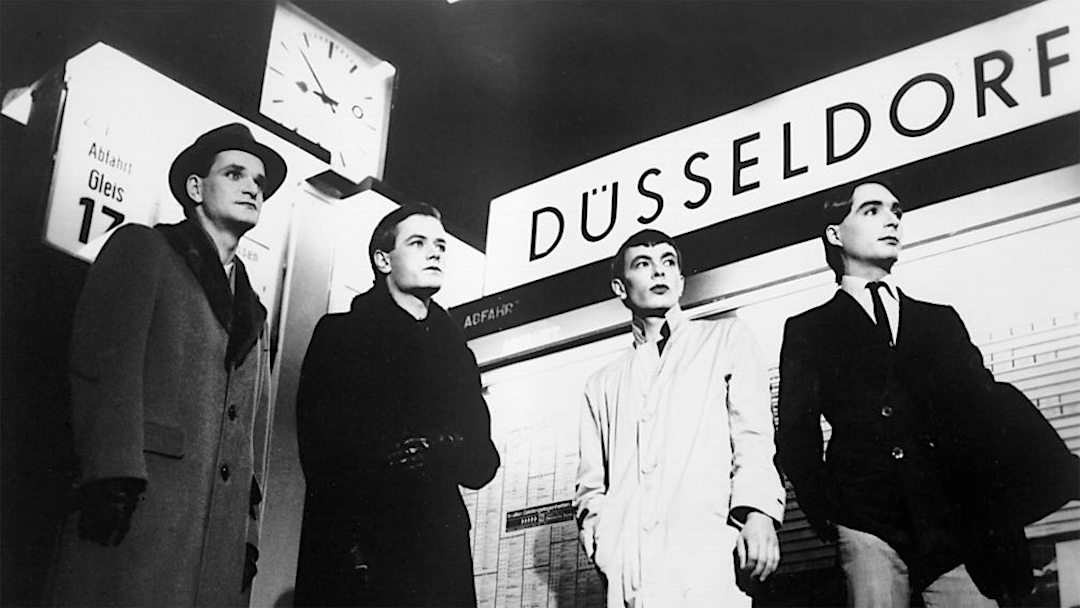
Kraftwerk at Düsseldorf station, 1977: Florian Schneider at left. (Photo, Frähling)

➢ Extracts from some vintage interviews republished
yesterday at David Bowie’s website…

❏ You’ve no doubt heard the sad news regarding the passing of Kraftwerk founder, Florian Schneider, aged 73. A spokesperson said he “passed away from a short cancer disease just a few days after his 73rd birthday”, his birthday being April 7. Schneider formed Kraftwerk with Ralf Hütter in 1970 and remained a member until his departure in 2008. He is pictured bottom left in our photo at Düsseldorf Hbf station with the rest of the band.

In a Kraftwerk feature for MOJO magazine Ralf Hütter responded to the question “How important was David Bowie’s infatuation with you?” thus:

“That was very important for us, because it linked what we were doing with the rock mainstream. Bowie used to tell everyone that we were his favourite group, and in the mid-Seventies the rock press used to hang on every word from his mouth. We met him when he played Düsseldorf (April 8, 1976) on one of his first European tours. He was travelling by Mercedes, listening to nothing but Autobahn all the time.”

In 1978 Bowie recalled the meeting in an interview: “I like them as people very much, Florian in particular. Very dry. When I go to Düsseldorf they take me to cake shops, and we have huge pastries. They wear their suits. A bit like Gilbert and George… When I came over to Europe – because it was the first tour I ever did of Europe (1976), the last time – I got myself a Mercedes to drive myself around in, because I still wasn’t flying at that time, and Florian saw it. He said, “What a wonderful car” and I said, “Yes, it used to belong to some Iranian prince, and he was assassinated and the car went on the market, and I got it for the tour.” And Florian said, “Ja, car always lasts longer.” With him it all has that edge. His whole cold emotion/warm emotion, I responded to that. Folk music of the factories.”

Kraftwerk immortalised the Düsseldorf meeting on the title track of the band’s 1977 album, Trans-Europe Express, in its lyric:

From station to station, back to Düsseldorf City,
Meet Iggy Pop and David Bowie…

David returned the compliment later the same year on the “Heroes” album, when he paid Florian the ultimate tribute by using his name for the title of V-2 Schneider.

❏ Bowie also spoke in some depth about Kraftwerk in an UNCUT interview several years back…

UNCUT: Many reasons have been suggested for moving to Berlin. Can you remember why the city appealed?

DB: Life in LA had left me with an overwhelming sense of foreboding. For many years Berlin had appealed to me as a sort of sanctuary. It was one of the few cities where I could move around in virtual anonymity… Since my teenage years I had obsessed on the angst-ridden, emotional work of the expressionists, both artists and film makers, and Berlin had been their spiritual home. This was the nub of Die Brücke movement, Max Rheinhardt, Brecht and where Metropolis and Caligari had originated. It was an art form that mirrored life not by event but by mood. This was where I felt my work was going. My attention had been swung back to Europe with the release of Kraftwerk’s Autobahn in 1974. The preponderance of electronic instruments convinced me that this was an area that I had to investigate a little further.

Much has been made of Kraftwerk’s influence on our Berlin albums. Most of it lazy analysis, I believe. Kraftwerk’s approach to music had in itself little place in my scheme. Theirs was a controlled, robotic, extremely measured series of compositions, almost a parody of minimalism. One had the feeling that Florian and Ralf were completely in charge of their environment, and that their compositions were well prepared and honed before entering the studio.
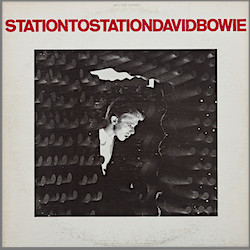
David Bowie, Station to Station, album sleeve , pop music

Bowie’s album Station to Station: it preceded Trans-Europe Express by a year

My work tended to expressionist mood pieces, the protagonist (myself) abandoning himself to the zeitgeist (a popular word at the time), with little or no control over his life. The music was spontaneous for the most part and created in the studio.

In substance too, we were poles apart. Kraftwerk’s percussion sound was produced electronically, rigid in tempo, unmoving. Ours was the mangled treatment of a powerfully emotive drummer, Dennis Davis. The tempo not only “moved” but also was expressed in more than “human” fashion. Kraftwerk supported that unyielding machine-like beat with all synthetic sound-generating sources. We used an R&B band. Since Station to Station the hybridization of R&B and electronics had been a goal of mine. Indeed, according to a Seventies interview with Brian Eno, this is what had drawn him to working with me.

One other lazy observation I would like to point up is the assumption that Station to Station was homage to Kraftwerk’s Trans-Europe Express. In reality Station to Station preceded Trans-Europe Express by quite some time, ’76 and ’77 respectively. Btw, the title drives from the Stations of the Cross and not the railway system.

What I WAS passionate about in relation to Kraftwerk was their singular determination to stand apart from stereotypical American chord sequences and their wholehearted embrace of a European sensibility displayed through their music. This was their very important influence on me.

UNCUT: V-2 Schneider – a tribute to Florian?
DB: Of course.

So long Florian.

https://youtu.be/y7n65wQhTNU
❏ ABOVE: Kraftwerk playing Autobahn in 1975 on the BBC science strand Tomorrow’s World to demonstrate their “Machinemusik”. This was their first UK appearance on British television.

❏ ABOVE: View the long-haired radicals in Kraftwerk reinventing German music from “Stunde null” in the BBC Four documentary Krautrock: The Rebirth of Germany.

➢ Florian Schneider: the enigma whose codes broke open pop music – Alexis Petridis in The Guardian – “Schneider had kept such a low profile after leaving Kraftwerk that rumours of his death had circulated before, only to be revealed as erroneous.”

➢ How Florian Schneider and Kraftwerk influenced five decades of music – Mark Savage at BBC News

➢ How Kraftwerk’s synth wizard Florian Schneider rewired the world – Rob Sheffield at Rolling Stone – “It’s all electric energy, anyway,” Schneider said, summing up a sonic philosophy that upended the Seventies rock ideal, and influenced everyone from Depeche Mode to Derrick May.

FRONT PAGE

1980 ➤ 40 years of musical freedom thanks to what we Brits enjoyed calling the Sony Stowaway

➢ Sony launches the cool, sexy Stowaway
in the UK, April 1980

Sony, Stowaway, Walkman, cassette player, UK launch

First posted here on 5 September 2009

FRONT PAGE

➤ Thanks, Steve, for my invitation to the Swinging 80s

Blitz Kids, New Romantics, Observer Music Magazine, Derek Ridgers,Spandau Ballet, Steve Dagger, Steve Strange, Tipping points,London, Media, Politics, Pop music, Swinging 80s,,

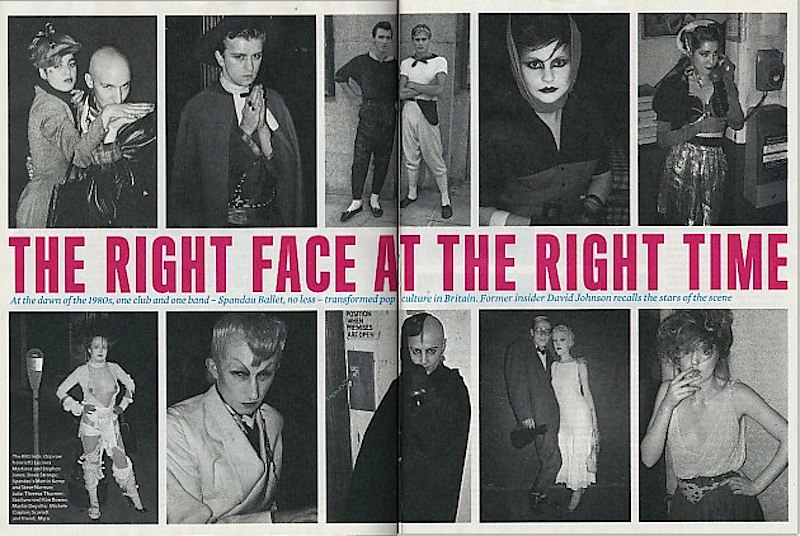
The Observer Music Monthly, Oct 4, 2009. Pictures © by Derek Ridgers

40
YEARS
ON

ALSO THE FIFTH ANNIVERSARY OF
STEVE STRANGE’S DEATH

WHEN MY PHONE RANG IN JANUARY 1980, little did I realise its message meant: “Put out the cat. You’re coming to the party of your life.” The voice on the other end spoke without pausing: “My name’s Steve Strange and I run a club called the Blitz on Tuesdays and I’m starting a cabaret night on Thursdays with a really great new band…. they combine synthesised dance music for the future with vocals akin to Sinatra, they’re called Spandau Ballet and they’re going to be really big. . .”

➢ Click through to continue reading Yours Truly’s eye-witness account of Spandau Ballet, the Blitz Kids and the birth of the New Romantics at The Observer Music Monthly

➢ Elsewhere at Shapers of the 80s:
The Invisible Hand of Shapersofthe80s draws a selective
timeline for the break-out year of 1980

FRONT PAGE

1979 ➤ Spandau’s manager Steve Dagger tells of two offers to sign his band at their debut

rel=nofollow

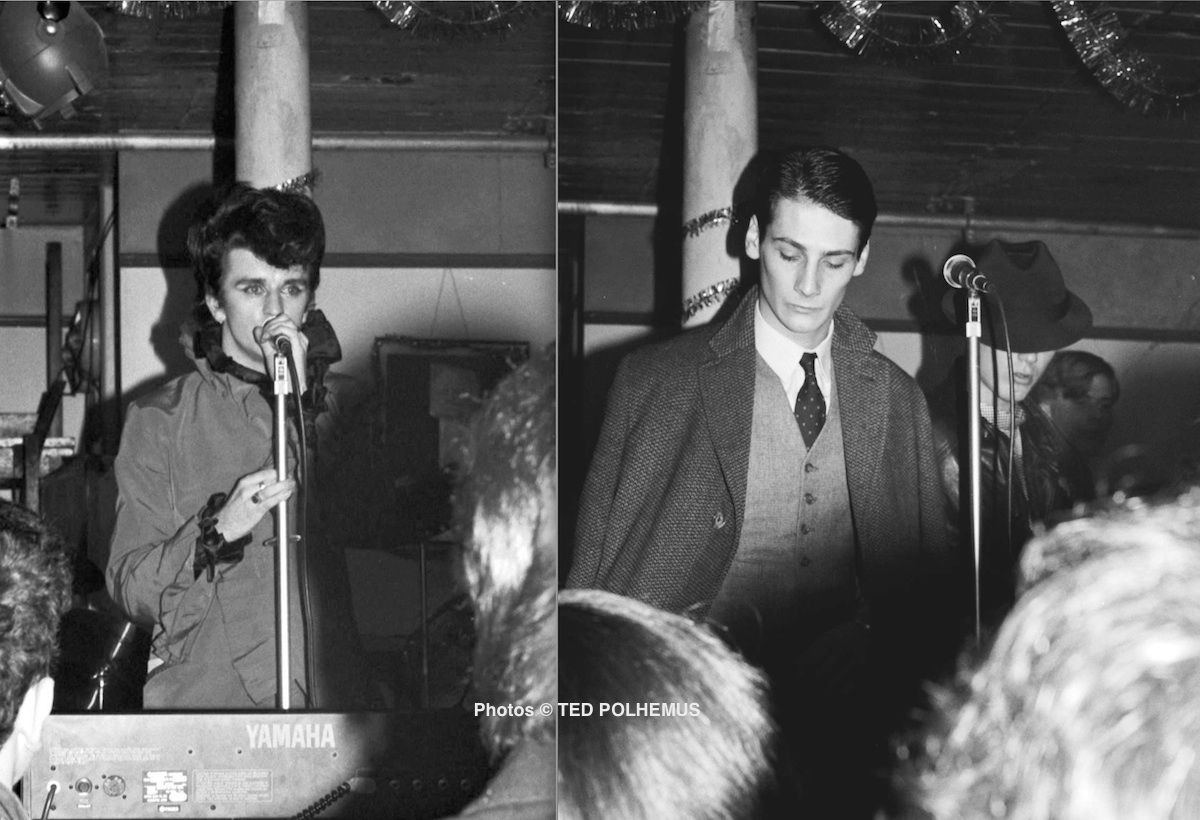
Spandau Ballet’s debut beneath festive bunting: left, Steve Strange in PX frills introduces the new band at the Blitz Christmas party in December 1979… Tony Hadley supercool in collar, tie, waistcoat and overcoat, Martin Kemp in jaunty trilby with Steve Norman beyond. Dagger’s blog seems unaware of these photos and after seeing them here at Shapersofthe80s, Gary Kemp recalls “being terrified while playing the little Yamaha CS-10, that we wouldn’t get away with it. Apart from many of the songs that made up our first album we also played Iggy Pop’s Fun Time and On Her Majesty’s Secret Service”

On the 40th anniversary of Spandau Ballet’s debut
performance at London’s Blitz club spearheading
the post-punk new wave, the band’s manager
Steve Dagger publishes his eye-witness account…

❏ On the 5th of December 1979, Spandau Ballet was born. After a year in metamorphosis and following a successful preview show two weeks before at Halligan’s rehearsal studios, when they were named by journalist and broadcaster to be, Robert Elms, Spandau Ballet emerged onto the stage and into the world at the Blitz on the occasion of Steve Strange and Rusty Egan’s Christmas party in 1980 [1979 surely – Ed].

Much has been written about the Blitz and its extraordinary position as a cultural funnel at the beginning of the 80s. But Spandau Ballet’s two performances there and subsequent meteoric rise to success did much to drive this tiny club and its spectacular cliental [clientele? – Ed] into the headlines and its ethos into popular culture and serve as the template to the 80s.

What happened that night?

No band had played before at a Steve Strange/Rusty Egan event, so the audience was not used to seeing live music in this context. Music was normally provided by Rusty Egan’s DJing, an extraordinary montage of epic electronica which seemed to give a tantalizing glimpse of a future we were all going to take part in.

How would “Spandau Ballet” be received? The preview show had gone incredibly well, so a handful of our friends and key faces on the scene had seen the band already, liked them and spread the word. But it was an impossibly cool crowd. Whether they were fashion students, artists, embryonic designers, wannabe writers, film directors or just London’s coolest of the cool night people, they all had an opinion of themselves and everything else.

The usual crowd was supplemented by a sprinkling of older cognoscenti, a Chelsea crowd who had become aware of the Blitz scene. The likes of Keith Wainwright, uber-cool hairdresser of Smile; artist Dougie Fields to name but a few, plus some musicians who had been drawn to the Blitz. Richard Burgess of Landscape (Spandau Ballet producer to be), Midge Ure of Ultravox and Billy Idol, Steve Severin of Siouxsie and the Banshees and Marco Pirroni of Adam & The Ants.

rel=nofollow

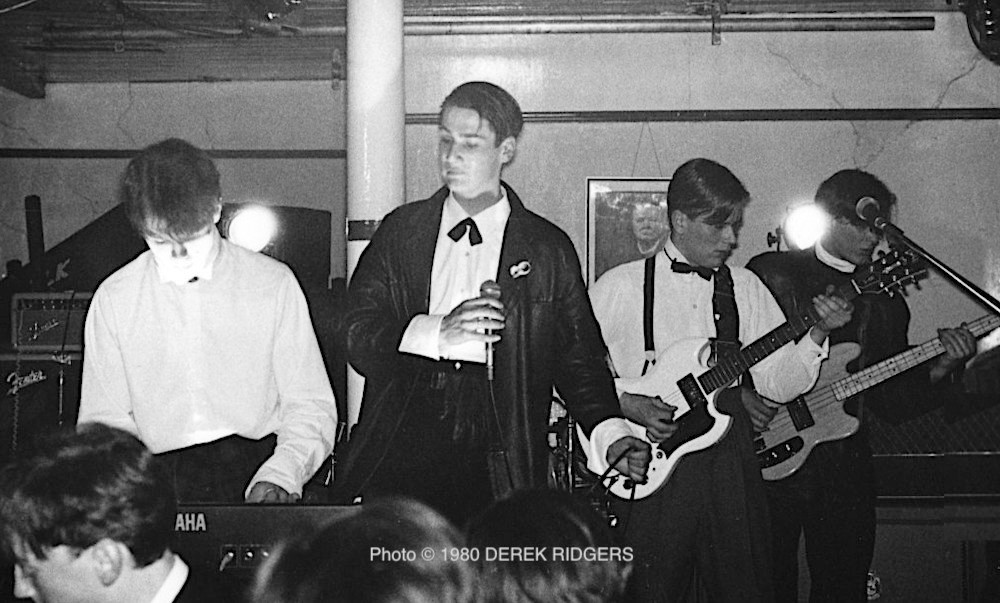
Spandau Ballet’s second Blitz date, January 1980, despite Dagger’s belief on his blog that this pic shows the band’s debut. Most are sporting bow ties – Gary Kemp on synth at left, Tony Hadley as vocalist, with Steve Norman and Martin Kemp on guitars held high in their anti-rock stance. Churchill gazes out from his photo on the rear wall

So the battle lines were drawn and into the valley [of] death… Actually, the band were much less nervous than they had been for the preview show and also excited about playing in “their” club. When Rusty’s music stopped and they got onto the tiny stage there was a degree of anticipation and curiosity. I think the band realised collectively it was now or never and they seized the moment and started to play confidently and with a bit of swagger. Some of the audience danced, some applauded but almost everyone watched.

Tony sang brilliantly. The set which included most of the songs on “Journeys to Glory” fitted the club. Spandau Ballet fitted the club. “To Cut a Long Story” sounded like a massive hit.

Halfway through the set I was feeling quietly confident and was standing by the mixing desk next to the sound engineer when I became aware of a man standing next to me. He spoke to me.
“Who is this band?”
“It’s Spandau Ballet,” I said.
The new name sounded f*cking great.
“Which record label are they signed to?”
“They aren’t signed.”
“Who is their manager.”
“I am,” I said proudly.
“Well I am Chris Blackwell and I own Island Records, and I would like to sign them.”

First gig as Spandau Ballet… 5-0 up. Another man approached me. He was Danny Goodwin from Peninsula Music Publishing. He wanted to sign them too.

Spandau Ballet, Blitz Club, New Romantics, Steve Strange, London, Heritage award,The band finished their set. I could not wait to go backstage into the tiny dressing room to talk to them. We had all worked very hard for this moment. They were about to become a very important band. The only band that could play in the Blitz. The most important club in the world at that time. Everyone in the Blitz that night was hugely complimentary and positive about them.

We owned the space, we had claimed it. We were about to go through the looking glass and our lives were never going to be the same. The next day, I spoke to Chris Blackwell on the phone and arranged to meet him in a pub. He was softly spoken, charming and very cool. He owned the coolest record label in the world – Bob Marley, Roxy Music, Traffic, Free, Spencer Davis – and he wanted to sign Spandau Ballet. Now. He even gave me a list of lawyers he recommended to act for the band.

It all felt a little strange but somehow like it was all supposed to happen like this. I felt unbelievably relaxed and comfortable, empowered, and the band very confident, entitled energised. Uncrowned Princes of pop culture all of a sudden. We turned him down. But that is another story.

© Steve Dagger
First published today at Spandau Ballet’s website

➢ Previously at Shapers of the 80s:
1980, Strange days, strange nights, strange people

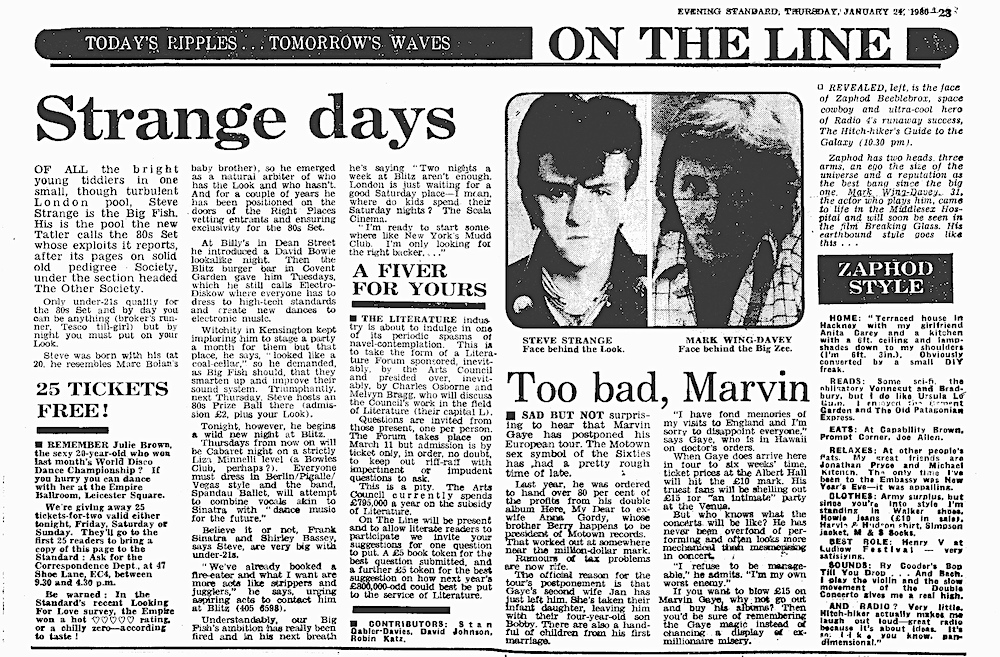
Spandau Ballet,Evening Standard, Blitz Club, New Romantics, Steve Strange

Steve Strange’s first interview with the Evening Standard, 24 Jan 1980, telling us of Spandau Ballet’s second performance that day

RARE VIDEO OF THE BLITZ A-BUZZ:

❏ You won’t find much authentic filmed footage inside the Blitz Club because so little exists and many posts claiming to show the Blitz at YouTube do not. The brief but glorious clip we see above captures the visual excess of its dancefloor in Spandau Ballet’s 2014 biopic Soul Boys of the Western World. The interiors come from Lyndall Hobbs’ short doc about London tribes called Steppin’ Out, shot in the summer of 1979. The first half-minute here comes from a TV report showing Blitz Kids gathering outside Sloane Square underground station to celebrate Steve Strange’s 21st birthday aboard a Circle Line train on 28 May 1980. We hear Martin Kemp voicing the sequence which zooms in on him at 23 seconds. The black-and-white stills collaged into the segment are Shapersofthe80s originals, and the closing seconds are from LWT’s 20th-Century Box.

Spandau Ballet, Blitz Club, New Romantics, Heritage award,

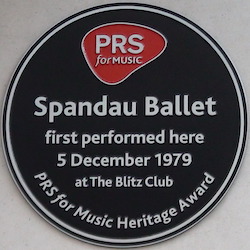
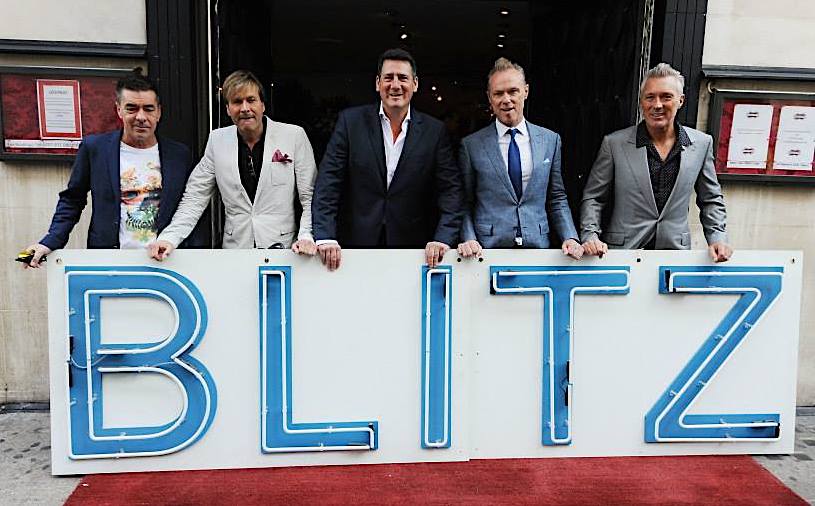
Heritage award from the Performing Rights Society: In September 2014 Spandau Ballet returned to the site of the Blitz Club to see a plaque installed remembering their debut. The club’s original neon sign was also present for the photoshoot

SPANDAU RECALL THE BLITZ IN 2014:

➢ Previously… 1980, The Invisible Hand of Shapersofthe80s
draws a selective timeline for the unprecedented
rise and rise of Spandau Ballet

FRONT PAGE

➤ Bowie TV trilogy triumphs thanks to candour and a few tears

David Bowie,pop music, TV documentary, review,

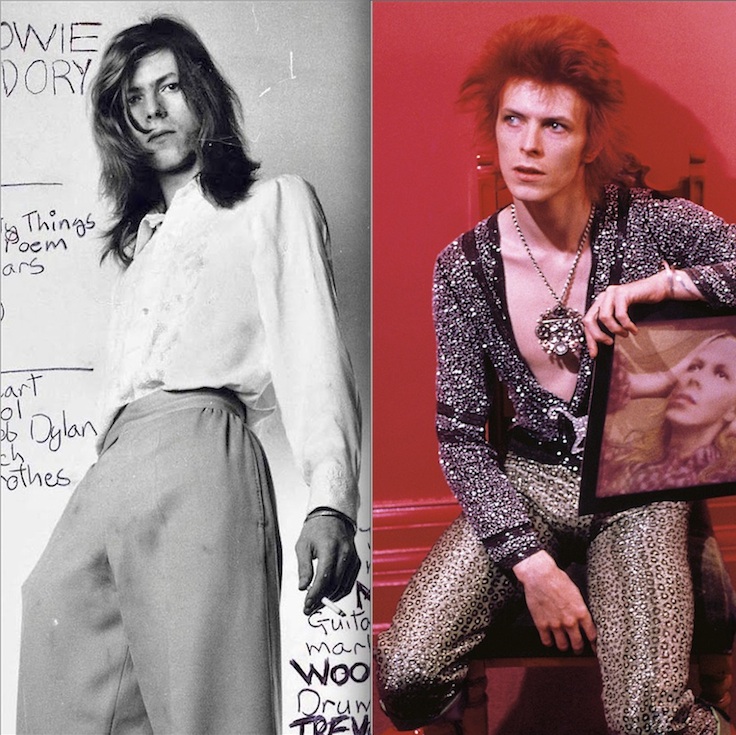
Bowie’s search for identity: the hippy look for the Hunky Dory sleeve 1971 and red-haired alien for Space Oddity 1972. (Photos by Brian Ward and Mick Rock)

WHAT AN EYE-OPENER! Nine failed bands in ten years of struggle before David Bowie emerged as a star. “He was no Marcel Marceau,” said his mentor and lover Lindsay Kemp of David’s attempts at mime. Saturday’s TV doc Bowie Finding Fame directed by Francis Whately was chock-full of jaw-droppingly frank evaluations by all his pals and workmates from his earliest days in music. Among the kindest was his girlfriend in 1968 Hermione Farthingale who said: “He was actually 21 and looked about eight. . . He wasn’t lost, but he wasn’t found either”. For 90 minutes Bowie’s own voiceover was disarmingly full of insight too and this episode, the third in Whately’s consummate trilogy for the BBC, proved probably the‬ most moving of all.

And today comes a thorough and informative appreciation of this the latest landmark documentary about Bowie’s early life in a review published by Andy Polaris, Eighties singer with Animal Nightlife, at his website APolarisView. As a fan utterly in thrall at a formative age to Bowie’s charisma, Andy brings personal insights to the final doc, which follows on from David Bowie: Five Years (2013) and The Last Five Years (2017), both being repeated live tonight from 11.15pm (despite the confusion in newspaper listings guides), and subsequently viewable on iPlayer.

Andy also adds further essential points of reference to the Bowie story omitted from the new biopic, possibly because, as its series consultant and Bowie chronicler Kevin Cann has explained this week, the production team ultimately had to exclude masses because of time limitations: “Sadly there are a few fabulous interviews we made that we couldn’t fit in – all important in their own way. . . At one point we had close on a three-hour edit. We were basically overwhelmed with options at times – and that’s exactly why future generations, I’m sure, will never be bored of this man’s immense talent. He will never cease to impress.” Another gem they discovered was the complete Russell Harty TV interview from 1973: “. . . the whole Bowie section, interview and song performances. Even though ITV erased their original master a year or two after original broadcast, the recording we have still belongs to them, so its immediate future is yet to be decided.”

➢ Meanwhile here’s an excerpt from Andy’s blog
APolarisView where he reviews Saturday’s superb doc,
Finding Fame, which starts in the mid-Sixties:

Swinging 80s, Andy Polaris,TV review, David Bowie Finding Fame,,singer,pop music,

Polaris: surprised

I came away admiring Bowie more as an artist due to his single-minded pursuit to achieve his goal and establish a career in the arts. Eleven years (which brought massive cultural changes generally) and nine different bands failed to launch his career. With such limited rewards most people would have fallen at the second or third hurdle and contemplated a different choice of career. A lot of the bands I had heard of, but the film surprised me by exhuming the music of Riot Squad (a name sounding more like a later oi/skinhead band) where he spent eight weeks as their singer in 1967.

Bowie learned quickly to jettison anyone or thing that stood in the way of his mission and made sure that he was front and centre of the action. Early associates talk of how he was the driving force behind stage performances, style and presentation and how to stand out from the crowd.

Whately’s biopic marks the first time I can remember hearing about the inspiration for Letter to Hermione (a beautiful song on Space Oddity) in a filmed interview where his former girlfriend talks candidly about their love affair and the aftermath of their break-up. In a rare moment of personal confession it reveals the crushing effect it had on David at the time and he wanted her to forever realise the hurt. . . / Continued at APolarisView

➢ Bonus clips at the BBC’s programme website:
Of the surplus footage researched for Finding Fame, Kevin Cann reports that My Death survives in full, as does the whole interview. As also does probably 90% of the 1970 Glastonbury set. “Just in case you haven’t seen them, here are some of the brief edits that came out along the way. There are many more and I hope, over time, more is made available.”

WHAT THE TV CRITICS SAID OF FINDING FAME

➢ “Whately arguably does get closer to who the flesh and blood David Jones really was than anyone has previously, largely thanks to securing interviews with an elusive cousin and a just as elusive first love” – The Arts Desk

➢ “Still think of Bowie as the last word in cool? You’ve obviously forgotten his novelty single about gnomes, his dire mime days… and his cover of Chim Chim Cher-ee” – Guardian TV review

➢ “The BBC’s ‘talent selection group’ had dismissed Bowie as ‘devoid of personality’ (ah, the irony). Yet Bowie doubled down and worked harder” – The Times review

➢ “One of the most miraculous things about Bowie is that he didn’t wind up as a drama teacher in Bromley” – Sunday Times Culture

➢ “Fascinating insight into the young singer’s quest for fame and his evolutionary struggle to burst out of suburbia” – The Telegraph review

➢ View David Bowie: Five Years (2013) at the iPlayer

➢ View David Bowie: The Last Five Years (2017) at the iPlayer

FRONT PAGE