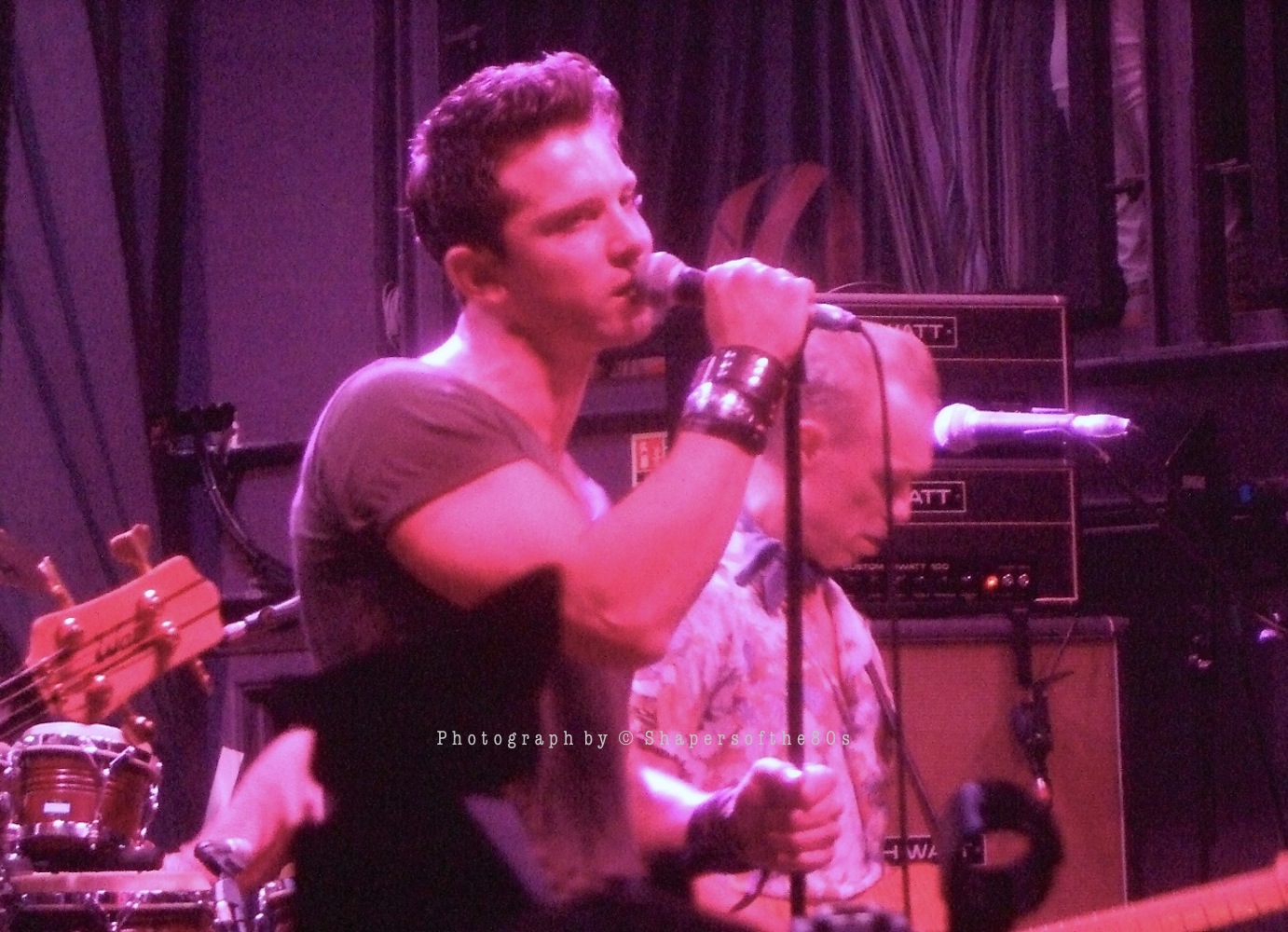
A confident debut with Spandau Ballet: Ross William Wild at Subterania last night
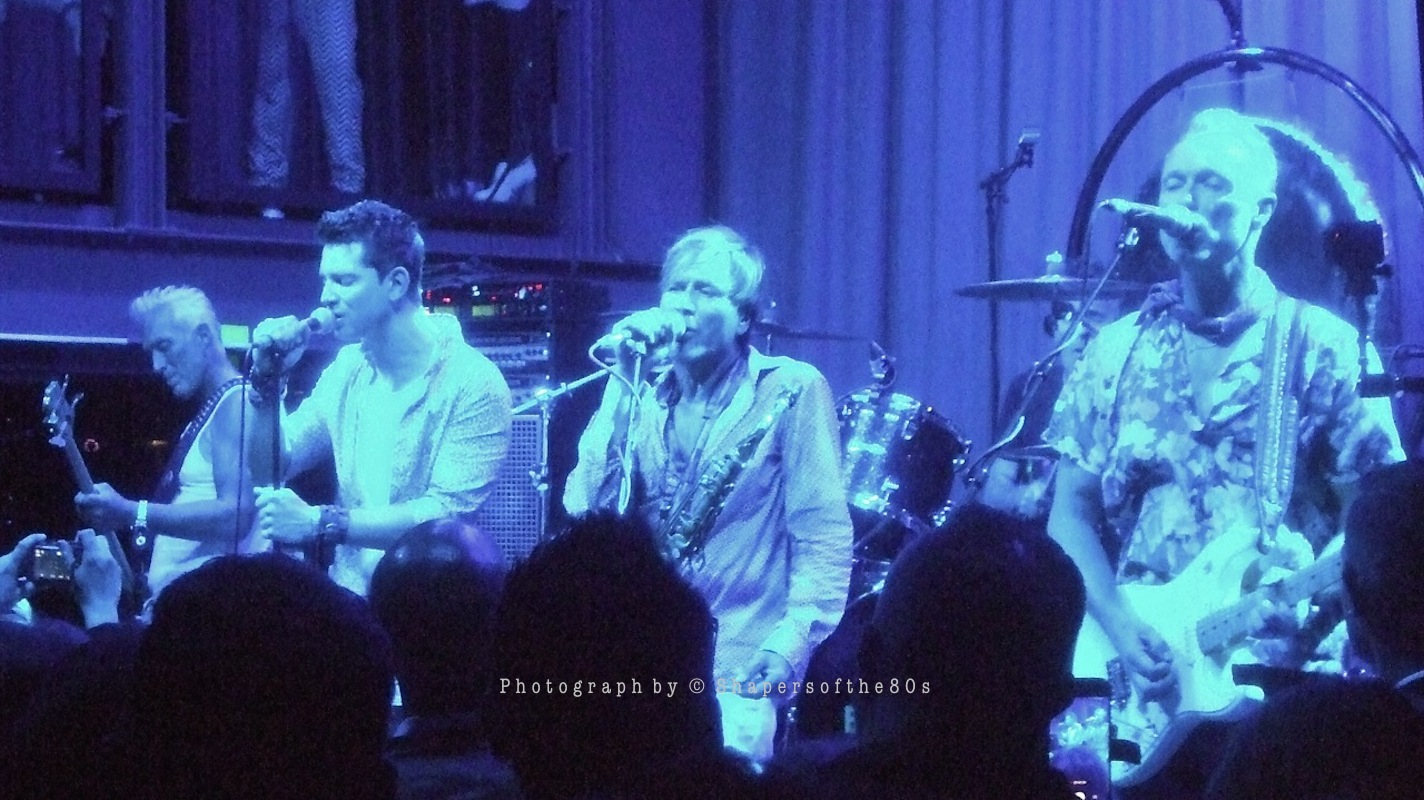
Ross William Wild’s debut with Spandau Ballet: from left, Martin, Ross, Steve and Gary
◼ AND WHAT TOUR DE FORCE the entire band made of Spandau Ballet’s rebirth last night to showcase their new singer Ross William Wild who effortlessly filled the space onstage vacated by Tony Hadley. At the age of 30 Aberdeen-reared Ross could easily be the son of any of the Spandau dads around him, yet he had infused new energy into them to inspire one of the tightest all-round performances in recent years. He embodies all a lead singer should: energy, confidence, instantly likeability and a strong singing voice that almost never sounds like his predecessor.
Ross was announced by the tabloids as an Elvis Presley impersonator so it was a relief that this is not what we saw or heard: in fact the inflexions in his singing voice do reflect his principal experience in musical theatre, most recently in The Million Dollar Quartet, The Witches of Eastwick, and We Will Rock You. And though in the Noughties he was the lead singer in a nu-metal band called Lethal Dosage, Ross performs with shoulders, arms, hips, feet – in fact, his entire body just as you’d expect in a stage musical.
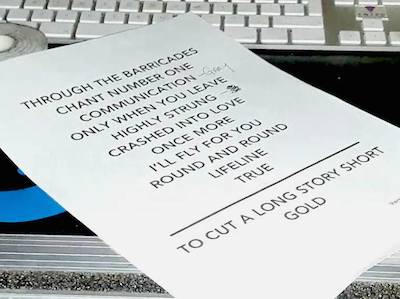
Spandau’s rebirth set list
From Spandau’s nostalgically involved opening hit Through the Barricades, Ross made each of the set’s 13 hit numbers his own (with almost as many changes of shirt!).
Spotlit on a darkened stage, his first three minutes were a vocal slow-burn alongside a masterly Gary Kemp on solo guitar. It was a daring move to persuade us to listen. By the second line, as he gave vibrato to the lyric, Ross was evidently “feeling strong”, and from here on he introduced us to his voice in gentle stages, slowly raising the temperature, until the pause. . . Then: bam-bam! Keeble’s drums announced the bombast of Barricades proper, and Ross let rip to command centre-stage, amid the familiar Spandau front-line on vocals. They climaxed with a big sound in an intimate clubby space, up close to 500 of their fans. What a statement of intent!
HEAR ROSS’S FIRST VERSE OF ‘BARRICADES’
Ross excelled in another emotional classic Only When You Leave, had the audience eating out of his spiralling hand for Round and Round, pogoing through Lifeline, and by the encore the hot summer’s evening had him stripped down to a vest as he gloriously re-energised To Cut a Long Story Short to sound like a brand-new number. Amazingly, at the bar afterwards, Ross said he was intrigued by its lyrics since he first heard this hit from 1980, but read none of Gary Kemp’s meaning into it or the lyrical quotation it contains. He imagines it is set in the first world war trenches and reflects the strange solitude of the soldier.
The band’s families and friends turned out along with veteran Blitz Kids and Beat Routers (smashing to see you again, genial doorman Ollie O’Donnell) who could all be seen grooving to Rusty Egan’s unique mixes at the after-party. Sentimental as ever, Martin Kemp had announced from the stage that last night’s venue, Subterania beneath Westway at Portobello Road, was chosen because in its days as Acklam Hall community centre, the original Spandau lineup had played a benefit there under their early name, Gentry, on Saturday 24 February 1979. In the after-bash I recognised the curly-haired photographer Denis O’Regan who was at work with his camera. Spookily I’d just posted one of his seminal band images here at Shapersofthe80s on my own tribute revisit to 1980 when Denis had posed the band in his studio and uplit them to create the dramatic shot of Spandau which became the expressionist motif of their live performance that spring at the Scala Cinema.
Verdicts from the band on their young vocalist are breathless. Gary Kemp said: “Ross’s great talent and passion has given us the confidence to continue.” Drummer John Keeble who drove the show with his usual percussive enthusiasm said: “I bonded with Ross over our mutual love of rock music. He may have come up through the theatres but he loves bands like Tool.” Steve Norman added: “He’s also a right nice bloke. We struck lucky.” [I often wonder whether Steve realises just how richly musical his own sax playing is! Ben Webster will be smiling benignly at this.]
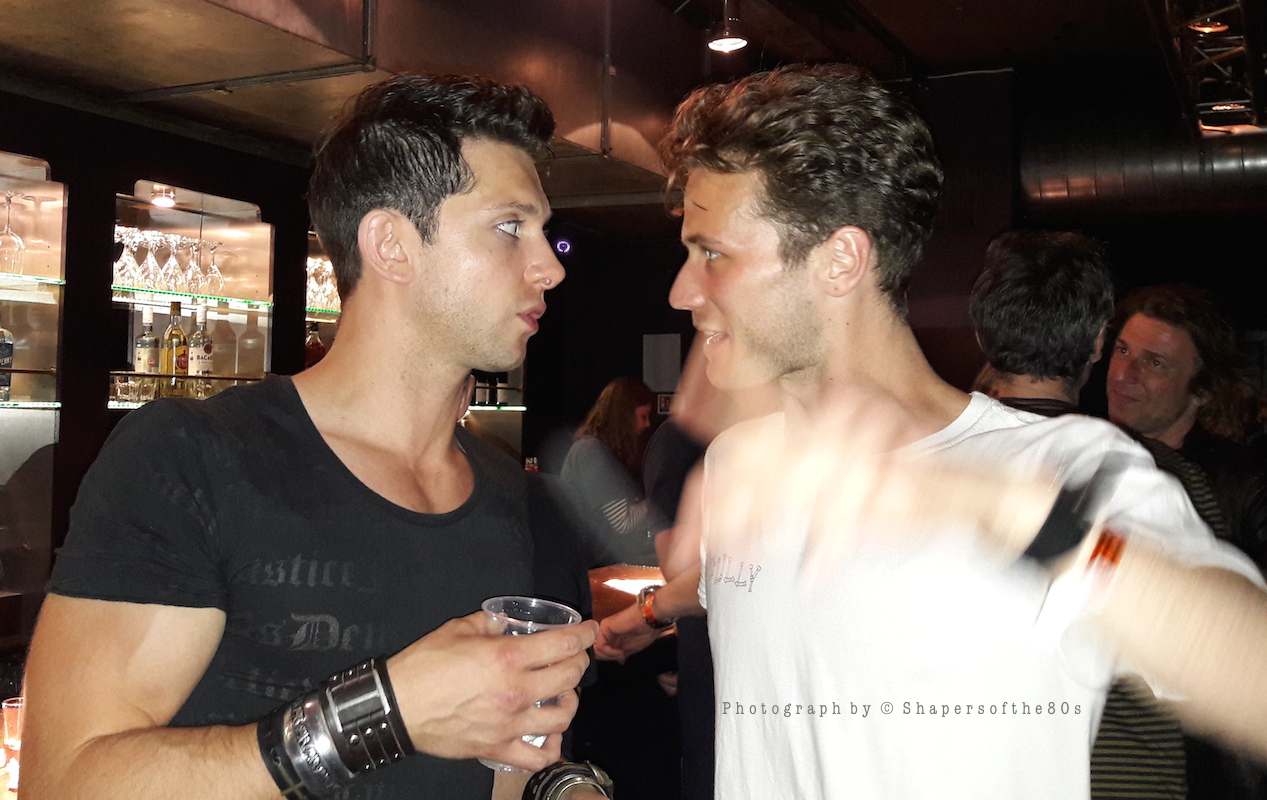
At the after-party: Ross William Wild shares song-writing ambitions with Steve Norman’s son Jaco
Patrolling the audience during Spandau’s rebirth gig: their trusty manager Steve Dagger evidently chuffed to bits at their new singer
Above: Two bands who played in London as Spandau Ballet…
SBv1 originated the name and here play their final gig at the
Hope & Anchor in 1979 with singer Mark Robinson, drummer
Gordon Bowman, bass guitarist David Wardill, (guitarist Mick Austin
off-camera) . . . SBv2, here in their previous incarnation as Gentry,
playing Camden School for Girls in December 1978, with Tony Hadley
on vocals and the chart-topping single True five years in the future
❚ DID YOU KNOW LONDON HAD TWO POP GROUPS called Spandau Ballet in 1979? The one who became famous adopted their name from the one who didn’t. That’s the claim in a jaw-dropping new history of the New Romantics scene, unauthorised and meticulously researched by David Barrat, a long-time music fan. His book is published this week titled New Romantics Who Never Were: The Untold Story of Spandau Ballet.
Barrat has gathered a mind-boggling compilation of spooky coincidences and things we never knew before in his 117,000-word paperback, self-published today on his own imprint Orsam Books. Here is no mere fan, but an obsessive one who has made himself the Mastermind champion in the two themes identified in his tongue-twisting title: Who exactly were the New Romantics of the early 1980s, who many of us believe powered one of the most transformational youth cultures of Britain’s postwar years? Barrat discusses how “New Romantics” as a two-word description came to characterise the style-leaders of British clubland when those leaders unanimously rejected it themselves.
His second theme is the true story of Spandau Ballet, the five-piece from Islington who set out with a cunning plan to weave a tapestry of fictions around their launch as electro-synth popsters in 1979. At the outset the band were coolly vague about their origins, as if they’d sprung from nowhere – or rather, from the dancefloor of the trendiest London nightspot in years, Covent Garden’s Blitz Club. You’d also have to be a fan with Barrat’s persistence to piece together spasmodic revelations about the band’s genesis as these slipped out during the succeeding decades. Spandau subsequently became global superstars in that momentous decade when image-conscious new British bands invaded the American pop charts. Then they quarrelled, as pop groups do, and arrived in the High Court in 1996 rowing over royalty payments. Individual members remained belligerent for years.
Whether or not you care for Spandau and the 80s music scene, Barrat’s forensic approach to reassessing this creative landscape is utterly hypnotic and unlike anything you’ve read by the hacks of the creaking rock press. He has spent years in deep Holmesian research delving into official records, newspaper cuttings, TV interviews and conducting first-hand interviews. The result is gripping, original and epic. For instance: he reveals all about another band sharing exactly the same distinctive name a matter of months before Tony Hadley stepped onto the stage at the Blitz Club! Here is a well-informed juggernaut delivering into our laps mighty fact upon tiny fact, laid out for inspection and challenge. Barrat’s intent is resolute: to convince us he knows his stuff, and he has purged the popular version of events of their mutability.
David Barrat contacted me a few years back in order to check dates and events against my own detailed diaries and his aggregation of facts and assumptions is mostly hard to fault. His book now pays extraordinary and generous tribute to this website, Shapers of the 80s, and to myself as a former features editor of the Evening Standard who set out to celebrate the potency of the youthquake erupting in 1980.
SO WHO WERE THE OTHER BAND?
❑ The musicians originally called Spandau Ballet (hereafter called SBv1) were four lads who met in 1978 during their teens in Bedfordshire: guitarist Mick Austin, singer Mark Robinson, drummer Michael Harvey and punky bass guitarist David Wardill. They agonised for ages over a band name and Austin remembers a “eureka” moment while they were using the Dadaist method of juggling words on random scraps of paper. They arrived at the darkly Germanic first word (originally with an incorrect umlaut over the U, as in Spandaü) and then paired it with “the softer, romantic” word Ballet. The package was deemed “nicely decadent”, a debut gig was planned for 30 August 1978 and accordingly Robinson designed a poster for it, which we see below. Wardill declared his ambition: “We were going to go to London and become rock stars.”
So how on earth did their oddball band name transfer itself to a struggling five-piece from Islington? The reader’s mind boggles at the number of spooky coincidences that Barrat’s book uncovers. Wardill had fallen in love with journalism graduate Deanne Pearson who rented a flat at 32 Sibley Grove in East Ham, so in October 1978 he moved in and subsequently members of SBv1 often came to crash on the floor. Coincidentally . . . this flat was shared with the yet-to-become seminal Blitz Kids, Kim Bowen and Lee Sheldrick while freshers at St Martin’s School of Art, who soon joined up with a stylish posse mainly lodged in Battersea’s Ralph West halls of residence which served the population of all London’s art schools. These included graphics student Graham Smith and the social dynamo Chris Sullivan who would soon find himself running the seminal Wag club for nearly 20 years.
Click any pic below to view complete images
In her forthcoming autobiography Kim relates how, in mid-1979, she fled far-flung East Ham and, accompanied by “a trio of self-described Nelly Queens”, penetrated an empty Georgian house in Fitzrovia to establish a squat in Warren Street, a leisurely walk away from St Martin’s. It was to become notorious. “Within weeks the creme de la creme of young London was living there,” Kim writes, and her bold manuscript spares no detail about their very un-private lives. This stylish property became the hub of social life for the Blitz Kids who were meeting every Tuesday at the Covent Garden Blitz Club since Steve Strange’s Neon Nights had begun that February. As milliner Stephen Jones’s mannequin de vie, the wild and startlingly elegant Kim elevated herself to Queen of the Blitz. Many of the Kids’ high-style antics were documented by Graham Smith while he – coincidentally – became the official photographer of the second Spandau Ballet (SBv2) who announced their name for their first public concert on 5 December that year, with invitations designed by Smith. (His lavish photo-book We Can Be Heroes, with authoritative text by Chris Sullivan, was published in 2011 and remains an unbeatable record of both style and excess).
In October 1978, the Beds boys SBv1 had started working as busboys as well as rehearsing at The Venue, Virgin’s new nightclub in Victoria, where they immortalised their band’s name by spraying it in green paint on the toilet walls and on other public walls elsewhere in central London. Amid all the ancient myths about where SBv2 found their name, this band’s early propagandist and future broadcaster Bob Elms has said he first spotted the phrase “Spandau Ballet” as graffiti variously on prison walls or toilet walls in the Spandau district of Berlin during a soulboy group trip in summer 1979.
Coincidentally – however, during an interview way back in 1984 one prominent Blitz Kid told me the graffiti had been very visible on the toilet wall of The Hope, a favourite pub in Tottenham Street in London, not far from the Warren Street squat. “Some boys from north-east London were using that name in a school-type band.” Also coincidentally – along the same block as The Hope stood the trendy new Scala cinema, whose programmer then was 22-year-old Stephen Woolley (today a major player in the British film industry), who was a contemporary of SBv2 manager Steve Dagger and their stage designer Simon Withers, all of whom coincidentally attended Dame Alice Owen’s school in Islington and grew up there with the other members of SBv2 – Gary and Martin Kemp, Tony Hadley, John Keeble and Steve Norman.
Barrat’s fabulous cascade of coincidences throws up at least SIX PRIME SUSPECTS in The Ballet Great Mystery: Who really did feed the name Spandau Ballet through to the Islington band SBv2, who during 1978–79 were known as Gentry, a power-pop combo? Barrat’s new book draws its own conclusion.
PS: EVEN MORE SPOOKILY
ON MY DOORSTEP. . .
David Wardill: bass guitarist with SBv1, who joined The Passions in 1980
❑ Scroll forward a few years from the birth of SBv2. . . After my day-jobs in journalism, I taught an adult evening class in Creative Writing for 16 years in west London, after which it was traditional for the more entertaining students to continue the evening at a nearby pub. Among several who became long-standing friends was – coincidentally – the same David Wardill of SBv1 (also visible in the video below). His musical background meant we had lots to discuss when we met in 1989, including his earlier life in East Ham with Kim Bowen and Lee Sheldrick.
David and I drifted apart but had a sudden email reunion while I was building this website in 2009. He told me that soon after completing the writing class he sent a story to the BBC which turned up two years later as a film from BBC Birmingham. These days he was a father and teaching art in a secondary school.
As for SBv2, he admitted: “I never really cared much that they had borrowed our band’s name, as I didn’t see much chance of us wanting it back.” SBv1 ground to a standstill in May 1979 and David soon joined another band called The Passions who enjoyed airplay by Radio 1’s influential deejay John Peel and eventually made it to Top of The Pops in 1981 with their song on Polydor, I’m in Love with a German Film Star, which reached No 25. (Coincidentally – SBv2 arrived at No 17 with Musclebound in the same edition of TOTP and we hear them being announced at the end of the clip below. Oo, er.)
David added: “The Passions reunited recently for a day at a studio in Shepherd’s Bush. That laid a lot of ghosts to rest. Our main song has been covered by the Foo Fighters and Pet Shop Boys. Strange how the past hangs around, although I find the continued interest gratifying, as well as financially useful.” Spoken like a star.
❑ And here today we still have not given away the truly spookiest coincidence among those that Barrat reveals about SBv1 & v2 when their paths almost crossed in May 1979 – it’s a goose-pimples moment that stops you in your tracks, so we’re not going to spoil it. However, other reflections on this vital addition to our bookshelves will follow here at Shapers of the 80s as we read on…
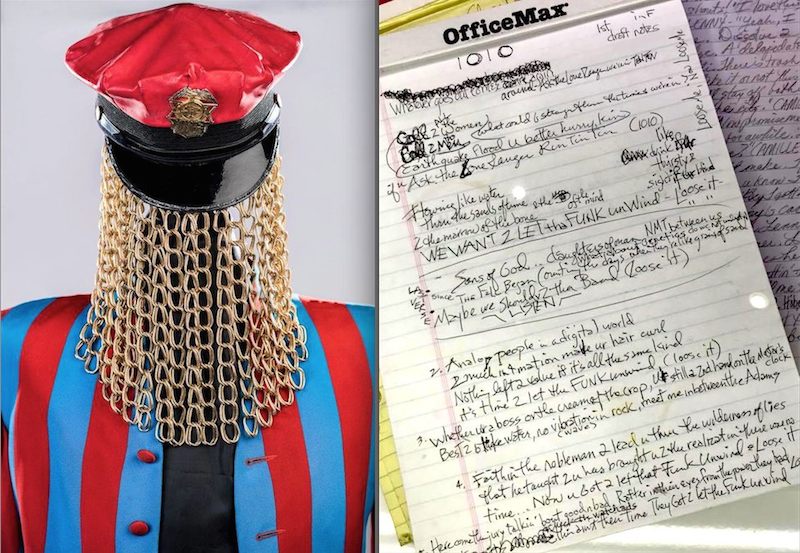
Prince exhibition: chain-hat to conceal his identity in The New Power Generation and lyrics for We Want 2 Let the Funk Unwind (Getty)
◼ Hold your breath! An exhibition that could so easily have been a lightweight commercial ripoff about the myth of Prince Rogers Nelson proves to be a surprisingly affecting tribute. Scores of artefacts have been loaned out for the first time direct from Paisley Park, Prince’s lush Minnesota estate, in a dazzling rush of bling and sentiment for My Name is Prince, his official exhibition which runs in London for the next ten weeks.
It seems a strange idea to visit seven galleries packed with video screens and to stand clad in earphones watching them play out the most vibrant highlights from the American pop icon’s uniquely anarchic imagination. Yet the very impact of so many screens disseminating so much talent only magnifies the intensity of the moment.
This one-man band’s genius is all too evident in every direction you look. In turns, you’re gasping at the audacity of Dirty Mind, smiling at the ingenuity of Sign ‘o’ the Times and shedding tears of envy for his sheer virtuosity in While My Guitar Gently Weeps.
Above all, the entire immersive experience is very, very lovesexy. The attention Prince lavished on his many lubricious costumes is revealing: so many apparently plush brocade garments are woven on light see-through black mesh that reveal the sinewy muscles of his tiny but taut 5ft frame within.
Prince the dandy also took any opportunity to shed his garments and flash his intimate zones, including his bare buttocks in orgiastic videos such as Gett Off, shot amid scantily clad girls and boys (“23 positions in a one-night stand”) at the 1991 MTV awards. Indeed one of the exhibition’s biggest draws is the video for Thieves in the Temple, from the 1990 Graffiti Bridge album, in which cutaway jeans reveal his bum and thighs and bouncing crotch capped with a glittering gold lamé jockstrap, in some of the most frenetic team dancing ever in high heels. The choreography is shamelessly horny.
The sheer range of Prince’s musical gifts during a 40-year career is well recognised – 70 albums, 2,000? songs, an Oscar, a Golden Globe, eight Grammies, 100 million records sold, and a ranking at No 28 among Rolling Stone’s 100 Greatest Artists of All Time. But to assemble in a three-dimensional venue 200 tangible examples of his workaholic creativity as an all-round showman results in an affectionate multi-media tribute. For us to devour the close-up detail in his guitars, his hand-written notes and drawings, and his jewelled accessories becomes a truly moving privilege. And for a fan, the power of his achievements is reaffirmed as you bask in his subversive glow.
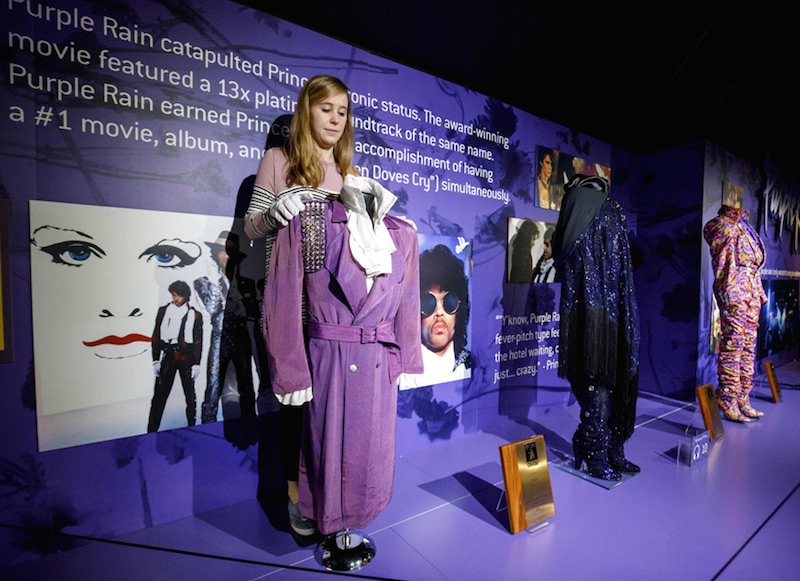
Prince exhibition: stage costumes from his Purple Rain tour (Getty)
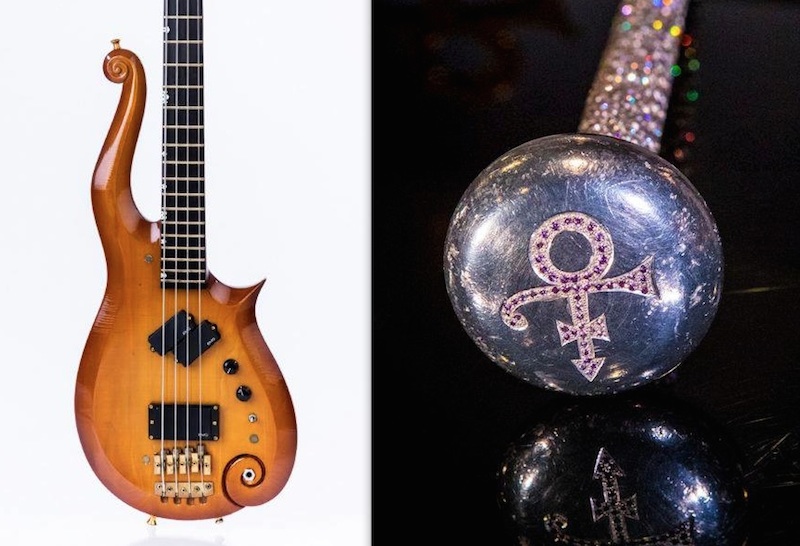
Prince exhibition: bass guitar that inspired his trademark Cloud and diamond-studded cane from 2015
PRINCE’S PURPLE REIGN STILL EXERTS ITS PULLING POWER
London’s Eighties pop star Andy Polaris visits the Prince exhibition to assess the enduring impact of the black performer who in his day challenged the norms of sexuality and race. . .
“ The first time Prince triggered my radar was a review in the music press of his concert at the Lyceum in London 1981, part of his Dirty Mind tour. He was featured in the accompanying review wearing a trench coat covering a lithe brown body and wearing black briefs and leggings, topped by his mop of black hair and pretty face. I was miffed to have missed his only show but before the internet niche events could slip by easily without social media to flag them up.
It was obvious from the start that this was a black artist who, despite the flamboyance of disco/funk stage-wear and album covers, was taking it a little bit extra with some sexual ambiguity. The lyrics of the funky album track Controversy (a bass-driven early dance-floor favourite) set the tone:
I just can’t believe all the things people say
Controversy
Am I black or white? Am I straight or gay?
Controversy
I was fascinated to see the parade of Prince’s petite outfits complete with matching coloured heeled boots that covered Purple Rain, his purple metallic frock coat through to a crystal-encrusted cane and Balmain waistcoat he wore for W magazine. The materials are colourful, sheer and shimmering and in some cases boldly designed. He wasn’t interested in the toxic masculinity that permeates so many black artistes, one of the reasons he flew the freak flag for those who were not interested in paying £50 to see artists dressed in denim and T-shirts. . . ” / Continued at Andy’s own website
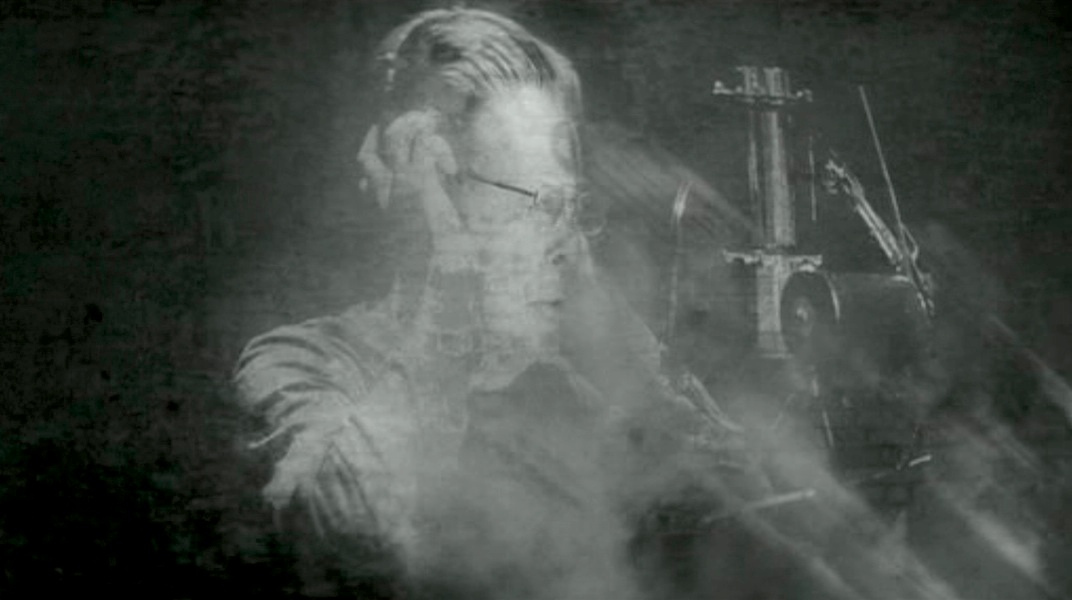
Bowie as a projected image in the video for Sue (Or in a Season of Crime)
“If you feel safe in the area that you’re working in, you’re not working in the right area. Always go a little further into the water than you feel capable of. Go a little bit out of your depth and when you don’t feel that your feet are quite touching the bottom, you’re just about in the right place to do something exciting” – David Bowie
◼ THE MOST GRIPPING SEQUENCES in the new TV documentary about Bowie’s final surge of creativity are those which assemble every musician in the bands he worked with from 2012 to the end. Each band re-enacts pivotal moments when they rehearsed the music, inspired by his lyrics, and laid down the tracks for the albums The Next Day and Blackstar. Particularly revealing is the session when pure jazz soloists created the nerve-tingling Sue (Or in a Season of Crime), which Bowie added to his 2014 “best-of” collection, Nothing Has Changed.
To mark the first anniversary of the star’s death, this weekend BBC2 screened David Bowie: The Last Five Years, Francis Whately’s sequel to his other superb documentary Five Years broadcast in 2013. The role of jazz in Bowie’s musical temperament seldom gets discussed, though his producer Tony Visconti says the jazz influence had always been there in the music but underneath the surface. As a small child Bowie heard a jazz band and right away said: “I’m going to learn the saxophone. When I grow up, I’m going to play in [this] band. So I persuaded my dad to get me a kind of a plastic saxophone on hire purchase.”
In 2013 in New York he met Maria Schneider, a jazz composer, handed her a demo disc and asked her to extemporise around a tune called Sue. In turn, she told him he had to listen to this sax player Donny McCaslin and without missing a beat Bowie went straight into the studio with his group and Maria and out came possibly the purest jazz number of his career, a discomfiting tale of infidelity. It won Schneider a Best Arrangement Grammy in 2016.
Donny McCaslin enthuses about Bowie during rehearsals
Maria Schneider’s proposed scoring for Sue
REVIEWS OF THE LAST FIVE YEARS TV DOC
➢ A thrilling portrait of a late-life renaissance
– Jasper Rees at the Arts Desk “ The opening yielded much joyful footage of Bowie goofing around on the Reality tour (2003), seeming much more like one of the boys than he ever managed with Tin Machine. The band still seemed spooked at the memory of his collapse, before he was carted off to retirement in an ambulance.
Maria Schneider was one of many musicians – three complete bands – who re-formed to walk through the creation of the music. Drummer Zachary Alford still looked shocked at the NDA handed him as he showed up to work on The Next Day. “If I said anything about it,” remembered bassist Gail Ann Dorsey, “I would be in big trouble legally.” Nobody was asked if Bowie really would have sued his collaborators for spilling the beans.
The recent collaborators reflected on the extent to which the new music was steeped in the past. But there was also good stuff from the old lags who worked (and sometimes slept) with Bowie in the feather-cut era: Ideally there would be a DVD with extras featuring much more from each of them. Chief keeper of the flame Tony Visconti sat at a console and played excerpts of Bowie’s unaccompanied vocal takes. On Blackstar came the haunting sound of Bowie wheezing like an ancient mariner fighting for every last scrap of breath. . . ” / Continued online
➢ A treat and a treatise on music’s departed genius
– by James Hall, Daily Telegraph “ The Last Five Years wove previously unheard Bowie interview material with on-screen contributions from collaborators including producer Tony Visconti. The access and insights were faultless. Whately’s programme was essentially a treatise on artistic rebirth. And it showed that although Bowie’s musical style constantly changed, the themes that preoccupied him — alienation, escape, the notion of fame — were there until the end.
During his final creative burst, Bowie gradually revealed to collaborators that he was ill. In the most poignant scene, we learned that Bowie only discovered his cancer was terminal three months before he died. This was in October 2015 when he was filming the video for Lazarus, in which he sings the line “Look up here, I’m in heaven”. Bowie worked and cared and joked until the end. Through tears, Visconti said that he was at ‘the top of his game’. . . ” / Continued online
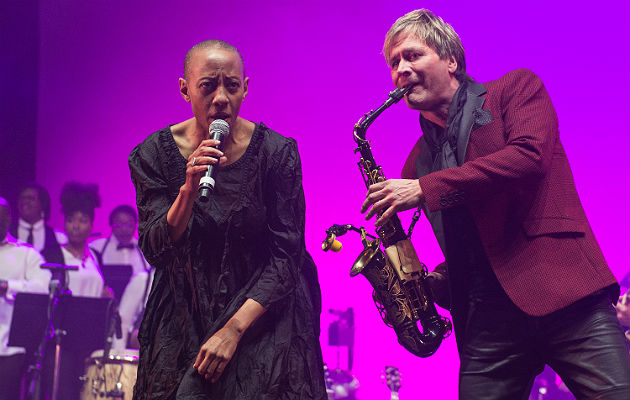
Brixton tribute concert for Bowie: Gail Ann Dorsey singing Young Americans with Spandau Ballet’s Steve Norman. (Photo: Getty)
❏ On what would have been Bowie’s 70th birthday his friend the actor Gary Oldman gathered at the Brixton Academy a 30-strong all-star lineup of musicians who had collaborated throughout his career, with some glorious orchestral and choral support. The show is the first in a run of gigs around the world taking place in cities that have a strong connection with Bowie and his work.
The London concert featured Mike Garson, Earl Slick, Adrian Belew, Mark Plati, Gerry Leonard, Sterling Campbell, Zachary Alford, Holly Palmer, Catherine Russell, plus such guests as Tony Hadley and Simon Lebon. Special highlights saw Gail Ann Dorsey singing Young Americans with Spandau’s Steve Norman on sax; and an audience singalong to Life on Mars? led by Adrian Belew and gifted vocals from Tom Chaplin from the band Keane. Plenty of live videos at YouTube.
Egan deejaying at Tramp this week: a nightclub launch for Welcome to the Dancefloor
◼ AFTER FIVE YEARS OF BLAGGING, and five years of feuding with former collaborators, 80s Blitz Club deejay Rusty Egan’s own “electro-diskow” album, Welcome to the Dancefloor, amounts to a superb sonic landmark. He and his guest performers engage an impressive range of emotions by dramatically humanising the potential starkness many associate with electronica.
ALBUM REVIEW
Welcome to the Dancefloor
Rusty Egan
Spookily, their energy rockets us immediately into that vast clean stereo soundscape that uniquely defined the new music of 1980. Here synthesiser chords are stretched and layered and cracked like a whip, as if by an invisible hand in another time and space, which of course was precisely the sound of London clubland when its youth culture erupted as a volcano of creativity. The album’s pacey opening track finds ex-New Order’s Peter Hook on The Other Side spinning through the Milky Way, his thin 80s vocal style querulous and wistful, yet poppily optimistic.
That era did after all abandon the overpowering noise of the rock stadium and the punk nihilists to celebrate a return to melodious singing voices and to arch lyrics meant for listening, while synthesisers defined a fresh musical ambience. Inexperienced young artists unsure about their singing ability half shouted, half vocodered their limited vocal range to re-imagine their teenage dreams on a different planet.
Egan’s collaborators: click any pic below to launch slideshow
Ure: an inspired rewrite job
Huntley: spiritual resonance
Stein: astonishing, contemplative
Porter: gorgeous inflections
Hook: shades of New Order
Hadley: canters with a coltish love song
While Egan has carefully selected 13 tracks reflecting the wide spectrum of synth possibilities, half are love songs in the spirit of the 80s generation who were dubbed by the press New Romantics. Nevertheless he has created a consummate showcase for electronic music, co-produced by Nick Bitzenis (aka Nikonn). He has had a hand in writing a majority of the songs, many co-written with Chris Payne (of Fade to Grey fame), these being subsequently endorsed and expressed by a handful of starry friends such as Midge Ure and Tony Hadley on tracks of their own.
Despite its title, this is not dance music that the funk nation would groove to. Laying down a dominant 4-4 beat is not conducive to free-form movement unless you think you’re Tik or Tok. Exceptions include Egan’s own pulsating title track with robo vocals as if by Stephen Hawking and knowing breaks parodying Tenek and the Human League; also the nippy number Hero, which gains spiritual resonance from Andy Huntley’s richly textured delivery.
The stand-out track is Midge Ure’s transformation of an Egan/Payne song titled Glorious. He rewrote lyrics and melody so as to construct one magnificent crescendo filled with space and tension reminiscent of “Ohhhhh, Vienna!” A close second for reconjuring the authentic 80s is Egan’s own Wunderwerke, driven by his Trans-Europe vocals through classic synth sweeps, hypnotic repeats and bass stabs. Third comes Erik Stein on the astonishingly contemplative Ballet Dancer, basking in a wonderful waterfall of synths.
Like Brexit, Tony Hadley *is* Tony Hadley and here (without the Ballet) on the coltish lovesong Lonely Highway he canters to the top of a whole new hill as a crooner. What distinguishes this album is that it’s awash with affecting lyrics and fine voices to listen to in the name of electro pop – among the gentlest are Be The Man featuring the gorgeous inflections of Kira Porter; Nicole Clarke’s ethereal contribution to Love Can Conquer All; and Love Is Coming My Way, a second number from the silken-voiced Stein.
And just wait for the Chariots of Fire finale: Egan’s intensely personal track, Thank You, which unleashes a shock of the best kind. To describe more would be to spoil a gifted idea. It is emotional and all too evidently sincere. Thank you, Rusty.
Rusty Egan: co-producer, co-writer and much else – has created a landmark album in Welcome to the Dancefloor
➢ Choose “View full site” – then in the blue bar atop your mobile page, click the three horizontal lines linking to many blue themed pages with background article
MORE INTERESTING THAN MOST PEOPLE’S FANTASIES — THE SWINGING EIGHTIES 1978-1984
They didn’t call themselves New Romantics, or the Blitz Kids – but other people did.
“I’d find people at the Blitz who were possible only in my imagination. But they were real” — Stephen Jones, hatmaker, 1983. (Illustration courtesy Iain R Webb, 1983)
“The truth about those Blitz club people was more interesting than most people’s fantasies” — Steve Dagger, pop group manager, 1983
PRAISE INDEED!
“See David Johnson’s fabulously detailed website Shapers of the 80s to which I am hugely indebted” – Political historian Dominic Sandbrook, in his book Who Dares Wins, 2019
“The (velvet) goldmine that is Shapers of the 80s” – Verdict of Chris O’Leary, respected author and blogger who analyses Bowie song by song at Pushing Ahead of the Dame
“The rather brilliant Shapers of the 80s website” – Dylan Jones in his Sweet Dreams paperback, 2021
A UNIQUE HISTORY
➢ WELCOME to the Swinging 80s ➢ THE BLOG POSTS on this front page report topical updates ➢ ROLL OVER THE MENU at page top to go deeper into the past ➢ FOR NEWS & MONTH BY MONTH SEARCH scroll down this sidebar
❏ Header artwork by Kat Starchild shows Blitz Kids Darla Jane Gilroy, Elise Brazier, Judi Frankland and Steve Strange, with David Bowie at centre in his 1980 video for Ashes to Ashes
VINCENT ON AIR 2026
✱ Deejay legend Robbie Vincent has returned to JazzFM on Sundays 1-3pm… Catch up on Robbie’s JazzFM August Bank Holiday 2020 session thanks to AhhhhhSoul with four hours of “nothing but essential rhythms of soul, jazz and funk”.
TOLD FOR THE FIRST TIME
◆ Who was who in Spandau’s break-out year of 1980? The Invisible Hand of Shapersofthe80s draws a selective timeline for The unprecedented rise and rise of Spandau Ballet –– Turn to our inside page
SEARCH our 925 posts or ZOOM DOWN TO THE ARCHIVE INDEX
UNTOLD BLITZ STORIES
✱ If you thought there was no more to know about the birth of Blitz culture in 1980 then get your hands on a sensational book by an obsessive music fan called David Barrat. It is gripping, original and epic – a spooky tale of coincidence and parallel lives as mind-tingling as a Sherlock Holmes yarn. Titled both New Romantics Who Never Were and The Untold Story of Spandau Ballet! Sample this initial taster here at Shapers of the 80s
CHEWING THE FAT
✱ Jawing at Soho Radio on the 80s clubland revolution (from 32 mins) and on art (@55 mins) is probably the most influential shaper of the 80s, former Wag-club director Chris Sullivan (pictured) with editor of this website David Johnson
LANDMARK FAREWELLS. . . HIT THE INDEX TAB UP TOP FOR EVERYTHING ELSE










 ➢➢ Shapers of the 80s ➣➣