Immature? Alternative unused shot of 21-year-old Christine Keeler from the famous 1963 photo session in Lewis Morley’s Greek Street studio. . . Right, in 1990, a fully-clad Keeler returned to the pose she made famous for a photograph taken by Terry O’Neill
◼ “THEY NEVER STOPPED CALLING ME A PROSTITUTE.” So said the notorious “showgirl” who helped bring down a Tory government, quoted in today’s impressively well rounded Times obituary of Christine Keeler who has died aged 75. Despite posing naked for a now definitive photograph on a plywood chair in 1963, she fell victim to the mores of those times in the whole sex-and-spying soap opera enacted by a cast of deeply sleazy characters. Found guilty of perjury, she was sentenced to nine months in prison.
“Her only real crime was immaturity,” according to The Times obituarist. The war minister John Profumo lied “again and again” throughout the scandal, also according to The Times, whose own editor back in the day thundered that adultery “is a moral issue”. Well worth reading as a comprehensive slice of social history just as the Sixties began to swing.
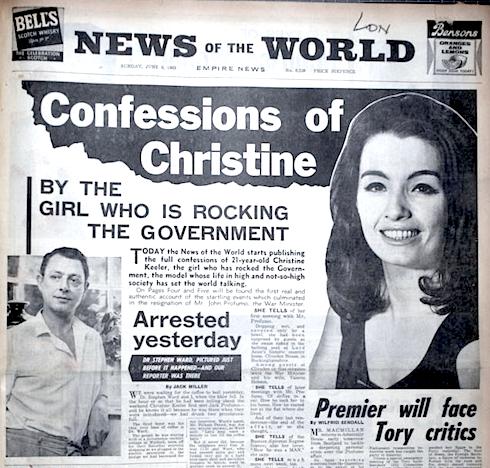
Telling her own story – News of the World from June 1963
❏ One sympathetic reappraisal of Keeler’s reputation came with the powerful 1989 feature film Scandal directed by Michael Caton-Jones who created an even-handed and realistic evocation of the saga, with an immaculate cast. Best of all for pop-culture fans was its title track by the Pet Shop Boys who had the brilliant notion of bringing Sixties icon Dusty Springfield out of retirement and she rendered the vocals beautifully. Among a classic collection of tunes for the soundtrack, Chubby Checker even re-recorded The Twist because his original had been embargoed for rights reasons.
This video compilation intercuts clips from the film Scandal with authentic news footage of the rum cast implicated in the Profumo affair of 1963, all overdubbed with Dusty who sings the film’s soundtrack, Nothing Has Been Proved. And yet, nothing about the story was fake by today’s standards.
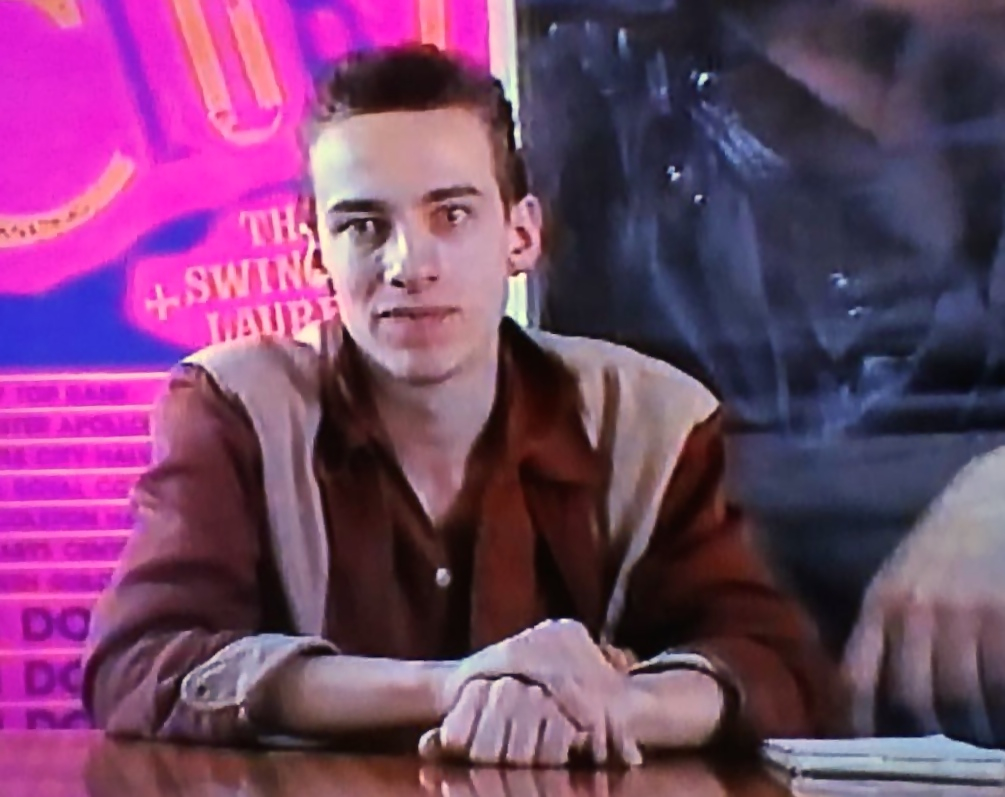
The boy wonder: “Scoop” Simper plugging No1 on Switch, the TV pop show
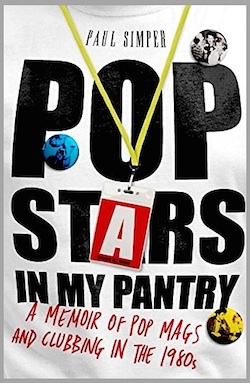
A rare book is published this month giving a vivid eye-witness account of one of the most creative eras for British pop music, the Swinging 80s. Paul Simper himself says: “It’s the pop life story pop-pickers have been gagging for.”
He should know, having emerged from London clubland to become the leading commentator on the New Pop led by image-conscious young bands when the rock press at large was giving them short shrift. Not only was he genuinely The Friend of The Stars but was one of the few writers who could also give it pure laldy dancing his socks off down Le Beat Route. Pop Stars in My Pantry is his confessional memoir and today Shapers of the 80s reprints an exclusive extract. . . But first, who is the man called Simper?
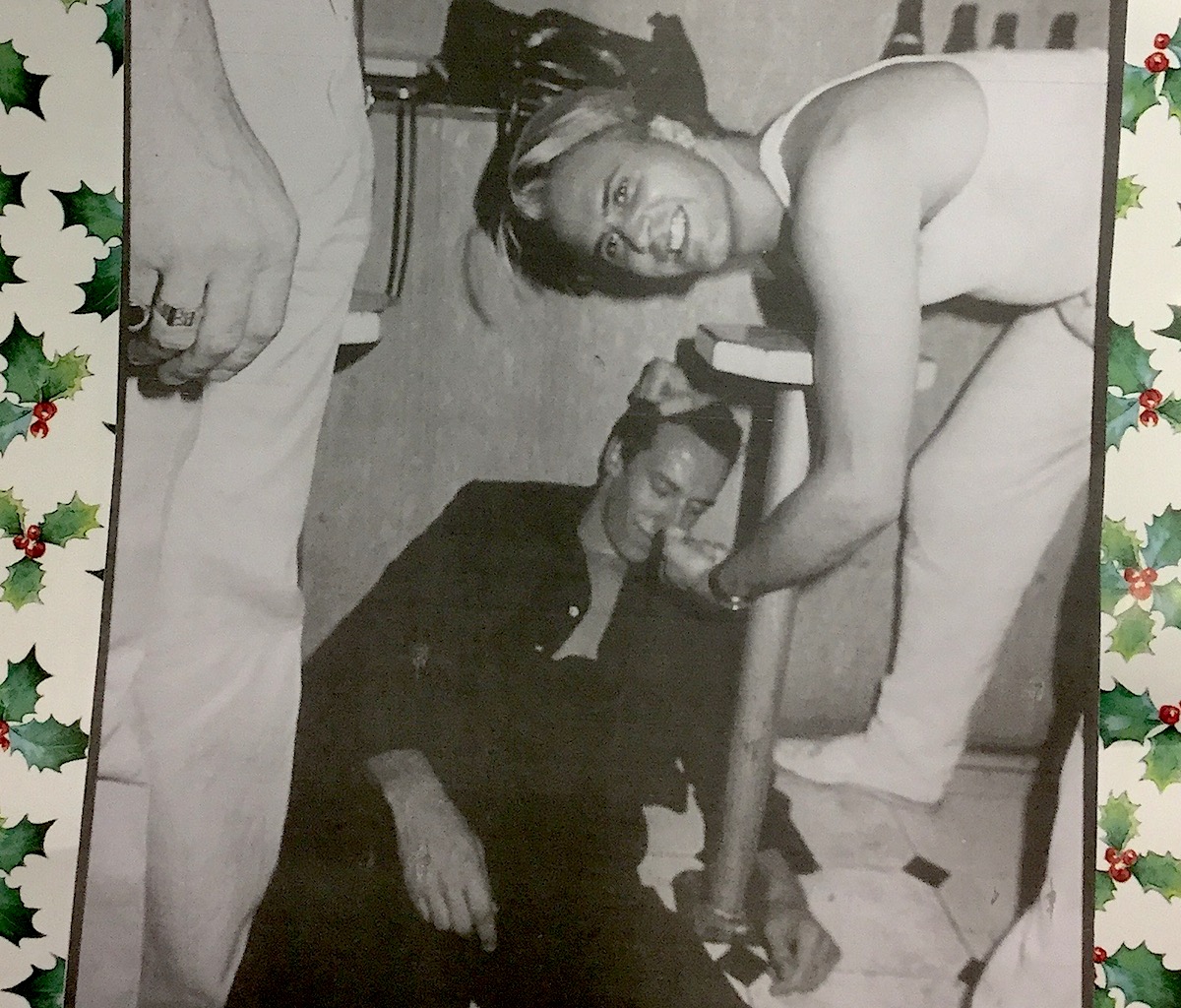
Wakey-wakey! Spandau Ballet sax player Steve Norman discovers our hero Simper relaxing during a characteristic night out on the town during London’s Swinging 80s
◼ THERE’S NO EXPLAINING PAUL SIMPER except as a life force which is Always On – sometimes as a mouse, sometimes a bunny, often in a skirt or a sequinned tuxedo. Not usually at same time, obvs. He’s obsessive, definitely bonkers, extremely good “in the room” and, oh yes, quite an entertaining showbiz writer.
Now he’s had the nerve to bring out his life story as a book called Pop Stars in My Pantry (PSIMP for short) when you’d think people in the music biz would have learned a lesson from Morrissey’s Pooterish own goal. Luckily Simper seems to have had massively more fun than Moz, actually likes the people he writes about and, oh yes, brings a wicked sense of humour to an industry not noted for knowing how to laugh.
As a singer in Slippry Feet – a marriage of supper-club in a circus ring meets David Lynch in a disco – Simper only ever got as far as being the best group of December 1993. Bar none. Fortunately for this book he has the day job to fall back on and he is SUCH a namedropper. Look at the puffery adorning his book’s back jacket: “Always a joy to hang with” – Siobhan Fahey; “The most trusted person in 80s pop” – Patsy Kensit; “Truly the epitome of the embedded journalist” – Gary Kemp.
Goes with territory when you have become Friend of The Stars, having leapfrogged from Melody Maker within minutes of coming up from the sticks in 1981, onto smart new fan mags like New Sounds New Styles and No 1 which counted clubbing on-the-town as research. There from the off, he was friends with the burgeoning new generation of self-invented nightlife stars who were storming off fashionable dancefloors across the UK and into the singles charts to knock the rock dinosaurs for six. Fellow clubbing names being dropped go from George Michael to Frankie Goes to Hollywood, Bananarama to Boy George. Not to mention Madonna, Prince, Whitney, Elton and Weller. Woohoo!
Early on I nicknamed him “Scoop” Simper because even though I worked for a Deeply Influential Mainstream Newspaper, whenever any big sexy pop star, like, y’know Debbie Harry, flew in from abroad *he* got the exclusive interview even though he “only” worked for one of those pure-pop weeklies full of pinups and lyrics and breathless reviews.
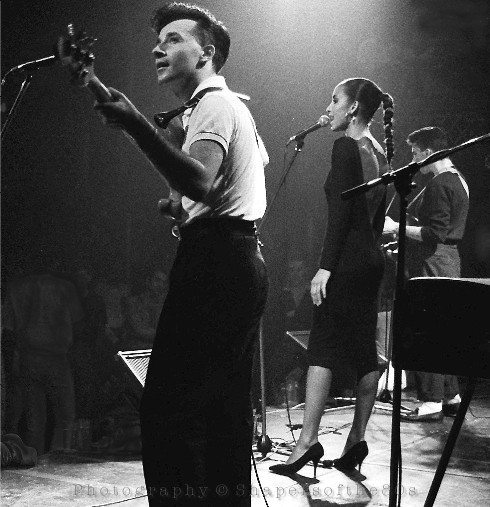
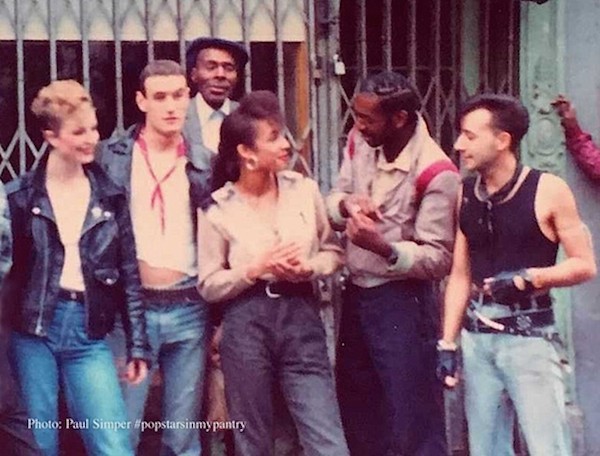
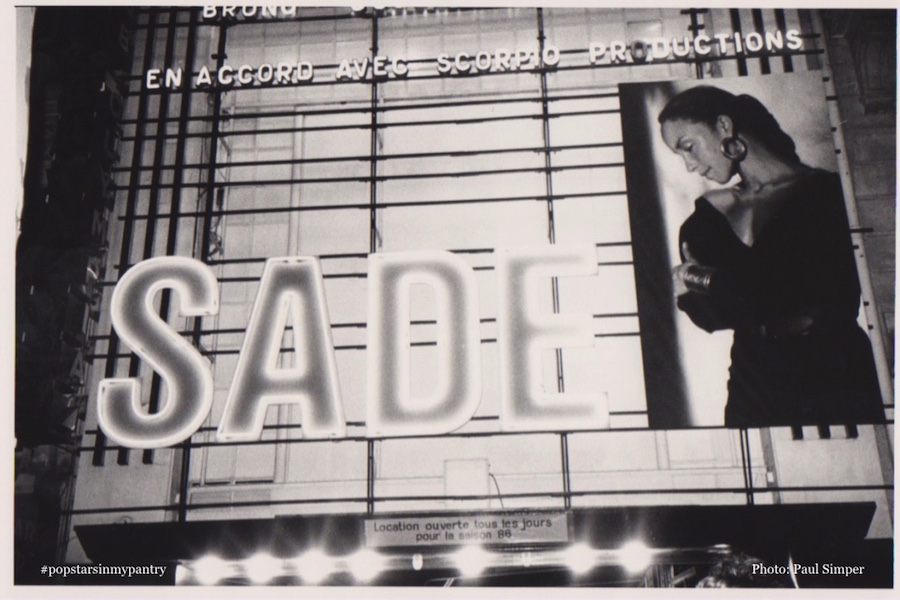
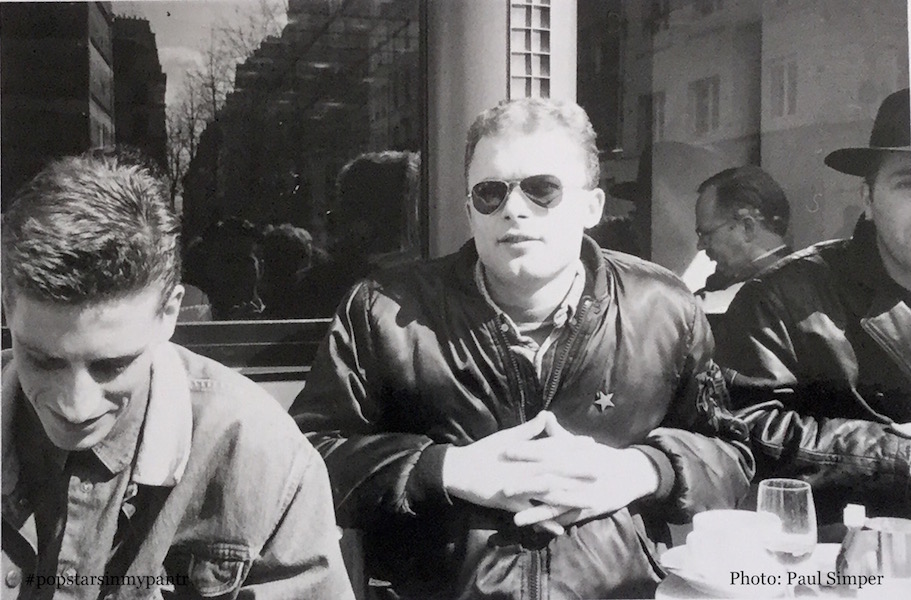
So who’s having the last laugh now?! Well probably Scoop, as usual, since PSIMP proves to be “a right frollicking read for the adults in your family”, while my own book has blurted itself out and into this website for several years, clocking up barely a handful of Wikipedia footnotes to credit. And now His Majesty is entrusting Shapers of the 80s with running an excerpt from one of the best chapters in his book, the story of Sade Adu, the Essex girl who rose via St Martin’s School of Art to become one of the UK’s biggest Grammy-award winning pop exports, described by Robert Sandall in The Sunday Times in 2010 as “the most successful solo British female artist in history”.
Scoop spills the beans: “Sade was very much a part of my early years as a young pop writer living in London. She even used to kindly let me sleep on her sofa.” So here’s a short teaser-taster from PSIMP, but do click through to our inside page for the full extract when Sade’s first band Pride goes in search of Manhattan’s edgy Village scene. . .
“ I owed Sade and Bob Elms plenty. When I first moved to London I couldn’t have been more grateful for the existence of their north London home tucked away in multi-cultural Wood Green on the Noel Park Estate.
Their old sofa didn’t exclusively have my name on it – fresh-down-from-Hull saxophonist Stuart Matthewman was pretty much clothed, housed and fed by them over the same period – but on the occasions I was invited back, I took some shifting. Sade reckoned that a pair of my old socks stuck around even longer than me until she ceremonially buried them, like high-grade plutonium, in the back garden.
I was never so bold as to turn up unannounced, but if Bob suggested a home viewing of an under-the-counter video of Texas Chainsaw Massacre or The Hills Have Eyes that he’d got his mitts on in Soho (I’d discovered in my early days in London there was a black market for everything), then I was more than up for it.
My telly viewing habits were not of primary importance to the residents at No 64 Hewitt Avenue by the spring of 1982, though, when Bob and Lee Barrett started talking up this new band called Pride that “Shard” was in. Stuart Matthewman was also involved, as were fellow Hull lads drummer Paul Cooke and bass player Paul Denman.
Back in Hull, Stuart had been in The Odds, a pop/mod band similar to The Piranhas that had started out doing speeded-up punk versions of 60s hits like The Dave Clark Five’s Glad All Over. He then played sax in a ten-piece Elvis impersonator show called Ravin’ Rupert, which covered the whole spectrum of The King’s career from rockabilly to Vegas delivered by a front man sporting a quiff and wearing Rupert-the-Bear checked trousers. A tad cooler was Paul Cooke and Paul Denman’s prog-rock band, The Posers, which Stuart credits as being the only band in Hull trying to do something new.
As for Sade, her singing career had only begun a few months previous when she sang onstage for the first time as part of another London band, Ariva. Considering Ariva were viewed as a bit of a Blue Rondo rip-off, ironically it was on the way to a Rondo gig on Barry Island that Lee first clocked Sade singing along to the radio and asked her if she could sing. She thought she probably could so said Yes. . . ”
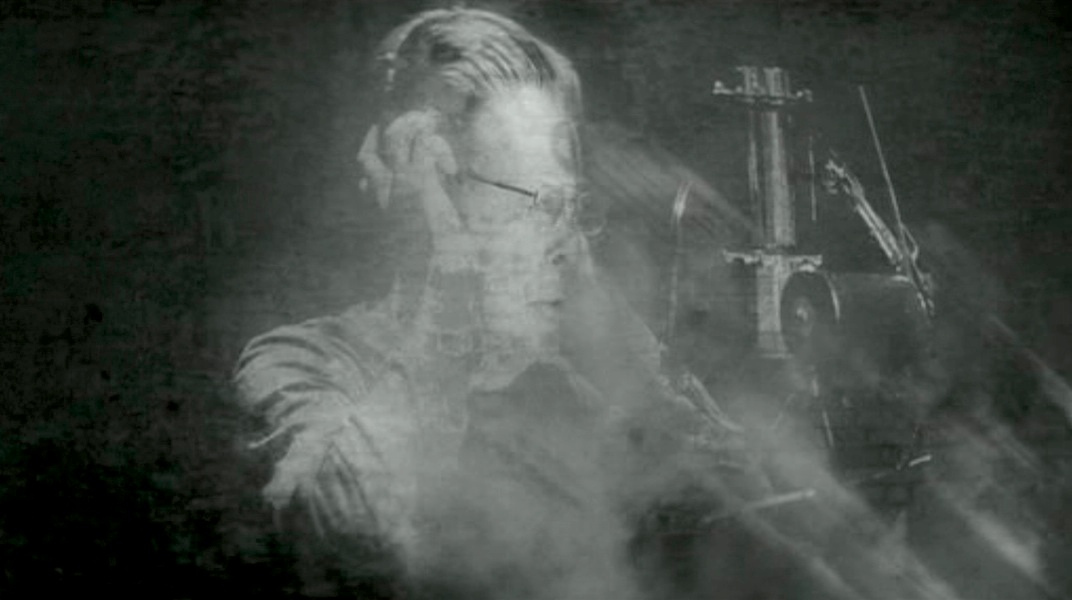
Bowie as a projected image in the video for Sue (Or in a Season of Crime)
“If you feel safe in the area that you’re working in, you’re not working in the right area. Always go a little further into the water than you feel capable of. Go a little bit out of your depth and when you don’t feel that your feet are quite touching the bottom, you’re just about in the right place to do something exciting” – David Bowie
◼ THE MOST GRIPPING SEQUENCES in the new TV documentary about Bowie’s final surge of creativity are those which assemble every musician in the bands he worked with from 2012 to the end. Each band re-enacts pivotal moments when they rehearsed the music, inspired by his lyrics, and laid down the tracks for the albums The Next Day and Blackstar. Particularly revealing is the session when pure jazz soloists created the nerve-tingling Sue (Or in a Season of Crime), which Bowie added to his 2014 “best-of” collection, Nothing Has Changed.
To mark the first anniversary of the star’s death, this weekend BBC2 screened David Bowie: The Last Five Years, Francis Whately’s sequel to his other superb documentary Five Years broadcast in 2013. The role of jazz in Bowie’s musical temperament seldom gets discussed, though his producer Tony Visconti says the jazz influence had always been there in the music but underneath the surface. As a small child Bowie heard a jazz band and right away said: “I’m going to learn the saxophone. When I grow up, I’m going to play in [this] band. So I persuaded my dad to get me a kind of a plastic saxophone on hire purchase.”
In 2013 in New York he met Maria Schneider, a jazz composer, handed her a demo disc and asked her to extemporise around a tune called Sue. In turn, she told him he had to listen to this sax player Donny McCaslin and without missing a beat Bowie went straight into the studio with his group and Maria and out came possibly the purest jazz number of his career, a discomfiting tale of infidelity. It won Schneider a Best Arrangement Grammy in 2016.
Donny McCaslin enthuses about Bowie during rehearsals
Maria Schneider’s proposed scoring for Sue
REVIEWS OF THE LAST FIVE YEARS TV DOC
➢ A thrilling portrait of a late-life renaissance
– Jasper Rees at the Arts Desk “ The opening yielded much joyful footage of Bowie goofing around on the Reality tour (2003), seeming much more like one of the boys than he ever managed with Tin Machine. The band still seemed spooked at the memory of his collapse, before he was carted off to retirement in an ambulance.
Maria Schneider was one of many musicians – three complete bands – who re-formed to walk through the creation of the music. Drummer Zachary Alford still looked shocked at the NDA handed him as he showed up to work on The Next Day. “If I said anything about it,” remembered bassist Gail Ann Dorsey, “I would be in big trouble legally.” Nobody was asked if Bowie really would have sued his collaborators for spilling the beans.
The recent collaborators reflected on the extent to which the new music was steeped in the past. But there was also good stuff from the old lags who worked (and sometimes slept) with Bowie in the feather-cut era: Ideally there would be a DVD with extras featuring much more from each of them. Chief keeper of the flame Tony Visconti sat at a console and played excerpts of Bowie’s unaccompanied vocal takes. On Blackstar came the haunting sound of Bowie wheezing like an ancient mariner fighting for every last scrap of breath. . . ” / Continued online
➢ A treat and a treatise on music’s departed genius
– by James Hall, Daily Telegraph “ The Last Five Years wove previously unheard Bowie interview material with on-screen contributions from collaborators including producer Tony Visconti. The access and insights were faultless. Whately’s programme was essentially a treatise on artistic rebirth. And it showed that although Bowie’s musical style constantly changed, the themes that preoccupied him — alienation, escape, the notion of fame — were there until the end.
During his final creative burst, Bowie gradually revealed to collaborators that he was ill. In the most poignant scene, we learned that Bowie only discovered his cancer was terminal three months before he died. This was in October 2015 when he was filming the video for Lazarus, in which he sings the line “Look up here, I’m in heaven”. Bowie worked and cared and joked until the end. Through tears, Visconti said that he was at ‘the top of his game’. . . ” / Continued online
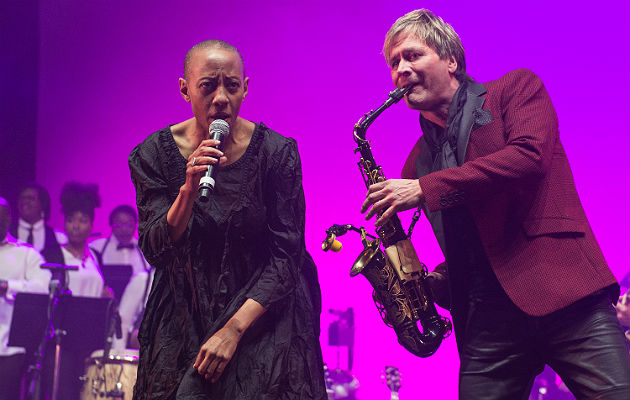
Brixton tribute concert for Bowie: Gail Ann Dorsey singing Young Americans with Spandau Ballet’s Steve Norman. (Photo: Getty)
❏ On what would have been Bowie’s 70th birthday his friend the actor Gary Oldman gathered at the Brixton Academy a 30-strong all-star lineup of musicians who had collaborated throughout his career, with some glorious orchestral and choral support. The show is the first in a run of gigs around the world taking place in cities that have a strong connection with Bowie and his work.
The London concert featured Mike Garson, Earl Slick, Adrian Belew, Mark Plati, Gerry Leonard, Sterling Campbell, Zachary Alford, Holly Palmer, Catherine Russell, plus such guests as Tony Hadley and Simon Lebon. Special highlights saw Gail Ann Dorsey singing Young Americans with Spandau’s Steve Norman on sax; and an audience singalong to Life on Mars? led by Adrian Belew and gifted vocals from Tom Chaplin from the band Keane. Plenty of live videos at YouTube.
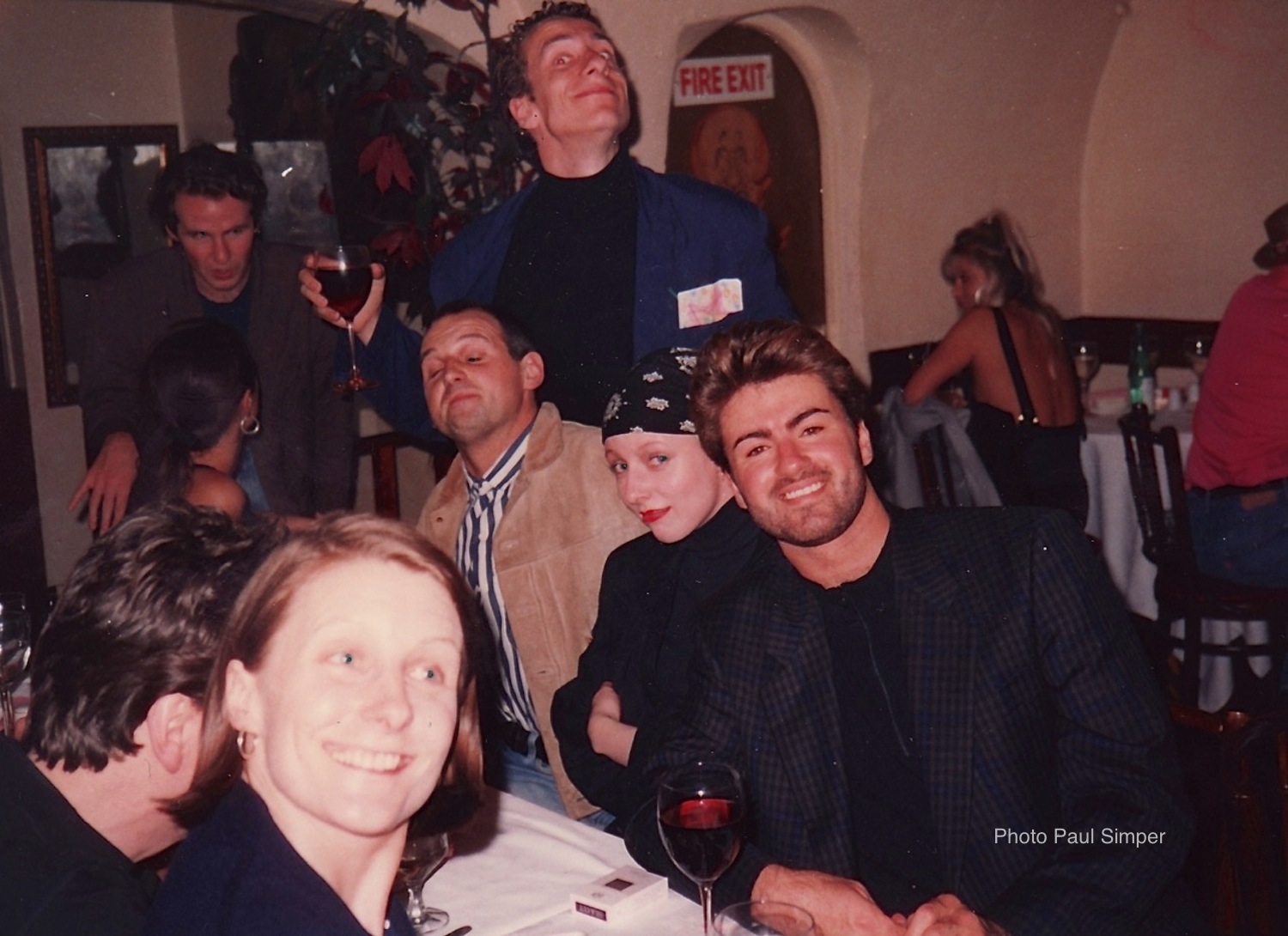
Simper’s 25th birthday at Aldo Zilli’s Il Siciliano in Soho: visible faces clockwise from front left: Lilli Anderson, Alex Godson (standing), Sam McKnight, the host (standing), Josie Jones, George Michael. Photo by Simper
Paul “Scoop” Simper arrived in London as a cub
journalist who soon became a backbone of No1, one
of the two leading pop magazines covering the
Swinging 80s. He also became a face about clubland
and in the years after he first met George Michael,
when Wham! was launched, became friends.
Shapers of the 80s is pleased to publish Scoop’s very personal tribute to one of the UK’s leading superstars who died this week
◼ OF COURSE HE HAD TO LEAVE US ON CHRISTMAS DAY. As a pop lover, especially one raised in the 80s, George Michael has been a part of mine and so many people’s Christmases for years.
This one was no exception. Nipping up the high street to the supermarket for one last shop on Christmas Eve, there was something both joyous and comforting about hearing him – not just as Wham! but on his lonesome giving us December Song and on Band Aid – whilst trolling up and down the aisles for a bottle of fizz and a few more festive nibbles.
If anything, this year he’d felt ever more present. A pre-Christmas gathering of my old 80s pals had stirred up memories of Whambley – that perfect pop farewell on the sunniest of days in ’86 in front of 72,000 adoring but heartbroken fans when George and Andrew signed off at the top of the charts (both albums and singles) with their friendship still intact.
Wham! fans came in all shapes and sizes. Not long ago I’d been listening to a bootleg of The Final concert, lovingly recorded and shared with me by No1 magazine’s then editorial assistant Dave Ling, later of Metal Hammer, a heavy metaller through and through, who made an honourable exception when it came to George and Andrew.
As I think about it now, not being a Wham! or George fan has always been a bit of a deal-breaker. One early relationship of mine came to a very swift end when she questioned my love of George. My pal June Montana (lead singer with Brilliant and gatekeeper on the Limelight’s VIP bar, who was actually a bona fide friend of his) and I were like the George gestapo. We could sniff out a non-believer at 100 paces.
Part of that devotion came from the fact that in 80s London clubland, Wham! were never really cool. They were outsiders. They were from Bushey, Hertfordshire. As a country lad from Wiltshire I felt a kinship, particularly with George.
He was a year younger but for both of us our first introduction to the game-changing London club scene of the early 80s was Le Beat Route – a Soho club I was gagging to go to the second I saw Spandau Ballet’s Chant No1 video, the anthem for this pop moment.
In the last interview I did with George, in 2006, when we were talking about Spandau, he remembered the thrill of going down for the first time to what was then the hottest club on the planet and actually sighting both Steve Strange (on the Space Invaders) and Tony Hadley (at the bar).
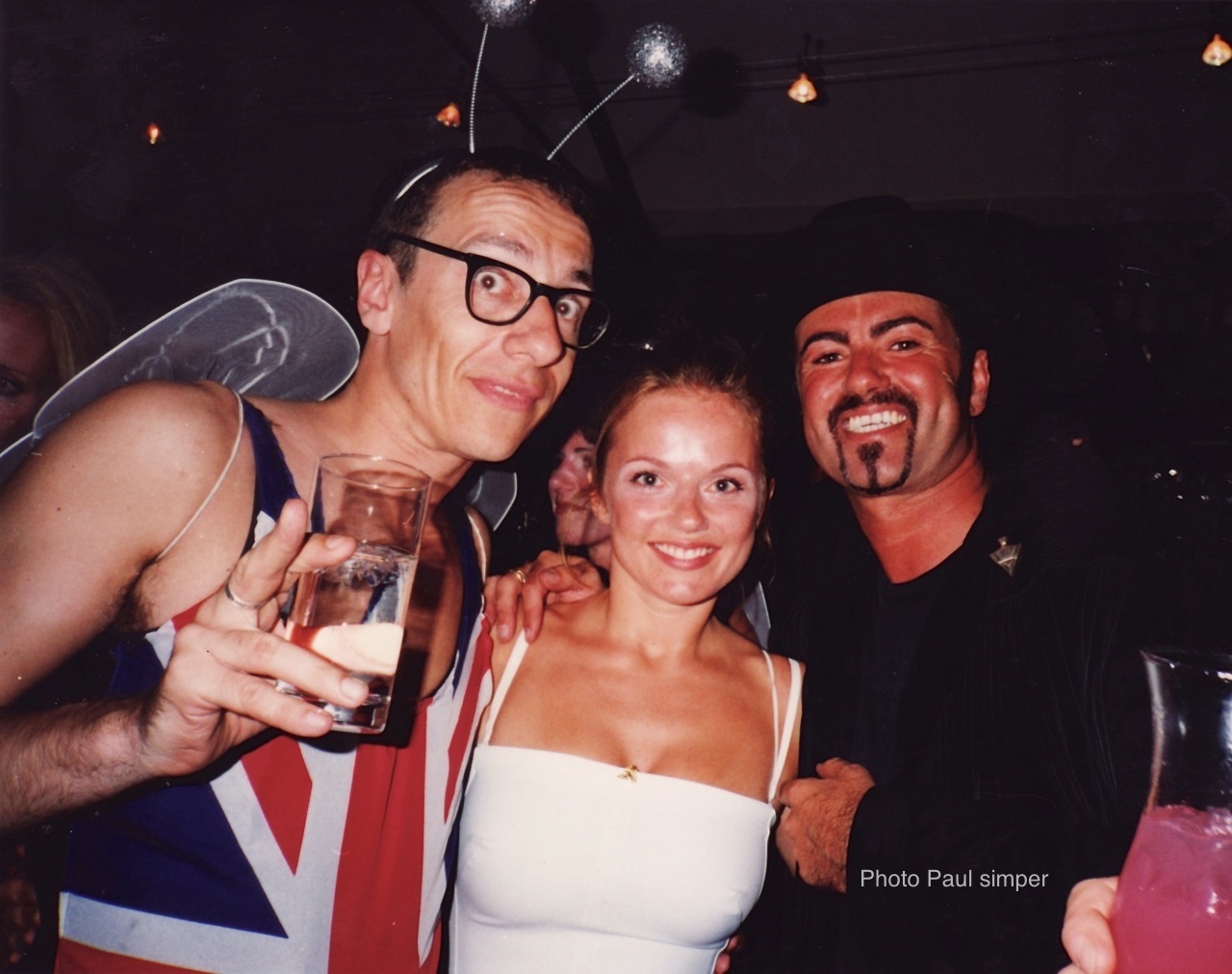
George’s 35th birthday where Simper was deejaying dressed as a Spice Girl angel: George was obliged to introduce him to Ginger Spice. Photo by Simper
Le Beat Route was where Andrew Ridgeley came up with the “Wham! Bam! I am a man!” rap. It was where George would perfect his pair dancing with Shirlie Holliman to D-Train, Was Not Was and Evelyn “Champagne” King. It was the inspiration for Club Tropicana.
Of equal importance though had been Saturday Night Fever – the movie that rang the death knell for disco for the cool kids of the underground dance scene but for those in the sticks in our teens the first pulling back of the curtain (even though it was actually set in faraway Brooklyn) on a thrilling new world. On reflection, it’s perhaps surprising that George never covered a Bee Gees song, with the exception of side project Boogie Box High’s Jive Talkin’, but he was always a massive fan, applauding their return to the top of the charts after a lengthy absence with You Win Again and marvelling, after a visit to Barry Gibbs’ home in Miami, that he was the only man he’d met who took even longer over his hair than George did.
Friday nights at Le Beat Route were just about over by the time I first interviewed George and Andrew in October ’82, although Wham! did throw one last Christmas party there to celebrate leaving their first record company, Innervision. Instead it was now The Wag on Wardour Street, which, as Wham! took off, increasingly became George’s place to hang out, unbothered.
If Chant No1 belongs to Le Beat Route, then The Wag at Christmas ’84 is where I think of for Wham!’s Everything She Wants. It was where I first heard deejay Fat Tony play the 12-inch mix with its glorious, expanded middle eight, which George had handed him that night to test out on the dance floor. From its rapturous reception and the delighted look on George’s face you could see he’d got the confirmation he was after. Like Chant, he’d delivered his club classic.
First at Melody Maker, then at No1, I was lucky enough to get my fair share of interviews with George. In early No1 days that included him going on a Blind Date with Keren Woodward from Bananarama which ended with him popping up to the 26th floor of IPC magazine’s HQ in King’s Reach Tower to play us a just-finished mix of Bassline (later retitled A Ray of Sunshine) on our tinpot stereo system.
They were more innocent, uncomplicated times in terms of pop coverage but even once Fleet Street turned its attentions to him and much of that side of it became more wearisome, he continued to be one of my favourite pop stars to interview, funny and forthright, as I hope the two interview clips attached here illustrate.
GEORGE/SIMPER 1987 INTERVIEW ON BEING CAMP:
++++++++++++
GEORGE/SIMPER 1987 INTERVIEW ON UNDERPANTS:
++++++++++++
Thanks primarily to June – “Don’t forget Simper!” she’d holler – I saw him more socially once Wham! finished and his solo career began. Merry Chianti-filled nights at Aldo Zilli’s two Dean Street restaurants, Il Siciliano and Signor Zilli’s, and dancing to his records at Brown’s and later Abba, the weekly Hanover Square one-nighter run by June and Fat Tony.
I loved the fact that he danced to his own records. After all if you can’t dance to your records why should anyone else? Fellow clubber and George fan Bayo Furlong reminded me that George always danced exactly like George Michael – the soul boy steps, the arms aloft, the finger and toe points, the hips shake, the swivel, the spin – which is even more brilliant. He was the singing, dancing embodiment of his own Wham! mantra (Wham!tra?) “Enjoy what you do”!
And what a voice. Of his generation, take your pick between him and the other George, for greatest white male soul singer of the 80s. It was there as early as Wham! ballads Nothing Looks the Same in the Light and Club Tropicana B-side Blue and grew on Careless Whisper and A Different Corner. His duets with Aretha Franklin and Mary J Blige – ringing endorsements in themselves – raised the bar again only for him to reach even higher with the likes of Older, You Have Been Loved and Jesus to a Child.
He said himself that he wasn’t the most prolific of writers. Two Wham! and four solo albums of original material and rarely much left over for B-sides (though Fantasy is a little gem) but as a pop star he aced it – twice over.
First in the perfect pop group, two teenage buddies who remained in spirit, sound and success as Wham!-like from the opening volley of Wham Rap! and Young Guns to the last howl of The Edge of Heaven. Then a second time, making the daunting leap from teen idol to internationally successful solo artist, barely breaking a sweat where so many others have fallen.
He told me he’d set himself the goal of joining the then 80s elite of Prince, Michael Jackson, Madonna and Bruce Springsteen. If the Faith album was his Thriller, with its 25 million sales, he went one better than MJ, surpassing it artistically with Older. And, despite the subsequent fall-out with Sony over record sales, Listen Without Prejudice Vol I – which includes the gorgeous Bacharach-style ballad Cowboys and Angels – isn’t too shabby either.
As our careers both went in different directions, I got to interview him less, but deejay for him more. Fat Tony got me on board to help out with George’s 30th birthday celebrations and I was there again for his 35th in 1998. Both had fancy-dress themes, the latter one Cowboys and Angels, and good sport that he was he didn’t bat an eyelid when I asked him, dressed in a fetching Spice Girl Union Jack bathing suit and wings, to persuade a reluctant Geri Halliwell to do a photo with me.
“He’s a bit strange,” George explained to Ginger Spice, “but he’s a very old friend.”
I’ll settle for that. He did a lot more for me than I’m sure I ever did for him. Dancing to Everything She Wants – dancing like him to Everything She Wants – still gives me more pleasure than most things in life.
At the time of that last Spandau interview he was in the studio still working on his final studio album, Patience. When he played me Flawless (Go to the City) I knew he’d got me again.
“It’s no good waiting. You’ve got to go to the city.”
That small-town thrill. The anticipation for those Beat Route, Saturday Night Fever moments was still somewhere in our DNA.
I was back in the countryside, tucked up in bed at my mum’s, when I heard he had gone. I only ever went to his house in Goring once, one Boxing Day thanks to June and another good pal, his wonderfully considerate PA Shiv Bailey. He sent a car for me and the only way it could have been any more perfect is if Richard and Judy hadn’t just departed. Otherwise it was all my Last Christmas joy rolled into one.
So thank you, George, for all those happy Christmases, and for everything else you gave.
A bearded George Michael before Wham! came along: Captured on 20 February 1981 with his eye on the Nationwide TV camera, among many familiar faces at Soho’s Friday night Beat Route – where the Caribbean beach decor was to inspire his song Club Tropicana. (Photo BBC)
◼ THIS ENTIRE WEBSITE CELEBRATES the Swinging 80s when UK subcultures were uniquely re-shaped by the youngest generation since the 60s to create new sounds and new styles in music, fashion and media. George Michael, who died this week, was one among hundreds of inveterate Soho clubbers, except that in his own mind he was a global superstar. Yet before the teenaged George and his schoolmate Andrew Ridgeley signed to Innervision as Wham!, there were several false starts to their career, not least being turned away from the Friday-night Beat Route during its coolest-club-in-town heyday when gatekeeper Ollie O’Donnell decided the boys from Bushey looked just too suburban. The Soho elite of 20-somethings who ran the new club-nights and managed the cool new image bands were very protective of their post-Romantic projects. George was however fly enough to use his contacts behind the bar to ensure he was on the dancefloor during the BBC Nationwide filming for a Spandau Ballet package in February ’81, when he clearly had the camera in his sights.
The irony was that by the next year Wham! were pushing a glossy brand of unashamedly “pure pop” that was so new, the debut single Wham Rap! failed to chart when released that June – the BBC declined to playlist the number partly because of its “anti-social” lyrics. After a touch of retuning, four months later Wham! released Young Guns (Go For It!) and this time their hedonistic attitude – mixing humour with social conscience – clicked with the clubland audiences that were growing all over Britain.
A lucky break got them onto Top of the Pops in November when the group came as a shock to the eyeballs. The vocal foursome were immaculately rehearsed. Chinese-slippered George held himself like a star, bare-chested and sporting a leather waistcoat while Andrew and backing singers Shirlie Holliman and Dee C Lee stepped out with panache, all fully choreographed down to their finger-points and slippered toe-points. Then whoosh. Wham! rocketed to No 3 in the UK singles chart in December, the next three singles all made the Top 10, and the Bushey boys graduated to the international A-Team of British superstars. The next four years turned out 25 million albums and 15 million singles and scored four US number one hit singles.
It was evidently an advantage that all four members of Wham! had emerged as faces among London’s clubland soul tribes, the dance-crazy cognoscenti who banished rock from the singles charts during 1980-81 and provided an eager audience for new music. Some of them can be seen in the music video for Young Guns shot by Tim Pope at the glitzy Churchill’s club in Piccadilly.
Pop journalist about town Paul “Scoop” Simper recalls first meeting Wham! in autumn 1982 while working for Melody Maker. In his forthcoming autobiography, Pop Stars in My Pantry, he writes:
“ George told me: “I loved dancing at Le Beat Route. Nobody gave a fuck who I was so you could throw yourself around. If Shirlie was with me we’d really do that pair dancing. It was cool. We’d always make a bit of space and really show off.”
There’s footage from a BBC Nationwide report on the club which appears in Spandau Ballet’s Soul Boys of the Western World movie showing a bearded, curly-haired George in an alarmingly orange suit slap bang in the middle of the dancefloor [pictured at top] from a time when he was still in a ska band called The Executive, before Le Beat Route’s playlist helped transform them into Wham!
“Andrew and I were at Le Beat Route when Andrew started going ‘Wham! Bam! I am a man!’’ and doing this terrible rap,” said George. “It was supposed to be funny. But that’s where he had the idea. ”
It was the Beat Route itself – actually, its Caribbean beach decor – which was to inspire George’s song Club Tropicana and for more than two years O’Donnell’s Friday-nighter set the benchmark for the coolest sounds anywhere in Soho with 22-year-old deejay Steve Lewis ruling the turntables.
On an inside page, Soho’s young guns remember their pals in Wham! – led by…
Paul McKee, admin for Soul Boys Soul Girls at Facebook – “RIP George Michael – A regular at our clubs Le Beat Route, Wag, Bogarts and many others. Easy to forget now the impact Wham Rap! Had. It was not out of place at the time in 1983 when the likes of Funkapolitan, Spandau Ballet, Culture Club, who all came from our clubs, began producing great club records, as the Soul Boys and Soul Girls sound and styles began to change. When Wham! performed Young Guns on TOTP with that dance routine, we all noted some of those little moves he used, we’d witness at a club at any given weekend. Without doubt one of the greatest soul voices and songwriters this country has ever produced. He liked to club like the rest of us, George was one of us.”
➢ Choose “View full site” – then in the blue bar atop your mobile page, click the three horizontal lines linking to many blue themed pages with background article
MORE INTERESTING THAN MOST PEOPLE’S FANTASIES — THE SWINGING EIGHTIES 1978-1984
They didn’t call themselves New Romantics, or the Blitz Kids – but other people did.
“I’d find people at the Blitz who were possible only in my imagination. But they were real” — Stephen Jones, hatmaker, 1983. (Illustration courtesy Iain R Webb, 1983)
“The truth about those Blitz club people was more interesting than most people’s fantasies” — Steve Dagger, pop group manager, 1983
PRAISE INDEED!
“See David Johnson’s fabulously detailed website Shapers of the 80s to which I am hugely indebted” – Political historian Dominic Sandbrook, in his book Who Dares Wins, 2019
“The (velvet) goldmine that is Shapers of the 80s” – Verdict of Chris O’Leary, respected author and blogger who analyses Bowie song by song at Pushing Ahead of the Dame
“The rather brilliant Shapers of the 80s website” – Dylan Jones in his Sweet Dreams paperback, 2021
A UNIQUE HISTORY
➢ WELCOME to the Swinging 80s ➢ THE BLOG POSTS on this front page report topical updates ➢ ROLL OVER THE MENU at page top to go deeper into the past ➢ FOR NEWS & MONTH BY MONTH SEARCH scroll down this sidebar
❏ Header artwork by Kat Starchild shows Blitz Kids Darla Jane Gilroy, Elise Brazier, Judi Frankland and Steve Strange, with David Bowie at centre in his 1980 video for Ashes to Ashes
VINCENT ON AIR 2026
✱ Deejay legend Robbie Vincent has returned to JazzFM on Sundays 1-3pm… Catch up on Robbie’s JazzFM August Bank Holiday 2020 session thanks to AhhhhhSoul with four hours of “nothing but essential rhythms of soul, jazz and funk”.
TOLD FOR THE FIRST TIME
◆ Who was who in Spandau’s break-out year of 1980? The Invisible Hand of Shapersofthe80s draws a selective timeline for The unprecedented rise and rise of Spandau Ballet –– Turn to our inside page
SEARCH our 925 posts or ZOOM DOWN TO THE ARCHIVE INDEX
UNTOLD BLITZ STORIES
✱ If you thought there was no more to know about the birth of Blitz culture in 1980 then get your hands on a sensational book by an obsessive music fan called David Barrat. It is gripping, original and epic – a spooky tale of coincidence and parallel lives as mind-tingling as a Sherlock Holmes yarn. Titled both New Romantics Who Never Were and The Untold Story of Spandau Ballet! Sample this initial taster here at Shapers of the 80s
CHEWING THE FAT
✱ Jawing at Soho Radio on the 80s clubland revolution (from 32 mins) and on art (@55 mins) is probably the most influential shaper of the 80s, former Wag-club director Chris Sullivan (pictured) with editor of this website David Johnson
LANDMARK FAREWELLS. . . HIT THE INDEX TAB UP TOP FOR EVERYTHING ELSE









 ➢➢ Shapers of the 80s ➣➣