Category Archives: London

2019 ➤ Sounds of the 70s still cool in the heart of Soho

70s soul, jazz-funk, Soho, Old Compton Brasserie, Andy Polaris,
Eighties singer Andy Polaris was knocked back this month
to hear one cool track after another play out in a Soho eaterie
and he quickly synthesised a playlist from the dozen best
– here’s a taste from his website Apolarisview. . .

What’s unique about my dozen best tracks? Obviously they all formed the backbone of the funk and soul soundtrack to my teen years in the 1970s when I would hear them on the dancefloors of the Lacy Lady, Croc’s, Racquel’s, Gold Mine, and on Radio London’s Robbie Vincent show and on Capital Radio’s Greg Edwards session. What’s amazing is that only this month I heard some of them playing out at the newish if retro-styled Old Compton Brasserie as the most credible playlist in Soho that night. It reminded me of the pre-disco cocktail bars in Covent Garden which became our favourite haunts at the time.

Seventies jazz-funk in a millennial eaterie for an audience of all ages? You wonder how many ears present during this evening knew that every tune was a gem from the golden age of club music. The Brasserie’s funky dozen kicked off with Rufus feat. Chaka Khan Once You Get Started (1974) – The track that brought Chaka Khan to my attention in the UK. I was sent the vinyl import album Rufusized before its UK release. . . / Discover the whole playlist at Apolarisview>

FRONT PAGE

➤ A personal tale about the genius staring out from a painting expected to sell for £30m tonight

David Hockney, Henry Geldzahler, Christopher Scott, Photography, painting, auction, Christie's London,

Being auctioned tonight at Christie’s: Henry Geldzahler and Christopher Scott by David Hockney (1969, acrylic on canvas). Private collection. © David Hockney

THIS MESMERISING HUGE CANVAS TITLED Henry Geldzahler and Christopher Scott was painted by David Hockney in 1969 and is expected to sell at Christie’s tonight for at least £30million and today is the public’s last chance to view it until 4pm. It creates an intense dialogue between Hockney and his soulmate Henry, whose hairline is the picture’s vanishing point. By chance I got to know Henry in 1977, later stayed at his house in Greenwich Village and of course had to try-out the by then fabled pale mauve sofa pictured here.

We’d met during the best holiday of my life that summer at a house party hosted by the painter Teddy Millington-Drake at his vast 17th-century villa on Patmos, the Greek Island where St John had his apocalyptic Revelation. Two dozen guests, several with their kids, had arrived either like me on the weekly boat from Athens or on their own yachts (there were no direct flights to Patmos) for what proved to be a conclave of amusing, clever and influential movers and shakers from across the international art scene who utterly changed my understanding of life, the universe etcetera.

Henry himself, a three-in-one wit, wag and Svengali, undoubtedly changed the course of modern art by shifting its centre from Paris to New York, and affirmed the credibility of the term Pop Art. While only in his 30s he became the Metropolitan Museum’s first curator for 20th-century art and in 1969 mounted the landmark exhibition of 408 contemporary American works executed between 1940 and 1970 by artists he called “deflectors” of prevailing trends, such as Warhol, Gorky, Pollock, Rothko, Rauschenberg, Stella, Johns, Hopper. It was an immediate sensation. A new canon.

David Hockney, Henry Geldzahler, Christopher Scott, Irving Penn, Photography, painting, Andy Warhol

My photo of Henry Geldzahler in 1981: taking receipt of Irving Penn’s new portrait of him, in his NYC cultural commissioner’s office

I met Henry again in 1981 the very day he took receipt of a new portrait of him by photographer Irving Penn. I was in NYC that May during the First Blitz Invasion of the USA when I accompanied the 21 Blitz Kids who included the synth-led Spandau Ballet and Jon (Mole) Baker’s Axiom design collective who played a gig and staged a runway fashion show to introduce Manhattan to the new stars of Swinging London.

By then Henry had become New York’s first Commissioner of Cultural Affairs, appointed by the mayor Ed Koch. I visited his office at Columbus Circle and he played along when I suggested taking a souvenir snap so that my portrait of him cunningly captures him four times over: Henry in life reclining on his chaise, holding the Penn portrait, in the glass of which we see reflected the Warhol lithograph of him from 1979. Behind on an easel stands a further 1973 head-and-shoulders by Hockney (savagely cropped to maximise impact in this post).

Henry, who died in 1994, was described as the world’s “most powerful and controversial art curator”. He must also have been one of the most painted and photographed curators ever. “There are lots of pictures of Henry,” said Hockney. “He didn’t have many mirrors in his home. He knew what he looked like just by asking people to make portraits of him.”

David Hockney, Henry Geldzahler, Christopher Scott, art, painting,

Masterpiece of pictorial drama (detail): the central subject in Hockney’s painting of Geldzahler and Scott stares back, evaluating the painter’s every move. (My photo)

➢ Henry Geldzahler and Christopher Scott is Lot 8 in the sale An American Place: The Barney A. Ebsworth Collection at Christie’s London, 6 March 2019, from 7pm. Update: the painting went in three minutes flat for £33million.

FRONT PAGE

➤ Bowie TV trilogy triumphs thanks to candour and a few tears

David Bowie,pop music, TV documentary, review,

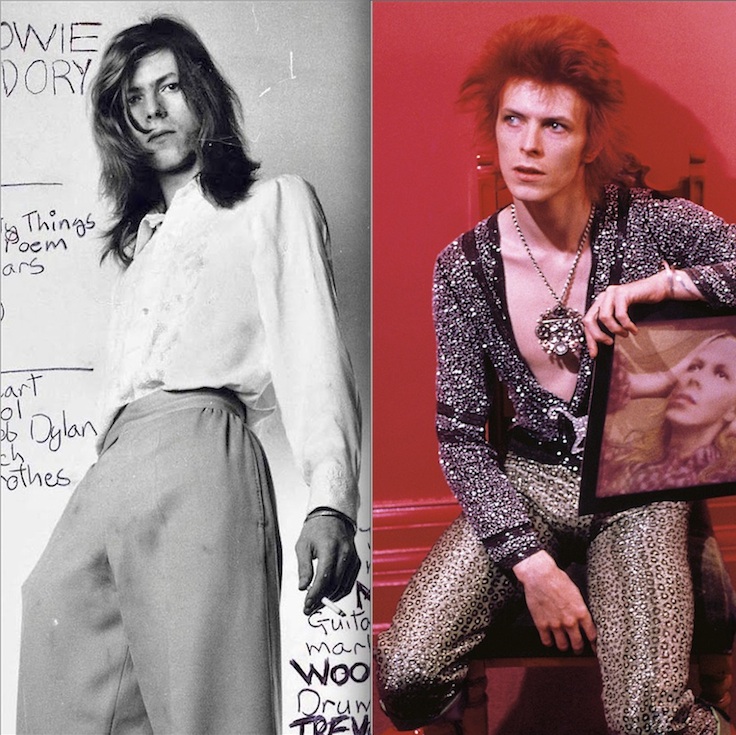
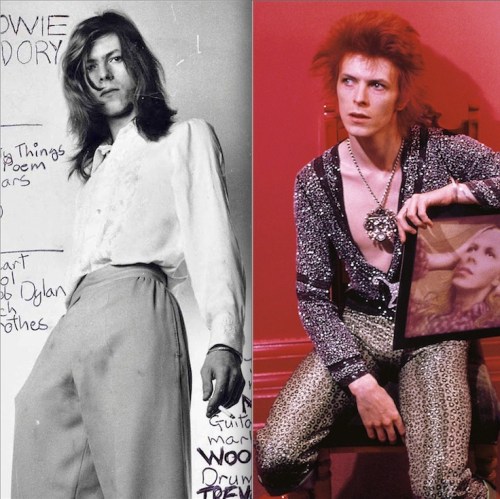
Bowie’s search for identity: the hippy look for the Hunky Dory sleeve 1971 and red-haired alien for Space Oddity 1972. (Photos by Brian Ward and Mick Rock)

WHAT AN EYE-OPENER! Nine failed bands in ten years of struggle before David Bowie emerged as a star. “He was no Marcel Marceau,” said his mentor and lover Lindsay Kemp of David’s attempts at mime. Saturday’s TV doc Bowie Finding Fame directed by Francis Whately was chock-full of jaw-droppingly frank evaluations by all his pals and workmates from his earliest days in music. Among the kindest was his girlfriend in 1968 Hermione Farthingale who said: “He was actually 21 and looked about eight. . . He wasn’t lost, but he wasn’t found either”. For 90 minutes Bowie’s own voiceover was disarmingly full of insight too and this episode, the third in Whately’s consummate trilogy for the BBC, proved probably the‬ most moving of all.

And today comes a thorough and informative appreciation of this the latest landmark documentary about Bowie’s early life in a review published by Andy Polaris, Eighties singer with Animal Nightlife, at his website APolarisView. As a fan utterly in thrall at a formative age to Bowie’s charisma, Andy brings personal insights to the final doc, which follows on from David Bowie: Five Years (2013) and The Last Five Years (2017), both being repeated live tonight from 11.15pm (despite the confusion in newspaper listings guides), and subsequently viewable on iPlayer.

Andy also adds further essential points of reference to the Bowie story omitted from the new biopic, possibly because, as its series consultant and Bowie chronicler Kevin Cann has explained this week, the production team ultimately had to exclude masses because of time limitations: “Sadly there are a few fabulous interviews we made that we couldn’t fit in – all important in their own way. . . At one point we had close on a three-hour edit. We were basically overwhelmed with options at times – and that’s exactly why future generations, I’m sure, will never be bored of this man’s immense talent. He will never cease to impress.” Another gem they discovered was the complete Russell Harty TV interview from 1973: “. . . the whole Bowie section, interview and song performances. Even though ITV erased their original master a year or two after original broadcast, the recording we have still belongs to them, so its immediate future is yet to be decided.”

➢ Meanwhile here’s an excerpt from Andy’s blog
APolarisView where he reviews Saturday’s superb doc,
Finding Fame, which starts in the mid-Sixties:
Swinging 80s, Andy Polaris,TV review, David Bowie Finding Fame,,singer,pop music,

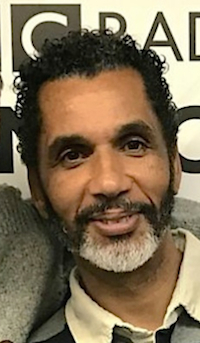
Polaris: surprised

I came away admiring Bowie more as an artist due to his single-minded pursuit to achieve his goal and establish a career in the arts. Eleven years (which brought massive cultural changes generally) and nine different bands failed to launch his career. With such limited rewards most people would have fallen at the second or third hurdle and contemplated a different choice of career. A lot of the bands I had heard of, but the film surprised me by exhuming the music of Riot Squad (a name sounding more like a later oi/skinhead band) where he spent eight weeks as their singer in 1967.

Bowie learned quickly to jettison anyone or thing that stood in the way of his mission and made sure that he was front and centre of the action. Early associates talk of how he was the driving force behind stage performances, style and presentation and how to stand out from the crowd.

Whately’s biopic marks the first time I can remember hearing about the inspiration for Letter to Hermione (a beautiful song on Space Oddity) in a filmed interview where his former girlfriend talks candidly about their love affair and the aftermath of their break-up. In a rare moment of personal confession it reveals the crushing effect it had on David at the time and he wanted her to forever realise the hurt. . . / Continued at APolarisView

➢ Bonus clips at the BBC’s programme website:
Of the surplus footage researched for Finding Fame, Kevin Cann reports that My Death survives in full, as does the whole interview. As also does probably 90% of the 1970 Glastonbury set. “Just in case you haven’t seen them, here are some of the brief edits that came out along the way. There are many more and I hope, over time, more is made available.”

WHAT THE TV CRITICS SAID OF FINDING FAME

➢ “Whately arguably does get closer to who the flesh and blood David Jones really was than anyone has previously, largely thanks to securing interviews with an elusive cousin and a just as elusive first love” – The Arts Desk

➢ “Still think of Bowie as the last word in cool? You’ve obviously forgotten his novelty single about gnomes, his dire mime days… and his cover of Chim Chim Cher-ee” – Guardian TV review

➢ “The BBC’s ‘talent selection group’ had dismissed Bowie as ‘devoid of personality’ (ah, the irony). Yet Bowie doubled down and worked harder” – The Times review

➢ “One of the most miraculous things about Bowie is that he didn’t wind up as a drama teacher in Bromley” – Sunday Times Culture

➢ “Fascinating insight into the young singer’s quest for fame and his evolutionary struggle to burst out of suburbia” – The Telegraph review

➢ View David Bowie: Five Years (2013) at the iPlayer

➢ View David Bowie: The Last Five Years (2017) at the iPlayer

FRONT PAGE

➤ Thanks, Steve, for my invitation to the Swinging 80s

Blitz Kids, New Romantics, Observer Music Magazine, Derek Ridgers,Spandau Ballet, Steve Dagger, Steve Strange, Tipping points,London, Media, Politics, Pop music, Swinging 80s,,

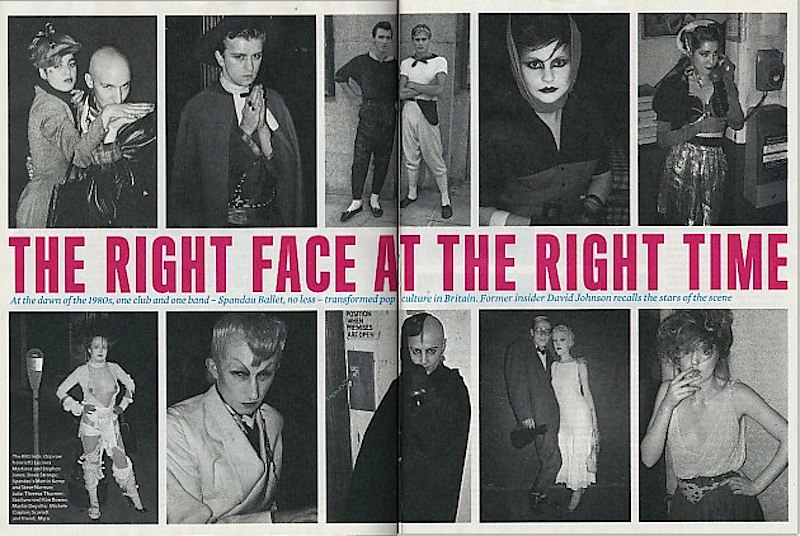
The Observer Music Monthly, Oct 4, 2009. Pictures © by Derek Ridgers

MARKING THE FOURTH ANNIVERSARY
OF STEVE STRANGE’S DEATH

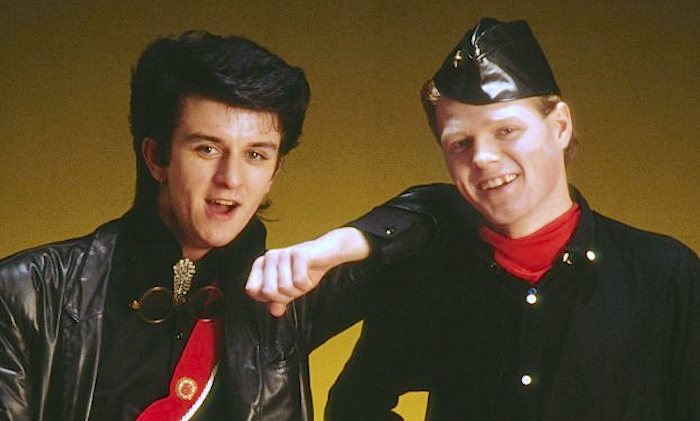
WHEN MY PHONE RANG IN JANUARY 1980, little did I realise its message meant: “Put out the cat. You’re coming to the party of your life.” The voice on the other end spoke without pausing: “My name’s Steve Strange and I run a club called the Blitz on Tuesdays and I’m starting a cabaret night on Thursdays with a really great new band…. they combine synthesised dance music for the future with vocals akin to Sinatra, they’re called Spandau Ballet and they’re going to be really big. . .”

➢ Click through to continue reading Yours Truly’s eye-witness account of Spandau Ballet, the Blitz Kids and the birth of the New Romantics at The Observer Music Monthly

➢ Elsewhere at Shapers of the 80s:
The Invisible Hand of Shapersofthe80s draws a selective
timeline for the break-out year of 1980

FRONT PAGE

➤ Four years on: How the Blitz Kids paid magnificent tribute to Steve Strange

On the fourth anniversary of Steve Strange’s passing
(not to mention the 40th anniversary of his Tuesday club-night
opening at the Blitz), how better to remember the man who revolutionised London nightclubbing than with the massive collection of tributes assembled here at Shapers of the 80s
from every significant Blitz Kid the day after Steve died…

1978, when Steve Strange teamed up with Rusty Egan (Photo © Fin Costello/Redferns)

1978, when Steve Strange met Rusty Egan. (Photo © Fin Costello/Redferns)

➢ Previously at Shapers of the 80s:
Read the fulsome tributes to Steve paid by the Blitz Kids here after his sudden death in 2015

Brief tasters. . .
Original Blitz Club deejay Rusty Egan said: “I’m very, very sad and down tonight because I’ve lost an old friend. We had our disagreements but we did have a decade of the best times that anybody could ever have wished for. We made some amazing music, some amazing parties, clubs and fun and friends. Underneath it all he was a good soul. Steve, I’m so sorry I didn’t get a chance to say I still love you.”

Chris Sullivan, who ran Soho’s Wag Club: “We were both flamboyant club-running Welsh dandies but were never rivals. Steve had too much dignity for that. We were friends and remained so for the rest of his life. And I can say that Steve, despite quite a few hard years, never lost that that spark, humour or joie de vivre, was forever stylish and was always a pleasure to see.”

Princess Julia, writer and deejay: “Getting dressed up, going out and getting noticed… Steve was head of a subculture the likes of which perhaps we will never see again.”

Kim Bowen, stylist, onetime Queen of The Blitz: “Rushing enthusiasm, involving everyone, creating insane parties going round and round on the Circle Line. Some truly bad outfits (his not mine.) Shockingly, ‘Kim, will you be my official girlfriend?’ ”

And many, many more delicious anecdotes…

FRONT PAGE