Tag Archives: David Bowie

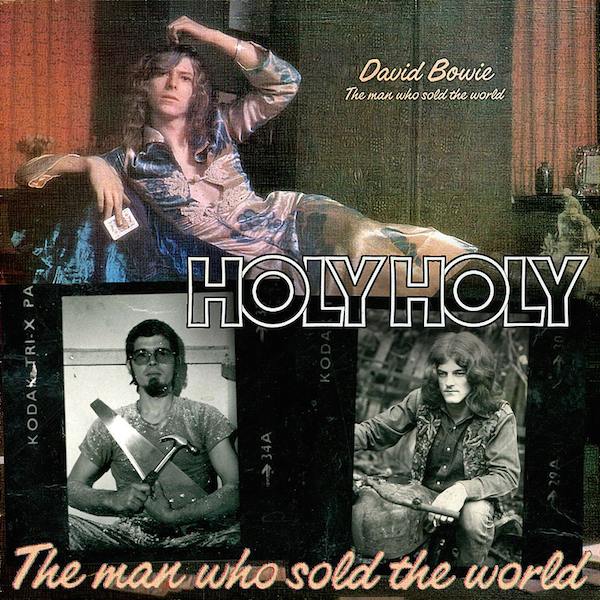
➤ The non-Bowie tribute super-duper group Holy Holy to stage The Man Who Sold The World

Tony Visconti, Woody Woodmansey , Holy Holy, The Man Who Sold The World,David Bowie,album, live concert,UK, pop music

TMWSTW: Bowie’s ambitious album to be updated in live performance by Tony Visconti and Woody Woodmansey’s band Holy Holy

➢ David Bowie’s website announces:
Tony Visconti and Woody Woodmansey perform David Bowie’s classic The Man Who Sold the World album with supergroup Holy Holy. Keep reading for further details of this and Holy Holy’s debut 45 with a Bowie cover on the B-side, not to mention a few words from a clearly excited Tony and Woody regarding the event. [Today’s update: After the Sept 17 London gig, a second performance is announced for Sheffield, Sept 18.]

David Bowie’s seminal album The Man Who Sold the World, produced by Tony Visconti, was recorded in 1970. It is unusually sonically heavy and dystopian for a Bowie album, with lyrical themes including annihilation and a totalitarian machine. The sound combines riff-laden heavy rock with futurist synth sounds and Visconti’s innovative production techniques.

Tony Visconti says: “I’ve rarely played anything as ambitious and demanding as the music of that great batch of songs conceived by David Bowie. With Woody Woodmansey and Mick Ronson, two of the finest musicians I’ve had the pleasure of recording and playing with, we set out to create something both new and classic, we called it our Sgt. Pepper. David gave us a chance to bring our unique talents to the table and we made up our parts within David’s framework. Mick forced me to listen to Jack Bruce, however, and told me ‘That’s what great bass playing was all about’. I got it, lead bass playing – as a guitarist this came natural to me. With David as our charismatic frontman we were Young Turks determined to spin heads and change the world of music… / Continued at davidbowie.com

Holy Holy, The Man Who Sold The World,David Bowie,album, live concert,UK, pop music,Malcolm Doherty, Steve Norman,

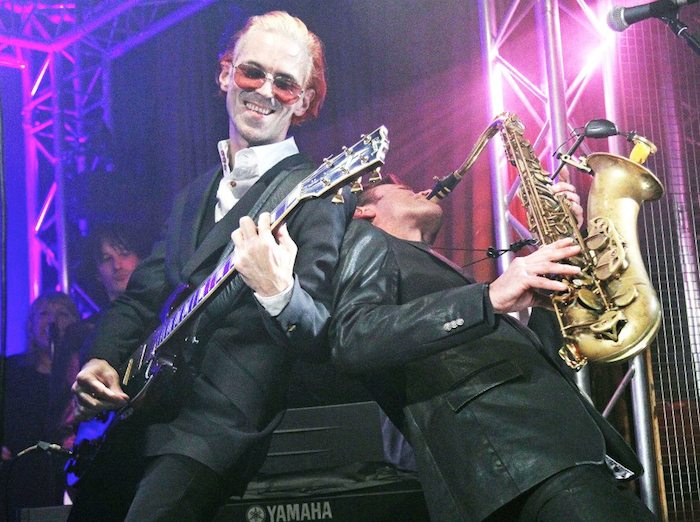
Holy Holy at Peckham Liberal Club last December: Malcolm Doherty on guitar and Steve Norman on sax. Photograph © Marilyn Kingwill

➢ A few tickets remain for Holy Holy’s TMWSTW on Sept 17 at The Garage, London
➢ Buy tickets for Holy Holy’s second performance on Sept 18 at the O2 Academy, Sheffield
➢ Update 5 June: more dates added, for Glasgow and Shepherd’s Bush Empire, plus a live discussion about the Bowie album at the ICA

Tony Visconti on bass, and Woody Woodmansey on drums, will be joined by this stellar Holy Holy line-up:
Glenn Gregory (Heaven 17), lead vocals
Steve Norman (Spandau Ballet), sax, guitar, percussion and vocals
Erdal Kizilcay (David Bowie, Iggy Pop, Freddie Mercury), keyboards and vocals
James Stevenson (Generation X, Scott Walker, Gene Loves Jezebel), guitar
Paul Cuddeford (Ian Hunter, Bob Geldof), guitar
Rod Melvin (Ian Dury, Brian Eno), piano
Malcolm Doherty (Rumer), 12-string guitar and vocals
Lisa Ronson (A Secret History), vocals
Maggi Ronson backing vocals and recorder
Hannah Berridge Ronson backing vocals, recorder and keyboards

➢ Bowie collaborators Woody Woodmansey and Tony Visconti will lead a 12-strong ensemble, says The Guardian:
Woodmansey said the time was right to revive the album that first brought him, Visconti and Bowie together, and that it would be a fitting tribute to Mick Ronson, the guitarist and musical genius behind Bowie’s most successful run of albums, who died in 1993. The Man Who Sold the World was the first album Mick Ronson and I played on, our first even in a proper London studio, yet it never got played live,” Woodmansey said. “It was the forerunner of what we could do sound-wise, and we just let rip. We spent three weeks recording [it] because we were creating the songs as we went… / Continued at Guardian Online

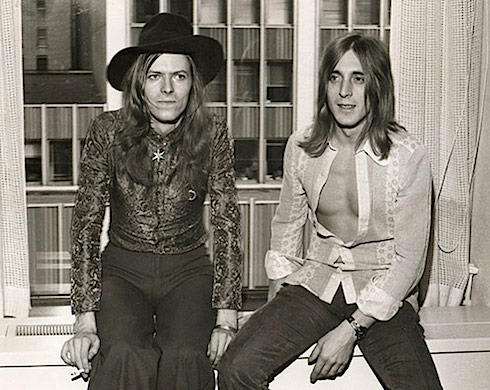
David Bowie, Mick Ronson, 1971,

The day they signed the deal for Hunky Dory in 1971… In a band called Hype, Bowie, Visconti and Ronson (right) created a sound that led to The Man Who Sold the World. And that meant the future was hunky-dory

➢ At Facebook Spandau Ballet’s Steve Norman confirms: “And if that’s not enough, there’s a brand new track scheduled for release on the day of the gig, We Are King. I can’t wait!” A little bird says Steve himself wrote it as the Holy Holy debut single, backed with their cover version of Bowie’s Holy Holy.

❑ Not forgetting possibly the definitive performance of the title track The Man Who, with Klaus Nomi. This thrillingly exact video is (for rights reasons) available to view only in the V&A’s touring exhibition, Bowie Is, which is currently at Martin-Gropius-Bau, Berlin, Germany, until August 10, later visiting Chicago and next year Paris.

➢ Previously at Shapersofthe80s: Bowie drags up in the Mr Fish “man-dress” that appears on the sleeve for The Man Who Sold The World

➢ Previously at Shapersofthe80s: How Bowie defined the difference between glam and glitter

FRONT PAGE

➤ Toasting the Blitz Kid dynamos who have driven the success of Shapers of the 80s

rel="nofollow"

Blitz Kids as stars of David Bowie’s Ashes to Ashes video in 1980: from the left, Steve Strange, Darla Jane Gilroy, Elise and Judi Frankland. When they got back to London after filming, they all went clubbing. Video © 1983 Jones Music / EMI Records Ltd

◼ SHAPERS OF THE 80S TELLS THE DEFINITIVE STORY of a subcultural revolution in British music and style 30 years ago. Its detonator was a youthful blast of impossible trendiness and its stars didn’t call themselves New Romantics, or the Blitz Kids – but other people did. This site gathers together the eye-witness journalism and photography of one observer who knew a good time when he saw one and was published in the coolest titles of the day.

Now in its fifth year, this site has attracted a total of 722,500 views since its launch, according to year-ending WordPress stats. The figures also identify the 20 most widely read items out of more than 600 posted here. Most of these pieces were first published back in the day, but seven of the Top 20 items reflect the continuing interest expressed through the recent 80s revival. In many ways, London is again displaying all the symptoms of being the world’s most swinging city, as it was in the 60s and the 80s, when there were a galaxy of reasons to hit the town every single night of the week.

THE 20 MOST VIEWED POSTS AT SHAPERS OF THE 80S

1  ➢ The Blitz Kids — 50 crucial nightclubbers who
set the style for a decade

2  ➢ The key men in Boy George’s life, but why has TV changed some of the names? (2010)

3  ➢ Golden rules for keeping Studio 54
ahead of the pack (1981)

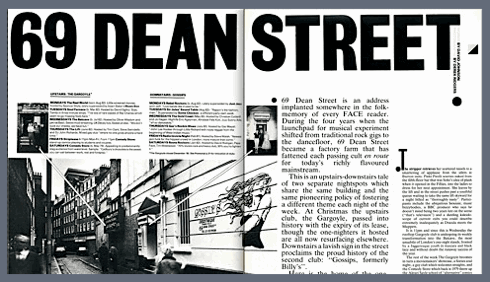
4  ➢ 69 Dean Street and the making of UK club culture – birth of the once-weekly party night (1983)

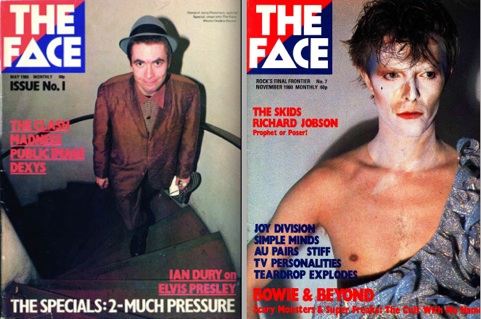
The Face, magazine, May 1980, launch, Jerry Dammers, David Bowie, The Cult With No Name, New Romantics

The difference seven months made: In May 1980 The Face launched with Jerry Dammers of the Specials on its cover. By November the new direction was Bowie plus a feature on The Cult With No Name, as the New Romantics were first known

5  ➢ The Face and other power brokers of the fourth estate — a new media language for a new decade (1980)

6  ➢ First Blitz invasion of the US — Spandau Ballet and the Axiom fashion collective take Manhattan by storm (1981)

Blitz club, London 1979, Wilf, Stephen Linard, 2010, Worried About the Boy, Boy George, Daniel Wallace,Douglas Booth

Left, real Blitz Kids – right, the TV version… George’s boyfriend Wilf and fashion student Stephen Linard in 1979 (picture, Andy Rosen)… Daniel Wallace as a Linard lookalike and Douglas Booth as Boy George in Worried About the Boy, 2010 (BBC)

7  ➢ How real did 1980 feel? Ex-Blitz Kids give verdicts on the 2010 TV drama about Boy George’s teen years, Worried About the Boy

8  ➢ Hockney’s new vision of the world — Britain’s favourite artist reveals his insights into cubism (1983)

9  ➢ Paradise Point: live leaders of a new Brit pop blitz (2010)

i-D 1980

Seminal spread in i-D issue one: the straight-up style of photography is established with, at left, one then unknown New Romantic and, right, one punkette. Photographed on the King’s Road by Steve Johnston

10  ➢ ‘i-D counts more than fashion’ — launch of the
street-style bible in 1980

11  ➢ 19 gay kisses in pop videos that made it past the censor

12  ➢ Who’s who in the New London Weekend — key clubs that set the capital swinging (1983)

13  ➢ Aside from the freaks, George, who else came to your 50th birthday party? (2011)

© Shapersofthe80s

Londres est arrivée au Palace, 1982: classic set, nouveaux styles. Pictures © by Shapersofthe80s

14  ➢ Steve Strange takes fashion to the French — six British designers rock Le Palace in Paris (1982)

15  ➢ Posing with a purpose at the Camden Palace — power play among the new non-working class (1983)

16  ➢ Who are the New Romantics? — A mainstream deejay’s guide published by Disco International (1981)

Spandau Ballet, 1980

Houseband of the Blitz club: at the London megaclub Heaven Spandau Ballet play their tenth live date on 29 Dec 1980. From left, Steve Norman, Tony Hadley, Martin Kemp, Gary Kemp, plus John Keeble on drums. © Shapersofthe80s

17  ➢ They said it — landmark quotes about the decade of change by the people who made it happen

18  ➢ Rich List puts George Michael top of the popstars from the un-lucrative 80s (2010)

19  ➢ Comeback Shard comfy as ‘Auntie Sade’ — an enduring star who made 2010 her own

20 ➢ Robbie Vincent: 35 years as master of hot cuts and getting our “rhythm buds” going (2011)

FRONT PAGE

➤ Essential pop-cultural landmarks reported here at Shapers of the 80s

Andrew Ridgeley,George Michael, Wham Rap, video, Face magazine, Club Culture,

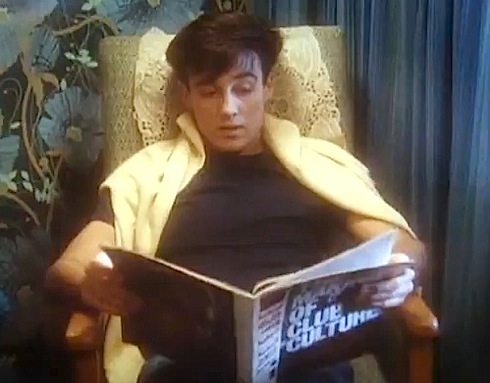
Click pic to open the Wham Rap! video in another window … “Man or mouse” Andrew Ridgeley establishes his clubbing credentials – along with sidekick George Michael – in the opening shots of the Wham! video by reading this very Face cover story on Club Culture that you’re about to read!

THE MOST READ FEATURE ARTICLE AMONG 720,000 VIEWS SINCE THE LAUNCH OF SHAPERS OF THE 80s

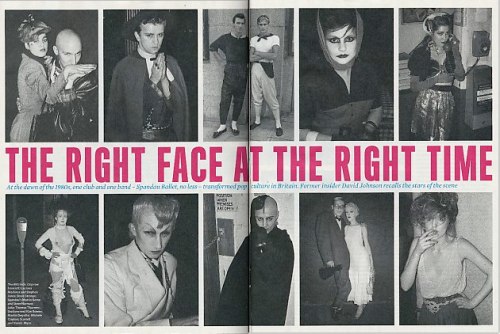
➢ 1983, The Making of UK Club Culture — Definitive Face cover story by yours truly seen here in the Wham Rap! video. This account of how London nightlife had become an international magnet was first published as “an upstairs‑downstairs tale of two key nightspots” in The Face No 34 in February 1983. Photography © by Derek Ridgers. Reprinted in The Faber Book of Pop, 1995; and in Night Fever, Boxtree, 1997

69 Dean Street, Soho, club culture, The Face magazine, London, 1980s, clubbing, nightlife,Billys, Gargoyle,Red Studio,Blitz Kids

From The Face, February 1983

THE ORIGINAL HISTORY OF THE BLITZ KIDS

The Observer Music Magazine. Pictures © by Derek Ridgers

The Observer Music Monthly, Oct 4, 2009. Pictures © by Derek Ridgers

➢ Spandau Ballet, the Blitz Kids and the birth of the New Romantics — The much-plundered story originally researched by Shapers of the 80s tells who did what to make stars out of a club houseband, change the rhythm of the UK charts — and ultimately rejuvenate the British media. The obsessive fashionistas behind one small club in London in 1980 went on to dominate the international landscape of pop and fashion, while putting more British acts into the US Billboard charts than the 1960s ever achieved.

EARLY 80s REPORTS REVISITED

➢ How three wizards met at the same crossroad in time — an inside scene-setter on the forces shaping the Swinging Eighties

➢ 1980, Strange days, strange nights, strange people: at The Blitz a decade dawns

➢ 1980, One week in the private worlds of the new young: London blazes with creativity

➢ 1980, Shapersofthe80s tells how Duran Duran’s road to stardom began in the Studio 54 of Birmingham, UK

➢ 1981, Birth of Duran’s Planet Earth … when other people’s faith put the Brummies into the charts

Romance blossoms: Drummer Jon Moss gives George O’Dowd a peck at Planets club in July 1981 way before their band Culture Club existed. Photographed © by Shapersofthe80s

➢ Three key men in Boy George’s life – In 2010 the BBC turned the pop star’s teens ’n’ twenties into a 90-minute drama of foot-stamping, chair-throwing, cry-baby tantrums over his self-confessed “dysfunctional romances”, all of which he had documented in his eye-wateringly frank 1995 autobiography, Take It Like a Man. Shapers of the 80s summarises George O’Dowd’s stormy lovelife.

➢ Ex-Blitz Kids give their verdicts on the TV drama Worried About the Boy – During and after its broadcast in 2010, this authoritative mixture of opinions on the Boy George story reshaped the accepted clichés about the Blitz Kids.

Chris Sullivan, club-host, deejay, Wag club, Blue Rondo, pop music,We Can Be Heroes, youth culture,

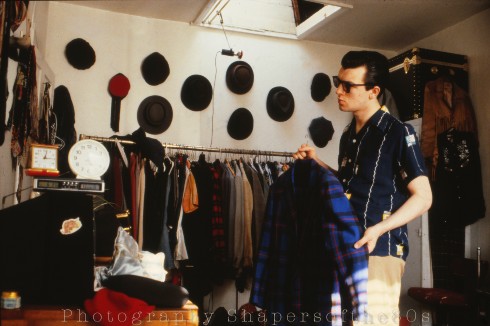
At home in Kentish Town Chris Sullivan chooses the right zootsuit for today’s mood: his wardrobe is legendary, his taste impeccable, and his influence immeasurable. Shapersofthe80s shot this for his first Evening Standard interview in June 1981

➢ 1976–1984, How creative clubbing started and ended with the 80s – “We were all kids,” says Chris Sullivan who would eventually host the Wag, the coolest club in town, for 19 years. “We went out and had a go. Empowerment is what’s important about this story.”

Photocall: Spandau Ballet, Richard Burgess and assorted Blitz Kid designers gather for the press conference before their fashion-and-music shows in New York. Yes that is Sade towards the far right. Photograph © by Shapersofthe80s

➢ 1981, First Blitz invasion of the US – 21 Blitz Kids take Manhattan by storm with a fresh fashion show and the live new sound of London. Eye-witness words and pix by Shapers of the 80s

ROMANTIC REVIVAL OF THE NOUGHTIES

Sade 1983

Wow! Then and now: Sade backstage in August 1983 while still seeking a recording contract and, right, as shot to launch her 2010 album. Vintage picture © by Shapersofthe80s

➢ 2010, Shapers of the 80s finds comeback Shard comfy as ‘Auntie Sade’ – Having wowed the 80s clubbing scene, in 2011 Sade’s band won a Grammy award for Best R&B Performance By A Group.

➢ 2009, Onstage, Spandau Ballet’s Hadley and Kemp finally get huggy in a mighty Reformation – Shapers of the 80s follows the reunion of the band who wrote the new rules for pop in the Swinging 80s.

WE ARE ALL BOWIE’S CHILDREN NOW

David Bowie, Starman, 1972, Top of the Pops, tipping point, BBC

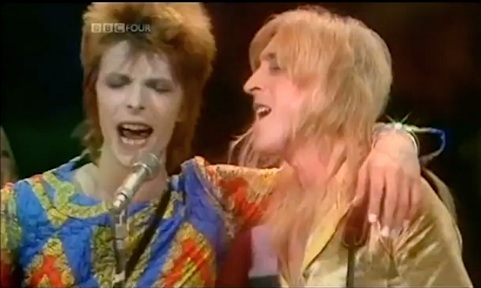
The moment the earth tilted July 6, 1972: During Starman on Top of the Pops, David Bowie drapes his arm around the shoulder of Mick Ronson. Video © BBC

➢ 40 years since “I picked on you-oo-oo”! July 6, 1972 saw the seminal pop moment — David Bowie’s first appearance on Top of the Pops as Ziggy Stardust, the day he created the next generation of popstar wannabes

➢ Where to draw a line between glitter and glam – defining what separates the naff blokes in Bacofoil from starmen with pretensions

FRONT PAGE

➤ RIP Lou Reed… Today we lost another legend

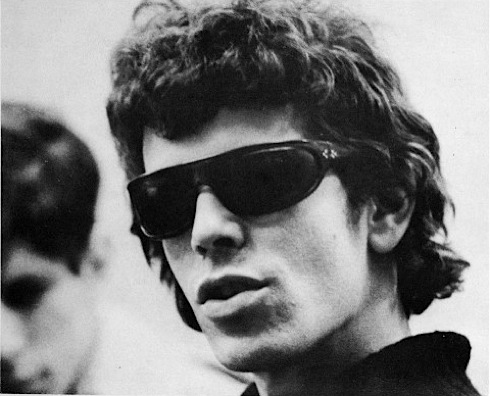
Lou Reed, Velvet Underground

Lou Reed on his bare-bones guitar style: “One chord is fine. Two chords are pushing it. Three chords and you’re into jazz”

“He was a master” – David Bowie today
on his old friend

➢ Lou Reed, Velvet Underground leader and rock pioneer
who helped shape nearly fifty years of rock music
– Rolling Stone tribute, Oct 27:

After splitting with the Velvets in 1970, Reed traveled to England and, in characteristically paradoxical fashion, recorded a solo debut backed by members of the progressive-rock band Yes. But it was his next album, 1972’s Transformer, produced by Reed-disciple David Bowie, that pushed him beyond cult status into genuine rock stardom. Walk On the Wild Side, a loving yet unsentimental evocation of Warhol’s Factory scene, became a radio hit (despite its allusions to oral sex) and Satellite of Love was covered by U2 and others. Reed spent the Seventies defying expectations almost as a kind of sport. 1973’s Berlin was brutal literary bombast while 1974’s Sally Can’t Dance had soul horns and flashy guitar. In 1975 he released Metal Machine Music, a seething all-noise experiment his label RCA marketed as avant-garde classic music, while 1978’s banter-heavy live album Take No Prisoners was a kind of comedy record in which Reed went on wild tangents and savaged rock critics by name… / Continued at Rolling Stone

“Lou Reed… said that the first Velvet Underground
record sold 30,000 copies in the first five years.
But that was such an important record for
so many people, I think everyone who bought one
started a band!” – Brian Eno, 1982

➢ Alexis Petridis says Reed was capable of writing perfect pop songs – in Monday’s Guardian:

Their 1967 debut The Velvet Underground And Nico is the single most influential album in rock history. Certainly, it’s hard to think of another record that altered the sound and vocabulary of rock so dramatically, that shifted its parameters so far at a stroke. Vast tranches of subsequent pop music exist entirely in its shadow: it’s possible that glam rock, punk, and everything that comes loosely bracketed under the terms indie and alt-rock might have happened without it, but it’s hard to see how…

… the four gruelling songs that make up side two of his 1973 concept album Berlin are quite astonishing expressions of coldness and cruelty… [but] he could write songs that were impossibly moving, that spoke of a tenderness and sensitivity: the lambent, peerless Pale Blue Eyes; Halloween Parade’s heartbreaking lament for New York’s gay community, devastated by Aids; his meditation on death, Magic And Loss… / Continued at Guardian Online

➢ Reed’s own website with his last portrait
taken earlier this month

Click any pic to launch carousel

➢ In this firey Telegraph interview from 2011, Reed and Metallica defended their controversial collaboration album Lulu to Neil McCormick

➢ “Lou Reed is to 1970s New York as the poet Baudelaire was to 1850s Paris” – ft.com

➢ Wide-ranging 1995 conversation between novelist Paul Auster and Lou Reed, who reveals his rarely seen good-humoured side – online at Dazed & Confused

➢ Punk old-timer Legs McNeil on how, despite acting like a grump, the Velvet Underground front man was beloved – The Daily Beast

➢ “Second only to Bob Dylan in his impact on rock and roll’s development” – Variety

Lou Reed, Mick Rock,photography

Lou Reed and his favourite British photographer Mick Rock in 1975

➢ Lou Reed and Mick Rock were a great double act: The Quietus talks to them about their enduring relationship and a new book of photos, 2013

➢ Mick Rock talks to Galore magazine about the limited edition of Transformer, his photobook of Lou Reed pix from 1972 to 1980 (Genesis Publications)

FRONT PAGE

➤ No flash, no mob, as Occupy Bowie proves a damp squib

Occupy Bowie , V&A, exhibitions, fans,flash mob,David Bowie

More like Freddie Starrdust: The Bowie Experience tribute act outside the V&A yesterday in shabby Earthling coat and filthy lace. Photograph by Andy Polaris

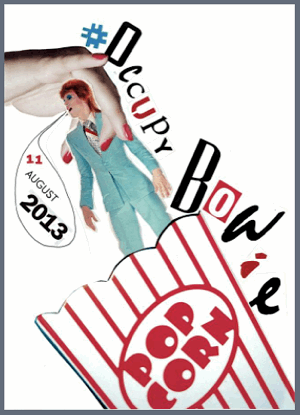
Occupy Bowie , V&A, exhibitions, fans,flash mob,David Bowie❚ “CALLING ALL MISFITS, ANDROGYNES, glam rockers, goblin kings, scary monsters and super creeps: you are invited to a gathering on the steps of the V&A on the last day of the Bowie exhibition, 11 August. Together we will create a tableau vivant.” This call to arms by an ad hoc faction calling itself Occupy Bowie posted a tortuous Tumblr page that dared to translate this difficult French phrase as a “living picture” and illustrated several examples from a long tradition blah blah of motionless, silent models in poses plastiques blah blah often theatrically lit blah blah.

Another page at Facebook declared: “In honour of music, art and David Bowie, it will be a spectacle. It is a participatory event for visual extremists of all stripes. Don’t call us a flash mob.”

As it happens, this tribal turnout by a few dozen fans yesterday afternoon proved to be less a flash mob, more a naff huddle. There was a singalong to Rebel Rebel, but no truly glam Bowie persona in sight, what with the low-rent mimes and the generally jumble-sale approach to costume topped with nylon wigs that could have come from Ridley Road Market. By midnight we could count only three photographs of this act of mass homage posted online, then a couple more today.

Click any pic to launch carousel

As it happens, Andy Polaris, who lives in East London, claims he was “passing by” the V&A in West London at 3pm and snapped the faithful engaged in their mystical rites. His verdict: “It looked more Freddie Starrdust than Ziggy Stardust.” This referred to the shabby Earthling playing guitar who is known as The Bowie Experience, a professional tribute impersonator wearing the least glam costume of any Bowie incarnation. Polaris said: “The women looked a lot better than the men and the girl with the dark hair and Aladdin streak was the best.” Funny, that. Even the apparent ringleaders themselves, University of the Arts types subtly disguised on Facebook as Occu PyBowie, let the side down in scruffy old jeans. They’d never have let each other get away with that in 1973, let alone the Blitz in 1980.

Brilliant sunshine put paid to any “theatrical lighting” to compare with the photographs of Ryan Schude or the Society of Beaux-Arts Architects Ball, 1931, that Occupy Bowie had cited as inspiration on that ambitious Tumblr page. Better luck at the exhibition’s Toronto opening in September, lads.

FRONT PAGE