Category Archives: Youth culture

1980 ➤ The day Spandau signed on the line and changed the sound of British pop

Spandau Ballet, Virginia Turbett,Chrysalis,Steve Dagger, New Romantics

The way they wore: Spandau Ballet minutes before signing their record record deal in October 1980. Photographed at London’s Waldorf Hotel © by Virginia Turbett

◼ AS THE COOLEST CULT LEADERS OF 1980, Spandau Ballet’s songwriter Gary Kemp claimed: “We want the band to be at all times the most contemporary statement we could possibly make on modern London.” In the face of the post-punk new wave, it took courage to decide to play fresh sexy dance music in a corporate landscape dominated by adult-oriented rock supergroups. In the event, the five boys from the Angel, Islington, quickly assumed the role of houseband to the Blitz club and by placing the bass guitar and the bass drum at the front of the sound made it hip once more to play pop.

Spandau Ballet were being managed by their onetime schoolmate Steve Dagger, aged only 23, while three record labels competed to secure them. On this day 30 years ago they signed a deal with Chrysalis Records and walked into the future clutching an advance cheque for £85,000 — at the time, a record sum for an untried band that had played all of eight bookings and had refused to cut demo discs.

“We were strong, it was a real gang, a real team mentality. It was: We’re Spandau Ballet, who the f*** are you?” — John Keeble, Spandau drummer

By breaking all the industry rules, Spandau triggered a fashion and dance music movement that had been evolving in the nightclubs of Britain. At the very moment that the Blitz closed its doors, the press dubbed their followers the New Romantics, and a slipstream of more than 100 new image bands was born. The new sounds and new styles of this, the last of the Babyboomer generation, went on to dominate the international landscape of pop and over the next three years put more British acts in the US Billboard charts than the 1960s ever achieved.

ELSEWHERE ON SHAPERS OF THE 80s

➢ Oct 16, 1980: One week in the private worlds of the new young
➢ Birth of the New Romantics and the band who made it hip to play pop
➢ How the rhythm of the pop charts changed

Spandau Ballet, The Makers,The Cut,Roots, Dame Alice Owens

Tony Hadley fronts The Makers: Spandau as a school band playing to the fourth form at Dame Alice Owens — grabbed from video

➢ VIEW ♫ Early footage of Spandau Ballet in the Young Guns documentary from 2000
➢ New Romantics: I Was There — ex-Sounds hackette Betty Page’s recollections for Record Collector, written with the benefit of hindsight in 2004
FRONT PAGE

1976 ➤ When Iain met Stephen, London traffic stopped and St Martin’s stood still

❚ ON CENTRAL ST MARTIN’S ALUMNI PAGES, Iain R Webb — later CSM professor and fashion editor of The Times newspaper — recalls the unforgettable instant he arrived there as a student and clapped eyes Stephen Jones, who this month celebrates his 30 years as milliner to the stars…

Stephen Jones, milliner, Iain R Webb,fashion,St Martin’s School of Art, journalist,

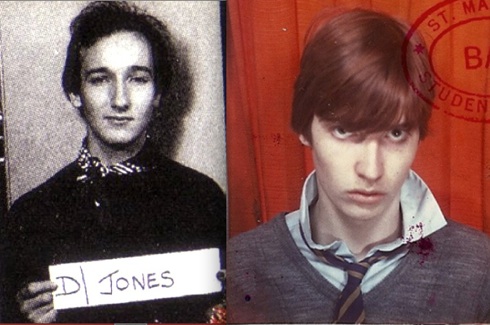
Side-knotted scarf versus thin school tie: despite their differences in 1976, Jones and Webb became firm friends at St Martin’s

“I remember vividly the day I visited St Martin’s School of Art (now Central Saint Martin’s) in the autumn of 1976. Before I even entered the building I was convinced this was the place for me. Standing on the pavement outside, plucking up the courage to go in and wondering if I cut the sartorial mustard wearing a liquorice-thin school tie, plastic sandals and sloppy orange mohair sweater (knitted by my Mum). The doors swept open and out sashayed a boy (or at least I guessed it was a boy) who looked like… well, I wasn’t sure what he looked like, only that I had never seen anyone look like that before. Not in the real world, anyway.

“He was wearing a skinny matelot T-shirt with giant shoulder pads, exaggerated peg-top pants and stiletto-heeled boots. Around his neck was a scarf knotted at the side and the finishing touch (it should have been a clue) was a black beret worn at a very jaunty angle. He looked breathtaking and fearless and was ‘traffic-stopping’. Literally. He was Stephen Jones, later to become the celebrated and much-loved milliner to the stars, from Carla Bruni to Marilyn Manson.

“After a spell of work experience at London couture house Lachasse, where his head was turned for ever under the tutelage of Shirley Hex, for his final collection at St Martin’s in 1979 Stephen created silvery draped cocktail suits, accessorised with turbans featuring peacock feathers. The mood was 1950s couture with a punk attitude. ‘The last two looks were white court presentation dresses worn with broken tiaras with dead seagulls in them,’ he remembers, as adamant today as he was then that creativity is often born out of necessity. If you don’t have a lot of money it forces you to think alternatively. You have to be more creative. Like when I left college I bought hats from Oxfam and reworked them’.”

FRONT PAGE

2010 ➤ Index of posts for Sept

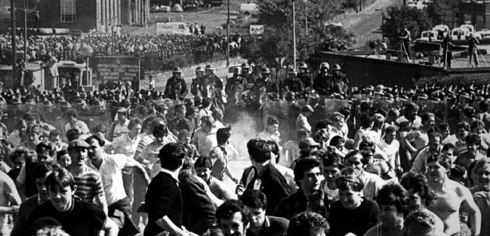
Orgreave, Yorkshire , miners' strike, riot police

Revisiting June 1984: Striking miners start to run as the police line opens to let mounted officers charge the mass picket at Orgreave Coking Plant, South Yorkshire. Photographed © by John Sturrock/Report Digital

➢ 1925-2010: Tony Curtis — for ever hot

➢ In the face of Cowell X-culture, Polhemus discovers the style supermarket afresh

Peter Frampton, David Bowie, schooldays

Peter Frampton today: Bowie’s best friend at school

➢ Six things some people might not know about Bowie

➢ As Station to Station is re-released, Egan discusses Bowie’s legacy: ‘It’s not rocket science and it is music’

➢ Slashed! Wallinger’s knife demonstrates a 25% cut on a Turner masterpiece

➢ Anna declares McQueen a pioneer of dreams and drama

➢ The 1980s: A new history of that most turbulent of decades which sounded a knell for the mining industry

➢ Robinson takes the Cowell shilling — so whose bum is on the throne at Popjustice?

➢ Egghead versus bimbo: Paglia demolishes Gaga

➢ The xx steal away with the Mercury Music Prize … a quiet storm for uncertain times

➤ In the face of Cowell X-culture, Polhemus discovers the style supermarket afresh

Street Style, Ted Polhemus, the Book Club, PYMCA,Viva Las Vegas Festival

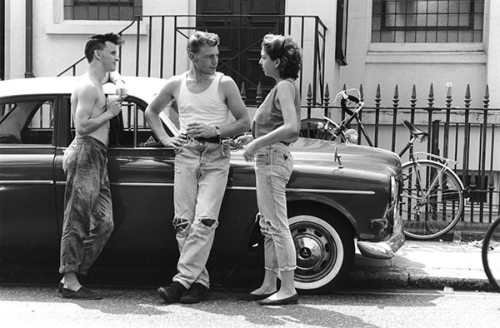
Street cred: Janette Beckman’s cover shot of the rude-boy twins, Chuka & Dubem Okonkwo, shot for The Face in London 1980. Right, two 50s fans at the Viva Las Vegas Festival, USA 2006. Photograph © Tim Scott/PYMCA

❚ IN ITS FIFTH ANNIVERSARY ISSUE, i-D MAGAZINE asked its photo-gallery of People of the 80s to sum up that year, 1985. Shapersofthe80s replied: “It is the year the style supermarket repackaged the previous four as an over-the-counter culture.” What was being signalled was the end of the Swinging 80s, the symbolic sub-cultural “decade” which had seen Soho become the crucible for new sounds and new styles as they broke free from the stadium-rock and post-punk past. 1985 saw a torrent of colour and attitude and tunes drive the mainstream of British youth culture that then came to characterise the “Thatcher decade”, at best personified by Stock Aitken Waterman, and at worst traduced by nightclub impresario Peter Stringfellow.

Ted Polhemus, Street Style, PYMCA

Polhemus as 70s hippie — wardrobe master for Starsky and Hutch, or his idea of irony?

Tonight in Shoreditch, the new London pool of cool, an eponymous exhibition opens to launch an updated edition of Street Style, the 1994 picture book by Ted Polhemus that celebrated the style-tribes which postwar Britain’s class-ridden society excelled at evolving, from mods and rockers, to goths and casuals, to ravers and what he called riot grrrls (which inevitably invoked the dread term bricolage, so much more cultural studies than saying DIY). Publication coincided then with a groovy exhibition around the V&A costume court.

Images and graphics from the new Street Style inevitably feature many of our original Shapers of the 80s, if current Facebook twitterings are any indication. These are being exhibited (Sep 30-Oct 31)  in the former Victorian warehouse in EC2 refurbished as The Book Club. Polhemus’s new publisher is PYMCA, the Photographic Youth Music Culture Archive which was established in 1997 by Jon Swinstead, brains behind Jockey Slut and Sleazenation. His aim was “to create a collection of images that capture the real essence of life as a young person”. PYMCA was launched this spring as a research resource, having teamed up with leading cultural commentators to offer detailed analyses of youth subcultures, music and movements around the world. Swinstead maintains: “PYMCA is both edgy and documentary and the newest material will visually reflect the hottest stuff happening among the youth of today.”

Next month Polhemus, the self-styled “anthropologist, author and photographer extraordinaire”, leads a discussion at The Book Club titled “Supermarket of Style in the 21st century” (Oct 27, tickets £8). This is the theme that introduces his new book and which he calls “his latest theory”. Well, better late than never! The supermarket has certainly entertained us for 25 years but a general consensus agrees that Britain’s youthful creative juices finally ran dry in the noughties as Cowell X-culture came to dominate our televised lives. Presumably Ted has fresh observations to offer…

Rockabilly, Paul Sturridge, Ted Polhemus,Dale Cammack, Susan Cammack

The no-socks “hard times” style promulgated by the itinerant Dirtbox club-nights: The ever-photogenic Paul Sturridge caught in 1984 with Dale and Susan Cammack, plus his Volvo Amazon outside the Chelsea Potter. From the Street Style exhibition at the V&A, photographed © by Ted Polhemus

AT THE EVENT, STURRIDGE CATCHES THE MOMENT . . .

Chuka Okonkwo, Dubem Okonkwo , Theola Sturridge, Street Style

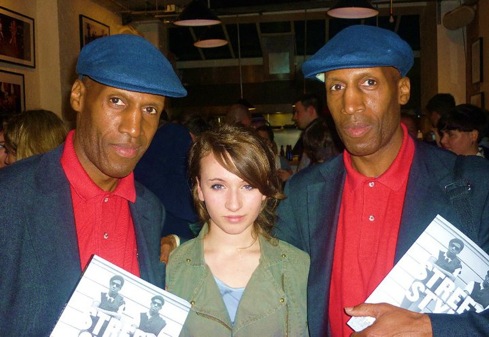
At the book launch: cover stars the Okonkwo twins with Theola Sturridge. Photograph © by Paul Sturridge

Theola Sturridge, Paul Sturridge, Street Style

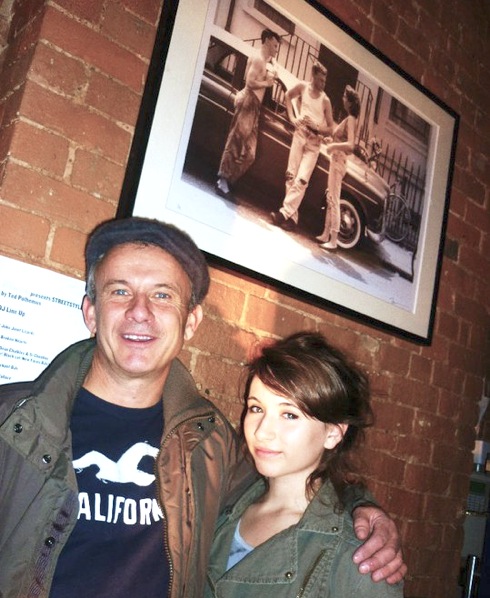
A lifetime later: Paul Sturridge with daughter Theola beneath the photo of him in his “hard times” guise. Photograph © by Paul Sturridge

FRONT PAGE

➤ Egan on Bowie’s legacy: ‘It’s not rocket science and it is music’

Today The Thin White Duke walks tall again — the god, the brand, the signifier — the three-in-one trinity that is David Bowie fired up one of the great transformative albums of the 70s, Station to Station. His 10th in a studio, it is now re-released in special edition 3-CD box set.

Bowie as The Man Who Fell to Earth, a 1976 film by Nicolas Roeg, based on the Walter Tevis novel about a humanoid alien who crash-lands on Earth. © Rex

This month the German journalist Finn Johannsen interviewed the club deejay and co-founder of the Blitz Club, Rusty Egan for the Nokia blog, Sounds Like Me. He discusses Bowie’s seminal role in 70s and 80s music, describes a typical night out at the Blitz, and what today’s clubbers can take from such an innovative chapter of music-making. Here’s a taster…

Rusty Egan, Blitz club

Rusty Egan at the Blitz, 1980: rare pic of him spinning the discs

FJ — David Bowie was always famous for continuously reinventing his career, but did this phase particularly appeal to you?

RE — Bowie’s Berlin years I believe were the foundation of the Blitz club playlist. Via Bowie I found Kraftwerk, and that lead to Neu!, Can, Cluster and Krautrock, as it was called. Bryan Ferry then led to the work of Brian Eno, and his ambient series … All this music lead to the basis of my collection. If you join the dots Bowie, Eno, Iggy, Kraftwerk, Mick Ronson, Lou Reed.

FJ — It is obvious that Bowie was heavily influenced by German experimental groups like Kraftwerk or Neu! How much of them can be found in Low and Heroes?

RE — Massive influences. Bowie is a SONGWRITER. Without songs you have music. The Germans made amazing music without lyrics. It was experimental because of the instruments used and the long, long tracks. Bowie took the basis of this experimental music and the growing feelings evoked by Möbius, Cluster, Can, Neu! and went into Hansa studios by the Wall and with Brian Eno created the Berlin sound. Heroes sung in German as Helden is a perfect example. Six minutes long, but what were the instruments used? Can you hear guitar, bass and drums? Nothing but a long, long tone changing and changing… It’s not rocket science and it is music.

➢ Read the full Egan interview at Sounds Like Me

FRONT PAGE