Category Archives: Clubbing

2020 ➤ Beyond: Learning how to be black and gay and blaze a trail to the future

Shapersofthe80s, black issues, gay issues, film, Beyond, Claire Lawrie,

Beyond director Claire Lawrie, centre: with some of her garrulous cast answering questions after a screening at Central Saint Martins college last year. Andy Polaris in red. (Photo by Shapersofthe80s)

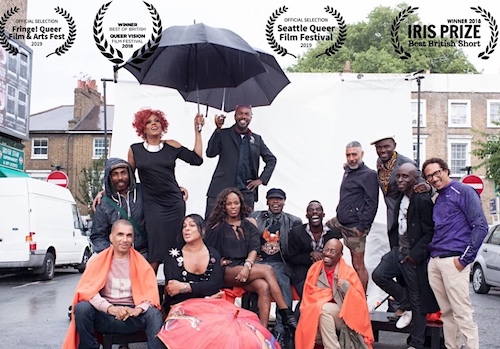
AFTER A STREAM OF EXCLUSIVE SCREENINGS for a poignant and edgy short documentary about growing up black and queer in Seventies Britain, everyone can now view it online. Titled Beyond “There is always a black issue Dear”, the 34-minute film explores black LGBT identities and the ways in which they have influenced the collective history of London’s alternative club, fashion, fine art, dance and music scenes. The cast of ten are long-standing friends of director/photographer Claire Lawrie who helps tell their personal stories when these fans of soul and disco, punks and Blitz Kids found each other’s company in underground clubs.

Over the past year Claire has won a fistful of film-festival awards and, prompted by the coronavirus lockdown, she has posted the full version online, and repeat viewings reward with deeper appreciation.
Black issues, gay issues, film, Beyond, Claire Lawrie,

Photo that inspired the movie Beyond – Click pic to view the film in another window

“To me it’s important now that people
realise that black people were there,
because a lot of the time they
tried to paint us out”
– Andy Polaris

Onetime Blitz Kid Andy Polaris is part of the project and he recalls its origins in this extract from his own website Apolarisview. . .

“ A 2013 exhibition at the V&A museum in London titled Club to Catwalk was instrumental in bringing the collective creative talent of Eighties fashion stalwarts and club luminaries together for a preview party that summer. It was a splendid event, one of the last memorable social events with such a vibrant successful crowd. Among the assembled were Judy Blame, Princess Julia, Andrew Logan, Zandra Rhodes, Body Map, Antony Price, Chris Sullivan and it was the last time I saw Steve Strange (who along with Rusty Egan) had brought us all together at the Blitz Club in 1979.

The visual artist Claire Lawrie was at the V&A and pondered on the omission from the exhibition of gay black talent whose influence had permeated Eighties club culture. Although Jeffrey Hinton’s brilliant cave of projected nightlife photography did feature some of us, Lawrie echoed some of her friends’ frustration that their experience was not reflected in the exhibition. She set about organising an open-call photograph to celebrate a contingent of black talent and arranged for the gathering to be filmed by her friends, Emile Kelly and Kim Mnguni. This was the genesis of something deeper and her award-winning documentary, Beyond “There is always a black issue Dear”, emerged from that event with her as director.

Click any pic of the Beyond interviewees to enlarge all in a slideshow:

Continued: “ Over the next year Claire arranged interviews with ten of the candidates who were filmed on a shoestring. Contributions of archive footage were given by a long list of talented artists, people who, over the years had collaborated with and who wanted to show their respect and love for the cast. These included Pam Hogg, Dick Jewell, Dave Swindells and Nicola Tyson as well as John Maybury, Derek Ridgers, BodyMap, Devon Buchanon and Rankin.

The film adjusts the colour settings of the standard view of black creative lives when telling the story about club culture and its impact in the UK. Featuring ten black queer voices from the diaspora, born in the late Fifties and Sixties in the UK, Guyana and New York, the documentary delves into personal stories of discovery and eventual self-acceptance, looking back at struggles with identity and family and the wider world. The cast features stylist Frank Akinsete, transgender model Winn Austin, international model Roy Brown, make-up artist Kenny Campbell, choreographer Les Child, clubland pioneer Kenrick Davis and his mother Velma “Vee” Davis, nightclub host Nicky Green, gender-fluid performer Lanah Pellay, composer Robb Scott and myself as an original Blitz Kid turned pop singer.

Roy Brown, Black issues, gay issues, film, Beyond, Claire Lawrie

Roy Brown in 1985: poster boy for the Barbican’s recent exhibition on Masculinities. (Photo: Rotimi Fani-Kayode)

In the mid-Seventies and Eighties the UK’s attitudes to both race and gay issues were particularly brutal, endorsed by the anti-gay policies of Thatcher’s government and tabloid sensationalism regarding anything queer, especially later with the arrival of the Aids epidemic. The Seventies were marred by stereotypes of both marginalised groups, joining the sexist and misogynistic tropes in light entertainment and films which set the tone for how the world viewed us and how we viewed ourselves.

This lack of representation and role models forced us to create our own image during our teens, which in some cases was defiantly camp. Instead of allowing bullies to mock us, we accentuated certain behaviour, not just as a direct challenge to the heteronormative majority but against the conservative oppression in society.

Music and fashion were an escape from small-mindedness and even as early teens we were exploring alternatives and the fashionable disco and punk clubs were our laboratories of choice. . . / Continued at Apolarisview

➢ All about the making of Beyond “There is always
a black issue Dear”

➢ Interview with director Claire Lawrie: “These were
people that I looked up to and admired”

➢ On video – Beyond Q&A by RankinFilm after
the July 2019 screening at his studio
FRONT PAGE

➤ Thanks, Steve, for my invitation to the Swinging 80s

Blitz Kids, New Romantics, Observer Music Magazine, Derek Ridgers,Spandau Ballet, Steve Dagger, Steve Strange, Tipping points,London, Media, Politics, Pop music, Swinging 80s,,

The Observer Music Monthly, Oct 4, 2009. Pictures © by Derek Ridgers

40
YEARS
ON

ALSO THE FIFTH ANNIVERSARY OF
STEVE STRANGE’S DEATH

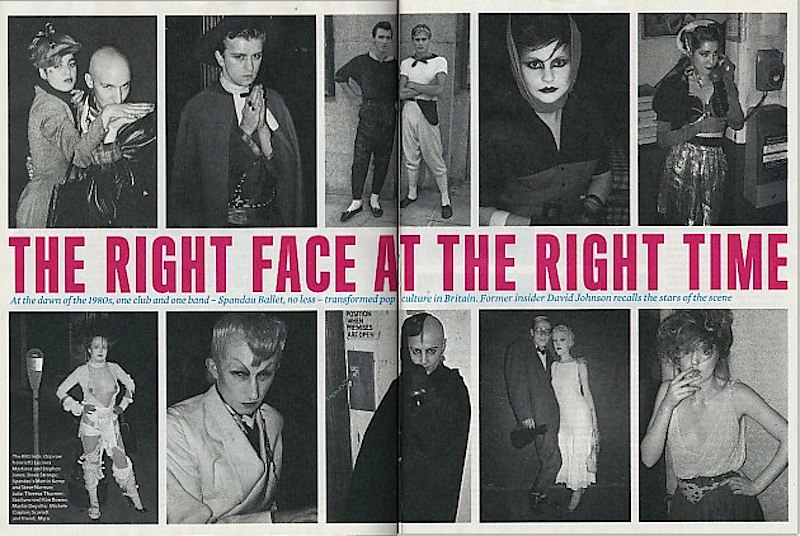
WHEN MY PHONE RANG IN JANUARY 1980, little did I realise its message meant: “Put out the cat. You’re coming to the party of your life.” The voice on the other end spoke without pausing: “My name’s Steve Strange and I run a club called the Blitz on Tuesdays and I’m starting a cabaret night on Thursdays with a really great new band…. they combine synthesised dance music for the future with vocals akin to Sinatra, they’re called Spandau Ballet and they’re going to be really big. . .”

➢ Click through to continue reading Yours Truly’s eye-witness account of Spandau Ballet, the Blitz Kids and the birth of the New Romantics at The Observer Music Monthly

➢ Elsewhere at Shapers of the 80s:
The Invisible Hand of Shapersofthe80s draws a selective
timeline for the break-out year of 1980

FRONT PAGE

➤ Second time unlucky as fire ravages former Camden Palace nightspot

Koko, Camden Theatre, Camden Palace, nightclubbing, music venue, fire, architecture, Music Machine,

Koko nightclub ablaze last night: 60 firefighters extinguished the flames within five hours

TWICE IN 40 YEARS Camden Town’s most renowned theatre has been set ablaze. Last night the 119-year-old former Royal Camden Theatre, currently known as the nightclub Koko, burst into flames at about 9pm during the course of renovation work. Video footage showed giant flames devouring its historic copper dome. London Fire Brigade reported 30% of the roof to be alight and despatched eight fire engines and 60 firefighters to tackle the inferno.

The venue was also damaged by fire during its last gasp as the post-punk Music Machine, soon after a Theatre of Hate gig in December 1980. Subsequent restoration saw it reopen in 1982 renamed the Camden Palace as Steve Strange and Rusty Egan made this the flagship for their New Romantic movement when they took it mainstream. Madonna played her first London date there by Rusty’s invitation.

Click any pic below to enlarge all in a slideshow

The rave scene saw Camden Palace through its second decade until it closed in 2004. Koko emerged after major refurbishment of its richly ornate interior by new owners who established a cool reputation for live music and with clubbing capacity for 1,500 people. However during further refurbishment in September 2018 surveyors deemed the building unsafe so the venue was forced to close.

Theatre historian Matthew Lloyd reports: “As of 2017 the theatre was to undergo a full restoration, including the replacement of the cupola on the roof. The Hope and Anchor at the back of the theatre was projected to become a boutique hotel at the same time, and would be a part of the whole complex, including a restaurant on the roof.” This £40-million state-of-the-art redevelopment was scheduled to finish in April this year but the latest fire is likely to impose a delay.

Opened in 1900 by the celebrated actress Ellen Terry, the theatre has enjoyed a dozen or so reincarnations as playhouse, music-hall and until 1940 as the Hippodrome and Gaumont cinemas. In 1945 the BBC revived the Camden Theatre name as its studio for recording variety shows and most famously The Goon Show (1951-60), starring Spike Milligan, Harry Secombe and Peter Sellers. Their Last Goon Show of All was recorded for radio and television at the studio in 1972, the year the building was awarded a Grade II listing. It had lain empty for several years and faced demolition, so the listing at least postponed that fate. English Heritage drew attention to the original architecture by W.G.R. Sprague, celebrated for his many West End theatres: a pillared façade “in baroque pastiche style”, and cantilevered dress circle and balcony with plaster work by Waring & Gillow in a mixture of baroque and rococo ornament.

Let’s hope Koko’s owners can wave a wand to revive the lustre of this iconic play-place.

➢ More about the Camden Theatre at Matthew Lloyd’s wide-raging history site named after his great grand-father Arthur Lloyd

POSTSCRIPT IN THE TIMES

➢ Another iconic building wrecked by fire during renovations – Richard Morrison in The Times’s arts column writes on 10 Jan 2020:
It’s striking how often historic buildings go up in smoke when there is renovation work happening, as there was at Koko… Recent examples are the 2018 fire that ripped through Charles Rennie Mackintosh’s superb Glasgow School of Art building as a £36-million restoration was being completed after a fire in 2014. Incredulous MSPs of all parties asked a series of questions that mostly cannot be answered… And the fire that devastated Note-Dame in Paris… rebuilding doesn’t appear to be going smoothly either… / Continued online

Koko, Camden Theatre, Camden Palace, nightclubbing, music venue, fire, architecture, Music Machine,

Steve Strange in 1982: invariably being filmed at Camden Palace

➢ Previously at Shapers of the 80s:
1983, Posing with a purpose at the Camden Palace

FRONT PAGE

2019 ➤ Ever wondered how Rusty Egan does what he does?

Blitz Club, New Romantics,Blitz Kids, Kraftwerk, Steve Strange, Rusty Egan, Visage, London Palladium

Egan onstage at the Palladium: video grab by Willy Billiams

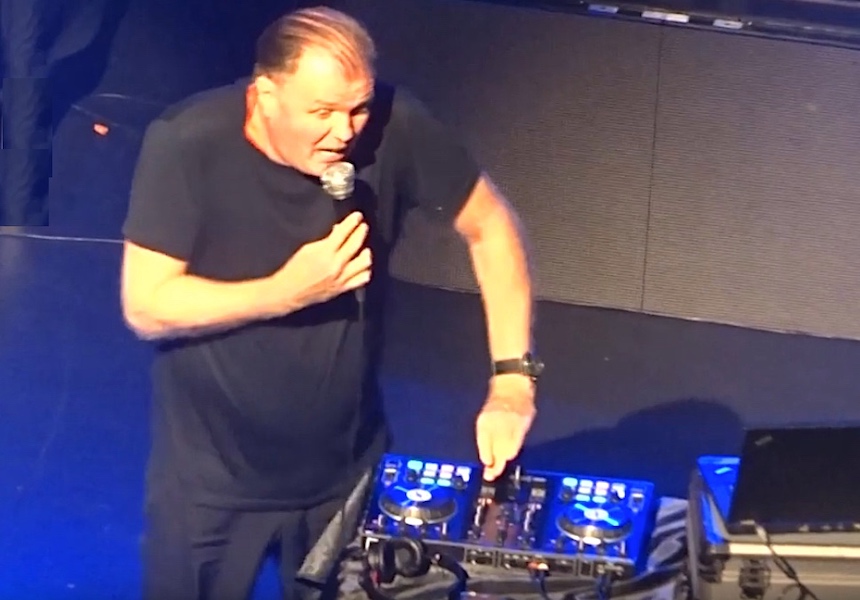
◼ ONSTAGE AT THE LONDON PALLADIUM supporting Midge Ure’s tour last week, Blitz Club co-founder Rusty Egan gave a highly first-person history lesson about his early days while demonstrating his mixing talents at a deejay console.

Of 1979, he says: “I wasn’t really a deejay, I was a drummer, and I thought you can put one record on and you can put another record on at the same time and I thought I can do that, you don’t have to stop, I’d keep it going and I mixed the records together and started to enjoy it. Us suburban 19 to 25-year-olds with ‘no future’ in 1979 suddenly had some music that spoke to us. I was basically a fan and I am 40 years later still a fan of music.”

Here is half an hour of Egan’s stream of consciousness, doing what he does best, choosing good music and showing off. All spiced with his usual frankness, natch.

➢ Rusty Egan at Bandcamp

➢ History of the Blitz Kids and the birth of the New Romantics – a brisk history of who did what in 1979-80

FRONT PAGE

➤ The makings of Scarlett, a perfect muse for the Eighties

DuoVision , Scarlett Woman, Photography, painting, sculpture, exhibition, Swinging Eighties, The Gallery Liverpool,

Scarlett Cannon at her preview: flanked by DuoVision curators James Lawler and Martin Green. (Photo © Melanie Smith)

WHICH ICON OF THE EIGHTIES catapulted herself to fame using a single name, sculpted hair and red lips? The clue is in the exhibition title just opened in Liverpool: Scarlett Woman. The Gallery in Stanhope Street is crammed with dozens of instantly recognisable images of her in all media – posters, prints, drawings, photos, videos, holograms, mosaics, sculpture and even painting. Fortunately the savviest interpreter of 80s style is at hand to make sense of the life and times of Scarlett Cannon, since she began fronting a club-night called Cha-Cha in 1981. In a guide to the exhibition, the lynchpin fashion editor Iain R Webb outlines how he promoted her career as model and muse.

He writes with intense concision: “It was a time of transformation and transgression, self-expression and collective empowerment. I was immediately taken by Scarlett’s uniqueness, an individual look being our club-kid rallying cry. With her startling peroxide blond haircut and a profile almost as flat as her reflection in the mirror she was magnificent!”

Scarlett says: “I wanted to look like a black and white photograph.” And Webb was happy to oblige, styling her in fashion spreads for BLITZ magazine. “She was an ideal made real, the perfect muse. We shared a common aim: to present our version of the world that celebrated difference and redefined beauty.” Scarlett, he reports, emerged from London’s demi-monde “artfully constructed from captured moments from yesteryear movies and imagined narratives. We made it up as we went along. . . Scarlett has always lived on the outskirts.” She adds: “It was extreme, we were really not afraid and we lived in a different world then.”

DuoVision , Scarlett Woman, The Gallery Liverpool,

Scarlett with Maude, alongside David Hiscock’s 1985 photograph, scarfed by Hermès. (Liverpool photo by Marc Albert)

Never before has there been such a perfect summary of the ingredients that made the Swinging Eighties unique, though Webb’s consummate book As Seen in Blitz: Fashioning ’80s Style came close in 2013. Coincidentally that was the year that Scarlett was visible across London as the poster girl for the V&A’s brave exhibition Club to Catwalk, a sharp retrospective nailing London fashion in the Eighties.

What’s impressive about the Liverpool retrospective mounted by the DuoVision team James Lawler and Martin Green is the number of artists whose work it embraces. . . Andrew Logan, Derek Jarman, Nick Knight, Robyn Beeche, Monica Curtin, Mark Lebon, Thomas Degen, Donald Urquhart, David Hiscock, Julian Kalinoswki, Sadie Lee, Judy Blame and others – most intriguingly the Polish expressionist painter Feliks Topolski, whose huge Punk Triptych makes a rare outing.

VIDEO TOUR BY MARK JORDAN

➢ Scarlett Woman runs until 15 September at The Gallery Liverpool, 41 Stanhope St, Liverpool, L8 5RE

➢ Gender-bending 1980s muse paints the town Scarlett – review in the Art Newspaper

➢ Previously at Shapers of the 80s: Scarlett from i-D cover girl to glamorous gardening mode

➢ Previously at Shapers of the 80s:
2013, Webb’s flipside of the 80s fashion revolution

DuoVision , Scarlett Woman, Photography, painting, sculpture, exhibition, Swinging Eighties, The Gallery Liverpool,

Scarlett Cannon with a slice of history: Feliks Topolski’s enormous Punk Triptych en route to Liverpool

REMEMBERING TOPOLSKI

➢ Feliks Topolski’s reputation reaches back to King George V’s silver jubilee while his monumental postwar mural of people and events called Topolski Century was unveiled by the Duke of Edinburgh and housed in the artist’s studio in the Hungerford Bridge arches beside the Festival Hall, where his legacy at Bar Topolski today is well worth a visit. His caricatures adorned the opening credits of John Freeman’s landmark series of TV interviews, Face to Face.

FRONT PAGE