
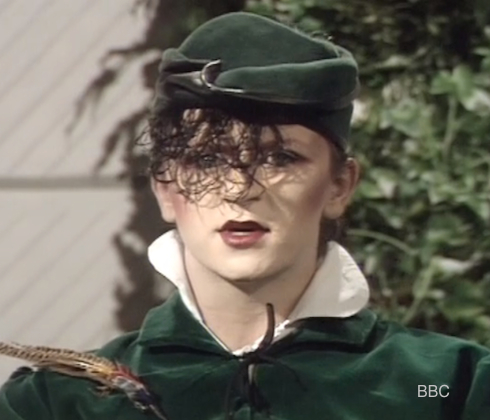
Steve Strange in 1981: here in Robin Hood guise (BBC)
FIRST PUBLISHED 13 FEBRUARY 2015
◼ ONE OF STEVE STRANGE’S TALENTS was persuading the press to believe in his latest wheeze, however fantastic. He had a way of convincing himself that a story was already written and a mission achieved before he had pressed the accelerator and set off. This irritated as many journalists as it amused and many were consequently very sceptical of his next big announcement – like saying he’d booked a big American star to do her first live promotional performance in Britain at his crowning glory, the Camden Palace, capacity 1,410. But in fact he had and she did, and in June 1983 the unknown Madonna was launched in the UK singing to backing tapes for half an hour.
The myths surrounding Steve were always the stuff of self-promotion. Dressing up was part of the same story-telling ritual. Today, he would say, I am Robin Hood, tomorrow Ruritanian Space Cadet, the next day Marionette with the mind of a toy. A compulsive man of masks presents a tricky subject for the scribblers obliged to capture that life once it is spent, so we must tiptoe through the obituaries like a minefield, and beware of tripping over Steve’s much-spun versions of history that were pure fantasy. Even national newspapers seemed to fall for many of the dreams he spouted, as well as the exceedingly vague memories committed to his 2002 book, Blitzed. As the mainstream obituary writers lead you through those New Romantic years, see if you can spot the porkies. . .
➢ The Times obituary:
“ As the head boy of the “new romantics”, Steve Strange was the flamboyant scene-maker of a colourful subculture that dominated early 1980s British pop music as a showily garish counter-reaction to the stylistic austerity of punk. If punks were the roundheads in pop’s civil war, the “new romantics” were the cavaliers, ushering in a restoration of glitz and glamour, with a delectably decadent flourish…” / Continued online
➢ Adam Sweeting, Guardian:
“ In 1978, Strange and Rusty Egan (then drummer with the Rich Kids) began holding David Bowie nights on Tuesdays at Billy’s club in Soho, a squalid bunker situated beneath a brothel. “We played Bowie, Roxy Music and electro,” said Strange. “It was where our friends could be themselves.” Billy’s could hold only 250 people [not quite!] but swiftly developed an outsize reputation, numbering among its garishly clad clientele such stars-to-be as George O’Dowd (the future Boy George), Siobhan Fahey, later of Bananarama, and Marilyn. . . ” / Continued online
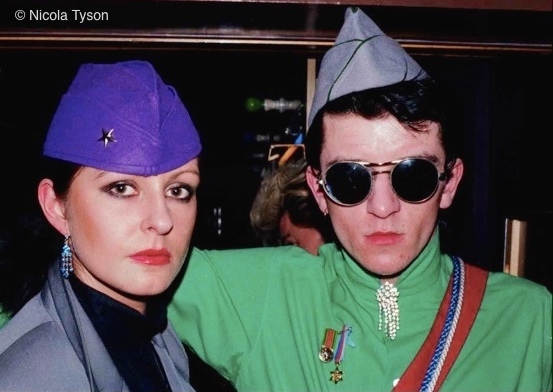
Billy’s club 1978: Strange as Ruritanian Space Cadet alongside PX designer Helen Robinson. (Photograph by © Nicola Tyson)
➢ Daily Telegraph obituary:
“ Strange fronted sleek operations, such as Club For Heroes in Baker Street and the Camden Palace in north London, where Madonna performed her first British live concert. But Visage split amid acrimony over the division of royalty payments, and his nightspots fell out of vogue in the mid-1980s with the rise of rap, hip-hop and dance music. By this time Strange had a reputation for high-handedness. Years later, Boy George lampooned Strange as the preposterous club host character “Nobby Normal” in his biographical musical Taboo. Strange was not amused. “I don’t think I have that strong a Welsh accent,” he complained. . . ” / Continued online
➢ The Scotsman obituary:
“ Although his career as a pop star afforded him only one real hit as frontman of the band Visage, 1980’s austere synthesiser anthem Fade to Grey, Steve Strange’s distinctive image and party-loving persona saw him help invent London’s New Romantic scene. . . Visage’s time in the sun flared all too briefly; with Strange being courted to repeat the clubbing success of places like the Blitz in various US cities, he dived wholeheartedly into the life of the international rock star, with all the pitfalls that entailed. Put off by Strange’s drug use, spending sprees and debauched behaviour, Midge Ure left to concentrate on Ultravox and Visage’s 1984 third album Beat Boy was a critical and commercial failure. The band split the following year, the same year that Strange first took heroin. . . ” / Continued online
➢ Pierre Perrone in The Independent:
“ A flamboyant figure with a self-destructive streak . . . By the late 90s he was back in Wales and, by his own admission, acting “very bizarrely”. He spent six weeks in a psychiatric hospital, was arrested for shoplifting and given a suspended sentence. “I don’t know whether it was cry for help,” he told The Independent in 2000, blaming an over-reliance on Prozac, though he seemed comfortable with his avowed bisexuality. . . ” / Continued online





 ➢➢ Shapers of the 80s ➣➣