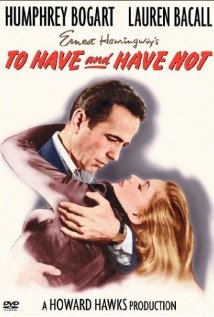
❚LAUREN BACALL WAS 19 AND GORGEOUS when she was introduced to tough guy Humphrey Bogart on the set of the war movie Passage to Marseille in 1944. Within the year she was making her Hollywood debut opposite the star in the much under-rated gem, To Have and Have Not. This too was a war movie and it made an overnight star of Bacall. It also brought her love, even though Bogie was 45. Within another year he was divorced and remarried to Bacall. They were separated only by Bogie’s early death in 1957.
Fashion editor Diana Vreeland had discovered Bacall’s photogenic qualities and turned her into one of the hot models in Harper’s Bazaar. Today Bacall still exudes the sensuality we see in her first screen role of Marie “Slim” Browning, the sassy adventuress who sings in the bar where Bogart as Harry “Steve” Morgan hangs out. Her opening line in that silky voice “Does anyone here have a match?” set the screen ablaze. But it was the song in the video clip above, How Little We Know, that announced a star is born. As a Hollywood epithet, Bacall became simply “The Look”.
Made during the second world war and wonderfully crafted by director Howard Hawks, this loose adaptation of Ernest Hemingway’s novel is a sensitive morality tale. It centres on Morgan as a hard-boiled American with a past he seeks to forget by captaining a sports-fishing boat on the Caribbean island of Martinique. For the duration of the war this overseas region of France, and an integral part of the Republic, is under Vichy control.
The couple’s real-life romance is electric, and caught on-screen for all to see. It is beautifully nuanced in the playful pet names the pair adopt for each other, when “Slim” as a resistance sympathiser persuades “Steve” to compromise his neutrality and help transport a fugitive on the run from the Nazis.
♫ Maybe you’re meant to be mine.
Maybe I’m only meant to stay in your arms a while
(As others have done) ♫
The clip above has the fine pianist Hoagy Carmichael as Cricket accompanying “Slim” as she sizzles her way through How Little We Know. The film’s music contributes toward a piece of pure entertainment which grows with every viewing. It contains some of the best lines of its day — almost in the Casablanca league — including these:
Their regular gig: The early Beatles at the Cavern club in 1961 with Pete Best on drums
❚ ON THIS THIS DAY 50 YEARS AGO four Scousers played the first of 292 gigs at the Cavern club in Liverpool — 292! They were paid £5 and Pete Best was playing drums that day, although when they played their last Cavern lunch date two years later, in Feb 1963, Ringo Starr sat behind the kit and Please Please Me was heading towards No 2 in the charts to be followed by four No 1 hits in a row.
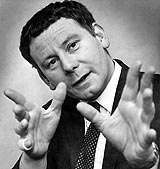
Bob Wooler, Cavern deejay: urged the owner Ray McFall to give The Beatles a try. Picture from Liverpool Post
Two hundred and ninety two gigs is the equivalent of playing every night for 48 weeks without break. In fact, many of those dates were, like the first on Thursday Feb 9, 1961, played to few dozen office workers at lunchtime. Practice may well make perfect but, even so — 292 at one venue! The Cavern’s deejay Bob Wooler booked the bands and gave The Beatles their residency, “playing lunchtime and evening sessions for about 25 shillings a session”, according to Ray Coleman in a definitive biography of John Lennon. “The Cavern, with little ventilation, appalling acoustics, walls dripping with dampness… would tax even the most enthusiastic of young musicians.”
Coleman explains why playing in this club was a decisive tipping point: “It was a hotbed of traditional jazz… The audiences were, in John Lennon’s opinion, snobs against rock’n’roll. He hated them for their superior attitude. The Cavern was to represent, to John, something more than success for The Beatles. He saw it as a crusade against jazz and all it stood for.
“John told jazz singer [author, journalist and cultural guru], George Melly, who had played the club with the Mick Mulligan Band: ‘You lot kept us from getting into the Cavern and other places much earlier. All that jazz crap held us back.’
“Melly conceded this point to Lennon… With rock’n’roll groups, led by The Beatles, pulling in students, previously jazz’s natural audience, ‘the game was up’, as Melly succinctly puts it. Lennon relished the kill.” On that cramped stage in that desperate year of 1961, Coleman maintains: “Lennon’s demeanour could be likened to that of a caged tiger. Here, he honed his short-sighted, head-tilted, legs-astride stance into a statement of defiance, much more than mere music.”
The Cavern residency was a testament to the determination of the man who had been a founder-member of The Quarrymen in 1956. Let’s not forget that the world-beating band who evolved from them also played four seasons in the German city of Hamburg between their bass player Stuart Sutcliffe eventually naming them The Beetles in August 1960 [a spelling Lennon later changed to reflect the beat], and securing their first recording contract in June 1962 with EMI, which was to turn them into the most famous pop group in history.
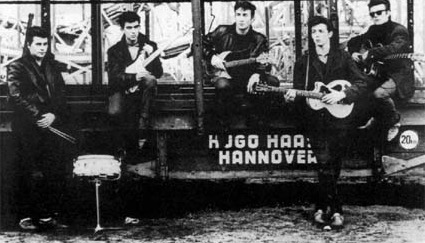
The Beatles’ beat look, 1960: honed in Hamburg by photographer Astrid Kirchherr who took this picture when guitarist Stuart Sutcliffe was in the lineup
So how many gigs did these musicians from Liverpool have to play in order to clinch a deal with a major London label in an era when the metropolis viewed the provinces as a foreign land? These were the dark ages before the internet, when television was only starting to replace newspapers as the mass medium, and when many singers upped their vocal register as far as falsetto to be heard clearly through the latest piece of technology, the handheld transistor radio.
A chance phone call in 1960 won The Beatles their first stint in Hamburg where they played seven nights a week at £15-a-week, Aug-Oct (46 gigs at the Indra club) straight on through Oct-Nov (57 gigs at the Kaiserkeller). They returned to Liverpool with moptop hairstyles and bespoke cuban-heeled Chelsea boots from London’s theatrical shoemakers Anello & Davide. After their Cavern debut the next year, 1961, The Beatles returned to Hamburg, Mar-July (98 gigs). They were viewed at the Cavern that November by Brian Epstein who agreed to manage them a month later, and played their first southern gig in Aldershot to 18 people. It was back to Hamburg in spring 1962, April-May (49 gigs), to find that Epstein had a deal ready to sign† the week after they returned. So let’s say that those four tours of duty in Germany amounted to almost exactly 250 gigs. Two hundred and fifty!
Beatles relaxing, probably 1961: Rare photo including Stuart Sutcliffe at left and Pete Best at right. (Photo courtesy Yoko Ono Lennon)
The Beatles themselves described their far from meteoric progress in their own words in the monumental Anthology published for their company Apple Corps in 2000. It makes you want to weep.
John Lennon says: “In Hamburg every song lasted 20 minutes and had 20 solos in it. We’d be playing eight or ten hours a night. [This is rather more practice than young musicians achieve at a western conservatoire, and rather less than Chinese music students.] That’s what improved the playing. And the Germans like heavy rock… Paul would be doing What’d I say? for an hour and a half.”
Paul McCartney says: “What’d I say? became like trying to get into the Guinness Book of Records — who could make it last the longest… It has the greatest opening riff ever… then the chorus… then it had the killer ‘Oh yeah!’ — audience participation.”
George Harrison says: “We had to learn millions of songs. We had to play so long we just played everything — Gene Vincent, Chuck Berry, Little Richard, Everly Brothers, Buddy Holly, Fats Domino — everything. Hamburg was really our apprenticeship, learning how to play in front of people.”
Ringo Starr, who met the others in Hamburg while playing drums in Rory Storm and the Hurricanes, says: “This was the point in our lives when we found pills, uppers. That’s the only way we could continue playing for so long. We’d get really wired and go on for days. So with beer and Preludin, that’s how we survived.”
Brian Epstein: local businessman who became The Beatles’ manager
When they signed with EMI their average age was 20. The band calling itself The Beatles had played 250 gigs in Hamburg, and averaging their Cavern appearances over the year and a half before signing suggests they played 206 gigs there.
So in addition to many other local dates, it took The Beatles at least 456 live gigs to clinch their future as the most commercially successful group in pop. In the UK The Beatles have had more number one albums than any other musical act, and in the US they top Billboard magazine’s list of the all-time top-selling Hot 100 artists.
Four hundred and fifty-six live gigs! And in 1980, when Spandau Ballet signed to Chrysalis just less than a year after assuming their New Romantic identity, they had given — as part of a cunningly formulated plan — exactly 18 live performances (six in the UK plus 12 in St Tropez on-stage nightly). Whatever this says, it’s a measure of how effective mass communications had become during the intervening two decades. And what an exhilarating hurricane they swept before them as the 80s turned into the second great era of British pop.
† LITTLE-KNOWN FOOTNOTE TO HISTORY
❚ THE 1999 PHOTO-BOOK HAMBURG DAYS — a limited edition box-set by Astrid Kirchherr and Klaus Voormann — reveals that the early Beatles lineup (with Pete Best as drummer but without Stuart Sutcliffe who had left the band) had signed their first recording contract in 1961 with Bert Kaempfert, the German Polydor agent who also ran a celebrated light orchestra.
Hamburg Days: the cover shot
He had hired The Beatles to play under the pseudonym The Beat Brothers to back singer Tony Sheridan, with whom they’d often jammed at The Indra club. On June 22 1961 at the Friedrich Ebert Halle — seen in the slideshow (above) of wonderful early Silver Beatles photos — they all recorded the Sheridan single My Bonnie, which effectively became the band’s first commercial recording when it was released in October 1961 and reached No 5 in the hit parade.
It has become part of Beatles folklore that it was a Sheridan fan called Raymond Jones who brought the band to Brian Epstein’s attention that November by asking for My Bonnie in the record-shop Epstein ran in Liverpool. What Kirchherr and Voorman reveal, contrary to most accounts, is that it was not until May 25 1962 while the band was engaged at the Star Club in Hamburg that Epstein finally persuaded Kaempfert to release The Beatles from his contract with them, effective from June 1. (Only after The Beatles auditioned for George Martin at Abbey Road on June 6 was an EMI deal confirmed.) The Kaempfert contract actually had a further year to run until July 1963. Imagine how mad he must have been when 1963 came round and The Beatles notched those four No 1 hits in a row.
VERDICT OF HISTORY
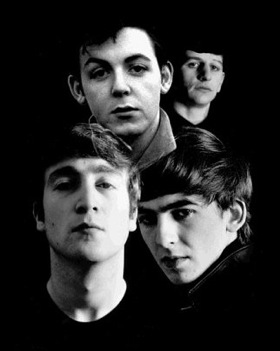
The late Charlie Gillett, in his consummate history of rock, The Sound of the City (1970), passes this judgement on the Fab Four: “Musically, The Beatles were exciting, inventive and competent; lyrically, they were brilliant, able to work in precisely the right kind of simple images and memorable phrases that distinguished rhythm and blues from other kinds of popular music… But there was something else about them, and it was this that transformed the nature of the world’s popular music as decisively as rock’n’roll had done nine years before — their character as people.”
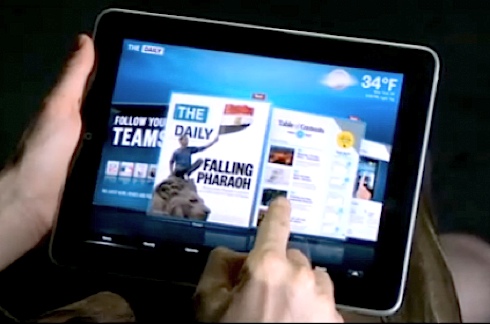
Jemima Kiss on The Daily: “First impressions are that this looks quite Microsoft to me which is probably not exactly what Apple were hoping for — the navigation is like a not-quite-so-good version of Cover Flow, which is how you navigate albums in the iTunes store”
❚ WITH A HUGE ROLL OF THE DICE, Rupert Murdoch has sought to put a seal on his reputation as a visionary media tycoon by launching The Daily, a digital-only news operation created from scratch and designed specifically for the iPad. Much is riding on it, not just Murdoch’s personal legacy in the twilight of his career, but, in his own description, the future of how people produce and consume journalism…
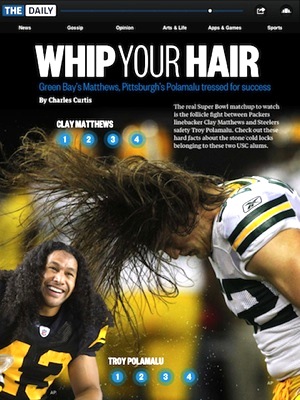
❚ SO WHAT DOES AN iPAD NEWSPAPER FEEL LIKE? The answer is “not much like a newspaper”. Instead, The Daily feels much more like one of the better examples of an iPad magazine, along the lines of Wired or Virgin’s Project. Despite the fact that both publications are ultimately owned by the same company, The Daily is nothing like The Times’s iPad app, as there’s little attempt to replicate much of the look, feel or tone of a traditional print newspaper. There’s plenty of video, both in stories and the ads that are strewn through The Daily. In some cases, rather than use ordinary photographs, there are 360-degree panoramic shots…
❚ IT’S NOT A ‘NATIVE’ iPAD EXPERIENCE AT ALL, it’s a news magazine torn up and stuffed, page-by-page onto the iPad screen… If this is the best that journalism’s brightest brains can do, given a huge budget and input from Apple itself, then we’re in worse trouble than I thought.
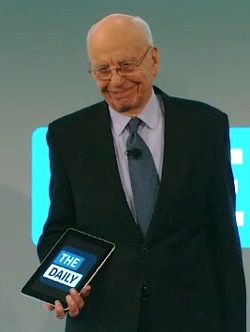
“Not a legacy brand”: Murdoch shows off The Daily at its launch
❚ RUPERT MURDOCH SPEAKING YESTERDAY: “The iPad demands that we completely reimagine our craft… The magic of newspapers — and great blogs — lies in their serendipity and surprise, and the deft touch of a good editor. We’re going to bring that magic to The Daily. Similarly, we can and we must make the business of newsgathering and editing viable again. In the tablet era there’s room for a fresh and robust new voice.
“No paper, no multimillion dollar presses, no trucks — we’re passing on these savings to the reader for just 14 cents a day… Our target audience is the 50m Americans who are expected to own tablets next year. Success will be determined by utility and originality. The Daily is not a legacy brand moving from the print to the digital world.”
❚ TECHNOLOGY BLOGGER JOHN GRUBER: “Nothing groundbreaking, but better than most such efforts to date. The carousel feature is incredibly laggy. I can’t believe they shipped it like this. Maybe they’ve hired a good staff of writers and editors, but they sure need better designers and engineers. The experience just isn’t good enough.”
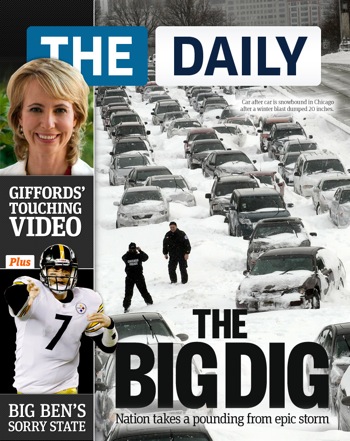
❚ THE NEWS SECTION IS EXTREMELY WEAK. The first edition contains precisely two real news articles, one of which (a story about Egyptian president Hosni Mubarak’s global address) had been thoroughly covered by all the major news outlets the previous day; the other, about the snow storm currently hitting the US, was borrowed from the AP.
❚ THE DAILY IS PARTNERING with the Associated Press for its content… [although] it’s been selling itself as a place to go for original content. As its website puts it: The Daily is “a tablet-native national news brand built from the ground up to publish original content exclusively for the iPad”. Apparently “original” here means “not aggregated.” Which is fair enough. But “original content” also implies “special content.” The kind of content you can’t get anywhere else.
Duran Duran in 1980: Birmingham’s fluffiest New Romantics
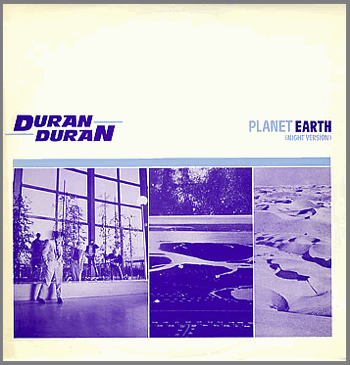
◼ 30 YEARS AGO TODAY the Birmingham club-band Duran Duran released their debut single Planet Earth, less than two months after signing to EMI. It charted in mid-March, peaked at No 12, and bagged the band a spot on Top of the Pops, Britain’s premier music TV show. They were the first New Romantic band from outside London to make good, and this week the writer Steve Jansen claims that “inside of three short years, Duran were officially the biggest band on the planet”.
He celebrated Duran’s birthpangs with a monumental survey of their origins titled Switch It On! – Planet Earth & The Launch of Duran Duran, on the blog gimmeawristband.com. As a shorter alternative, Shapersofthe80s has documented a few key excerpts from his epic account, where Jansen talked to all the key players involved during the run-up to the band’s chart debut. They are published here with his permission…
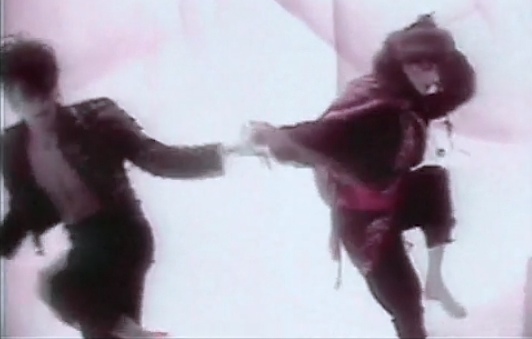
The New Romantic Jive: Rum Runner regulars Gay John Lupton and Lavinya Jatjm, dressed to the hilt and dancing in the official 1981 video for Planet Earth, co-directed by Blitz Kid Perry Haines and Russell Mulcahy
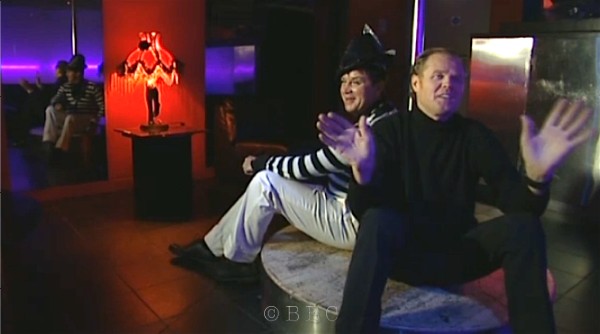
Motormouths back in action: Strange and Egan interviewed on BBC London news in the club where they once reigned. Such were members’ powers of self-promotion at the Blitz, Egan said, that it was the 80s equivalent of Facebook Live!
➢ Choose “View full site” – then in the blue bar atop your mobile page, click the three horizontal lines linking to many blue themed pages with background article
MORE INTERESTING THAN MOST PEOPLE’S FANTASIES — THE SWINGING EIGHTIES 1978-1984
They didn’t call themselves New Romantics, or the Blitz Kids – but other people did.
“I’d find people at the Blitz who were possible only in my imagination. But they were real” — Stephen Jones, hatmaker, 1983. (Illustration courtesy Iain R Webb, 1983)
“The truth about those Blitz club people was more interesting than most people’s fantasies” — Steve Dagger, pop group manager, 1983
PRAISE INDEED!
“See David Johnson’s fabulously detailed website Shapers of the 80s to which I am hugely indebted” – Political historian Dominic Sandbrook, in his book Who Dares Wins, 2019
“The (velvet) goldmine that is Shapers of the 80s” – Verdict of Chris O’Leary, respected author and blogger who analyses Bowie song by song at Pushing Ahead of the Dame
“The rather brilliant Shapers of the 80s website” – Dylan Jones in his Sweet Dreams paperback, 2021
A UNIQUE HISTORY
➢ WELCOME to the Swinging 80s ➢ THE BLOG POSTS on this front page report topical updates ➢ ROLL OVER THE MENU at page top to go deeper into the past ➢ FOR NEWS & MONTH BY MONTH SEARCH scroll down this sidebar
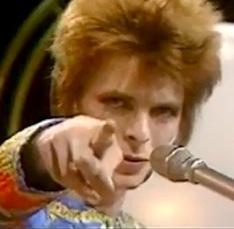
❏ Header artwork by Kat Starchild shows Blitz Kids Darla Jane Gilroy, Elise Brazier, Judi Frankland and Steve Strange, with David Bowie at centre in his 1980 video for Ashes to Ashes
VINCENT ON AIR 2026
✱ Deejay legend Robbie Vincent has returned to JazzFM on Sundays 1-3pm… Catch up on Robbie’s JazzFM August Bank Holiday 2020 session thanks to AhhhhhSoul with four hours of “nothing but essential rhythms of soul, jazz and funk”.
TOLD FOR THE FIRST TIME
◆ Who was who in Spandau’s break-out year of 1980? The Invisible Hand of Shapersofthe80s draws a selective timeline for The unprecedented rise and rise of Spandau Ballet –– Turn to our inside page
SEARCH our 925 posts or ZOOM DOWN TO THE ARCHIVE INDEX
UNTOLD BLITZ STORIES
✱ If you thought there was no more to know about the birth of Blitz culture in 1980 then get your hands on a sensational book by an obsessive music fan called David Barrat. It is gripping, original and epic – a spooky tale of coincidence and parallel lives as mind-tingling as a Sherlock Holmes yarn. Titled both New Romantics Who Never Were and The Untold Story of Spandau Ballet! Sample this initial taster here at Shapers of the 80s
CHEWING THE FAT
✱ Jawing at Soho Radio on the 80s clubland revolution (from 32 mins) and on art (@55 mins) is probably the most influential shaper of the 80s, former Wag-club director Chris Sullivan (pictured) with editor of this website David Johnson
LANDMARK FAREWELLS. . . HIT THE INDEX TAB UP TOP FOR EVERYTHING ELSE

 Made during the second world war and wonderfully crafted by director Howard Hawks, this loose adaptation of Ernest Hemingway’s novel is a sensitive morality tale. It centres on Morgan as a hard-boiled American with a past he seeks to forget by captaining a sports-fishing boat on the Caribbean island of Martinique. For the duration of the war this overseas region of France, and an integral part of the Republic, is under Vichy control.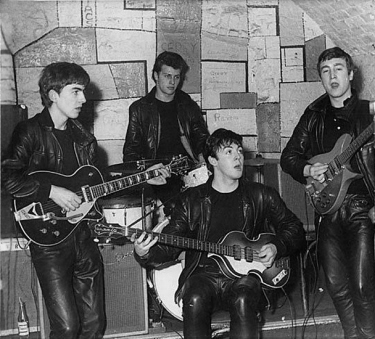









 ➢➢ Shapers of the 80s ➣➣