Category Archives: Social trends

➤ Launching tomorrow, Soho’s new radio station gives Sullivan the wag a place in its shop window

Wag club, London, nightclubbing, Chris Sullivan,1980s,

On TV in 1984: Wag club host Chris Sullivan talks of his love for jazz (BBC)

❚ DEEJAY AND WAG CLUB FOUNDER and reinventor of the zoot suit Chris Sullivan writes today: “My first radio show on Soho Radio tomorrow from 4 till 6pm …. Tune in online for an afternoon tickle…. and please like the page if you can. I’d be most grateful.”

➢ His Presenter page at Soho Radio reads like his job app to me:
Soho Radio, online,London, UK The show would be called Sullivan Suits and would cover all the music I come across each week on my quest as a DJ that might be Scorpio by Dennis Coffey, You and Me By Slave, Hustlers Convention by the Last Poets or re-edits by Joey Negro such as Same Old Scene by Roxy or stuff that I refind such as Manhattan Fable by Babs Gonsales, Light My Fire by Erma Franklyn. These would be backed up by old favourites such as A Boy Named Sue by Johnny Cash, Wonderful World by Louis Armstrong, Kooks by David Bowie. Howling Wolf, Little Walter, Aretha etc etc.

I’d throw in odd facts, stories and hoaxes. All in all it would be whatever suits me and the listener that day. I would also get a guest from time to time and get them to pick a few tracks – Mark Powell, Phil Dirtbox, Kevin Rowlands, Bernie from Groucho, Mark Hix etc and perhaps discuss Soho and swop stories.

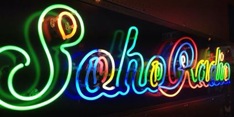
❏ Launching at 2pm Weds May 7, Soho Radio is a new independent radio station with 24/7 live streaming and pre-recorded programming from its own shop/cafe in Great Windmill Street, next to Paul Raymond’s Windmill Club. Wave to the Cuban Brothers and later to Sullivan through the studio’s large shop window onto the street. The station says it aims to provide an eclectic mix of the vibrant and diverse which this district of central London is renowned for – breaking underground acts and bringing together musicians, artists, film makers, chefs, poets and local piano tuners. Nowhere does the website says who’s behind the radio station, so until it proves itself we’d better assume it’s some Russian oligarch, as usual these days.

TALKING OF THE WAG, HERE’S A RARE OLD VIDEO

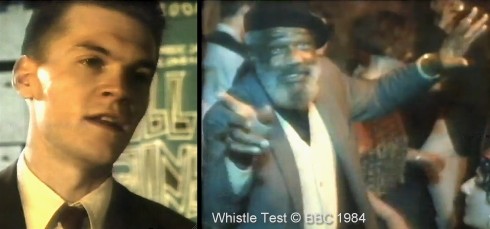
❏ Newly posted at YouTube, here’s a supercool glimpse inside Chris Sullivan’s Wag club on Wardour Street when it was London’s landmark nightspot during 1984. Monday nights were given over to the clubland’s most fashionable music craze – jazz! This segment comes from the BBC2 Whistle Test music programme on the Jazz Room when David Hepwoth ventures into the Wag to meet clubland’s jazz deejay Paul Murphy, old-timers Slim Gaillard and Will Gaines, Jerry IDJ, Dr Bob Jones, Robert Elms, among others. While club dudes complain “There’s no good pop music around at the moment” we see the American vocalist and true legend Slim Gaillard boogeying on the Wag’s dancefloor and also in a great vintage clip from 1946 singing his “groovy orooney” number, Dunkin’ Bagel.

Chris Sullivan comments: “I’ve never seen this … but then again I really didn’t like the interviewer hence my lack of enthusiasm in our chat.”
Wag Club, London, 1980s, Paul Murphy, nightclubbing,Slim Gaillard

At the Wag in 1984: jazz deejay Paul Murphy, and American trouper Slim Gaillard (BBC)

➢ Previously at Shapersofthe80s: When the Wag club shaped the New London Weekend
FRONT PAGE

➤ Mad man dies after skewering the American Dream and bequeathing us Alfred E Neuman

Al Feldstein , Mad magazine, Alfred E Neuman , comics, satire, American Dream,

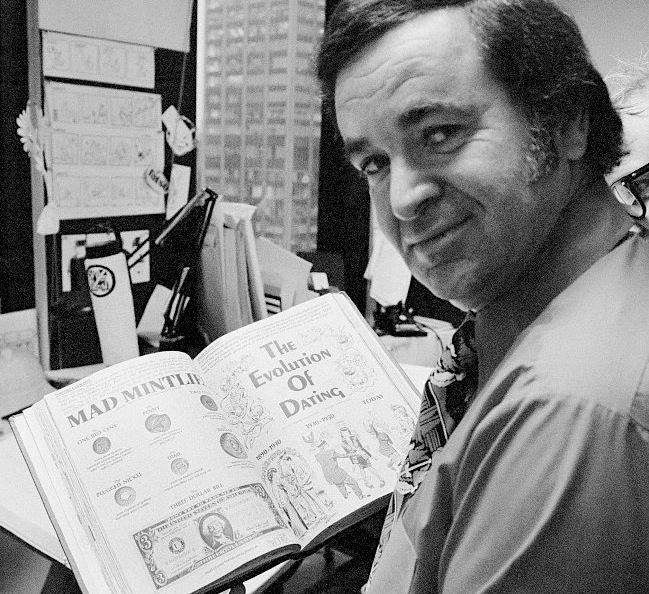
Al Feldstein in 1972 © Photograph by Jerry Mosey/Associated Press

❚ THE CREATIVE GIANT WHO EDITED America’s most influential satirical magazine has died. From 1956 Al Feldstein took the circulation of Mad from 400,000 to a peak of 2,850,000, and spent 29 years not only making a young generation laugh but fearlessly challenging sacred cows and urging scepticism about the American Dream and its furshlugginer advocates (a not-Yiddish word invented for the purpose). One issue a few years ago contained contributions from ten Pulitzer-winning cartoonists. In creating an American institution, Feldstein paved the way for National Lampoon, Saturday Night Live, The Simpsons, South Park, The Onion – and for Britain’s Viz magazine, according to its editor Graham Dury, creator of the Fat Slags…

Al Feldstein , Mad magazine, Alfred E Neuman ,

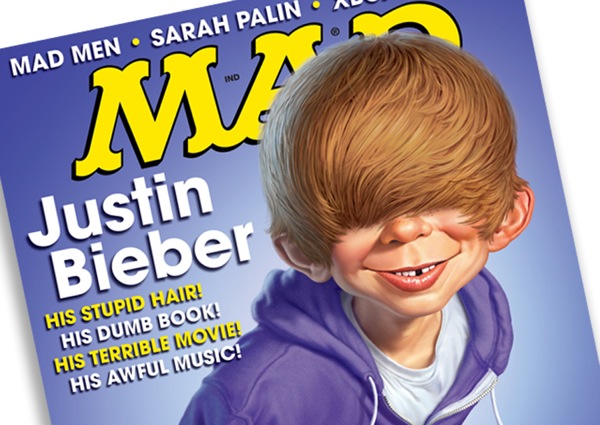
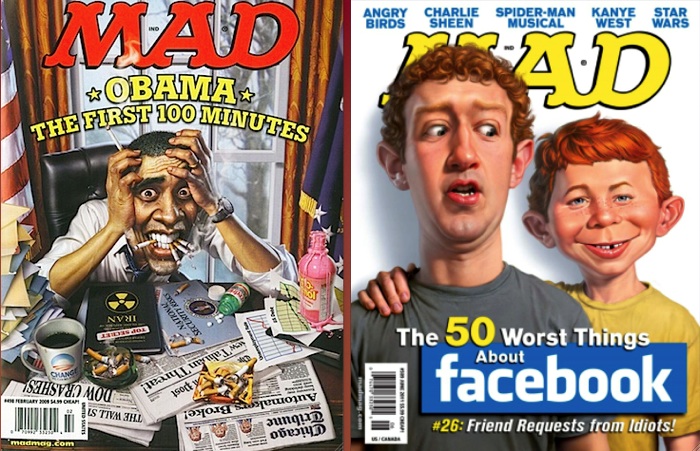
Mad magazine’s trademark, the grinning gap-toothed Alfred E. Neuman created by Feldstein: as an American icon, he is the face of every cover star

➢ The soul of Mad magazine dies at 88 –
by Bruce Weber in the New York Times:

The founding editor, Harvey Kurtzman, established its well-informed irreverence, but Al Feldstein gave Mad its identity as a smart-alecky, sniggering and indisputably clever spitball-shooter of a publication with a scattershot look, dominated by gifted cartoonists of wildly differing styles.

In his second issue, Mr Feldstein seized on a character who had appeared only marginally in the magazine — a freckled, gaptoothed, big-eared, glazed-looking young man — and put his image on the cover, identifying him as a write-in candidate for president campaigning under the slogan “What, me worry?”
At first he went by Mel Haney, Melvin Cowznofski and other names. But when the December 1956 issue, No 30, identified him as Alfred E. Neuman, the name stuck.

He became the magazine’s perennial cover boy, appearing in dozens of guises, including as a joker on a playing card, an ice-skating barrel jumper, a totem on a totem pole, a football player, a yogi, a construction worker, King Kong atop the Empire State Building… Neuman signaled the magazine’s editorial attitude, which fell somewhere between juvenile nose-thumbing at contemporary culture and sophisticated spoofing… / Continued at NYTimes

Click any pic to launch slideshow


➢ He was not a warm and fuzzy guy –
David Colker in the LA Times:

The goofy, cartoon face of Alfred E. Neuman looked out from the cover of Mad magazine for decades in various guises, always with the same message: “What, Me Worry?”

“He looked like a boob, but he had a very interesting philosophy,” said Al Feldstein, who as editor built Mad from near-obscurity in the 1950s into a satirical powerhouse, “meaning no matter how bad things get, if you maintain a sense of humor, you can get through it.” Under Feldstein, who edited Mad from 1956 to 1984, the magazine skewered presidents, the Cold War, the tobacco industry, Madison Avenue advertising, Hollywood and numerous other targets. And its legacy from that time lives on.

“Basically, everyone who was young between 1955 and 1975 read Mad,” comedy writer/producer Bill Oakley said in the book The Simpsons: An Uncensored, Unauthorized History. “That’s where your sense of humor came from… / Continued in LA Times

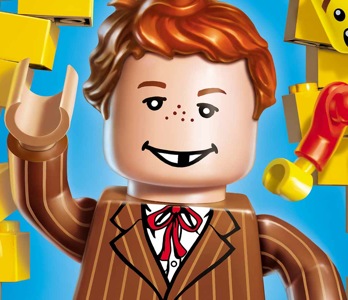
Mad magazine, Alfred E Neuman, Lego issue ➢ Today, Mad is published by DC Entertainment – The latest issue No 526 is the Lego issue (right), after the number one movie in America.

➢ 15 things Mad magazine gave the world:

Comics in the 50s didn’t encourage people to question anything – everything was more about being pleasant and not rocking the boat. Mad came along and started picking holes in the American Dream, suggesting the products Americans were buying were crap, their leaders were clueless and that the people were being treated like dicks. These days everyone’s a cynical bastard, but Mad invented it… / Continued at Anorak online

➢ The UK edition of Mad Magazine, published by Thorpe and Porter, began in 1959 – Over the years there were a number of UK sourced covers and sometimes UK produced interior stories. View a few Mad UK covers from the 1970s with such topics as British Rail, Doctor Who, the Royal Family… even the long-running TV soap opera Coronation Street.

Mad magazine, Alfred E Neuman , comics

Feldstein’s spirit still alive and well in recent issues of Mad

FRONT PAGE

2014 ➤ Spandau together again as their ‘surprise’ movie is slated for Texas premiere

Spandau Ballet, Botanic Gardens, New Romantics, Blitz Kids, Birmingham.

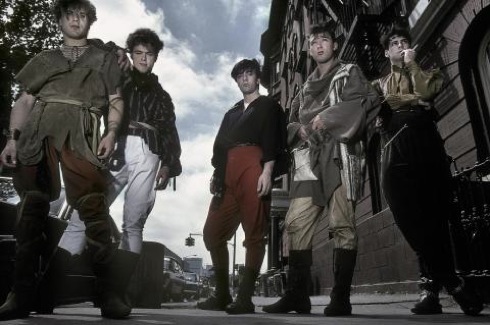
Kilted leaders of the New Romantics in 1980: Spandau Ballet plus their entourage of Blitz Kids travelled to Birmingham’s Botanic Gardens to play their eighth live date. (Photograph by Shapersofthe80s)

[Updated Feb 12]

❚ WITH A TITLE AS ZEALOUS AS any of their New Romantic songs from 1980, Soul Boys of the Western World is the documentary movie about the time Spandau Ballet became the musical leaders of London’s underground clubland. For two years they were the trendiest creatures on the planet as they reshaped British music and fashion, believe it. The 102-minute biopic is to be premiered on March 12 in the 24 Beats Section of the prestige new-media conference SXSW in Austin, Texas, running March 7–16. To complete the first reunion of the whole band since their 2010 tour ended, singer Tony Hadley will be flying out to join Gary, Martin, John and Steve at the screening.

Fans who imagine they can gate-crash, however, will be seriously stymied by the price of registration for the film programme which increases to $650 the later you book. Before travelling to Austin, Spandau fans are advised to ensure they have secured a ticket. Hints from the Spandau team suggest there may be more news soon.

Spandau Ballet, New York, Underground club, 1981

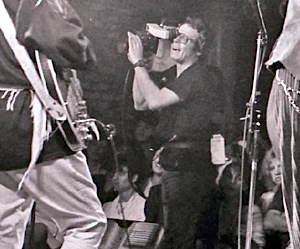
1981 footage found: Spandau’s first New York performance recovered after this cameraman was traced. Photographed by © Shapersofthe80s

The film contains no present-day pontificating from the band’s famously garrulous entourage of talking heads, only through vintage film footage telling their story as it unfolds. Steve Dagger, Spandau’s manager and its sixth member since the band was created and now the film’s co-producer, is impressed and excited by the extensive research which has been fanatically pursued for the past three years. Initiated by archive producer Kate Griffith, this has turned up many true gems of previously unseen footage even of the landmark “First Blitz invasion of America” with the Axiom fashion collective in 1981 which was located in only the past three months. Offcuts from footage of the band’s followers shot in Le Kilt club for BBC Newsnight were also discovered in a box that remained unopened for 30 years. There are also clips from the band’s home movies.

Songwriter Gary Kemp is over the moon at the painstaking finesse of the production led by Scott Millaney, one of the iconic producers of 80s pop videos. Kemp said last week: “People should be really knocked out by some of the material we’ve discovered.”

Director George Hencken aims to takes audiences through the cultural, political and personal landscapes of Britain as the Swinging 80s burst from the recessionary gloom of the 70s. Soul Boys Of The Western World explores life inside the bubble of global superstardom when British pop music ruled the world. Spandau Ballet themselves believe the film to be “a brutally honest story of how friendships can be won, lost and ultimately regained”.

documentary, film, Soul Boys of the Western World, Spandau Ballet, SXSW, Texas, premiere, pop music, Swinging 80s, London, fashion, nightclubbing, New Romantics, Blitz Kids,

Nomad warriors on the streets of north London, 1981: Spandau Ballet dressed for their Musclebound video. Martin Kemp called his the Mad Monk outfit. (Promotional pic for the documentary film, Soul Boys of the Western World)

FRONT PAGE

➤ Toasting the Blitz Kid dynamos who have driven the success of Shapers of the 80s

rel="nofollow"

Blitz Kids as stars of David Bowie’s Ashes to Ashes video in 1980: from the left, Steve Strange, Darla Jane Gilroy, Elise and Judi Frankland. When they got back to London after filming, they all went clubbing. Video © 1983 Jones Music / EMI Records Ltd

◼ SHAPERS OF THE 80S TELLS THE DEFINITIVE STORY of a subcultural revolution in British music and style 30 years ago. Its detonator was a youthful blast of impossible trendiness and its stars didn’t call themselves New Romantics, or the Blitz Kids – but other people did. This site gathers together the eye-witness journalism and photography of one observer who knew a good time when he saw one and was published in the coolest titles of the day.

Now in its fifth year, this site has attracted a total of 722,500 views since its launch, according to year-ending WordPress stats. The figures also identify the 20 most widely read items out of more than 600 posted here. Most of these pieces were first published back in the day, but seven of the Top 20 items reflect the continuing interest expressed through the recent 80s revival. In many ways, London is again displaying all the symptoms of being the world’s most swinging city, as it was in the 60s and the 80s, when there were a galaxy of reasons to hit the town every single night of the week.

THE 20 MOST VIEWED POSTS AT SHAPERS OF THE 80S

1  ➢ The Blitz Kids — 50 crucial nightclubbers who
set the style for a decade

2  ➢ The key men in Boy George’s life, but why has TV changed some of the names? (2010)

3  ➢ Golden rules for keeping Studio 54
ahead of the pack (1981)

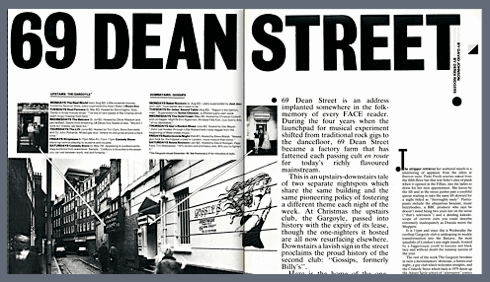
4  ➢ 69 Dean Street and the making of UK club culture – birth of the once-weekly party night (1983)

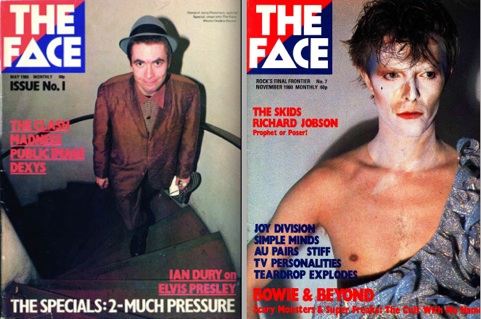
The Face, magazine, May 1980, launch, Jerry Dammers, David Bowie, The Cult With No Name, New Romantics

The difference seven months made: In May 1980 The Face launched with Jerry Dammers of the Specials on its cover. By November the new direction was Bowie plus a feature on The Cult With No Name, as the New Romantics were first known

5  ➢ The Face and other power brokers of the fourth estate — a new media language for a new decade (1980)

6  ➢ First Blitz invasion of the US — Spandau Ballet and the Axiom fashion collective take Manhattan by storm (1981)

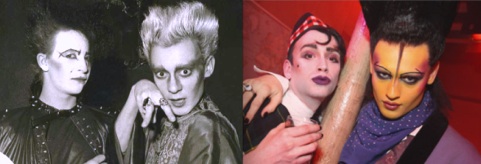
Blitz club, London 1979, Wilf, Stephen Linard, 2010, Worried About the Boy, Boy George, Daniel Wallace,Douglas Booth

Left, real Blitz Kids – right, the TV version… George’s boyfriend Wilf and fashion student Stephen Linard in 1979 (picture, Andy Rosen)… Daniel Wallace as a Linard lookalike and Douglas Booth as Boy George in Worried About the Boy, 2010 (BBC)

7  ➢ How real did 1980 feel? Ex-Blitz Kids give verdicts on the 2010 TV drama about Boy George’s teen years, Worried About the Boy

8  ➢ Hockney’s new vision of the world — Britain’s favourite artist reveals his insights into cubism (1983)

9  ➢ Paradise Point: live leaders of a new Brit pop blitz (2010)

i-D 1980

Seminal spread in i-D issue one: the straight-up style of photography is established with, at left, one then unknown New Romantic and, right, one punkette. Photographed on the King’s Road by Steve Johnston

10  ➢ ‘i-D counts more than fashion’ — launch of the
street-style bible in 1980

11  ➢ 19 gay kisses in pop videos that made it past the censor

12  ➢ Who’s who in the New London Weekend — key clubs that set the capital swinging (1983)

13  ➢ Aside from the freaks, George, who else came to your 50th birthday party? (2011)

© Shapersofthe80s

Londres est arrivée au Palace, 1982: classic set, nouveaux styles. Pictures © by Shapersofthe80s

14  ➢ Steve Strange takes fashion to the French — six British designers rock Le Palace in Paris (1982)

15  ➢ Posing with a purpose at the Camden Palace — power play among the new non-working class (1983)

16  ➢ Who are the New Romantics? — A mainstream deejay’s guide published by Disco International (1981)

Spandau Ballet, 1980

Houseband of the Blitz club: at the London megaclub Heaven Spandau Ballet play their tenth live date on 29 Dec 1980. From left, Steve Norman, Tony Hadley, Martin Kemp, Gary Kemp, plus John Keeble on drums. © Shapersofthe80s
17  ➢ They said it — landmark quotes about the decade of change by the people who made it happen

18  ➢ Rich List puts George Michael top of the popstars from the un-lucrative 80s (2010)

19  ➢ Comeback Shard comfy as ‘Auntie Sade’ — an enduring star who made 2010 her own

20 ➢ Robbie Vincent: 35 years as master of hot cuts and getting our “rhythm buds” going (2011)

FRONT PAGE

➤ Essential pop-cultural landmarks reported here at Shapers of the 80s

Andrew Ridgeley,George Michael, Wham Rap, video, Face magazine, Club Culture,

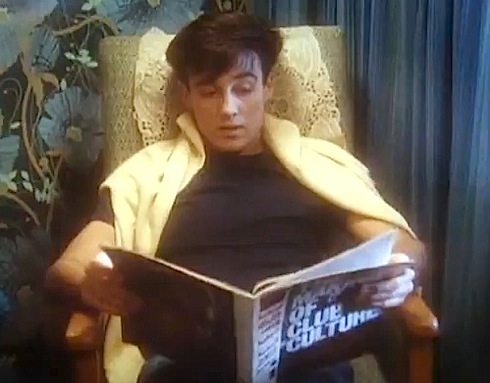
Click pic to open the Wham Rap! video in another window … “Man or mouse” Andrew Ridgeley establishes his clubbing credentials – along with sidekick George Michael – in the opening shots of the Wham! video by reading this very Face cover story on Club Culture that you’re about to read!

THE MOST READ FEATURE ARTICLE AMONG 720,000 VIEWS SINCE THE LAUNCH OF SHAPERS OF THE 80s

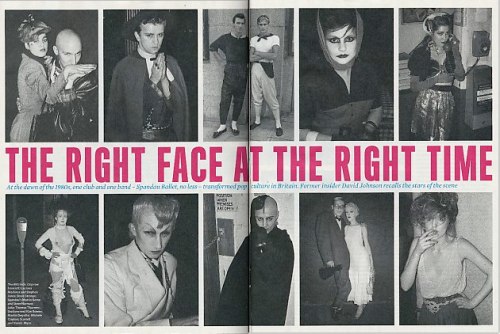
➢ 1983, The Making of UK Club Culture — Definitive Face cover story by yours truly seen here in the Wham Rap! video. This account of how London nightlife had become an international magnet was first published as “an upstairs‑downstairs tale of two key nightspots” in The Face No 34 in February 1983. Photography © by Derek Ridgers. Reprinted in The Faber Book of Pop, 1995; and in Night Fever, Boxtree, 1997

69 Dean Street, Soho, club culture, The Face magazine, London, 1980s, clubbing, nightlife,Billys, Gargoyle,Red Studio,Blitz Kids

From The Face, February 1983

THE ORIGINAL HISTORY OF THE BLITZ KIDS

The Observer Music Magazine. Pictures © by Derek Ridgers

The Observer Music Monthly, Oct 4, 2009. Pictures © by Derek Ridgers

➢ Spandau Ballet, the Blitz Kids and the birth of the New Romantics — The much-plundered story originally researched by Shapers of the 80s tells who did what to make stars out of a club houseband, change the rhythm of the UK charts — and ultimately rejuvenate the British media. The obsessive fashionistas behind one small club in London in 1980 went on to dominate the international landscape of pop and fashion, while putting more British acts into the US Billboard charts than the 1960s ever achieved.

EARLY 80s REPORTS REVISITED

➢ How three wizards met at the same crossroad in time — an inside scene-setter on the forces shaping the Swinging Eighties

➢ 1980, Strange days, strange nights, strange people: at The Blitz a decade dawns

➢ 1980, One week in the private worlds of the new young: London blazes with creativity

➢ 1980, Shapersofthe80s tells how Duran Duran’s road to stardom began in the Studio 54 of Birmingham, UK

➢ 1981, Birth of Duran’s Planet Earth … when other people’s faith put the Brummies into the charts

Romance blossoms: Drummer Jon Moss gives George O’Dowd a peck at Planets club in July 1981 way before their band Culture Club existed. Photographed © by Shapersofthe80s

➢ Three key men in Boy George’s life – In 2010 the BBC turned the pop star’s teens ’n’ twenties into a 90-minute drama of foot-stamping, chair-throwing, cry-baby tantrums over his self-confessed “dysfunctional romances”, all of which he had documented in his eye-wateringly frank 1995 autobiography, Take It Like a Man. Shapers of the 80s summarises George O’Dowd’s stormy lovelife.

➢ Ex-Blitz Kids give their verdicts on the TV drama Worried About the Boy – During and after its broadcast in 2010, this authoritative mixture of opinions on the Boy George story reshaped the accepted clichés about the Blitz Kids.

Chris Sullivan, club-host, deejay, Wag club, Blue Rondo, pop music,We Can Be Heroes, youth culture,

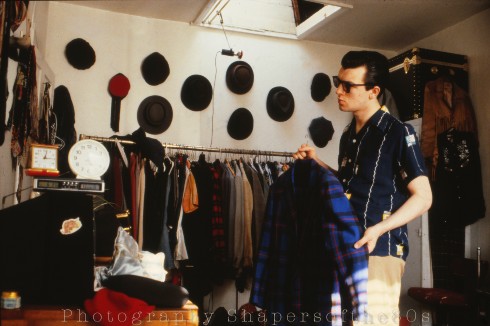
At home in Kentish Town Chris Sullivan chooses the right zootsuit for today’s mood: his wardrobe is legendary, his taste impeccable, and his influence immeasurable. Shapersofthe80s shot this for his first Evening Standard interview in June 1981

➢ 1976–1984, How creative clubbing started and ended with the 80s – “We were all kids,” says Chris Sullivan who would eventually host the Wag, the coolest club in town, for 19 years. “We went out and had a go. Empowerment is what’s important about this story.”

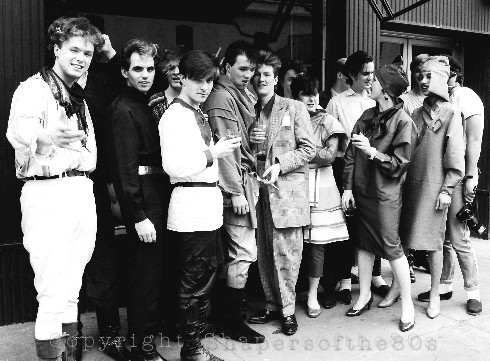
Photocall: Spandau Ballet, Richard Burgess and assorted Blitz Kid designers gather for the press conference before their fashion-and-music shows in New York. Yes that is Sade towards the far right. Photograph © by Shapersofthe80s

➢ 1981, First Blitz invasion of the US – 21 Blitz Kids take Manhattan by storm with a fresh fashion show and the live new sound of London. Eye-witness words and pix by Shapers of the 80s

ROMANTIC REVIVAL OF THE NOUGHTIES

Sade 1983

Wow! Then and now: Sade backstage in August 1983 while still seeking a recording contract and, right, as shot to launch her 2010 album. Vintage picture © by Shapersofthe80s

➢ 2010, Shapers of the 80s finds comeback Shard comfy as ‘Auntie Sade’ – Having wowed the 80s clubbing scene, in 2011 Sade’s band won a Grammy award for Best R&B Performance By A Group.

➢ 2009, Onstage, Spandau Ballet’s Hadley and Kemp finally get huggy in a mighty Reformation – Shapers of the 80s follows the reunion of the band who wrote the new rules for pop in the Swinging 80s.

WE ARE ALL BOWIE’S CHILDREN NOW

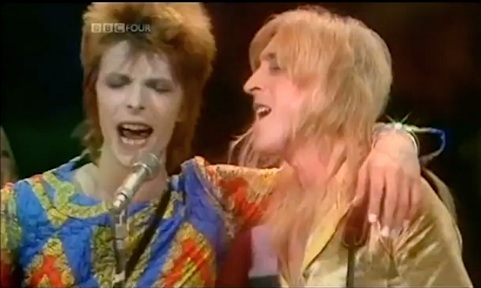
David Bowie, Starman, 1972, Top of the Pops, tipping point, BBC

The moment the earth tilted July 6, 1972: During Starman on Top of the Pops, David Bowie drapes his arm around the shoulder of Mick Ronson. Video © BBC

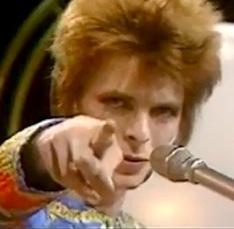
➢ 40 years since “I picked on you-oo-oo”! July 6, 1972 saw the seminal pop moment — David Bowie’s first appearance on Top of the Pops as Ziggy Stardust, the day he created the next generation of popstar wannabes

➢ Where to draw a line between glitter and glam – defining what separates the naff blokes in Bacofoil from starmen with pretensions

FRONT PAGE