+++ ❚ ON NOV 28 SPANDAU BALLET’S 1983 chart hit Gold is re-released as an iTunes download newly remixed by superstar trance deejay Paul Oakenfold. But there’s a twist involving 20 fans who stepped up to the mike to record the chorus of the song that has echoed throughout sporting arenas the world over.
In 1981, Cadbury launched its Wispa chocolate bar with bubbles as a competitor to Rowntree’s Aero. Now that Cadbury is the Official Treat Provider of the London 2012 Olympic and Paralympic Games, the bar is relaunched as Wispa Gold with caramel, retailing at 56 pence. The London 2012 Games offer a billion-pound retail opportunity that is unlike anything Britain has experienced before and a quarter of these sales are likely to be made in the final months of this year. When 25m Brits watched the recent Royal Wedding, total revenue hit £50m, so retailers are keen to capitalise on London 2012.
Cadbury is investing £8m in an advertising and sponsorship campaign plus another £1.5m on marketing, all aiming to support Team GB ahead of the 2012 Olympics with the slogan Keep Them Pumped.
Fan, commuter bike, shoelaces: all gilded ready for the video of the remixed Gold
Six of pop’s greatest power training anthems have been re-recorded as campaign soundtracks to encourage athletes preparing for the July Games. New music videos have been shot for The Final Countdown, Simply the Best, Danger Zone while an epic video for We Will Rock You [below] has enlisted more than 200 inhabitants of Merthyr Tydfil to cheer on their Olympic hockey player Sarah Thomas.
Spandau’s sleek and glitteringly golden video for the Oakenfold remix features Team GB athlete and BMX champion Shanaze Reade, plus the 120 fans selected in online auditions who then came into the studio to give full voice to the chorus. Below, we see one of them definitely getting into the Olympic spirit. “The song will be equally at home in the charts as it will in the clubs,” reckons the optimistic sax player Steve Norman. Oakenfold has one word for it: “floor-filler”.
“As a cherishable example of alternative British culture,
it makes you wonder why this isn’t the orthodoxy”
— Nigel Andrews, Financial Times
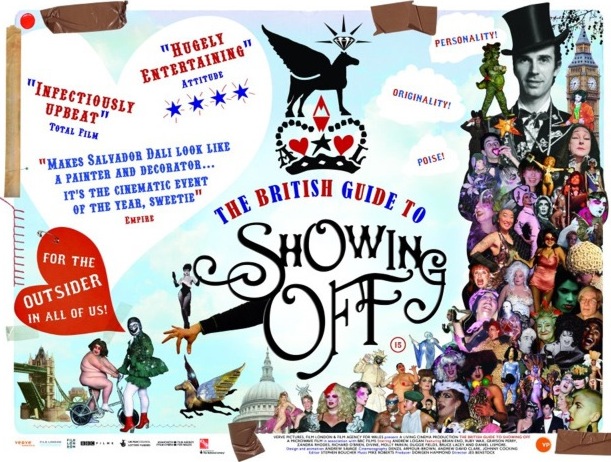
❚ ANDREW LOGAN. BRITISH ARTIST. SOCIAL MAGICIAN. Here is one of the giants of the subcultural landscape during the 70s who helped shape the imaginations of the Blitz Kids of the 80s. In 1972, Logan created the anarchic and outrageous Alternative Miss World Show, a spectacular costume pageant and fancy dress party for grown-ups, which has been reborn in 12 incarnations over the years. In a new film, The British Guide to Showing Off, director Jes Benstock takes us under Logan’s glittering wing to share this joyous and exotic subcultural event. Raucous, liberating and sexually charged, The British Guide to Showing Off “speaks to the outsider in all of us”, they say. At the ICA cinema from today.
“Makes Salvador Dali look like a painter and decorator”
— Empire magazine
➢ Former Blitz Kid now international deejay Princess Julia introduces us to the world of Logan at i-D online: “ Andrew’s eclectic crowd has consisted of musicians such as Brian Eno and Divine and Nick Rhodes, designer Zandra Rhodes who has designed all of Andrew’s she-male stage costumes, fellow artists Duggie Fields, Derek Jarman, Grayson Perry and even David Hockney… a cast which includes models, scene stealers and individualists that have made London so vital from the days of glam-rock to the very present… ”
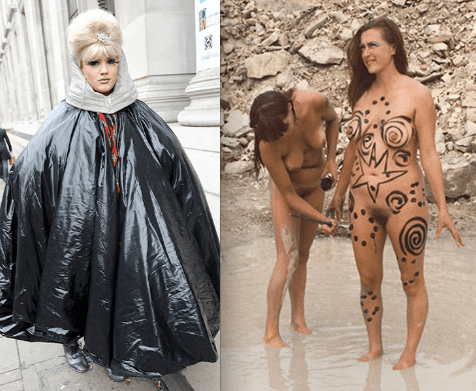
➢ Nov 13 update: The 10 best show-offs — in the Observer Andrew Logan, founder of The Alternative Miss World, pays homage to the outrageous, outlandish and out of this world
Two of Logan's choice show-offs: clubhost Daniel Lismore (pic from Rex) and the Binnie Sisters, aka the Neo-Naturists
❏ iPAD, TABLET & MOBILE USERS PLEASE NOTE — You may see only a tiny selection of items from this wide-ranging website about the 1980s, not chosen by the author. To access fuller background features and site index either click on “Standard view” or visit Shapersofthe80s.com on a desktop computer. ➢ Click here to visit a different random item every time you click
+++ ❚ FRIDAY NIGHT WAS AN EXCUSE for the wags to tell their tall tales of clubbing in the 80s. This was the first reunion in recent memory of the bright sparks the media once called Blitz Kids and New Romantics. We’re talking about the straighter faction tonight — the make-up brigade had their day at Boy George’s 50th birthday party in June. All of them, whatever their persuasion, were diehard nightowls, the spiritual offspring of the mighty innovator who shaped the 1970s pop scene almost singlehandedly, David Bowie. He taught them to adopt stances: individualism, transgression. He bequeathed them principles for living amusing lives: disposable identities, looks not uniforms. In turn, they then shaped the sounds and styles of the Swinging 80s set in motion by 1976 and the birth of punk, along with a passion for black dance music, on through the decadent glamour of the Blitz Club years, to the watershed of Band Aid in 1984.
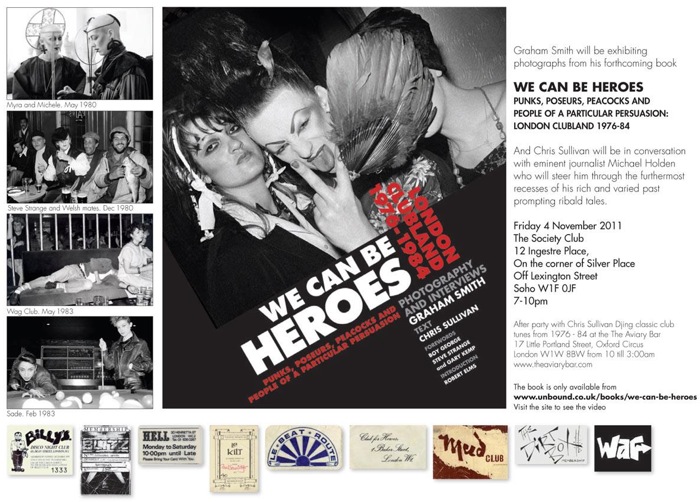
On Friday, photographer Graham Smith took over Soho’s newest rendezvous, the Society Club, for a gallery show of his 80s photographs, which capture the panache and derring-do of style leaders such as PX, Stephen Jones, Kim Bowen Melissa Caplan, Stephen Linard, Fiona Dealey, John Maybury and such nascent popstars as Spandau Ballet, Visage, Animal Nightlife, Sade, Blue Rondo à la Turk and others.
Our two videos capture the essence of Smith’s collaborators, Robert Elms and Chris Sullivan, powering through their often unprintable anecdotes, edited on video down to bite-sized chunks and garnished with Graham’s images. The highspot was meant to be Sullivan as guest speaker, but when he was reportedly “still on his way”, in stepped writer and broadcaster Elms to recall the early one-night clubs he also helped to run. He sounded genuinely shocked by the precociousness of his peers — “We were kids!” — who persuaded West End nightclubs to hand over door control to them as teenagers. Eventually, Sullivan arrived in the guise of Vladimir Ilyich Lenin, and of course excelled at spinning his “ribald tale of excess” about the mayhem he helped cause in clubland, en route to running Soho’s Wag club for 19 years.
+++
The photos form a dossier creative endeavour, as we’ll soon see in We Can Be Heroes, a 320-page coffee-table book containing 500 mostly unseen images and 100 voxpop interviews by Graham Smith. Warts-and-all main text is penned by the mellifluous Welshman Sullivan, with other contributions from Robert Elms, Boy George, Steve Strange and Gary Kemp.
Smith & Sullivan’s invitation to a party
➢ Visit the publisher Unbound.co.uk to place your order for We Can Be Heroes and secure your name in the limited first edition. This month the authors aim to hit an advance sales target by this new “crowd-funding” technique in order to guarantee publication.
➢ Visit The Society Club, London W1F 0JF where Graham Smith’s photographs are on sale until Christmas. Subjects include Boy George, Sade, Steve Strange, Spandau Ballet, Iggy Pop, Siouxsie Sioux, the Sex Pistols and many more.
❚ ONLY ABOUT 400 “LOOKERS-IN” were able to view the world’s first scheduled television service in high-definition (240+ lines) at 3pm on November 2, 1936. The engineers wore white dust-coats and the star wore a cocktail dress. With immaculate middle-class enunciation, she sang a song full of amazement at the newest technology of its day:
♫ A mighty maze of mystic, magic rays Is all about us in the blu-u-u-u-e, And in sight and sound they trace Living pictures out of space To bring our new wonder to you-u-u-u-u ♫
Everyone knew the musical comedy star Adele Dixon, though not yet the BBC Television Orchestra conducted by Hyam Greenbaum, also glimpsed in the clip above. The opening show was called Variety, and the song was called simply Television — known universally today as The Television Song. It had been specially written for the occasion, with lyrics by James Dyrenforth and music by Kenneth Leslie-Smith. Its innocence still wows us for six.
The broadcast was being beamed from what became a landmark transmitter tower atop customised studios 350ft over North London at Alexandra Palace, the original “people’s palace of entertainment”. Two different black-and-white television systems were being tested in quick succession on that first afternoon, and then on alternate weeks for six months: in the 70 x 30 feet Studio A the Marconi-EMI 405-line electronic system; and in Studio B, John Logie Baird’s 240-line mechanical system.
Baird the tenacious Scot is usually claimed to be the inventor of television and between 1923–1925 he demonstrated his clunky apparatus with a spiral of revolving lenses in the Soho building which became Bianchi’s restaurant soon after, refurbished today as Little Italy. The Times reported in 1926: “The image was often blurred. But it substantiated a claim that it is possible to transmit and reproduce instantly such things as the play of expression on the human face.”
Baird’s televisor in Frith Street, 1925: before transmission, the received image at left has been scanned by a spiral of revolving lenses, shown at right with inventor Logie Baird. Photo: Hulton/Getty
The flaw lay in Baird’s underlying technology being mechanical. In the end, Marconi’s electronic rival proved to be the future and it endured until the 1960s. Cecil Madden, the BBC’s fledgling TV Programme Organiser, says the differences were all too apparent: “Working in the Baird studio was a bit like using Morse code when you knew that next door you could telephone.”
A kick-start to the novice TV industry had come two months earlier. At very short notice the rival systems had been demonstrated at Radiolympia, the annual exhibition mounted by the Radio Manufacturers’ Association. The radio industry couldn’t sell the stands for the 1936 show (Aug 24-Sep 3) and a desperate call for help went out: could television save the day? (All the more desperate considering that TV sets in 1936 cost a princely £150, which is equivalent to £8,300 in today’s money.) Given only nine days’ warning, Cecil Madden appointed himself producer of its first broadcast.
❏ On August 26 at 11:45 a piece of Duke Ellington was heard, accompanied by a caption card reading, BBC Demonstration to Radiolympia by the Baird System, transmitted from its tiny one-camera studio. This was followed by another ten minutes of music. The highlight of the demonstration was to be a variety show someone had the bright idea of calling Here’s Looking At You, featuring a song with the same title by Ronnie Hill, performed by Helen McKay.
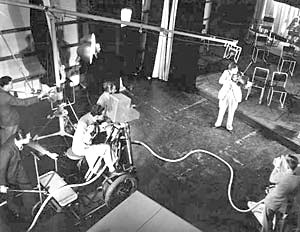
Alexandra Palace: Studio A with an Emitron camera
It was not until the next day, when everything was repeated using the Marconi-EMI system, that the show was seen in its full glory: with three cameras, two mobile and one fixed. This was the version filmed by British Movietone news cameras and featured above. “Hello Radiolympia,” said announcer Leslie Mitchell, standing in front of the first set of curtains. “Ladies and gentlemen, Here’s Looking at You.” And Miss McKay sang:
♫ Here’s looking at you From out of the blue Don’t make a fuss Just settle down and look at us ♫
The 30-minute show that followed went out twice a day. Cecil Madden says: “It’s still unique because noone has ever done 20 programmes live, twice a day for ten days, from Alexandra Palace to the radio show at Olympia.”
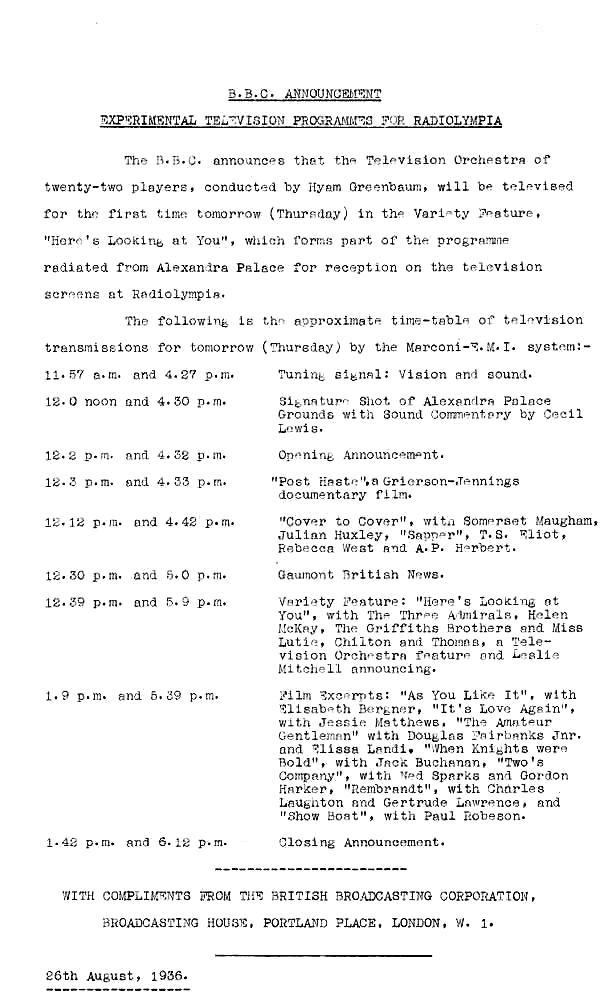
The BBC’s twice-daily running order for Radiolympia 1936. Click for the full document where eagle eyes will note readings by T S Eliot, Aldous Huxley and Rebecca West, and film appearances by Charles Laughton, Gertrude Lawrence and Paul Robeson. Source: Terra Media
The programme was received as far away as Bournemouth and Nottingham, and the Marconi-EMI team, with their mobile camera, were able to include some exterior shots from Ally Pally. All of which resulted in the official inauguration of the BBC Television Service being brought forward to early November. Regular programmes were broadcast twice a day from 3pm to 4pm and from 9pm to 10pm, except on Sundays. One of the early fears was that television would cause eye strain — even after only two hours a day.
❚ iPAD, TABLET & MOBILE USERS PLEASE NOTE — You may be viewing only a tiny selection of items, not chosen by the author, here at Shapersofthe80s which is a wide-ranging website about the 1980s, when British youth culture was at its finest. To access fuller background features and full site index either click on “Standard view” or visit Shapersofthe80s on a desktop computer.
➢ Choose “View full site” – then in the blue bar atop your mobile page, click the three horizontal lines linking to many blue themed pages with background article
MORE INTERESTING THAN MOST PEOPLE’S FANTASIES — THE SWINGING EIGHTIES 1978-1984
They didn’t call themselves New Romantics, or the Blitz Kids – but other people did.
“I’d find people at the Blitz who were possible only in my imagination. But they were real” — Stephen Jones, hatmaker, 1983. (Illustration courtesy Iain R Webb, 1983)
“The truth about those Blitz club people was more interesting than most people’s fantasies” — Steve Dagger, pop group manager, 1983
PRAISE INDEED!
“See David Johnson’s fabulously detailed website Shapers of the 80s to which I am hugely indebted” – Political historian Dominic Sandbrook, in his book Who Dares Wins, 2019
“The (velvet) goldmine that is Shapers of the 80s” – Verdict of Chris O’Leary, respected author and blogger who analyses Bowie song by song at Pushing Ahead of the Dame
“The rather brilliant Shapers of the 80s website” – Dylan Jones in his Sweet Dreams paperback, 2021
A UNIQUE HISTORY
➢ WELCOME to the Swinging 80s ➢ THE BLOG POSTS on this front page report topical updates ➢ ROLL OVER THE MENU at page top to go deeper into the past ➢ FOR NEWS & MONTH BY MONTH SEARCH scroll down this sidebar
❏ Header artwork by Kat Starchild shows Blitz Kids Darla Jane Gilroy, Elise Brazier, Judi Frankland and Steve Strange, with David Bowie at centre in his 1980 video for Ashes to Ashes
VINCENT ON AIR 2026
✱ Deejay legend Robbie Vincent has returned to JazzFM on Sundays 1-3pm… Catch up on Robbie’s JazzFM August Bank Holiday 2020 session thanks to AhhhhhSoul with four hours of “nothing but essential rhythms of soul, jazz and funk”.
TOLD FOR THE FIRST TIME
◆ Who was who in Spandau’s break-out year of 1980? The Invisible Hand of Shapersofthe80s draws a selective timeline for The unprecedented rise and rise of Spandau Ballet –– Turn to our inside page
SEARCH our 925 posts or ZOOM DOWN TO THE ARCHIVE INDEX
UNTOLD BLITZ STORIES
✱ If you thought there was no more to know about the birth of Blitz culture in 1980 then get your hands on a sensational book by an obsessive music fan called David Barrat. It is gripping, original and epic – a spooky tale of coincidence and parallel lives as mind-tingling as a Sherlock Holmes yarn. Titled both New Romantics Who Never Were and The Untold Story of Spandau Ballet! Sample this initial taster here at Shapers of the 80s
CHEWING THE FAT
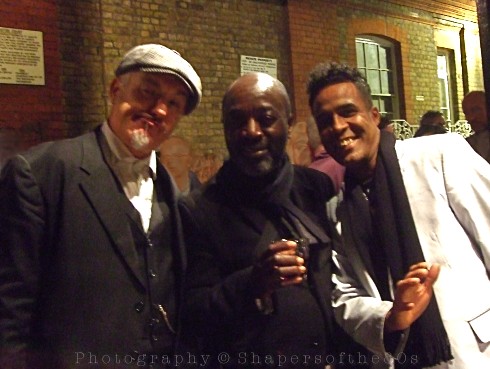
✱ Jawing at Soho Radio on the 80s clubland revolution (from 32 mins) and on art (@55 mins) is probably the most influential shaper of the 80s, former Wag-club director Chris Sullivan (pictured) with editor of this website David Johnson
LANDMARK FAREWELLS. . . HIT THE INDEX TAB UP TOP FOR EVERYTHING ELSE









 ➢➢ Shapers of the 80s ➣➣