ALSO THE FIFTH ANNIVERSARY OF
STEVE STRANGE’S DEATH
◼ WHEN MY PHONE RANG IN JANUARY 1980, little did I realise its message meant: “Put out the cat. You’re coming to the party of your life.” The voice on the other end spoke without pausing: “My name’s Steve Strange and I run a club called the Blitz on Tuesdays and I’m starting a cabaret night on Thursdays with a really great new band…. they combine synthesised dance music for the future with vocals akin to Sinatra, they’re called Spandau Ballet and they’re going to be really big. . .”
Egan onstage at the Palladium: video grab by Willy Billiams
◼ ONSTAGE AT THE LONDON PALLADIUM supporting Midge Ure’s tour last week, Blitz Club co-founder Rusty Egan gave a highly first-person history lesson about his early days while demonstrating his mixing talents at a deejay console.
Of 1979, he says: “I wasn’t really a deejay, I was a drummer, and I thought you can put one record on and you can put another record on at the same time and I thought I can do that, you don’t have to stop, I’d keep it going and I mixed the records together and started to enjoy it. Us suburban 19 to 25-year-olds with ‘no future’ in 1979 suddenly had some music that spoke to us. I was basically a fan and I am 40 years later still a fan of music.”
Here is half an hour of Egan’s stream of consciousness, doing what he does best, choosing good music and showing off. All spiced with his usual frankness, natch.
◼ WHICH ICON OF THE EIGHTIES catapulted herself to fame using a single name, sculpted hair and red lips? The clue is in the exhibition title just opened in Liverpool: Scarlett Woman. The Gallery in Stanhope Street is crammed with dozens of instantly recognisable images of her in all media – posters, prints, drawings, photos, videos, holograms, mosaics, sculpture and even painting. Fortunately the savviest interpreter of 80s style is at hand to make sense of the life and times of Scarlett Cannon, since she began fronting a club-night called Cha-Cha in 1981. In a guide to the exhibition, the lynchpin fashion editor Iain R Webb outlines how he promoted her career as model and muse.
He writes with intense concision: “It was a time of transformation and transgression, self-expression and collective empowerment. I was immediately taken by Scarlett’s uniqueness, an individual look being our club-kid rallying cry. With her startling peroxide blond haircut and a profile almost as flat as her reflection in the mirror she was magnificent!”
Scarlett says: “I wanted to look like a black and white photograph.” And Webb was happy to oblige, styling her in fashion spreads for BLITZ magazine. “She was an ideal made real, the perfect muse. We shared a common aim: to present our version of the world that celebrated difference and redefined beauty.” Scarlett, he reports, emerged from London’s demi-monde “artfully constructed from captured moments from yesteryear movies and imagined narratives. We made it up as we went along. . . Scarlett has always lived on the outskirts.” She adds: “It was extreme, we were really not afraid and we lived in a different world then.”
Scarlett with Maude, alongside David Hiscock’s 1985 photograph, scarfed by Hermès. (Liverpool photo by Marc Albert)
Never before has there been such a perfect summary of the ingredients that made the Swinging Eighties unique, though Webb’s consummate book As Seen in Blitz: Fashioning ’80s Style came close in 2013. Coincidentally that was the year that Scarlett was visible across London as the poster girl for the V&A’s brave exhibition Club to Catwalk, a sharp retrospective nailing London fashion in the Eighties.
What’s impressive about the Liverpool retrospective mounted by the DuoVision team James Lawler and Martin Green is the number of artists whose work it embraces. . . Andrew Logan, Derek Jarman, Nick Knight, Robyn Beeche, Monica Curtin, Mark Lebon, Thomas Degen, Donald Urquhart, David Hiscock, Julian Kalinoswki, Sadie Lee, Judy Blame and others – most intriguingly the Polish expressionist painter Feliks Topolski, whose huge Punk Triptych makes a rare outing.
Scarlett Cannon with a slice of history: Feliks Topolski’s enormous Punk Triptych en route to Liverpool
REMEMBERING TOPOLSKI
➢ Feliks Topolski’s reputation reaches back to King George V’s silver jubilee while his monumental postwar mural of people and events called Topolski Century was unveiled by the Duke of Edinburgh and housed in the artist’s studio in the Hungerford Bridge arches beside the Festival Hall, where his legacy at Bar Topolski today is well worth a visit. His caricatures adorned the opening credits of John Freeman’s landmark series of TV interviews, Face to Face.
Discussion following Beyond at Vogue Fabrics Dalston: around Claire Lawrie wearing white), Andy Polaris, Roy Brown, David Holah, Iain R Webb, Greg Davis. (Photo Shapersofthe80s)
◼ WELL THAT WAS A HILARIOUS BOUT OF GAY BANTER following the first community screening of director Claire Lawrie’s Iris prize-winning short documentary featuring eleven highly individual creatives telling their stories about growing up black and queer in 1970s and 80s Britain. Thursday’s screening at Vogue Fabrics Dalston of Beyond “There’s always a black issue, Dear” was as moving and thoughtful as it was entertaining. Joining Claire in Thursday’s follow-on discussion were some of its stars, Frank Akinsete, Andy Polaris, Roy Brown and Winn Austin, plus David Holah, Iain R Webb, Greg Davis, Shaun Cole and other individualists who made their mark before and during Margaret Thatcher’s regime.
Navigating their gender-fluid youth in this period of cultural and political turbulence saw the protagonists tackling things their own way. London’s alternative nightclub scene provided sanctuary for disco to meet soul and punks to become Blitz Kids. As fierce LGBTQ trailblazers, the cast recount vivid memories which tell of singular determination and of resisting definition, through dance, art, fashion and music and seeing their ideas appropriated by the mainstream. The film acknowledges the importance of family, whether as parents or a group of like-minded friends. “You needed somewhere to go where you felt good about yourself,” and in the post-punk moment that meant Soho nightclubs such as Crackers and Billy’s.
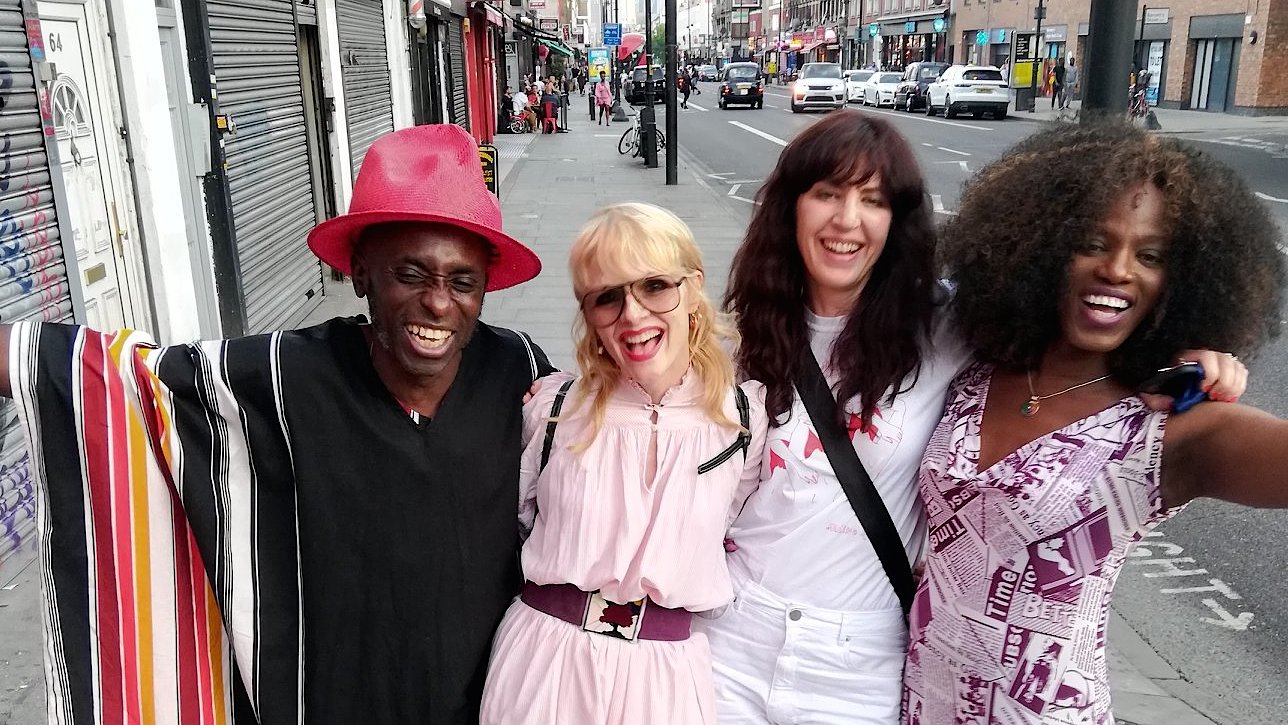
Claire Lawrie with guests outside Vogue Fabrics Dalston: Frank Akinsete, Pippa Brooks, Winn Austin. (Photo Andy Polaris)
In Thursday’s discussion Frank said that race itself wasn’t the issue, simply feeling “weird”. Within black circles the choice was also between reggae or soul, Andy said on today’s Robert Elms show on BBC Radio London: “The power of the film is not just about gay or straight, black or white – we were all rejects from some type of conservatism and we came together in a safe space where we could explore ourselves.”
Also on the Elms show, Claire said the film started with Les Childs being in Lindsay Kemp’s company in the mid-70s (he later worked with Michael Clark and choreographed for the Pet Shop Boys) and goes through to 1991 and the Michael and Gerlinde Costiff club Kinky Gerlinky. Claire added: “London is another star of this film – we all moved to London to be individual.”
There’s another screening tonight (6 July) at the Conduit club in Mayfair as part of BlackOut’s starry Pride programme (tickets via Eventbrite) and again on 23 July at Manchester Pride, with another hopefully in Liverpool.
MARKING THE FOURTH ANNIVERSARY
OF STEVE STRANGE’S DEATH
◼ WHEN MY PHONE RANG IN JANUARY 1980, little did I realise its message meant: “Put out the cat. You’re coming to the party of your life.” The voice on the other end spoke without pausing: “My name’s Steve Strange and I run a club called the Blitz on Tuesdays and I’m starting a cabaret night on Thursdays with a really great new band…. they combine synthesised dance music for the future with vocals akin to Sinatra, they’re called Spandau Ballet and they’re going to be really big. . .”
➢ Choose “View full site” – then in the blue bar atop your mobile page, click the three horizontal lines linking to many blue themed pages with background article
MORE INTERESTING THAN MOST PEOPLE’S FANTASIES — THE SWINGING EIGHTIES 1978-1984
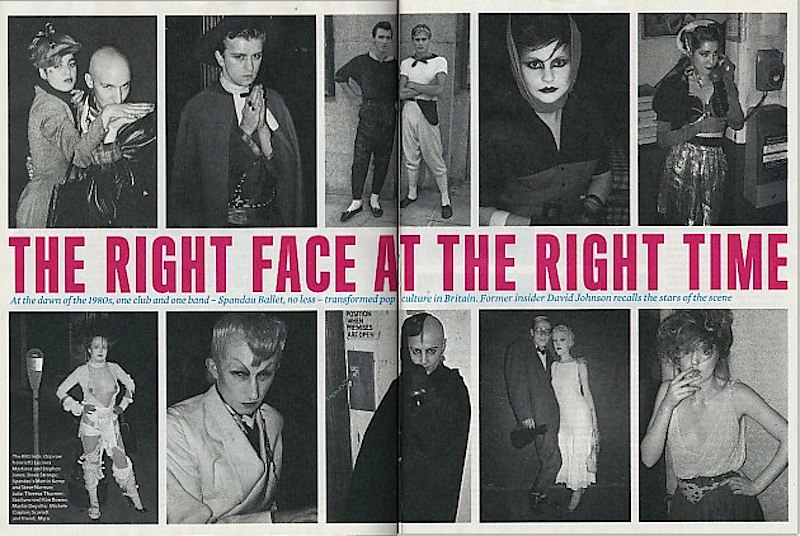
They didn’t call themselves New Romantics, or the Blitz Kids – but other people did.
“I’d find people at the Blitz who were possible only in my imagination. But they were real” — Stephen Jones, hatmaker, 1983. (Illustration courtesy Iain R Webb, 1983)
“The truth about those Blitz club people was more interesting than most people’s fantasies” — Steve Dagger, pop group manager, 1983
PRAISE INDEED!
“See David Johnson’s fabulously detailed website Shapers of the 80s to which I am hugely indebted” – Political historian Dominic Sandbrook, in his book Who Dares Wins, 2019
“The (velvet) goldmine that is Shapers of the 80s” – Verdict of Chris O’Leary, respected author and blogger who analyses Bowie song by song at Pushing Ahead of the Dame
“The rather brilliant Shapers of the 80s website” – Dylan Jones in his Sweet Dreams paperback, 2021
A UNIQUE HISTORY
➢ WELCOME to the Swinging 80s ➢ THE BLOG POSTS on this front page report topical updates ➢ ROLL OVER THE MENU at page top to go deeper into the past ➢ FOR NEWS & MONTH BY MONTH SEARCH scroll down this sidebar
❏ Header artwork by Kat Starchild shows Blitz Kids Darla Jane Gilroy, Elise Brazier, Judi Frankland and Steve Strange, with David Bowie at centre in his 1980 video for Ashes to Ashes
VINCENT ON AIR 2026
✱ Deejay legend Robbie Vincent has returned to JazzFM on Sundays 1-3pm… Catch up on Robbie’s JazzFM August Bank Holiday 2020 session thanks to AhhhhhSoul with four hours of “nothing but essential rhythms of soul, jazz and funk”.
TOLD FOR THE FIRST TIME
◆ Who was who in Spandau’s break-out year of 1980? The Invisible Hand of Shapersofthe80s draws a selective timeline for The unprecedented rise and rise of Spandau Ballet –– Turn to our inside page
SEARCH our 925 posts or ZOOM DOWN TO THE ARCHIVE INDEX
UNTOLD BLITZ STORIES
✱ If you thought there was no more to know about the birth of Blitz culture in 1980 then get your hands on a sensational book by an obsessive music fan called David Barrat. It is gripping, original and epic – a spooky tale of coincidence and parallel lives as mind-tingling as a Sherlock Holmes yarn. Titled both New Romantics Who Never Were and The Untold Story of Spandau Ballet! Sample this initial taster here at Shapers of the 80s
CHEWING THE FAT
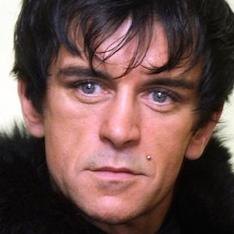
✱ Jawing at Soho Radio on the 80s clubland revolution (from 32 mins) and on art (@55 mins) is probably the most influential shaper of the 80s, former Wag-club director Chris Sullivan (pictured) with editor of this website David Johnson
LANDMARK FAREWELLS. . . HIT THE INDEX TAB UP TOP FOR EVERYTHING ELSE










 ➢➢ Shapers of the 80s ➣➣