Remember Eartha Kitt? – the sauciest thing on Fifties TV
◼ CHRISTMAS BRINGS OUT a lot of musical schmaltz over the festive period, most of which is consumed in earnest like mince pies and mulled wine. So Andy Polaris – frontman in Eighties popsters Animal Nightlife – decided to dig around Santa’s vintage vinyl to find some more discerning winter jukebox favourites to present his Dozen Festive Songs that Slay. Among his underrated gems we hear from Bob Dylan, Darlene Love, Eartha Kitt, George Michael, k.d.lang, Kurtis Blow, Marvin Gaye, Poly Styrene, Santa Baby, Sounds of Blackness, The Emotions and The Waitresses. Here’s a delicious novelty number from Stevie Wonder – One Little Christmas Tree. Andy says on his blog: “Perfectly synced with a Charlie Brown cartoon episode, this sweet narrative below is new to my ears and deserves a wider audience especially with Stevie’s storytelling clarity.”
Scott Walker photographed in October 2012 by Jake Walters
◼ A REVEALING APPRECIATION of Scott Walker appears in today’s Observer obituaries of the decade … Co-director of Artangel Michael Morris recalls the great experimental musician as a witty and charming man who freed himself from the trappings of fame:
“ He’s a completely singular figure in late 20th-century, early 21st-century art and ideas. Scott’s work doesn’t fit into a cultural compartment: he was interested in all forms of human expression. . . Scott was held in such high regard by so many other artists. David Bowie often acknowledged his influence, as does Brian Eno. I think they also revered his ability to cast off the mantle of celebrity and focus simply on the work.
“ He was not in any way caught up in the myth of Scott Walker. You just felt that you were working with a very precise, open mind, someone who was completely uninterested in the trappings of image or fame. Bike or the bus were his preferred modes of travel. I think he’d found a way to live and work outside of the public gaze that was much more liberating and creative. . . ” / Continued online
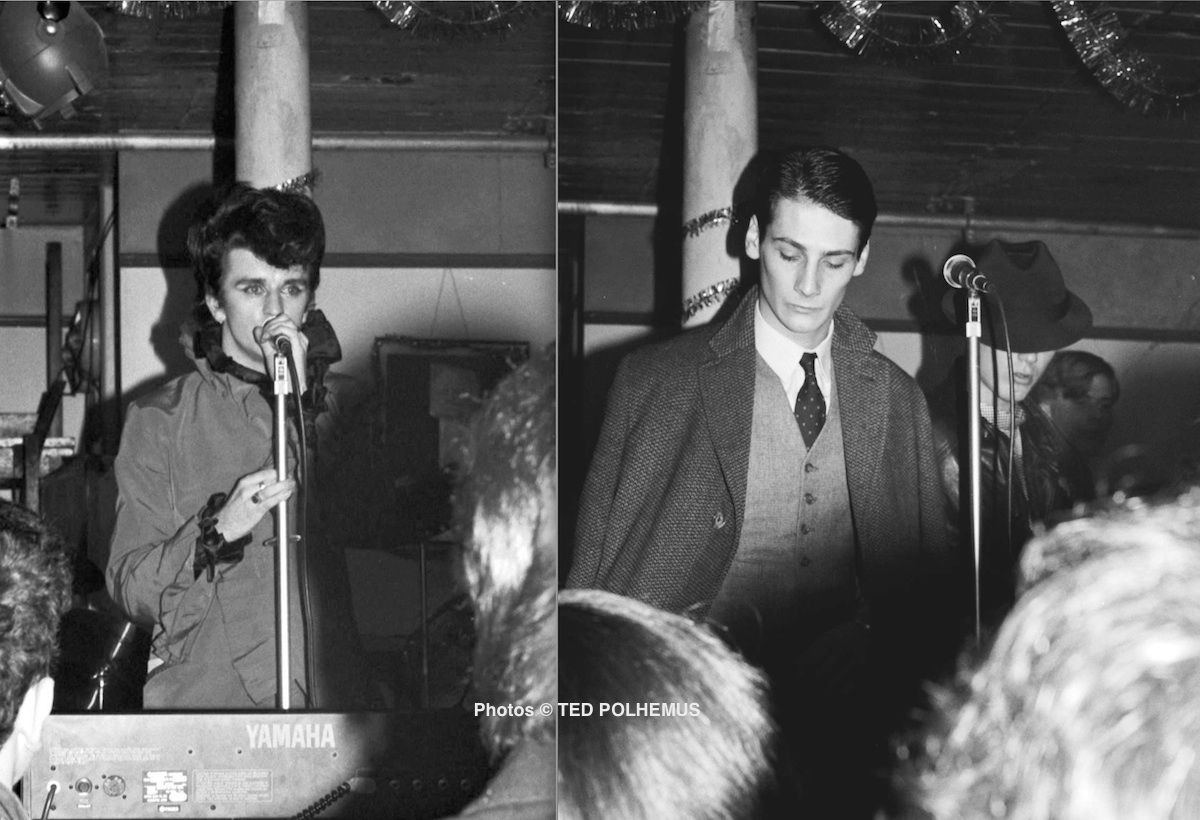
Spandau Ballet’s debut beneath festive bunting: left, Steve Strange in PX frills introduces the new band at the Blitz Christmas party in December 1979… Tony Hadley supercool in collar, tie, waistcoat and overcoat, Martin Kemp in jaunty trilby with Steve Norman beyond. Dagger’s blog seems unaware of these photos and after seeing them here at Shapersofthe80s, Gary Kemp recalls “being terrified while playing the little Yamaha CS-10, that we wouldn’t get away with it. Apart from many of the songs that made up our first album we also played Iggy Pop’s Fun Time and On Her Majesty’s Secret Service”
On the 40th anniversary of Spandau Ballet’s debut
performance at London’s Blitz club spearheading
the post-punk new wave, the band’s manager
Steve Dagger publishes his eye-witness account…
❏ On the 5th of December 1979, Spandau Ballet was born. After a year in metamorphosis and following a successful preview show two weeks before at Halligan’s rehearsal studios, when they were named by journalist and broadcaster to be, Robert Elms, Spandau Ballet emerged onto the stage and into the world at the Blitz on the occasion of Steve Strange and Rusty Egan’s Christmas party in 1980 [1979 surely – Ed].
Much has been written about the Blitz and its extraordinary position as a cultural funnel at the beginning of the 80s. But Spandau Ballet’s two performances there and subsequent meteoric rise to success did much to drive this tiny club and its spectacular cliental [clientele? – Ed] into the headlines and its ethos into popular culture and serve as the template to the 80s.
What happened that night?
No band had played before at a Steve Strange/Rusty Egan event, so the audience was not used to seeing live music in this context. Music was normally provided by Rusty Egan’s DJing, an extraordinary montage of epic electronica which seemed to give a tantalizing glimpse of a future we were all going to take part in.
How would “Spandau Ballet” be received? The preview show had gone incredibly well, so a handful of our friends and key faces on the scene had seen the band already, liked them and spread the word. But it was an impossibly cool crowd. Whether they were fashion students, artists, embryonic designers, wannabe writers, film directors or just London’s coolest of the cool night people, they all had an opinion of themselves and everything else.
The usual crowd was supplemented by a sprinkling of older cognoscenti, a Chelsea crowd who had become aware of the Blitz scene. The likes of Keith Wainwright, uber-cool hairdresser of Smile; artist Dougie Fields to name but a few, plus some musicians who had been drawn to the Blitz. Richard Burgess of Landscape (Spandau Ballet producer to be), Midge Ure of Ultravox and Billy Idol, Steve Severin of Siouxsie and the Banshees and Marco Pirroni of Adam & The Ants.
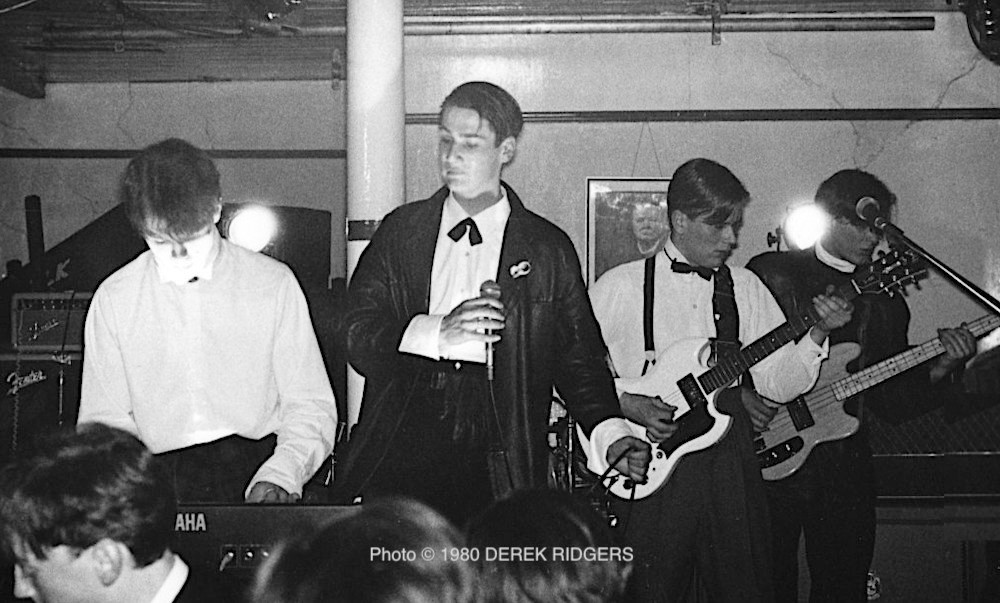
Spandau Ballet’s second Blitz date, January 1980, despite Dagger’s belief on his blog that this pic shows the band’s debut. Most are sporting bow ties – Gary Kemp on synth at left, Tony Hadley as vocalist, with Steve Norman and Martin Kemp on guitars held high in their anti-rock stance. Churchill gazes out from his photo on the rear wall
So the battle lines were drawn and into the valley [of] death… Actually, the band were much less nervous than they had been for the preview show and also excited about playing in “their” club. When Rusty’s music stopped and they got onto the tiny stage there was a degree of anticipation and curiosity. I think the band realised collectively it was now or never and they seized the moment and started to play confidently and with a bit of swagger. Some of the audience danced, some applauded but almost everyone watched.
Tony sang brilliantly. The set which included most of the songs on “Journeys to Glory” fitted the club. Spandau Ballet fitted the club. “To Cut a Long Story” sounded like a massive hit.
Halfway through the set I was feeling quietly confident and was standing by the mixing desk next to the sound engineer when I became aware of a man standing next to me. He spoke to me.
“Who is this band?”
“It’s Spandau Ballet,” I said.
The new name sounded f*cking great.
“Which record label are they signed to?”
“They aren’t signed.”
“Who is their manager.”
“I am,” I said proudly.
“Well I am Chris Blackwell and I own Island Records, and I would like to sign them.”
First gig as Spandau Ballet… 5-0 up. Another man approached me. He was Danny Goodwin from Peninsula Music Publishing. He wanted to sign them too.
The band finished their set. I could not wait to go backstage into the tiny dressing room to talk to them. We had all worked very hard for this moment. They were about to become a very important band. The only band that could play in the Blitz. The most important club in the world at that time. Everyone in the Blitz that night was hugely complimentary and positive about them.
We owned the space, we had claimed it. We were about to go through the looking glass and our lives were never going to be the same. The next day, I spoke to Chris Blackwell on the phone and arranged to meet him in a pub. He was softly spoken, charming and very cool. He owned the coolest record label in the world – Bob Marley, Roxy Music, Traffic, Free, Spencer Davis – and he wanted to sign Spandau Ballet. Now. He even gave me a list of lawyers he recommended to act for the band.
It all felt a little strange but somehow like it was all supposed to happen like this. I felt unbelievably relaxed and comfortable, empowered, and the band very confident, entitled energised. Uncrowned Princes of pop culture all of a sudden. We turned him down. But that is another story.
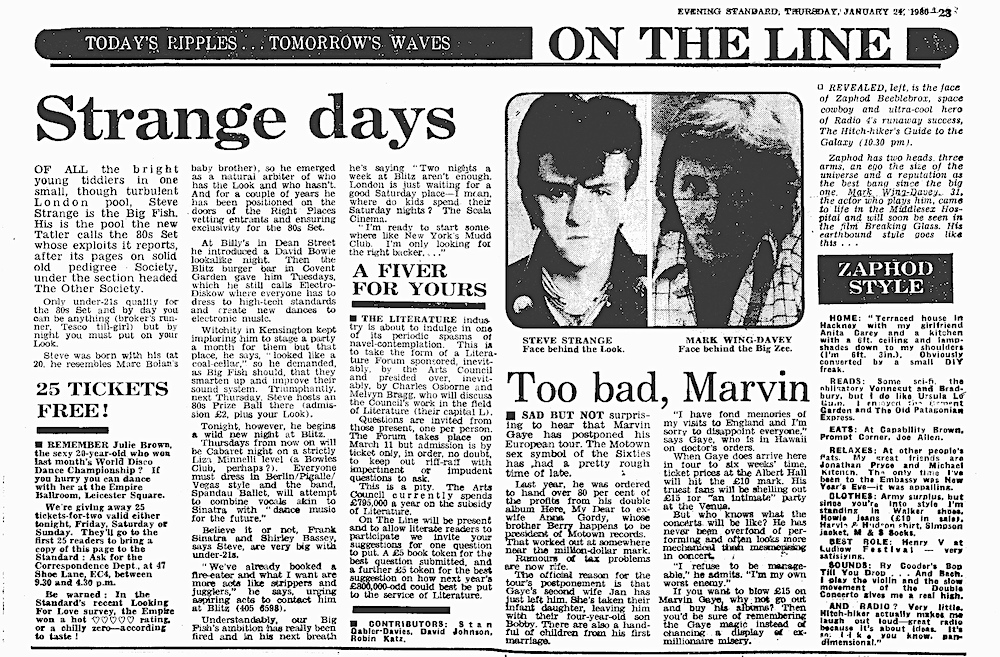
Steve Strange’s first interview with the Evening Standard, 24 Jan 1980, telling us of Spandau Ballet’s second performance that day
RARE VIDEO OF THE BLITZ A-BUZZ:
❏ You won’t find much authentic filmed footage inside the Blitz Club because so little exists and many posts claiming to show the Blitz at YouTube do not. The brief but glorious clip we see above captures the visual excess of its dancefloor in Spandau Ballet’s 2014 biopic Soul Boys of the Western World. The interiors come from Lyndall Hobbs’ short doc about London tribes called Steppin’ Out, shot in the summer of 1979. The first half-minute here comes from a TV report showing Blitz Kids gathering outside Sloane Square underground station to celebrate Steve Strange’s 21st birthday aboard a Circle Line train on 28 May 1980. We hear Martin Kemp voicing the sequence which zooms in on him at 23 seconds. The black-and-white stills collaged into the segment are Shapersofthe80s originals, and the closing seconds are from LWT’s 20th-Century Box.
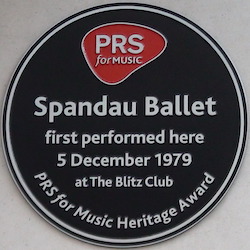
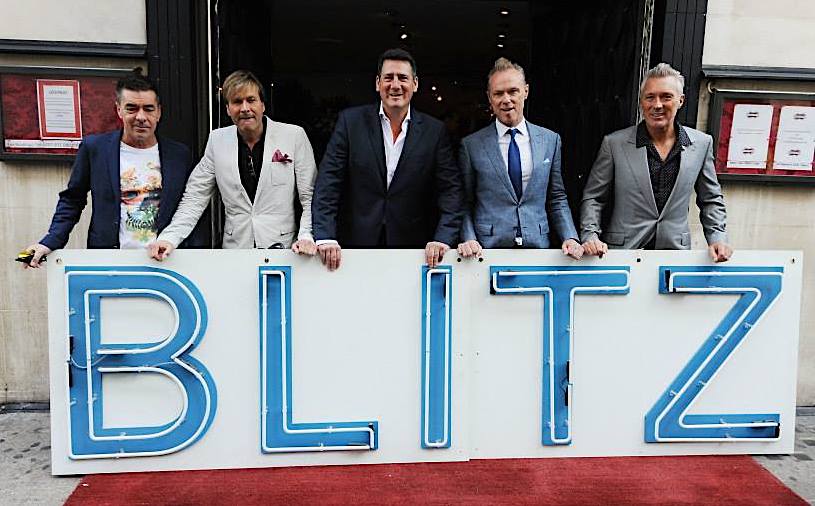
Heritage award from the Performing Rights Society: In September 2014 Spandau Ballet returned to the site of the Blitz Club to see a plaque installed remembering their debut. The club’s original neon sign was also present for the photoshoot
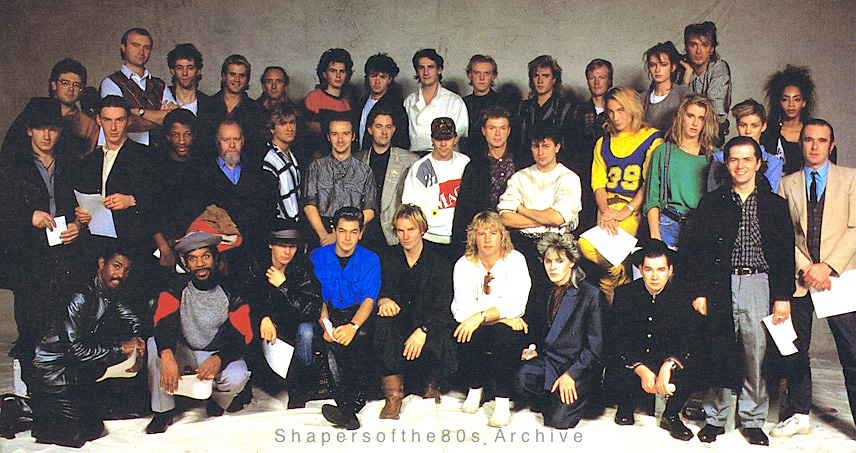
The Band Aid band, Nov 25, 1984: most of the pop stars who performed, plus artist Peter Blake who created the record sleeve for Do They Know It’s Christmas?
◼︎ TODAY WAS THE DAY IN 1984 THEY RECORDED the song that became, for 13 years, the biggest selling UK single of all time. Do They Know It’s Christmas was released four days later, stayed at No 1 for five weeks, sold over three million copies and raised significant funds for famine relief in Africa. The project lead naturally the next year to Live Aid, the biggest globally televised rock concerts ever, viewed by two billion people in 60 countries, who coughed up still more dollars…/ Continued inside
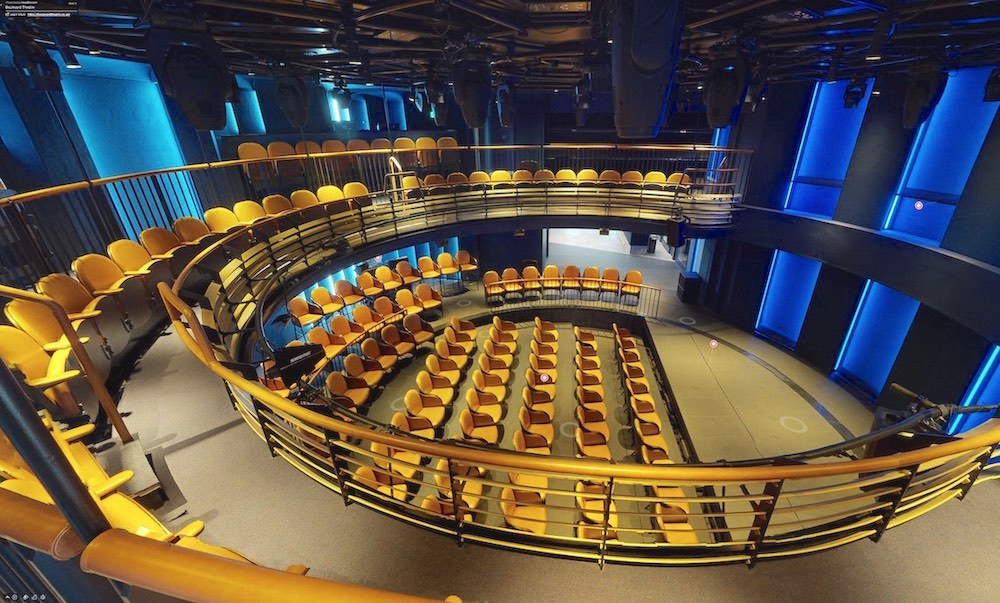
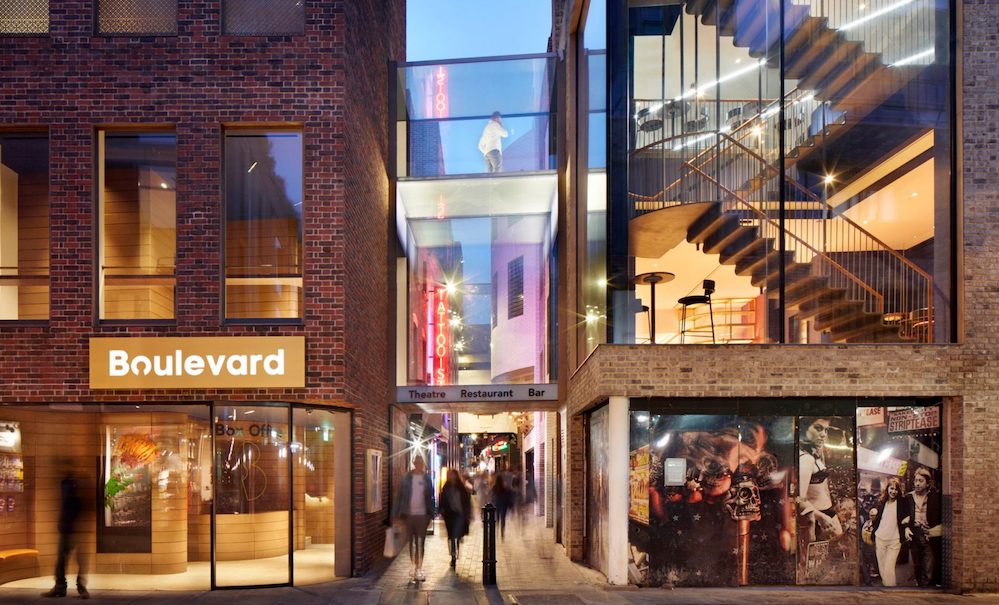
Contemporary new Boulevard Theatre and function space, photographed by Jack Hobhouse
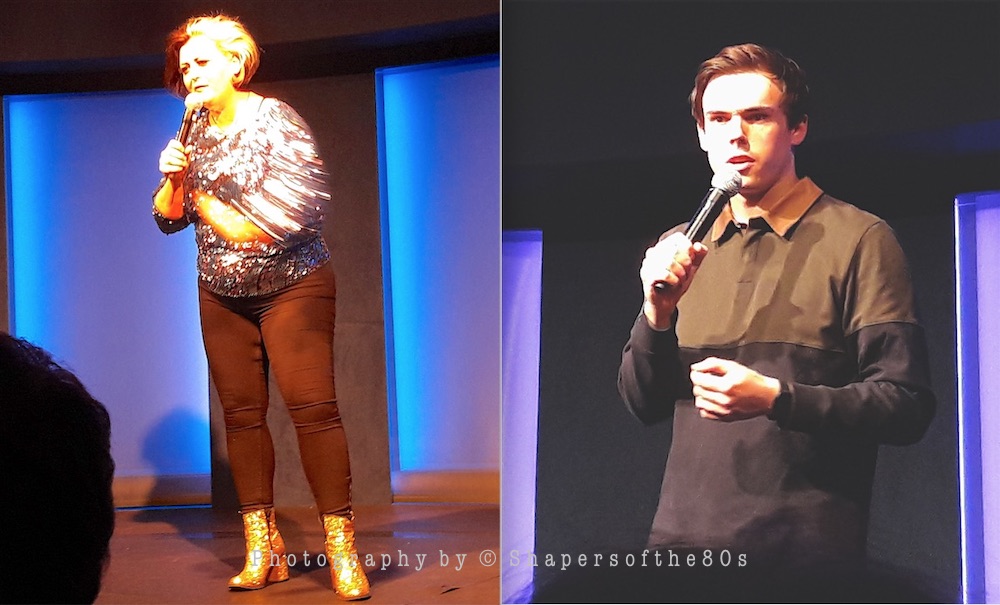
Friday’s Late Night Scene: Kiri Pritchard-McLean and Rhys James
◼ AN INTIMATE NEW 170-SEAT THEATRE and function space has opened in Soho on the site of Paul Raymond’s original striptease Revuebar from 1958 to 2004. It is named after the Boulevard Theatre which reinvented itself there in 1980 from its racy predecessor by showcasing The Comic Strip team who went on to rewrite the rules of British comedy. The stage proved the springboard to success for Alexei Sayle, Ade Edmondson and Rik Mayall, Nigel Planer and Peter Richardson and Dawn French and Jennifer Saunders.
After a £40m redevelopment of the site in Walker’s Court under the shrewd business eye of Raymond’s grand-daughter Fawn James, there’s now an active programme of theatre and weekly late events for live music, cabaret and comedy. This weekend’s unruly Friday comedy set from 10.30pm was fronted by the wry Kiri Pritchard-McLean. Stand-ups included Olga Koch, whose name struck a risqué note from the start, plus an Edinburgh Award winner who sadly didn’t quite click. However, topping the bill at machine-gun speed was TV face Rhys James and he alone was worth the £15 ticket price.
The in-house theatre production playing daily is Ghost Quartet, the 2014 “song cycle about love, death and whiskey” by American Dave Malloy, directed by Bill Buckhurst. In January comes The Sunset Limited, from the American novelist Cormac McCarthy, his 2006 exploration of free will dubbed “a novel in dramatic form” and directed by Terry Johnson, the multi-award-winning British dramatist.
The Boulevard’s rebirth is down to Fawn James as a director of Soho Estates, who says she intends to honour her grandfather’s legacy as an impresario and property investor by helping to promote Soho as an arts and entertainment district. The Boulevard’s artistic director is Rachel Edwards who founded the award-winning Tooting Arts Club.
The glorious Revuebar neon sign from Raymond’s era has been faithfully reconstructed to shine out as a Brewer Street landmark though, true to neon tradition, several letters have already blacked out! The four-storey building houses an adaptable, state-of-the-art auditorium, restaurant, bar, lounge and rehearsal room. Versatility is at the core of the venue, with every space fully customisable for a range of functions embracing weddings and conferences. The Boulevard has been actively recruiting to fill a variety of jobs.
Click any pic below to enlarge
Boulevard Theatre’s new facade and bridge by Soda Studio
“ The Boulevard Theatre features stalls and a balcony that both revolve independently, along with a stage that moves up and down, making a wide variety of different configurations possible. The entire project is designed by Soda, a London-based studio that works across architecture, interiors and graphic design. It forms part of a new development in the heart of Soho.
The bar and restaurant is an art-deco-inspired space featuring pink panelled walls, marble surfaces, brass lighting, and leather and velvet upholstery. There are also subtle references here to the Boulevard logo, while the glass bridge features an inlay of lace, in reference to a brothel previously located on this street.
Soda worked with theatre specialist Charcoalblue to make the auditorium as functional as possible. The transformations all take less than 10 minutes, so the space can easily host three or four different types of performance in one day.
Developer Fawn James said: “One of the things that I really wanted was that element of surprise, because when you’re in Soho you don’t necessarily know what you’re getting. Sometimes you could come to a show in the round, go downstairs, grab a bite to eat, then come back up for the next show and feel like you’re in a completely different room…” / Continued at Dezeen online
Photography is by Jack Hobhouse unless otherwise stated
➢ Choose “View full site” – then in the blue bar atop your mobile page, click the three horizontal lines linking to many blue themed pages with background article
MORE INTERESTING THAN MOST PEOPLE’S FANTASIES — THE SWINGING EIGHTIES 1978-1984
They didn’t call themselves New Romantics, or the Blitz Kids – but other people did.
“I’d find people at the Blitz who were possible only in my imagination. But they were real” — Stephen Jones, hatmaker, 1983. (Illustration courtesy Iain R Webb, 1983)
“The truth about those Blitz club people was more interesting than most people’s fantasies” — Steve Dagger, pop group manager, 1983
PRAISE INDEED!
“See David Johnson’s fabulously detailed website Shapers of the 80s to which I am hugely indebted” – Political historian Dominic Sandbrook, in his book Who Dares Wins, 2019
“The (velvet) goldmine that is Shapers of the 80s” – Verdict of Chris O’Leary, respected author and blogger who analyses Bowie song by song at Pushing Ahead of the Dame
“The rather brilliant Shapers of the 80s website” – Dylan Jones in his Sweet Dreams paperback, 2021
A UNIQUE HISTORY
➢ WELCOME to the Swinging 80s ➢ THE BLOG POSTS on this front page report topical updates ➢ ROLL OVER THE MENU at page top to go deeper into the past ➢ FOR NEWS & MONTH BY MONTH SEARCH scroll down this sidebar
❏ Header artwork by Kat Starchild shows Blitz Kids Darla Jane Gilroy, Elise Brazier, Judi Frankland and Steve Strange, with David Bowie at centre in his 1980 video for Ashes to Ashes
VINCENT ON AIR 2026
✱ Deejay legend Robbie Vincent has returned to JazzFM on Sundays 1-3pm… Catch up on Robbie’s JazzFM August Bank Holiday 2020 session thanks to AhhhhhSoul with four hours of “nothing but essential rhythms of soul, jazz and funk”.
TOLD FOR THE FIRST TIME
◆ Who was who in Spandau’s break-out year of 1980? The Invisible Hand of Shapersofthe80s draws a selective timeline for The unprecedented rise and rise of Spandau Ballet –– Turn to our inside page
SEARCH our 925 posts or ZOOM DOWN TO THE ARCHIVE INDEX
UNTOLD BLITZ STORIES
✱ If you thought there was no more to know about the birth of Blitz culture in 1980 then get your hands on a sensational book by an obsessive music fan called David Barrat. It is gripping, original and epic – a spooky tale of coincidence and parallel lives as mind-tingling as a Sherlock Holmes yarn. Titled both New Romantics Who Never Were and The Untold Story of Spandau Ballet! Sample this initial taster here at Shapers of the 80s
CHEWING THE FAT
✱ Jawing at Soho Radio on the 80s clubland revolution (from 32 mins) and on art (@55 mins) is probably the most influential shaper of the 80s, former Wag-club director Chris Sullivan (pictured) with editor of this website David Johnson
LANDMARK FAREWELLS. . . HIT THE INDEX TAB UP TOP FOR EVERYTHING ELSE









 ➢➢ Shapers of the 80s ➣➣