➤ Happy New Year from Frosty The Snowman — and The Ronettes

TURN UP YOUR VOLUME BEFORE YOU
CLICK HERE TO VIEW A VIDEO MONTAGE OF
♫ ♫ FROSTY THE SNOWMAN . . .

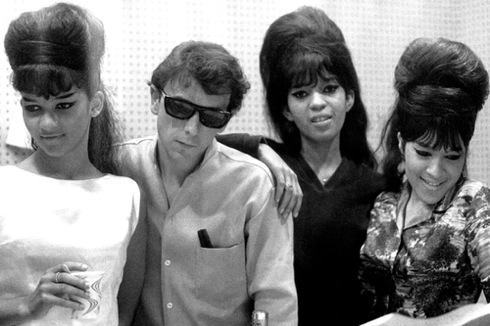
The Ronettes, Phil Spector, Frosty the Snowman, Be My Baby, Wall of Sound, 1963

The Ronettes in 1963: beehive hair-dos and producer Phil Spector

➢ WHILE WE’RE WITH THE RONETTES, WHAT’S THE SMASH THAT CHANGED THE SOUND OF 60s POP?
♫ ♫ CLICK TO VIEW VIDEO …

Ronettes, Be My Baby, Phil Spector, Wall of sound, 1963

❚ BRIAN WILSON OF THE BEACH BOYS has declared Be My Baby by the Ronettes his own all-time favourite, and the greatest pop record ever: “The choruses blew me away.” Whoa-oh-oh-oh-ohhh! In August 1963 it changed the game entirely. Be My Baby swept into the charts with a lush new approach to orchestration called the “Wall of Sound” that was to bring down a cleaver between rock and pop. Both however were infected by the sheer musicality introduced by its creator, the record producer Phil Spector. He layered pianos, guitars, reeds, brass and most daringly strings, adding studio overdubs and echo, plus any number of people on percussion — famously, castanets. His own description was “little symphonies for the kids”.

Be My Baby, Ronettes, Phil Spector, Wall of sound, PhillesBe My Baby took 42 takes to complete, and its spine-tingling intro is unbeatable. The Ronettes’ original has been immortalised in the Grammy Hall of Fame and the Library of Congress for being the quintessence of the dense Spector sound that influenced all who followed, including The Beatles on Let It Be, and the output of Trevor Horn in the 1980s.

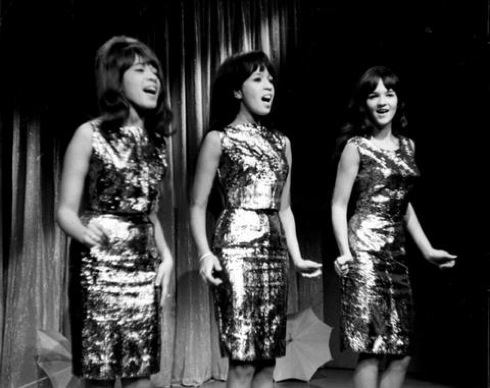
The song was co-written by one of the many writing partnerships based in New York’s Brill Building — Ellie Greenwich and Jeff Barry — with a few finishing flourishes added by Spector. The Ronettes themselves were three hot girls from Spanish Harlem, the sisters Estelle and Ronnie Bennett (who later married Spector), and their cousin, Nedra Talley. Their trademarks were beehive hair-dos, eye makeup in the Cleopatra style and tight skirts. Spector signed the Ronettes to his Philles record label and subsequently managed them. Other smash hits included Baby I Love You, The Best Part of Breaking Up, and Walking In the Rain with Spector’s classic storm effects (covered memorably by the Walker Brothers in 1967).

♫ ♫ View video of Brian Wilson playing Be My Baby live — In Q Magazine’s 1001 Best Songs Ever Wilson said: “This is a special one for me. What a great sound, the Wall of Sound. Boy! First heard this on the car radio and I had to pull off the road, I couldn’t believe it. The choruses blew me away; the strings are the melody of love. It has the promise to make the world better.”

♫ ♫ John Lennon covers Be My Baby

FRONT PAGE

2010 ➤ Index of posts for December

Duran Duran, 80s, pop

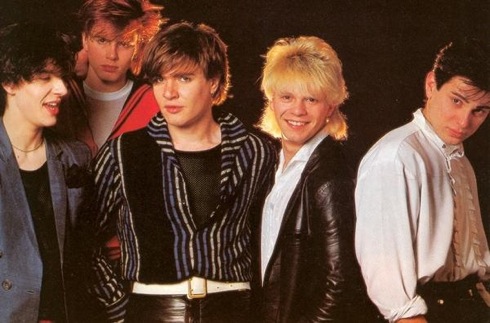
The early Duran Duran: discovered by invitation in 1980

➢ 80s shapers win 2010 New Year Honours for fashion, music and walking in space

➢ 1980 secrets revealed about the SAS, arming Afghanistan and death of the tanner

➢ 1980, As Spandau play in Heaven, all around we can hear the new sounds of 1981

➢ 1980s, So many shapers shaped the decade that people think was all down to Margaret Thatcher — key books of the year

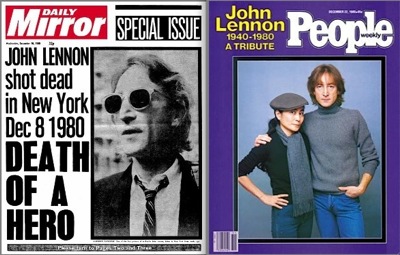
John Lennon death, Daily Mirror, people magazine, 30th anniversary
➢ What larks! Festive fun and games and British ways to make merry

➢ A jolly festive tree by Andrew Logan

➢ 2010, Duran no turkey: here’s the Bacofoil video and two new tracks premiered at East Village Radio

➢ 1980, How Duran Duran’s road to stardom began in the Studio 54 of Birmingham

➢ A feast of Bowie-ana served in waffeur-thin slices

➢ Whatta they like? Essex reality stars shake their vajazzles in the face of Hollywood

➢ 1980, The Lennon we knew: unfulfilled talent with a genius for making friends the world over

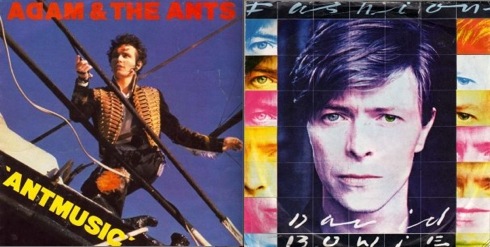
Adam & The Ants, David Bowie, Swinging 80s,Top Of The Pops
➢ 1980, The week the Swinging 80s clicked into gear

➢ Live online now, mad hatter Stephen Jones

➢ This £5m iPhone has to be a spoof! Yes, that’s $7.8m or €6m or 52m Chinese Yuan or 245m Russian Rubles

FRONT PAGE

➤ 80s shapers win 2010 New Year Honours for fashion, music and walking in space

Katharine Hamnett, Fashion Aid

Fashion Aid 1985: Katharine Hamnett’s dazzling style, plus slogans

❚ IN THE FASHION WORLD, protest T-shirt designer Katharine Hamnett, 63, and Raymond Kelvin, 55 (founder of Ted Baker), are appointed CBEs, an order of chivalry granted twice a year by the British monarch for exceptional public service. Hamnett graduated from Saint Martin’s School of Art in 1969. Ten years on, she launched the Katharine Hamnett label and her first protest T-shirts bearing slogans such as Choose life, Worldwide nuclear ban now, Preserve the rainforests, Save the world. The British Fashion Council declared her designer of the year in 1984, when her designs became popular with pop stars including Wham! and Madonna. That year she famously met the then-prime minister Margaret Thatcher at a Downing Street party wearing a T-shirt proclaiming “58% don’t want Pershing” (the US ballistic missile). The meeting made news across the world and Vogue called it one of the most iconic moments in fashion. Hamnett remembers: “She didn’t notice it at first, but then she looked down and made a noise like a chicken. Then quick as a fishwife she said: ‘Oh well we haven’t got Pershing here, so maybe you are at the wrong party’, which I thought was rather rude as she had invited me.”

➢ New Year Honours reported by the BBC

Sandy Powell, Gwyneth Paltrow, Shakespeare in Love, OBE, Oscars

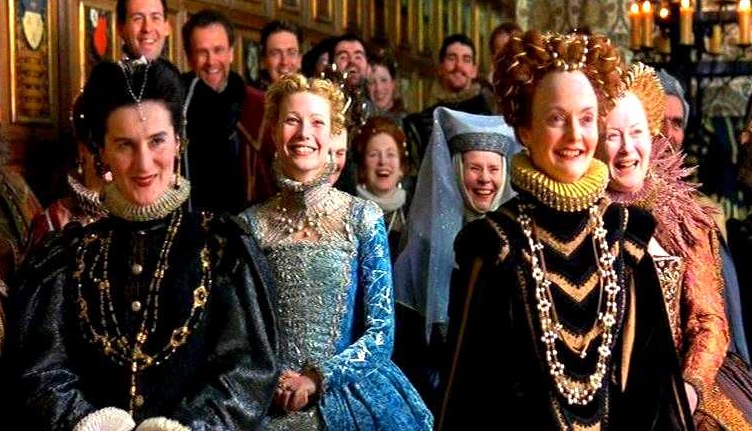
Gwyneth Paltrow sports her blue number from Shakespeare in Love: Sandy Powell’s costumes drew on half a century of Elizabethan design

❚ OSCAR-WINNING COSTUME DESIGNER SANDY POWELL, 50, receives an OBE for services to the film industry. She studied theatre design at Saint Martin’s and won her third Oscar earlier this year for The Young Victoria. Her previous wins were for Shakespeare In Love, in 1999 and The Aviator, in 2005. Of her job, she once said: “A costume designer’s contribution is to help make some believable characters, that’s all.”
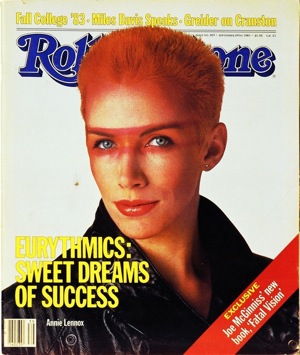
Annie Lennox, Eurythmics, Rolling Stone

Annie Lennox: Cover girl in 1983. Photographed by C J Camp © Time Inc

❚ ABERDEEN-BORN SINGER ANNIE LENNOX, 56, is appointed an OBE for work fighting Aids and poverty in Africa. As one half of the Eurythmics, she brought her own unique voice and style to the music scene in 1981 with the hit Sweet Dreams, and later Thorn in My Side and Walking on Broken Glass. Today she is an Oxfam ambassador and, inspired by Nelson Mandela, founded her SING campaign to raise awareness of Aids in Africa. She said of her OBE: “It either means I’ve done something terribly right — or they’ve done something terribly wrong.”

➢ Entertainment honours reported by the BBC

Buggles, Video Killed the Radio star, Trevor Horn

Trevor Horn, left, as one half of Buggles, 1979

❚ RECORD PRODUCER TREVOR HORN, 61, who dominated orchestral pop in the 80s, receives a CBE, as does Howard Goodall, 52, National Ambassador for Singing, who created theme tunes for TV shows that included Blackadder. During Horn’s influential career his epic treatment made ABC’s The Lexicon of Love one of the masterpieces of 1980s pop, and enhanced hits by Frankie Goes to Hollywood on his own ZTT label, the Pet Shop Boys, Robbie Williams, Tina Turner, Simple Minds and Grace Jones’s mesmerising Slave To The Rhythm. He was named best producer at the Brit awards in 1983, 1985 and 1992, and won a Grammy in 1995 when Seal’s Kiss from a Rose was named record of the year.

❚ TALKING OF BLACKADDER, its producer John Lloyd, 59, also becomes a CBE — he also oversaw the landmark 80s comedy series Not The Nine O’Clock News and Spitting Image.

BRITISH ASTRONAUT RECALLS
THE SMELL OF SPACE

Atlantis, Nasa, Piers Sellers,shuttle, STS-112 crew portrait

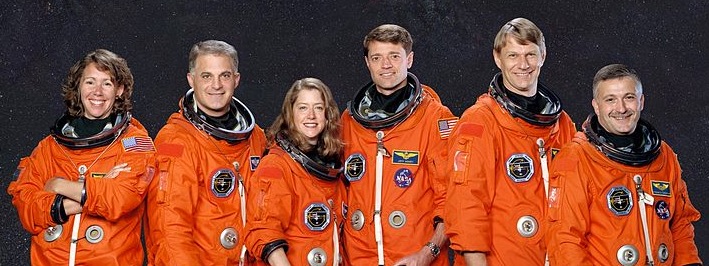
Atlantis shuttle crew, summer 2002: Sandra Magnus, David Wolf, Pamela Melroy, Jeff Ashby, Piers Sellers, and the Russian cosmonaut Fyodor Yurchikhin © Nasa

❚ HE WAS NEVER A NEW ROMANTIC, but astronaut Piers Sellers, 55, from Crowborough, East Sussex, is from the same generation. He is one of the nine Brits who have flown in space and he receives an OBE for services to science. Dr Sellers had to become an American citizen to be considered by Nasa, and then flew three missions aboard the shuttles Atlantis and Discovery in 2002, 2006 and again this year. He has carried out six spacewalks to continue the assembly and maintenance of the International Space Station. With the shuttle programme coming to an end, Dr Sellers — who took a degree in ecology and a PhD in climate simulation — is set to return to Nasa Goddard to resume his science pursuits.

Nasa, patch,space shuttle,Atlantis, STS112

Nasa patch for Atlantis mission STS112

When I met him and the Atlantis crew at the US embassy in London, touring the world in 2004 to talk up the Nasa programme following the Columbia shuttle disaster, the most startling thing he said was that space had a unique smell of its own: “Like burning steel.” The most shocking aspect of this observation is how the smell is transmitted. Smells comprise minute particles of material, which stimulate the sensory receptors in the nose. They could be as small as molecules, or ions, but to notice them at all space-walking astronauts must inevitably have brought them inside the shuttle from the exterior working environment of space. You hesitate to mention the word “alien”, but surely these particles have the potential to infect us earthlings with, er, whatever?

Each of the crew seemed to have been handpicked for their social skills, so during the party I questioned them all on the nature of this smell. Unprompted, every astronaut provided roughly similar descriptions of the smell of space — a mixture of sharp, smoky, acrid, burned metallic odours that permeate their Orlan space suits.

Michael Fossum,Piers Sellers, spacewalk,Nasa, space shuttle, Discovery, mission STS121

British astronaut Piers Sellers during the third spacewalk from the shuttle Discovery, July 2006: photographed by Michael Fossum, whose reflection is visible in the visor

When I asked mission commander Jeffrey Ashby about the risks of contamination, he said that in the early days of space flight, astronauts were always quarantined on returning to Earth and kept under observation for many days. With the passing of the years, and a marked absence of spiny creatures bursting out of people’s chests, quarantine was simply abandoned. The reasoning is that the extreme temperatures in the vacuum of space (+270 degrees C to –270 degrees C) would have exterminated any viral threats — especially the searing heat that had created the smell of space by burning the shuttle’s steel exterior, similar to that from an arc-welding torch used to repair heavy equipment. Yes, but, I hear you say: What about the cockroach?

➢ More from Nasa on the smell of space

FRONT PAGE

1980 ➤ Secrets revealed about the SAS, arming Afghanistan and death of the tanner

Yes Minister, Nigel Hawthorne, Paul Eddington

Rt Hon James Hacker MP (right): “This is a democracy, and the people don’t like it.” — Civil servant Sir Humphrey Appleby: “The people are ignorant and misguided.” — Hacker: “Humphrey, it was the people who elected me.” (From Yes Minister, BBC TV’s satirical sitcom set in Westminster, launched Feb 25, 1980)

❚ PREVIOUSLY SECRET UK GOVERNMENT RECORDS are routinely declassified after 30 years. Cabinet documents for 1980 were released by the National Archives at noon today, Dec 30 2010. Here’s a selection of titbits most of us have been unaware of…

➢ SAS to be given immunity for killing foreigners — The televised storming of the Iranian embassy building in London in 1980 boosted the SAS’s international prestige and generated invitations to deploy them on overseas hostage rescue missions. (Guardian)

➢ Margaret Thatcher in cover-up after Czech spy exposed John Stonehouse — Did you know that John Stonehouse, the former Labour minister who “did a Reggie Perrin” and vanished abroad, was said to have been a spy? (Guardian)

➢ Britain secretly agreed to back Afghan resistance fighters after the Soviet invasion of their country — One faction of the Mujahideen fighters, who were also covertly funded by the CIA, went on to become founding members of the al-Qaeda terrorist network. (Daily Telegraph)

➢ Unflappable Douglas Hurd stunned into silence during Afghan revelations — UK Confidential on the BBC iPlayer

Ahmad Shah Massoud ,Afghanistan, 1983, Nagakura

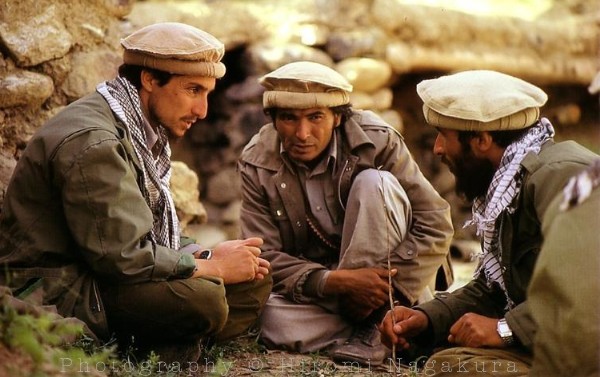
Ahmad Shah Massoud (left): on the ground in Afghanistan in the Panjshir province of Afghanistan 1983. Photographed © by Hiromi Nagakura

❏ Listen online to BBC Radio 4’s response to today’s revelations in an excellent edition of UK Confidential chaired by Martha Kearney. After hearing that western powers had decided in 1980 to provide “discreet support for Afghan guerrilla resistance”, former Labour minister Roy Hattersley and former BBC chief political correspondent John Sergeant wrong-foot Douglas Hurd who had been a foreign office minister at the time. How much aid was spent on arms? Had we armed the wrong people? Kearney herself notes that “arms were going to Shah Massoud” (later dubbed “the Afghan who won the Cold War”.) Twice Hurd is forced into silence, as he formulates his eventual reply: “I’m not saying. Of course I’m not saying.” Terrific radio, from the 32-minute mark.

Other topics include Margaret Thatcher’s patrician scolding by Harold Macmillan… her furious row with the Bank of England… her moderate reaction to early trade-union strikes … and how the government tackled an Iranian warship on the River Tyne.

➢ Cabinet ministers feared 30 years ago that MPs were abusing their expenses — Margaret Thatcher was warned that there was a “grave risk of serious public scandal” over Parliamentary allowances and that some politicians may have to be prosecuted. (Daily Telegraph)

Harold Macmillan, Supermac, Vicky

Harold Macmillan: depicted as Supermac by the cartoonist Vicky

➢ Macmillan’s 11-page private warning to Margaret Thatcher — “Supermac”, the Conservative prime minister from 1957-63, sent a remarkable letter criticising the PM’s economic strategy. (Guardian)

➢ The sixpence was killed off to raise £3.5m by melting down the old coins — Margaret Thatcher ordered the “death of the tanner”, introduced in 1551 and made obsolete by the decimalisation of sterling. The last coins were struck in 1967. (Daily Telegraph)

FRONT PAGE

1980 ➤ As Spandau play in Heaven, all around we can hear the new sounds of 1981

Spreading the New Romantic message, including clothes by PX: Spandau Ballet play Heaven, Dec 29, 1980. Photographed © by Shapersofthe80s

❚ SIX WEEKS IN THE CHARTS with their debut single, To Cut a Long Story Short, on this day in 1980 Spandau Ballet play at Heaven, the biggest disco in London, and probably in Europe. Their average age is 20. A year after their unveiling at the Blitz club, this is still only the band’s tenth public date, and only their second concert since signing to Chrysalis in October. Their policy is to maintain an air of exclusivity, to thwart the backward rock press by playing admission-by-invitation dates in nightclubs rather than conventional rock venues, and to rely on stylish videos to stress the message that here was a new generation of new sounds and, equally important, new styles. Take it on trust that for the whole of 1980 Spandau Ballet had been the most achingly fashionable pop group on the planet, dressed by the designers of the moment. Significantly, as the first club band to win a record deal, they had been the only New Romantics to appear on Christmas Day’s year-ending edition of Top of The Pops, the BBC’s flagship music show. (Yes, Adam and the Ants also appeared, but he was “glam-punk”, important distinction, as Marco Pirroni confirms.)

On Dec 20, Visage, the Blitz club’s seven-piece studio line-up had entered the singles chart with Fade to Grey. The same week saw Le Kilt’s Christmas party, the new New Romantic club that had opened almost as soon as Steve Strange’s clubnights at the Blitz had ceased. Le Kilt’s co-host Chris Sullivan had murmured something about putting together a band he called Blue Rondo à La Turk. Not to be outdone, i-D’s cub editor Perry Haines had mentioned not only a band he was managing, Alix Sharkey’s Stimulin, but tonight in Heaven he now talks of his involvement with Duran Duran, the Rum Runner house band we’d all run into at Spandau’s November show in Birmingham.

Depeche Mode, Daniel Miller, Dreaming of Me, synthpop

Basildon’s finest: Depeche Mode recorded their first single, Dreaming of Me, in December 1980, after a verbal contract with Daniel Miller’s synth-driven label Mute

Here too is Daniel Miller, an anarchic electronic musician with his own label called Mute and a recording studio in an old church where he had set up all his synthesisers. Only last night he’d been watching Depeche Mode, an unsigned teenage band from Essex, playing the Bridge House pub in east London where they were regulars — he’d heard them play their technopop tune Dreaming of Me, helped them record it and they’d all agreed it would make a great first single.

All round us in UK clubland platoons of amazingly young bands making dance music were lining up to storm the charts in the New Year. By the spring, Spandau Ballet was staging the first Blitz invasion of America with a live concert plus fashion show by a gang of Blitz Kids whose average age was 21. During 1981 the group decided against a tour as being “too rocky”, and played only 10 live dates in the whole year — OK, plus a fortnight at the Ku club in Ibiza that summer, which counted as one booking. While the movement took root, staying cool seemed to suit the style of the times.

FRONT PAGE