“As a cherishable example of alternative British culture,
it makes you wonder why this isn’t the orthodoxy”
— Nigel Andrews, Financial Times
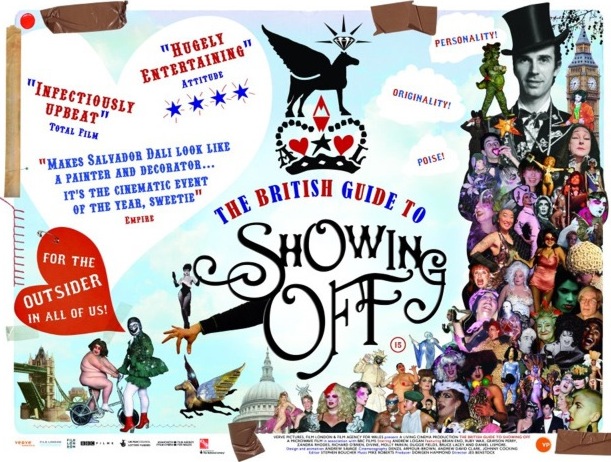
❚ ANDREW LOGAN. BRITISH ARTIST. SOCIAL MAGICIAN. Here is one of the giants of the subcultural landscape during the 70s who helped shape the imaginations of the Blitz Kids of the 80s. In 1972, Logan created the anarchic and outrageous Alternative Miss World Show, a spectacular costume pageant and fancy dress party for grown-ups, which has been reborn in 12 incarnations over the years. In a new film, The British Guide to Showing Off, director Jes Benstock takes us under Logan’s glittering wing to share this joyous and exotic subcultural event. Raucous, liberating and sexually charged, The British Guide to Showing Off “speaks to the outsider in all of us”, they say. At the ICA cinema from today.
“Makes Salvador Dali look like a painter and decorator”
— Empire magazine
➢ Former Blitz Kid now international deejay Princess Julia introduces us to the world of Logan at i-D online: “ Andrew’s eclectic crowd has consisted of musicians such as Brian Eno and Divine and Nick Rhodes, designer Zandra Rhodes who has designed all of Andrew’s she-male stage costumes, fellow artists Duggie Fields, Derek Jarman, Grayson Perry and even David Hockney… a cast which includes models, scene stealers and individualists that have made London so vital from the days of glam-rock to the very present… ”
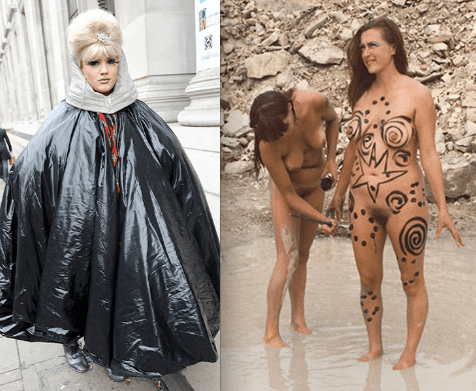
➢ Nov 13 update: The 10 best show-offs — in the Observer Andrew Logan, founder of The Alternative Miss World, pays homage to the outrageous, outlandish and out of this world
Two of Logan's choice show-offs: clubhost Daniel Lismore (pic from Rex) and the Binnie Sisters, aka the Neo-Naturists
❏ iPAD, TABLET & MOBILE USERS PLEASE NOTE — You may see only a tiny selection of items from this wide-ranging website about the 1980s, not chosen by the author. To access fuller background features and site index either click on “Standard view” or visit Shapersofthe80s.com on a desktop computer. ➢ Click here to visit a different random item every time you click
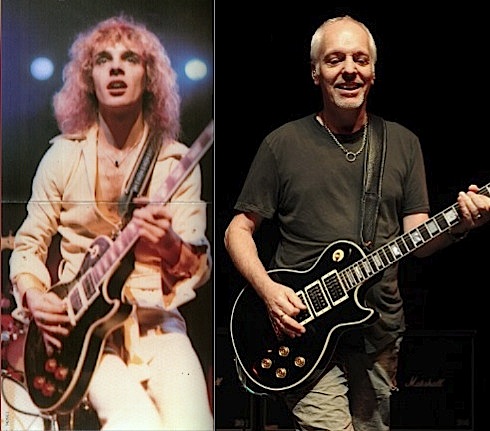
Frampton then and now: the 1976 gatefold sleeve shot for Frampton Comes Alive! by Richard Aaron... and earlier this year playing live at Shepherd’s Bush Empire, photographed by Wenn... Both pictures are united by Frampton’s signature guitar, the solidbody “Black Beauty” 1954 Les Paul Custom, which was re-finished with three pickups by the Gibson factory in 1970. In fact the original Black Beauty (left) was lost in a 1980 cargo plane crash, after which Gibson’s crafted another guitar in the image of the 1954 Les Paul Custom but with a slim-carved neck profile for optimum speed plus ebony black finish (above right)
❚ 35 YEARS AGO BRITISH-BORN GUITARIST Peter Frampton was a rock god, given two Rolling Stone covers within months of each other, the second declaring him Rock Star of the Year. His appeal has evidently been reignited by this year’s 35th anniversary world tour of his multi-platinum album Frampton Comes Alive!, drenched as it always was with West Coast sunshine. The “better than ever” tour has been extended from this Friday with extra dates in the UK and Europe, and yet more in the US from February. There is no support and the show runs for three hours. FCA! is the first set, including a 14-minute arrangement of Do You Feel Like We Do to re-create his epic stadium concerts of 1976. The second half features newer work, but also earlier numbers that resulted from forming the supergroup Humble Pie with “little” Stevie Marriott of the Small Faces in 1969.
Cover star: in April 1976 Frampton Comes Alive! won him the cover of Rolling Stone. Afterwards, he feared the shirtless photo by Francesco Scavullo “turned me into a pop idol” and would reduce his career to 18 months... Fortunately by the following February he was photographed by Annie Liebovitz as Rock Star of the Year
It has taken this comeback to remind us, or for most of us to reveal, that Frampton learned to play the rock classics at the feet of another Beckenham boy, David Bowie, when they were students together in south London.
➢ The Bowiezone website supplies these (and other) childhood details: “ [Frampton] first became interested in music when he was seven years old. Upon discovering his grandmother’s banjolele (a banjo-shaped ukulele) in the attic, he taught himself to play, and later taught himself to play guitar and piano as well. At the age of eight he started taking classical music lessons.
Both he and David Bowie were pupils at Bromley Technical High School where Frampton’s father, Owen Frampton, was head of the art department. The Little Ravens played on the same bill at school as Bowie’s band, George and the Dragons. Peter and David would spend time together at lunch breaks, playing Buddy Holly songs.
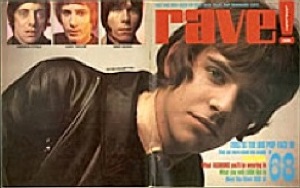
At the age of 11, Peter was playing with a band called The Trubeats followed by a band called The Preachers, produced and managed by Bill Wyman of The Rolling Stones. He became a successful child singer, and in 1966, he became a member of The Herd, scoring a handful of British pop hits. Frampton was named The Face of 1968 by teen magazine Rave!. ”
“ I got to know [Bowie] when I was 12 and he was 14, 15, maybe. I said, ‘What music do you like right now?’ He said, ‘Buddy Holly.’ I said, ‘Teach me that.’ I remember sitting on the stairs at lunchtime with two guitars and him and George Underwood — who became the artist who did the covers of Ziggy Stardust and Aladdin Sane — and the three of us would hang out and play Eddie Cochran and Buddy Holly numbers.”
While in school, Frampton became lead singer and guitarist of the Herd. In 1969, he formed Humble Pie with Steve Marriott of the Small Faces and also did session work on albums, including George Harrison’s classic All Things Must Pass. After five LPs with Humble Pie, he went solo in 1971. ”
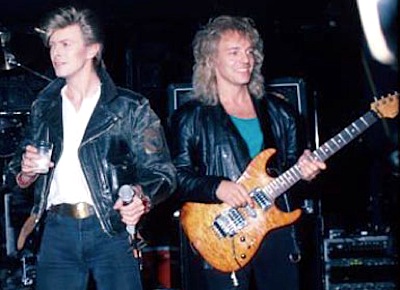
Bowie and Frampton in New York rehearsing for the Glass Spider Tour, 1987: Peter contributed to the album Never Let Me Down, Bowie’s follow-up to Let’s Dance, then played lead guitar on tour. Photograph by David McGough
The Bowie connection was rekindled in 1987 when Frampton was hired to play on the Never Let Me Down album and then as lead guitarist for that year’s Glass Spider Tour. Echoes of Bowie can often be heard in Frampton’s own vocals, especially his acoustic version of Baby I Love Your Way — shown below in impressive footage recently released from promoter Bill Graham’s archive.
+++ ❚ FRIDAY NIGHT WAS AN EXCUSE for the wags to tell their tall tales of clubbing in the 80s. This was the first reunion in recent memory of the bright sparks the media once called Blitz Kids and New Romantics. We’re talking about the straighter faction tonight — the make-up brigade had their day at Boy George’s 50th birthday party in June. All of them, whatever their persuasion, were diehard nightowls, the spiritual offspring of the mighty innovator who shaped the 1970s pop scene almost singlehandedly, David Bowie. He taught them to adopt stances: individualism, transgression. He bequeathed them principles for living amusing lives: disposable identities, looks not uniforms. In turn, they then shaped the sounds and styles of the Swinging 80s set in motion by 1976 and the birth of punk, along with a passion for black dance music, on through the decadent glamour of the Blitz Club years, to the watershed of Band Aid in 1984.
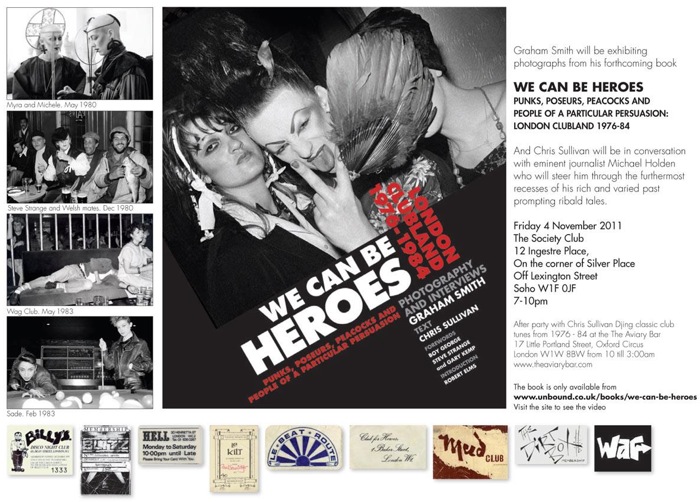
On Friday, photographer Graham Smith took over Soho’s newest rendezvous, the Society Club, for a gallery show of his 80s photographs, which capture the panache and derring-do of style leaders such as PX, Stephen Jones, Kim Bowen Melissa Caplan, Stephen Linard, Fiona Dealey, John Maybury and such nascent popstars as Spandau Ballet, Visage, Animal Nightlife, Sade, Blue Rondo à la Turk and others.
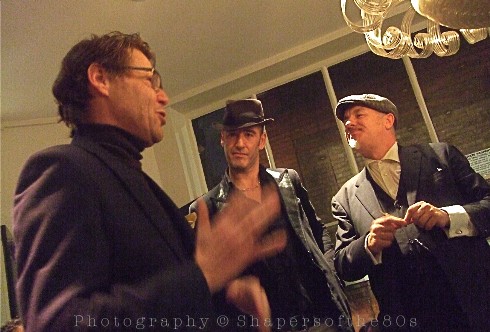
Our two videos capture the essence of Smith’s collaborators, Robert Elms and Chris Sullivan, powering through their often unprintable anecdotes, edited on video down to bite-sized chunks and garnished with Graham’s images. The highspot was meant to be Sullivan as guest speaker, but when he was reportedly “still on his way”, in stepped writer and broadcaster Elms to recall the early one-night clubs he also helped to run. He sounded genuinely shocked by the precociousness of his peers — “We were kids!” — who persuaded West End nightclubs to hand over door control to them as teenagers. Eventually, Sullivan arrived in the guise of Vladimir Ilyich Lenin, and of course excelled at spinning his “ribald tale of excess” about the mayhem he helped cause in clubland, en route to running Soho’s Wag club for 19 years.
+++
The photos form a dossier creative endeavour, as we’ll soon see in We Can Be Heroes, a 320-page coffee-table book containing 500 mostly unseen images and 100 voxpop interviews by Graham Smith. Warts-and-all main text is penned by the mellifluous Welshman Sullivan, with other contributions from Robert Elms, Boy George, Steve Strange and Gary Kemp.
Smith & Sullivan’s invitation to a party
➢ Visit the publisher Unbound.co.uk to place your order for We Can Be Heroes and secure your name in the limited first edition. This month the authors aim to hit an advance sales target by this new “crowd-funding” technique in order to guarantee publication.
➢ Visit The Society Club, London W1F 0JF where Graham Smith’s photographs are on sale until Christmas. Subjects include Boy George, Sade, Steve Strange, Spandau Ballet, Iggy Pop, Siouxsie Sioux, the Sex Pistols and many more.
+++ ❚ SPONSORSHIP, EH? Why fork out your own money to make a pop video when you’re a penniless 80s retro band and you can persuade an international luxury brand to pay for it? In return for a few words of gratitude of course. So before we get to see the real thing, here is the 12th tease trailer, yes 12th, posted today, for Duran Duran’s next video. The first eleven can be viewed on DD’s YouTube channel.
This one is the “making of” version, and do not view it unless you’re braced for a hair-raising and shameless suck-up to their wonderful sponsor by all four members of the film-it-grab-it-and-run Rio gang. They are seen on location at London’s Savoy Hotel (B&B from £455 per night) shooting the archetypal DD lush-life single, Girl Panic! (Musically, the stand-out track on the album, more’s the pity.)
The Birmingham-born and high-school educated former nightclub disc jockey turned keyboardist Nick Rhodes whispers seductively from behind a cut-crystal glass curtain: “We teamed up with Swarovski who have provided some fantastic elements, crystals, for us in the video. You really do need to try to work with people who fit the aesthetic of what you’re trying to do, and with Swarovski, er, I think they, er, [he did pause, twice, let’s hope for ironic effect, though we cannot be sure] they represent quality, glamour and glitz and shiny things.” Yes, Nick did say shiny things. And yes again, dear reader, the key word there was aesthetic, with its very scholarly diphthong. As we discover, “Hey, this is only rock’n’roll” — the final words of the real video — is nearer the OTT mark.
Models ARE Duran Duran (No, not really, it’s just make-believe) ... Cindy Crawford, Helen Christensen, Naomi Campbell, Eva Herzigova and Yasmin Le Bon play Duran Duran for a photoshoot in the December issue of Harper’s Bazaar UK
Guitarist John Taylor adds his tuppenceworth of product plug for the Austrian gemstones-to-home-decor-to-optics-to-luminous-road-markings brand, yes, road markings, whose energy-intensive glass grinding processes take advantage of hydroelectricity in the local mountains: “That connection has brought a beauty to the look of the video that we wouldn’t have had without them.” And yes, everything from guitar straps to hand mikes were vajazzled with Austrian glitzy bits — 700 on the singer’s microphone alone, we are told.
Off-screen Rhodes spoke about the project from New York, where the band have just completed a six-week US tour: “Harpers UK had approached us about collaborating with the magazine on something really special when the new album came out. I’d had this crazy idea for a video for the song Girl Panic! that looked fantastic on paper — to recreate a day-in-the-life of the band, with five of the world’s greatest supermodels playing all of us. The magazine loved the idea of doing a cover shoot within the video itself.” (Domenico Dolce and Stefano Gabbana play Harper’s guest fashion editors for the day, during a photoshoot scene which will form a 22-page cover story for the December issue. Yes, 22!)
+++
Giving their services free are the supermodels: Naomi Campbell IS lead singer Simon Le Bon, Cindy Crawford IS bassist John Taylor, blonde Eva Herzigova IS blond keyboardist Nick Rhodes, Helena Christensen IS drummer Roger Taylor, while Yasmin Le Bon does a droll turn as “the anonymous guitarist”. (Only joking about the free bit.) Directed by Jonas (Telephone) Åkerlund, Girl Panic! will have its world premiere at the Harper’s Bazaar Women of the Year Awards 2011 at Claridge’s Hotel on Monday, and is released next day online at Vevo.
Wags at YouTube commented today: “It could be a Duran Duran commercial brought to us by Swarovski” … or “This Swarvoski commercial is brought to you by Duran Duran.”
❏ Wikipedia footnote: “Swarovski is also product-placed in the 2011 J-Lo promo video for the single On The Floor.” Eat your heart out, J-Lo.
+++ ❚ AS TOYAH’S 30th ANNIVERSARY TOUR, From Sheep Farming To Anthem, comes to an end in London on Saturday after months on the road, let’s compare and contrast the manic bouncing Toyah from the Rainbow Theatre in 1981 (above) with the smiling mumsy Toyah 22 studio albums and a stage career later (having happily admitted to having had a facelift in 2008). Earlier this summer she seemed genuinely affected by the welcome War Boys received 30 years on (video below) … The hour-long Rainbow video is a brilliant reminder of what a force Toyah was in the singles charts of 1981 when her second album Anthem also went platinum — by year’s end she won the Smash Hits Reader’s Poll as both Best Female Singer and Most Fanciable Female. In 1982 she was voted the Best Female Singer at the Brits.
All of which had become a curious adventure following her lucky break aged 18 and fresh from drama school in Birmingham. In 1977 Toyah was cast in the role of Emma in Tales from the Vienna Woods at the National Theatre. The role required her to front a band they called Toyah wearing orange hair, and the rest is history. OK, a couple of edgy parts in Jubilee (video clip with Adam) and Quadrophenia helped too.
Toyah’s lucky year, 1977: playing Emma in Tales from the Vienna Woods, and a shaven-headed punkette in Derek Jarman’s film Jubilee
❏ Back in the present, Toyah can take only a short rest, however, before she’s back onstage, yeahhh! In panto, yeahhh! As the Wicked Queen in Snow White, boooo! Toyah says: “It’s a gift as an actress to play a baddie because you can be really nice and noone believes you, and you can be plain bad and noone loves you.” Panto comes to us all, darlings. Even Cliff Richard. Eventually.
➢ Choose “View full site” – then in the blue bar atop your mobile page, click the three horizontal lines linking to many blue themed pages with background article
MORE INTERESTING THAN MOST PEOPLE’S FANTASIES — THE SWINGING EIGHTIES 1978-1984
They didn’t call themselves New Romantics, or the Blitz Kids – but other people did.
“I’d find people at the Blitz who were possible only in my imagination. But they were real” — Stephen Jones, hatmaker, 1983. (Illustration courtesy Iain R Webb, 1983)
“The truth about those Blitz club people was more interesting than most people’s fantasies” — Steve Dagger, pop group manager, 1983
PRAISE INDEED!
“See David Johnson’s fabulously detailed website Shapers of the 80s to which I am hugely indebted” – Political historian Dominic Sandbrook, in his book Who Dares Wins, 2019
“The (velvet) goldmine that is Shapers of the 80s” – Verdict of Chris O’Leary, respected author and blogger who analyses Bowie song by song at Pushing Ahead of the Dame
“The rather brilliant Shapers of the 80s website” – Dylan Jones in his Sweet Dreams paperback, 2021
A UNIQUE HISTORY
➢ WELCOME to the Swinging 80s ➢ THE BLOG POSTS on this front page report topical updates ➢ ROLL OVER THE MENU at page top to go deeper into the past ➢ FOR NEWS & MONTH BY MONTH SEARCH scroll down this sidebar
❏ Header artwork by Kat Starchild shows Blitz Kids Darla Jane Gilroy, Elise Brazier, Judi Frankland and Steve Strange, with David Bowie at centre in his 1980 video for Ashes to Ashes
VINCENT ON AIR 2026
✱ Deejay legend Robbie Vincent has returned to JazzFM on Sundays 1-3pm… Catch up on Robbie’s JazzFM August Bank Holiday 2020 session thanks to AhhhhhSoul with four hours of “nothing but essential rhythms of soul, jazz and funk”.
TOLD FOR THE FIRST TIME
◆ Who was who in Spandau’s break-out year of 1980? The Invisible Hand of Shapersofthe80s draws a selective timeline for The unprecedented rise and rise of Spandau Ballet –– Turn to our inside page
SEARCH our 925 posts or ZOOM DOWN TO THE ARCHIVE INDEX
UNTOLD BLITZ STORIES
✱ If you thought there was no more to know about the birth of Blitz culture in 1980 then get your hands on a sensational book by an obsessive music fan called David Barrat. It is gripping, original and epic – a spooky tale of coincidence and parallel lives as mind-tingling as a Sherlock Holmes yarn. Titled both New Romantics Who Never Were and The Untold Story of Spandau Ballet! Sample this initial taster here at Shapers of the 80s
CHEWING THE FAT
✱ Jawing at Soho Radio on the 80s clubland revolution (from 32 mins) and on art (@55 mins) is probably the most influential shaper of the 80s, former Wag-club director Chris Sullivan (pictured) with editor of this website David Johnson
LANDMARK FAREWELLS. . . HIT THE INDEX TAB UP TOP FOR EVERYTHING ELSE








 ➢➢ Shapers of the 80s ➣➣