LISTEN TO MCLAREN’S REQUIEM
EXCLUSIVELY AT SHAPERS OF THE 80S
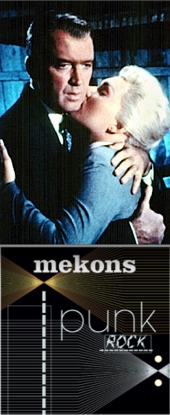
Romance and anguish: James Stewart and Kim Novak in the psycho-drama Vertigo (top), and the post-punk Mekons
◼︎ TWO UNEXPECTED RECENT VIDEOS have acquired poignant new life in the wake of Malcolm McLaren’s death, Svengali of punk that he was. Few people could have guessed that the soundtrack to one of last month’s Paris ready-to-wear fashion shows [in the video above] would be McLaren’s final creative achievement.
It was completed after his diagnosis of cancer and possibly in acceptance of his own mortality.
What seduces the listener is the overwhelming melancholy McLaren evokes, in what suddenly amounts to a Requiem to Myself. It was commissioned by Dries Van Noten – to set a deliberately discomfiting mood for his runway show amid the gilded opulence of the Hôtel de Ville in Paris on March 3.
After McLaren’s funeral, his partner Young Kim described the piece to Shapers of the 80s as “quintessential Malcolm McLaren – an entirely original and powerful, elegant but punk collage”. She gave us permission to run the full 13-minute mash-up in clean mp3 format, featuring the Vertigo theme, Mekons, Roxy, Raincoats and Burundi Beat.
McLaren on how to fail brilliantly
in this ‘karaoke world’
◼︎ “THIS WORLD WE LIVE IN TODAYis no more than a karaoke world, an ersatz society, which provides us with only the opportunity to revel in our stupidity… A karaoke world is one in which life is lived by proxy.” So said Malcolm McLaren last October, only days before he discovered he was unwell. He was presenting a keynote speech to 1,000 delegates in London at the Handheld Learning Conference 2009 about the future of learning and education.
Visage Mk 1: Egan, Strange and Ure in 1978 searching for sounds and styles
❚ “I’LL NEVER FORGET FIRST TIME I SAW a synthesiser on Tomorrow’s World. For the first time I saw the possibility to create sounds that had only existed in my head. I’d had no chance of getting my hands on one because they were size of house or at least the cost of one. But then cheaper Japanese synths came on the market, so I bought one. It changed my life because I could make music in a small home studio. The possibilities for young musicians like myself seemed endless.”
This was Midge Ure enthusing during Rocking the Blitz Club (audio at YouTube), another remarkably well-informed BBC Radio 4 documentary on our favourite scene that went out this morning. It was also remarkable for handing over the commentary to Ure, who — despite having earned an OBE for being half the brains behind Band Aid’s smash hit for charity in 1984, and being a founder member of Visage and the voice of Ultravox’s directional chart hit Vienna — is not among the first rank of mythologists programme-makers wheel out to explain the Blitz phenomenon.
This R4 slice of the 80s gave us a refreshingly different take on the familiar fables recycled by the usual suspects, but mediated in this show by Midge’s deeply un-London Lanarkshire lilt. He’s more than qualified to stake his claim to have shaped the music of the Blitz Kids, though he’s reluctant to be described as one of them, being a good four years older, and having had fingers in more pop pies than most on the post-punk scene. Even as the word punk was given the heave-ho in favour of the term “new wave”, Ure was probably the first active player of a synth among any of his clubbing pals, having bought his first, the polyphonic CS-50, at cost direct from Yamaha in the summer of ’78.
His was an obsession shared by fellow Rich Kid, the drummer Rusty Egan, and it led the way to a whole new British dancefloor sound. Ure felt synths “embodied a kind of nostalgia for the future”.
He says: “Rusty and his friend Steve Strange realised our crowd needed somewhere to try out our styles and listen to Euro synth bands like Kraftwerk, Dusseldorf and Telex, whose cutting edge sounds seemed to represent the future.” In almost no time the tribal forces of fashion had granted their wish. Rusty’s deejaying at Billy’s in Soho was augmented by Strange vetting the door to ensure an extreme clubbing attitude, then as 1979 dawned their band of outlandishly dressed clubbing heroes descended on the Blitz.
In his straight-from-the-hip autobiography, If I Was, Midge Ure makes the bold claim: “I had this idea to make music to play in the club. We had to invent our own musical style because our points of reference were very limited — after Kraftwerk, Yello and early Bowie we ran out of influences.” His own taste was for the very textured sounds of the synth built round classic songs, which intuitively caught a mood, unarticulated at that time, for a return to melody. And yet …
“A synth is just a software program and it has a very specific sound — a cold European soulless sound that drummers couldn’t emulate. Only a machine could do this,” he says with eagerness appropriate to a new-wave innovator. “Everybody aspired to be a robot — we didn’t want any human element in there at all, so people sang in a very robotic way. It was not going to sound like Jimi Hendrix. It was going to sound like a watered down version of Kraftwerk.”
❚ MIDGE IS THE ONLY PERSON AMONG THE NEW ROMANTICS to go on record and acknowledge the role of Gary Numan, an otherwise dread name who was perceived as an aloof and unclubbable loner. He definitely never signed in at the Blitz. Yet as 1979 unfolded Numan’s dystopian sci-fi synth sound sidestepped the Blitz Kids to reach No 1 in the UK charts, twice: in May with Are Friends Electric? and in September with Cars. They were blatantly commercial records and that wasn’t how Blitz Kids defined cool.
But Ure recognised Numan had broken down barriers of disapproval within the old guard of the music biz. He was being a great spur. Ure dreamed up the name Visage for his new band who knocked out a demo covering the classic In The Year 2525, with Egan on drums and the eye-catching Strange posing away as vocalist after a few lessons from Ure. Despite music industry scepticism, it won them a deal with Radar Records, the attention of producer Martin Rushent who had an office above the Blitz, and helped rope in Magazine members Dave Formula, John McGeoch and Barry Adamson, and Ultravox keyboardist Billy Currie. A single called Tar was released that September. It didn’t chart, but did clinch them a bigger deal with Polydor in 1980.
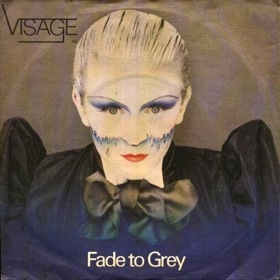
Ure says: “Visage was never really a proper band, just a group of our favourite musicians who we brought together to make experimental music for the Blitz club. Because they were all signed to other labels we chose Steve Strange as our frontman because he looked the part.” This worked well enough. Even while Ure and Currie part-timed with the seven-man studio-only Visage line-up, while steering Ultravox along similar synth-pop lines, Visage put out two successful albums, and a handful of chart singles (the most enduring being Fade to Grey in November 1980). What laid the pathfinding flares for the movement were some uber-stylish art-videos — the first starred Blitz coat-check girl Julia Fodor before she became the fabulous princess and deejay — which disseminated the OTT New Romantic ethos for fans to emulate.
Ure scored the significant double of taking Ultravox’s majestic Vienna to No 2 a month later and for four weeks, then seeing it win Single of the Year at the 1981 Brit Awards. It was produced by the German Conny Plank with an evocatively romantic landmark video stunningly directed by Russell Mulcahy who was creating a whole visual vocabulary for the then novel music video. Ure can take full credit as lead singer and guitarist for breathing a subtle blend of Roxy Music’s style and krautrock clarity into Ultravox and building them into a credible vanguard for the electronic New Wave.
Reflecting back in the R4 doc, Ure says: “There’s no doubt the early 80s was a golden age of music made by real popstars who created themselves. It was more than just padded shoulders and asymmetrical haircuts. It was a pivotal moment in our cultural history when new tech mixed with new ideas to create something really good. All in the pressure cooker environment that was the Blitz club.”
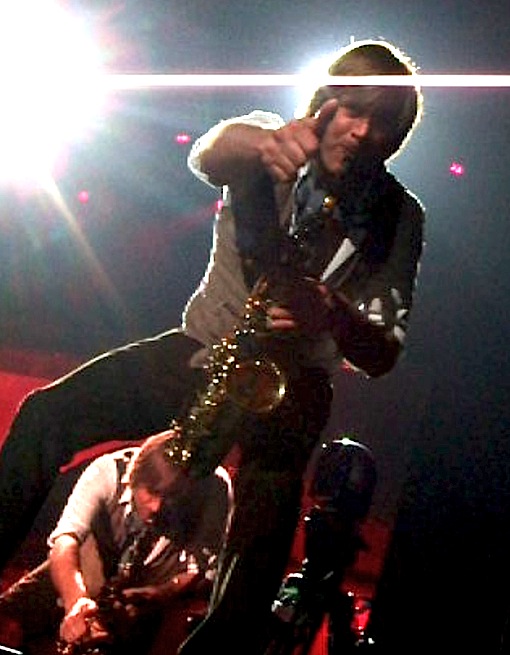
❚ STEVE NORMAN GIVES A THUMBS-UP to Shapersofthe80s during one of his dirrrty sax solos on Friday in the closing stages of the European leg of Spandau Ballet’s Reformation world tour. The band had to take in Spain, obviously, and we were there along with their families who weren’t going to miss a weekend in Barcelona – and that included two grannies, Steve’s mum Sheila and Tony Hadley’s mum Josie, both of whom once cut fine figures on the dance floors of yore.
During the Swinging 80s the cosmopolitan and leafy capital of the “autonomous community” of Catalonia – proud to have its own language and its own parliament – became the hippest city on the continent. Any number of London’s pop cognoscenti from Sade to writer Robert Elms made their homes in Barcelona and those who didn’t made this global city a civilised holiday destination to rival the naked hedonism of Ibiza or the Costa Brava. For the Spanish, Spandau enlivened the pop scene at exactly the right moment…
◆ These are the unique rhythms of Spandau Ballet’s earliest tracks, which changed the sound of the British pop charts for ever. Released today are remastered special editions of Spandau’s first two albums across four CDs: March 1981’s synth-led Journeys To Glory, and Diamond, the first soulful singles for which were being released to satisfy fast-changing tastes in the UK even as the first album took off in North America. Bonuses include 12-inch remixes of the band’s debut single To Cut A Long Story Short, The Freeze and Glow — a much underestimated gem driven by Keeble’s “boom-ka” dancebeat — plus a previously unreleased BBC session from March 1981 … Bonuses on the Diamond set include remixes of what became 1982’s clubbing anthem for soulboys and girls, Chant No 1 (just pipped at the post for the chart No 1 spot), Instinction, Paint Me Down and She Loved Like Diamond — all of which are appearing for the first time in CD format. The listing contains five previously unreleased BBC tracks recorded on April 10, 1982, live at the Winter Gardens, Bournemouth, during the UK tour that saw Spandau trigger the return of the full-throated teen scream.
❚ SADE IS TALKING FRANKLY AND REFLECTIVELY. It’s a rare treat from a singer who rarely ever breaks cover. Ten years on from her last album, Lovers Rock, she is said to be the most successful solo female artist Britain has ever produced – more than 50m albums sold over 26 years, valued at £30m in The Sunday Times Rich List. She is the first to acknowledge that Sade is a band, and together they have won a Brit Award for Best British Album of 1984 (view award speech) plus nine other Brit nominations, three Grammies (for 1985, 1993, 2001, plus two other nominations) and Sade herself was appointed an OBE, an order of chivalry, by the Queen (2002).
In yesterday’s Sunday Times Magazine, according to the writer Robert Sandall whom Sade knows of old, the Blitz clubbing veteran was giving the only face-to-face interview to coincide with this month’s release of her new album, titled Soldier of Love.
Sandall delivers full value as Sade really does let her guard down, surprisingly further than most of us who used to know her might have expected, especially about her “complicated” inter-racial family background. (She was born Helen Folasade Adu in Nigeria, raised in the UK at Clacton-on-Sea, and took a fashion BA at St Martin’s School of Art). She also talks about motherhood with a 13-year-old daughter and her several romances – “I’ve paid some rugged dues,” she observes. Highlights among many soundbites…
❏ On being a black singer in a white soul outfit: “I didn’t have any confidence as a singer, but I found that I liked writing songs.”
❏ The same band of clubbing wags from 1983 is reunited for the album – Paul Denman, Andrew Hale and Stuart Matthewman. They remain one tight unit on the new album, we’re told, under the control of a matriarch who likes the nickname “Auntie Sade”. [Note for newbies: say it Shah-day /ʃɑːˈdeɪ/. Only friends are allowed to use the nickname Shard.]
❏ On her new man, Ian Watts, who has been in turn Royal Marine, fireman and scientist: “I always said that if I could just find a guy who could chop wood and had a nice smile it didn’t bother me if he was an aristocrat or a thug as long as he was a good guy. I’ve ended up with an educated thug!”
❏ The old charge that Sade was the backdrop of the yuppie era still rankles: “With my family history, that really irks me. And it so annoyed me at the time, when we were secretly giving money we didn’t even have yet to Arthur Scargill and the striking miners.”
➢ Choose “View full site” – then in the blue bar atop your mobile page, click the three horizontal lines linking to many blue themed pages with background article
MORE INTERESTING THAN MOST PEOPLE’S FANTASIES — THE SWINGING EIGHTIES 1978-1984
They didn’t call themselves New Romantics, or the Blitz Kids – but other people did.
“I’d find people at the Blitz who were possible only in my imagination. But they were real” — Stephen Jones, hatmaker, 1983. (Illustration courtesy Iain R Webb, 1983)
“The truth about those Blitz club people was more interesting than most people’s fantasies” — Steve Dagger, pop group manager, 1983
PRAISE INDEED!
“See David Johnson’s fabulously detailed website Shapers of the 80s to which I am hugely indebted” – Political historian Dominic Sandbrook, in his book Who Dares Wins, 2019
“The (velvet) goldmine that is Shapers of the 80s” – Verdict of Chris O’Leary, respected author and blogger who analyses Bowie song by song at Pushing Ahead of the Dame
“The rather brilliant Shapers of the 80s website” – Dylan Jones in his Sweet Dreams paperback, 2021
A UNIQUE HISTORY
➢ WELCOME to the Swinging 80s ➢ THE BLOG POSTS on this front page report topical updates ➢ ROLL OVER THE MENU at page top to go deeper into the past ➢ FOR NEWS & MONTH BY MONTH SEARCH scroll down this sidebar
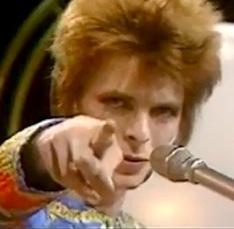
❏ Header artwork by Kat Starchild shows Blitz Kids Darla Jane Gilroy, Elise Brazier, Judi Frankland and Steve Strange, with David Bowie at centre in his 1980 video for Ashes to Ashes
VINCENT ON AIR 2026
✱ Deejay legend Robbie Vincent has returned to JazzFM on Sundays 1-3pm… Catch up on Robbie’s JazzFM August Bank Holiday 2020 session thanks to AhhhhhSoul with four hours of “nothing but essential rhythms of soul, jazz and funk”.
TOLD FOR THE FIRST TIME
◆ Who was who in Spandau’s break-out year of 1980? The Invisible Hand of Shapersofthe80s draws a selective timeline for The unprecedented rise and rise of Spandau Ballet –– Turn to our inside page
SEARCH our 925 posts or ZOOM DOWN TO THE ARCHIVE INDEX
UNTOLD BLITZ STORIES
✱ If you thought there was no more to know about the birth of Blitz culture in 1980 then get your hands on a sensational book by an obsessive music fan called David Barrat. It is gripping, original and epic – a spooky tale of coincidence and parallel lives as mind-tingling as a Sherlock Holmes yarn. Titled both New Romantics Who Never Were and The Untold Story of Spandau Ballet! Sample this initial taster here at Shapers of the 80s
CHEWING THE FAT
✱ Jawing at Soho Radio on the 80s clubland revolution (from 32 mins) and on art (@55 mins) is probably the most influential shaper of the 80s, former Wag-club director Chris Sullivan (pictured) with editor of this website David Johnson
LANDMARK FAREWELLS. . . HIT THE INDEX TAB UP TOP FOR EVERYTHING ELSE