Category Archives: Youth culture

1981 ➤ Chant No 1: Spandau revive the rumble of funk while hard times loom

❚ ON THIS DAY IN 1981 Spandau Ballet, spearhead band of the New Romantic movement, were flying off to Spain and Portugal by way of a working holiday with sun and sand — a brief tour of principal cities to establish their first European fan base, which remains strong today. Most significantly, on Ibiza, the island which young British sunseekers were starting to make their own, Spandau played at the then spanking new Ku club, as one of the first fashion bands whose visits were to make Ku one of the Mediterranean’s destination nightspots.
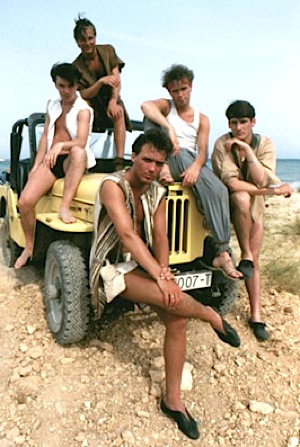
Spandau Ballet, Ibiza, 1981

Spandau Ballet in 1981: a quick sprint to the Iberian peninsular as well as a hot date at Ibiza’s Ku club

But the day before their departure, Spandau had lit the fuse to a musical bombshell. They changed their sound to outflank the emergent slipstream of new image bands invading the British charts with synth-pop.

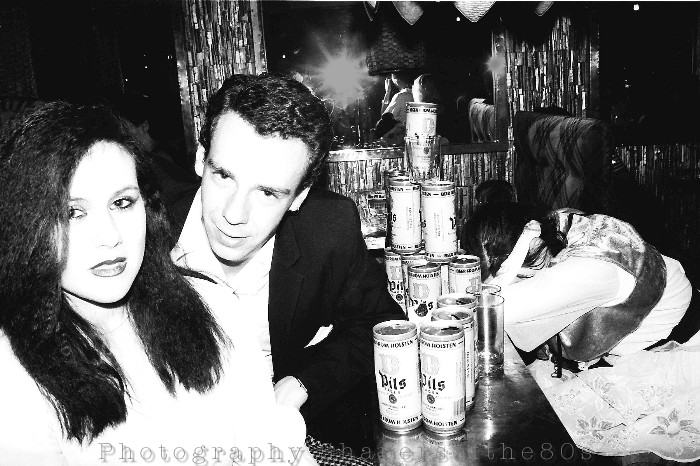
That Thursday they had taken over Le Beat Route in Soho, a mythical Mod club during the 60s, now fronted by Ollie O’Donnell, a suited but laid-back young crimper from Keith-at-Smile’s cool salon in Knightsbridge. The downstairs hideaway in Soho was the current Friday-night HQ of London’s nightlife leaders whose jackets and printed ties were hastily shaking off the New Romantic tag even as Duran Duran’s second single revelled in it. The bamboo decor helped: hints of a tropical holiday-camp with baskets for lampshades. South Seas tongue-in-cheek, maybe. Glamorous it was  not. The ethos for new one-nighters was never to be smart, always gently ironic.

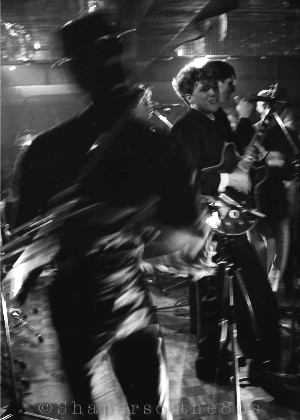
Here before an invited audience of Friday regulars the innovative Russell Mulcahy directed Spandau’s promotional video for their fourth single, Chant No 1. The bombshell was a surprise change of direction, announced by rat-a-tat congas and a burst of brass. The new tune, Gary Kemp said, had been inspired directly by the dissonant brass on the disco-funk track Wheel Me Out, the debut 12-inch dance single on Ze from US new-wave group Was (Not Was). The eerie sound had been introduced to keen Brit ears during the Axiom fashion show that had preceeded Spandau’s set in New York that May, during the first Blitz Invasion.

Chant No 1 was a blue-eyed funk mover that echoed the band’s teen years on the soul circuit, musically fresh while the lyrics seeped a certain seedy paranoia. There on-camera was a black trio of brass instrumentalists, Beggar & Co, who were the horn section for the British funksters Light of the World, and who’d already had their own hit with Somebody Help me Out.

Gone were the artsy settings and OTT costumes of Spandau’s early videos. This razor-sharp musical documentary intercuts Soho streetlife with a live club  performance by Spandau. “Down, down, down, pass the Talk of the Town” urges the deejay’s Chandleresque rap as Tony Hadley sweeps past The Talk, the cobwebbed Mecca of international cabaret from the Judy Garland era. Inside the steamy Beat Route itself we take in the stylish ambience where the “mobile knives” now live to dance, as well as dress up in a distinctly more boy-meets-girl way than the incessant camperie of the Blitz, the long-gone poser-paradise. We glimpse the deejay Steve Lewis before his portrait of Lenin, in a season when Soviet button badges are also de rigueur, and it’s evident that, yes, things are different here.
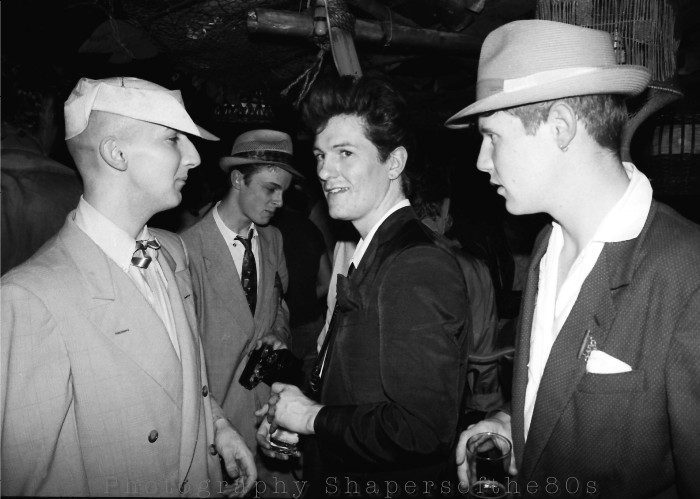
Stephen Jones, Graham Smith, Ollie O’Donnell, Robert Elms

Three hats and a quiff: Stephen Jones, Graham Smith, Robert Elms and at centre Beat Route host Ollie O’Donnell, during the shooting of the Chant No1 video in 1981. Photography © Shapersofthe80s

The video emphatically makes the point that clubland rules. Spandau drummer John Keeble spoke with only slight exaggeration when he said: “For the next couple of years, no new band played live on a stage.” What he meant was that rock venues as the source for original music had been superseded by nightclubs. White socks and hedonism were the key: girls in swirling party frocks with hair cropped like chives, and boys wearing braces and rolled-up sleeves soon walked the streets of every town. Ha! Why, even the NME finally conceded by introducing a “Dance Chart” alongside their lists of Indie garage bands.
Spandau Ballet, Gary Kemp, Chant No 1, video, Beat Route, clubbing

Chant No 1: Gary Kemp with one of Beggar & Co’s brass section at front

Once released on July 6, Chant No 1 rocketed straight up the charts to reach No 3 on August 1 (the NME chart actually placed it at No 1). Simultaneously remixed by Richard Burgess as a B-side and as an extended twelve-incher for clubs, the track immediately became an upbeat dance anthem for the school-leavers who were discovering what economic “hard times” were going to mean.

“I Don’t Need This Pressure On” ran Spandau’s chorus as a timely slogan for that summer when Britain went into shellshock from the rare experience of repeated race riots on the streets of London, Manchester and Liverpool. The fashion-conscious band who had been dismissed by the rockist press as fascists and dandies hit back with supreme optimism. This vibrant tune pressed the pop button with fans as well as rival bands who envied the chemistry of Spandau plus Beat Route. It announced a new brand: Team Soho. For ten weeks in the charts, Chant No 1 confirmed its rhythm as the sound of the new pop: once-and-for-all the dominance of the rock guitar was shifting to the supremacy of bass and drum for pop generations to come.

Ironies were everywhere. Not only did the crepe-shoed rocker Shakin’ Stevens occupy the No 1 spot for four consecutive weeks with Green Door, a comforting throwback to 50s nostalgia. By contrast, the cool young band who also held Chant off the top spot for another three consecutive weeks were The Specials, whose haunting single Ghost Town (where “all the clubs have been closed down”) became a poignant epitaph for the inner-city angst starting to erupt among the ranks of the hard-pressed in Margaret Thatcher’s Britain. The times were changing, not entirely for the better.
Beat Route, nightclubbing, Soho, Spandau Ballet, video,Chant No 1,

The legend that became Le Beat Route: a little light romancing, a lot of heavy drinking. Photography © Shapersofthe80s

THE SPANDAU STORY SO FAR

➢ 1980, Spandau fire the starting gun for British clubland’s pop hopefuls: dada didi daaa!
➢ 1980, The day Spandau signed on the line and changed the sound of British pop

How many people dID it take to launch an electro-diskow band?
Waldorf Hotel, Spandau Ballet, Covent Garden, Blitz club, New Romantics, youth culture,youth movement, Blitz Kids , To Cut a Long Story Short, London, UK, singles chart, aged 20, club-hosts, DJs, Herbie Knott

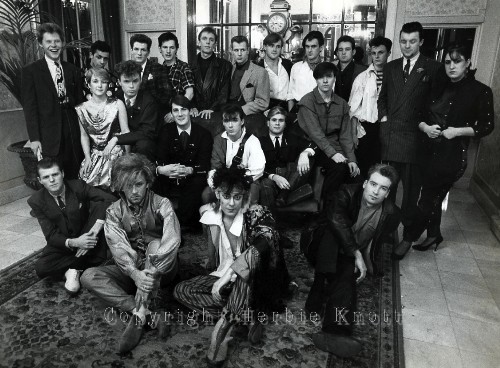
Waldorf Hotel 1980: seated at centre, Spandau Ballet, house band of Covent Garden’s Tuesday-night Blitz Club, home of the New Romantics movement, plus support team of Blitz Kids who helped put their first single To Cut a Long Story Short into the UK singles chart at No 5, on Dec 6, 1980. Average age 20, everyone had a specific role to play in staging and promoting the band: seven musicians, six designers, three media and management, three club-hosts, two DJs, one crimper and 22 egos. Photographed for the Evening Standard © by Herbie Knott

FRONT PAGE

➤ INDEX of posts for June 2011

Boy George, 50th birthday,Jon Moss, Barbara Moss,

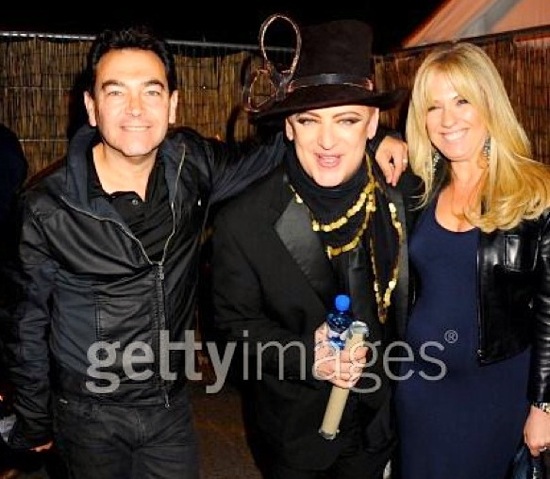
That Man in the Middle: George O’Dowd at his 50th birthday party with former Culture Club drummer and father of three children, Jon Moss and his wife Barbara. © Dave Benett/Getty

➢ Jarvis takes his lyrics to Eliot’s publisher Faber — video interview with Pulp’s songwriter

➢ Too cool to crow — Paradise Point just happen to be gigging in Hyde Park before Grace and Pulp top the bill

➢ Lest we forget: man has changed his ways since Peter Wyngarde cracked the sickest joke on vinyl

➢ Irrational, Professor Cox! Discussing science in a tent at Glastonbury?

➢ Martin Kemp’s Stalker gets autumn DVD release

➢ Will the magical blasts from the past follow St Martin’s out of Soho? Plus — Pulp’s finest hour at the art school’s farewell party

➢ Heaven 17 remind us how electronic music can send the soul soaring!

➢ The Blitz Kids WATN? No 28: Stephen Linard, fashion designer

➢ Hot days, cool nights, as Blue Rondo join the new Brits changing the pop charts — first glimpse of the crazy seven-piece as the 1981 charts fill with the new British pop

Pepsi DeMacque, Shirlie Holliman, Pepsi & Shirlie, then and now,Here & Now, tour

Back on tour: Pepsi & Shirlie in 1987, and this year photographed by Shirlie Kemp’s daughter, Harleymoon

➢ When Shirl asked Peps if she fancied an arena tour, Peps said to Shirl, Why not? — TV interview

➢ EPIC forecasts for the 2015 media landscape loom closer than we think

➢ Aside from the freaks, George, who else came to your 50th birthday party?

➢ One million people think Charlie really is SoCoolLike — meet  the UK’s most popular YouTuber

➢ 1904, The day Nora made a man of Joyce — Bloomsday celebrated

➢ Boy George hits the big Five-0 and he now says, yes, he has ‘lots of regrets’

Paradise Point, Run In Circles , video, Cameron Jones,pop music

Cameron Jones: Paradise Point vocalist

➢ Hear about the many lives of Midge Ure, the Mr Nice of pop — This Is Your Life, 2001

➢ Wise-cracking Sallon shimmies back onto London’s party scene — Boy George’s best friend recovers after assault

➢ Mix your own version of Bowie’s Golden Years with a new iPhone app

➢ 2010, Lady Gaga ousts Lily Allen as UK’s most played artist

➢ Martin Rushent is dead — friends pay tribute to the man who made stars of the Human League and shaped the sound of 80s electro-pop

➢ What happens when retromania exhausts our pop past — Simon Reynolds on our compulsion to relive and reconsume pop history

➢ Up close and cool — Paradise Point’s first official video wins Boy George’s approval

Farewell St Martin’s, Pulp, Jarvis Cocker,University of the Arts, CSM,

Pulp playing at St Martin’s: Jarvis Cocker bids farewell to his old art school at the best party for years. Grabbed from gstogdon’s YouTube video

FRONT PAGE

➤ Too cool to crow — Paradise Point just happen to be gigging in Hyde Park before Grace and Pulp

Paradise Point,O2Academy ,Wireless Festival ,livepop,Hyde Park, music festival

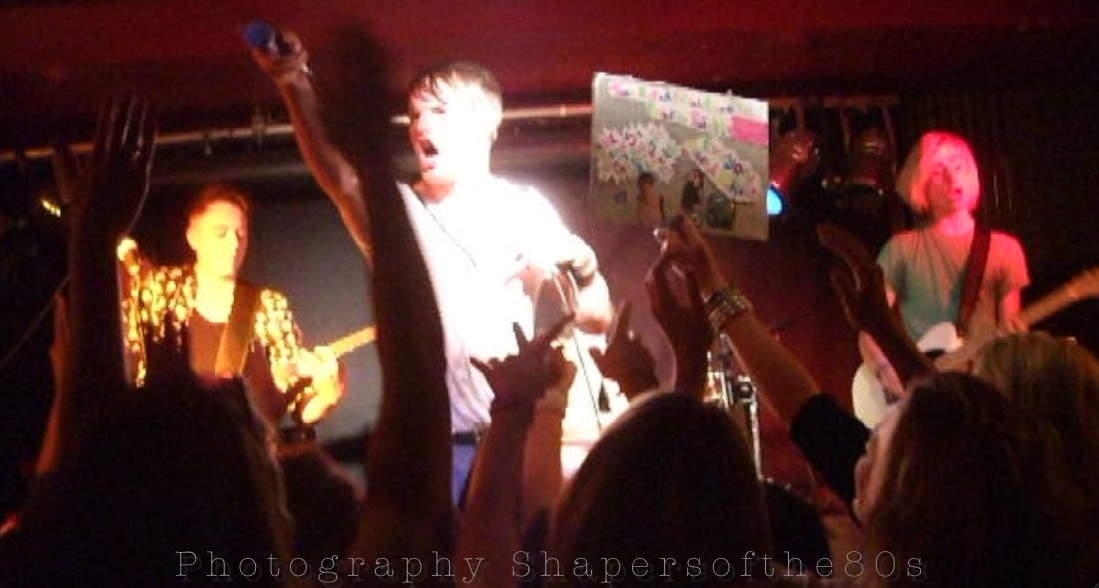
“It takes a minimum of four girls to start The Scream,” said Steve Dagger in the 80s: the old rule of pure-pop was certainly fulfilled at Islington’s sold-out O2Academy when Paradise Point headlined tonight. Cam Jones leads an encore of Run In Circles which basically the girls sang for him — in between screams. Roman Kemp at left, Adam Saunderson right © Shapersofthe80s

Wireless Festival ,Hyde Park, Paradise Point , 2011◼ THIS WEEK BASSIST ROMAN KEMP told Hemel FM: “We’ve only been around for eight months so we’re amazed by how it’s been going. The other day we were confirmed for the Wireless Festival on Sunday. We were amazed. Playing before Pulp!”

OK, a bit of artistic licence there. The club scene’s dynamic pure-pop teen band Paradise Point are scheduled to strike up at exactly 15:20 in Hyde Park, which is about four hours before Grace Jones goes on, to be followed by Jarvis Cocker’s band Pulp who top the bill at the three-day fest. All the same, Kemp wasn’t exactly overdoing the crowing rights. This gig is a huge coup for a bunch of live 18-year-old popsters without a recording deal.

➢ Wireless Festival runs July 1–3 in Hyde Park, London,
with Black-Eyed Peas, Chemical Brothers and Pulp
headlining a bill of 91 acts across four stages

Paradise Point, O2Academy,Steve Dagger, Martin Kemp,Wireless Festival

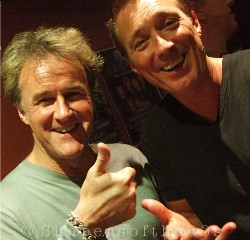
In the audience for Paradise Point at Islington’s O2Academy: Spandau manager Steve Dagger and Martin Kemp vote Roman Kemp’s band a hit. So no surprises there, then.

Call of the Wyld is a blogger who “tracks young, new and exciting bands as they emerge” and last month he wrote: “This lot are sex on legs and even if they weren’t actually any good they would still find it hard to walk on stage without being shrieked at. Fortunately their music is excellent too. These are real pop gems — certainly 80s inflected, but delivered with a whomp and panache that would put a lot of other acts to shame. The Only One is a track that is going to get them a lot of attention.” As a taster or three, view PP’s live debut last November (below), videoed by Shapersofthe80s, scan our first PP concert review and give the Hemel FM interview a spin:/%20

FRONT PAGE

➤ The Blitz Kids WATN? No 28, Stephen Linard

drakes-london,Stephen Linard,British tailoring, haberdashery,Drake’s,Michael Hill,luxury shops, Clifford Street , London

Former Blitz Kid and St Martin’s fashion graduate Stephen Linard: today he is a designer with Drake’s, the gentlemen’s haberdasher, seen here at a staff preview for the opening of its first shop just off Savile Row. Photographed © by Shapersofthe80s

❚ WACKIEST AMONG THE 80s BLITZ KID RACERS was Stephen Linard, the Essex boy who nevertheless graduated from St Martin’s art school with a first-class degree in menswear 30 years ago this summer. Modelled by six of his hunky clubland pals, his collection titled Reluctant Emigrés featured swishy draped greatcoats, pinstripe trousers and city shirts that all evinced an Edwardian air of immaculate tailoring while declaring edgy details with organza and contrast patches. Amid the women’s outfits shown by most of the other fashion graduates, Linard’s chic street-savvy lads had a gasp-out-loud impact, as commentator Suzy Menkes noted after the show. The influential South Molton Street shop Browns immediately wanted to develop the range, but Stephen decided instead to sell his original garments to a short-lived synthpop band called Animal Magnet. “I needed the money,” he says now in a shocking confession of short-termism.

A hugely original and resourceful talent, Stephen was feted by the fashion press upon graduation. His high-visibility fashion leads were key among the 15 sharpest Blitz Kids who shaped the New Romantics silhouette from Covent Garden’s Blitz club — Stephen Jones, Kim Bowen, Lee Sheldrick, Helen Robinson, Melissa Caplan, Fiona Dealey, Judi Frankland, Michele Clapton, David Holah, Stevie Stewart, Julia Fodor, Dinny Hall, Simon Withers and über-wag Chris Sullivan were the others. Most significantly, Linard advertised his bizarre imagination by changing his appearance on an almost daily basis, from his foppish Fauntleroy dandy, to the Endangered Species outfit made from animal skins, to the Bonnie Prince Charlie tartans copied for his character in Worried About the Boy, last year’s TV biodrama on Boy George, who became a soulmate the moment Stephen walked into Billy’s club, where the Swinging 80s were hatched in 1978.

Click any pic below to enlarge Linard’s degree collection 1981:


So… where is he now, the dignified Stephen Linard pictured this month sporting a three-button, three-piece linen suit in a faded shade of indigo, and handmade in Venice? Well, since 1989 Stephen has been on the design team at Drake’s, the respected men’s haberdasher which has just opened its first shop at No 3 Clifford Street, just off Savile Row, the global epicentre of serious tailoring. Those with fond memories of Bowring Arundel & Co — for whom Stephen’s late father once supplied handmade leather goods — have welcomed the arrival of the new shop.  Though Drake’s was founded in 1977, the firm has never had its own retail outlet.

Michael Drake, a former head of design at Aquascutum, was its co-founder (and incidentally, “my grandmother’s nephew,” Stephen said). He began making the finest accessories, from cashmere scarves and printed silk handkerchiefs to knitwear, shirts and the elegant neckwear that has made Drake’s the largest independent producer of handmade ties in England. It enjoys a prodigious export market, by designing collections for international luxury shops and collaborating with such style-leaders as the Japanese fashion label Commes des Garçons.

drakes-london,British tailoring, Clifford Street,London, Michael Drake, handmade ties, haberdashery,Adam Dant

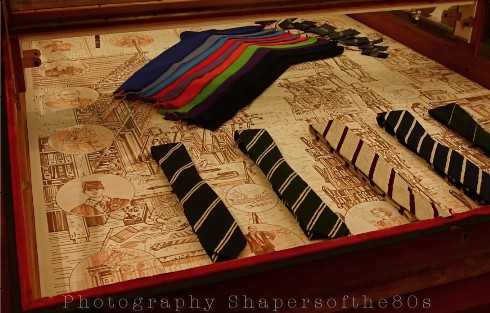
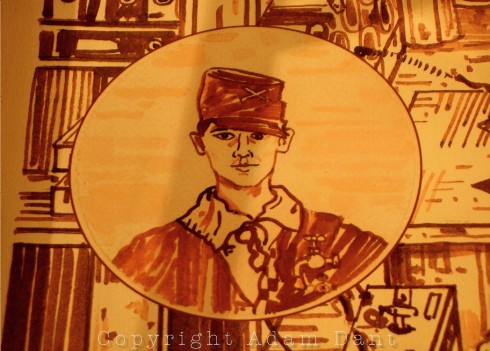
The young Linard by artist Adam Dant: lining this antique vitrine at Drake’s new shop is a busy tableau of life at the firm’s Clerkenwell factory. At lower left we see a youthful portrait of the designer alongside some of the handmade ties in fine Shantung silk Drake’s is renowned for. Photographed © by Shapersofthe80s

Today the creative director Michael Hill encourages his designers to refresh the seasonal ranges with new textiles, both for readymade production and for bespoke handcrafting at Drake’s workrooms in the artisan quarter of Georgian Clerkenwell. A revival of bespoke suit-making has seen a new appetite for accessories in raw shantung and Indian tussah silk — its slubbed texture playing well with both formal suits and casual jackets — as well as traditional madder silk from Macclesfield in Cheshire, where Stephen is a frequent visitor ensuring that exacting standards are met.

A stylish touch to Drake’s new strategy has been to recruit the impish graphic artist Adam Dant, whose witty drawings adorn the shop and the stylishly written Drake’s website. In particular it commissioned him to create one of the Hogarthian “mockuments” which won him the Jerwood Prize. Rather like flowcharts, these reveal the inner workings of an institution and its people, and Dant’s depiction of Drake’s Clerkenwell factory provides the lining to one antique vitrine, formerly property of the Victoria and Albert museum and now in Clifford Street, displaying shantung ties and enormously long (in the Italian style) knee-socks.

Included among Dant’s portraits of colleagues who are said to have influenced Michael Drake is Stephen Linard’s and it echoes an emblematic photograph published in i-D magazine in which he wears a Yohji jacket and jaunty Confederate Army leather cap, “bought in Anchorage airport in the days when I was rich — bathtubs filled with champagne”. This is a reminder of the period 1983–86 when he lived in Tokyo designing for Jun Co, the fashion giant, on a salary which, he liked to boast, exceeded the prime minister Margaret Thatcher’s. In the mid-80s, to be an English designer brought you popstar status in Japan, as those fellow Blitz Kids Stephen Jones and Lee Sheldrick also discovered.

drakes-london,British tailoring, Clifford Street,London, Michael Drake, handmade ties, haberdashery,Adam Dant

Close-up of the portrait: Linard is one of many talents associated with Drake’s who have been captured by the artist Adam Dant. His reference was a photograph dating from 1983 — note the ornamental bath tap. Courtesy of Adam Dant and Drake’s

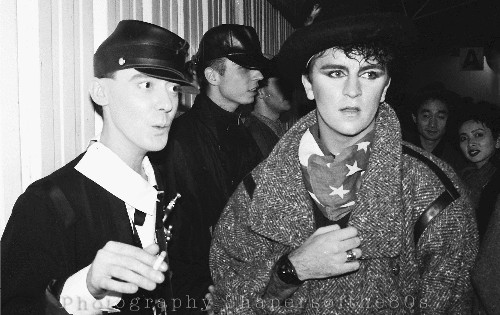
The 1983 look that inspired the portrait: Stephen Linard sports a leather Confederate Army cap $15 from Alaska, and Yohji Yamamoto jacket £250, over giant-collared Yohji shirt £120. Artfully placed on his left lapel is a silvered bathroom tap £60 and faucet brooch £40, both from a jewellery collection for Chloe, Paris. Seen here with Lee Sheldrick (rear) and Steve Strange at the Worlds End fashion show in Paris that October. Photographed © by Shapersofthe80s

Long before he joined the “Japanese invasion” effected by Britain’s emergent new wave of streetwise fashionistas, Stephen had gained the admiration of the international fashion glossies. With 1983 came his collection Angels With Dirty Faces, inspired by the Bogart-Cagney gangster movie set in the 30s depression. It was both pretty and poignant and it sold worldwide. That year, the snappiest magazine of the day, New York, headlined a special fashion section The British Are Here, and selected as the UK’s five leading lights Jean Muir, Zandra Rhodes, Katharine Hamnett, Vivienne Westwood — and Stephen Linard, “one of the most creative of the young designers”.

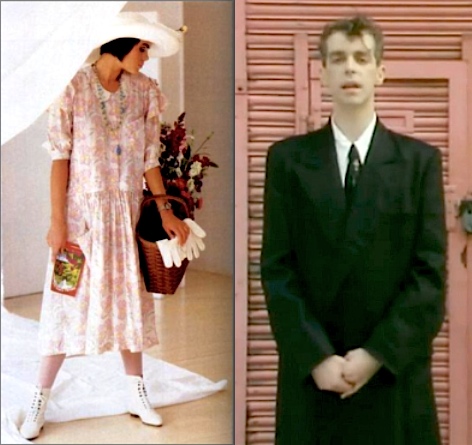
Linard designs from his heyday: bias-cut tea dress, $100 in Bloomingdale’s, from his 1983 Angels With Dirty Faces collection, here photographed by Tony McGee for New York magazine. Right, Neil Tennant wears a Reluctant Emigrés topcoat by Linard in the Pet Shop Boys video for West End Girls (Parlophone 1984)

Stephen’s clothes had always been sought after by his popstar contemporaries from Spandau Ballet, Boy George and The Slits, to U2, Womack & Womack, even Cliff Richard and Johnny Mathis, and ultimately to the great god David Bowie himself. (Stephen had to turn down the invitation to go on location to appear in the Ashes to Ashes video in 1980 “because I was on a disciplinary warning at St Martin’s over attendance”!) His Reluctant Emigrés collection enjoyed a curiously long life and in 1984 we see Neil Tennant lording it in one of the black linen topcoats in the Pet Shop Boys video for West End Girls, their first single which went to No 1 in the UK and US.

Many Linard looks have been coveted by the fashionistas but, as with so many gifted designers, let’s say a head for business came second to his eye for fashion. The timing of funds hit the rocks in more than one of Stephen’s creatively successful ventures, and decades ago he complained loudly that the St Martin’s fashion department didn’t do enough to equip graduates with basic business skills. (This, we are assured, has since been addressed by the college.) In the end it wasn’t surprising that he accepted the offer to join the Drake’s family, which seems to have dealt him a lucky hand.

One tip for wearing the perfect handmade tie? “Never tuck the smaller blade through the ‘keeper’— the loop on the back of the large blade. Much more stylish to let it flap free. Like undoing the button-cuff on your jacket, to show you don’t care.”

drakes-london,British tailoring, Clifford Street,London,Augustin Vidor, Michael Drake, handmade ties, haberdashery,Stephen Linard

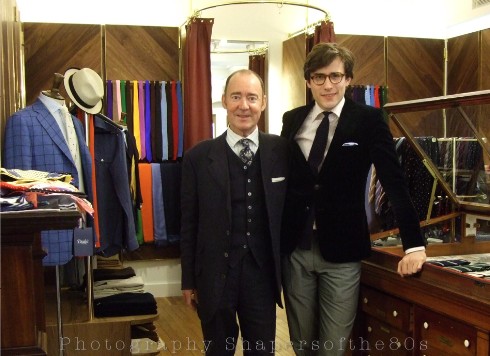
The new shop in Clifford Street: Linard joined the Drake’s design team in 1989 whereas sales assistant Augustin Vidor is currently an intern. Photographed © by Shapersofthe80s

FRONT PAGE

1981 ➤ Hot days, cool nights, as Blue Rondo join the new Brits changing the pop charts

Blue Rondo à la Turk , pop music, 1981

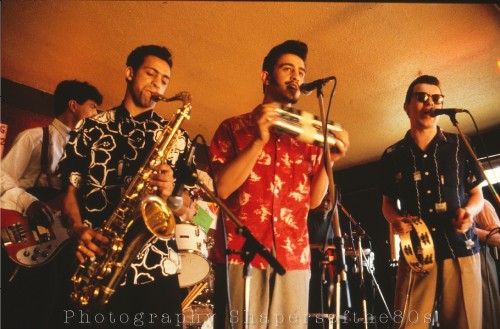
Blue Rondo’s official debut in Chelmsford, June 1981: Moses Mount Bassie, Christos Tolera and Chris Sullivan front the seven-piece. Photograph © Shapersofthe80s

◼ “GET IN THE BACK OF THE VAN,” I was told on this day 30 years ago. “You’re coming for a ride.” Graham Ball was a club host empowered to open the trendiest of doors in Soho, so “No thanks” was not an option. “I’ve got a new band to show you. And you’re not quite going to believe what you’ll hear and see.” He was, apparently, now also a manager. We arrived in blisteringly hot sunshine at a characterless modern pub in Chelmsford, Essex, well away from Soho clubland, and there of course were the rest of The Firm — the handful of sharp young dudes at least half the age of the grunters who dominated the pop industry, all being groomed by Spandau’s 23-year-old Steve Dagger to inherit the mysteries of management for a new generation of bands.

Assembling an assortment of instruments onstage were five, six, no, seven of the most variegated musicians you felt might belong in a special institution for their own safety. I had been invited to write the first piece about the craziest combo  inspired by London’s Blitz Club, which had closed the previous autumn, and by this summer they were but one among the slipstream of bands erupting on London’s burgeoning nightlife scene. From their opening vocals — “Oo-oo, aa-aa, mm-mm ah!” — Blue Rondo à la Turk were sensational, and my review appeared in the second issue of New Sounds New Styles. It took only three months before Rondo signed a deal and charted in November.

➢ Read that first review of Blue Rondo as they create a buzz with their new Latin sounds — from NSNS August 1981

This was the summer
of New Romance

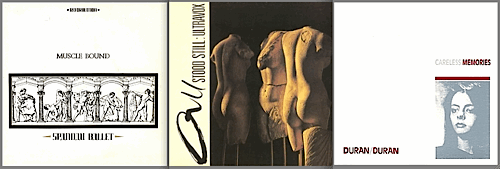
Spandau Ballet, Ultravox, Duran Duran, 1981

Leaders of the Romantics in 1981: Spandau Ballet, Ultravox, Duran Duran

ON THIS DAY in 1981 the UK charts were bursting with the new generation of image-conscious British groups who whose linking of soul and electro-pop were to change the style and the rhythm of pop charts for ever. . .

Ultravox were enjoying their fifth hit single All Stood Still.
Linx were enjoying their third hit Throw Away the Key.
Spandau Ballet were enjoying their double-sided third hit single, Muscle Bound/Glow. At Easter they had also signalled their new funky direction by introducing Chant No 1, which would become London’s clubbing anthem and reach No 2 later this summer.
Duran Duran were enjoying their second hit Careless Memories.
Orchestral Manoeuvres in the Dark were enjoying their second hit Messages.
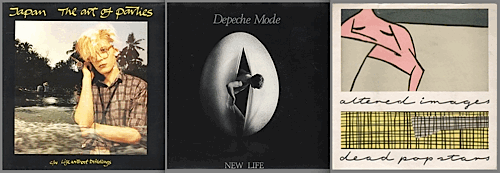
Japan were charting with The Art of Parties.
Landscape were charting with Norman Bates.
Shalamar (with honorary Brit and body-popping pioneer Jeffrey Daniel) were charting with A Night to Remember.

➢ Elsewhere at Shapers of the 80s: 100+ acts who set the style for the new music of the 1980s

Light of the World were charting with I’m So Happy.
Imagination were charting with their debut Body Talk.
The Human League entered the charts on this day with Empire State Human.
Depeche Mode’s second single New Life was soaring towards No 11.
Visage’s second hit single had just fallen out of the chart.
❏ Likewise Heaven 17’s debut Fascist Groove Thang.
❏ Likewise Altered Images’ debut Dead Pop Stars.
❏ Likewise Level 42 with their second hit, Love Games.
❏ And the honorary Brit, Kid Creole, was heading into the charts with his Coconuts and their debut single, Me No Pop I — a compulsively danceable new sound on Antilles introduced to London last year by i-D co-editor Perry Haines.

New Romantics, bands, Swinging 80s,Japan the band, pop music, Depeche Mode, Altered Images

Going Romantic in 1981: Japan the band, Depeche Mode, Altered Images

Oh, and two nights earlier at Le Beat Route I’d snapped the new boy in George O’Dowd’s life enjoying their first date. Nobody dreamt that George and Jon Moss would one day be putting together their own band.

♫ VIEW fine Northern Soul footwork from Rondo mentalists in this performance of Me and Mr Sanchez shot at the Venue in London:
+++

FRONT PAGE