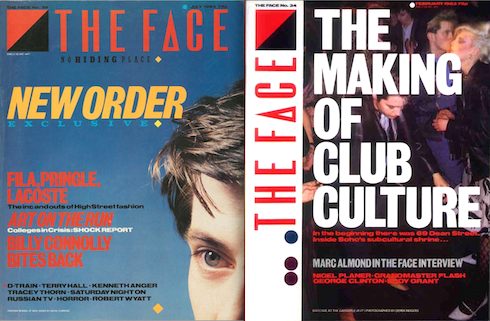
◼ 1983 PROVED TUMULTUOUS for British youth culture. By December, London’s leading club deejay Jay Strongman declared “This was the year of Go For It”, after 17 new British pop groups lorded it in the US top 40 chart that autumn, while our spirited fashionistas were making waves around the world, with Princess Diana playing ambassador for the classic designers, and Boy George pushing the wilder extremes of street style. Among major features I wrote for The Face was February’s cover story The Making of Club Culture, and in the Evening Standard Posing with a purpose at the Camden Palace, a centre spread on the runaway megaclub hosted by Strange and Egan.
Nightlife was a burgeoning story as black beats took over dancefloors everywhere and Manchester’s tearaway megaclub was the Hacienda, despite the oppressive clean-up being imposed by the city’s infamous Chief Constable. Clubbers from across the nation swarmed in to create a grand coalition of all the cults – “your complete i-D line-up, minus the Worlds End spendthrifts”. In my January report for The Face one inmate bemoaned Hacienda music as “too funk-based” though another, a flat-top lad called Johnny Maher, revealed his secret, despite having launched some new indie rock band minutes earlier. “I schtupp to funk,” he said.
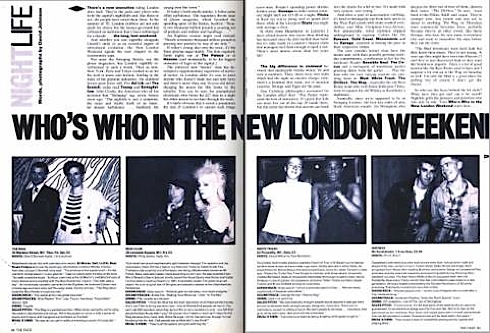
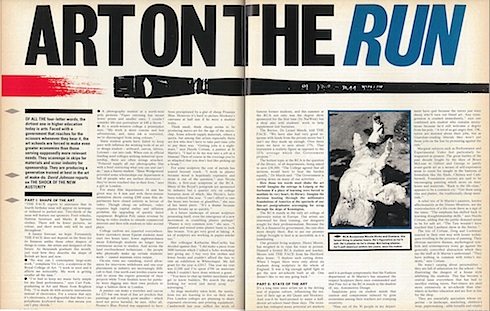
In July The Face published a major piece of reportage, Art on the Run, prompted by numerous friends in fine-art education, and billed it as a “shock report” on the Conservative government’s debilitating squeeze on the art schools. Ironically in the same issue my regular Nightlife column identified the four hottest clubland teams as a Who’s Who in the New London Weekend: “Not since the Swinging Sixties had London nightlife reverberated to such a boom.” These clubs were the unofficial job centres that kept a generation in freelance employment and introduced the verb to vop into the language (derivation: “What are you up to these days?” – “Oh, a Variety Of Projects”). Some of that effort was fuelling the rise of computer games which in the June issue Virgin assured me was “the new pop industry”!
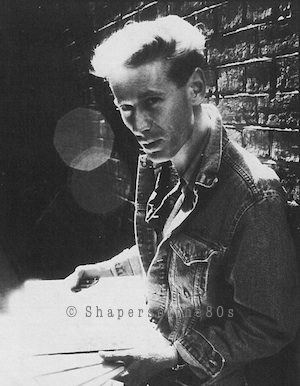
Brighton hotspot 1983: Ian, Oliver Peyton and Kate hosting The Can (Photo Shapersofthe80s)
My Nightlife column in The Face’s October issue featured Brighton’s trendiest hotspot (seconds before the very word trendy passed its sell-by outside the Greater London stockade). The Can was presided over by a young Oliver Peyton with Andy Hale as the deejay breaking funk there. Years later Oliver thanked me for this exposure and said he would never have come up to London and started opening restaurants without The Face’s prompt! (One of the few people who have ever thanked me for writing about them! Cheers, Oliver.)
Jay Strongman in 1983: ruling London’s three hottest turntables
By this fertile year’s end I had FIVE indicative pieces of reportage published in the December issue of The Face including a detailed rundown on the new dance music by club deejay Jay Strongman, plus news of the imminent Westwood/ McLaren break-up which I’d scented from body language backstage at their Paris runway show.
The launch of the first London Fashion Week that same October confirmed that British street style was being feted in the international spotlight, yet it begged the question how on earth had this suddenly come about? Click through to our inside page to read the feature investigation that set out to answer such questions, by asking decision-makers in the industry to identify the best of Britain’s young designer talent under the headline Eight for ’84. . .
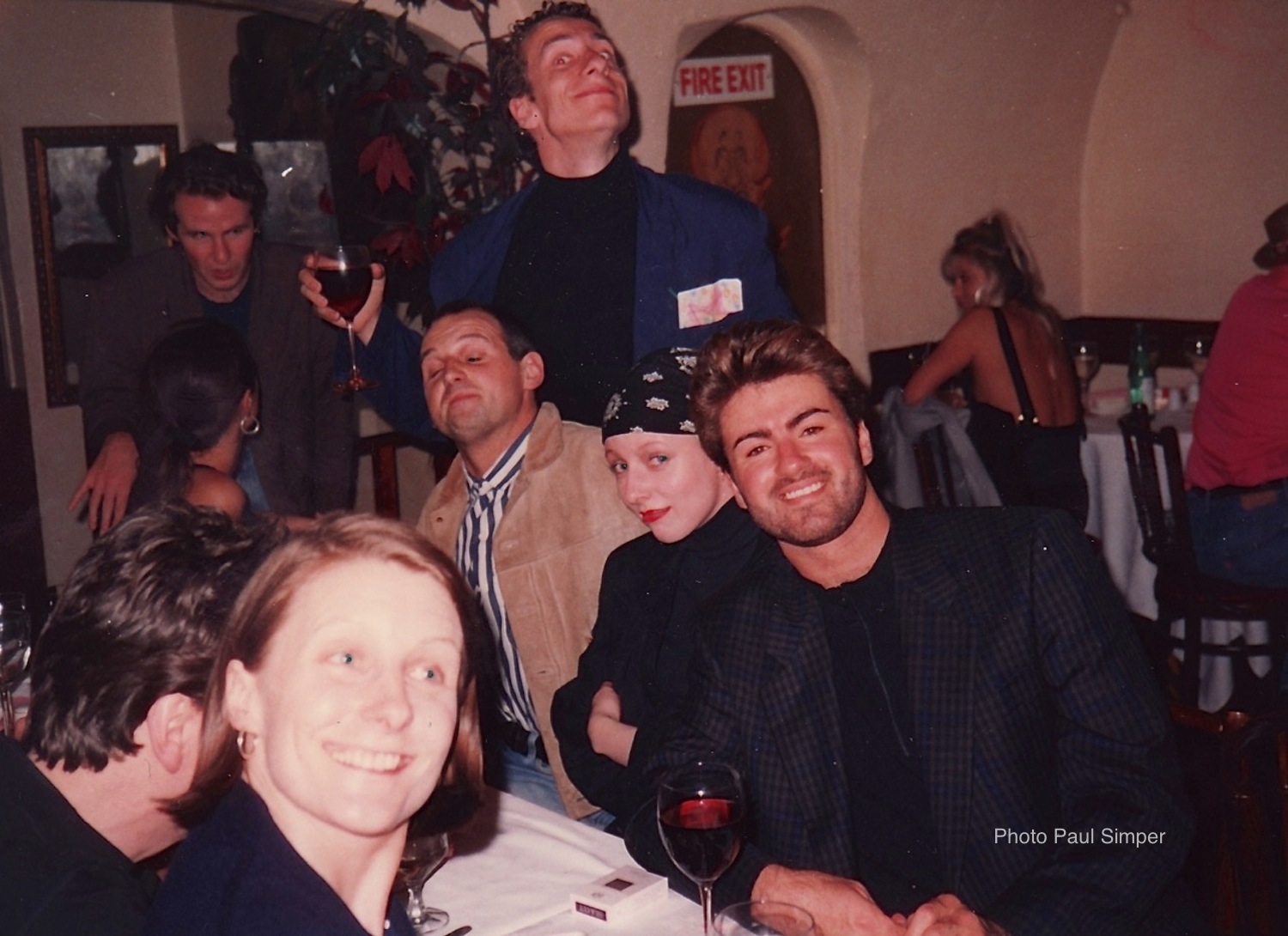
Simper’s 25th birthday at Aldo Zilli’s Il Siciliano in Soho: visible faces clockwise from front left: Lilli Anderson, Alex Godson (standing), Sam McKnight, the host (standing), Josie Jones, George Michael. Photo by Simper
Paul “Scoop” Simper arrived in London as a cub
journalist who soon became a backbone of No1, one
of the two leading pop magazines covering the
Swinging 80s. He also became a face about clubland
and in the years after he first met George Michael,
when Wham! was launched, became friends.
Shapers of the 80s is pleased to publish Scoop’s very personal tribute to one of the UK’s leading superstars who died this week
◼ OF COURSE HE HAD TO LEAVE US ON CHRISTMAS DAY. As a pop lover, especially one raised in the 80s, George Michael has been a part of mine and so many people’s Christmases for years.
This one was no exception. Nipping up the high street to the supermarket for one last shop on Christmas Eve, there was something both joyous and comforting about hearing him – not just as Wham! but on his lonesome giving us December Song and on Band Aid – whilst trolling up and down the aisles for a bottle of fizz and a few more festive nibbles.
If anything, this year he’d felt ever more present. A pre-Christmas gathering of my old 80s pals had stirred up memories of Whambley – that perfect pop farewell on the sunniest of days in ’86 in front of 72,000 adoring but heartbroken fans when George and Andrew signed off at the top of the charts (both albums and singles) with their friendship still intact.
Wham! fans came in all shapes and sizes. Not long ago I’d been listening to a bootleg of The Final concert, lovingly recorded and shared with me by No1 magazine’s then editorial assistant Dave Ling, later of Metal Hammer, a heavy metaller through and through, who made an honourable exception when it came to George and Andrew.
As I think about it now, not being a Wham! or George fan has always been a bit of a deal-breaker. One early relationship of mine came to a very swift end when she questioned my love of George. My pal June Montana (lead singer with Brilliant and gatekeeper on the Limelight’s VIP bar, who was actually a bona fide friend of his) and I were like the George gestapo. We could sniff out a non-believer at 100 paces.
Part of that devotion came from the fact that in 80s London clubland, Wham! were never really cool. They were outsiders. They were from Bushey, Hertfordshire. As a country lad from Wiltshire I felt a kinship, particularly with George.
He was a year younger but for both of us our first introduction to the game-changing London club scene of the early 80s was Le Beat Route – a Soho club I was gagging to go to the second I saw Spandau Ballet’s Chant No1 video, the anthem for this pop moment.
In the last interview I did with George, in 2006, when we were talking about Spandau, he remembered the thrill of going down for the first time to what was then the hottest club on the planet and actually sighting both Steve Strange (on the Space Invaders) and Tony Hadley (at the bar).
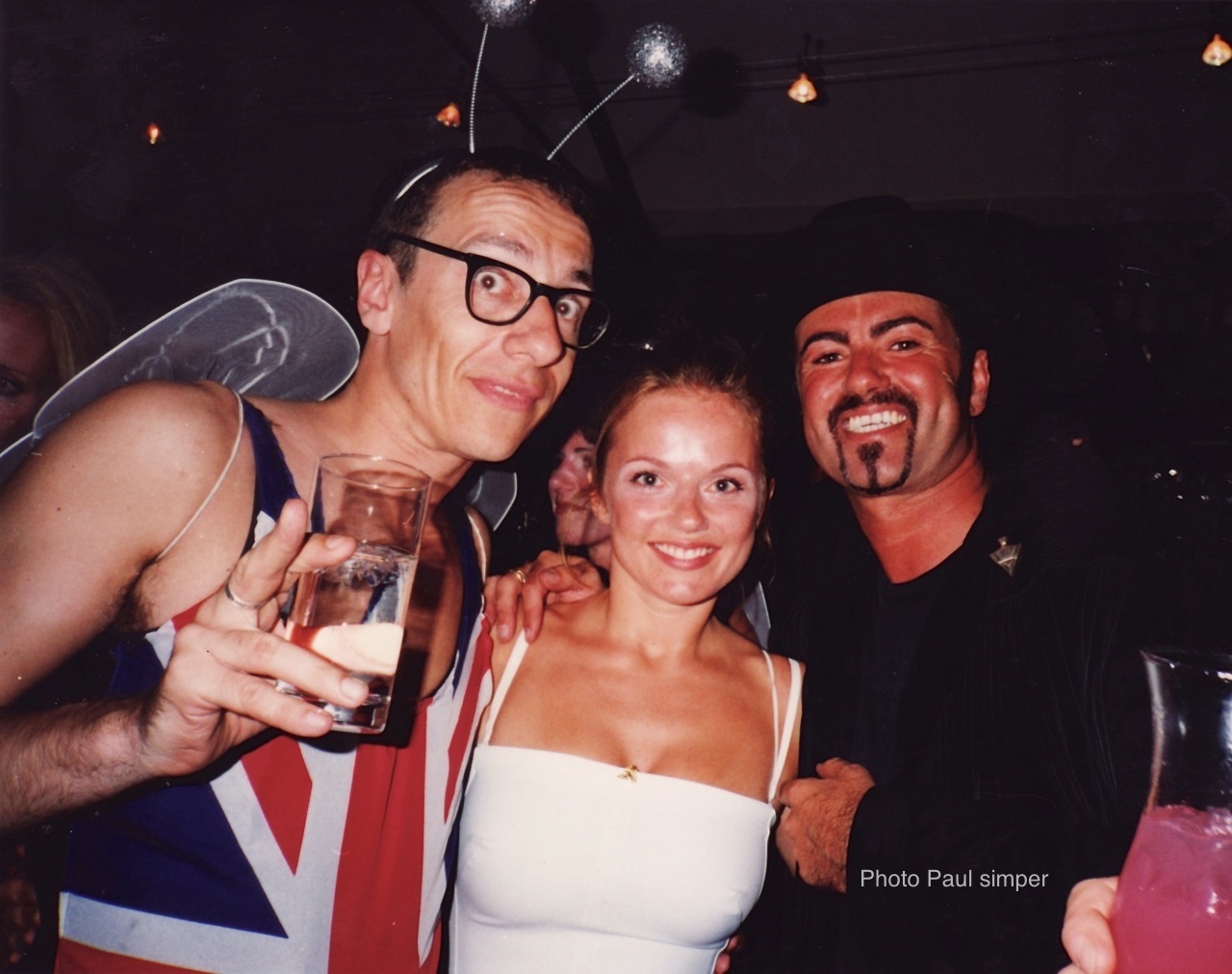
George’s 35th birthday where Simper was deejaying dressed as a Spice Girl angel: George was obliged to introduce him to Ginger Spice. Photo by Simper
Le Beat Route was where Andrew Ridgeley came up with the “Wham! Bam! I am a man!” rap. It was where George would perfect his pair dancing with Shirlie Holliman to D-Train, Was Not Was and Evelyn “Champagne” King. It was the inspiration for Club Tropicana.
Of equal importance though had been Saturday Night Fever – the movie that rang the death knell for disco for the cool kids of the underground dance scene but for those in the sticks in our teens the first pulling back of the curtain (even though it was actually set in faraway Brooklyn) on a thrilling new world. On reflection, it’s perhaps surprising that George never covered a Bee Gees song, with the exception of side project Boogie Box High’s Jive Talkin’, but he was always a massive fan, applauding their return to the top of the charts after a lengthy absence with You Win Again and marvelling, after a visit to Barry Gibbs’ home in Miami, that he was the only man he’d met who took even longer over his hair than George did.
Friday nights at Le Beat Route were just about over by the time I first interviewed George and Andrew in October ’82, although Wham! did throw one last Christmas party there to celebrate leaving their first record company, Innervision. Instead it was now The Wag on Wardour Street, which, as Wham! took off, increasingly became George’s place to hang out, unbothered.
If Chant No1 belongs to Le Beat Route, then The Wag at Christmas ’84 is where I think of for Wham!’s Everything She Wants. It was where I first heard deejay Fat Tony play the 12-inch mix with its glorious, expanded middle eight, which George had handed him that night to test out on the dance floor. From its rapturous reception and the delighted look on George’s face you could see he’d got the confirmation he was after. Like Chant, he’d delivered his club classic.
First at Melody Maker, then at No1, I was lucky enough to get my fair share of interviews with George. In early No1 days that included him going on a Blind Date with Keren Woodward from Bananarama which ended with him popping up to the 26th floor of IPC magazine’s HQ in King’s Reach Tower to play us a just-finished mix of Bassline (later retitled A Ray of Sunshine) on our tinpot stereo system.
They were more innocent, uncomplicated times in terms of pop coverage but even once Fleet Street turned its attentions to him and much of that side of it became more wearisome, he continued to be one of my favourite pop stars to interview, funny and forthright, as I hope the two interview clips attached here illustrate.
GEORGE/SIMPER 1987 INTERVIEW ON BEING CAMP:
++++++++++++
GEORGE/SIMPER 1987 INTERVIEW ON UNDERPANTS:
++++++++++++
Thanks primarily to June – “Don’t forget Simper!” she’d holler – I saw him more socially once Wham! finished and his solo career began. Merry Chianti-filled nights at Aldo Zilli’s two Dean Street restaurants, Il Siciliano and Signor Zilli’s, and dancing to his records at Brown’s and later Abba, the weekly Hanover Square one-nighter run by June and Fat Tony.
I loved the fact that he danced to his own records. After all if you can’t dance to your records why should anyone else? Fellow clubber and George fan Bayo Furlong reminded me that George always danced exactly like George Michael – the soul boy steps, the arms aloft, the finger and toe points, the hips shake, the swivel, the spin – which is even more brilliant. He was the singing, dancing embodiment of his own Wham! mantra (Wham!tra?) “Enjoy what you do”!
And what a voice. Of his generation, take your pick between him and the other George, for greatest white male soul singer of the 80s. It was there as early as Wham! ballads Nothing Looks the Same in the Light and Club Tropicana B-side Blue and grew on Careless Whisper and A Different Corner. His duets with Aretha Franklin and Mary J Blige – ringing endorsements in themselves – raised the bar again only for him to reach even higher with the likes of Older, You Have Been Loved and Jesus to a Child.
He said himself that he wasn’t the most prolific of writers. Two Wham! and four solo albums of original material and rarely much left over for B-sides (though Fantasy is a little gem) but as a pop star he aced it – twice over.
First in the perfect pop group, two teenage buddies who remained in spirit, sound and success as Wham!-like from the opening volley of Wham Rap! and Young Guns to the last howl of The Edge of Heaven. Then a second time, making the daunting leap from teen idol to internationally successful solo artist, barely breaking a sweat where so many others have fallen.
He told me he’d set himself the goal of joining the then 80s elite of Prince, Michael Jackson, Madonna and Bruce Springsteen. If the Faith album was his Thriller, with its 25 million sales, he went one better than MJ, surpassing it artistically with Older. And, despite the subsequent fall-out with Sony over record sales, Listen Without Prejudice Vol I – which includes the gorgeous Bacharach-style ballad Cowboys and Angels – isn’t too shabby either.
As our careers both went in different directions, I got to interview him less, but deejay for him more. Fat Tony got me on board to help out with George’s 30th birthday celebrations and I was there again for his 35th in 1998. Both had fancy-dress themes, the latter one Cowboys and Angels, and good sport that he was he didn’t bat an eyelid when I asked him, dressed in a fetching Spice Girl Union Jack bathing suit and wings, to persuade a reluctant Geri Halliwell to do a photo with me.
“He’s a bit strange,” George explained to Ginger Spice, “but he’s a very old friend.”
I’ll settle for that. He did a lot more for me than I’m sure I ever did for him. Dancing to Everything She Wants – dancing like him to Everything She Wants – still gives me more pleasure than most things in life.
At the time of that last Spandau interview he was in the studio still working on his final studio album, Patience. When he played me Flawless (Go to the City) I knew he’d got me again.
“It’s no good waiting. You’ve got to go to the city.”
That small-town thrill. The anticipation for those Beat Route, Saturday Night Fever moments was still somewhere in our DNA.
I was back in the countryside, tucked up in bed at my mum’s, when I heard he had gone. I only ever went to his house in Goring once, one Boxing Day thanks to June and another good pal, his wonderfully considerate PA Shiv Bailey. He sent a car for me and the only way it could have been any more perfect is if Richard and Judy hadn’t just departed. Otherwise it was all my Last Christmas joy rolled into one.
So thank you, George, for all those happy Christmases, and for everything else you gave.
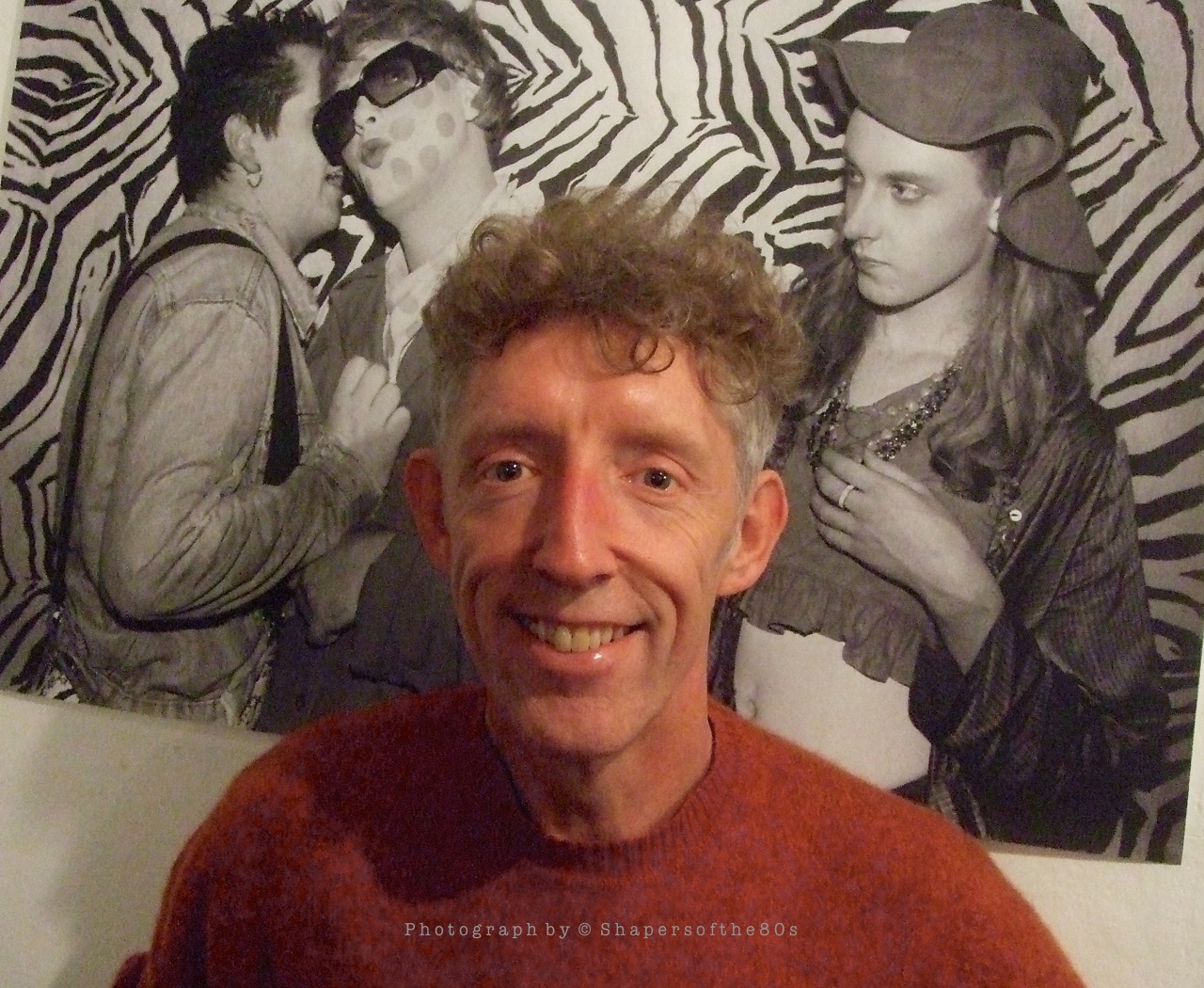
Dave Swindells at Doomed, in front of one of his photos of Taboo in 1985: “It was such an adventure, a crazy night in terms of what happened there, partly because there would be a whole suitcase load of ecstasy” (Photo by Shapersofthe80s)
◼ WE FIRST MET, I VAGUELY RECALL, at the Leadmill in that damp autumn of ’82 when Dave Swindells was still a student at Sheffield Uni. I was the hotshot “Man from The Face” doing a whistle-stop tour of Sheffield clubs for my monthly Nightlife column in Britain’s coolest subcultural magazine, so I was quite used to people standing in front of my camera trying to get into shot. Swindells on the other hand turned his back on me while he lined up his Kodak Box Brownie in a pathetic attempt to capture some new-wave synth band on the barely lit stage. I smiled smugly to myself at his teen gaucheness and leaned in paternally to whisper the advice I’d gleaned from another snapper of the night, Richard Young, himself emerging as the celebrity paparazzo we know and love today: “Give give it f/8 and push the film in the developer.”
The grateful Swindells gushed his thanks and asked: “Please, sir, how do I get into photography for a living?” – “Stick to what you know,” I replied sagely. “Why not photograph what your friends get up to at night?” Ha! I knew full well dark clubs were a nightmare to capture on the slow film of those years before digital, when the trickiest part was having to use flash at close quarters, which reduces faces to a white blotch.
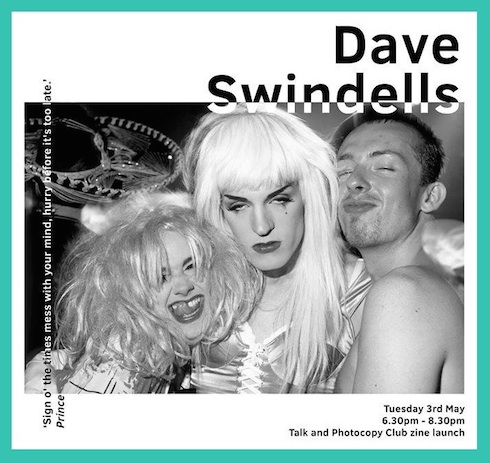
Flyer for the Swindells talk on Tuesday: explain this lot, Dave!
Within two years the little bastard had stabbed me in the back and was toting a very upmarket Pentax as Nightlife Editor of Time Out magazine – a job he then hung onto for the next 23 years!!! His photographs have been featured in i-D, The Face, The Observer etc, while swanning round the world on travel freebies. I’ve been kicking myself ever since.
Next Tuesday 3 May he’ll be telling us all how on earth he got away with it for so long. He’s giving a talk at some achingly on-fleek gallery in Dalston called Doomed, where there’ll be a display of photos and a limited edition Photocopy Club zine to take away. Dave’s title is “Keeping It Real” and he promises “a fascinating insight into the trends, attitudes, and nuances of London’s clubbers. Evocatively shooting the emergence of the rave scene in the late 1980s, Dave follows the journey from the wild attitude of rave to the night-time antics of modern day”.
Frankly, I can’t think of anybody better qualified to tell the tale of the past three decades of hedonism pursued to the hilt as only the Brits know how. Dave’s the one who’s got the proof in pictures, and how.
“ IN JULY 1969 men walked on the moon, a technological leap all but unthinkable 50 years before. Three years later they abandoned it, and have renounced all return ever since. What boosters saw as the great opening act of the space age turned out to be, in effect, its culmination. Within a few years presidential corruption, economic stagnation, military ignominy and imagined catastrophe had warped post-war America’s previously impervious belief in progress, a belief that had resonance across the then free world. After Apollo, the future would never again be what it used to be.
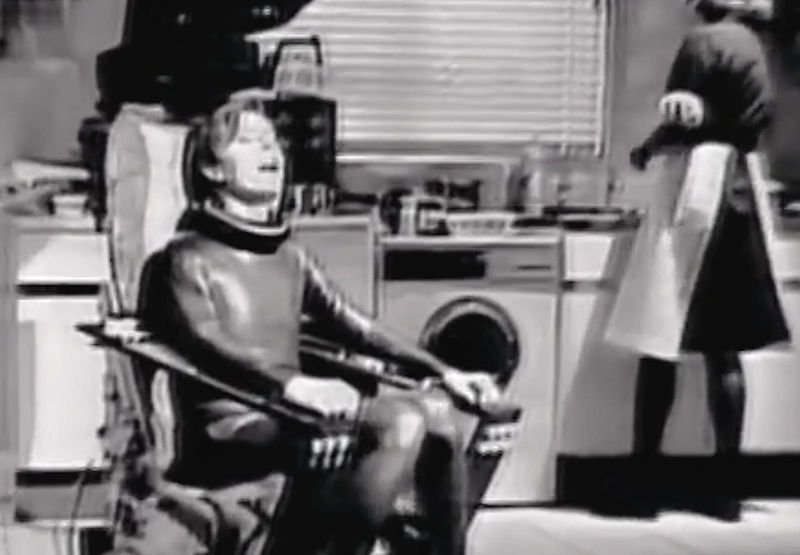
David Bowie’s greatest years began nine days before Apollo 11 touched down in the Sea of Tranquillity, with the release of his single Space Oddity; they ended 11 years later, with the single Ashes to Ashes. Over that decade he used imagined futures to turn himself into something contradictory and wonderful — an epitome of alienation with whom the alienated flocked to identify. In doing so, he laid bare one of the key cultural shifts of the 1970s: the giving up of past dreams. . . ” / Continued online
“In Space Oddity Major Tom, floating in a most peculiar way, had been an isolated spaceman;
by Ashes to Ashes his isolation was a junkie’s”
– The Economist
1980: “Ashes to ashes, funk to funky / We know Major Tom’s a junkie / Strung out in heaven’s high / Hitting an all-time low”
2016: The British astronaut Major Tim Peake – sporting the Union Jack on his shoulder – takes his first spacewalk at 2pm today from the International Space Station (via NASA Television)
NOT FORGETTING COMMANDER CHRIS HADFIELD
❏ This is the cover version Bowie called “possibly the most poignant version of the song ever created”, recorded by Commander Chris Hadfield on board the International Space Station in 2013.
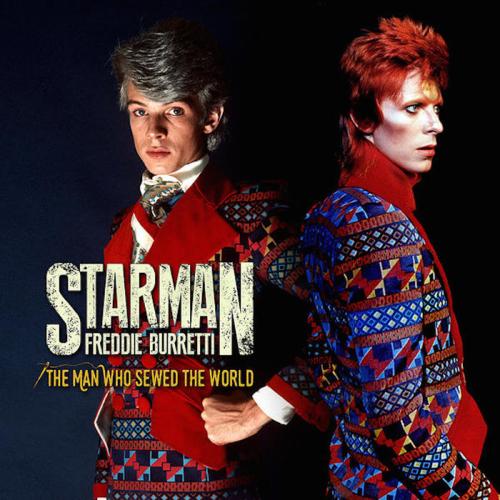
Connected by “otherness”: In a scoop for the film Starman, Bowie himself gave this unseen 1973 picture of Freddie Burretti wearing his own design for a lush crimson suit to launch the Aladdin Sane album. Both photographs by Masayoshi Sukita
❚ BETWEEN 1970 AND 1974 FREDDIE BURRETTI not only became David Bowie’s intimate teenage playmate but gave visual expression to the singer’s pop ambition. When they met Bowie was 23 and married to Angie while former Mod face Freddie, with his 28-inch waist and voluptuous long-hair, was as sexy as many another 19-year-old in that moment when David Johansen, Marc Bolan and Bowie were creating what became known as glam rock. But Freddie and David clicked instinctively in what Bowie calls their “otherness”, much of which derived from their sexuality. David’s career rebirth as an alien on Planet Earth was a masterstroke of pop invention and it was Burretti who created the exotic and brazenly sexual one-piece style of costuming in lush fabrics that we associate with Ziggy Stardust.
A new documentary biopic was previewed in London last night and not only breathes fresh life into familiar Bowie music but pieces together a unique chapter about his personal relationships against the austere climate of Britain in the 70s. Director Lee Scriven captures on film a score of eye-witness accounts, chief among them Freddie’s brother Stephen, his special friend and flatmate Wendy Kirby, his younger It-girl protégée Daniella Parmar, and biographer Kevin Cann.
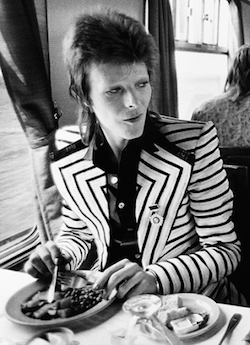
Burretti stripes 1973: Bowie photographed on the Aberdeen express by Mick Rock
Titled Starman: Freddie Burretti – The Man Who Sewed The World, the biopic’s impact is cumulative. Burretti described himself as “just a dress designer” – raised in Hackney, transplanted at 14 to Bletchley in the home counties, then escaping at 18 back to London to live the life – yet by the time the on-screen talking heads arrive at GQ editor Dylan Jones, it becomes clear that a body of opinion today ranks Burretti alongside giants such as Zandra Rhodes, Vivienne Westwood and even Alexander McQueen, whose design talent blossomed more than a decade later.
Indeed, Burretti’s “stylish, yet slightly whimsical approach to tailoring” and the enduring influence of his adventurous cutting in several suits of the moment during 1973–74 is thoroughly acknowledged in the V&A catalogue to its touring exhibition, David Bowie Is. The singer’s blurring of the line between stage wear and day wear persuades an impressive list of high-fashion designers to admit their debt to him, including Riccardo Tisci at Givenchy whose SS2010 show opened with a black-and-white striped blazer in a blatant tribute to the one Bowie was famously photographed wearing on an intercity train in May 1973.
Bowie told Fan magazine in 1974: “Freddie is extremely patient. He just listens to my ideas and has this sort of telepathy, because whatever I think of in my mind he produces for real. I just hope he’ll continue to design incredible clothes for me.”
Click on these pics to enlarge
At Radio City Music Hall, New York, 1973
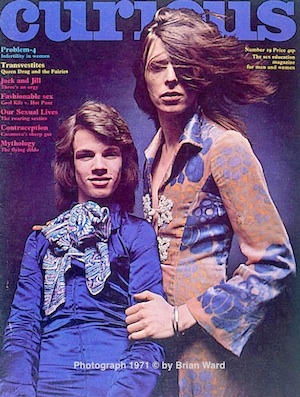
❏ Up until now very few pictures of Freddie Burretti were known to the public – even the cover of the sex education magazine Curious shown below surfaced in only 2010 with Cann’s chronology of Bowie’s early life, Any Day Now. As the gay liberation movement was gathering momentum in Britain, we see Bowie wearing a floral “man-dress” designed by Savile Row tailor Mr Fish, known for putting Mick Jagger in a frock for the Stones’ 1969 Hyde Park concert. Bowie had two Mr Fish dresses which he wore in 1970 in cover photographs for the album The Man Who Sold the World.
With Starman, Scriven’s company LJS films has scored a major coup. The publicity photo you see up top has never been published before and was given to the project by Bowie himself, showing off Freddie’s good looks, with grey highlights in the hair. Today you’ll come across very few pictures of the gorgeous suit in rich crimson-and-blue velvet with flared crimson trousers created for the launch of the Aladdin Sane album. Its first outing was Bowie’s interview on the Russell Harty TV chat show recorded on 17 January 1973, and in an associated live clip singing Drive-In Saturday.
Uniquely, what Starman has done is to collage together Burretti and Bowie in the crimson suit to simulate a sumptuous set of photos taken that February by Masayoshi Sukita against the glistening art deco interior of Radio City Music Hall in New York. Scriven said: “I have been told Freddie would arrive at studio shoots in advance with the clothes and help the photographer by standing in as a model so he or she could set up the lighting etc ready for Mr Bowie.” Some of the shots play with his mirrored reflection and the collage cleverly echoes the originals.
In the UK an NME headline revealed the new persona, “Goodbye Ziggy, Big Hello to Aladdin”, while at Radio City on 14–15 February Bowie and the Spiders were launching their US tour. One poor black-and-white photograph suggests he might well have been wearing the crimson suit as he helicoptered onto the Music Hall stage. In this 90-minute show Bowie transitioned through the hit songs of Ziggy Stardust to introduce Aladdin Sane and all but one track from the new album – all this, remember, before his official and unexpected “retirement of Ziggy” announcement in London that July. Included in Freddie’s £1,000 invoice for costumes supplied to the tour, Cann’s meticulous book records “Red Check Suit 40 guineas” (about £500 today).
The tragedy is that the Burretti-Bowie partnership ended the next year, over a “financial disagreement”, according to Cann’s book. Immediately, Burretti slipped out of the public eye.
THE NIGHT DAVID MET FREDDIE
Curious magazine, 1971: Bowie wears his Michael Fish “man-dress” and plans to create a band called The Arnold Corns to showcase Freddie as “the next Mick Jagger”. In the studio, it turned out that Freddie couldn’t sing
❏ Their relationship had begun in 1970 in Kensington’s fashionable gay disco Yours Or Mine beneath El Sombrero, a Mexican restaurant. The Bowies were regulars, and one night David spotted Freddie cutting a dash on the up-lit dancefloor. Angie Bowie crossed the room to ask him and Wendy to join them for a drink.
In an interview with 5years.com Angie said in 2000: “You have no idea how handsome this man was. Freddie was wearing white Spandex hotpants with a navy blue sailors trim and a sailor shirt with short sleeves out of the same white Spandex edged in navy on the collar and sleeves. He looked totally Scandinavian with high cheek-bones and lots of blond hair, but he was tall and had big hands and feet speaking of his artistry and physical stamina. Every night he made new clothes to wear. He was so brilliant.”
At last night’s screening flatmate Wendy also remembered that day: “Angie approached us and asked us to have a drink. We hesitated and that’s what’s missing from the film – our sheer arrogance. We nearly said no!” She added: “Watching the film was quite strange. No one imagines their youth will be portrayed on screen and it was a little unsettling. I think the film was an affectionate glimpse of a time long gone. I didn’t appreciate at the time how talented Freddie really was. Lee’s film brought home how exceptional his work was. I’m proud to have known the man who was ‘just Freddie’ to me.”
Was Bowie’s gay phase in truth a marketing stance, as some argue? In his 2011 biography Starman, Paul Trynka reports American actor Tony Zanetta saying: “He was bisexual, but what he really was, was a narcissist – boys or girls, it was all the same. He was attracted to the gay subculture because he loved its flamboyance. Sometimes it was just an expression of communication – sometimes it was a way of. . . assimilating someone.” Bowie knew exactly what he was doing.
❏ Read on for a review of the film by Andy Polaris, ex-Blitz Kid and 80s pop singer who regards Bowie as one of rock’s serious gods.
Angie and David at home to Freddie in Haddon Hall: the host wears his Michael Fish designed “man-dress” that was banned from his American album cover for The Man Who Sold the World
Bowie’s designer Freddie and It-girl Daniella in about 1971: striking a pose that David and Angie came to emulate
Andy Polaris
❏ Starman: The Man Who Sewed The World gives a fascinating insight into the relatively unknown life of fashion future legend Freddie Burretti. This working-class lad had a creative mind able to absorb everything he loved about Mod fashion, having taught himself to make his own clothes at an early age. With enough dedication and focus to learn tailoring as well as the youthful dynamics of the dancefloor, he was obviously adept at observing styles and reworking looks to his own vision.
A chance meeting at the disco lead to the serendipitous collaboration with Bowie and the singer’s as yet not fully realised Ziggy Stardust wardrobe. These bold textured prints and coloured jumpsuits were, and are, extraordinary for capturing Bowie’s otherness at that time. Aladdin Sane prints that looked like Liberty worn by the androgynous male rock star blew our tiny minds back then.
What I loved about the movie was seeing the genesis of Freddie’s glamour vision in a mundanely drab landscape played out with the innocence of his mainly, it appears, female friends notably Wendy bf and Daniella protégée. Wonderful to hear their counterpoint stories of that inner ciricle involved in Bowie’s creation of Ziggy with Freddie’s ascendant talent and confidence.
The pairing of Freddie and Daniella wearing his clothes is groundbreaking. Looking at those photos we see the androgynous beauty of Freddie (like a still from James Bidgood’s 1971 cult movie Pink Narcissus) teamed with Daniella’s Asian complexion and short spiky blonde crop. They had already created David and Angie’s classic image before the rest of the world saw it!
Coordination of styles, 1973: which came first, Johansen of New York Dolls or Bowie in Burretti suit?
In fact, Daniella also anticipates Ava Cherry singing with Bowie in Young Americans several years later when we note the similar styling – how did that happen?
From my own black perspective, a brown or black face was something I would immediately zone in on, seeing someone like you up there on a stage and hanging out with the stars. Marc Bolan having the black Gloria Jones as his wife was a big bloody deal to some black kids, for sure.
Freddie’s whole look seems to have been adopted wholesale by David Johansen of the New York Dolls, so the influence of this young British designer can today be recognised rippling out into the wider pop culture although it probably wasn’t acknowledged at the time. Maybe a parallel could be drawn between Freddie and Alexander McQueen – both gay and from working-class backgrounds – though McQueen came to work with Bowie as an established star, whereas Freddie created an image that made Bowie a star. Today it is unreal to imagine any designer could achieve such pivotal pop success without a massive team behind them.
➢ Choose “View full site” – then in the blue bar atop your mobile page, click the three horizontal lines linking to many blue themed pages with background article
MORE INTERESTING THAN MOST PEOPLE’S FANTASIES — THE SWINGING EIGHTIES 1978-1984
They didn’t call themselves New Romantics, or the Blitz Kids – but other people did.
“I’d find people at the Blitz who were possible only in my imagination. But they were real” — Stephen Jones, hatmaker, 1983. (Illustration courtesy Iain R Webb, 1983)
“The truth about those Blitz club people was more interesting than most people’s fantasies” — Steve Dagger, pop group manager, 1983
PRAISE INDEED!
“See David Johnson’s fabulously detailed website Shapers of the 80s to which I am hugely indebted” – Political historian Dominic Sandbrook, in his book Who Dares Wins, 2019
“The (velvet) goldmine that is Shapers of the 80s” – Verdict of Chris O’Leary, respected author and blogger who analyses Bowie song by song at Pushing Ahead of the Dame
“The rather brilliant Shapers of the 80s website” – Dylan Jones in his Sweet Dreams paperback, 2021
A UNIQUE HISTORY
➢ WELCOME to the Swinging 80s ➢ THE BLOG POSTS on this front page report topical updates ➢ ROLL OVER THE MENU at page top to go deeper into the past ➢ FOR NEWS & MONTH BY MONTH SEARCH scroll down this sidebar
❏ Header artwork by Kat Starchild shows Blitz Kids Darla Jane Gilroy, Elise Brazier, Judi Frankland and Steve Strange, with David Bowie at centre in his 1980 video for Ashes to Ashes
VINCENT ON AIR 2026
✱ Deejay legend Robbie Vincent has returned to JazzFM on Sundays 1-3pm… Catch up on Robbie’s JazzFM August Bank Holiday 2020 session thanks to AhhhhhSoul with four hours of “nothing but essential rhythms of soul, jazz and funk”.
TOLD FOR THE FIRST TIME
◆ Who was who in Spandau’s break-out year of 1980? The Invisible Hand of Shapersofthe80s draws a selective timeline for The unprecedented rise and rise of Spandau Ballet –– Turn to our inside page
SEARCH our 925 posts or ZOOM DOWN TO THE ARCHIVE INDEX
UNTOLD BLITZ STORIES
✱ If you thought there was no more to know about the birth of Blitz culture in 1980 then get your hands on a sensational book by an obsessive music fan called David Barrat. It is gripping, original and epic – a spooky tale of coincidence and parallel lives as mind-tingling as a Sherlock Holmes yarn. Titled both New Romantics Who Never Were and The Untold Story of Spandau Ballet! Sample this initial taster here at Shapers of the 80s
CHEWING THE FAT
✱ Jawing at Soho Radio on the 80s clubland revolution (from 32 mins) and on art (@55 mins) is probably the most influential shaper of the 80s, former Wag-club director Chris Sullivan (pictured) with editor of this website David Johnson
LANDMARK FAREWELLS. . . HIT THE INDEX TAB UP TOP FOR EVERYTHING ELSE