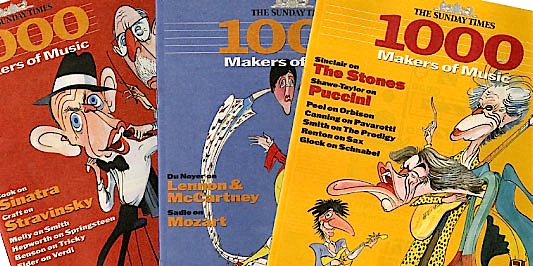
❚ ON THE 20TH ANNIVERSARY of The Sunday Times publishing its encyclopedic Abba-to-Zappa partwork, 1000 Makers of Music, let’s recall the first pop biography in its 1,000 music-makers. The Swedish four-piece Abba won the Eurovision contest in 1974 with their Waterloo wall of sound, not to mention instant celebrity for their self-selected kitsch costumes from the age before stylists had been invented. We’ve dug out from the vaults my assessment of Abba to remind us how these deeply embarrassing Scandinavians went on to transform their reputation from cheesemakers to the most ironic definition of Pure-Popsters!
Within a decade Abba were utterly rehabilitated in the UK by London’s subcultural opinion formers. Most memorably, Shapersofthe80s witnessed (sadly without a camera to hand) an immaculate recreation of Abba’s Dancing Queen video by clubland’s coolest Blitz Kids cutting the rug at designer Fiona Dealey’s 1983 birthday party. Spontaneously, movers and shapers such as Dylan Jones not only fell into dance formation but knew all the words, plus Agnetha and Anni-Frid’s hand moves too! It was, in that frozen moment of time, a shockingly unbelievable sight. It marked the birth of a much-loved cult.
1000 Makers of Music: six-week partwork from The Sunday Times
FROM 1000 MAKERS OF MUSIC, MAY 1997:
Abba – Swedish, 1973-82, vocal group
As cheesy now as when they won the 1974 Eurovision song contest singing Waterloo, Abba embody a perennial contradiction: you may make the quintessential pop music of the decade but you must remain for ever a bad joke if that era proves as tasteless as the 1970s. Abba’s lovingly coupled foursome – the acme of glitz in their satins and flares – were derided because Benny Andersson and Björn Ulvaeus, as journeymen songsmiths, wrote singalong melodies epitomising Europe’s dreaded folkloric tradition. Worse, their sentimental lyrics about love and money – in English – nauseated purists who preferred Anglo-American guitar heroes who mouthed youthful dissent.
Yet Abba scored eight consecutive No 1 albums in Britain and 25 Top 40 singles so catchy that everybody can hum one. In 1992 Abba’s hits were revived ironically by Erasure and ingenuously by a tribute band called Björn Again. Today Abba enjoy cult status in Britain as new generations, numbed by the joylessness of techno and talent contests, recycle yesteryear’s kitsch to discover ecstasy in pure pop.
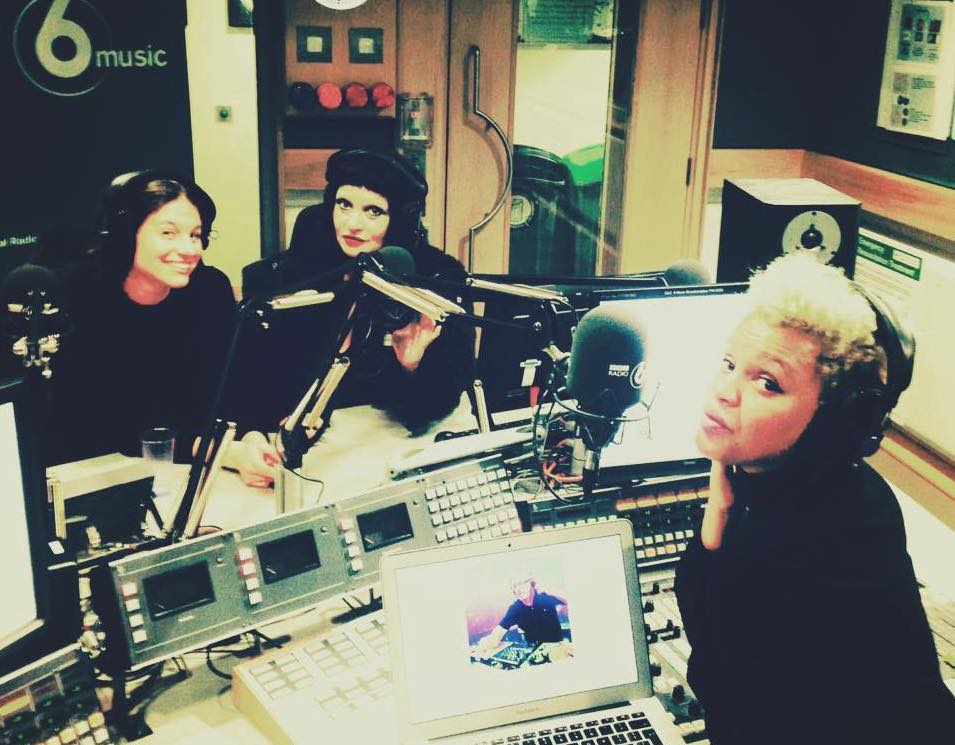
In the BBC 6 Music studio for Lost Clubs: Princess Julia, centre, with deejay Gemma Cairney at front. (BBC)
◼ AT FACEBOOK TODAY original Blitz Kid and club deejay Princess Julia reports: “Jolly afternoon recording a Radio 6 show with presenter Gemma Cairney due to be aired Sunday 1pm. Graeme Park is on as well, we did a live link-up and covered nightlife from over 4 decades! Past, present and future #lostclubs all in the space of an hour!”
➢ Tune in to Julia live on Sunday at 1pm or catch up later at BBC 6 Music online – “As a companion show to Lamacq’s Indie Venue week, Gemma Cairney explores the rich history of clubs like the Blitz, Hacienda, Club NME, and White Trash that are no longer running, and look at how Fabric was saved. Talking to experts and those involved with the clubs, she’ll play tunes that were the soundtrack to a night out. Expect Happy Mondays, New Order, Bowie, Oasis, Spandau Ballet, Visage, Yeah Yeah Yeahs and Pulp.” [BBC Online]
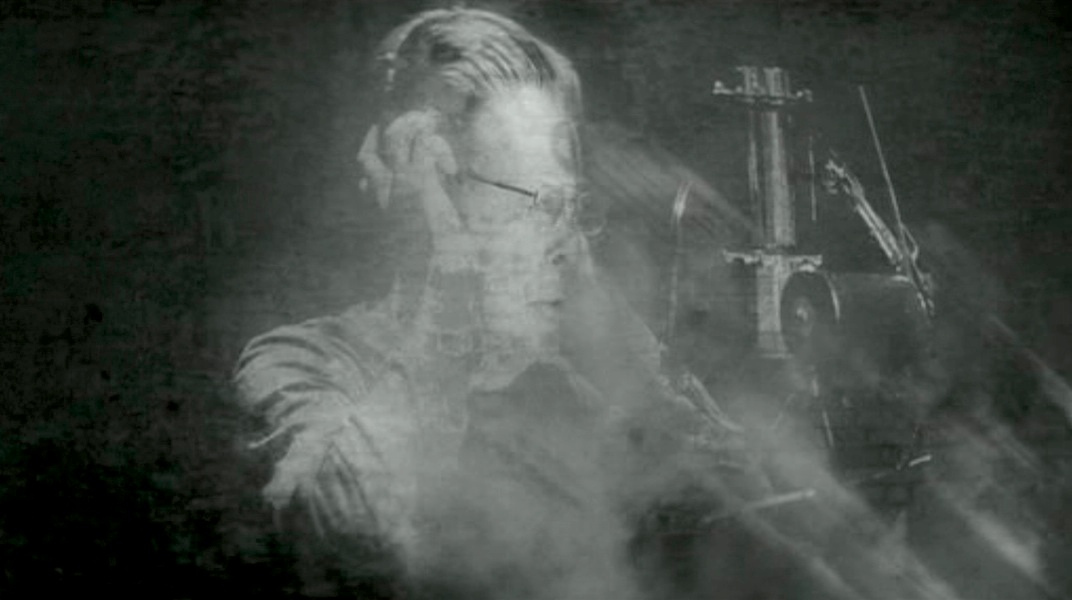
Bowie as a projected image in the video for Sue (Or in a Season of Crime)
“If you feel safe in the area that you’re working in, you’re not working in the right area. Always go a little further into the water than you feel capable of. Go a little bit out of your depth and when you don’t feel that your feet are quite touching the bottom, you’re just about in the right place to do something exciting” – David Bowie
◼ THE MOST GRIPPING SEQUENCES in the new TV documentary about Bowie’s final surge of creativity are those which assemble every musician in the bands he worked with from 2012 to the end. Each band re-enacts pivotal moments when they rehearsed the music, inspired by his lyrics, and laid down the tracks for the albums The Next Day and Blackstar. Particularly revealing is the session when pure jazz soloists created the nerve-tingling Sue (Or in a Season of Crime), which Bowie added to his 2014 “best-of” collection, Nothing Has Changed.
To mark the first anniversary of the star’s death, this weekend BBC2 screened David Bowie: The Last Five Years, Francis Whately’s sequel to his other superb documentary Five Years broadcast in 2013. The role of jazz in Bowie’s musical temperament seldom gets discussed, though his producer Tony Visconti says the jazz influence had always been there in the music but underneath the surface. As a small child Bowie heard a jazz band and right away said: “I’m going to learn the saxophone. When I grow up, I’m going to play in [this] band. So I persuaded my dad to get me a kind of a plastic saxophone on hire purchase.”
In 2013 in New York he met Maria Schneider, a jazz composer, handed her a demo disc and asked her to extemporise around a tune called Sue. In turn, she told him he had to listen to this sax player Donny McCaslin and without missing a beat Bowie went straight into the studio with his group and Maria and out came possibly the purest jazz number of his career, a discomfiting tale of infidelity. It won Schneider a Best Arrangement Grammy in 2016.
Donny McCaslin enthuses about Bowie during rehearsals
Maria Schneider’s proposed scoring for Sue
REVIEWS OF THE LAST FIVE YEARS TV DOC
➢ A thrilling portrait of a late-life renaissance
– Jasper Rees at the Arts Desk “ The opening yielded much joyful footage of Bowie goofing around on the Reality tour (2003), seeming much more like one of the boys than he ever managed with Tin Machine. The band still seemed spooked at the memory of his collapse, before he was carted off to retirement in an ambulance.
Maria Schneider was one of many musicians – three complete bands – who re-formed to walk through the creation of the music. Drummer Zachary Alford still looked shocked at the NDA handed him as he showed up to work on The Next Day. “If I said anything about it,” remembered bassist Gail Ann Dorsey, “I would be in big trouble legally.” Nobody was asked if Bowie really would have sued his collaborators for spilling the beans.
The recent collaborators reflected on the extent to which the new music was steeped in the past. But there was also good stuff from the old lags who worked (and sometimes slept) with Bowie in the feather-cut era: Ideally there would be a DVD with extras featuring much more from each of them. Chief keeper of the flame Tony Visconti sat at a console and played excerpts of Bowie’s unaccompanied vocal takes. On Blackstar came the haunting sound of Bowie wheezing like an ancient mariner fighting for every last scrap of breath. . . ” / Continued online
➢ A treat and a treatise on music’s departed genius
– by James Hall, Daily Telegraph “ The Last Five Years wove previously unheard Bowie interview material with on-screen contributions from collaborators including producer Tony Visconti. The access and insights were faultless. Whately’s programme was essentially a treatise on artistic rebirth. And it showed that although Bowie’s musical style constantly changed, the themes that preoccupied him — alienation, escape, the notion of fame — were there until the end.
During his final creative burst, Bowie gradually revealed to collaborators that he was ill. In the most poignant scene, we learned that Bowie only discovered his cancer was terminal three months before he died. This was in October 2015 when he was filming the video for Lazarus, in which he sings the line “Look up here, I’m in heaven”. Bowie worked and cared and joked until the end. Through tears, Visconti said that he was at ‘the top of his game’. . . ” / Continued online
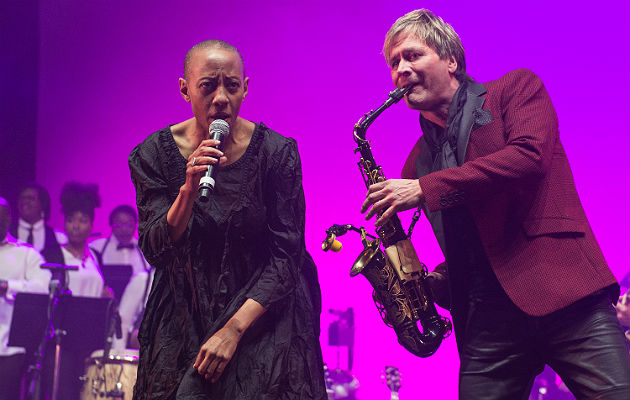
Brixton tribute concert for Bowie: Gail Ann Dorsey singing Young Americans with Spandau Ballet’s Steve Norman. (Photo: Getty)
❏ On what would have been Bowie’s 70th birthday his friend the actor Gary Oldman gathered at the Brixton Academy a 30-strong all-star lineup of musicians who had collaborated throughout his career, with some glorious orchestral and choral support. The show is the first in a run of gigs around the world taking place in cities that have a strong connection with Bowie and his work.
The London concert featured Mike Garson, Earl Slick, Adrian Belew, Mark Plati, Gerry Leonard, Sterling Campbell, Zachary Alford, Holly Palmer, Catherine Russell, plus such guests as Tony Hadley and Simon Lebon. Special highlights saw Gail Ann Dorsey singing Young Americans with Spandau’s Steve Norman on sax; and an audience singalong to Life on Mars? led by Adrian Belew and gifted vocals from Tom Chaplin from the band Keane. Plenty of live videos at YouTube.
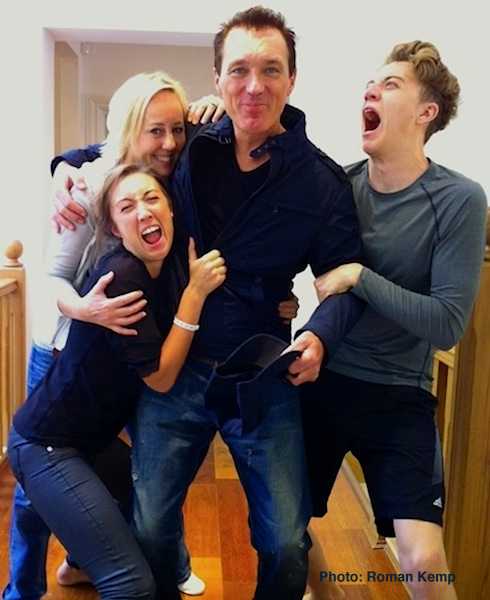
Martin Kemp sets off for the Celebrity Big Brother house: apparently his wife Shirlie, and children Harleymoon and Roman can’t bear to part with him. (Selfie courtesy of Roman)
“ George Michael planned to have a Boxing Day dinner with his ex-Wham! bandmate Shirlie Holliman, husband Martin Kemp and son Roman before tragic death. Late singer’s health did not stop him from organising a festive get-together with Shirlie and his godson.
“ Michael was discovered dead at his Oxfordshire home on Christmas Day after a long battle against drug and alcohol addition – aged just 53. However, George’s health had not stopped him from organising a festive get-together with Shirlie, 54, one half of pop duo Pepsi and Shirlie, her husband and fellow 80s star Martin Kemp, 55, their daughter Harley, 27, and son Roman, an up-and-coming Capital FM DJ and TV presenter who is also the Faith singer’s godson.
“ Speaking before George passed away, Roman, 23, said: “We’re going to George’s house on Boxing Day.”
“ On 26 Dec Roman also tweeted: “To me, you do the Christmas rounds and you see all those people who are big influences on my life. I speak to him quite often. He speaks to my mum every week. He’s just family to me, fame is not a big deal. I know it sounds strange but I’ve known him my whole life. We love you Yog”… ”
This slideshow requires JavaScript.
THE KEMP FAMILY TWEET THEIR OWN TRIBUTES
Martin Kemp, actor, bassist with Spandau Ballet – “My whole family and I are devastated at the loss of our beautiful friend Yog! We will miss him so much! We are all heartbroken!”
Shirlie Kemp, née Shirlie Holliman of Wham! – “Words can not express how sad we all are, only last week I saw him laughing and happy. My heart is broken to lose someone so special.”
Roman Kemp, son of Martin and Shirlie, George’s godson, TV host and radio deejay – “The man who toured the world with my mum; her best friend. / The man who introduced my parents; who forced my mum to call my dad. / The man that took me and Harley around the world; just to see us smile. / The man we all love. / We love you Yog.”
Harleymoon Kemp, daughter of Martin and Shirlie, photographer – “Such a kind, special man who has played such a huge part in our family history and shared with us nothing but love. We are all very sad.”
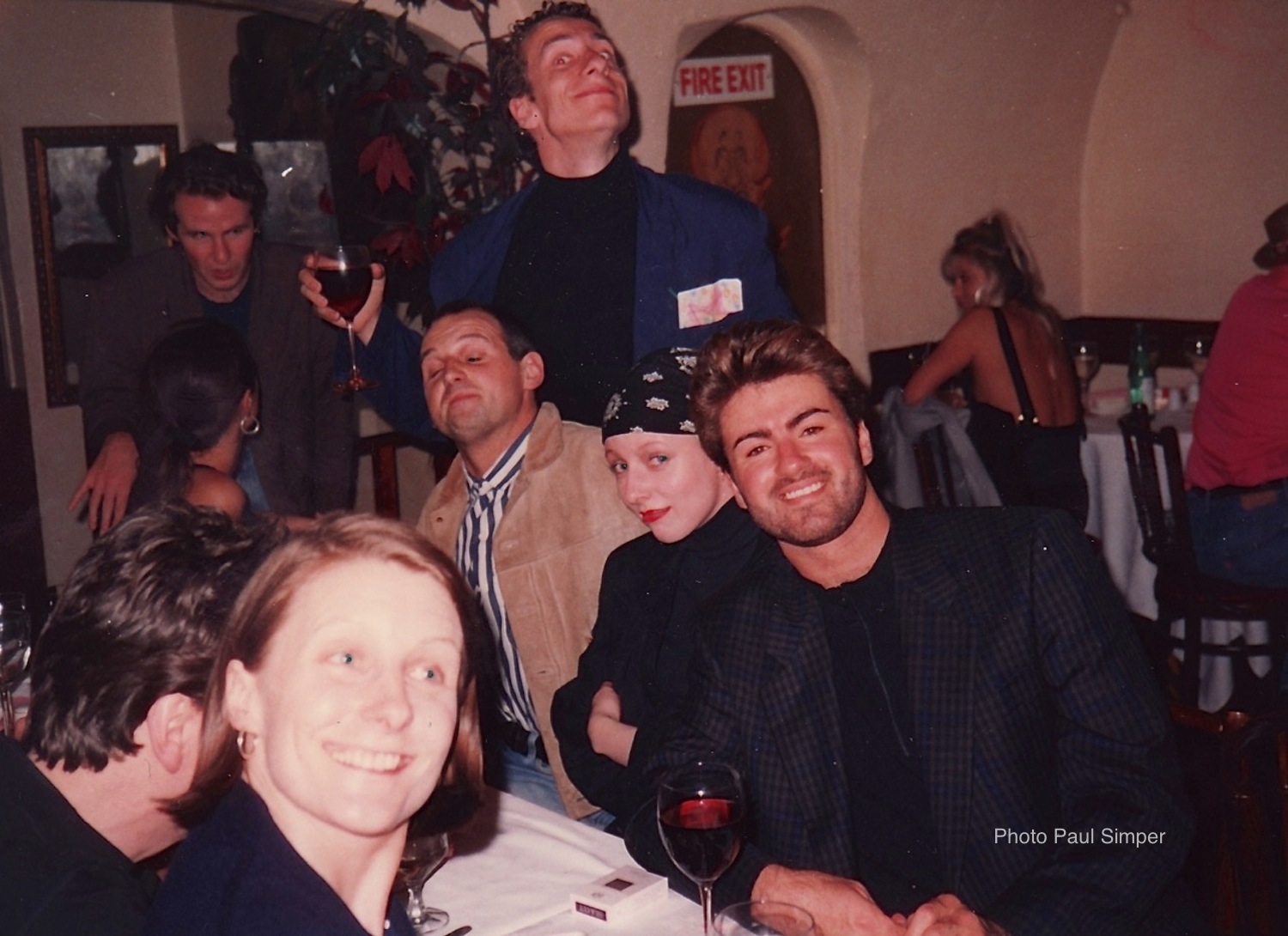
Simper’s 25th birthday at Aldo Zilli’s Il Siciliano in Soho: visible faces clockwise from front left: Lilli Anderson, Alex Godson (standing), Sam McKnight, the host (standing), Josie Jones, George Michael. Photo by Simper
Paul “Scoop” Simper arrived in London as a cub
journalist who soon became a backbone of No1, one
of the two leading pop magazines covering the
Swinging 80s. He also became a face about clubland
and in the years after he first met George Michael,
when Wham! was launched, became friends.
Shapers of the 80s is pleased to publish Scoop’s very personal tribute to one of the UK’s leading superstars who died this week
◼ OF COURSE HE HAD TO LEAVE US ON CHRISTMAS DAY. As a pop lover, especially one raised in the 80s, George Michael has been a part of mine and so many people’s Christmases for years.
This one was no exception. Nipping up the high street to the supermarket for one last shop on Christmas Eve, there was something both joyous and comforting about hearing him – not just as Wham! but on his lonesome giving us December Song and on Band Aid – whilst trolling up and down the aisles for a bottle of fizz and a few more festive nibbles.
If anything, this year he’d felt ever more present. A pre-Christmas gathering of my old 80s pals had stirred up memories of Whambley – that perfect pop farewell on the sunniest of days in ’86 in front of 72,000 adoring but heartbroken fans when George and Andrew signed off at the top of the charts (both albums and singles) with their friendship still intact.
Wham! fans came in all shapes and sizes. Not long ago I’d been listening to a bootleg of The Final concert, lovingly recorded and shared with me by No1 magazine’s then editorial assistant Dave Ling, later of Metal Hammer, a heavy metaller through and through, who made an honourable exception when it came to George and Andrew.
As I think about it now, not being a Wham! or George fan has always been a bit of a deal-breaker. One early relationship of mine came to a very swift end when she questioned my love of George. My pal June Montana (lead singer with Brilliant and gatekeeper on the Limelight’s VIP bar, who was actually a bona fide friend of his) and I were like the George gestapo. We could sniff out a non-believer at 100 paces.
Part of that devotion came from the fact that in 80s London clubland, Wham! were never really cool. They were outsiders. They were from Bushey, Hertfordshire. As a country lad from Wiltshire I felt a kinship, particularly with George.
He was a year younger but for both of us our first introduction to the game-changing London club scene of the early 80s was Le Beat Route – a Soho club I was gagging to go to the second I saw Spandau Ballet’s Chant No1 video, the anthem for this pop moment.
In the last interview I did with George, in 2006, when we were talking about Spandau, he remembered the thrill of going down for the first time to what was then the hottest club on the planet and actually sighting both Steve Strange (on the Space Invaders) and Tony Hadley (at the bar).
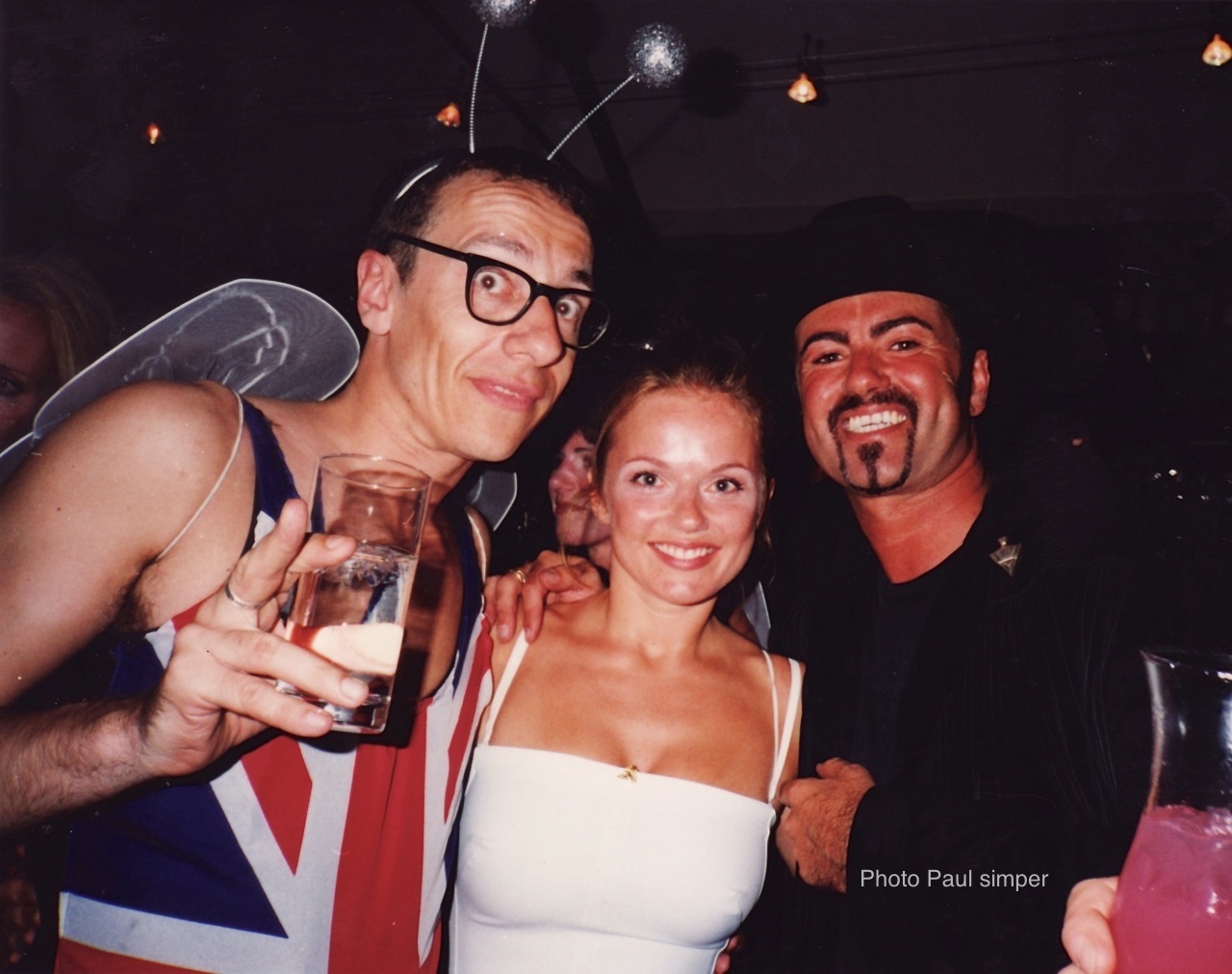
George’s 35th birthday where Simper was deejaying dressed as a Spice Girl angel: George was obliged to introduce him to Ginger Spice. Photo by Simper
Le Beat Route was where Andrew Ridgeley came up with the “Wham! Bam! I am a man!” rap. It was where George would perfect his pair dancing with Shirlie Holliman to D-Train, Was Not Was and Evelyn “Champagne” King. It was the inspiration for Club Tropicana.
Of equal importance though had been Saturday Night Fever – the movie that rang the death knell for disco for the cool kids of the underground dance scene but for those in the sticks in our teens the first pulling back of the curtain (even though it was actually set in faraway Brooklyn) on a thrilling new world. On reflection, it’s perhaps surprising that George never covered a Bee Gees song, with the exception of side project Boogie Box High’s Jive Talkin’, but he was always a massive fan, applauding their return to the top of the charts after a lengthy absence with You Win Again and marvelling, after a visit to Barry Gibbs’ home in Miami, that he was the only man he’d met who took even longer over his hair than George did.
Friday nights at Le Beat Route were just about over by the time I first interviewed George and Andrew in October ’82, although Wham! did throw one last Christmas party there to celebrate leaving their first record company, Innervision. Instead it was now The Wag on Wardour Street, which, as Wham! took off, increasingly became George’s place to hang out, unbothered.
If Chant No1 belongs to Le Beat Route, then The Wag at Christmas ’84 is where I think of for Wham!’s Everything She Wants. It was where I first heard deejay Fat Tony play the 12-inch mix with its glorious, expanded middle eight, which George had handed him that night to test out on the dance floor. From its rapturous reception and the delighted look on George’s face you could see he’d got the confirmation he was after. Like Chant, he’d delivered his club classic.
First at Melody Maker, then at No1, I was lucky enough to get my fair share of interviews with George. In early No1 days that included him going on a Blind Date with Keren Woodward from Bananarama which ended with him popping up to the 26th floor of IPC magazine’s HQ in King’s Reach Tower to play us a just-finished mix of Bassline (later retitled A Ray of Sunshine) on our tinpot stereo system.
They were more innocent, uncomplicated times in terms of pop coverage but even once Fleet Street turned its attentions to him and much of that side of it became more wearisome, he continued to be one of my favourite pop stars to interview, funny and forthright, as I hope the two interview clips attached here illustrate.
GEORGE/SIMPER 1987 INTERVIEW ON BEING CAMP:
++++++++++++
GEORGE/SIMPER 1987 INTERVIEW ON UNDERPANTS:
++++++++++++
Thanks primarily to June – “Don’t forget Simper!” she’d holler – I saw him more socially once Wham! finished and his solo career began. Merry Chianti-filled nights at Aldo Zilli’s two Dean Street restaurants, Il Siciliano and Signor Zilli’s, and dancing to his records at Brown’s and later Abba, the weekly Hanover Square one-nighter run by June and Fat Tony.
I loved the fact that he danced to his own records. After all if you can’t dance to your records why should anyone else? Fellow clubber and George fan Bayo Furlong reminded me that George always danced exactly like George Michael – the soul boy steps, the arms aloft, the finger and toe points, the hips shake, the swivel, the spin – which is even more brilliant. He was the singing, dancing embodiment of his own Wham! mantra (Wham!tra?) “Enjoy what you do”!
And what a voice. Of his generation, take your pick between him and the other George, for greatest white male soul singer of the 80s. It was there as early as Wham! ballads Nothing Looks the Same in the Light and Club Tropicana B-side Blue and grew on Careless Whisper and A Different Corner. His duets with Aretha Franklin and Mary J Blige – ringing endorsements in themselves – raised the bar again only for him to reach even higher with the likes of Older, You Have Been Loved and Jesus to a Child.
He said himself that he wasn’t the most prolific of writers. Two Wham! and four solo albums of original material and rarely much left over for B-sides (though Fantasy is a little gem) but as a pop star he aced it – twice over.
First in the perfect pop group, two teenage buddies who remained in spirit, sound and success as Wham!-like from the opening volley of Wham Rap! and Young Guns to the last howl of The Edge of Heaven. Then a second time, making the daunting leap from teen idol to internationally successful solo artist, barely breaking a sweat where so many others have fallen.
He told me he’d set himself the goal of joining the then 80s elite of Prince, Michael Jackson, Madonna and Bruce Springsteen. If the Faith album was his Thriller, with its 25 million sales, he went one better than MJ, surpassing it artistically with Older. And, despite the subsequent fall-out with Sony over record sales, Listen Without Prejudice Vol I – which includes the gorgeous Bacharach-style ballad Cowboys and Angels – isn’t too shabby either.
As our careers both went in different directions, I got to interview him less, but deejay for him more. Fat Tony got me on board to help out with George’s 30th birthday celebrations and I was there again for his 35th in 1998. Both had fancy-dress themes, the latter one Cowboys and Angels, and good sport that he was he didn’t bat an eyelid when I asked him, dressed in a fetching Spice Girl Union Jack bathing suit and wings, to persuade a reluctant Geri Halliwell to do a photo with me.
“He’s a bit strange,” George explained to Ginger Spice, “but he’s a very old friend.”
I’ll settle for that. He did a lot more for me than I’m sure I ever did for him. Dancing to Everything She Wants – dancing like him to Everything She Wants – still gives me more pleasure than most things in life.
At the time of that last Spandau interview he was in the studio still working on his final studio album, Patience. When he played me Flawless (Go to the City) I knew he’d got me again.
“It’s no good waiting. You’ve got to go to the city.”
That small-town thrill. The anticipation for those Beat Route, Saturday Night Fever moments was still somewhere in our DNA.
I was back in the countryside, tucked up in bed at my mum’s, when I heard he had gone. I only ever went to his house in Goring once, one Boxing Day thanks to June and another good pal, his wonderfully considerate PA Shiv Bailey. He sent a car for me and the only way it could have been any more perfect is if Richard and Judy hadn’t just departed. Otherwise it was all my Last Christmas joy rolled into one.
So thank you, George, for all those happy Christmases, and for everything else you gave.
➢ Choose “View full site” – then in the blue bar atop your mobile page, click the three horizontal lines linking to many blue themed pages with background article
MORE INTERESTING THAN MOST PEOPLE’S FANTASIES — THE SWINGING EIGHTIES 1978-1984
They didn’t call themselves New Romantics, or the Blitz Kids – but other people did.
“I’d find people at the Blitz who were possible only in my imagination. But they were real” — Stephen Jones, hatmaker, 1983. (Illustration courtesy Iain R Webb, 1983)
“The truth about those Blitz club people was more interesting than most people’s fantasies” — Steve Dagger, pop group manager, 1983
PRAISE INDEED!
“See David Johnson’s fabulously detailed website Shapers of the 80s to which I am hugely indebted” – Political historian Dominic Sandbrook, in his book Who Dares Wins, 2019
“The (velvet) goldmine that is Shapers of the 80s” – Verdict of Chris O’Leary, respected author and blogger who analyses Bowie song by song at Pushing Ahead of the Dame
“The rather brilliant Shapers of the 80s website” – Dylan Jones in his Sweet Dreams paperback, 2021
A UNIQUE HISTORY
➢ WELCOME to the Swinging 80s ➢ THE BLOG POSTS on this front page report topical updates ➢ ROLL OVER THE MENU at page top to go deeper into the past ➢ FOR NEWS & MONTH BY MONTH SEARCH scroll down this sidebar
❏ Header artwork by Kat Starchild shows Blitz Kids Darla Jane Gilroy, Elise Brazier, Judi Frankland and Steve Strange, with David Bowie at centre in his 1980 video for Ashes to Ashes
VINCENT ON AIR 2026
✱ Deejay legend Robbie Vincent has returned to JazzFM on Sundays 1-3pm… Catch up on Robbie’s JazzFM August Bank Holiday 2020 session thanks to AhhhhhSoul with four hours of “nothing but essential rhythms of soul, jazz and funk”.
TOLD FOR THE FIRST TIME
◆ Who was who in Spandau’s break-out year of 1980? The Invisible Hand of Shapersofthe80s draws a selective timeline for The unprecedented rise and rise of Spandau Ballet –– Turn to our inside page
SEARCH our 925 posts or ZOOM DOWN TO THE ARCHIVE INDEX
UNTOLD BLITZ STORIES
✱ If you thought there was no more to know about the birth of Blitz culture in 1980 then get your hands on a sensational book by an obsessive music fan called David Barrat. It is gripping, original and epic – a spooky tale of coincidence and parallel lives as mind-tingling as a Sherlock Holmes yarn. Titled both New Romantics Who Never Were and The Untold Story of Spandau Ballet! Sample this initial taster here at Shapers of the 80s
CHEWING THE FAT
✱ Jawing at Soho Radio on the 80s clubland revolution (from 32 mins) and on art (@55 mins) is probably the most influential shaper of the 80s, former Wag-club director Chris Sullivan (pictured) with editor of this website David Johnson
LANDMARK FAREWELLS. . . HIT THE INDEX TAB UP TOP FOR EVERYTHING ELSE








 ➢➢ Shapers of the 80s ➣➣