Category Archives: nightlife

2023 ➤ The Blitz Kid poser who reshaped Eighties fashion

An exhibition of fashion legend Stephen Linard’s archive of drawings, photographs and garments runs for a month from 8 September and provides eye-opening insights into his startling influence on the other Blitz Kids and on the fashion jetset…

rel=nofollow

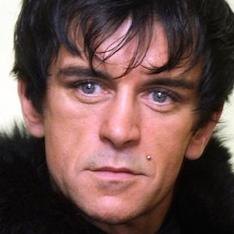
Ex-St Martin’s fashion designer Stephen Linard at the height of his commercial success in 1984, when he worked for three years for Jun Co in Japan. Here pictured by Toscani for i-D magazine’s issue No 15 in “An illustrated guide to detail”. He sports a leather Confederate Army cap $15 bought in transit through Anchorage airport in Alaska. The jacket £250 over giant-collared shirt £120, and trousers £200 are all by Yohji Yamamoto. Waistcoat £180 by Gianni Versace. Artfully placed on his left lapel is a silvered bathroom tap £60 and faucet brooch £40, both from a jewellery collection for Chloe, Paris. He said: “It was worth it for the stir it caused at the Paris collections.”

❚ THE PRESS CALLED THEM the New Romantics and the Blitz Kids, declaring the Eighties the Age of the Pose. Art-school tutor Rosetta Brooks compared their self-consciously styled poses to “street theatre ultimately extended into continuous performance as a post-punk embodiment of Gilbert and George in one person (the individualist).” Each poser, she believed, is a ready-made. Step forward fashion student Stephen Linard for ticking all the above boxes – a flamboyant Canvey Island boy from Southend School of Art (1975-78) who yearned to make a statement in every street or room he graced.

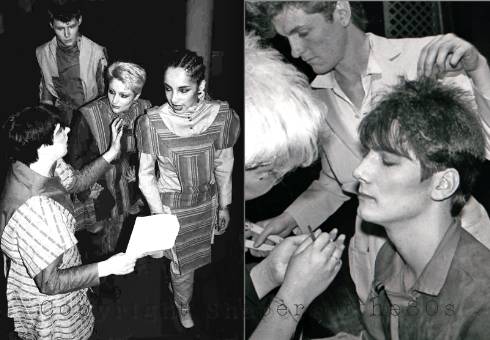
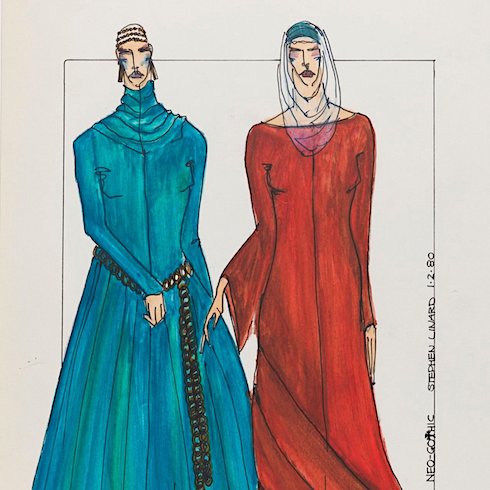
Arriving at St Martin’s School of Art in London (1978-81), Linard pushed the boundaries of excess. Annually, second-year students organised an Alternative Fashion Show but in May 1980 the college’s resoundingly prim middle-class students were out-gunned when Linard sent out his sensational Neon Gothic collection – a stark collision of Space 1999 meets liturgical Gothic meets the masonic livery which was displayed in shops serving the Freemasons’ Hall just along the street from the Blitz Club, the capital’s coolest nightspot.

The audience erupted in cheers. Strutting the runway to the Human League came the then-unknown George O’Dowd sporting a soaraway post-punk mullet atop sharp grosgrain suit with dog collar, Michele Clapton and Myra Falconer wearing risen-from-the-dead pallor beneath shaven heads, along with Fiona Dealey and Julia Fodor (today a Princess). Their vestments were accessorised with religious motifs while emanating a curiously spare chic. Finally, all in white as a “space-age pope”, came gifted Lee Sheldrick, modelling a white silk grosgrain suit with his head shaved bald to become the embodiment of Nosferatu the Vampyre. Resonances abounded for the show’s title to be adopted by the nascent Goth movement.
Stephen Linard, Total Fashion Victim, St Leonards on Sea, East Sussex, Graham Smith, Rogue Gallery, September 2023, exhibition, fashion illustrations, art for sale,

A stark collision of Space 1999 meets liturgical Gothic: Two robes from Stephen Linard’s sensational Neon Gothic collection in his second year at St Martin’s

One year later Linard was determined to submit menswear for his degree collection, despite the efforts of the head of the fashion department to insist on women’s wear. She actually threatened to eject Linard from the college until strong internal protests backing Linard’s pursuit of menswear ultimately prevailed. Modelled by six of his hunky clubland pals, his collection titled Reluctant Emigrés featured swishy draped cashmere greatcoats, patched pinstripe trousers and city shirts that all evinced an Edwardian air of immaculate tailoring punctuated with edgy details.

Linard’s street-savvy lads made a gasp-out-loud impact, as Fleet Street’s Suzy Menkes noted in print. Historians Alan J. Flux and Daryl F. Mallett have also written: “The clothes were instantly covetable, thoroughly masculine in an entirely new way, and electrifying as only the truly innovative can be.” Linard won his first-class Honours degree.

The fashion press feted him upon graduation. His outrageous fashion details flagged direction for the two dozen sharpest Blitz Kids who shaped the New Romantics silhouette from the Blitz onwards. Most significantly, Linard changed his own appearance daily from his foppish Fauntleroy dandy, to the Endangered Species outfit made from animal skins, to the cowboy gilded from hat to toe. Linard has admitted: “The competition pushed you on, especially Lee Sheldrick. At the Warren Street squat [where they lived] you might change what you were going to wear eight times on a Tuesday to try to outdo everyone else at the Blitz.”

Inspiration was all around. In 2020 Linard said: “The Blitz was an art students’ club. The place was choc-a-bloc with artists: Brian Clarke, Zandra Rhodes, Molly Parkin, Antony Price, Duggie Fields, Kevin Whitney and us because it was halfway between Central School and St Martin’s. People who said ‘Oh you Blitz Kids don’t DO anything’ were talking rubbish, because WE all did. We were the ones with our work in the glossy magazines long before the rest.”

Stephen Linard, Total Fashion Victim, St Martins School, degree show, Reluctant Emigres, menswear

Smiles from the press at Linard’s degree show: The Reluctant Emigrés wore pinstripe trousers in Savile Row fabrics and city shirts in feminine couture fabrics evoking Edwardiana. (Photo by Shapersofthe80s)

Linard’s styles had always been sought after by pop-star contemporaries from Spandau Ballet, Boy George, Frankie Goes to Hollywood, Haysi Fantayzee and The Slits, to U2, the Bee Gees, Womack & Womack, even Cliff Richard and Johnny Mathis, and ultimately to the great god David Bowie himself.

In 1982 the Railway Children collection of stripey Edwardian coats and frocks for school-girls became the first of Linard’s two womenswear collections. He was one of six budding British designers taken to Paris by Blitz Club host Steve Strange to help launch his Anvil album, but also to show that the English could be as stylish as the French – staged at Europe’s coolest nightclub, Le Palace.

Meanwhile Linard’s reputation went on growing among the international fashion set. 1983 brought his collection Angels with Dirty Faces, inspired by the Bogart-Cagney gangster movie set in the Thirties depression. It was both pretty and poignant and it sold worldwide. That year, the snappiest magazine of the day, New York, headlined a special fashion section “The British Are Here”, and selected as the UK’s five leading lights Jean Muir, Zandra Rhodes, Katharine Hamnett, Vivienne Westwood — and Stephen Linard, “one of the most creative of the young designers”.

As recently as 2018, Laird Borrelli-Persson was writing in Vogue online: “Stephen Linard deserves credit for many innovations in fashion and its presentation that we take for granted… One of the Blitz Kids whose dandyish ways had an outsize impact on 1980s style, his early work was distinguished not only by irreverence, but also by a strong sense of narrative… Linard insists his aim was not to cause outrage. ‘I was into doing couture stuff and I was ‘just making clothes,’ really, as Sonia Rykiel used to say’.”

PS: Since you ask, Total Fashion Victim was the name of the one-nighter Linard hosted at the Wag Club during the Eighties.

➢ The Total Fashion Victim exhibition is hosted by Ray Gange at the Rogue Gallery, 65 Norman Road, St Leonard’s On Sea TN38 0EG

rel="nofollow"

St Martin’s Alternative Fashion Show 1980: Linard’s Neon Gothic collection modelled by his most stylish Blitz Kid friends – from the left, Michele Clapton, George O’Dowd, Lee Sheldrick in white as a space-age pope, and Myra Falconer

➢ Previously at Shapersofthe80s: 1980, The year the Blitz Kids took their first steps into the headlines

POSTSCRIPT FROM i-D’s FIFTH ANNIVERSARY
Stephen Linard, Total Fashion Victim, i-D magazine, Nick Knight, photography, fashion,

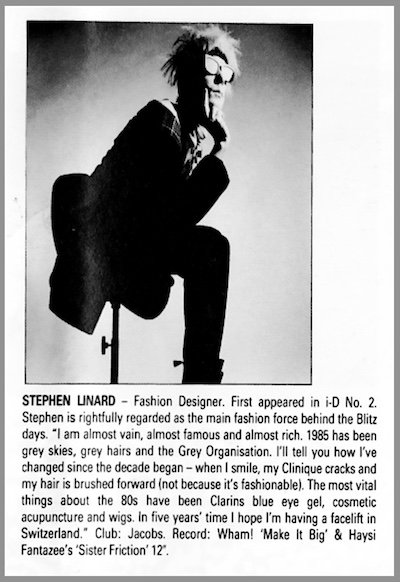
Stephen Linard seen in i-D magazine’s fifth birthday issue, No 30 in 1985, as one of their gallery of creative protagonists they titled 99 People of the 80s, all photographed by Nick Knight.
FRONT PAGE

➤ Hottest Shapers during 2022

Andrew Ridgeley , Wham Rap, video, Face magazine, Club Culture,

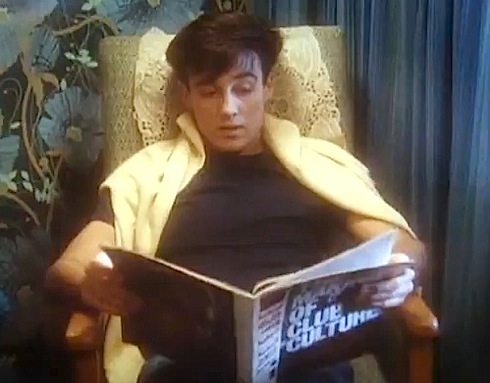
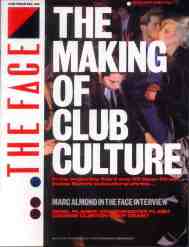
Click pic to open the Wham Rap! video in another window … “Man or mouse” Andrew Ridgeley establishes his group’s clubbing credentials in the opening shots of the Wham video by reading my cover story on Club Culture first published in The Face in 1983 and in recent years the No 1 read at Shapers of the 80s!

❚ OVER THE PAST 14 YEARS Shapers of the 80s has received 2.2 million views, according to year-ending stats measured by our host, WordPress. Our 850+ published items total half-a-million words, which is several times more than most books, so it pays to explore the various navigation buttons. Here are the half dozen posts which remained among the most popular with readers during 2022…

➢ Photos inside the Blitz Club, exclusive to Shapers of the 80s

FACE No 34,club culture ➢ 69 Dean Street and the making of UK club culture – evolution of the once-weekly party night (1983)

➢ Why Bowie recruited Blitz Kids for his Ashes to Ashes video in 1980 from the club-night founded by Steve Strange and Rusty Egan

➢ 20 gay kisses in pop videos that made it past the censor

➢ First Blitz invasion of the US —
Spandau Ballet and the Axiom fashion collective take Manhattan by storm (1981)

NYC,Axiom,Melissa Caplan, Sade, Elms, Tony Hadley, Ollie O'Donnell

At the Underground club in NYC 1981: Melissa Caplan rehearses Bob Elms, Mandy d’Wit and Sade Adu for the Axiom runway show. Right, Ollie “the snip” O’Donnell goes to work on singer Tony Hadley’s hair. Photographed by © Shapersofthe80s

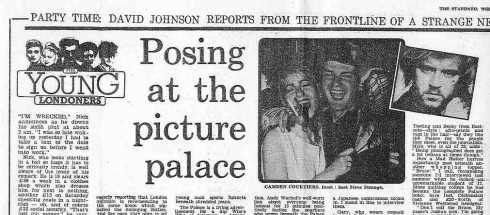
➢ Posing with a purpose at the Camden Palace — power play among the new non-working class (1983)

FRONT PAGE

1982 ➤ Strange takes UK clubbing mainstream

Koko, Camden Theatre, Camden Palace, nightclubbing, music venue, fire, architecture, Music Machine,

Steve Strange in 1982: for ever being filmed at Camden Palace

40
YEARS
ON

❏ In the same season that Next opened its first shops in Britain to bring colour to the high street, Steve Strange and Rusty Egan went mainstream with their first mega-club venue for the growing generation of nightlifers who had discovered that dressing up could change your life. On this day in April 1982, Strange & Egan began fronting what became the Camden Palace a couple of nights a week, way north of London’s West End. This huge Edwardian theatre was most famous in the postwar years as BBC radio’s studio for recording the Goon Shows.

Within its first year and open five nights a week, the Palace came to offer easily the best night out in London because, as well as the usual delights, this poser’s paradise won a reputation for offering more. The world’s media and photographers learned this was the fashionable place to find the next big thing and on the crowded stairways here, posing truly began to pay its way…

During 1982 mega-clubs began appearing across the country, from the Hacienda in Manchester to Rock City in Nottingham and the Academy in Bournemouth. Click below to read my report in the Evening Standard nailing how streetwise New Romantic followers set about expressing their inner talents in ways that helped transform rampant unemployment into a jobs market in which the young began to thrive…

Camden Palace, nightclubbing, Steve Strange

First published in the Evening Standard, 11 May 1983

➢ Previously at Shapers of the 80s:
1983, A silly hat and a calculated look might be
the best career move you’ve ever made

London, nightlife

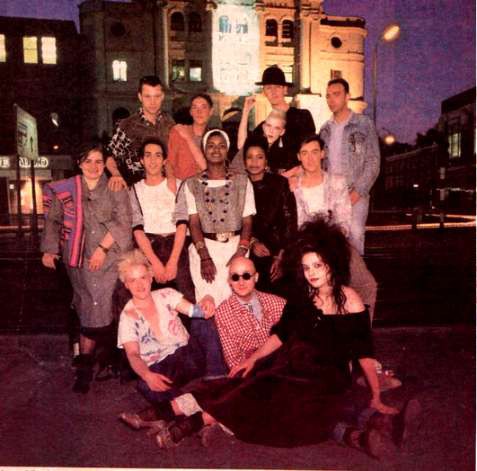
Palace forecourt 1983: in their circle of peers everyone in this picture is a household name. Picture © by David Montgomery

➢ Previously at Shapers of the 80s:
2020, Second time unlucky as fire ravages
the former Camden Palace nightspot

➢ 2022, On 29 April Koko, the renamed Camden Palace,
reopens as a state-of-the-art venue after massive refurbs
including a new roof garden. Arcade Fire plays live

Koko, nightclub, London, reopens, live venue

Koko in 2022: a roof-terrace bar as part of its £70m refurbishment

FRONT PAGE

➤ It’s A Sin reviewed: “Supporting the sadness there is an abundance of humour”

It’s A Sin, Lydia West, TV drama, gay issues, youth culture, Channel4, Olly Alexander

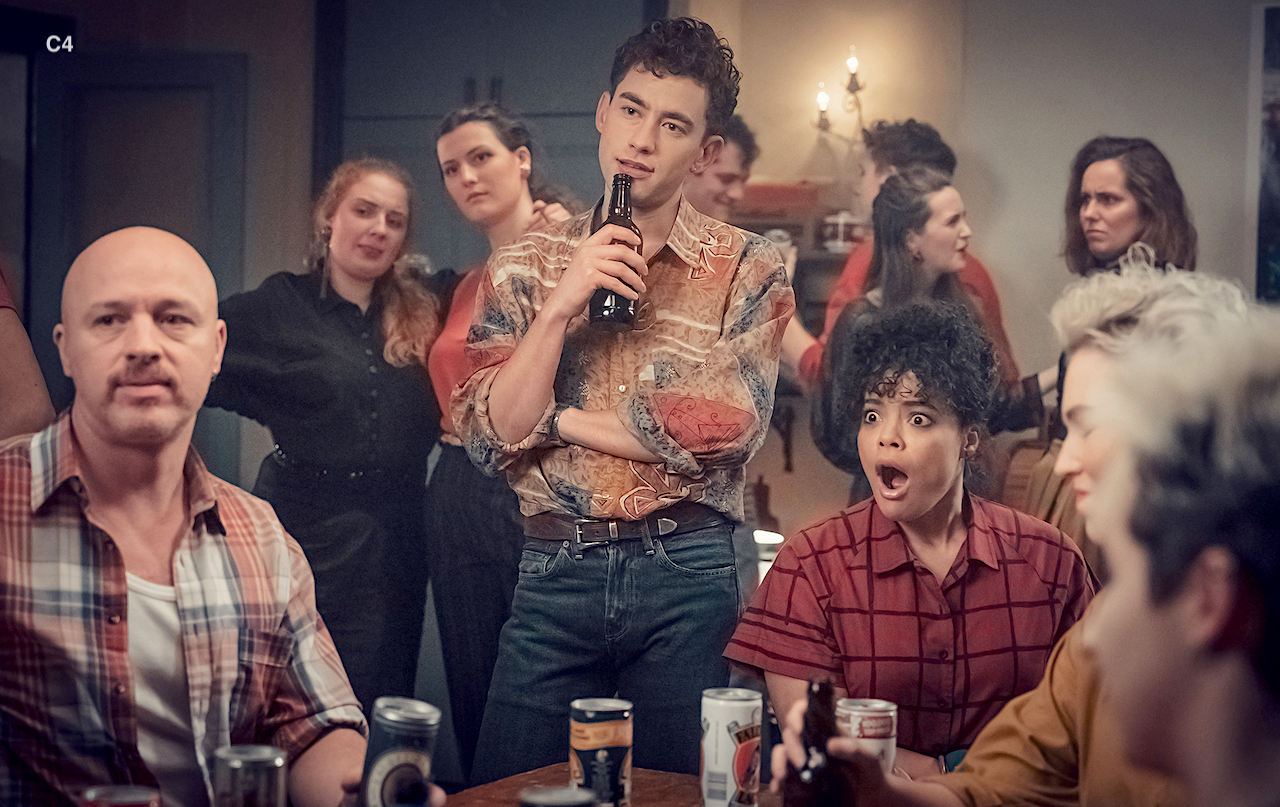
Good times in the Eighties: Olly Alexander fronts the It’s A Sin gang. (Channel 4)

As It’s a Sin is premiered on Channel 4 amid great expectations, Eighties singer Andy Polaris reviews the exuberant five-part TV series. Here’s an extract…

“ ❚ The much-feted writer Russell T Davies broke barriers with the pioneering British TV series Queer As Folk in 1999 and more recently with Cucumber, both lively depictions of gay life in contemporary Britain. Now comes It’s A Sin which focuses on a diverse group of gay friends mostly escaping from the familiar claustrophobia of suburban life (mostly closeted) and attracted to that well-trodden lure of big-city life. We are off to see the wizard, but this time we’re thrown back to 1981, the year of the first recorded British death from Aids at Brompton Hospital in London.

Ritchie (popstar Olly Alexander) is a gauche, attractive, closeted twink leaving home to study law in London, and his send-off from the Isle of Wight is a multi-pack of condoms from his bigoted dad (Shaun Dooley) as they both stress “It’s different on the mainland”. Roscoe (Omari Douglas) is a flamboyant young Nigerian whose strict religious parents are so fraught over his sexual orientation that he bolts defiantly before an intervention. Colin (Callum Scott Howells) leaves the Welsh valleys to lodge with a family and start his apprenticeship with a Savile Row tailor.

It’s A Sin, Lydia West, TV drama, gay issues, youth culture, Channel4,

It’s A Sin: Lydia West as Jill emerges as the anchor for her hedonistic friends. (Channel 4)

Soon the group become fast friends with Ash (Nathaniel Curtis) becoming Ritchie’s first lover. We follow the group with Ritchie as lynchpin while his horizons broaden along with the thriving bar scene. Casual sex becomes addictive and flashes past in a blaze of encounters against a soundtrack of the hideous but popular Hooked on Classics.

A scene where Ritchie’s pals party at Heaven, the biggest, brand new gay club, was a baptism by sexual freedom for gay men in a pre-internet landscape including myself and friends. (My group Animal Nightlife played early concerts there along with Culture Club, Spandau Ballet and Musical Youth). The scene was blossoming through a whole network of bars and clubs. Safe sex had not yet been advocated, neither had the government’s “Don’t Die of Ignorance” leaflet campaign. It seemed to be abstain or die. Aids awareness was bad for business. As the Eighties proceed in the TV drama each gay character has to deal with the possibility of an early and lonely death if the dreaded health-test proved positive… / Continued at Apolarisview

➢ Read Andy’s full review – It’s A Sin: Pitch-perfect drama about the worst of times

➢ Catch up on the whole series of It’s A Sin online at All 4

➢ Previously at Shapers of the 80s: More background discussion about the making of It’s A Sin

FRONT PAGE

2021 ➤ Olly Alexander fronts new C4 drama series exploring Aids in the Eighties

TV drama, gay issues, youth culture, It’s A Sin, Channel4, Olly Alexander

Gay activist as Aids casts its shadow: Olly Alexander as Ritchie in It’s A Sin

GAY TIMES has teamed up with Channel 4 for a series of video conversations between cast members from tonight’s new series It’s A Sin and artists and activists who lived through the decade, offering social and political context to the themes explored in this LGBTQ+ drama from Russell T Davies. . .

Gay Times, Omari Douglas, Andy Polaris, video, It's A Sin,

Comparing notes: Omari Douglas and Andy Polaris in conversation for Gay Times

❏ “People forget how homophobic and racist it was in the 80s. People would actually say to you bluntly ‘You’re going to die of Aids – this is going to happen to you.” So says Andy Polaris – Eighties pop-singer with Animal Nightlife – to Omari Douglas, star of It’s A Sin. Omari plays a character called Roscoe who is forced to leave home when he’s 17 and his family finds out he is gay. The character quickly finds his tribe and a new group of friends who support each other during the decade that revealed the horrors of a new deadly virus.
➢ Click to watch Omari and Andy’s conversation at Gay Times

TV drama, gay issues, youth culture, It’s A Sin, Channel4, Olly Alexander

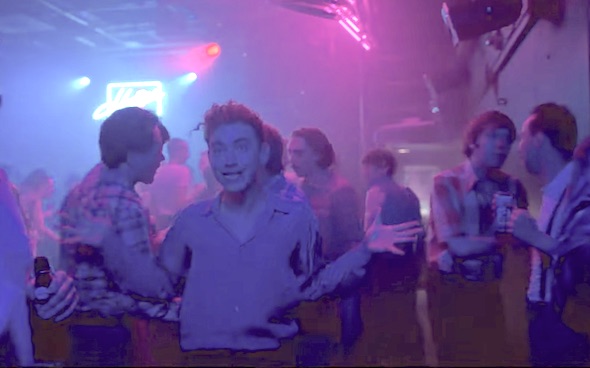
Hedonism in Heaven: Olly Alexander on the dancefloor in It’s A Sin

Russell T Davies has given us iconic television shows such as Queer As Folk, Years & Years, Banana, Cucumber, A Very English Scandal, and more. Set during the 80s, his new queer drama It’s A Sin has a soundtrack (guided inevitably by Murray Gold) that evokes the youth, vibrancy and gay sensibility of the era – big electronic anthems that have stood the test of time and changed the musical landscape.

Asked for an iconic tune that he loved, singer-actor Olly Alexander chose for his ambitious and complex character who leads the show Hungry Like The Wolf by Duran Duran. Omari chose Respectable by Mel and Kim, saying: “I just went through a phase of being completely obsessed with them.”

It’s A Sin starts today 22 January at 9pm on Channel 4, with all episodes available immediately after on All 4.

TRAILER PLUS DISCUSSION


❏ At YouTube, the BFI organised a 40-minute panel discussion on It’s A Sin, hosted by comedian Matt Lucas with guests Russell T Davies, exec producer Nicola Shindler, director Peter Hoar, Channel 4 head of drama Caroline Hollick, and from the cast Olly Alexander, Keeley Hawes, Omari Douglas, Callum Scott Howells, Lydia West and Nathaniel Curtis. The trailer for the series precedes the discussion.

➢ AnotherMag airs the vital role today of It’s A Sin with its creator Russell T Davies who declares: “Cast gay as gay – you not only get authenticity; you get revenge”

A HIT WITH REVIEWERS

TV drama, gay issues, youth culture, It’s A Sin, Channel4, Omari Douglas

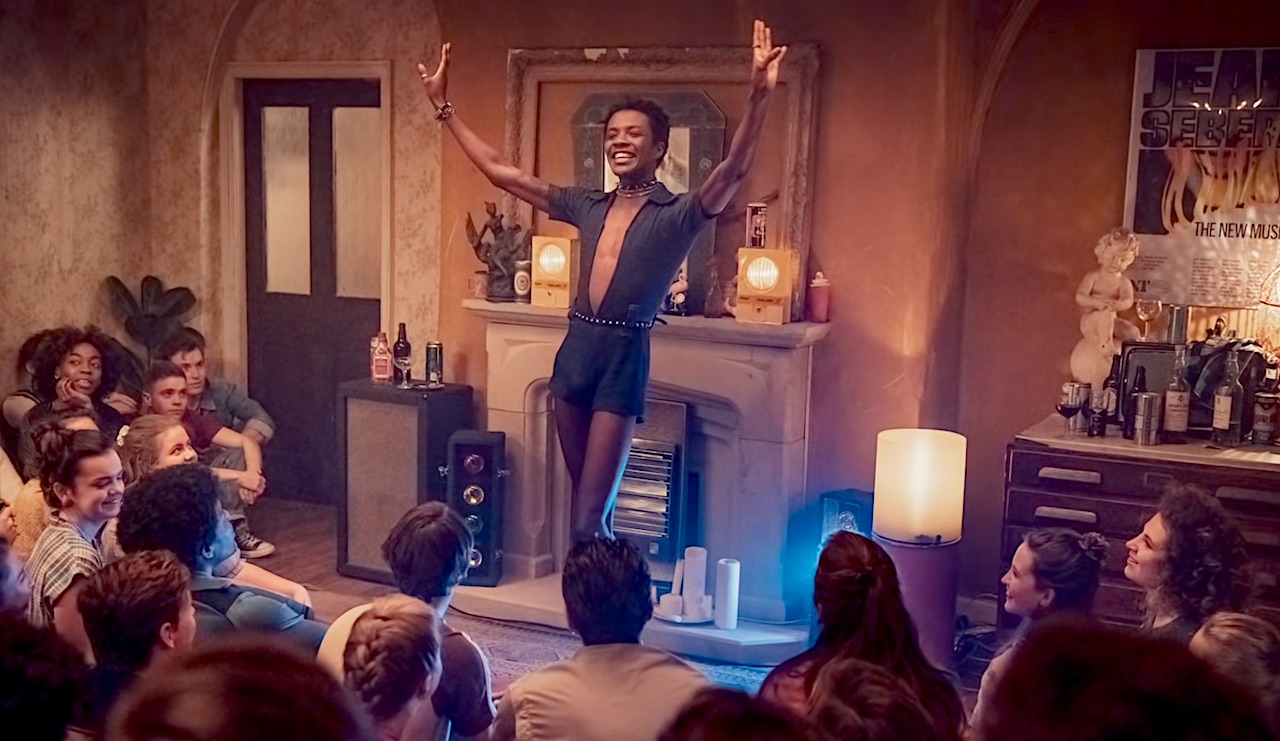
It’s A Sin: Omari Douglas assumes the role of entertainer

➢ Aids drama is a poignant masterpiece – Lucy Mangan in The Guardian: “Humour and humanity are at the heart of this sublime series about London’s gay community in the 1980s, from the creator of Queer as Folk.”

➢ Aids drama is a reminder to find joy in the scariest times – Ed Cumming in the Independent: “For anyone who’s been through the agony of coming out, especially to a hostile family, or who lost loved ones to Aids, this series will be especially moving.”

➢ Living young, free and under the shadow of Aids in the 1980s – Hugo Rifkind in The Times: “Russell T Davies is a thousand miles away from, say, Hugo Blick or David Hare with their darkness and portentous heft. And yet I’m pretty sure he’s a far more important dramatist than either of them.”

➢ A dance in the face of death – Euan Ferguson in The Observer: “Russell T Davies depicts with wisdom how so many, shunned and ‘othered’ for most of their lives, might have chosen to adopt a defiant mood towards yet another orthodoxy, that of scientific reason.”

➢ Aids-crisis drama will break your heart and fill you with joy – Anita Singh in The Telegraph: “Russell T Davies’s best series so far.”

FRONT PAGE