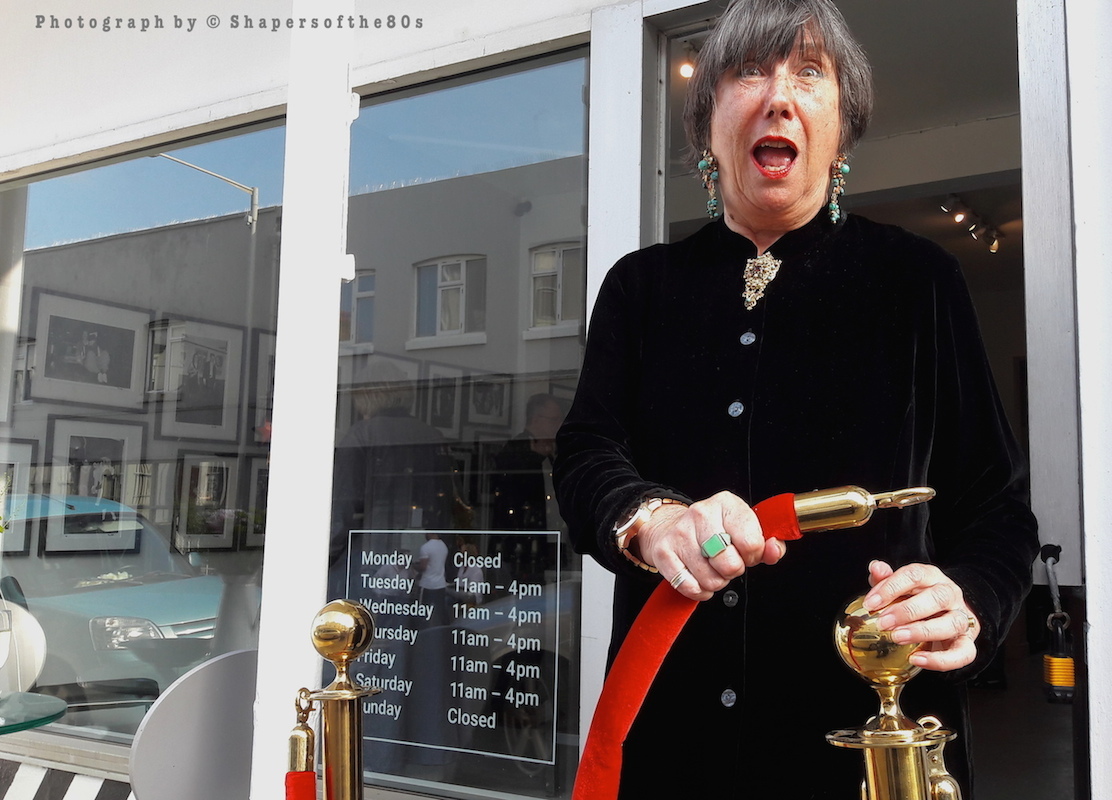
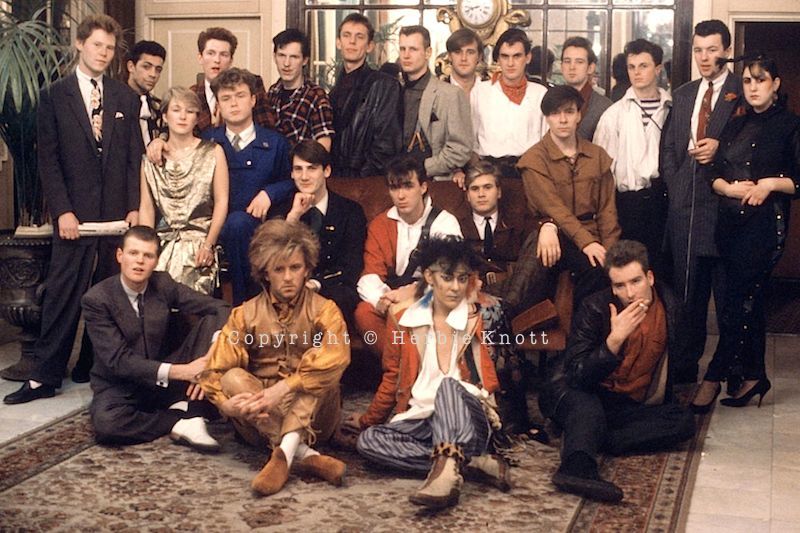
Former door-girl at the Blitz: “Your Look isn’t extreme enough, you’re not coming in!” Janet Lyon guards the door to Lucy Bell’s photo gallery in St Leonards where vintage Blitz Kids gathered to view themselves in their prime
+++ ◼ EVERY TUESDAY FOR A YEAR as the 1980s dawned, Steve Strange had been declaring a “private party” in the shabby Blitz wine bar near London’s Covent Garden. Inside, precocious 19-year-olds presented an eye-stopping collage, posing away as stiletto-heeled vamps dressed for cocktails in a Berlin cabaret. Others came as wicked witches, kohl-eyed ghouls, futuristic man machines. Bored by the nihilism of punk with its message of “No future”, these school-leavers were determined to shape a future for themselves. At the Blitz only outrage secured entry: and some Blitz Kids spent the whole of Tuesday perfecting their Look.
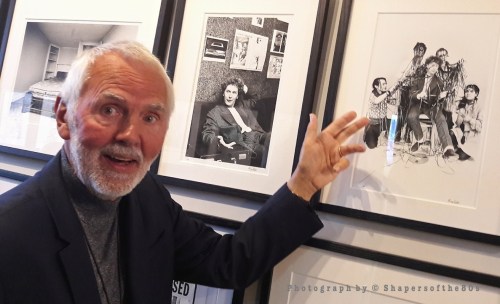
Last Thursday in Sussex, previously unseen images taken in 1980 inside the club by ex-Time magazine photographer Terry Smith went on show and for sale for the next six weeks. In the spirit of the Blitz, we set up a snap of Janet Lyon with a red rope barrier on the door at Lucy Bell’s gallery for this week’s Private View. Back in the day Janet helped Steve Strange to vet new arrivals by judging how much wit and outrage they had invested in their Look. Turn inside to read our report on the vintage Blitz Kids and others who made it past the door. . .
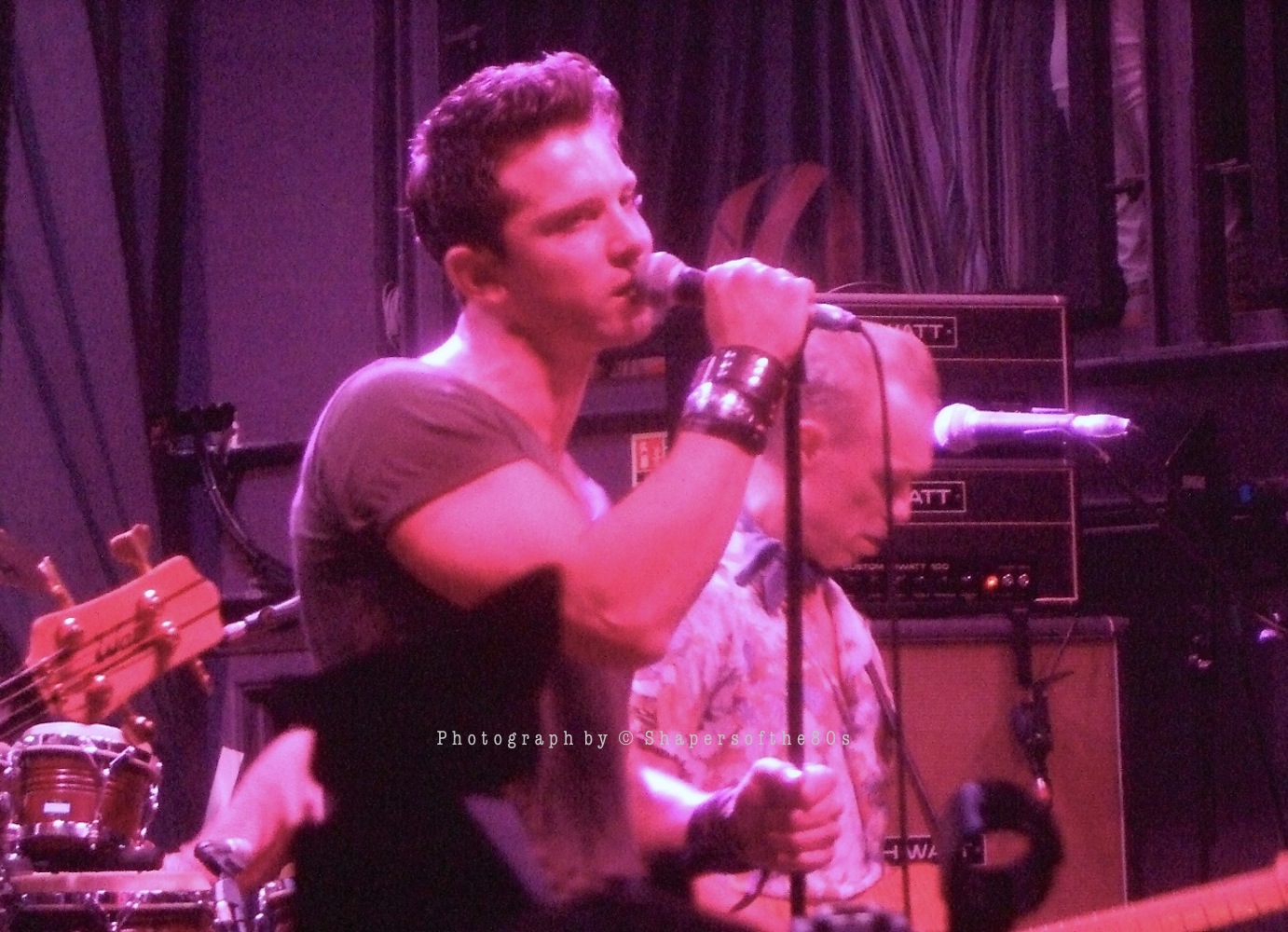
A confident debut with Spandau Ballet: Ross William Wild at Subterania last night
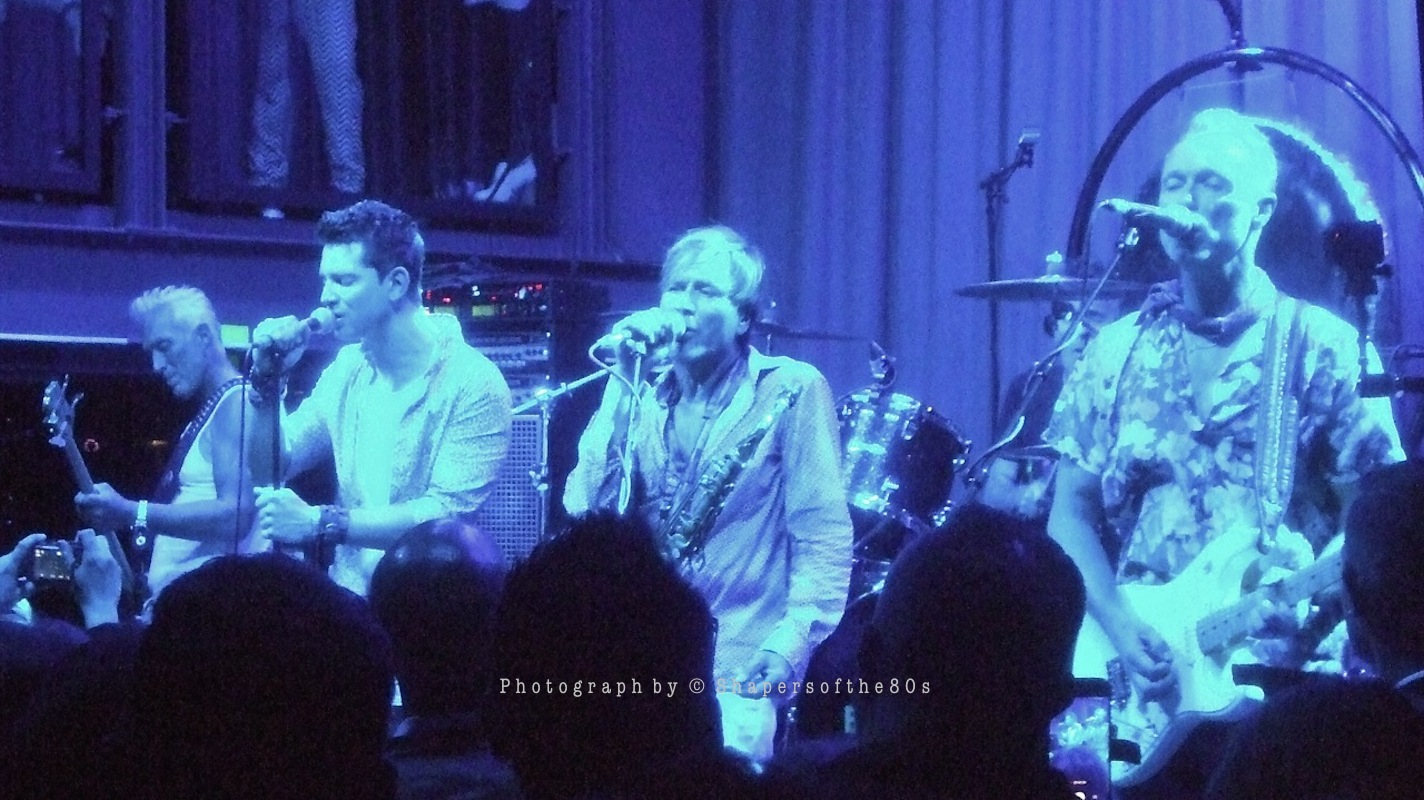
Ross William Wild’s debut with Spandau Ballet: from left, Martin, Ross, Steve and Gary
◼ AND WHAT TOUR DE FORCE the entire band made of Spandau Ballet’s rebirth last night to showcase their new singer Ross William Wild who effortlessly filled the space onstage vacated by Tony Hadley. At the age of 30 Aberdeen-reared Ross could easily be the son of any of the Spandau dads around him, yet he had infused new energy into them to inspire one of the tightest all-round performances in recent years. He embodies all a lead singer should: energy, confidence, instantly likeability and a strong singing voice that almost never sounds like his predecessor.
Ross was announced by the tabloids as an Elvis Presley impersonator so it was a relief that this is not what we saw or heard: in fact the inflexions in his singing voice do reflect his principal experience in musical theatre, most recently in The Million Dollar Quartet, The Witches of Eastwick, and We Will Rock You. And though in the Noughties he was the lead singer in a nu-metal band called Lethal Dosage, Ross performs with shoulders, arms, hips, feet – in fact, his entire body just as you’d expect in a stage musical.
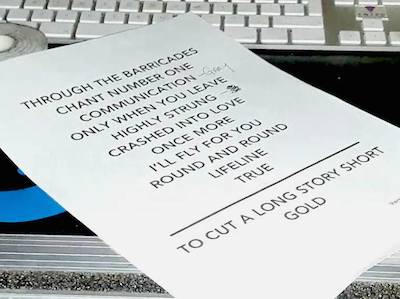
Spandau’s rebirth set list
From Spandau’s nostalgically involved opening hit Through the Barricades, Ross made each of the set’s 13 hit numbers his own (with almost as many changes of shirt!).
Spotlit on a darkened stage, his first three minutes were a vocal slow-burn alongside a masterly Gary Kemp on solo guitar. It was a daring move to persuade us to listen. By the second line, as he gave vibrato to the lyric, Ross was evidently “feeling strong”, and from here on he introduced us to his voice in gentle stages, slowly raising the temperature, until the pause. . . Then: bam-bam! Keeble’s drums announced the bombast of Barricades proper, and Ross let rip to command centre-stage, amid the familiar Spandau front-line on vocals. They climaxed with a big sound in an intimate clubby space, up close to 500 of their fans. What a statement of intent!
HEAR ROSS’S FIRST VERSE OF ‘BARRICADES’
Ross excelled in another emotional classic Only When You Leave, had the audience eating out of his spiralling hand for Round and Round, pogoing through Lifeline, and by the encore the hot summer’s evening had him stripped down to a vest as he gloriously re-energised To Cut a Long Story Short to sound like a brand-new number. Amazingly, at the bar afterwards, Ross said he was intrigued by its lyrics since he first heard this hit from 1980, but read none of Gary Kemp’s meaning into it or the lyrical quotation it contains. He imagines it is set in the first world war trenches and reflects the strange solitude of the soldier.
The band’s families and friends turned out along with veteran Blitz Kids and Beat Routers (smashing to see you again, genial doorman Ollie O’Donnell) who could all be seen grooving to Rusty Egan’s unique mixes at the after-party. Sentimental as ever, Martin Kemp had announced from the stage that last night’s venue, Subterania beneath Westway at Portobello Road, was chosen because in its days as Acklam Hall community centre, the original Spandau lineup had played a benefit there under their early name, Gentry, on Saturday 24 February 1979. In the after-bash I recognised the curly-haired photographer Denis O’Regan who was at work with his camera. Spookily I’d just posted one of his seminal band images here at Shapersofthe80s on my own tribute revisit to 1980 when Denis had posed the band in his studio and uplit them to create the dramatic shot of Spandau which became the expressionist motif of their live performance that spring at the Scala Cinema.
Verdicts from the band on their young vocalist are breathless. Gary Kemp said: “Ross’s great talent and passion has given us the confidence to continue.” Drummer John Keeble who drove the show with his usual percussive enthusiasm said: “I bonded with Ross over our mutual love of rock music. He may have come up through the theatres but he loves bands like Tool.” Steve Norman added: “He’s also a right nice bloke. We struck lucky.” [I often wonder whether Steve realises just how richly musical his own sax playing is! Ben Webster will be smiling benignly at this.]
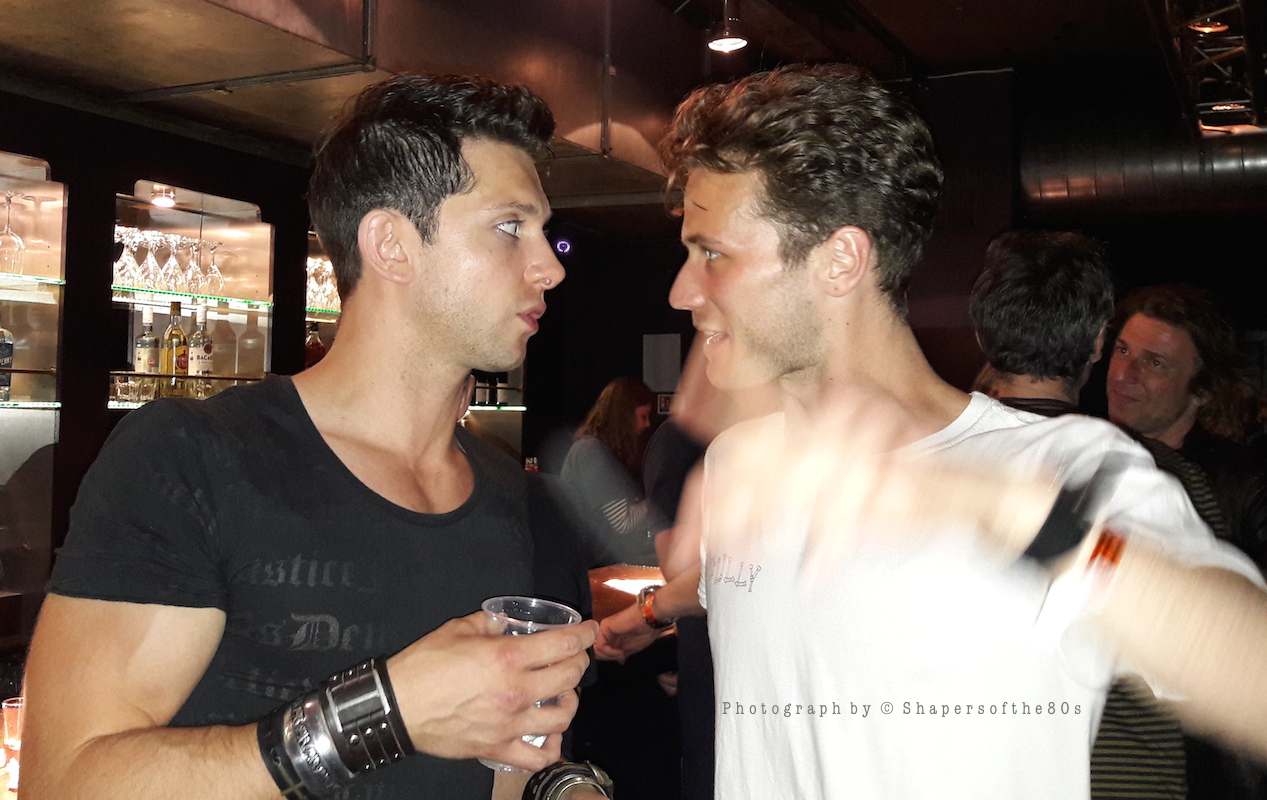
At the after-party: Ross William Wild shares song-writing ambitions with Steve Norman’s son Jaco
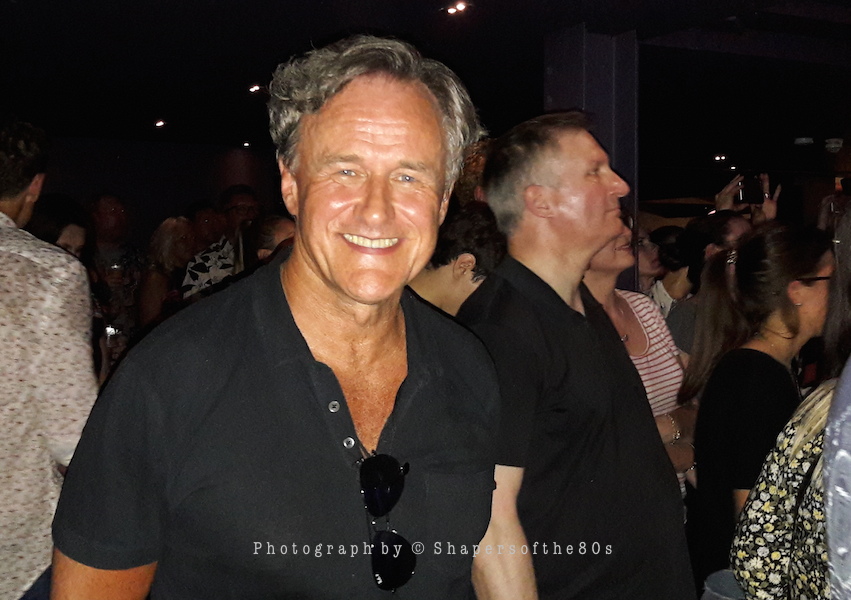
Patrolling the audience during Spandau’s rebirth gig: their trusty manager Steve Dagger evidently chuffed to bits at their new singer
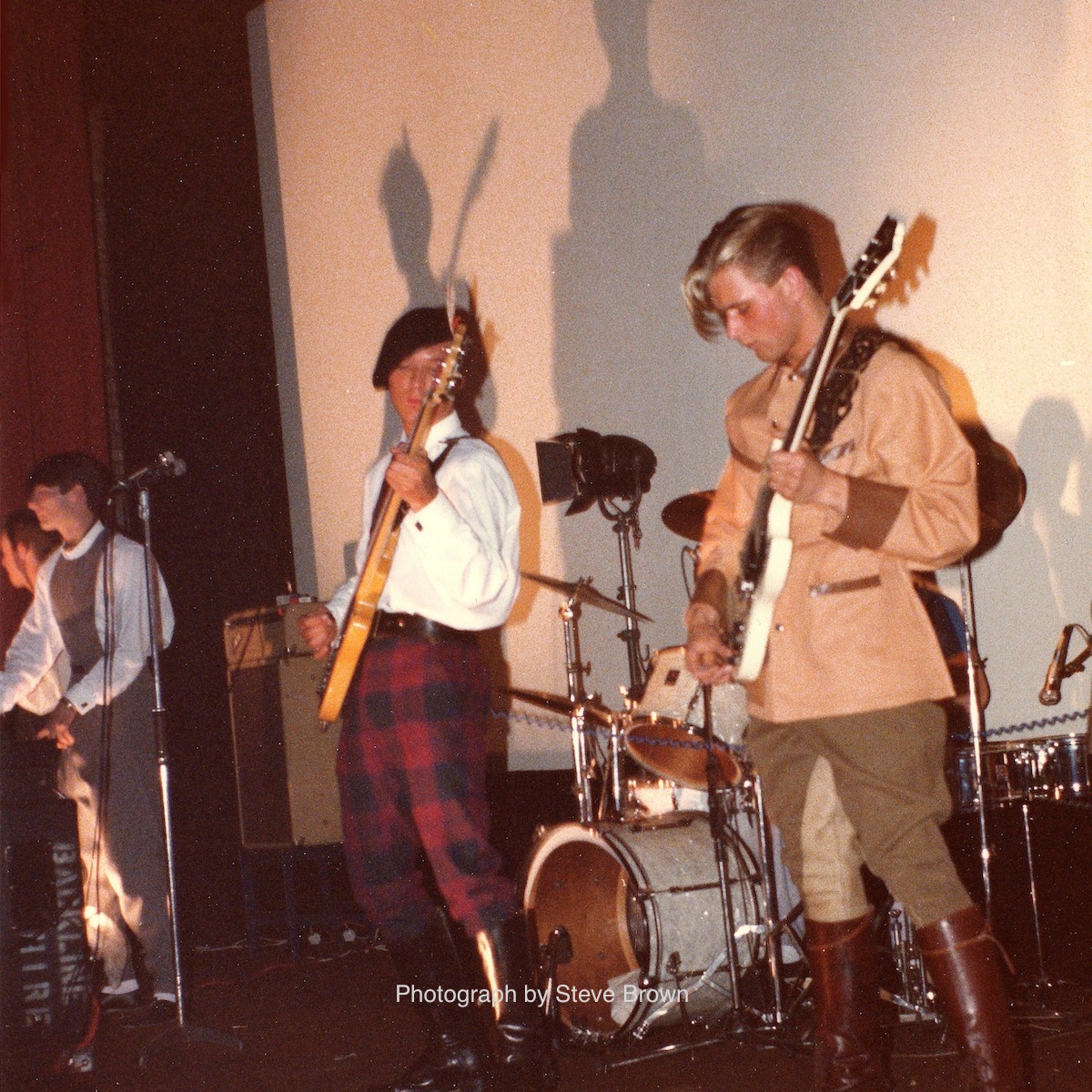
A photograph never before published: sharply styled Spandau Ballet in 1980 playing the dramatically lit Scala Cinema gig that eventually brought the record companies scrambling to sign them. Photograph by Steve Brown
◼ FIRST COMES THIS UNAUTHORISED BOOK that tells the world there were two bands called Spandau Ballet back in 1979 and turns over the whole myth about where their name came from. There are a least two huge marmalade-dropper revelations, plus several dozen eye-openers about the birth of Blitz culture, however well you think you knew the early 80s. The author David Barrat even knows John Keeble’s middle name. In fact he gives us everybody’s middle name, just to prove his overdue diligence. Barrat is also very revealing about the band’s legal falling-out that ended in the high court before an apparently congenial judge who quite liked their music.
Then out of the blue I find there are about 100 shockingly well-informed pages not exactly about me, long before this website existed, but following my every footstep through every month of 1980 as the second SB with the stolen name takes its first tentative steps toward a record deal and the UK charts all within a single year – which was indeed good going for a new band by any standards. Very flatteringly Barrat suggests that I am waving some Invisible Hand behind the scenes to make the Spandau magic happen and actually writes that “their success can be pinned on one Evening Standard journalist”. Talk about blush!
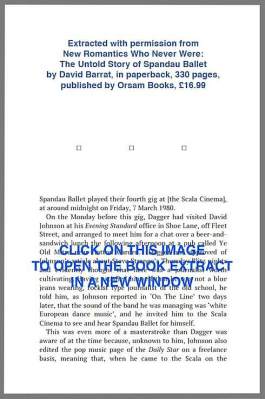
So what we’re doing here today is offering a modest extract from Barrat’s book for you to read how he theorises about my ducking and diving as a regular young journalist about town who suddenly fell into five years of rollicking night-clubbing. Then on an inside page you can read my own parallel account of falling under the spell of the real Svengali, Steve Dagger, Spandau’s manager. I blow the gaff on his game called Squeeze the Lemon.
David Barrat says he became “just an ordinary fan of the band” at the age of 16, who two decades later created a cult SB-related MSN group online called Deformation. It focussed on three subjects: 1, origins of the band’s name; 2, whether SB were real “New Romantics” or not, as a friend’s mum claimed; 3, the legal battle that tore the band apart in the late 1990s. He tackles other questions such as “When was Gary Kemp visited at home by a bishop? What was the real story behind Bob Geldof’s idea for the Band Aid Christmas single?” All the while he unnervingly debunks myths put about by celebrities with faulty memories.
He has also dug up a mass of colourful detail about London clubland in the past when the police were as dodgy as the club-owners, the notorious Roxy in particular, which adds quite a bit to the sum of human knowledge.
So tuck into Barrat’s own book in the extract embedded here as a PDF which will open in a new window. Then contrast it with my own account at the link below.
Click on this image to read the David Barrat book extract
◼ ONE WEEK UNTIL YET MORE unseen Blitz Club pix by Terry Smith – this time in black and white – go on show at the Lucy Bell Fine Art gallery in St Leonards, Sussex. All for sale, various sizes, contact Lucy (pictured here) about the 7 June PV.
A New Romantics keynote was your invented image: startling make-up and a towering hat complete Blitz superstar Peter Probert’s wicked witch of the west
+++ ◼ EVEN AMONG THE UK ROCK PRESS, few of its music historians have conceded that the New Romantics amounted to an ambitious subculture that changed the rules of the game – largely because the rockists completely missed the boat by idolising guitar idols, never went to nightclubs, and what’s more, couldn’t dance.
The most audible consequence of the clubbing underground was to fundamentally change the rhythm of the pop singles charts within a year – from the rock guitar to the bass-and-drum, namely, to dance music. After 1981 scarcely any significant new rock groups made the singles charts, only the old dinosaurs, if at all. Rock was relegated to the album chart and new dance-music stars such as Madonna and Prince transformed the pop music of the new decade.
The other New Romantics keynote was the central role of image with the dawn of MTV as a platform for music videos. A band became the leaders of fashion, while their style-conscious nightlife followers collaborated in promoting them through the clubbing grapevine. As synth-pop pioneers during 1980 Spandau Ballet pushed a button for the fashion-conscious young. They were signalling that the language of pop called for new styles as much as new sounds.
During the first five years of the decade, more than 100 “image bands” and acts entered the UK charts – most of them new, led in the South-East by Ultravox, Linx, Spandau Ballet, Visage, Landscape, Depeche Mode, Kid Creole, Blue Rondo a la Turk. Many more emerged from clubland across the UK: Duran Duran, Soft Cell, Heaven 17, Altered Images, Imagination, Eurythmics, Thomas Dolby, ABC.
During Spandau’s North American tour in November 1983, alongside their hit True among the Billboard Top 40 singles in the USA, there were 17 other British bands – more than the Swinging 60s ever knew. Insolence and narcissism lit a torch that led a generation of school-leavers through what threatened to be Britain’s dark age of unemployment. As clubs became workplaces and nightlife the essential engine of cultural evolution, they liberated music, design and, especially, ambition for the young.
➢ Choose “View full site” – then in the blue bar atop your mobile page, click the three horizontal lines linking to many blue themed pages with background article
MORE INTERESTING THAN MOST PEOPLE’S FANTASIES — THE SWINGING EIGHTIES 1978-1984
They didn’t call themselves New Romantics, or the Blitz Kids – but other people did.
“I’d find people at the Blitz who were possible only in my imagination. But they were real” — Stephen Jones, hatmaker, 1983. (Illustration courtesy Iain R Webb, 1983)
“The truth about those Blitz club people was more interesting than most people’s fantasies” — Steve Dagger, pop group manager, 1983
PRAISE INDEED!
“See David Johnson’s fabulously detailed website Shapers of the 80s to which I am hugely indebted” – Political historian Dominic Sandbrook, in his book Who Dares Wins, 2019
“The (velvet) goldmine that is Shapers of the 80s” – Verdict of Chris O’Leary, respected author and blogger who analyses Bowie song by song at Pushing Ahead of the Dame
“The rather brilliant Shapers of the 80s website” – Dylan Jones in his Sweet Dreams paperback, 2021
A UNIQUE HISTORY
➢ WELCOME to the Swinging 80s ➢ THE BLOG POSTS on this front page report topical updates ➢ ROLL OVER THE MENU at page top to go deeper into the past ➢ FOR NEWS & MONTH BY MONTH SEARCH scroll down this sidebar
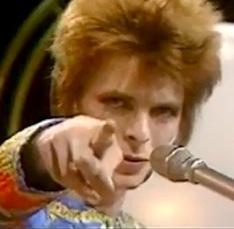
❏ Header artwork by Kat Starchild shows Blitz Kids Darla Jane Gilroy, Elise Brazier, Judi Frankland and Steve Strange, with David Bowie at centre in his 1980 video for Ashes to Ashes
VINCENT ON AIR 2026
✱ Deejay legend Robbie Vincent has returned to JazzFM on Sundays 1-3pm… Catch up on Robbie’s JazzFM August Bank Holiday 2020 session thanks to AhhhhhSoul with four hours of “nothing but essential rhythms of soul, jazz and funk”.
TOLD FOR THE FIRST TIME
◆ Who was who in Spandau’s break-out year of 1980? The Invisible Hand of Shapersofthe80s draws a selective timeline for The unprecedented rise and rise of Spandau Ballet –– Turn to our inside page
SEARCH our 925 posts or ZOOM DOWN TO THE ARCHIVE INDEX
UNTOLD BLITZ STORIES
✱ If you thought there was no more to know about the birth of Blitz culture in 1980 then get your hands on a sensational book by an obsessive music fan called David Barrat. It is gripping, original and epic – a spooky tale of coincidence and parallel lives as mind-tingling as a Sherlock Holmes yarn. Titled both New Romantics Who Never Were and The Untold Story of Spandau Ballet! Sample this initial taster here at Shapers of the 80s
CHEWING THE FAT
✱ Jawing at Soho Radio on the 80s clubland revolution (from 32 mins) and on art (@55 mins) is probably the most influential shaper of the 80s, former Wag-club director Chris Sullivan (pictured) with editor of this website David Johnson
LANDMARK FAREWELLS. . . HIT THE INDEX TAB UP TOP FOR EVERYTHING ELSE