Tag Archives: nightclubbing

2015 ➤ Steve Strange’s anniversary: deciphering the pen portraits of the man of masks

Steve Strange, Stephen Harrington, Blitz Kids, New Romantics, nightclubbing, Swinging 80s, London, fashion, pop music, Visage, tributes, youth culture, obituaries

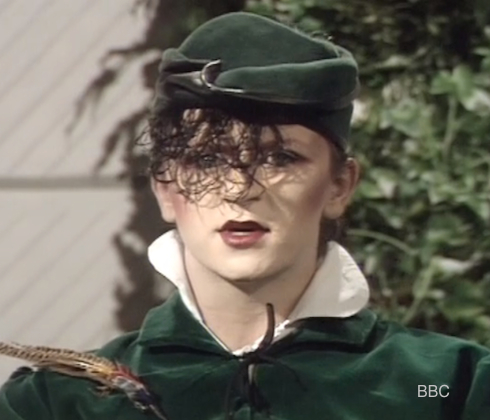
Steve Strange in 1981: here in Robin Hood guise (BBC)

FIRST PUBLISHED 13 FEBRUARY 2015

◼ ONE OF STEVE STRANGE’S TALENTS was persuading the press to believe in his latest wheeze, however fantastic. He had a way of convincing himself that a story was already written and a mission achieved before he had pressed the accelerator and set off. This irritated as many journalists as it amused and many were consequently very sceptical of his next big announcement – like saying he’d booked a big American star to do her first live promotional performance in Britain at his crowning glory, the Camden Palace, capacity 1,410. But in fact he had and she did, and in June 1983 the unknown Madonna was launched in the UK singing to backing tapes for half an hour.

The myths surrounding Steve were always the stuff of self-promotion. Dressing up was part of the same story-telling ritual. Today, he would say, I am Robin Hood, tomorrow Ruritanian Space Cadet, the next day Marionette with the mind of a toy. A compulsive man of masks presents a tricky subject for the scribblers obliged to capture that life once it is spent, so we must tiptoe through the obituaries like a minefield, and beware of tripping over Steve’s much-spun versions of history that were pure fantasy. Even national newspapers seemed to fall for many of the dreams he spouted, as well as the exceedingly vague memories committed to his 2002 book, Blitzed. As the mainstream obituary writers lead you through those New Romantic years, see if you can spot the porkies. . .

➢ The Times obituary:
As the head boy of the “new romantics”, Steve Strange was the flamboyant scene-maker of a colourful subculture that dominated early 1980s British pop music as a showily garish counter-reaction to the stylistic austerity of punk. If punks were the roundheads in pop’s civil war, the “new romantics” were the cavaliers, ushering in a restoration of glitz and glamour, with a delectably decadent flourish… / Continued online

➢ Adam Sweeting, Guardian:
In 1978, Strange and Rusty Egan (then drummer with the Rich Kids) began holding David Bowie nights on Tuesdays at Billy’s club in Soho, a squalid bunker situated beneath a brothel. “We played Bowie, Roxy Music and electro,” said Strange. “It was where our friends could be themselves.” Billy’s could hold only 250 people [not quite!] but swiftly developed an outsize reputation, numbering among its garishly clad clientele such stars-to-be as George O’Dowd (the future Boy George), Siobhan Fahey, later of Bananarama, and Marilyn. . . / Continued online

Billy’s club,Helen Robinson, nightlife, London ,Steve Strange, PX

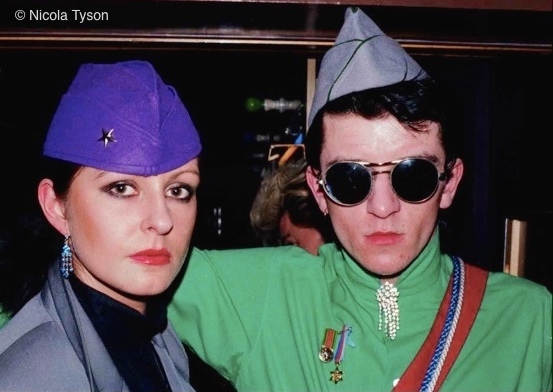
Billy’s club 1978: Strange as Ruritanian Space Cadet alongside PX designer Helen Robinson. (Photograph by © Nicola Tyson)

➢ Daily Telegraph obituary:
Strange fronted sleek operations, such as Club For Heroes in Baker Street and the Camden Palace in north London, where Madonna performed her first British live concert. But Visage split amid acrimony over the division of royalty payments, and his nightspots fell out of vogue in the mid-1980s with the rise of rap, hip-hop and dance music. By this time Strange had a reputation for high-handedness. Years later, Boy George lampooned Strange as the preposterous club host character “Nobby Normal” in his biographical musical Taboo. Strange was not amused. “I don’t think I have that strong a Welsh accent,” he complained. . . / Continued online

➢ The Scotsman obituary:
Although his career as a pop star afforded him only one real hit as frontman of the band Visage, 1980’s austere synthesiser anthem Fade to Grey, Steve Strange’s distinctive image and party-loving persona saw him help invent London’s New Romantic scene. . . Visage’s time in the sun flared all too briefly; with Strange being courted to repeat the clubbing success of places like the Blitz in various US cities, he dived wholeheartedly into the life of the international rock star, with all the pitfalls that entailed. Put off by Strange’s drug use, spending sprees and debauched behaviour, Midge Ure left to concentrate on Ultravox and Visage’s 1984 third album Beat Boy was a critical and commercial failure. The band split the following year, the same year that Strange first took heroin. . . / Continued online

➢ Pierre Perrone in The Independent:
A flamboyant figure with a self-destructive streak . . . By the late 90s he was back in Wales and, by his own admission, acting “very bizarrely”. He spent six weeks in a psychiatric hospital, was arrested for shoplifting and given a suspended sentence. “I don’t know whether it was cry for help,” he told The Independent in 2000, blaming an over-reliance on Prozac, though he seemed comfortable with his avowed bisexuality. . . / Continued online

FRONT PAGE

➤ Steve Strange remembered by Martin Kemp

Steve Strange, tribute, Martin Kemp, New Romantics. Blitz Kids,Swinging 80s, London, nightlife

Steve Strange, right, and Martin Kemp at Tokyo Joe’s in London in 1981. Photograph by Robert Rosen/Rex

➢ Spandau Ballet bassist Martin Kemp recalls the Visage frontman, nightclub host and New Romantic pioneer who kickstarted his band’s career – in today’s Observer:

It’s lovely being asked to talk about Steve now, because I couldn’t right after he died. I’d start, but then I’d just burst into tears. He was one of my best friends and he created a big part of my personality. He showed me how exciting life could be, but how you could be a decent person with it. I also genuinely believe that everything that the 80s was, he started it. What people wore, how they did their hair, the decade of excess – that was all him. . .

Steve Strange, pop music, gravestone

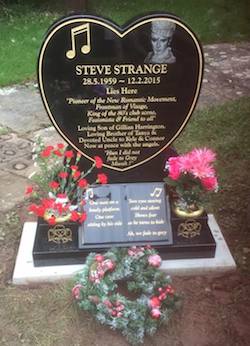
Steve Strange’s gravestone erected 18 December in Porthcawl, South Wales

We were both working-class boys who had always wanted to do something else and here he was, doing it brilliantly. I looked up to him. He’d set up punk gigs back home in Wales, came up to London to work for Malcolm McLaren, and now he was carving out his own path away from punk. . . He succeeded because he was smothered in charisma. It drew everyone to him – the working class and the middle class loved him, but even the most upper-class people were immediately in the palm of his hand.

London made Steve, but it wasn’t good for him. He was a very intelligent man, but he got scrambled and crossed the line with drugs. . . The saddest thing is that I could see the end of Steve’s story long before it had been told. I’d waited for the phone call for years, so it wasn’t a shock. But to go to his funeral in Wales… it was incredibly sad. . . / Read the full tribute at the Observer online

➢ Previously at Shapersofthe80s:
Original Blitz Kids say farewell to Steve Strange – read exclusive tributes to the King of the Posers

➢ Read the story of Spandau Ballet, the Blitz Kids and the birth of the New Romantics at The Observer, by Yours Truly

FRONT PAGE

➤ Steve Strange RIP: the great provocateur who led from the front and inspired a generation

Visage ,Blitz Club,Steve Strange ,Blitz Kids, New Romantics, nightclubbing, tributes

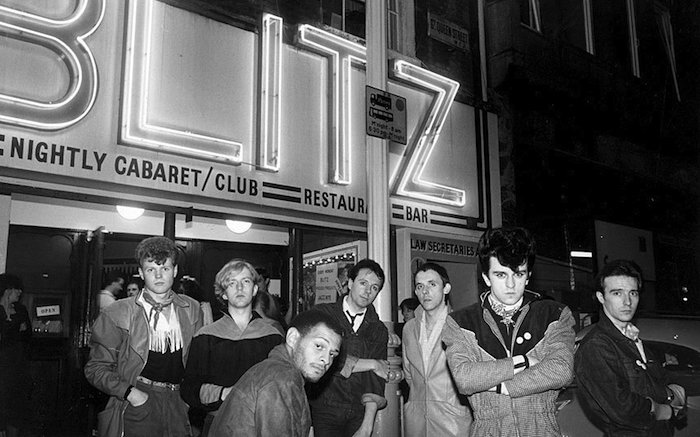
The early Visage outside the Blitz Club in 1979: Steve Strange (second right) and from the left, Rusty Egan, John McGeoch, Barry Adamson, Billy Currie, Dave Formula and Midge Ure. (Picture © Sheila Rock)

SO FAR ONLY A FEW SERIOUS COMMENTATORS HAVE glimpsed STEVE’S WIZARDY…

➢ Tom Ewing in today’s Guardian:

The reruns of 1980s Top of the Pops on BBC4 will provide an opportunity to see the change Strange and his friends wrought – a pop scene becoming funnier, more dramatic, and more delightful to look at with each week. By 1981, and Strange’s move to a new venue, Club For Heroes, pop music looked and sounded quite different than when he’d arrived, and he’d played a huge part in the change. Nobody in pop is trusted less than the fashionable. But a generation of small viewers learned more about glamour, improvisation and style from the pop music of Steve Strange’s generation than from anything else on TV, or in real life.

Strange kept making music and running clubs, but the records he left behind – fantastic as they often were – are still only half the story. Steve Strange was important not just as a pop star from a particularly colourful scene, but as one of pop’s secret architects. . . / Continued at Guardian online

Steve Strange, Steven Harrington, Blitz Kids, New Romantics,

Leather-clad Steve Strange photographed in 1982 by Helmut Newton

➢ Neil McCormick in today’s Daily Telegraph:

Strange was a significant figure . . . his influence behind the scenes proving crucial to the newfound confidence and flamboyance of post-punk British pop in the Eighties. . . Dance music became cool again, synths reigned supreme, with Strange amongst the chief instigators of a fresh colourfulness and extravagance that brought fun and glamour back into pop, giving impetus to a flashy, eccentric scene that ultimately inspired the second British musical invasion of America.

His death from a heart attack at 55 may only leave a tiny mark on pop music but Strange himself had already made a much bigger mark. To those who knew, Strange was a genuine pioneer, an inspiration to a generation. . . / Continued at Telegraph online

➢ LISTEN to broadcaster Robert Elms – one of the original Blitz Kids – paying tribute today on BBC London 94.9:

This working-class kid orchestrated London for a couple of years. He was a worker of people, a creator of ideas, a cultural agent provocateur. . . down-to-earth, funny, scurrilous. . . And he made things happen. He played London like a musical instrument

➢ More memories of the man behind the make-up
– by ‘Betty Page’:

I interviewed Steve just before Visage’s first album was released, fully expecting to meet an arrogant 20th-century version of Beau Brummell. He was modelling the Little Lord Fauntleroy look – porcelain face make-up, tumbling curls and two finely drawn black dots placed on the tip of his nose completed the look. I told him that I wished I had the patience to apply such an immaculate maquillage.

“I’ll get up as early as it takes to get my face right,” he replied. “No matter how big the hangover.”

Now there’s dedication. That’s what it takes to be A Creation. I no longer feared that the room was too big for the three of us – Steve, his reputation and me. He was just a sweet working-class boy from Wales who liked to dress up and party. . . / Continued at Berverleyglick.com

18 FEB UPDATE: SULLIVAN’S SOHO RADIO SHOW

I had the immense pleasure of dedicating my radio show today to my old partner in crime and friend since early teens Steve Strange and rounded up some of his best friends to tell us some great Strangie stories including Princess Julia, Jennie Matthias of the Belle Stars, Glen Matlock of the Sex Pistols, Jeanette Calliva who ran Double Bass and The Bank with him. A real honour to do as it was a privilege to be his good friend for 40 years. He was a complete and utter maverick. He had balls the size of basketballs. He didn’t know when to stop and he never knew when the night had ended. Steve’s greatest achievement was that he sussed out he could become notorious being himself in every way and he made a living out of it.

➢ Previously at Shapersofthe80s:
Nowt so Strange as Steven John Harrington, 1959–2015

FRONT PAGE

➤ Return to the Blitz 2011 – London Tonight reports

◼ FLASHBACK TO 17 JAN 2011 – ITV’s six o’clock news magazine London Tonight reports on Saturday night’s RETURN TO THE BLITZ party hosted by Steve Strange & Rusty Egan. They’re celebrating the launch of their official website theblitzclub.com and a load of nostalgic New Romantics from 1979 find themselves mingling with Neo Romantics from 2011.

ITV’s intrepid entertainment correspondent Lucrezia Millarini dives into the scrum and Shapersofthe80s topped and tailed her report – all content is © itv.com … Includes three classic Blitz photographs of Boy George and Spandau Ballet by Derek Ridgers, plus one by yours truly of George and Stephen Linard

FRONT PAGE

➤ Smith & Sullivan sign off We Can Be Heroes with a sigh

We Can Be Heroes,Unbound publishing, books,Graham Smith,Chris Sullivan,Blitz Kids, New Romantics, Boy George,nightclubbing, Swinging 80s, photography,

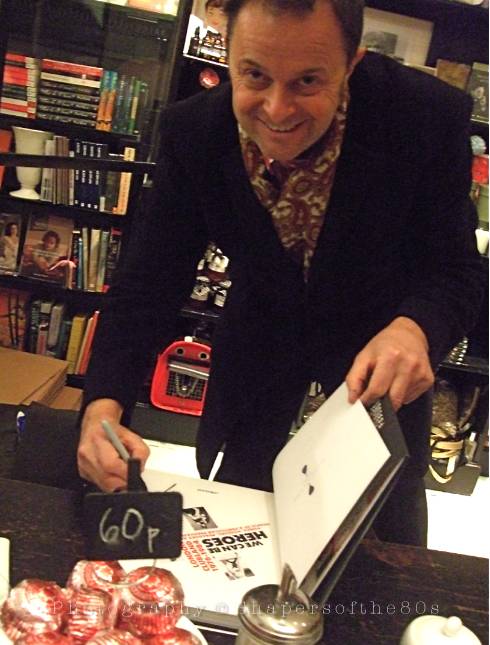
Graham Smith: signing advance copies of We Can Be Heroes between coffee and cake today at Soho’s Society Club. Photographed by Shapersofthe80s

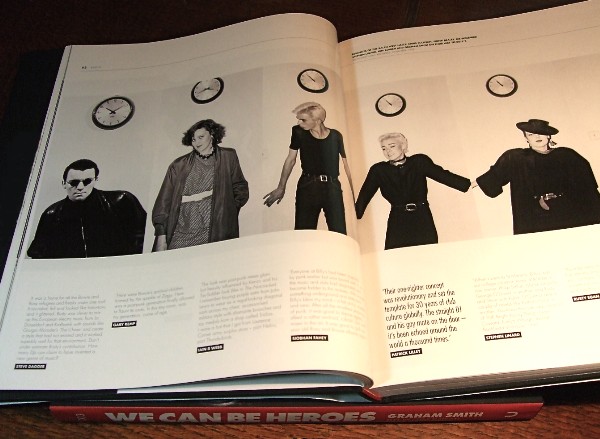
❚ THE BOOK OF THE DECADE has arrived and early buyers of the 2,000-copy first edition had it in their hands today. The photo-story of 80s clubland, We Can Be Heroes, felt reassuringly hefty to the touch and we finally discovered the page size to be generous at 235 x 280mm. The five-colour printing gives intensity especially to the black-and-white photography on the high-gloss paper and author Graham Smith’s verdict on the quality was simple: “Stunning.” Collaborator and 80s club-host Chris Sullivan breathed a sigh: “We got there in the end.”

The 320 pages of story-telling and voxpops from perhaps 100 contributors will raise plenty of smiles when the postman delivers the book during the next week. Even if you’ve read Shapersofthe80s from top to bottom, you’ll find as many more quotes and insights from the original Blitz Kids themselves. Deejay Jeffrey Hinton reminds us in the book: “People think this was a premeditated scene but it was not. It was childlike, thrown together. We didn’t do it for the money, we were innocent. It’s all so marketed today.”

We Can Be Heroes,Unbound publishing, books,Graham Smith,Chris Sullivan,Blitz Kids, New Romantics, Boy George,nightclubbing, Swinging 80s, photography,

Ringleaders who shaped the style of the 80s celebrated in We Can Be Heroes: Chris Sullivan, Fiona Dealey, Lee Sheldrick, Stephen Linard and Kim Bowen — the rebels within St Martin’s School of Art, all photographed by Graham Smith

We Can Be Heroes,Unbound publishing, books,Graham Smith,Chris Sullivan,Blitz Kids, New Romantics, Boy George,nightclubbing, Swinging 80s, photography,

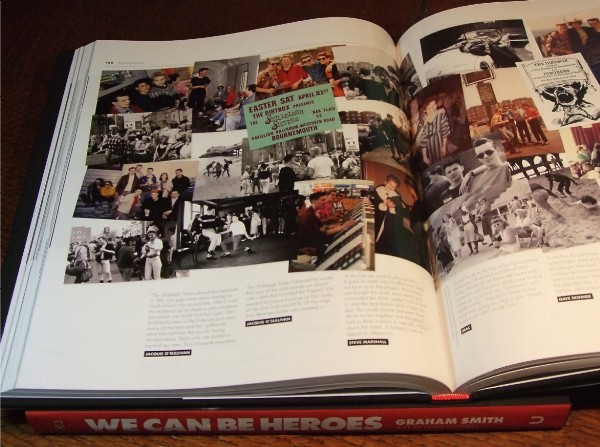
Bournemouth was the destination on bank holidays: good-natured hijinks brought London clubbers to the south-coast resort, and Smith has included many of their snaps in We Can Be Heroes

While the main images reveal just how small in number was the coterie who initiated the sounds and styles of the 80s, Smith has supplemented his own portfolio of pictures with many snaps from clubland wags themselves whose ambitions were liberated by the spirit of collaboration inspired in 1980. Nevertheless, designer Fiona Dealey makes a valid point in the book: “When anyone has written about the Blitz it has been by the same few blokes giving the same old soundbites with never a mention of what the women were up to. The Blitz was our youth club and I feel they hijacked it.”

Today John Mitchinson, the book’s publisher, said he was reasonably confident that a commercial edition of Heroes might follow in the autumn of 2012. In the meantime a limited number of copies of the first edition are still available only from Unbound Publishing.

➢ 1976–1984, Creative clubbing ended with the 80s — we profile three of the bright sparks behind We Can Be Heroes and how they shaped the decade

➢ View Shapersofthe80s video — Chris Sullivan telling his “ribald tales of excess” from the Blitz era at a launch party for We Can Be Heroes… with Graham Smith and Robert Elms on video too

We Can Be Heroes,Unbound publishing, books,Graham Smith,Chris Sullivan,Blitz Kids, New Romantics, Boy George,nightclubbing, Swinging 80s, photography,

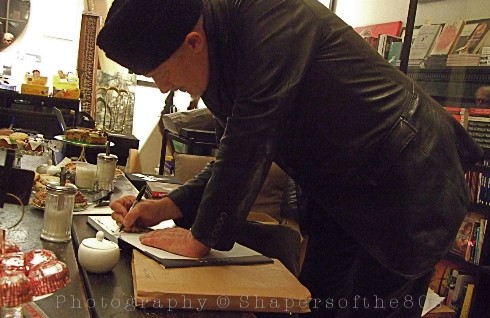
Chris Sullivan signing today: “Now people can see the book itself we might shift a few more copies.” Photographed by Shapersofthe80s

FRONT PAGE