1980 ➤ One week in the private worlds of the new young

Evening Standard, Oct 16, 1980

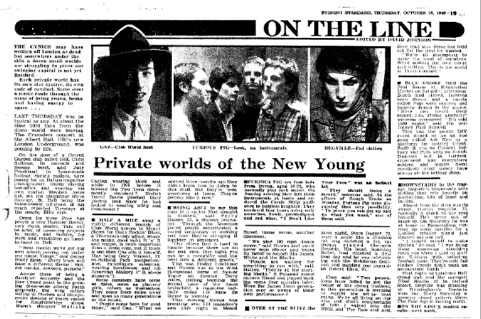
First published in the Evening Standard, 16 October 1980

THE CYNICS may have written off London as dead in 1980 but somewhere under the skin a dozen small worlds are struggling to prove our swinging capital is not yet finished. Each private world has its own star system and its own code of conduct. Some steer a scenic route through the maze of being young, broke and having energy to spare
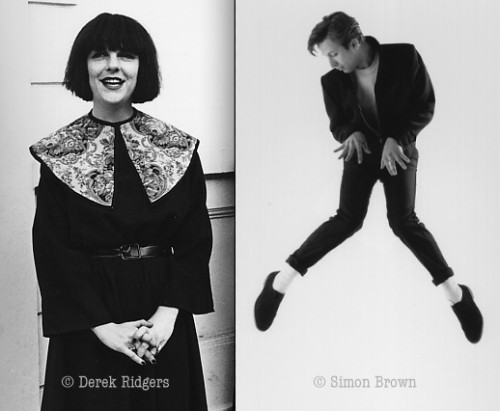
Judi Frankland in one of the clerical cassocks from her degree show summer of 1980, pictured by Derek Ridgers. Style commentator Perry Haines, by Simon Brown

◼ LAST THURSDAY was as typical as any. At about the time 5,000 fans from Disco World were leaving The Crusaders concert at the Royal Albert Hall, 1980’s new London underground was coming to life. On the door of a Covent Garden club called Hell, Chris Sullivan, in monocle and Basque beret, and Judi Frankland, in the home-made clerical cassock that she’d worn in Bowie’s video for his chart topping Ashes to Ashes, were posing for an Italian magazine photographer. Inside, playing box-office and wearing his own modish Stephen Jones hat and all too visible makeup, sat the ubiquitous Steve Strange, 21, Hell being the twice-weekly off-shoot of his much reported Tuesdays at the nearby Blitz club. For him, he said, dressing up is a way of life. “I don’t do it to get attention.” . . . / Continued on our inside page
➢ Read on inside Shapers of the 80s:
A rich slice of London life in 1980 – one week, a dozen prodigies setting the town ablaze, none of them over 22

FRONT PAGE

1980 ➤ How the rhythm of the pop charts changed

❚ SPANDAU BALLET’S MUSIC made a dramatic gear-change in 1980 by placing the bass guitar and the bass drum at the front of the sound, as a driving rhythm for movers. Within a year of their first hit, To Cut a Long Story Short, the rhythm of the UK charts shifted from the lead guitar to the 4:4 dance beat of the bass drum, due entirely to the number of the new “image bands” charting in 1981. Gary Kemp claimed at the time: “RnB was the backbone of pop music from 1962 to 1980. And since then, funk. Dance rhythms are the musical basis for all rock bands now. Really, you can’t say ‘rock band’ any more because the music isn’t rhythm-and-blues.”

SB80C-HvnJK-dj40

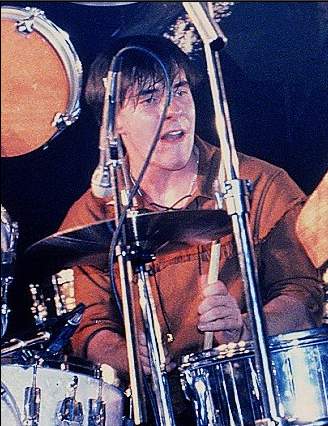
Heaven 1980: Keeble on drums, pictured by © Shapersofthe80s

Drummer John Keeble said then: “Spandau definitely altered the sound of British music. Not till the Journeys to Glory album came out in 1981 did anyone else push the bass drum so far upfront, except black disco. Our sound has a white feel because of our own rocky beginnings, but buying our first synth in 1979 made us re organise the sound in a more danceable way. A song called Eyes was the first number where I ever played a straight 4:4 beat on the bass drum like in disco. I’d be saying to the guys, ‘Don’t play rock, don’t play punk, just go boom-ka, boom-ka’, it’s dance music.

“It’s the difference between listening to funk instead of the RnB they all played in the Sixties – the kind that influenced the Stones and the Who. The drum track was almost inconsequential. Listen to old Stones tracks and you can hardly hear the drums.”

FRONT PAGE

1980 ➤ How many people does it take to launch an electro-diskow band?

Waldorf Hotel, Spandau Ballet, Covent Garden, Blitz club, New Romantics, youth culture,youth movement, Blitz Kids , To Cut a Long Story Short, London, UK, singles chart, aged 20, club-hosts, DJs, Herbie Knott

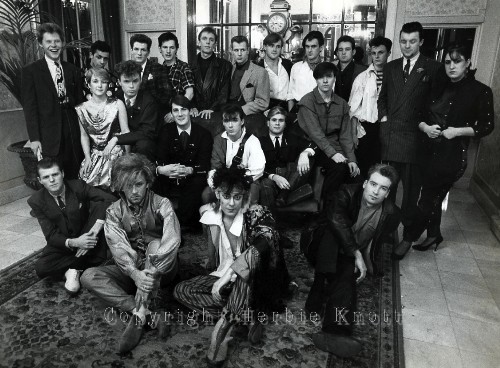
Waldorf Hotel 1980: seated at centre, Spandau Ballet, house band of Covent Garden’s Blitz club, home of the New Romantics movement, plus support team of Blitz Kids who helped put their first single To Cut a Long Story Short into the UK singles chart at No 5, on Dec 6, 1980. Average age 20, everyone had a specific role to play in staging and promoting the band: seven musicians, six designers, three media and management, three club-hosts, two DJs, one crimper and 22 egos. Photographed for the Evening Standard © by Herbie Knott

➢ CLICK to read the history of the Blitz Kids and
the birth of the New Romantics

FRONT PAGE

1980 ➤ Mankind’s first taste of musical freedom

Sony, Stowaway,Walkman, Regine,1980, 1986, TCS-300, roller-skating

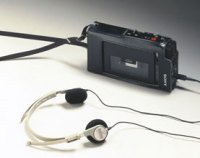
Sony Stowaway: the pioneering stereo cassette-player was launched in London at Regine’s nightclub. Headphones replaced speaker to make model TCS-300 light enough not only for jogging but also the burgeoning fad of roller-skating

‘Whaddaya mean, you’ve never been hang-gliding in headphones?’ To the Californian who recently delivered that crushing putdown while visiting London, the true Brit can now reply in the affirmative. This week, the Stowaway arrived in Britain, having already started crazes in Japan and America. Made by Sony and selling for around £99, it comprises lightweight headphones and a cassette machine the size of a small tranny which, as roller-skaters and parachutists have found, leaves the hands completely free. Consider the possibilities. [Source: On The Line, Evening Standard, April 24, 1980]

Update The no-frills Stowaway lacked a Dolby noise reduction system so in one bound it turned portable music into the pre-web equivalent of a rubbish P2P download direct to your ears. It has blessed public transport ever since. That summer, 1980, one of London’s rare Stowaways announced itself in the next seat to mine on a flight to St Tropez where for two weeks a then unknown British band called Spandau Ballet had brought the look and sound of Swinging London to the Papagayo nightclub. “Tss-tss-tss-tss” went the soundtrack to my trip from the next seat (with odd moments mercifully punctuated by the divine Chaka Khan’s “I wanna be naughty with you-oo-ooooo”).

In opposition to the Japanese-made name “Walkman”, invented for Sony’s home market, it was launched as the Soundabout in the US and as the Freestyle in Australia. Yet within three months, in the UK the Stowaway (cool, sexy name) had been rebranded the Walkman (dumb, dorky name). Somehow, the marketer’s S-curve inexplicably took sales to a million. By 1984 the price had plummeted to £30 and by 1986 the word Walkman was accepted into the Oxford English Dictionary

FRONT PAGE

1980 ➤ For an angry new decade a new breed of comedy puts trendiness itself within its sights

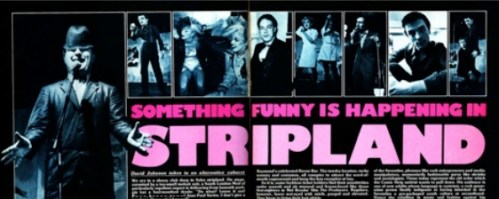
First published in Over21, January 1981

First published in Over21, January 1981

The satire boom of the Sixties chose as its targets politicians, church, unions. The world has moved on, and in 1980 so-called “alternative cabaret” is gunning for rock entrepreneurs, media manipulators and a pre-packaged youth culture inherited at second hand . . .

Click here to read on

alternative cabaret,comedy, Soho, Comic Strip,Nigel Planer , Peter Richardson, The Outer Limits, 1980

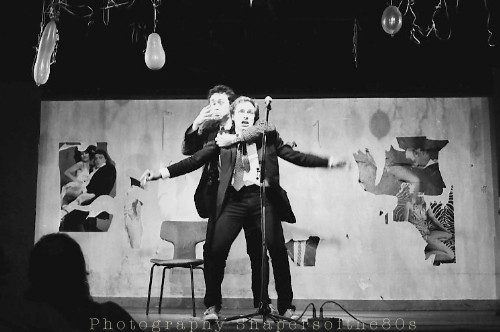
Airline disaster movie: Nigel Planer and Peter Richardson as The Outer Limits at the Comic Strip, Nov 1980. Photographed © by Shapersofthe80s

➢1980 ➤ Rik and pals detonate a timebomb beneath another kind of strip for Soho

GO TO FRONT PAGE