➤ “Too posh for pop” — Grandpa Waterman condemns two decades of musicmakers

posh pop ,Florence Welch, Lily Allen, UK pop charts

Posh pop totty: Florence Welch and Lily Allen. Photos by Dave Hogan/Getty, and Icon/Rex

❚ HALF OF ALL PEOPLE WHO know who Pete Waterman is regard him as a genius. Or they did, until today’s outburst on BBC radio when he wrote off two decades of pop music. “It’s never been worse,” he harrumphed over breakfast on R4’s Today show, hinting at some insidious infection. His detractors have always condemned him as the schlock-meister who bulldozed the freshness of early 80s pop into oblivion by churning out some of the crassest tunes of the decade.

Waterman’s personal claim is to have created 22 UK number one singles, but the former apprentice electrician and club deejay is best-known as the founder of SAW, the Stock Aitken Waterman songwriting and production hit factory that put 100 singles into the UK top 40 chart and sold 40m records in a formulaic mix of Hi-NRG and Eurobeat (think Rick Astley, Jason Donovan, Hazell Dean, Mel & Kim, not forgetting Kylie). Immediately before impresario Simon Cowell stepped fully formed from the egg, Waterman left no less of an imprint on the British music scene through a strategy that skilfully avoided overestimating public taste.

➢ Hear the extended Waterman interview:
“It’s a totally different industry today — it’s all about job protection. It’s not what music is about”

What detonated 64-year-old, father-of-four Waterman this morning was the Today show. For no obvious reason it exhumed a survey from last month’s issue of The Word music magazine which had generated newspaper headlines in December by calculating that 60 per cent of current chart pop and rock acts must be middle class because they went to what we Brits paradoxically term “public” schools (meaning posh fee-paying private schools), compared with 20 per cent ten years ago. On average, fewer than a tenth of Brits attend fee-paying schools.

Examples cited were Lily Allen who boarded at Bedales, Grammy nominee Florence Welch from Alleyn’s School, the Nu-Folkies Mumford & Sons from King’s College School, and the not exactly current Coldplay’s Chris Martin from Sherborne, and Radiohead all ex-Abingdon.

Pete Waterman, Today programme,posh pop, The Word,

Pete Waterman: “pop has become snobbish”. Photograph © by Andrew Crowley

Bah humbug. Light blue touchpaper and off Pete goes, whizz-bang. “This has been a gripe I’ve had for over 20 years, and particularly right now. It’s never been worse,” he blasted.

“The major companies dominate and they see a CV and if you haven’t got 96 O-levels you ain’t getting a job. When all the A&R people wear Jack Wills clothes [slogan: Fabulously British clothes for the university crowd”] it tells you where they’re going. It’s become snobbish. It’s become a snobbish culture.”

Click through to the iPlayer to hear Pete in full spate on Today today. What he’s lamenting really is an end to John Lennon’s Working Class Hero who made British pop great in the swinging 60s — because he’d known what it was to live a hard life. “You’ve got to have lived the life to have sung the life.” Despite his honorary doctorate in music from University College Chester, Dr Waterman OBE concludes: “There’s no university in the world, ever, that has given you a degree in a hit record.”

➢ Read Has pop become posh? — Today reporter Tom Bateman at BBC News online

➢ How pop went posh — Will Hodgkinson front-paged the topic on the arts section of The Times, August 13, 2010 … Adds the ex-Rugby Horrors to the list of public-school suspects, along with Foals (Abingdon). “One of the reasons all these bands are emerging is because public schools have such great facilities,” says old Etonian Tom Bridgewater, MD at Loose Music. The Times tenuously lists the “Top schools of rock” as Abingdon (Radiohead), Bedales (Patrick Wolf), Eton (James Blunt), Marlborough (Chris de Burgh — Is he the latest Marlborough can offer?), Westminster (Mika), plus the free state-funded city college, The Brit School in Croydon (Amy Winehouse).

FOOTNOTE TO HISTORY

❚ Pete Waterman made one of the most inspirational guests on Desert Island Discs in 1995 by expressing real erudition about his industry and popular culture. In a model lesson that was worthy of the Open University, he explained how pop music worked. And he identified the three best groups in music history who defined the essence of pop: The Beatles, The Beach Boys and, unexpectedly but rightly, Abba.

FRONT PAGE

➤ Index of posts for December 2010

Duran Duran, 80s, pop

The early Duran Duran: discovered by invitation in 1980

➢ 80s shapers win 2010 New Year Honours for fashion, music and walking in space

➢ 1980 secrets revealed about the SAS, arming Afghanistan and death of the tanner

➢ 1980, As Spandau play in Heaven, all around we can hear the new sounds of 1981

➢ 1980s, So many shapers shaped the decade that people think was all down to Margaret Thatcher — key books of the year

John Lennon death, Daily Mirror, people magazine, 30th anniversary
➢ What larks! Festive fun and games and British ways to make merry

➢ A jolly festive tree by Andrew Logan

➢ 2010, Duran no turkey: here’s the Bacofoil video and two new tracks premiered at East Village Radio

➢ 1980, How Duran Duran’s road to stardom began in the Studio 54 of Birmingham

➢ A feast of Bowie-ana served in waffeur-thin slices

➢ Whatta they like? Essex reality stars shake their vajazzles in the face of Hollywood

➢ 1980, The Lennon we knew: unfulfilled talent with a genius for making friends the world over

Adam & The Ants, David Bowie, Swinging 80s,Top Of The Pops
➢ 1980, The week the Swinging 80s clicked into gear

➢ Live online now, mad hatter Stephen Jones

➢ This £5m iPhone has to be a spoof! Yes, that’s $7.8m or €6m or 52m Chinese Yuan or 245m Russian Rubles

FRONT PAGE

1981 ➤ Why naked heroes from antiquity stood in for Spandau on their first record sleeves

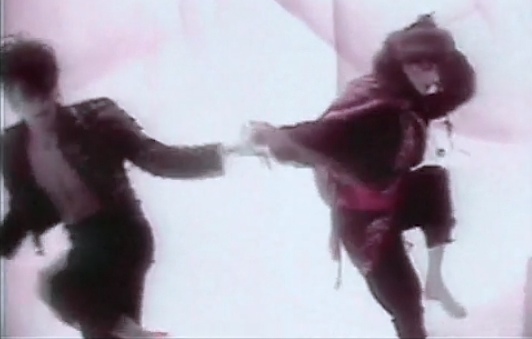
➢ CLICK TO VIEW ♫ THE VIDEO FOR SPANDAU BALLET’S SECOND SINGLE, THE FREEZE …

Spandau Ballet, The Freeze, John Keeble, video, New Romantics
♫ BLUE SING LA LUNE, SING LAGOON… ♫ No, nobody has ever known what the lyrics to The Freeze were going on about, but that wasn’t the point 30 years ago today when it entered the UK singles chart at No 24. It wasn’t an obvious choice for Spandau Ballet’s second single, after their first, To Cut a Long Story Short, had peaked at No 5. The Freeze was not chosen for singability but for its New Romantic clubbing credibility. In 1981 the pathfinding band were consolidating the new approach they had styled White European Dance Music — led on The Freeze by Gary Kemp’s two-fingered synth arpeggios, plus enough percussive kick-drum snaps underpinned with bassline rhythms to fill dancefloors even in Birmingham, where Duran Duran had yet to release their debut single.

The Freeze was a subtle rallying call to soulboys and girls up and down the land, as distinct from the new wave’s “electric” factions who were inventing alien soundscapes haunted by multi-layered synthesisers. Spandau were to release one more double-sided single and an album in similar style before throwing New Romantic rivals into confusion by changing their sound utterly — and fashionably — to funk by mid-summer. Spandau moved ever onward by translating the New Romantic mantra that “One look lasts a day” into its musical equivalent.

Likewise, the new video dispensed with their earlier tartans to reveal a mix of a medieval doublet from PX, masculine string vests, a pair of dark-glasses to transform Tony Hadley into Donald “The Forger” Pleasence [♫ The art is pretending it’s art ♫], and a grey pleated Melissa Caplan “gymslip” [above] for drummer John Keeble (not known in the years since for cross-dressing — although, no, hang on, there is one as-yet unpublished pic of him as Carmen Miranda on tour in the US).

Spandau Ballet, record sleeves,

Graham Smith’s minimalist livery for Spandau Ballet’s white record sleeves: To Cut..., The Freeze, Journeys to Glory

While ex-Middlesex art-school fashion-designer Simon Withers set the style for Spandau’s staging and clothing, a complete livery for their suite of vinyl record sleeves was masterminded by Graham Smith while still studying graphics at Camberwell (all of which counted towards his coursework and earned him a first-class degree in 1981 and, fortuitously, an entire window display in HMV’s Oxford Street record store). The early singles — To Cut…, The Freeze, Musclebound and Glow — were taken from Spandau’s first album Journeys to Glory, which reached No 5 in March, and were styled in black-on-white with minimal distraction beyond a few classical motifs, like those decorating the set in The Freeze video. Most daringly, there wasn’t even a photograph of the band on the debut single.

Graham says now: “I wanted to create an overall corporate visual package for Spandau that was cutting edge and reflected their aspirations. It had to have style. Style was the buzzword at the time. Even magazines were being named with Style in the title. It’s overused today, but it wasn’t then.”

Spandau Ballet, New Romantics, record sleeves

Sleeve for Spandau Ballet’s Glow: Another hero, by Smith after Flaxman

His minimalist vision was pretty prescient for 1980, though he wasn’t alone. Up North, former classmates at Manchester Polytechnic Peter Saville and Malcolm Garrett had been transforming graphic design in the record business for a couple of years, Saville for Joy Division and OMD among others while establishing a bold house style at Factory Records (where one post-punk sleeve was made of sandpaper as a Situationist joke), and Garrett for the new-wavers Buzzcocks and Magazine. Both were inspired by the pioneers of 20th-century typography to let stock fonts alone evoke mood and character, just as Penguin Books had done. The Mancunians, too, had often abandoned band portraits to underscore musical integrity.

Even so, it was quite a feat for Graham Smith to convince Spandau’s manager Steve Dagger and his five ostentantiously dandy band members with trendsetter ambitions that they remain invisible on their first set of singles.

Graham says: “This was obviously seen as a perverse and uncommercial move by Chrysalis [the record company], but that was the whole point. I felt by doing so we gave mystique to this new and very visual band. It added a strength to Spandau as they were clearly stating they were not packaged by the record company, but doing things on their terms. This move would still be considered questionable in marketing terms today.”

Spandau Ballet, Musclebound, record sleeves

More Flaxmanesque heroes: Spandau Ballet sleeve imagery for Musclebound

A few tasteful nudes from classical antiquity stood in for the band, resonating with the New Romantics’ lifeline back to Bowie’s “Heroes”. Graham says: “The iconic imagery for the album was based on Greek sculptor Myron’s The Discus Thrower. Glow was based on 18th-century etchings by the neoclassical sculptor John Flaxman. The Freeze image I sourced from a reference book on Egyptian icons — the chariot simply worked with the Journeys to Glory theme. The white spartan package was pure and reflected some of Gary’s lyrics and statements at the time, such as I am beautiful and clean.”

“There were claims at the time that some of the imagery had Aryan overtones which mirrored the band’s earlier fashion choices. I somewhat misguidedly thought this was perfect at the time – think of Bowie saluting at Victoria Station in an open limousine several years earlier!”

Spandau Ballet, St Tropez, Simon Withers, Graham Smith, Robert Elms,New Romantics

Graphic designer Graham Smith (right): The Spandau Ballet entourage in St Tropez in 1980 also includes writer Robert Elms (left) and stage/fashion designer Simon Withers (centre in white). Photograph © by Jean Aponte

FRONT PAGE

➤ Ferry backed by three bass players, Roxy back on the road — how cool is that?


❚ THE MAN WHO DEFINED COOL in the glitzy 70s — the decade that style forgot — was Bryan Ferry, who from Tuesday revives English art-rock gods Roxy Music — for a seven-date UK arena tour, Jan 25-Feb 7, ending at the O2. This will be a hair-tingling reunion of the original line-up of Ferry, Andy Mackay, Phil Manzanera and Paul Thompson…

Roxy Music, reunion, 2011 tourA propos last year’s Olympia, “his best album in two decades” with Kate Moss as the cover, and this Roxy tour, there’s a long, discursive, fan-moist interview with Ferry, “the sultan of suave”, at The Quietus. Ferry has a niggle — “Unless you have a top twenty record, Tesco won’t stock you” — but is pleased that owning your own studio “means you end up doing things that others wouldn’t be bothered to do. For instance, having three bass players on a track (You Can Dance), which people think is a bit mad. But it sounds great; it’s a great big machine. Like the great leader James Brown always had two drummers, and when I saw him he had two bassists as well. He supported me, believe it or not, at a gig at the Natural History Museum”.

FRONT PAGE

1981 ➤ The day they sold The Times, both Timeses

❚ ON THIS DAY 30 YEARS AGO… “Australian newspaper tycoon Rupert Murdoch has agreed to buy The Times and Sunday Times newspapers. But the deal will only go ahead if Mr Murdoch can reach a deal with the print unions within the next three weeks over the introduction of new technology. Mr Murdoch will be expected to meet a number of conditions aimed at preserving the editorial integrity of the papers.”

➢ Read Murdoch bids to take over Times
— On This Day at BBC online

Rupert Murdoch, 1981,Harold Evans, Sunday Times, William Rees-Mogg, The Times

In media circles this was the “sale of the century”, and it is captured here in what the photographer Sally Soames calls her “best shot” … Rupert Murdoch announcing his purchase of Times Newspapers on Jan 22, 1981, to a press conference at the Portman hotel. He is flanked by Harold Evans, editor of The Sunday Times, and William Rees-Mogg, editor of The Times. © Sally Soames

This picture of two doomed gazelles at the feet of the tiger is the one photographer Sally Soames last year nominated as her Best Shot ever. I had the pleasure of working with her shortly before her retirement and a print of this historic photo adorns my bathroom wall. Sally’s back catalogue has been a who’s who of political and artistic giants since her first assignment for The Observer in 1963. She works exclusively in black and white and her photographs are instantly recognisable for the richness and depth of her blacks. She told The Guardian last year:

“I WAS WORKING FOR THE SUNDAY TIMES IN 1981, and there was a rumour that Rupert Murdoch was buying the paper, along with The Times. I was sent to a packed press conference given by Murdoch and the two editors. When the purchase was announced, I knew it was the end of The Sunday Times. My newspaper was going down the tubes. I had tears pouring down my face as I worked.

“As always, I went down the front. I was the littlest, always “the girl”. The three of them sat down, and it was everybody’s first sight of Murdoch. I had brought three cameras, one of them with a wide-angle lens. Everyone started shooting Murdoch – except me. I photographed all three: Harold Evans, the Sunday Times editor, on the left; William Rees-Mogg, the Times editor, on the right. They all had name plates, and I knew I had to get Murdoch’s in there, to identify him. I had to tell the story: two papers were going to change completely…”

➢ Update 2019: Read “fearless” Sally Soames’s
obituary at The Guardian

Universal Daily Register, 1785, newspapers, The Times

First issue of the Universal Daily Register in 1785, later to become The Times

❚ THE ROMANCE OF THE BRITISH PRESS has always derived from its being simultaneously glorious and wretched, from its earliest days when kings would jail upstart editors to the decade of continual strife throughout British industry, the 1970s. So powerful were the trade unions that, as former Times editor Simon Jenkins wrote in his 1979 book Newspapers, The Power and the Money: “Action taken… has brought one paper after another to the brink of financial ruin.” Mind you, rich proprietors also made pretty ineffectual managers. One of the more enlightened was the Canadian Roy Thomson, who flexed his muscle by shutting down for a whole year both of the world-renowned newspapers he owned and published in London — The Times (founded 1785, and 200 years later broadening its appeal from its historic role as the “Top People’s paper”) and The Sunday Times (founded 1821, which under Harry Evans had set benchmarks with its hugely influential investigative journalism). In 1980 the papers ran up a £15m loss (equivalent to £50m today) and by then Thomson had reached the end of his tether, so put them up for sale.

Those were the days when ten nationally distributed daily newspapers and nine Sundays averaged 13m paid-for sales every day of the week (serving a UK population of 56m). Seven millionaire contenders sprang into the marketplace to bid for the two Timeses, yet Harry Evans thought none was worthy to own the world’s most prestigious titles. His book Good Times Bad Times is the rippingmost yarn about real newspaper life — “Who were these seven dwarves, I asked a staff meeting, to seek the hand of Snow White?” It was the Australian wot won it. The deal led to 563 redundancies.

 Rupert Murdoch

Rupert Murdoch in his computerised offices and printing plant newly built at Wapping, 1986 © by Sally Soames, National Portrait Gallery collection

FRONT PAGE