Category Archives: Youth culture

1980 ➤ Out of the blue, Duran’s first gig pictured at the Rum Runner

rel="nofollow"

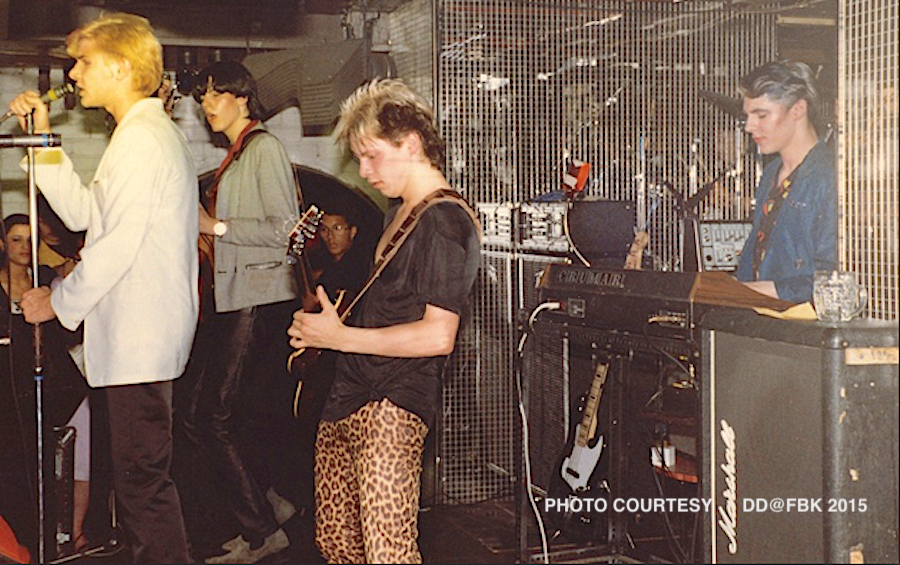
Duran Duran: Who’s who in this debut line-up on 16 July 1980 onstage at the Rum Runner in Birmingham? (More to the point, who actually took this photo?)

❚ NEVER SEEN BEFORE! Or so I thought a few days ago! This superb colour photo of Duran Duran’s debut gig introducing Simon Le Bon on vocals and Andy Taylor on guitar has just been published on Facebook. The band are captured live on 16 July 1980 at Birmingham’s stylish nightspot the Rum Runner and fans have been amazed at a certain blondness and general skinniness of the performers, but after all their average age is only 20. From the left: Yes Simon is blond, yes “Tigger” John Taylor looks truly gangly on bass, yes Andy is in leopard-print pants, and yes Nick Rhodes is playing the Crumar synth at rear. (Drummer Roger Taylor is sadly not visible.)

This sensational picture arrived on the Durantastic World page at Facebook on the 43rd anniversary of the gig and I was one among many fans who had never seen it before. Yet the DW Admin couldn’t say who took it. One follower, Emma Leigh, attributed the image to a photographer who goes only by his Twitter handle @Birmingham_81 (currently unused) and otherwise remains anonymous! Baffled and amazed by suddenly discovering that any photo of Duran’s live debut existed, I embarked on a prolonged Google search.

As the day went on I actually unearthed FOUR photos of that 1980 gig – now published here on this page – which were buried perhaps unsurprisingly in one official Duran website dating from 2015, and another encyclopedic online history of the band in 2018, so all the more puzzling that they haven’t spread widely across social media circles. The best pic, shown here at the top, has sat in DD’s album page at Facebook since 2015, unforgivably dated wrongly to 12 March 1980, months before Le Bon joined the band.

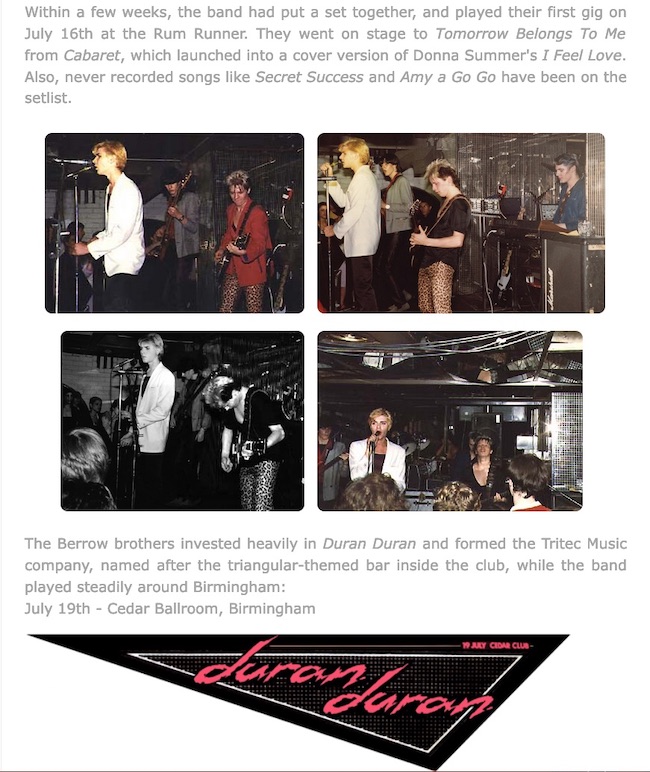
A second pic was also posted by DD at Facebook in 2018 on the correct anniversary of the debut. This is the frontal view in which we can just see Roger on drums, though really too small to enlarge very successfully. Further googling led us through Not Your Mother’s Playlist, a blog by Christina, a 25-year-old pop culture addict from San Francisco who pictured the key photo without comment in 2019, and on to Duran Compilations which uniquely revealed two further pix from DD’s debut in 2018 while showing all four on one page – see below – again without special comment or hint of a source! This website detailing the band’s unofficial history was “compiled and developed by Ansgar Thomann in dedication to the 40th anniversary of Duran Duran’s birth”. He based the anniversary on 1978, when the idea of DD was born!

All four images make a fascinating testament to DD’s sense of style, especially Le Bon. Sad that nobody seems sure who took these landmark photos.

IMAGES SCARCELY SEEN BEFORE – CLICK TO ENLARGE

Core band members had been employed for a year or more around the Rum Runner by its owners, the brothers Michael and Paul Berrow, as bouncers, deejays and glass collectors, while a series of new musicians were tried out and let go.

Cristina’s NYMPL reports: “In 1978, cool kids Nicholas Bates and Nigel Taylor (who would then become Nick Rhodes and John Taylor) handed the Berrows a demo tape for their fledgling band Duran Duran and the rest is history; they held auditions until D-Squared became a full-fledged band with a guitarist and everything, and the Berrows became their managers.”

She adds: “Guitarist Andy Taylor recounts many interesting things in his book Wild Boy (a fantastic read). He talks about the wild behaviour of the club-goers – how flamboyantly they dressed, how behaviour norms didn’t apply and how sex, drugs, and glam rock were paramount. He also talks about the aptly named ‘Sex Offender’s Room’ (‘People weren’t politically correct, then,’ he writes), where the Durans and the Berrows dragged in a nice fluffy bed in a vacant corner, and then would purposefully walk in on one another when they were enjoying the, uh, intimate company of their guests.”

Simon Le Bon told Quietus in 2011: “I had some pretty amazing sex-and-drugs combined occasions. Which, ultimately, were very rock’n’roll. Just thinking back to the Rum Runner, what a place that was for five guys. . . it was probably illegal. In fact, a lot of it was definitely illegal.”
rel="nofollow"

DuranCompilations pulls out the plums, 2018: two more new images to make four DD debut pix scarcely ever seen

Once the 1980 line-up was finalised, it then took DD another six months as the club’s house band before landing a contract with EMI. During this time London’s New Romantic heroes Spandau Ballet notched their first chart single before year’s end. In February 1981 DD’s first single Planet Earth charted at number 12 with the phrase “New Romantic” unsubtly woven into the lyrics, while cool London bands refused to subscribe to the term.

Both Spandau and DD followed the image-conscious practice of pioneering stylish music videos with savvy directors such as Russell Mulcahy and Godley & Creme, which fuelled the British invasion of the US by British bands just as MTV was launched in August 1981. The first person we see in Duran’s first video, Planet Earth, is Roger Taylor who also told Quietus: “I think [director] Russell Mulcahy had a bit of a crush on me: ‘OK, get your shirt off, you’re the first one, lie back’.”

Perry Haines, ex-Blitz Kid, producer and first editor of i-D, told me in 1982: “Duran Duran were destined to be mass market. I styled their first photo session in Milton Keynes in frilly Axiom shirts with bolero jackets and silk Antony Price suits. It was a street-level look with the cut and style of Antony.”

Rolling Stone magazine recorded the brothers’ ambition: “They said, We want a good-looking poser band. . . somewhere between Chic and the Sex Pistols.”

COMMENTS AT DW FACEBOOK THIS WEEK:

Bill Rosich: The 16 July set list was: 1, I Feel Love; 2, Girls on Film; 3, Amy a-Go-Go (later Rio); 4, Night Boat; 5, Tel Aviv; 6, Late Bar; 7, Secret Success.
James Barr: It’s funny, but they’re basically in the exact same stage arrangement that they remain in to this day: Simon out front with John on his right and Andy (or the guitar player) on Simon’s left. Nick is then back and to the left and Roger back and to the right.
Lance Lowe: Was there. I played bongos for 5 minutes. It was a jazz dance night. Paul Berrow asked me to stand behind the bongos with the rest of the band for press shots at the Rum Runner. I just wanted to dance to music by Lonnie Liston Smith.

➢ Durantastic World page at Facebook

➢ Previously at Shapersofthe80s: 1981, Birth of Duran’s Planet Earth
New Romantics, Swinging 80s, Birmingham, Duran Duran, Rum Runner,

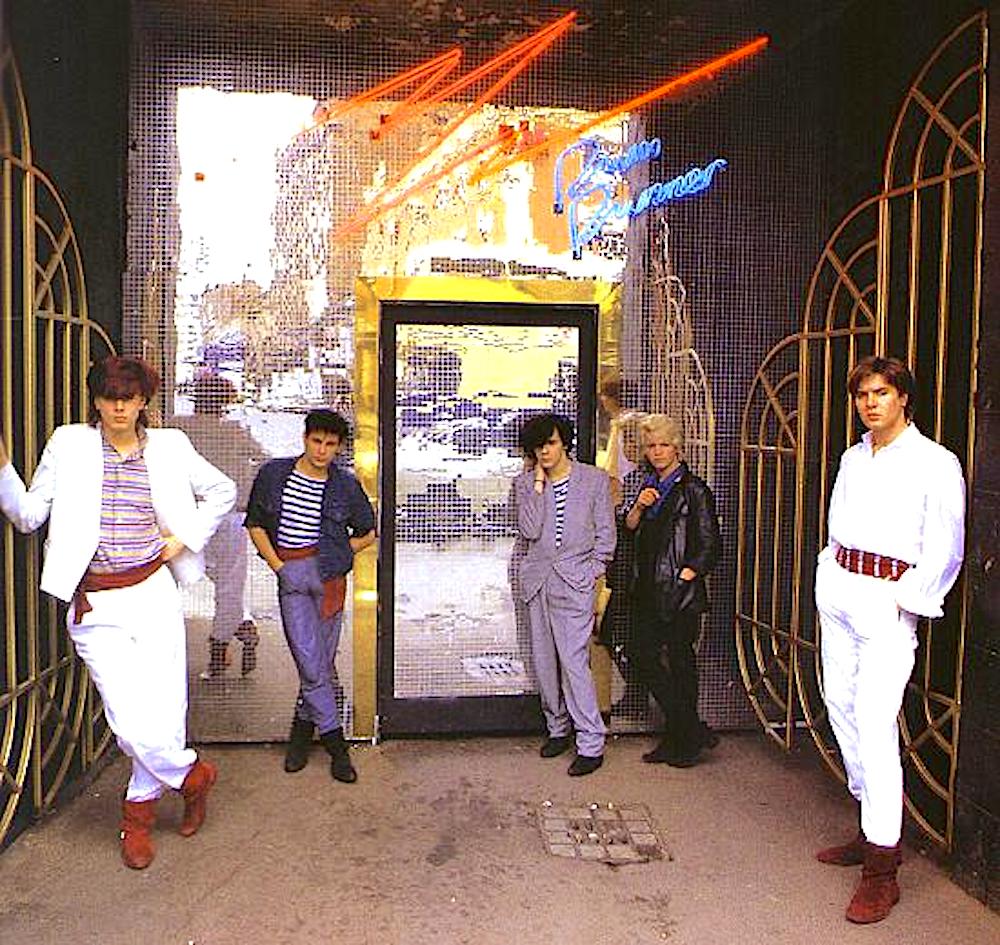
A broody looking Duran Duran en route to stardom: the band pose outside the glam entrance to the Rum Runner nightspot

➢ Previously at Shapersofthe80s: 2023 ➤ Celebrating Kahn and Bell’s role at the centre of Brummie fashion
➢ 1981, Inside the Rum Runner nightclub – by the people who were there
FRONT PAGE

2023 ➤ 80,000 items of Bowie baggage find final resting place in the Olympic Park

Bowie, David Bowie Centre for the Study of Performing Arts, V&A East Storehouse, , archive, David Bowie

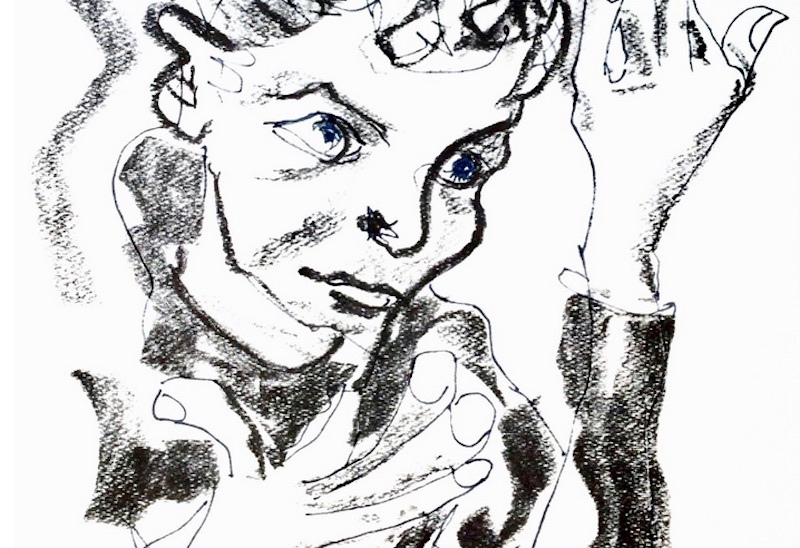
Into the archive: 1978 self-portrait sketched and signed by Bowie (detail)


❚ AT THE DAVID BOWIE CENTRE for the Study of Performing Arts fans will soon be able to get up-close to Bowie’s creative genius like never before. From 2025 the Victoria & Albert Museum’s East Storehouse in London’s Olympic Park will house more than 80,000 items amassed during the six decades of the performer’s pioneering career. His archive will be made available to the public, from fans to school children and researchers, thanks to the David Bowie Estate and a donation of £10m from the Blavatnik Family Foundation and Warner Music Group.

The archive features handwritten lyrics, letters, sheet music, original costumes, fashion, photography, film, music videos, set designs, Bowie’s own instruments, album artwork and awards. It also includes more intimate writings, thought processes and unrealised projects, the majority of which have never been seen in public before.

V&A East Storehouse will be a new type of museum experience taking visitors behind the scenes of the stored collections. The new Centre will also support the ongoing conservation, research and study of the archive.

Bowie, David Bowie Centre for the Study of Performing Arts, V&A East Storehouse, archive,

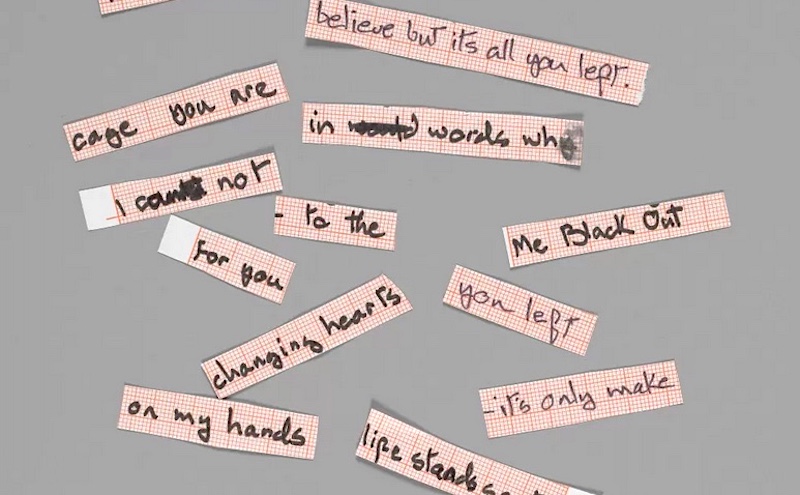
Into the archive: notes for Bowie lyrics created by the Burroughs “cut-up” technique

Highlights include stage costumes such as Bowie’s breakthrough Ziggy Stardust ensembles designed by Freddie Burretti (1972), Kansai Yamamoto’s flamboyant creations for the Aladdin Sane tour (1973) and the Union Jack coat designed by Bowie and Alexander McQueen for the Earthling album cover (1997). The archive also includes handwritten lyrics for songs including Fame (1975), “Heroes” (1977) and Ashes to Ashes (1980), as well as examples of the “cut-up” method of generating lyrics introduced to Bowie by the writer William Burroughs. Additionally, the archive holds a series of intimate notebooks from every era of Bowie’s life up to his death in 2016.

Tilda Swinton, one of David Bowie’s friends and collaborators, said: “In 2013, the V&A’s David Bowie Is… exhibition gave us unquestionable evidence that Bowie is a spectacular example of an artist who not only made unique and phenomenal work, but who has an influence and inspiration far beyond that work itself. Ten years later, the regenerative nature of his spirit grows ever further in popular resonance down through younger generations.”

Bowie, David Bowie Centre for the Study of Performing Arts, V&A East Storehouse, costumes, archive,

Into the archive: stage costumes from every decade of Bowie’s career

➢ Read further detail at the official David Bowie website

FRONT PAGE

2023 ➤ Bowie anniversaries: One fan’s teenage love remains undimmed

David Bowie, 1976, Man Who Fell to Earth, pop music, films, anniversary, birth, death,

Bowie’s new look for 1976 when he became The Man Who Fell to Earth, here in a Haywain shirt. Photographed by Steve Schapiro and published on the cover of the Sunday Times Magazine

David Robert Jones
8 January 1947 – 10 January 2016

Every January, two dates stir the souls of Bowie fans: the 8th being his birthday and the 10th the day he died. On the seventh anniversary of his death, Eighties Blitz Kid and pop singer ANDY POLARIS recalls the dramatic influence Bowie had on his early teens in the way that his fan base would also be galvanized by his art to inspire their own creative dreams. This extract comes from a much longer piece at his own website Apolarisview.wordpress.com … Andy writes:

Much has been written about Bowie’s Starman performance in 1972. I had begun a fascination with his image a little earlier after the Melody Maker interview, thanks to an older teenager who also had the album, Hunky Dory.

I began to spend the little pocket money I had on buying all the magazines and music papers that featured him, especially on the cover. Fab 208, PopSwop, Music Star, Music Scene and Jackie thankfully were relatively cheap and I began my scrapbook collection. Ziggy Stardust with his bold make-up and glamorous wardrobe (courtesy of Freddie Burretti and Kansai Yamamoto) was unlike anything seen before and blurred the line between sexes. This beautiful creature offered a world of possibilities to this youth already bored with football and the teenybop fandom that dominated our era. Clothes, style, identity – normal teenage rites of passage – all took on a greater importance over the next few years but now helped define a more alternative journey.

Seeking out Bowie’s references in lyrics opened a new door to imagination. His creative output eased my inner void of loneliness and probably kick-started my interest in science-fiction. Humdrum suburbia was replaced by the magical worlds of Alfred Bester, Philip K Dick, George Orwell and Robert Heinlein to a soundtrack of Ziggy Stardust, Aladdin Sane and Diamond Dogs.

Scissors, Pritt Stick or Gloy Gum and a large desk were my 1970s iPad, and all that were needed, as I lovingly read and then pasted articles onto A4 note paper into a hard grey binder. This became a ritual that continued for my teenage life. I never liked to create collages because I hated cutting up articles too much and words were equally important. What Bowie was saying or what people were saying about him seemed as important as the visuals. That shape-shifting style (musically and visually) meant I never got bored and felt that I evolved along with him, my anticipation becoming almost tangible with news of a new release or a TV appearance…

➢ Read Andy’s full article on Bowie: First anniversary of his death and my teenage love is undimmed

Andy Polaris , Billy's club, Derek Ridgers, nightlife

Future singer Andy Polaris and Sue at Billy’s in 1978. (Photograph © by Derek Ridgers)

FRONT PAGE

➤ Captured in 1983: the Westwood-McLaren showdown

Over two weeks I watched fashion gurus Westwood
and McLaren go their separate ways. Daggers-drawn,
they both talked exclusively to the Evening Standard…
Mine were the final pix of them together

Paris fashion, 1983, Vivienne Westwood, Malcolm McLaren, Worlds End, post-punk

Their last dance, Paris 1983… Westwood says: “Malcolm has one more chance to be good.” McLaren says: “I’m not incapable of designing the next collection myself.” Photographed © by Shapersofthe80s

➢ Click here to read my enhanced version about the day
the King and Queen of Outrage realised
the end was nigh, in 1983

First published in the Evening Standard, 4 Nov 1983

➢ Obituary for Dame Vivienne Westwood 1941-2022 at The Guardian

➢ BBC’s in-depth tribute to Vivienne – the godmother of punk

FRONT PAGE

2022 ➤ Finally, a blue heritage plaque to honour the Rum Runner

heritage plaque, Richard Whittingham, DJDick, Birmingham, nightlife, Swinging 80s, Rum Runner,

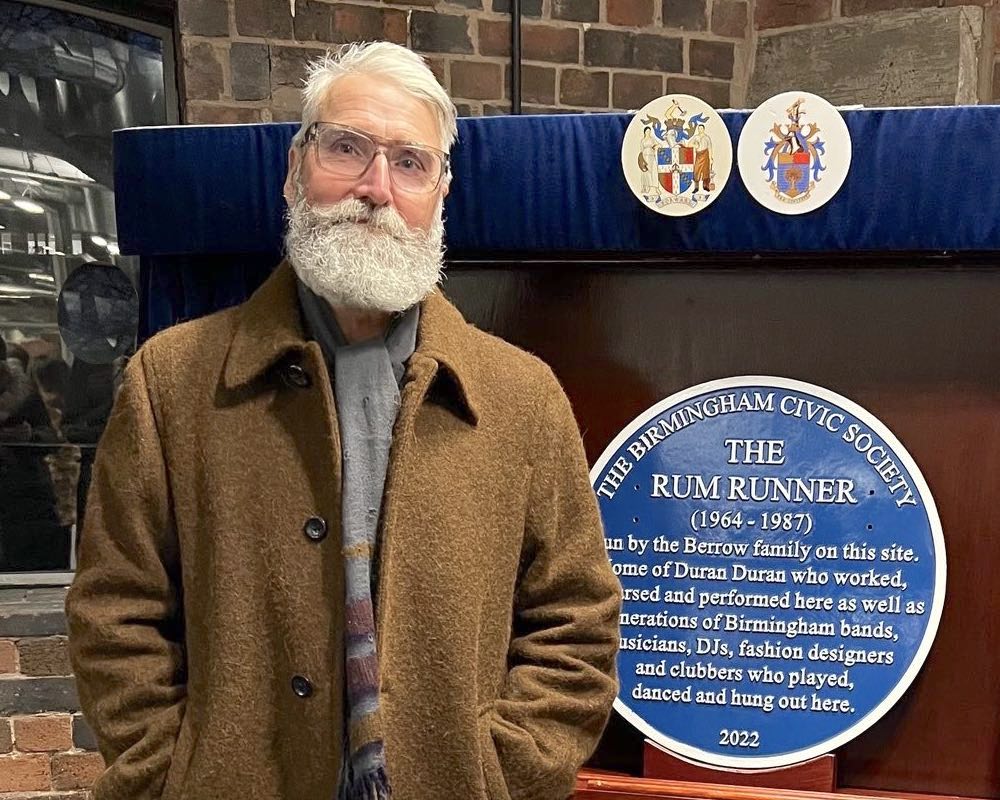
At the unveiling: Richard Whittingham beside the new plaque. (Photo by Adam Regan)

❚ NOT ONLY WAS A PLAQUE unveiled this month before the Lord Mayor of Birmingham to underline the importance of its key nightclub during the Swinging 80s, namely the Rum Runner. . . But the star of the occasion was clearly its deejay, judging from the immediate stream of affection from fans and friends that is appearing online alongside his bearded photo at the event, now aged 62. They said he’d flown in from Lapland especially.

At the age of 19 Richard Whittingham – aka, DJDick – was one of Britain’s most savvy club deejays, reading the tastes of Britain’s second largest city and trying to broaden them to embrace the new dance music like Duran Duran’s which was rapidly filling the post-punk vacuum. For my Nightlife column in the magazine New Sounds New Styles, Dick told me back then: “I’ve been trying to break the funk here for ages but nobody’s into it. The customers aren’t into it and the owners aren’t into anyone taking over their own night. I’m just buying the funk for the day when I have more freedom.”

Click any pic to enlarge:

He found all the glamorous dressing up led by Birmingham’s Kahn & Bell boutique crazily entertaining,  but he admitted what so many clubbers in the Eighties also did about not feeling safe on the streets. When the BBC’s One Show asked in 2011 what he would have worn at the Rum Runner, he replied: “Zoot suits, the odd frilly shirt, winklepickers of course – I had to hide them, to take them out of the house in a bag, and then put them on, because my mother thought they were trouble shoes.” [See interview in video clip below.] Today Dick describes himself as a carpenter and joiner, though he still deejays for occasional events.

Also at the plaque’s preview for the Lord Mayor of Birmingham, Councillor Maureen Cornish, and members of the sponsoring charity the Birmingham Civic Society, we see many local characters pictured at Facebook’s website The Rum Runner – Birmingham, which curiously fails to identify anybody by name! We’ve already guessed that the bearded one is DJDick. Another in the green coat caught wielding a mic and parting the curtains has to be Paul Berrow, one of the brothers who owned the Rum Runner, formerly of Wandering Star Pictures and Tritec Music in the Eighties.

The new plaque is attached to a modern building called Rum Runner Works, set back off Broad Street where the entrance once stood, today located between the  Solomon Cutler pub and the Walkabout sports bar. In the Eighties the council planned to turn Birmingham into a major conference city with developments including the ICC and Symphony Hall. The Rum Runner was demolished in 1987 to make way for the Hyatt Regency Hotel, which opened in summer 1990.

Click any pic to enlarge:

➢ Visit The Rum Runner – Birmingham website at Facebook

Photos displayed here were taken by Neil Drakeford, Debra Warren and Adam Regan who said: “Lovely to see this legendary Brummie club getting a much-deserved blue plaque. The club launched so many careers but none more relevant to me than this great man” [DJdick].

LISTEN TO DJDICK LIVE AT THE RUM RUNNER:

DJDick, 1983, RumRunner, live music,
At Dick Whittingham’s website we can listen to two recordings of him deejaying at the Rum Runner in 1983. These were donated on his 40-something birthday by Mark “Mack” McDonald, an old friend from way back.

VIEW THE BBC ONE SHOW FROM 2011:

➢ Previously at Shapersofthe80s:
1981, Birth of Duran’s Planet Earth

FRONT PAGE