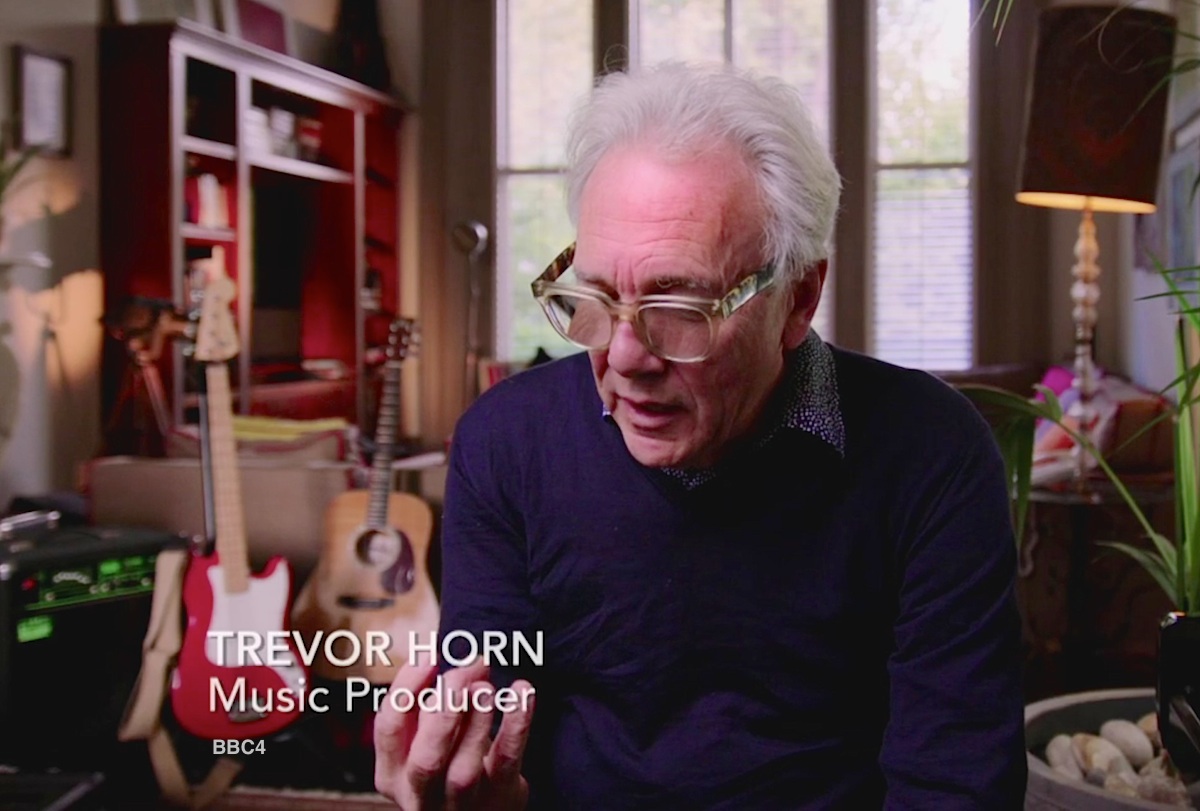
◼ RECORD PRODUCER TREVOR HORN – who helped shape the sounds of such 80s acts as ABC, Grace Jones, Pet Shop Boys and Frankie – last night shared five keys to being a successful pop artist. During the repeat of The Secret Science of Pop on BBC4 he said:
1 – Be able to write or have access to the best material.
2 – Have a really great voice, across two octaves.
3 – Have personal charm and charisma.
4 – Be physically and mentally strong.
5 – And, you’ve got to want it.
All of which made a deal more sense than the deluded “scientist” – a professor at London’s Imperial College who doesn’t deserve to be named! – who attempted to analyse success in the pop charts of the past 50 years by deconstructing thousands of hit tunes note by note. Nothing he proposed made any sense at all and after wasting 60 minutes of our time he shamelessly admitted he had “singularly failed” to out-flank Horn.
As compensation, Horn’s production team shared quite a lot of their intuitive magic in perhaps 15 of those minutes. Shame the whole documentary wasn’t about them instead.
◼ HERE’S ONE OF THE MOST exhilarating interviews you’re ever likely to read with a godlike genius of the American music industry who has won 28 Grammy awards and co-produced Michael Jackson’s biggest-selling albums. The Beatles aren’t the only stars to receive blunt verdicts today from Quincy Jones. But then he did train under the celebrated Nadia Boulanger who during seven decades taught hundreds of leading composers and musicians of the 20th century at the elite Paris Conservatoire, so he does know his stuff. Jones also reckons Jacko “stole lots of songs” and claims to know who shot JFK in 1963. Jones is about to turn 85, so what does he have to lose? Read his eye-poppingly frank revelations in a Q&A interview with Vulture, the culture and entertainment site from New York magazine. He does also pay respec’ to six young stars “doing good work”.
❏ Zayn Malik tells Elle India that he has recorded a tune in Hindi for a forthcoming Bollywood movie. Bradford-born Zayn is the son of a British Pakistani father and English mother who converted to Islam when they married.
❏ The Libertines to headline Kendal Calling, 26-29 July.
❏ Kylie to play two intimate shows in March in London and Manchester.
❏ Spice Girls ‘to kick off world tour in UK this summer’.
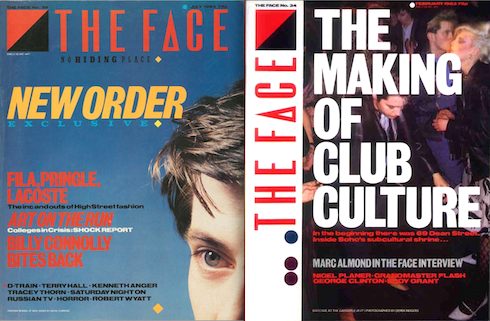
◼ 1983 PROVED TUMULTUOUS for British youth culture. By December, London’s leading club deejay Jay Strongman declared “This was the year of Go For It”, after 17 new British pop groups lorded it in the US top 40 chart that autumn, while our spirited fashionistas were making waves around the world, with Princess Diana playing ambassador for the classic designers, and Boy George pushing the wilder extremes of street style. Among major features I wrote for The Face was February’s cover story The Making of Club Culture, and in the Evening Standard Posing with a purpose at the Camden Palace, a centre spread on the runaway megaclub hosted by Strange and Egan.
Nightlife was a burgeoning story as black beats took over dancefloors everywhere and Manchester’s tearaway megaclub was the Hacienda, despite the oppressive clean-up being imposed by the city’s infamous Chief Constable. Clubbers from across the nation swarmed in to create a grand coalition of all the cults – “your complete i-D line-up, minus the Worlds End spendthrifts”. In my January report for The Face one inmate bemoaned Hacienda music as “too funk-based” though another, a flat-top lad called Johnny Maher, revealed his secret, despite having launched some new indie rock band minutes earlier. “I schtupp to funk,” he said.
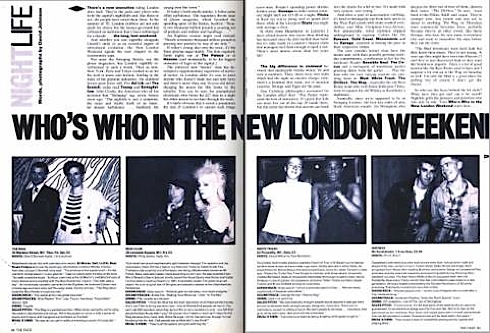
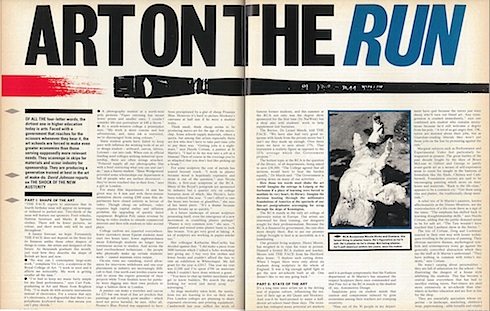
In July The Face published a major piece of reportage, Art on the Run, prompted by numerous friends in fine-art education, and billed it as a “shock report” on the Conservative government’s debilitating squeeze on the art schools. Ironically in the same issue my regular Nightlife column identified the four hottest clubland teams as a Who’s Who in the New London Weekend: “Not since the Swinging Sixties had London nightlife reverberated to such a boom.” These clubs were the unofficial job centres that kept a generation in freelance employment and introduced the verb to vop into the language (derivation: “What are you up to these days?” – “Oh, a Variety Of Projects”). Some of that effort was fuelling the rise of computer games which in the June issue Virgin assured me was “the new pop industry”!
Brighton hotspot 1983: Ian, Oliver Peyton and Kate hosting The Can (Photo Shapersofthe80s)
My Nightlife column in The Face’s October issue featured Brighton’s trendiest hotspot (seconds before the very word trendy passed its sell-by outside the Greater London stockade). The Can was presided over by a young Oliver Peyton with Andy Hale as the deejay breaking funk there. Years later Oliver thanked me for this exposure and said he would never have come up to London and started opening restaurants without The Face’s prompt! (One of the few people who have ever thanked me for writing about them! Cheers, Oliver.)
Jay Strongman in 1983: ruling London’s three hottest turntables
By this fertile year’s end I had FIVE indicative pieces of reportage published in the December issue of The Face including a detailed rundown on the new dance music by club deejay Jay Strongman, plus news of the imminent Westwood/ McLaren break-up which I’d scented from body language backstage at their Paris runway show.
The launch of the first London Fashion Week that same October confirmed that British street style was being feted in the international spotlight, yet it begged the question how on earth had this suddenly come about? Click through to our inside page to read the feature investigation that set out to answer such questions, by asking decision-makers in the industry to identify the best of Britain’s young designer talent under the headline Eight for ’84. . .
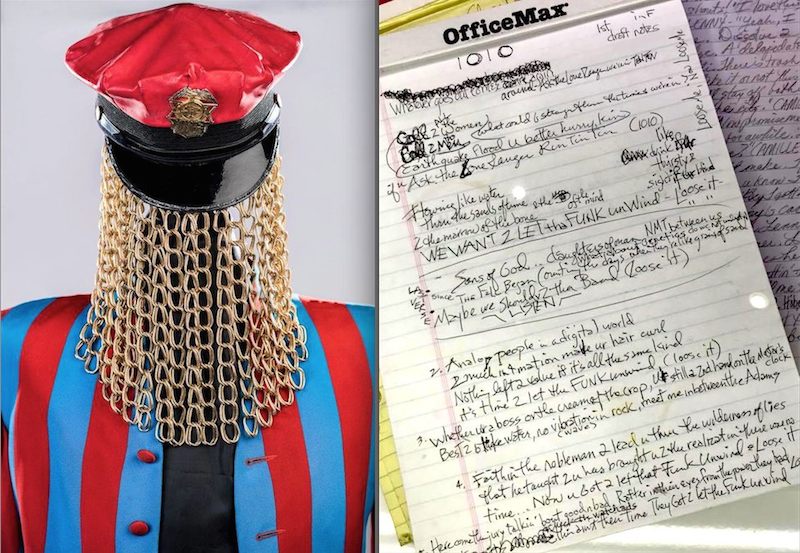
Prince exhibition: chain-hat to conceal his identity in The New Power Generation and lyrics for We Want 2 Let the Funk Unwind (Getty)
◼ Hold your breath! An exhibition that could so easily have been a lightweight commercial ripoff about the myth of Prince Rogers Nelson proves to be a surprisingly affecting tribute. Scores of artefacts have been loaned out for the first time direct from Paisley Park, Prince’s lush Minnesota estate, in a dazzling rush of bling and sentiment for My Name is Prince, his official exhibition which runs in London for the next ten weeks.
It seems a strange idea to visit seven galleries packed with video screens and to stand clad in earphones watching them play out the most vibrant highlights from the American pop icon’s uniquely anarchic imagination. Yet the very impact of so many screens disseminating so much talent only magnifies the intensity of the moment.
This one-man band’s genius is all too evident in every direction you look. In turns, you’re gasping at the audacity of Dirty Mind, smiling at the ingenuity of Sign ‘o’ the Times and shedding tears of envy for his sheer virtuosity in While My Guitar Gently Weeps.
Above all, the entire immersive experience is very, very lovesexy. The attention Prince lavished on his many lubricious costumes is revealing: so many apparently plush brocade garments are woven on light see-through black mesh that reveal the sinewy muscles of his tiny but taut 5ft frame within.
Prince the dandy also took any opportunity to shed his garments and flash his intimate zones, including his bare buttocks in orgiastic videos such as Gett Off, shot amid scantily clad girls and boys (“23 positions in a one-night stand”) at the 1991 MTV awards. Indeed one of the exhibition’s biggest draws is the video for Thieves in the Temple, from the 1990 Graffiti Bridge album, in which cutaway jeans reveal his bum and thighs and bouncing crotch capped with a glittering gold lamé jockstrap, in some of the most frenetic team dancing ever in high heels. The choreography is shamelessly horny.
The sheer range of Prince’s musical gifts during a 40-year career is well recognised – 70 albums, 2,000? songs, an Oscar, a Golden Globe, eight Grammies, 100 million records sold, and a ranking at No 28 among Rolling Stone’s 100 Greatest Artists of All Time. But to assemble in a three-dimensional venue 200 tangible examples of his workaholic creativity as an all-round showman results in an affectionate multi-media tribute. For us to devour the close-up detail in his guitars, his hand-written notes and drawings, and his jewelled accessories becomes a truly moving privilege. And for a fan, the power of his achievements is reaffirmed as you bask in his subversive glow.
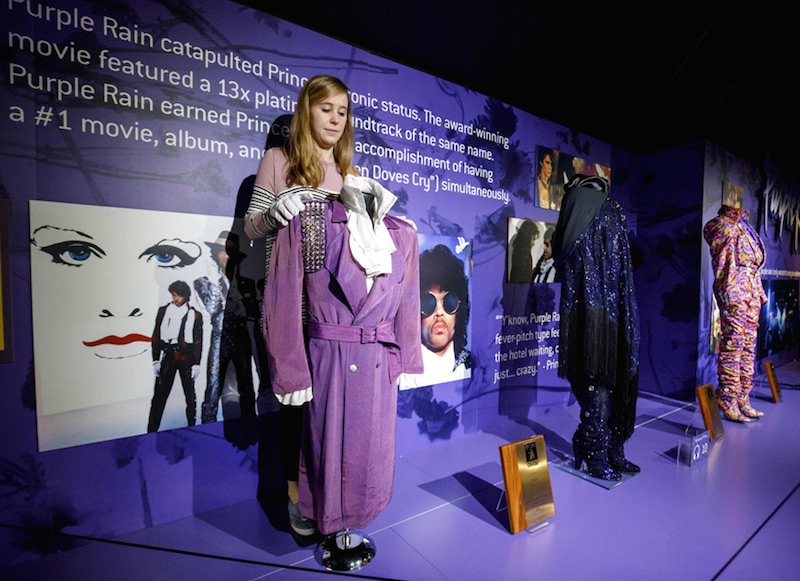
Prince exhibition: stage costumes from his Purple Rain tour (Getty)
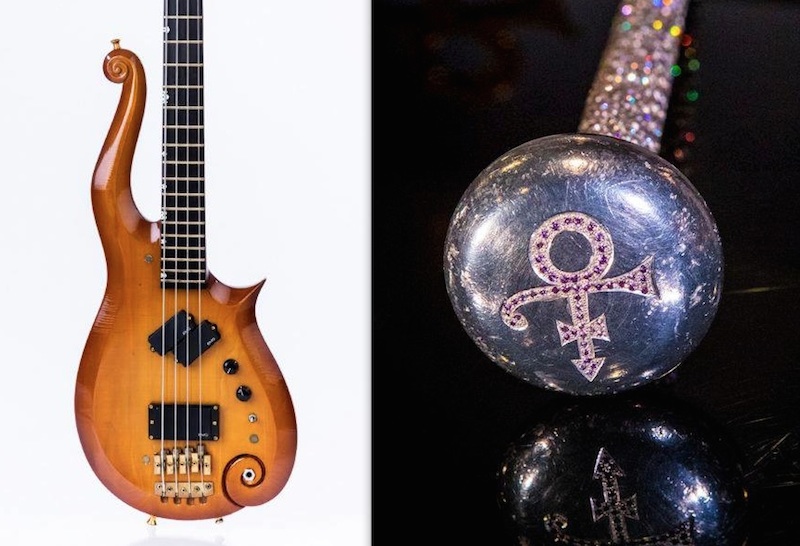
Prince exhibition: bass guitar that inspired his trademark Cloud and diamond-studded cane from 2015
PRINCE’S PURPLE REIGN STILL EXERTS ITS PULLING POWER
London’s Eighties pop star Andy Polaris visits the Prince exhibition to assess the enduring impact of the black performer who in his day challenged the norms of sexuality and race. . .
“ The first time Prince triggered my radar was a review in the music press of his concert at the Lyceum in London 1981, part of his Dirty Mind tour. He was featured in the accompanying review wearing a trench coat covering a lithe brown body and wearing black briefs and leggings, topped by his mop of black hair and pretty face. I was miffed to have missed his only show but before the internet niche events could slip by easily without social media to flag them up.
It was obvious from the start that this was a black artist who, despite the flamboyance of disco/funk stage-wear and album covers, was taking it a little bit extra with some sexual ambiguity. The lyrics of the funky album track Controversy (a bass-driven early dance-floor favourite) set the tone:
I just can’t believe all the things people say
Controversy
Am I black or white? Am I straight or gay?
Controversy
I was fascinated to see the parade of Prince’s petite outfits complete with matching coloured heeled boots that covered Purple Rain, his purple metallic frock coat through to a crystal-encrusted cane and Balmain waistcoat he wore for W magazine. The materials are colourful, sheer and shimmering and in some cases boldly designed. He wasn’t interested in the toxic masculinity that permeates so many black artistes, one of the reasons he flew the freak flag for those who were not interested in paying £50 to see artists dressed in denim and T-shirts. . . ” / Continued at Andy’s own website
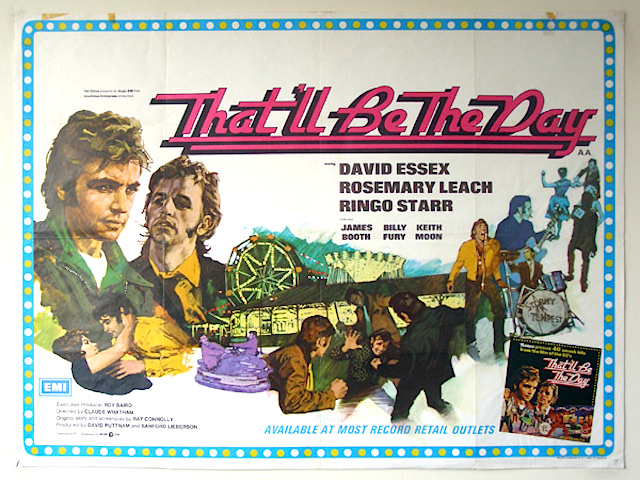
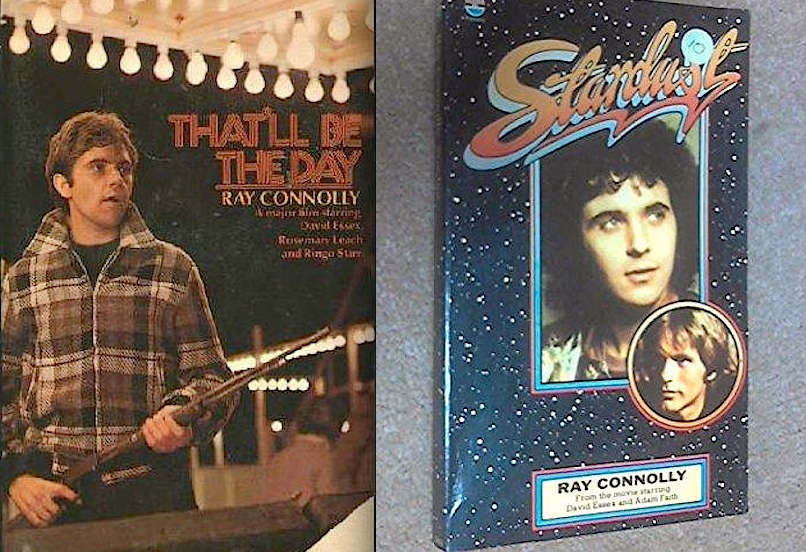
◼ HERE ARE TWO RADIO 4 DRAMA TREATS this Saturday 23 Sept and next at 2.30pm – first an adaptation by former Evening Standard pop columnist Ray Connolly of his 1973 film, That’ll Be the Day (which starred David Essex and Ringo Starr with cameos from Billy Fury and Keith Moon). It’s a very British coming-of-age story that keenly captures the vicissitudes of postwar austerity prevailing in the provinces as the Swinging Sixties dawned.
BBC sell: “It’s 1959 and young Jim Maclaine seems to have it all. He’s good looking and destined to go to a good university. But he’s haunted by the father who abandoned him and his mother when he was small. Is he ready for the normal life mapped out for him? Or is he restless like his old man?”
Jim’s story is followed through on Saturday 30th with Stardust. Sell: “Show me a boy who never wanted to be a rock star and I’ll show you a liar. In this sequel to That’ll Be the Day, it’s the early 1960s and Jim Maclaine is now an aspiring pop musician. He seeks out his old mate Mike, because every pop star needs a road manager. Performing to bored audiences in seedy clubs, the Stray Cats live on dreams of becoming as famous as the Beatles…” Based on the film of the same name which featured David Essex, Adam Faith, Larry Hagman and Keith Moon.
➢ Choose “View full site” – then in the blue bar atop your mobile page, click the three horizontal lines linking to many blue themed pages with background article
MORE INTERESTING THAN MOST PEOPLE’S FANTASIES — THE SWINGING EIGHTIES 1978-1984
They didn’t call themselves New Romantics, or the Blitz Kids – but other people did.
“I’d find people at the Blitz who were possible only in my imagination. But they were real” — Stephen Jones, hatmaker, 1983. (Illustration courtesy Iain R Webb, 1983)
“The truth about those Blitz club people was more interesting than most people’s fantasies” — Steve Dagger, pop group manager, 1983
PRAISE INDEED!
“See David Johnson’s fabulously detailed website Shapers of the 80s to which I am hugely indebted” – Political historian Dominic Sandbrook, in his book Who Dares Wins, 2019
“The (velvet) goldmine that is Shapers of the 80s” – Verdict of Chris O’Leary, respected author and blogger who analyses Bowie song by song at Pushing Ahead of the Dame
“The rather brilliant Shapers of the 80s website” – Dylan Jones in his Sweet Dreams paperback, 2021
A UNIQUE HISTORY
➢ WELCOME to the Swinging 80s ➢ THE BLOG POSTS on this front page report topical updates ➢ ROLL OVER THE MENU at page top to go deeper into the past ➢ FOR NEWS & MONTH BY MONTH SEARCH scroll down this sidebar
❏ Header artwork by Kat Starchild shows Blitz Kids Darla Jane Gilroy, Elise Brazier, Judi Frankland and Steve Strange, with David Bowie at centre in his 1980 video for Ashes to Ashes
VINCENT ON AIR 2026
✱ Deejay legend Robbie Vincent has returned to JazzFM on Sundays 1-3pm… Catch up on Robbie’s JazzFM August Bank Holiday 2020 session thanks to AhhhhhSoul with four hours of “nothing but essential rhythms of soul, jazz and funk”.
TOLD FOR THE FIRST TIME
◆ Who was who in Spandau’s break-out year of 1980? The Invisible Hand of Shapersofthe80s draws a selective timeline for The unprecedented rise and rise of Spandau Ballet –– Turn to our inside page
SEARCH our 925 posts or ZOOM DOWN TO THE ARCHIVE INDEX
UNTOLD BLITZ STORIES
✱ If you thought there was no more to know about the birth of Blitz culture in 1980 then get your hands on a sensational book by an obsessive music fan called David Barrat. It is gripping, original and epic – a spooky tale of coincidence and parallel lives as mind-tingling as a Sherlock Holmes yarn. Titled both New Romantics Who Never Were and The Untold Story of Spandau Ballet! Sample this initial taster here at Shapers of the 80s
CHEWING THE FAT
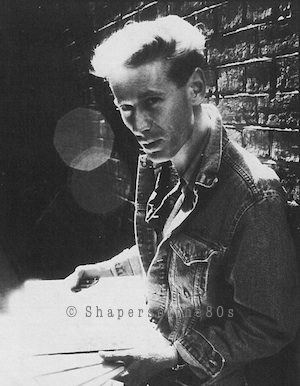
✱ Jawing at Soho Radio on the 80s clubland revolution (from 32 mins) and on art (@55 mins) is probably the most influential shaper of the 80s, former Wag-club director Chris Sullivan (pictured) with editor of this website David Johnson
LANDMARK FAREWELLS. . . HIT THE INDEX TAB UP TOP FOR EVERYTHING ELSE










 ➢➢ Shapers of the 80s ➣➣