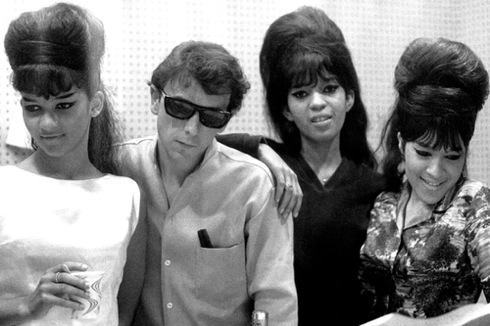
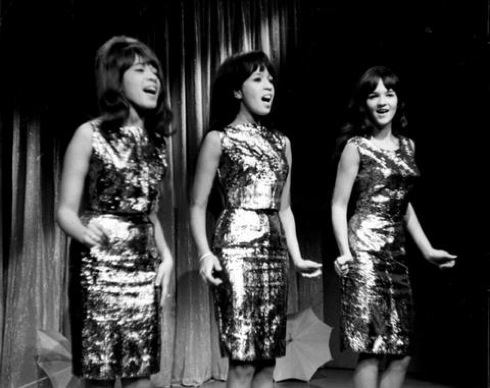
❚ BRIAN WILSON OF THE BEACH BOYS has declared Be My Baby by the Ronettes his own all-time favourite, and the greatest pop record ever: “The choruses blew me away.” Whoa-oh-oh-oh-ohhh! In August 1963 it changed the game entirely. Be My Baby swept into the charts with a lush new approach to orchestration called the “Wall of Sound” that was to bring down a cleaver between rock and pop. Both however were infected by the sheer musicality introduced by its creator, the record producer Phil Spector. He layered pianos, guitars, reeds, brass and most daringly strings, adding studio overdubs and echo, plus any number of people on percussion — famously, castanets. His own description was “little symphonies for the kids”.
Be My Baby took 42 takes to complete, and its spine-tingling intro is unbeatable. The Ronettes’ original has been immortalised in the Grammy Hall of Fame and the Library of Congress for being the quintessence of the dense Spector sound that influenced all who followed, including The Beatles on Let It Be, and the output of Trevor Horn in the 1980s.
The song was co-written by one of the many writing partnerships based in New York’s Brill Building — Ellie Greenwich and Jeff Barry — with a few finishing flourishes added by Spector. The Ronettes themselves were three hot girls from Spanish Harlem, the sisters Estelle and Ronnie Bennett (who later married Spector), and their cousin, Nedra Talley. Their trademarks were beehive hair-dos, eye makeup in the Cleopatra style and tight skirts. Spector signed the Ronettes to his Philles record label and subsequently managed them. Other smash hits included Baby I Love You, The Best Part of Breaking Up, and Walking In the Rain with Spector’s classic storm effects (covered memorably by the Walker Brothers in 1967).
♫ ♫ View video of Brian Wilson playing Be My Baby live — In Q Magazine’s 1001 Best Songs Ever Wilson said: “This is a special one for me. What a great sound, the Wall of Sound. Boy! First heard this on the car radio and I had to pull off the road, I couldn’t believe it. The choruses blew me away; the strings are the melody of love. It has the promise to make the world better.”
❚ UNVEILED TODAY: the Nick Egan directed video for All You Need Is Now, the new single by 80s supergroup Duran Duran — which was available worldwide on iTunes from Dec 8. The nine-track digital album of the same name, produced by Mark Ronson is the band’s 13th in a studio. Ronson has called it the “imaginary follow-up to Rio that never was”. An expanded LP with additional original tracks will be released in March 2011 in various formats.
❏ Update AYN debuts at No 6 on Billboard’s Alternative Albums Chart Jan 5. DD will be the featured artist on VH1’s Top 20 Spin on Jan 30.
❏ Here’s the new Duran track Mediterranea at beach-bum tempo, streamed live from East Village Radio on Dec 10:
It’s on the EP From Mediterranea With Love, an iTunes release in Europe, here premiered on the bumbling Mark Ronson’s show at East Village Radio, NYC, when Le Bon and Rhodes had a battle to get a word in edgeways. Whatever his gifts in a recording studio, the music producer is fudge as a broadcaster. Also, it’s not for him to tell us his own production is “amazing”, durr! Ronson, stick to the day job and leave the criticism to the big beasts who can tell a hawk from a handsaw. As it happens, the new tune proves to be classic DD.
❏ Another premiere streamed from East Village Radio — why this new album track is called The Man who Stole a Leopard (feat Kelis) is finally revealed by ITN newscaster Nina Hossein:
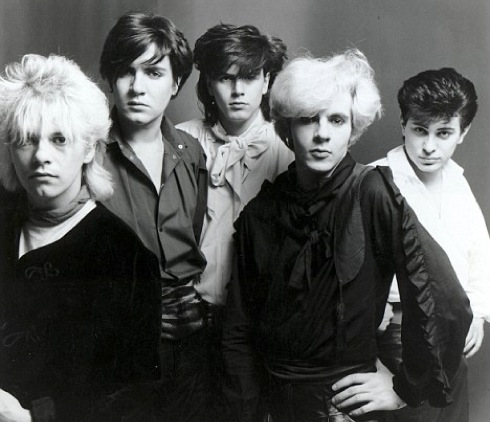
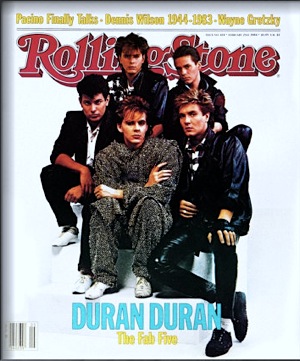
Duran Duran as full-on Romantics: Betty Page thought only co-founder Nick Rhodes (second right) passed the bouffant test convincingly
❚ ON OR ABOUT THIS DAY IN 1980 (MAYBE) some say Duran Duran signed their contract with EMI. The band seem mysteriously unable to remember when, so guesses might run from Dec 9 because Andy Taylor recalls the news of John Lennon’s death ruining his breakfast in London, and possibly Dec 22, date of a celebratory gig at Birmingham’s Cedar Club. However, the first official book, Their Story by Kasper de Graaf, places the signing firmly at 5 January 1981. According to co-manager Paul Berrow, the contract paid out a £28,000 advance (£90,000 in today’s money).
As the house band of the New Romantics in Britain’s second city, Birmingham, they were styled locally by Kahn & Bell, photographed by Paul Edmond, and managed by Paul and Michael Berrow, owners of the glitzy Rum Runner nightclub on Broad Street.
The Berrows had inherited the family business from their influential bookmaker father who had opened the club in the Swinging 60s and the sickly odours of Brut and Estee Lauder still lingered. Inspired directly by a visit to New York’s Studio 54, the brothers refurbished the Rum Runner in 1979 with state-of-the-art mirror-tiled walls and zigzags of neon. They then introduced a playlist heavily flavoured with Moroder-style imports and the American club-funk championed by the Nile Rodgers band Chic, whose string of chart hits was restoring credibility to disco music following the ridicule inflicted by the low-rent movie Saturday Night Fever. But how to become the Studio 54 of the Midlands?
Enter a band called Duran Duran in January 1980, armed with a four-song demo recorded at Bob Lamb’s studio which included Rio as a work in progress. The DD line-up were offered the club as daytime rehearsal space and jobs by night, including deejaying for Nick Rhodes. Roger Taylor recalls that the brothers “were looking for a band that was a cross between Gino Soccio, Genesis and Chic” — all the more curious that they made many attempts to contact Steve New to recruit the Rich Kids guitarist into the band, but they heard nothing from him.
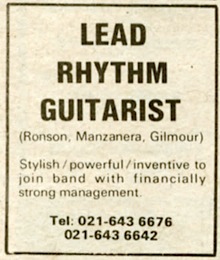
The Melody Maker ad that landed Andy Taylor in April 1980: unearthed by Duran fan Figital
Inevitably the lineup was rationalised and by the summer Andy had been recruited (“They were quite blatant,” Andy told Rolling Stone much later. “They said, ‘We’re posers. We want a good-looking poser band”). Then came Simon Le Bon as singer. According to him: “They had this thing about being between Chic and the Sex Pistols, but I thought they were more like in between Roxy Music and the Sex Pistols.” The band were searching for a musical direction.
Meanwhile as the rival nightclub Barbarella’s fell from favour, the Birmingham poser scene was reinventing itself in local bars around the peacock clothes designers Jane Kahn, Patti Bell and a veteran of Billy’s club in Soho, Martin Degville, who was commuting to London weekly to run a branch of his shop in Kensington Market. That summer the Rum Runner gave over Tuesdays to a Bowie/Roxy night. Sounds familiar? Enter journalist Betty Page and the rest is history.
Within three years Duran Duran’s synth-pop had made The Fab Five one of the handful of British supergroups dominating the global stage. Duran can claim to have led the MTV-driven “Second British Invasion” of the United States from the autumn of 1981 with their raunchy and cinematic videos, and over 30 years enjoyed 21 singles in the Billboard Hot 100 and sales of 100m records.
BETTY PAGE OF SOUNDS RECALLS HOW SHE WAS
INVITED TO “DISCOVER” DURAN DURAN
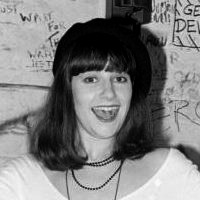
Betty Page in youthful bloom, more recently identified as Beverley Glick
In September 1980 in the pages of the music weekly, Sounds, Betty had slapped the label “New Romantics” on Spandau Ballet, house band of London’s Blitz club and then received a call from the hungry manager of this Brummie band called Duran Duran…
“ Paul Berrow was a smooth operator. ‘Come to the Rum Runner,’ he said of the club he co-owned with his brother Michael. ‘We’ve got a scene going on up here to put the Blitz to shame, and a band to go with it.’ Clever, I thought. He had singled me out to be the first journalist to write about his group. And they actually wanted to be called New Romantics! Nick was the most obviously New Romantic — a bouffant blond David Sylvian lookalike who sported extravagantly frilly shirts and shiny suits — but the style sat rather uncomfortably on the others.
Years after both bands had achieved superstar status, Steve Dagger, the manager of Spandau Ballet, wrote this nugget summarising Duran Duran’s contribution to the 80s music scene. It was published in a partwork published by The Sunday Times in 1997 titled 1000 Makers of Music, which spanned all genres from classical to pop:
“ Duran were among a new group of artists who provided a glittering, sexy contrast to the prevailing dull corporate pop-punk of the 1970s. Taking their influence from the art-school underground of electronics/Ferry/Bowie, they came to prominence as the Birmingham ‘it’ band at the same time Spandau Ballet reigned over a similar scene in London. After an awkward but successful period as the Birmingham ‘answer to’, Duran metamorphosed in 1982 into a sleek, glamorous international entity with the seminal album Rio, having perfected a distinctive Duran sound fusing synths and guitar licks over post-disco rhythm. Inspired songs such as Hungry Like the Wolf were accompanied by cinematic videos, together creating an electric pop culture moment. After being derided for years, Britain had produced a group America could not ignore: Duran surfed in on the newly conceived MTV to conquer the States. They continue to make great British records and should recently have won a Novello for their lament to the 1980s, Ordinary World. [Key work: Is There Something I Should Know? (1983)] ”
❏ View this hilarious early video of white-faced New Romantics doing their wobbly dances to Duran Duran’s first single Planet Earth, performed at the Rum Runner in 1980 (now remastered in high quality). Note the hijacked Warren Street Jive in the official promo video sequences shot much later in a studio . . .
❚ DAVID BOWIE HAS BEEN THE SINGLE MOST INFLUENTIAL FORCE IN POPULAR MUSIC SINCE [Fill in the benchmark of your choice, eg:] Mozart/ Schubert/ Marie Lloyd/ Gershwin/ Little Richard/ Sondheim/ Spinal Tap. In which case, this Christmas there can be no better present for anybody with the slightest interest in the godlike creator of Ziggy Stardust than Kevin Cann’s new photobook Any Day Now, The London Years 1947-1974 (Adelita, £25).
It is impossible adequately to acknowledge the trainspotterish, yet deeply rewarding scope of this sheer labour of love that has amassed 850 pictures — friends, lovers, costumes, contracts, doodles, laundry bills, performances, candid snaps — on 336 pages. Why, it even has a backstage photo I’ve never seen of the day I met Bowie at the London Palladium when he sang Space Oddity for charity (and met the cult ukulele player Tiny Tim, going on to record one of his B-sides, Fill Your Heart, on Hunky Dory).
This book is a feast of Bowie-ana served up like La Grande Bouffe, in ever more tempting waffeur-thin slices. Cann is a veteran chronicler of the pop star’s work and here neither attempts a long-form biography, nor detracts from Nicholas Pegg’s much more musically appreciative survey, The Complete David Bowie, last updated in 2006. Any Day Now is more a chronology that feels as if it has an entry for every day in the star’s first three decades, running to 140,000 words (original interviews, press reports, eye-witness accounts), all diced and dispersed through the calendar. Contributions include a foreword by Kenneth Pitt, Bowie’s gifted manager 1967-1970.
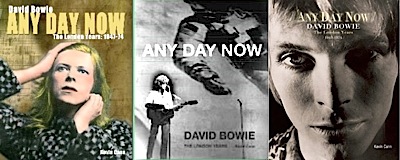
Early cover designs for Any Day Now, publicised during the past year. At centre, the Palladium performance of Space Oddity
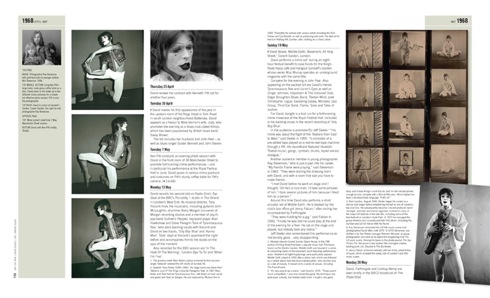
A typical spread [see below] might contain six images and as many short items, some of which are set in a font so small as to demand a magnifying glass for reading. An efficient index helps you to pick your topic and start panning for gold.
So for example, the “seminal” filmed version of Space Oddity, Bowie’s biggest hit, that has been exhumed then forgotten four times in the past 40 years, is finally accounted for in all its charmingly improvised glory. Since 2005, we have been able nonchalantly to click on YouTube to view this paradigm of all pop videos dating from before the word was invented. Yet originally it was a mere segment in a half-hour TV film about Bowie titled Love You Till Tuesday (LYTT) and directed by Malcolm Thomson.
While America was testing its first unmanned Apollo Lunar Module in 1968, the Space Oddity segment was of course inspired by that year’s visionary 70mm movie release, Stanley Kubrick’s 2001 A Space Odyssey. Cann’s chronology documents Thomson filming what Bowie evidently intended as a tongue-in-cheek spoof from its conception in Oct ’68 to wrap in Feb ’69. Bowie wrote the song itself, a forelorn meditation on love and fame, as his own love-life was falling apart and after viewing the Kubrick film “while stoned” (allegedly) that January, six months before the first Moon landing.
Ultimately in a studio in Greenwich, Bowie dons a barely-plausible zip-up silver space suit, blue visored helmet and Major Tom breast-plate while Samantha Bond and Suzanne Mercer as Barbarella-esque astro angels (more ’68 iconography), flaunting ludicrous blonde wigs and diaphanous gowns, simulate weightlessness among inflatable plastic furniture. It’s a modest little dig at Swinging 60s ephemera to set beside Barbarella, Blow-up and the incomparable Modesty Blaise.
Despite the single spending 14 weeks in the charts in 1969 and reaching No 5, Cann reports, TV networks showed “no interest” in the film, LYTT, containing this musical jewel, so it did not have its first public airing until 1972, on the BBC’s Old Grey Whistle Test. It then vanished until 1975 and the re-issue of Space Oddity when the clip was supplied as a promo to broadcasters, which doubtless helped the song’s progress to No 1 in the charts. Even then, the film clip did not receive a release until an album of same name, LYTT, came along in 1984. We then had an even longer wait until a DVD release in 2005 delivered the remastered version we enjoy today.
❏ Not many people know this, 1 – In the same month, Feb 1969, Bowie auditioned for the hippy stage musical Hair! Twice! [Any Day Now, page 146]
❏ Not many people know this, 2 – The book’s timeline ends in 1974 because Bowie left the UK on March 29 that year, aged 27, and has never resumed residency here since. Sob! Onboard the SS France bound for New York, the harmonica legend and Gershwin protege Larry Adler gives a recital. When the crew hear that Bowie is not going to do likewise while aboard and express their disappointment, Bowie gives them an impromptu performance in the canteen: 10 songs including Space Oddity. A few crew members took instruments and they played with him. What a jam session that must have been!
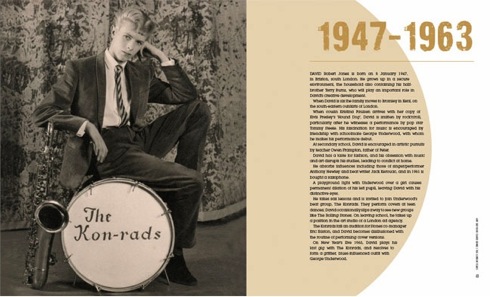
Spread from Any Day Now, the new book about Bowie’s formative years: here seen in his David Jones era when he formed his first band the Kon-rads at the age of 15
Another spread from Any Day Now, designed by Melissa Alaverdy: Bowie learning white-faced mime under Lindsay Kemp
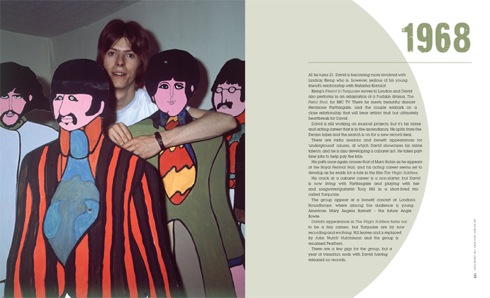
Another spread from Any Day Now, designed by Melissa Alaverdy: Bowie is seen here with Yellow Submarine-era Beatles
➢ Why there will never be another David Bowie— Caspar Llewellyn-Smith says Lady Gaga has got it wrong if she thinks the Thin White Duke’s brilliance comes down merely to striking a decent pose (from The Observer, Oct 10, 2010)
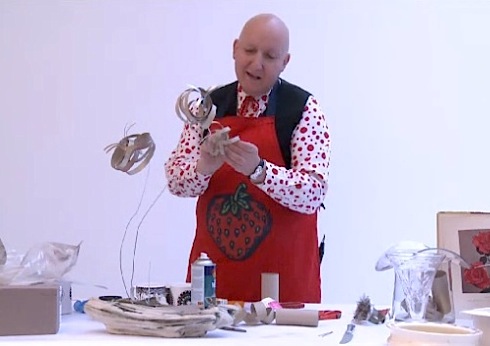
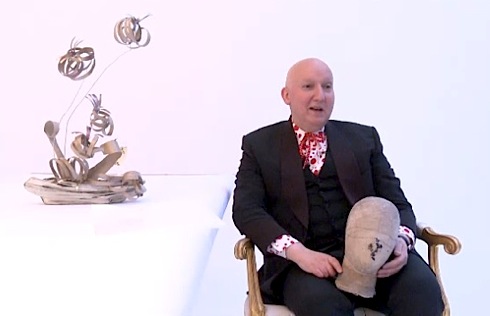
The hatmaker’s Blue Peter moment: Stephen Jones conducts a masterclass online today at ShowStudio.com
❚ HERE IS BRITAIN’S LEADING MILLINER, captured within his first hour online creating a unique piece for the ShowStudio shop’s latest exhibition, Florist. The live stream for two hours today amounted to a millinery masterclass by following Stephen Jones’s creative process through to conclusion. The finished hat will be exhibited and available for sale.
Wielding a wooden poupée head, he reveals: “The main thing about millinery is that you’re trying to make a 2D fabric 3D. So you’re moulding it over a form like a wooden block… and stretching it and it’s staying in that shape. Hat blocks are the same thing as shoe lasts and you can get them from lots of different places.”
On his theme of Glamour on a Budget, Jones has been offering handy hints and taking questions through the Livestudio web page where he informed us that the patron saint of millinery is St Catherine (martyred c AD305 on the notorious breaking wheel, known since as the Catherine wheel, from which of course we derive the firework of that name). Next stop: Blue Peter?
Princess Julia was in the studio and playing: ♫ Doing the Lambeth Walk, oi! ♫
The result: Jones with the first of today’s hats on his theme of Glamour on a Budget at ShowStudio.com
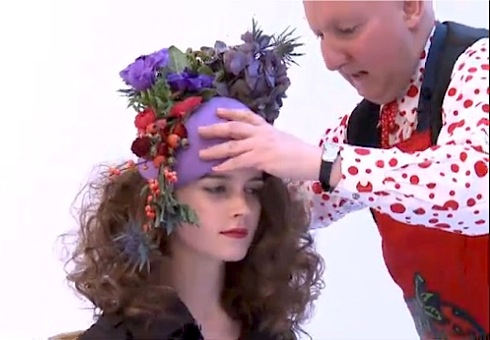
Second Jones creation today: a beret festooned with fresh flowers, thistles and seasonal fruit. Video captured from ShowStudio.com
➢ Choose “View full site” – then in the blue bar atop your mobile page, click the three horizontal lines linking to many blue themed pages with background article
MORE INTERESTING THAN MOST PEOPLE’S FANTASIES — THE SWINGING EIGHTIES 1978-1984
They didn’t call themselves New Romantics, or the Blitz Kids – but other people did.
“I’d find people at the Blitz who were possible only in my imagination. But they were real” — Stephen Jones, hatmaker, 1983. (Illustration courtesy Iain R Webb, 1983)
“The truth about those Blitz club people was more interesting than most people’s fantasies” — Steve Dagger, pop group manager, 1983
PRAISE INDEED!
“See David Johnson’s fabulously detailed website Shapers of the 80s to which I am hugely indebted” – Political historian Dominic Sandbrook, in his book Who Dares Wins, 2019
“The (velvet) goldmine that is Shapers of the 80s” – Verdict of Chris O’Leary, respected author and blogger who analyses Bowie song by song at Pushing Ahead of the Dame
“The rather brilliant Shapers of the 80s website” – Dylan Jones in his Sweet Dreams paperback, 2021
A UNIQUE HISTORY
➢ WELCOME to the Swinging 80s ➢ THE BLOG POSTS on this front page report topical updates ➢ ROLL OVER THE MENU at page top to go deeper into the past ➢ FOR NEWS & MONTH BY MONTH SEARCH scroll down this sidebar
❏ Header artwork by Kat Starchild shows Blitz Kids Darla Jane Gilroy, Elise Brazier, Judi Frankland and Steve Strange, with David Bowie at centre in his 1980 video for Ashes to Ashes
VINCENT ON AIR 2026
✱ Deejay legend Robbie Vincent has returned to JazzFM on Sundays 1-3pm… Catch up on Robbie’s JazzFM August Bank Holiday 2020 session thanks to AhhhhhSoul with four hours of “nothing but essential rhythms of soul, jazz and funk”.
TOLD FOR THE FIRST TIME
◆ Who was who in Spandau’s break-out year of 1980? The Invisible Hand of Shapersofthe80s draws a selective timeline for The unprecedented rise and rise of Spandau Ballet –– Turn to our inside page
SEARCH our 925 posts or ZOOM DOWN TO THE ARCHIVE INDEX
UNTOLD BLITZ STORIES
✱ If you thought there was no more to know about the birth of Blitz culture in 1980 then get your hands on a sensational book by an obsessive music fan called David Barrat. It is gripping, original and epic – a spooky tale of coincidence and parallel lives as mind-tingling as a Sherlock Holmes yarn. Titled both New Romantics Who Never Were and The Untold Story of Spandau Ballet! Sample this initial taster here at Shapers of the 80s
CHEWING THE FAT
✱ Jawing at Soho Radio on the 80s clubland revolution (from 32 mins) and on art (@55 mins) is probably the most influential shaper of the 80s, former Wag-club director Chris Sullivan (pictured) with editor of this website David Johnson
LANDMARK FAREWELLS. . . HIT THE INDEX TAB UP TOP FOR EVERYTHING ELSE

 Be My Baby took 42 takes to complete, and its spine-tingling intro is unbeatable. The Ronettes’ original has been immortalised in the Grammy Hall of Fame and the Library of Congress for being the quintessence of the dense Spector sound that influenced all who followed, including The Beatles on Let It Be, and the output of Trevor Horn in the 1980s.






 ➢➢ Shapers of the 80s ➣➣