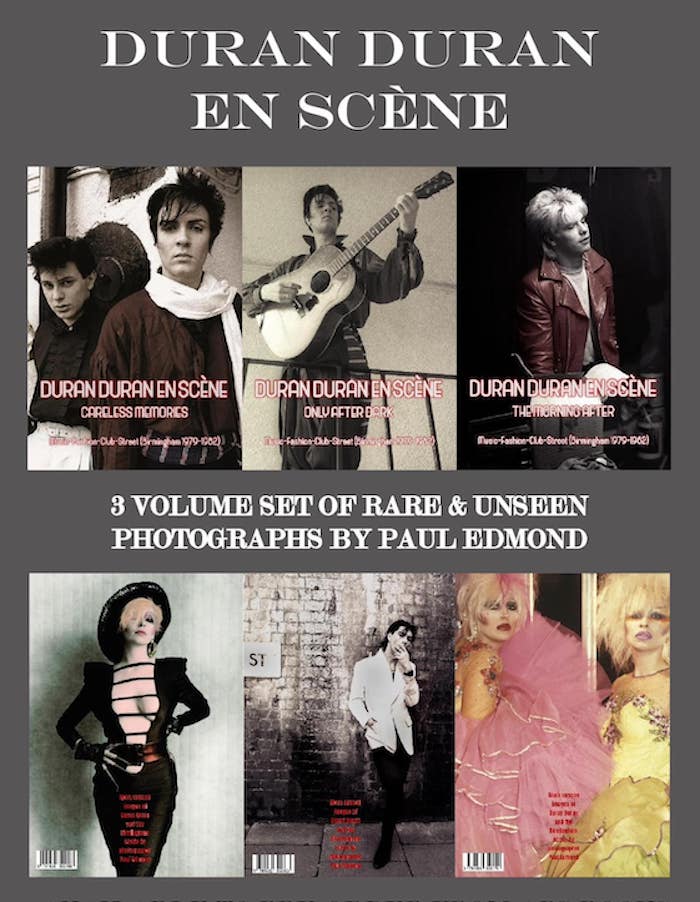
❚ ANY FAN OF DURAN DURAN remembers the very first photographs of the band in 1980 as they finalised their line-up which was to win a recording contract by year’s end and secure their first chart hit with Planet Earth. The five musicians were young and handsome and while they emerged as lucky leaders of the New Romantic music and fashion movement based on Birmingham’s Rum Runner nightclub, so local teenager Paul Edmond learned the skills of photography by capturing their frilly shirts. These Pose Age outfits took inspiration from Jane Kahn and Patti Bell’s futurist boutique, but in those DIY days before stylists had been invented, it fell to Paul to inject a sense of cool nonchalance into his images of the budding pop stars as they too practised how best to look a camera in the eye.
Four decades later, after selling 100 million records, winning umpteen music awards, and being welcomed into the Rock & Roll Hall of Fame, Duran themselves revel in releasing new material and reworking the old, their latest album being Danse Macabre. How appropriate then that the photographic archive of Paul Edmond – which embraces a wider world of youth culture than only that of Duran – is being published this spring. A trio of books filling 200 A4 pages has been initiated by his sister Maggie K de Monde, herself an all-round song-writer and performer. Nick Rhodes makes a contribution. Advance orders for the £90 package are being invited by APS Books of Yorkshire, with delivery expected in June.
Tragically, Paul himself cannot share this poignant moment because he was killed in a road accident in 2015. He and I became great friends working on the monthly magazine New Sounds New Styles in 1981, for which he took an arresting cover picture of Jane Farrimond and the flamboyant Martin Degville, a pair of Brummie style leaders who both ended up in the band Sigue Sigue Sputnik.
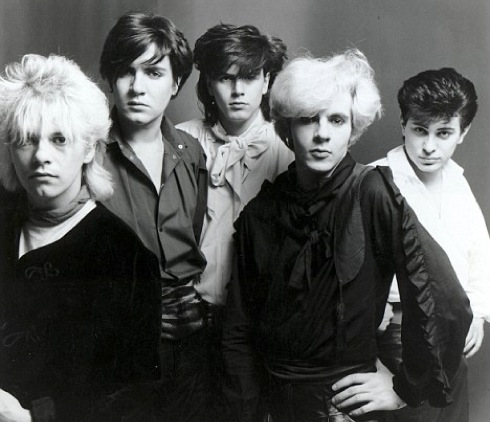
Duran Duran as full-on Romantics: Betty Page thought only co-founder Nick Rhodes (second right) passed the bouffant test convincingly
❚ ON OR ABOUT THIS DAY IN 1980 (MAYBE) some say Duran Duran signed their contract with EMI. The band seem mysteriously unable to remember when, so guesses might run from Dec 9 because Andy Taylor recalls the news of John Lennon’s death ruining his breakfast in London, and possibly Dec 22, date of a celebratory gig at Birmingham’s Cedar Club. However, the first official book, Their Story by Kasper de Graaf, places the signing firmly at 5 January 1981. According to co-manager Paul Berrow, the contract paid out a £28,000 advance (£90,000 in today’s money).
As the house band of the New Romantics in Britain’s second city, Birmingham, they were styled locally by Kahn & Bell, photographed by Paul Edmond, and managed by Paul and Michael Berrow, owners of the glitzy Rum Runner nightclub on Broad Street.
The Berrows had inherited the family business from their influential bookmaker father who had opened the club in the Swinging 60s and the sickly odours of Brut and Estee Lauder still lingered. Inspired directly by a visit to New York’s Studio 54, the brothers refurbished the Rum Runner in 1979 with state-of-the-art mirror-tiled walls and zigzags of neon. They then introduced a playlist heavily flavoured with Moroder-style imports and the American club-funk championed by the Nile Rodgers band Chic, whose string of chart hits was restoring credibility to disco music following the ridicule inflicted by the low-rent movie Saturday Night Fever. But how to become the Studio 54 of the Midlands?
Enter a band called Duran Duran in January 1980, armed with a four-song demo recorded at Bob Lamb’s studio which included Rio as a work in progress. The DD line-up were offered the club as daytime rehearsal space and jobs by night, including deejaying for Nick Rhodes. Roger Taylor recalls that the brothers “were looking for a band that was a cross between Gino Soccio, Genesis and Chic” — all the more curious that they made many attempts to contact Steve New to recruit the Rich Kids guitarist into the band, but they heard nothing from him.
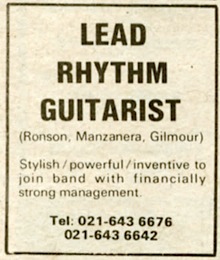
The Melody Maker ad that landed Andy Taylor in April 1980: unearthed by Duran fan Figital
Inevitably the lineup was rationalised and by the summer Andy had been recruited (“They were quite blatant,” Andy told Rolling Stone much later. “They said, ‘We’re posers. We want a good-looking poser band”). Then came Simon Le Bon as singer. According to him: “They had this thing about being between Chic and the Sex Pistols, but I thought they were more like in between Roxy Music and the Sex Pistols.” The band were searching for a musical direction.
Meanwhile as the rival nightclub Barbarella’s fell from favour, the Birmingham poser scene was reinventing itself in local bars around the peacock clothes designers Jane Kahn, Patti Bell and a veteran of Billy’s club in Soho, Martin Degville, who was commuting to London weekly to run a branch of his shop in Kensington Market. That summer the Rum Runner gave over Tuesdays to a Bowie/Roxy night. Sounds familiar? Enter journalist Betty Page and the rest is history.
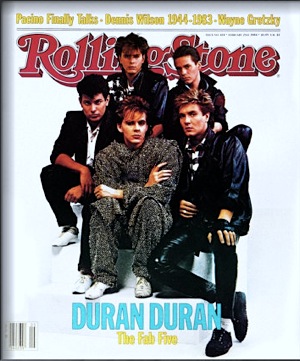
Within three years Duran Duran’s synth-pop had made The Fab Five one of the handful of British supergroups dominating the global stage. Duran can claim to have led the MTV-driven “Second British Invasion” of the United States from the autumn of 1981 with their raunchy and cinematic videos, and over 30 years enjoyed 21 singles in the Billboard Hot 100 and sales of 100m records.
BETTY PAGE OF SOUNDS RECALLS HOW SHE WAS
INVITED TO “DISCOVER” DURAN DURAN
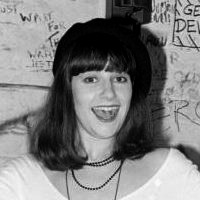
Betty Page in youthful bloom, more recently identified as Beverley Glick
In September 1980 in the pages of the music weekly, Sounds, Betty had slapped the label “New Romantics” on Spandau Ballet, house band of London’s Blitz club and then received a call from the hungry manager of this Brummie band called Duran Duran…
“ Paul Berrow was a smooth operator. ‘Come to the Rum Runner,’ he said of the club he co-owned with his brother Michael. ‘We’ve got a scene going on up here to put the Blitz to shame, and a band to go with it.’ Clever, I thought. He had singled me out to be the first journalist to write about his group. And they actually wanted to be called New Romantics! Nick was the most obviously New Romantic — a bouffant blond David Sylvian lookalike who sported extravagantly frilly shirts and shiny suits — but the style sat rather uncomfortably on the others.
Years after both bands had achieved superstar status, Steve Dagger, the manager of Spandau Ballet, wrote this nugget summarising Duran Duran’s contribution to the 80s music scene. It was published in a partwork published by The Sunday Times in 1997 titled 1000 Makers of Music, which spanned all genres from classical to pop:
“ Duran were among a new group of artists who provided a glittering, sexy contrast to the prevailing dull corporate pop-punk of the 1970s. Taking their influence from the art-school underground of electronics/Ferry/Bowie, they came to prominence as the Birmingham ‘it’ band at the same time Spandau Ballet reigned over a similar scene in London. After an awkward but successful period as the Birmingham ‘answer to’, Duran metamorphosed in 1982 into a sleek, glamorous international entity with the seminal album Rio, having perfected a distinctive Duran sound fusing synths and guitar licks over post-disco rhythm. Inspired songs such as Hungry Like the Wolf were accompanied by cinematic videos, together creating an electric pop culture moment. After being derided for years, Britain had produced a group America could not ignore: Duran surfed in on the newly conceived MTV to conquer the States. They continue to make great British records and should recently have won a Novello for their lament to the 1980s, Ordinary World. [Key work: Is There Something I Should Know? (1983)] ”
❏ View this hilarious early video of white-faced New Romantics doing their wobbly dances to Duran Duran’s first single Planet Earth, performed at the Rum Runner in 1980 (now remastered in high quality). Note the hijacked Warren Street Jive in the official promo video sequences shot much later in a studio . . .
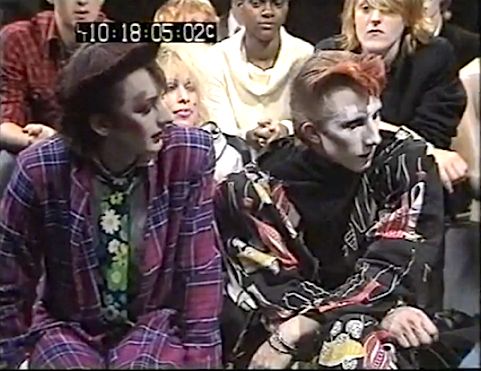
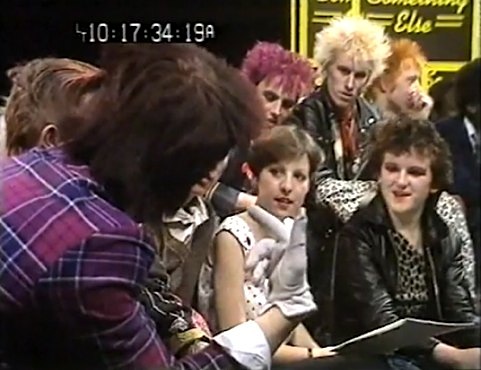
❚ IT WAS ALBERT EINSTEIN WHO SAID: “Common sense is the collection of prejudices acquired by age eighteen.” So listen up, kids, to the words of wisdom being expressed in George O’Dowd’s first known TV appearance at the age of 18 sporting the mauve tartan clownsuit he used to wear to Barbarella’s club in Birmingham. When this show went out nobody knew the faces in the studio crowd and as you can hear, other kids took their clothes just as seriously as George, but listen how his quiet Sarf London tones – not yet modulated into his posher popstar accent – take over the studio discussion in the face of sarcastic punks.
Punkette: “Everybody who looks different gets aggression. You always get picked on.”
George: “You don’t have to get involved in it though. I don’t fight. If you’re really into dressing up … you wouldn’t care what other people thought.”
Lad: “Yeah but say somebody hit ya?”
G: “So what? You don’t have to hit them back.”
Lad: “So are you gonna stand there and take it?”
G: “I do! It’s more cool to walk away from people.”
This newly discovered footage dates from October 1979 and the endearingly innocent freeform discussion magazine called Something Else, presented by a team of teenagers and made by the BBC Community Programmes unit, years before trendy Channel 4 was invented. Broadcast on Saturday evenings on the intellectual’s channel, BBC2, the show ran for six years until October 1982, closing down at the very moment Channel 4 launched. It is the clear inspiration for the torrent of yoof TV the new network spawned.
In this edition from Birmingham, the Coventry band the Specials had just finished playing and George is sitting beside Martin Degville, just in front of Jane Kahn, partner in the seminal outrage shop Kahn & Bell. In the spring of ’79 George was sharing Degville’s flat, an old dental surgery in Goodall Street, overlooking the Walsall market. George was earning £3.50 a day at Degville’s Dispensary, Martin’s clothes stall in the Oasis market at the Bull Ring.
George described Martin as “cool and alien” in those days, and one of his few remarks on the show nonchalantly raises the biggest laugh. A few months later, he opened a London branch of Degville’s Dispensary where he was always charming and polite and surprisingly shy for somebody who dressed to shock – only visually a precursor of the pop monster he became with Sigue Sigue Sputnik in 1986.
First published in the Evening Standard, 16 October 1980
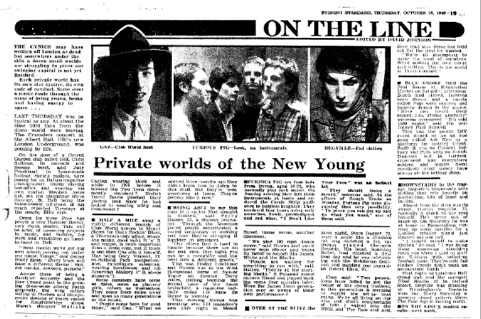
THE CYNICS may have written off London as dead in 1980 but somewhere under the skin a dozen small worlds are struggling to prove our swinging capital is not yet finished. Each private world has its own star system and its own code of conduct. Some steer a scenic route through the maze of being young, broke and having energy to spare
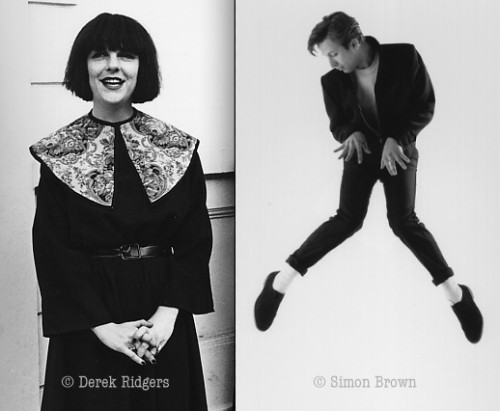
Judi Frankland in one of the clerical cassocks from her degree show summer of 1980, pictured by Derek Ridgers. Style commentator Perry Haines, by Simon Brown
◼ LAST THURSDAY was as typical as any. At about the time 5,000 fans from Disco World were leaving The Crusaders concert at the Royal Albert Hall, 1980’s new London underground was coming to life. On the door of a Covent Garden club called Hell, Chris Sullivan, in monocle and Basque beret, and Judi Frankland, in the home-made clerical cassock that she’d worn in Bowie’s video for his chart topping Ashes to Ashes, were posing for an Italian magazine photographer. Inside, playing box-office and wearing his own modish Stephen Jones hat and all too visible makeup, sat the ubiquitous Steve Strange, 21, Hell being the twice-weekly off-shoot of his much reported Tuesdays at the nearby Blitz club. For him, he said, dressing up is a way of life. “I don’t do it to get attention.” . . . / Continued on our inside page
➢ Choose “View full site” – then in the blue bar atop your mobile page, click the three horizontal lines linking to many blue themed pages with background article
MORE INTERESTING THAN MOST PEOPLE’S FANTASIES — THE SWINGING EIGHTIES 1978-1984
They didn’t call themselves New Romantics, or the Blitz Kids – but other people did.
“I’d find people at the Blitz who were possible only in my imagination. But they were real” — Stephen Jones, hatmaker, 1983. (Illustration courtesy Iain R Webb, 1983)
“The truth about those Blitz club people was more interesting than most people’s fantasies” — Steve Dagger, pop group manager, 1983
PRAISE INDEED!
“See David Johnson’s fabulously detailed website Shapers of the 80s to which I am hugely indebted” – Political historian Dominic Sandbrook, in his book Who Dares Wins, 2019
“The (velvet) goldmine that is Shapers of the 80s” – Verdict of Chris O’Leary, respected author and blogger who analyses Bowie song by song at Pushing Ahead of the Dame
“The rather brilliant Shapers of the 80s website” – Dylan Jones in his Sweet Dreams paperback, 2021
A UNIQUE HISTORY
➢ WELCOME to the Swinging 80s ➢ THE BLOG POSTS on this front page report topical updates ➢ ROLL OVER THE MENU at page top to go deeper into the past ➢ FOR NEWS & MONTH BY MONTH SEARCH scroll down this sidebar
❏ Header artwork by Kat Starchild shows Blitz Kids Darla Jane Gilroy, Elise Brazier, Judi Frankland and Steve Strange, with David Bowie at centre in his 1980 video for Ashes to Ashes
VINCENT ON AIR 2026
✱ Deejay legend Robbie Vincent has returned to JazzFM on Sundays 1-3pm… Catch up on Robbie’s JazzFM August Bank Holiday 2020 session thanks to AhhhhhSoul with four hours of “nothing but essential rhythms of soul, jazz and funk”.
TOLD FOR THE FIRST TIME
◆ Who was who in Spandau’s break-out year of 1980? The Invisible Hand of Shapersofthe80s draws a selective timeline for The unprecedented rise and rise of Spandau Ballet –– Turn to our inside page
SEARCH our 925 posts or ZOOM DOWN TO THE ARCHIVE INDEX
UNTOLD BLITZ STORIES
✱ If you thought there was no more to know about the birth of Blitz culture in 1980 then get your hands on a sensational book by an obsessive music fan called David Barrat. It is gripping, original and epic – a spooky tale of coincidence and parallel lives as mind-tingling as a Sherlock Holmes yarn. Titled both New Romantics Who Never Were and The Untold Story of Spandau Ballet! Sample this initial taster here at Shapers of the 80s
CHEWING THE FAT
✱ Jawing at Soho Radio on the 80s clubland revolution (from 32 mins) and on art (@55 mins) is probably the most influential shaper of the 80s, former Wag-club director Chris Sullivan (pictured) with editor of this website David Johnson
LANDMARK FAREWELLS. . . HIT THE INDEX TAB UP TOP FOR EVERYTHING ELSE





 ➢➢ Shapers of the 80s ➣➣