2012 ➤ Hockney tops bigger paintings than ever with hi-tech moving photo-collages

David Hockney, Bigger Picture, Yorkshire, landscapes,art, Royal Academy, exhibition, Arrival of Spring in Woldgate,reviews

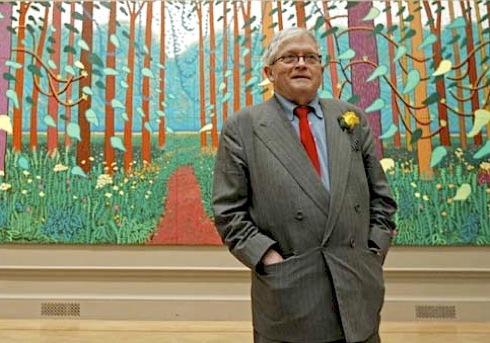
British artist David Hockney posing yesterday at the Royal Academy of Arts in London with his painting The Arrival of Spring in Woldgate, East Yorkshire in 2011. Photograph by Luke MacGregor, Reuters

➢ Hockney’s high-tech pictures open eyes at Royal Academy — by Martin Gayford, chief art critic for Bloomberg News, Jan 16…

The Royal Academy of Arts in London has never been host to an exhibition quite like David Hockney’s A Bigger Picture. The academy has a history dating to 1768. The one-man show, which runs from Jan 21 to April 9, is a tour de force. It consists almost entirely of new work, using both low-tech media such as painting and the latest high-tech tools. Hockney approaches the time-honored subject of nature in a fresh, contemporary way. The result is spectacular.

Hockney has also come up with a more hi-tech kind of picture created by multiple, high-definition cameras set at slightly different angles. The result is a moving photo-collage: a bigger picture because it sees more, from varying points of view. Most of the films on show are landscapes, though the most recent is a dance spectacular, shot on 18 cameras in Hockney’s studio. It gives a wonderful festive finale to the exhibition, in which Hockney paints the stage in sumptuous color, and shoots the action like a combination of Pablo Picasso and Busby Berkeley … / continued online

➢ Blue-sky painting, by Jackie Wullschlager,
in the Financial Times, Jan 13

[Hockney] is commanding new technologies in a countercultural quest to prove that painting, in an age dominated by conceptualism and installation, can be as theatrical and monumental as any 21st-century spectacle.

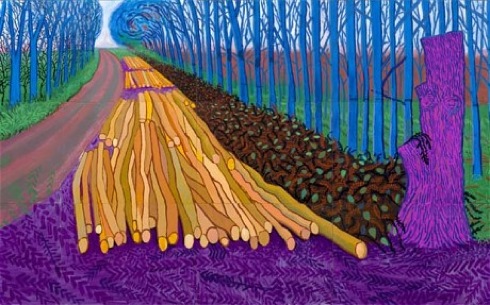
Winter Timber 2009, David Hockney, Royal Academy, Bigger Picture, reviews,art,

“Stump and logs as reminders of mortality ... Hockney has transformed a humdrum wintry scene into a gateway to the afterlife” — David Hockney, detail from Winter Timber, 2009. Oil on 15 canvases. (Private Collection. © David Hockney. Photo credit: Jonathan Wilkinson)

➢ Whatever game David Hockney is playing eludes me,
says Alastair Sooke in The Daily Telegraph

Hockney is best known as the raunchy Californian sensualist who painted sun-kissed boys gliding through the azure swimming pools of Los Angeles in the Sixties. And yet here he presents himself as a modest pastoralist, content to hymn the bounty of nature with quiet exultation – dancing, like Wordsworth, among the daffodils. Once inspired by distant destinations such as Egypt, China and America’s West Coast, he now seems happy pottering about a neglected nook of England. The prodigal son has returned to within 65 miles of Bradford, where he was born in 1937, and settled down. The internationalist has turned parochial. The radical has come over all conservative … Perhaps it’s a generational thing, but I don’t understand paintings like these. Fresh, bright and perfectly delightful, they are much too polite and unthinkingly happy for my taste: if they offer a vision of arcadia, it is a mindless one… / continued online

HOCKNEY REVEALS A ‘new vision of the world’
IN OUR OWN INTERVIEW 30 YEARS AGO

David Hockney, London, 1983, Roger Shattuck,painting, interview, cubism, Proust

Hockney at his London studio, July 3, 1983: after a pause of two years, new canvases indicate the urgency with which he has resumed painting. Photographed © by Shapersofthe80s

❚ WHILE IN LONDON FOR A FORTNIGHT in 1983 David Hockney says that he has resumed painting after a two-year break pursuing photography. The freshly primed canvases in his London studio testify to the urgency with which he wants “to deal with the ideas that are bubbling away”. He lobs in a shocker: “I’ve looked at some cubist paintings for 25 years without understanding them. Suddenly I see cubism differently, more clearly. And my experiments have led me to a couple of theories of my own . . .”

➢ Only at Shapersofthe80s, exclusive photographs and long, fascinating interview from 1983 at the time of his
London show, New Work With A Camera

➤ Spare a thought for the Sad Apostrophe who’s putting on a brave face at Twitter

SadApostrophe, Twitter, Waterstones,Franks,grammar

Waterstones,grammar,apostrophe,logos

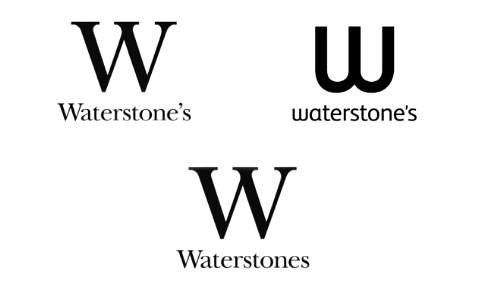
Three logos in as many years: >2010 classic font and grammatically correct, 2010–12 contemporary font and illiterate, 2012< classic font, illiterate but digitally expedient. And this shop sells books.

❏ A press release dated Jan 11 declares: “Waterstones, the UK’s largest high street bookseller, has today revealed a new logo for the company. It reinstates the much-loved Baskerville serif font with a capital W and no longer features an apostrophe. James Daunt, Managing Director of Waterstones said: “Waterstones without an apostrophe is, in a digital world of URLs and email addresses, a more versatile and practical spelling.”

Waterstones, Sainsbury's, McDonald's, logos

Gramatically: one wrong, two right

➢ Waterstones is sparking outrage among some of its customers — Harry Wallop at The Daily Telegraph
John Richards, the chairman of the Apostrophe Protection Society said: “It’s just plain wrong. It’s grammatically incorrect. If Sainsbury’s and McDonald’s can get it right, then why can’t Waterstones? You would really hope that a bookshop is the last place to be so slapdash with English.”

The change is also a slight to the founder Tim Waterstone, who set up the company more than 30 years ago, though long ago stopped having any involvement. Mr Daunt further explained the change in logo: “It also reflects an altogether truer picture of our business today which, while created by one, is now built on the continued contribution of thousands of individual booksellers.” Many on Twitter pointed out that this explanation made no sense, because if the new logo really was meant to reflect the contribution of many, it should include an apostrophe after the S.

SadApostrophe, Twitter, Waterstones,Foyles,grammar
➢ No apostrophe? No catastrophe — David Marsh at The Guardian
As many shopping centres boast a Tesco, a Morrisons, a Sainsbury’s, a Marks & Spencer, a Waterstones and a McDonald’s, it is hardly surprising that many young people, and greengrocers of all ages, find apostrophes so difficult. But however much the Apostrophe Protection Society huffs and puffs about it, these businesses are not going to change their orthography so we might as well get used to it and fight to save apostrophes where they are really needed: to aid communication and avoid ambiguity. The example in the Guardian style guide is:

❏ my sister’s friend’s books (refers to one sister and her friend).
❏ my sister’s friends’ books (one sister with lots of friends).
❏ my sisters’ friend’s books (more than one sister, and their friend).
❏ my sisters’ friends’ books (more than one sister, and their friends).

SadApostrophe, Twitter, Waterstones,grammar So if anyone tells you we don’t need apostrophes, they are wrong. Another tip: always carry a large felt-tip pen and bottle of Tipp-Ex with you to add apostrophes to signs where appropriate and remove them from plurals. It will make you feel much better.

➢ Rules concerning the use of apostrophes in written English “are very simple” — The Apostrophe Protection Society

➢ Express your consolations to SadApostrophe on Twitter

SadApostrophe, Twitter, Waterstones,ToysRUs,grammar
➢ How Oxfam is challenging the bookselling giants and which unwanted authors we are dumping after Christmas — “Out of the 700 Oxfam shops in Britain, 140 of them are bookshops. Oxfam sells 11 million books a year and are its second highest-selling items after clothing. The charity store has become the biggest second-hand bookseller in Europe, and the third largest general book retailer in Britain” … / continued online

FRONT PAGE

➤ DJ Mark Moore’s 40 tracks and 8 albums from the old year

❏ “A bit late but here are my faves of 2011. I actually think 2011 has been a great year for music but, more so now than ever, you just had to get through a hell of a lot of dross to find the good stuff.” Moore places S.C.U.M. at number 4.

+++
➢ Other picky people’s year-ending Best Ofs in music of all styles

PS — 100 MORE FROM DAZED & CONFUSED

❏ Listen online to the mammoth 6½ hour Top 100 Dazed & Approved tracks of 2011 which is pretty wild, they say… starting with Africa HiTech, AlunaGeorge and A$AP Rocky all the way to WU LYF, Zola Jesus and Zomby.

❏ iPAD, TABLET & MOBILE USERS PLEASE NOTE — You may see only a tiny selection of items from this wide-ranging website about the 1980s, not chosen by the author. To access fuller background features and site index either click on “Standard view” or visit Shapersofthe80s.com on a desktop computer. ➢ Click here to visit a different random item every time you click

FRONT PAGE

2012 ➤ If David Jones hadn’t become Bowie what would have become of the rest of us?

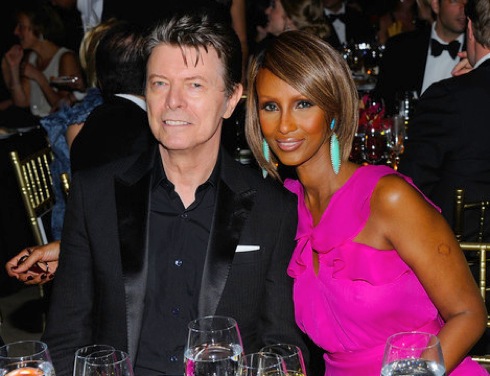
What, me, pensioner? David Bowie and his wife the supermodel Iman attend the DKMS Annual Gala in New York City last April. (Photo by Andrew H. Walker/Getty)

David Bowie, 65th birthday, New Romantics, Ziggy Stardust, glam-rock
❚ HAPPY BIRTHDAY MR BOWIE. And thanks for the boggling, inspirational, poptastic ride so far —140 million albums sold and the rules of rock rewritten. You will be the genie waiting at the end of time. Boy George has this to say in his foreword to Graham Smith’s new book on 80s clubland, named after David Bowie’s song We Can Be Heroes: “Of the New Romantic moment I have always said, It was all Bowie’s fault.” What he refers to is the Bowie bequest to the teen generations he entertains. As a cultural lightning rod he has bequeathed insights into the realm of the imagination. As a performer he has delivered a repertoire of life-skills through a cast of mythical personalities invented for himself as a popstar, from the self-destructive Ziggy Stardust and the amoral Thin White Duke, to his romanticised “Heroes” (his own quote marks added to emphasise self-awareness). Through their formative years, Bowie invited his acolytes:

✰ to explore identity, androgyny, the primacy of the visual.

✰ to adopt stances: individualism, alienation, decadence, transgression.

✰ to follow his principles for living amusing lives: disposable identities, portable events, looks not uniforms, tastelessness “on purpose”.

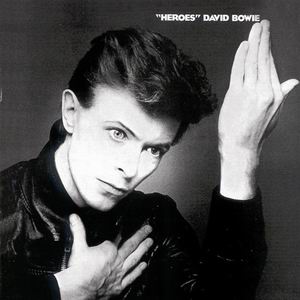
David Bowie, Heroes,His signature tune, “Heroes”, still echoes today as a heart-stirring anthem because he was passionate and optimistic and musically this number is brimming with awe. He sang about intimacy and love triumphing over the horrors of the outside world. Finding joy in simple pleasures could make heroes of us all, “just for one day”. As a creed to live by, it has underpinned his own life. “I’m an instant star,” he said. “Just add water and stir.”

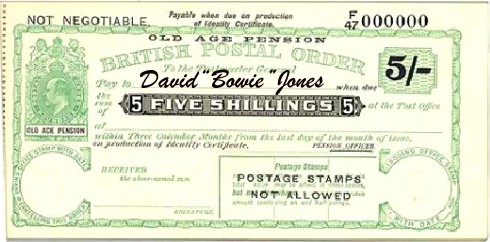
Were he still living in the UK, today’s birthday would designate him, in the idiom, “an old-age pensioner”, and the state would pay him slightly more than the five shillings a week handed over when the scheme began 100 years ago. He can’t be 65, you’re saying as you inspect the picture of him and his wife Iman [above] at a leukemia charity gala in New York last year. He looks too good for 65. “Waddayamean?” he’d be bound to snap, flinging back the old feminist line, “This is how 65 looks in the 21st century.”

True, if you start young, break the rules and push yourself to the max, as all geniuses do. While in short trousers, the little suburban Londoner David Jones was nothing if not prolific. At 11 he was playing a skiffle bass, buying and collecting the NME for future reference, learning the sax at 13 and soon moving up through a succession of bands: Konrads, Hookers, King Bees, Manish Boys, Lower Third, Buzz, and Riot Squad.

At school he fell under the spell of an art teacher, Owen Frampton, whose own son Peter went on to musical fame. Bowie has said: “I went to one of the first art-oriented high schools in England, where one could take an art course from the age of 12. Three-fourths of our class actually did go on to art school.”

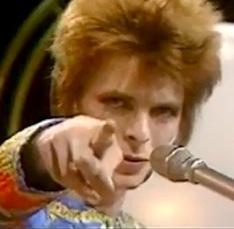
Everybody knows how this liberal education shaped his outsider stance, how he redefined glam-rock, and how his incarnation as Ziggy Stardust made him an international star and one of the most iconoclastic forces in 70s music. How much more fun though to celebrate a grand milestone by looking back to the earliest expressions of that genius and to wonder aloud how else might the talents of the young David Jones have developed? Today, we find whole chapters of his formative experiments on video online, from mime artist and music-hall hoofer, to actor and fin-de-siècle soothsayer. In all the springboard moments pictured in the slideshow above, Bowie is no older than 24. At any moment the fickle finger of fate could as easily have pointed in any number of directions…

➢ VIEW a dozen video turning points
in David Bowie’s early career 1965–1974

INSTEAD, THIS IS WHAT HAPPENED

In 1969 Bowie’s manager Kenneth Pitt proposed to showcase his talents by producing a half-hour film called Love You Till Tuesday. The compilation showcased tracks from his 1967 debut album, plus a spanking new song, Space Oddity, which introduced Major Tom and became his first hit. Cleverly anticipating the first Nasa Moonwalk in 1969, the filming for this number pastiches Stanley Kubrick’s cine-epic premiered the previous year. It effectively proposed what today we call the promo video which, as Kevin Cann reveals in his exhaustive 2010 Bowie biography Any Day Now, remained substantially unseen by the public until its release as a clip in 1984. The whole half-hour showreel went online for the first time only yesterday…

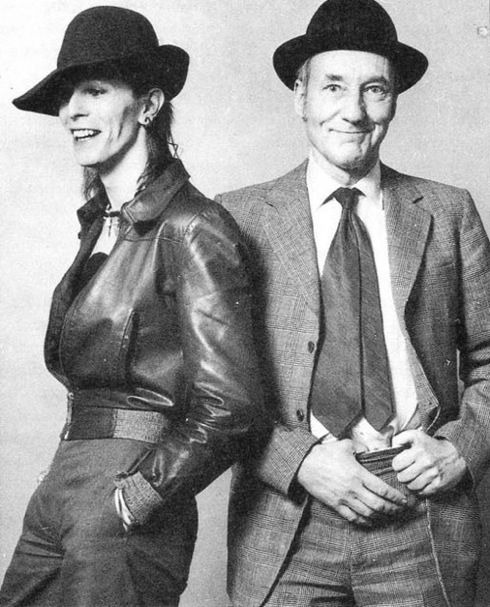
THEN HE MET WILLIAM BURROUGHS

David Bowie , William Burroughs

1973: Bowie is interviewed for Rolling Stone with novelist Wiliam Burroughs and photographed by Terry O’Neill

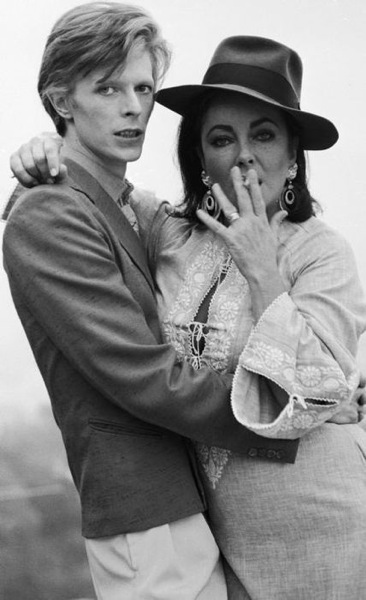
THEN HE MET LIZ TAYLOR

David Bowie , Liz Taylor, Terry O'Neill

1975: Bowie meets Hollywood legend Liz Taylor. Photographed by Terry O’Neill

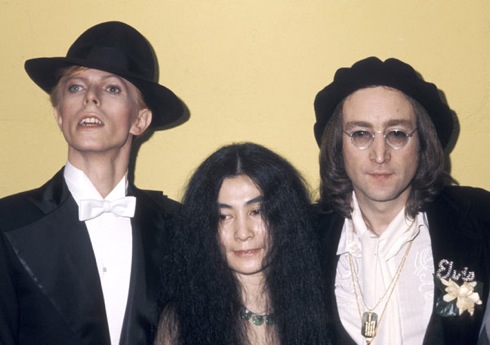
THEN HE WROTE A SONG WITH JOHN LENNON

David Bowie , Yoko Ono, John Lennon, Grammys

1975: At the Grammys, Bowie upstages Yoko Ono and John Lennon — one day he gets jamming with David in a studio and turns a lick into the song Fame

AND THE REST IS, WELL, BOWIE…

➢ Radio 2’s clips from Inspirational Bowie at iPlayer — Marc Almond: “I climbed over the orchestra pit and David Bowie took my hand. He sang Give me your hand in Rock ’n’ Roll Suicide and it was an epiphany”

➢ Happy 65th Birthday Bowie: BBC 6Music audience curates a playlist of favourite tracks, on iPlayer until Jan 13

FRONT PAGE

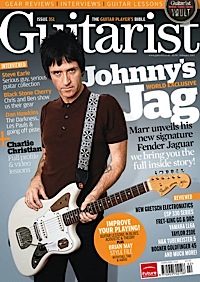
➤ Johnny Marr takes his own personal flight to the moon — on his new Fender

+++

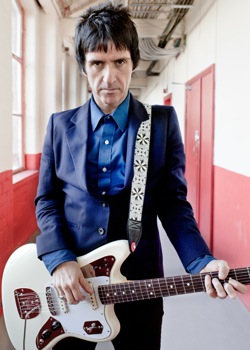
Johnny Marr, Signature Jaguar, Fender,guitars

Take me to the moon: Marr with his new Signature Jaguar

❚ YES, THIS IS ONE MASSIVE product plug but, wow, Johnny makes it also sound like a mighty love affair. From his fame with The Smiths, Johnny Marr is indisputably the maestro of the UK rock guitar sound of the 80s. Today on his blog he introduces his own bespoke guitar, the Johnny Marr Signature Jaguar, which he has spent years developing with Fender, the Arizona instrument maker.

This 14-minute video amounts to a low-key masterclass by one of the all-time greats in his field. In a play-through of all the Jag’s functions and switches, Johnny details what goes into customising a guitar to meet the individual musician’s needs. He has dealt with each little niggle that has irritated him over the years, the biggest being the jazz switch, he says, which was prone to being thrown at the wrong moment.

Johnny concludes: “For someone who’s grown up from being a little boy thinking that guitars are the greatest object in the world bar none, to have designed your own is a little bit like designing the spaceship that went to the moon.”

His verdict: “It sounds like I’m supposed to sound, I think.”

➢ Read more at Johnny Marr’s blog

➢ Every detailed spec of Johnny’s instrument a guitar geek
could want

Johnny Marr, signature Jaguar ,Fender , Guitarist magazine,Bill Puplett ,John Moore ➢ In issue 351 of Guitarist magazine — “We sit down with Johnny, his tech Bill Puplett and designer John Moore to discuss what makes the Johnny Marr Signature Jaguar so different”

➢ Another video interview from 2007 as Johnny Marr discusses his penchant for 1963 Stratocasters (and why he called his son Nile)

FRONT PAGE