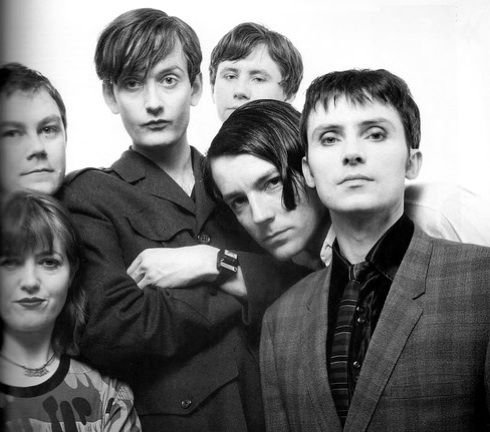
❚ ALL THE ORIGINAL MEMBERS OF PULP, the coolest band to represent Britpop, have decided to get together and play some concerts next summer, starting with May 27, 2011 at the Primavera Sound Festival in Barcelona, Spain, and on July 3 at the Wireless Festival in London, United Kingdom. Formed 1978 in Sheffield, England and originally called “Arabacus Pulp”, the six-piece achieved sudden success thirteen years later during the Britpop era as much for their music as for frontman Jarvis Cocker’s antics, ho-ho. Their unimpeachable breakthrough single was an ironic survey of class tourism titled Common People from their 1995 album Different Class which won the Mercury Music Prize the next year. The original lineup last played together onstage in 1996. They are frontman Cocker, drummer Nick Banks, keyboard player Candida Doyle, bass guitarist Steve Mackey, guitarist and violinist Russell Senior and guitarist Mark Webber.
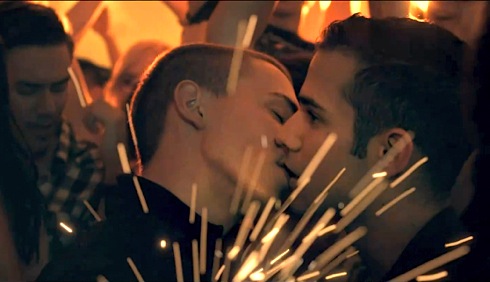
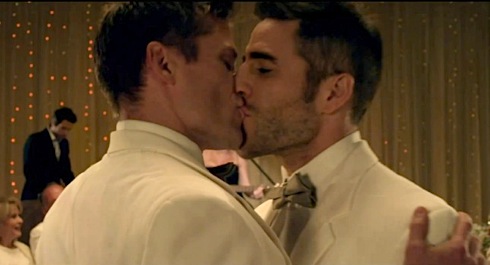
❚ CENSORSHIP! OH DEARIE ME!Digital Spy reports this weekend that the lavish video for Firework — the single currently No 4 in this week’s UK chart by American singer-songwriter Katy Perry — has been censored for British television channels. The ludicrous widescreen promo, which they say “plays out the song’s message of self-belief” (yuk), shows fireworks shooting from Perry’s chest, and from the bodies of prancing extras. More shocking, apparently, are the pyrotechnic depictions of a mugging, a cancer patient, a woman giving birth and two men kissing. The two-second “gay kiss” has been pixelated, presumably to save embarrassing the children, in a version of the video directed by Dave Meyers for delivery to TV channels under a cross-promotional deal with Deutsche Telekom. The European telecommunications group recruited fans from all over Europe to appear in the video when it was shot in Budapest.
It’s all too much. Why, this weekend too, fansites have been twittering that Katy Perry and BFF Rihanna got into an argument over Katy’s new hubby, the amoral buffoon Russell Brand (double yuk). The only good news is that Katy has at least vowed never to strip for Playboy.
Fireworks in Firework: British TV viewers see only a pixelated version
According to the star herself, Firework is influenced by Jack Kerouac’s novel about male bonding, On the Road. Digital Spy’s reviewer Nick Levine even accords the song the accolade of being a “straight up self-empowerment anthem”. Pass the sickbag, James.
OK, OK, boys and girls. In Frankie Goes to Hollywood’s immortal words, relax. For any TV viewers feeling deprived of the knee-trembling kiss in the Perry video, which is of course viewable in full 1080p HD on YouTube, there’s plenty more where that came from. The web is replete with more pop videos flaunting gay kisses than mum and dad might wish for. The following links round up the most notorious from both genders — four are viewable only behind age-restricted gateways. And because it’s so darn funky, Shapersofthe80s has thrown in the Pet Shop Boys’ most notorious Bruce Weber video for Being Boring, which contains naughtiness on any number of levels, but you’re going to need gimlet eyes to spot the gay kiss. You’re very welcome to propose your own favourite pop kisses. Thanks to Jobe, we’re up to 20 vidz now.
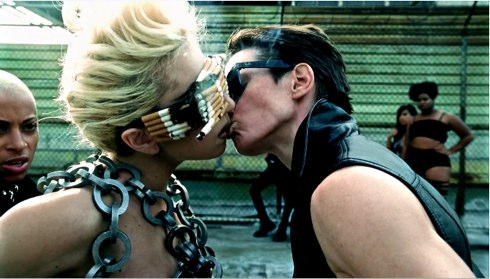
Lady Gaga: a jailbird’s perk in the video for Telephone
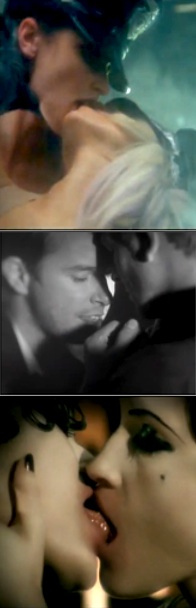
Pop smackers: Lady Gaga in Lovegame, Stephen Gately in Boyzone’s Better, two vamps in Blink-182’s I Miss You
“These artists represent a new wave of young (and mostly straight) women who are providing the soundtrack for a generation of gay fans coming to terms with their identity in a time of turbulent and confusing cultural messages.”
❚ WE LIKE POPJUSTICE BECAUSE it’s a website that confronts the heavyweight issues in a field some people regard as lightweight, namely, pop music. With some frequency PJ puts its finger on how our tiny minds work. Today it defines “the best pop music”…
Gets it: Lady Gaga, winner at the 2010 Brit Awards
[From PopJustice, Nov 3, 2010]
THE BEST POP MUSIC OFTEN SUCCEEDS by striking the right balance between trying just hard enough and looking like it’s not trying too hard. Lady Gaga turned things on their head slightly by very publicly and very unashamedly trying extremely hard and — in a world where there is no shortage of overstylised clubkids attempting to posture and preen their way to pseudo-avant garde popstar notoriety — she actually made it work.
Clearly Gaga is a cut above the rest in every respect: combined, her songwriting, style, collaborations, vocals and vision put her in a different league to almost every other popstar of the last twenty years. But her ascent to whatever and wherever she is now is an interesting case study in what happens when the right sort of person (and it has to be the right sort of person, with the right sort of tunes) strikes the right sort of pose…
[Here PJ discusses a Swedish upcomer called Viktorious who seems to “get it” in the same way Gaga does.]
We like popstars who get it. We like loads of popstars who don’t get it, too, but the ones who get it are our favourites. Success does not always come their way but they always make pop a little bit more interesting than the others.
And this is where the knife goes in. PJ has three lists of stars who “Get it”, headed by Gaga, those who “Don’t”, headed by Pixie Lott, and a third option where “The jury is out”: Rihanna.
❚ THEY’RE BROODY, A TOUCH SULKY, they’re very fresh and very photogenic in black and white. Four songs online show they play their instruments with startling energy — bass, rhythm guitar, syndrums and synth. Their music is high-octane power pop on one track called The Only One. Furious upbeat emo on another called Tears. Whiffs of Duran Duran on Unbearable Without You. The singer does also happen to have a voice, bone structure, mad hands, attitude. Can’t be more than 18. There’s no evidence on their website of ever playing in public. This is the Band With No Past.
Where do bands like this come from, fully formed, straight from the egg? A whisper tells you they’ve already landed a deal, but that can’t be true. Google the name Paradise Point and all you find is a Palm-dotted beach in San Diego.
Somebody else tells you PP are Brits, playing their first date this month, live with, er, actual instruments. Hang on. These aren’t indie scruffs or thrash rockers. These kids are in their teens, unashamedly popsters, writing songs and making their own music like real pop groups used to before boy-bands — and before the Cowell X-culture robbed the pop charts of a generation of musicians. We have to reach way back into the heritage for groups who could play their own pop.
It turns out to be Steve Strange who’s showcasing Paradise Point at The Face, the bleeding-edge Neo-Romantic clubnight of the 20-tens, but hang on again, you wouldn’t call this band Romos, they don’t dress like Alejandro Gocast. Yet. OK, they sing of angsty love, like in two more tunes they’ve covered on video and posted today — live versions of Katy Perry’s Firework, and Rihanna’s Only Girl in the World, just to show they can big-time it. Straight to-camera demos, in one take, in fashionable black-and-white, understated and fearless and fizzing with energy. Don’t say Busted. Don’t say McFly. Really, there’s no need to wince.
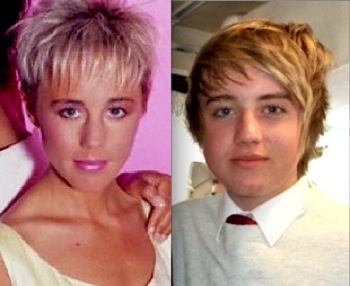
Strange, I’ve seen that face before ... the one on the right’s called Roman, and he somehow reminds me of her
So far, there’s no press coverage on the band. There’s no info, even of any kind, on Paradise Point’s MySpace page or at Facebook. Apart from four names in alpha order: Cameron Jones (vocals), Roman Kemp (bass), Adam Saunderson (guitar/synth), Johnnie Shinner (drums). So, Watson, what do you deduce? Kemp’s face, Holmes, looks familiar, seen it somewhere before. By jove, Watson, you’re right — some pretty high-powered friends on MySpace, as well, Lady Gaga top of the list. There’s a clue in their YouTube tags too: if you like the tags, you’ll probably like the Band With No Past. Better trek down to The Face Friday fortnight, see what they amount to…
➢ Choose “View full site” – then in the blue bar atop your mobile page, click the three horizontal lines linking to many blue themed pages with background article
MORE INTERESTING THAN MOST PEOPLE’S FANTASIES — THE SWINGING EIGHTIES 1978-1984
They didn’t call themselves New Romantics, or the Blitz Kids – but other people did.
“I’d find people at the Blitz who were possible only in my imagination. But they were real” — Stephen Jones, hatmaker, 1983. (Illustration courtesy Iain R Webb, 1983)
“The truth about those Blitz club people was more interesting than most people’s fantasies” — Steve Dagger, pop group manager, 1983
PRAISE INDEED!
“See David Johnson’s fabulously detailed website Shapers of the 80s to which I am hugely indebted” – Political historian Dominic Sandbrook, in his book Who Dares Wins, 2019
“The (velvet) goldmine that is Shapers of the 80s” – Verdict of Chris O’Leary, respected author and blogger who analyses Bowie song by song at Pushing Ahead of the Dame
“The rather brilliant Shapers of the 80s website” – Dylan Jones in his Sweet Dreams paperback, 2021
A UNIQUE HISTORY
➢ WELCOME to the Swinging 80s ➢ THE BLOG POSTS on this front page report topical updates ➢ ROLL OVER THE MENU at page top to go deeper into the past ➢ FOR NEWS & MONTH BY MONTH SEARCH scroll down this sidebar
❏ Header artwork by Kat Starchild shows Blitz Kids Darla Jane Gilroy, Elise Brazier, Judi Frankland and Steve Strange, with David Bowie at centre in his 1980 video for Ashes to Ashes
VINCENT ON AIR 2026
✱ Deejay legend Robbie Vincent has returned to JazzFM on Sundays 1-3pm… Catch up on Robbie’s JazzFM August Bank Holiday 2020 session thanks to AhhhhhSoul with four hours of “nothing but essential rhythms of soul, jazz and funk”.
TOLD FOR THE FIRST TIME
◆ Who was who in Spandau’s break-out year of 1980? The Invisible Hand of Shapersofthe80s draws a selective timeline for The unprecedented rise and rise of Spandau Ballet –– Turn to our inside page
SEARCH our 925 posts or ZOOM DOWN TO THE ARCHIVE INDEX
UNTOLD BLITZ STORIES
✱ If you thought there was no more to know about the birth of Blitz culture in 1980 then get your hands on a sensational book by an obsessive music fan called David Barrat. It is gripping, original and epic – a spooky tale of coincidence and parallel lives as mind-tingling as a Sherlock Holmes yarn. Titled both New Romantics Who Never Were and The Untold Story of Spandau Ballet! Sample this initial taster here at Shapers of the 80s
CHEWING THE FAT
✱ Jawing at Soho Radio on the 80s clubland revolution (from 32 mins) and on art (@55 mins) is probably the most influential shaper of the 80s, former Wag-club director Chris Sullivan (pictured) with editor of this website David Johnson
LANDMARK FAREWELLS. . . HIT THE INDEX TAB UP TOP FOR EVERYTHING ELSE