❚ YESTERDAY THIS BLITZ KIDS WEBSITEhit a total of 500,537 page views since we launched in autumn 2009. Last year visitor numbers doubled. See what were the hottest topics at Shapersofthe80s during 2011.
HOW THE MUSIC CHANGED
❏ In 1980 Spandau Ballet were the houseband of the Blitz Kids, whose New Romantic manifesto insisted that style was as important as their new synthesised brand of dance music. When London’s Blitz club hosts Steve Strange and Rusty Egan invented the notion of the once-a-week clubnight, they changed British nightlife habits for ever. Spandau’s music made no less a dramatic gear-change by placing the bass guitar and the bass drum at the front of the sound, as a driving rhythm for dancefloor movers. Within a year of their first hit, To Cut a Long Story Short, the rhythm of the UK pop charts shifted from the lead guitar to the 4:4 dance beat of the bass drum.
Spandau songwriter Gary Kemp claimed at the time: “RnB was the backbone of pop music from 1962 to 1980. And since then, funk. Dance rhythms are the musical basis for all rock bands now. Really, you can’t say ‘rock band’ any more because the music isn’t rhythm-and-blues.”
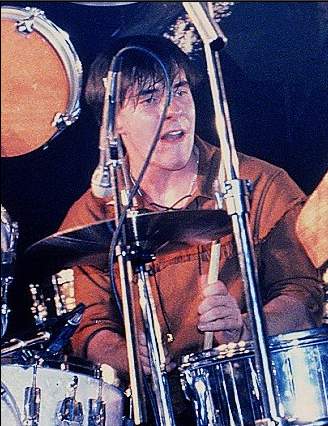
John Keeble (left): “It’s the difference between listening to funk instead of the RnB they all played in the Sixties.”++++++
◼ STARMAN: HOW DAVID BOWIE LIT UP THE 1970s is the title of a two-session course coming up next month at London’s premiere adult-education institute, the City Lit. But you will have to get out of bed on two Sunday mornings to attend. The course costs £41 and its tutor, the music writer Toby Manning whose specialist subject is Pink Floyd, aims it at “music lovers generally” who will find out “how David Bowie’s songs, persona and style broke with 60s values and aesthetics and largely ‘invented’ the 70s”.
Toby promises lots of videos and says: “Watch how, through constant reinvention, Bowie’s relentless creativity set and reset the agenda for rock music throughout the 1970s and beyond.” Test your tutor’s mettle by viewing the stupendous Young Americans video from 1973 [above] and asking why Bowie is wearing those fabulous shoulders and what agenda did they set?
Afterwards, Toby promises, you should be able to “hold your own in any discussion about David Bowie”. So you’ll be ready to impress Mastermind’s 1.74 million viewers. Howzaboutthatthen!
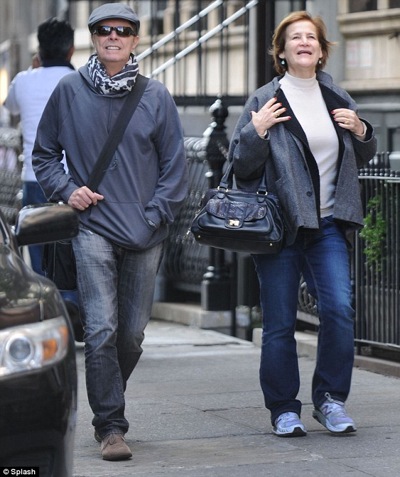
Between the two national newspaper reports accompanying these snaps of Bowie as a “hoodie”, neither offers one new piece of information and all the pix are completely undated. Eagle-eyed fashionistas will notice in the first “takeaway lunch” shot without his zebra print scarf he sports different shoes from today’s pix taken en route to a restaurant. So either David has scoffed two lunches, or, let’s guess, they were taken on different days.
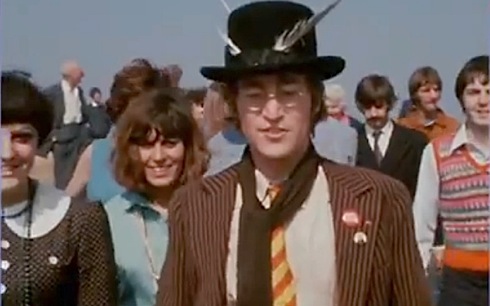
Fabled charabanc outing in 1967: Find the Fab Four among fellow travellers on their Magical Mystery Tour. (Top left we see fanclub secretaries Jenni and Sylvia)
❚ ROLLING STONE CALLED IT “the most important rock’n’roll album ever made … by the greatest rock’n’roll group of all time”. Crowning the era of LSD-fuelled psychedelia in 1967 came Sgt. Pepper’s Lonely Hearts Club Band. Its impact was extraordinary. The Beatles’ eighth studio album marked the height of their rise to global fame. With Dick Lester’s pair of high-octane feature films behind them — Help! and Hard Day’s Night — the Beatles decided to go straight on to direct their own unscripted, improvised film and it backfired in their faces.
Magical Mystery Tour was a dreamlike story of the Fab Four taking a typically British daytrip by coach with friends and family and a cast of crackpot characters exemplified in the eccentric humorist Ivor Cutler. Their adventures were intended to be “magical” and indeed the I Am the Walrus sequence has passed into legend. Generations of British comics such as Monty Python point to the film as their inspiration.
Yet its TV audience greeted Magical Mystery Tour with outrage and derision. It was seen by a third of the nation on Boxing Day when an expectant family audience, hoping for some light entertainment, were confronted by a drug-rinsed shambles in festive prime time. Paul McCartney told the press later: “We don’t say it was a good film. It was our first attempt. If we goofed, then we goofed. It was a challenge and it didn’t come off. We’ll know better next time.”
The critical reception was so hostile that the film’s negative didn’t become properly archived, which makes tonight’s BBC TV premiere of its meticulous restoration, overseen by Paul Rutan Jr, a significant landmark. The new DVD with remixed 5.1 soundtrack is due to be released internationally on October 8–9, packed with special features.
What few of us remember is that, as well as its new Beatles songs, MMT gave a guest spot to the founding fathers of anarchic musical comedy, The Bonzo Dog Doo-Dah Band, with Death Cab for Cutie, a spoof “teen tragedy” song from their own seminal 1967 album Gorilla. The Bonzos performed it onstage at the Raymond Revuebar as accompaniment to a stripper and the number turns out to be a show-stopper.
The mystery tour itself proves to be an affectionate travelogue about Britain’s quintessentially working-class hinterland (in the fish-and-chip shop, we hear marvellous strains of She Loves You rendered on a fairground organ). In contrast to his band’s reputation as fierce cultural pacemakers, McCartney concedes that “the whole film has a bit of a village fete atmosphere to it”. Even so, as deejay Paul Gambaccini remarks in a new Arena documentary also broadcast tonight, the film fizzes edgily with the very elements of advanced psychedelia the Beatles themselves had introduced into the culture. One surprise is Martin Scorsese saying this film influenced a lot of the work he has done! Restored to pristine colour, MMT emerges as a celebration of a defining moment in harmonic innovation and of the energy that made British pop glorious.
❏ Tonight’s Mystery Tour screening is preceded by a real treat from Britain’s leading arts documentary team, Arena, who have rounded up much unseen footage.
“ Series editor Anthony Wall says: “The idea that there’s anything you don’t know about The Beatles is startling enough. But the film was, consciously or unconsciously, suppressed. The out-takes were in the Apple vault, which is deep below the streets of London in a World War Two-type bunker. Sleeping down there for many, many years.”
Wall thinks Magical Mystery Tour will soon be re-appraised as “a piece of work in a very surreal, British, literary, visual tradition: from gothic to Lewis Carroll to H G Wells to William Golding to the Goons to what became Monty Python.
“For practical purposes it’s not been seen since 1967. The documentary tells the story — which in retrospect is hilarious, although it wasn’t for The Beatles at the time because they got such a drubbing — and contextualises it by looking at 1967 and what The Beatles were responding to: in London it was a very intense time, artistically.”
The cultural shifts of that specific part of the 1960s are key to understanding Magical Mystery Tour, Wall says, which meant the new Arena film had to represent the trends of the time accurately. “Very few films about the 1960s get it right. They usually mix things up hopelessly. It’s very important when you use archive to be precise — try to get it to the month. It invariably looks earlier than it is. When you see ‘1967’ it’s usually footage from 1970!” … / Continued online at Radio Times
❚ TWO BEATLES FANCLUB SECRETARIES recall how they hopped on board The Beatles’ Magical Mystery Tour bus at 7am one day in 1967 as special guests of the Fab Four. Sylvia Hillier was a 19-year-old receptionist in a factory who lost her job as a result, while 16-year-old schoolgirl Jenni Evennett bunked off school to join the week-long filming. They told this morning’s Saturday Live on Radio 4 that it was a bit like a “happening” where nobody was given lines or seemed to know what they were doing. Sylvia was dressed all psychedelic in orange, “my flower-power stage, with kaftan, flairs, bells and beads”. Jenni said that for continuity they couldn’t change for a whole week: “I wore a little brown spotted dress with white collar, bells and beads and lots of deodorant.”
Fan Sylvia Hillier from Bognor: seen here with Paul McCartney, she lost her job by ducking out of work to join the 1967 magical bus tour. (Pic from Facebook)
The Sullivan brand: Arguments raged in the 80s with his Wag co-host Ollie O’Donnell over who had designed/drawn/ordered the first zoot suit
❚ AS PROBABLY THE MOST INFLUENTIALshaper of the subcultural 80s, it’s hard to disassociate Chris Sullivan from his 19 years hosting the seminal Wag as the coolest black-music club in Soho. Today he’s a mighty standing stone on the shingle beach of club deejays, and much in demand on the society circuit. This week, however, he took stock: “A pal said to me, ‘I didn’t know you played music that was made past 1990’, so I, rather taken aback, did this mix that, although somewhat Latin and very me, is still very ‘modern’. Point is, I play mostly new stuff but hide it behind the patina of antiquity so no one ever notices.”
To surprise his pal, he’s posted this 73-minute hip-shaking and arm-waving mix at Soundcloud. You’ll find more there when you click through, plus the kind of mind-boggling CV of his life as, variously, a deejay, author, nightclub host, pop star in Blue Rondo à la Turk, painter, style commentator, entrepreneur and fashion designer today cutting a dash in a goatee. Find even more at Shapersofthe80s through the links below.
❚ THE NEW ALBUM ELYSIUM from the Pet Shop Boys this week entered the UK album chart at number 9. Curiously, it is being greeted with mixed reviews from younger critics, which is a shame for a creative duo widely regarded as a national treasure. Andy Polaris, lead singer with Animal Nightlife who provided a soundtrack to UK clubbing during the golden age of 80s pop, has offered to redress the balance with this review for Shapersofthe80s …
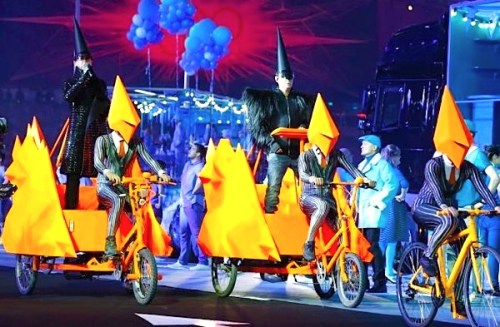
London Olympics closing ceremony, August 12: The Pet Shop Boys sing West End Girls from rickshaws. Their orange pointy masks were said to depict the London rush hour. (Photo: Reuters/ Phil Noble). Click pic to view video of PSBs talking on BBC Breakfast
❏ Andy writes:
The Pet Shop Boys were part of the UK music explosion of the 80s which saw the British invasion of the US and much other global success. Today, along with Yazoo and The Eurythmics, they are the last of the electronic duos from the 80s who are still intact and flourishing.
The passage of time is a recurring theme in their eleventh album, produced by Andrew Dawson who worked on three successful Kanye West albums. Despite their last few albums as recent as Yes in 2010 receiving Grammy nominations (how many of their 80s contemporaries can say that?), if you’re not constantly on heavy airplay rotation or in rehab people assume you’re dead or retired. The perennial problem is: Are your best years behind you? How relevant are you in the current pop climate?
“You’ve been around but you don’t look too rough/ And I still quite like some of your early stuff.” The lyric to Your Early Stuff wittily captures frequent comments from cab drivers and others when confronted with these pop icons. They need not have worried, having popped up twice during the Olympics, at the closing ceremony, riding origami rickshaws, and again last week performing outside Buckingham Palace their new song Winner (from Elysium), along with West End Girl and Go West. This had the Olympic champions and contestants swaying and singing along with the crowd.
Video grab from Invisible: “Am I tragic or a joke/ Wrapped in my invisibility cloak?”
The PSBs have a vast, enviable back catalogue of melodic hits but are still producing catchy electronic pop and Elysium contains some trademark mixes of — dare I say it? — their early stuff. Uptempo dance pop with strong choruses include the opening track Leaving, Requiem In Denim and Leopardskin, A Face Like That (no doubt with remixes already in the works), plus Radio 2-friendly songs like Hold On, Memory of A Future, Give It A Go and Winner, which all show off their knack with a melody. On the sombre, reflective ballads Breathing Space and Invisible, remorse never sounded so good.
Finally, never taking themselves too seriously, we have the brilliant, arch Ego Music which owes more to their influences, Sparks and Yellow Magic Orchestra. Lyrically, this number shreds the current crop of pretentious pop stars: “In the sea of negativity I’m a statue of liberty/ That’s why people love me, it’s humbling.”
I would recommend this whole album for its consistency and lack of filler tracks, which is unusual these days. If you haven’t heard the PSBs’ recent output, just sample Ego Music and Invisible. The album title was inspired by a walk in Elysian Park in Los Angeles, a protected area dating back to the founding of the city and given a name appropriately derived from the Greek word for paradise.
➢ Choose “View full site” – then in the blue bar atop your mobile page, click the three horizontal lines linking to many blue themed pages with background article
MORE INTERESTING THAN MOST PEOPLE’S FANTASIES — THE SWINGING EIGHTIES 1978-1984
They didn’t call themselves New Romantics, or the Blitz Kids – but other people did.
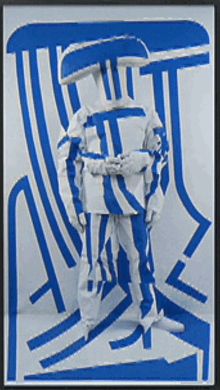
“I’d find people at the Blitz who were possible only in my imagination. But they were real” — Stephen Jones, hatmaker, 1983. (Illustration courtesy Iain R Webb, 1983)
“The truth about those Blitz club people was more interesting than most people’s fantasies” — Steve Dagger, pop group manager, 1983
PRAISE INDEED!
“See David Johnson’s fabulously detailed website Shapers of the 80s to which I am hugely indebted” – Political historian Dominic Sandbrook, in his book Who Dares Wins, 2019
“The (velvet) goldmine that is Shapers of the 80s” – Verdict of Chris O’Leary, respected author and blogger who analyses Bowie song by song at Pushing Ahead of the Dame
“The rather brilliant Shapers of the 80s website” – Dylan Jones in his Sweet Dreams paperback, 2021
A UNIQUE HISTORY
➢ WELCOME to the Swinging 80s ➢ THE BLOG POSTS on this front page report topical updates ➢ ROLL OVER THE MENU at page top to go deeper into the past ➢ FOR NEWS & MONTH BY MONTH SEARCH scroll down this sidebar
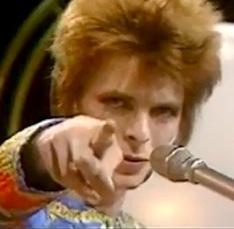
❏ Header artwork by Kat Starchild shows Blitz Kids Darla Jane Gilroy, Elise Brazier, Judi Frankland and Steve Strange, with David Bowie at centre in his 1980 video for Ashes to Ashes
VINCENT ON AIR 2026
✱ Deejay legend Robbie Vincent has returned to JazzFM on Sundays 1-3pm… Catch up on Robbie’s JazzFM August Bank Holiday 2020 session thanks to AhhhhhSoul with four hours of “nothing but essential rhythms of soul, jazz and funk”.
TOLD FOR THE FIRST TIME
◆ Who was who in Spandau’s break-out year of 1980? The Invisible Hand of Shapersofthe80s draws a selective timeline for The unprecedented rise and rise of Spandau Ballet –– Turn to our inside page
SEARCH our 925 posts or ZOOM DOWN TO THE ARCHIVE INDEX
UNTOLD BLITZ STORIES
✱ If you thought there was no more to know about the birth of Blitz culture in 1980 then get your hands on a sensational book by an obsessive music fan called David Barrat. It is gripping, original and epic – a spooky tale of coincidence and parallel lives as mind-tingling as a Sherlock Holmes yarn. Titled both New Romantics Who Never Were and The Untold Story of Spandau Ballet! Sample this initial taster here at Shapers of the 80s
CHEWING THE FAT
✱ Jawing at Soho Radio on the 80s clubland revolution (from 32 mins) and on art (@55 mins) is probably the most influential shaper of the 80s, former Wag-club director Chris Sullivan (pictured) with editor of this website David Johnson
LANDMARK FAREWELLS. . . HIT THE INDEX TAB UP TOP FOR EVERYTHING ELSE










 ➢➢ Shapers of the 80s ➣➣