Category Archives: Youth culture

➤ Stomping like the 70s but with Nutter style

Nutters of Savile Row, Peter Werth, London Collections Men,fashion,Cafe de Paris,

Dance-off Wigan fashion: The finale to the Nutter-Werth men’s collection at the Café de Paris. (Videograb from milavictoria)

❚ EXTRAVAGANT AND OVERSTATED could readily describe both the whole-body dance moves of Northern Soul fanatics, and the rock-and-roll men’s tailor Tommy Nutter, the Savile Row rebel who favoured gigantic hand-rolled lapels and Oxford bags. Last week the fashionistas attending a Café de Paris “runway” show during the London Collections for men certainly caught the uninhibited exuberance of the 1970s, as the videos here show.

An unexpected collaboration between high-street retailer Peter Werth and Nutters of Savile Row produced a show of two halves. It opened with regular jackety models in skinny pants who were upstaged by an explosion of casual soulboys in knitwear and baggies. The Café’s dancefloor suddenly became the fabled Wigan Casino, about 1975, climaxing with a jack-in-the-box dance-off to the stomping beats of Luther Ingram’s If It’s All The Same To You Babe.

+++
All very sporty for AW13 with classy fabrics and jaunty tailoring bringing a gentlemanly vibe to the look, described by designer David Mason as “Studio 54 meets Wigan Casino” (which closed in 1981). The dancers in fact turned out to be from the cast of a debut feature film titled Northern Soul, written and directed by Elaine Constantine, about two lads swept up in the subculture when they discovered uptempo American soul music. Creating a wardrobe for the film forged the alliance between the two London design houses. The current incarnation of Nutters decided it had to reach out to a ready-to-wear audience, and Peter Werth, today owned by JD Sports, is strong on working-class savvy.

+++
➢ Northern Soul, the film due for release this summer
➢ Britain’s got talcum – Guardian backgrounder on training up a generation to dance in the film
➢ Soulboy, the 2010 film directed by Shimmy Marcus

THE MAN WHO GLAMORISED SAVILE ROW

❏ Tommy Nutter, the charmer and dandy whose father ran a North London caff, would no doubt have voiced some self-deprecating witticism at today’s move to widen his market. The young Nutter wanted to work for the 60s designer Michael Fish and when he bumped into him said, “Can I do something with you?” Fish said, “Don’t be silly. You’ve got your own style. Do something yourself.” Nutter died in 1992 aged 49, having designed for Elton John, David Hockney, both the Jaggers, the Rolling Stones, David Bowie (Pinups), and for three of the Beatles who wear his outfits on the Abbey Road record sleeve, likewise Jack Nicholson as The Joker in Batman, the 1989 film. Nutter shook up Savile Row by injecting softer cuts and bold fabrics into the bespoke man’s suit while respecting classic tailoring. His was the first shop on the prestigious Row to design for women such as his backer, the pop singer Cilla Black.

Tailor Timothy Everest concludes: “Tommy’s was a brand that people wanted to buy into but within that you could be an individual and I think that’s a very modern approach. That’s what bespoke is all about.”

FRONT PAGE

➤ Do they know? How modest Midge wrote the biggest selling pop single of his generation

Do They Know It’s Christmas?, Band Aid, Live Aid, Midge Ure, Bob Geldof, 1984,pop music, UK charts,

Pop artist Peter Blake’s Band Aid sleeve… The original vinyl can be yours today for £6.99, US$11.25, €8.60 at eil.com

◼ 1.1 BILLION VIEWS FOR GANGNAM STYLE at YouTube!!! Merry Christmas, pop pickers. Now spare a few minutes to listen to the original demo of the tune that in its day became the biggest selling UK single of all time. In 1984 was at No 1 in the pop charts.

Midge Ure: recording the Band Aid single, here with Paul Young and Tony Hadley © 1984 Mercury Records

Midge Ure: recording the Band Aid single, here with Paul Young and Tony Hadley (© 1984 Mercury Records)

It was recorded under the artist name of Band Aid by a megagroup recruited from 47 of the biggest hitters in British rock and pop. It raised huge funds for famine relief in Africa and a year later led to Live Aid, the biggest global rock concert ever, viewed by two billion people in 60 countries, who coughed up still more dollars. Live Aid is said to have raised £150m (about £400m or US$650m at today’s prices).

The idea for Band Aid was proposed by one down-on-his-luck musician, Irishman Bob Geldof, who had been moved by a horrifying BBC TV news report on the famine in Ethiopia. The project sprang out of a telephone call with Midge Ure of Ultravox when he was appearing on The Tube, the weekly pop TV show broadcast from Newcastle. The song was written and produced in a flash by Scotsman Midge, who has emerged as one of the most genuinely multi-talented shapers of the 80s.

WALKING OUT OF THE SHOPS

Do They Know It’s Christmas?, Midge Ure, Bob Geldof, Band Aid, Record Mirror, cuttings
❏ The Band Aid single became the fastest seller of all time in its first week of release, ironically keeping one of its participants, George Michael and his band Wham! off the coveted No 1 spot in the Christmas singles chart, which would have been their third No 1 in a row. Bob Geldof, mover and shaker behind the charity project, told Record Mirror in the December 1984 page shown here: “It’s NOT a Geldof plot to get back in the limelight as some people are claiming. It allowed people who understandably felt a sense of impotence about Ethiopia to express their support.” DTKIC endured as the biggest-selling single of all time in the UK for 13 years, until it was overtaken in 1997 by Elton John’s Candle in the Wind, released following the death of Princess Diana.

HERE’S MIDGE’S ORIGINAL SOLO DEMO…

AND HOW IT SOUNDED A YEAR LATER AT LIVE AID

MORE BAND AID STORIES AT SHAPERS OF THE 80S

➢ 1984, Band Aid, when pop made its noblest gesture but the 80s ceased to swing

➢ 2001, Hear about the many lives of Midge Ure, the Mr Nice of pop

➢ Midge Ure and Gary Kemp lift the lid on the shenanigans that led up to Band Aid

FRONT PAGE

➤ Smash Hits and other mould-breakers of the 80s

Neil Tennant ,Smash Hits, Radio 4, documentary

1983: Neil Tennant as Smash Hits writer. (Photo by Virginia Turbett)

❚ ANOTHER NICELY PACKAGED Radio 4 documentary today celebrated the crucial years 1982–85 which Neil Tennant describes as “the golden age of 80s pop”. They luckily coincided with his tenure as a writer on Smash Hits magazine before stepping into the pop charts himself as half of the Pet Shop Boys. Obviously in a prog titled Neil Tennant’s Smash Hits Christmas Tennant and his cronies were full of back-slapping at the moulds they broke with the mass-selling fan mag, driven initially by two selling points – song lyrics and pull-out pinup posters.

Smash Hits, Radio 4, documentary,Pete Murphy

1982: Peter Murphy of Bauhaus (you really don’t want to see its Christmas cover star)

Launched in Nov 1978 as a monthly title, Smash Hits trailed “The words to 18 top singles” as its key feature. The mag was the invention of former NME editor (and later founder of The Face) Nick Logan who conceived it on the kitchen table and initially toyed with the title Disco Fever, presumably in homage to that year’s horror movie Saturday Night Fever. He chose the Belgian new-wave joker Plastic Bertrand for the cover of a pilot issue in the post-punk vacuum when any new direction seemed significant, but actually launched with Blondie. Smash Hits soon went fortnightly, ran for 28 years, and died with Celebrity Big Brother’s Preston gracing its last cover in 2006. In his Guardian obituary for the mag, Alexis Petridis wrote: “The period between the rise of Adam and the Ants and the collapse of Stock, Aitken and Waterman’s ‘Hit Factory’ empire may prove to be the last truly great pop era, in that it produced not just great pop music, but great pop stars.”

Tennant ignores the fact that 80s classic pop began with the music of Spandau Ballet and Adam Ant a couple of years earlier than his joining the mag. Also unmentioned in today’s doc was that the mould-breaking writing of this era was actually led by The Face and the subcultural flagship magazine New Sounds New Styles, which gently parodied the posers of the New Romantics movement and closed in 1982 through lack of promotion by its publisher Emap, who also happened to publish Smash Hits. The fresh rebel writers of NSNS had adopted a tongue-in-cheek tone which kickstarted a shift of power away from stars and their publicists into the hands of writers themselves. Once the 80s had revived the long-dead credibility of pop music – dubbed “pure pop” in vigorous public debates – Smash Hits took its cue by adopting a knowing approach to pop journalism and providing a cheeky foil to Britain’s four seriously po-faced weekly rock-music newspapers. We cannot underestimate how its humour helped sophisticate the Smash Hits reader, pragmatically described by Tennant as “the 12-year-old girl in Grantham”. Which was a neat way of deflating his own pomposity.

Spookiest quote today came from Toyah, after remarking that the pop scene has lost the airy optimism of the 80s: “We now view fame as something dark and faintly abusive.” Oo-er.

Neil Tennant ,Smash Hits, Radio 4, documentary, Pet Shop Boys

April 1985: Tennant as cover star and Pet Shop Boy with Chris Lowe

FRONT PAGE

2012 ➤ A brighter Bluer Rondo for the 20-tweens

Chewing the Fat, vinyl, Blue Rondo à la Turk, 1982, albums,pop music, Latin funk,Wag club, Chris Sullivan, Change, Club Mix,

Picture sleeve painted by vocalist Chris Sullivan, 1982

❚ TWO VINTAGE MUSICAL GEMS appeared online this week, casting a fresh magic spell. They are two tracks from Chewing the Fat, the debut album by the image dance-band of 80s clubland, Blue Rondo à la Turk. In the view of Shapersofthe80s, the 9-track stereo vinyl LP was then and remains now the standout pop album of 1982 for sheer verve and originality. Chris Sullivan, the band’s driving force who went on to run Soho’s Wag club for 19 years, has been remixing the Diable Noir masters which became available only a few months ago.
++++++
This week we heard the sparkling Change Club Mix 2, an original Poncioni-Sullivan composition tagged as “Afro-Latino funk”, and only released previously on the album. Sullivan says we can download the remix as a 58MB Wav file from Soundcloud so it plays right away through iTunes. “We’ll leave it up for downloads for a week,” he said. “Blue Rondo recorded this over 30 years ago and remixed it this year… Still shakes it.” At Facebook, Rondo fan Michael Feasey agrees: “Good stuff Chris – love that samba percussion coming up to 4:00 and the gritty sax. Hell, it’s all good.”

vinyl, Blue Rondo à la Turk, 1982, albums,pop music, Latin funk,Wag club, Chris Sullivan, Klacto Vee Sedstein,Oxford Road Show,TV,

Picture sleeve painted by vocalist Chris Sullivan,1982

The band’s second chart single was the witty Klacto Vee Sedstein. (“It’s got to mean something, it can’t be a dream” – Well, the title was inspired by Charlie Parker’s 1947 number, if not the tune itself.) Rondo’s track enlivened the top 100 for nearly six months, and its “mutant funk” has now emerged from the glitz of Godley & Creme’s 80s production. As Sullivan says: “This is how we’d have liked to have done the song initially but all we’ve done is clean it up a bit and take it back to the original idea… This was recorded 31 years ago.” Verdict at Mixcloud from Mark Huxley: “Lovely stripped down mix!”

Best revelation from Sullivan also came this week: “Expect a digital re-release of our album Chewing The Fat in the spring. I’m quite shocked by how well it’s aged.” He’s not wrong there.

♫ Listen to Klacto Vee Sedstein 2012, as it was meant to sound

Live Performance on Oxford Road Show

+++
➢ 2012, Blue Rondo breathe fresh life into Mr Sanchez – “Mark Reilly did the lion’s share,” says Sullivan, referring to Rondo’s guitarist

New Sounds New Styles, 1981

First published in New Sounds New Styles, August 1981

➢ 1981, Blue Rondo create a new buzz with Latin sounds – unveiled in New Sounds New Styles by Shapersofthe80s

DEC 3: MUTANT DISCO UPDATE

Michel Esteban, Michael Zilkha, ZE Records,

Michael Zilkha and Michel Esteban: label founders combined their initials into ZE

♫ Sullivan also offered an hour-long Mutant Disco mix for a recent Mark Jones show on BBC 6Music – The party kicks off with Contort Yourself (August Darnell remix from the 1979 US 12-incher) by No Wave pioneer James White & The Blacks on ZE Records, the boutique label based in Paris and New York which recharged the disco genre with edge and credibility while Manhattanites pursued dance-oriented rock and Euro-disco wandered its own byways, both folkloric and electronic.

No Wave, Mutant Disco, dance music, James White & The Blacks, ZE Records
Launched in 1978 by British-born old Oxonian and Mothercare heir Michael Zilkha, and French graphic artist Michel Esteban, ZE selected style-leading eccentrics of the day to redefine upfront New York disco. The Sullivan mix includes ZE artists such as Lizzy Mercier Descloux, Kid Creole & The Coconuts, Was (Not Was), Coati Mundi, Material, though alas no Cristina. The title of ZE’s witty vinyl cocktail of acts tagged “A Subtle Discolation of the Norm” put the term Mutant Disco into the language in 1981, and acted as soundtrack to the first Blitz invasion of the US that spring.

Sullivan explains, Dec 3: “Here’s a live mix straight off the decks I did for Mark Jones Back to the Phuture show on BBC 6Music. Kinda all that early 80s electro Ze records stuff we loved and still do … They’ve edited some of the mixes but still it’s a bit of a gas … With a few exceptions this is what I played at Hell” [the Blitz crowd’s breakaway club of 1980].

FRONT PAGE

2012 ➤ Soho’s nightowls revisit the club that sifted the Artex monkeys from Bowie’s Heroes

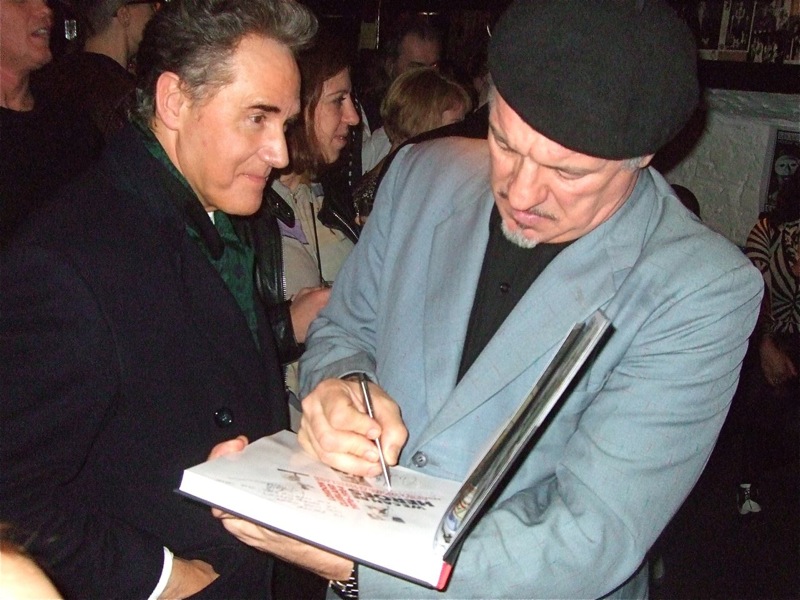
Cultural observer Peter York: eager for the Sullivan autograph on the new edition

❚ THE 80s BLITZ KIDS turned out in force last night. As Kitten Kouturist Franceska Luther King remarks today: “an elegant crowd, older, but still the same spirit.” Those clubbing compulsives who defined the sounds and styles of Soho 30 years ago, swarmed into the tiny steaming Artex-lined cellars of the St Moritz restaurant, the fit all the tighter thanks to a fair few middle-aged paunches. For three months in 1980 this was the site of their milestone one-nighter which signalled the first faction to break away from the futurists at Steve Strange and Rusty Egan’s pioneering electro-diskow, The Blitz. In host Chris Sullivan’s words, this was “the more alert end of the Blitz crowd” – in other words, the hardcore fashionistas.

Initially St Moritz’s music evoked interwar Berlin cabaret but the effect of Charles Fox, the theatrical costumiers, staging its closing-down sale in Covent Garden injected a huge Hollywood movie wardrobe. Sullivan notes:  “You could be a gangster, a geisha, or Geronimo.” The New Romantics had been born – just like that!

“No single shop sale ever had such an influence on street fashion before or since,” Sullivan writes in the fabulous photo-book, We Can Be Heroes. This ribald account of the dawn of UK clubbing in the 80s, led by the eye-popping photographs of Graham Smith, was the reason for last night’s beano. Soul-music diehards Smith and Sullivan graduated from The Blitz to become two of the St Moritz deejays (along with Robert Elms and Steve Mahoney) and half a lifetime on they were hosting yet another launch party. The book’s revised and amended second edition of 2,500 copies is released this week through regular retail outlets. Copies of last year’s limited edition are still available from the fund-it-yourself publisher Unbound.

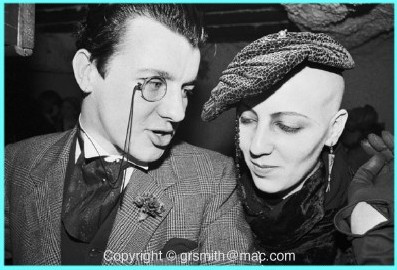
St Moritz 1980: Chris Sullivan and Michele Clapton – from Smith’s book We Can Be Heroes

Back in the day, the St Moritz posse distinguished themselves from The Blitz by playing retro lounge-lizard tunes from Lotte Lenya or Nat King Cole. In today’s arts pages of The Times Sullivan recaps how, in their efforts to avoid the present, he and his cohort helped create the future: “We decided to oppose Blitz futurism and turn the clock back with music from Marlene Dietrich, Monroe, Sinatra and soundtracks from A Clockwork Orange, Last Tango in Paris and Cabaret. It was an alarming success.”

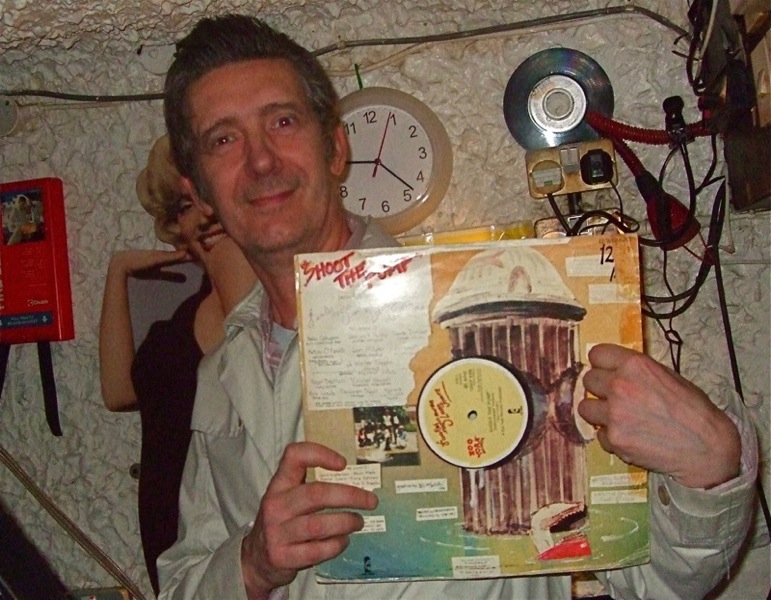
Rob Milton: Shooting the Pump in the deejay booth

♫ Click to hear Shoot the Pump in a new window

Fashions in music moved apace. Within a year successive London club-nights at Hell, Le Kilt and Le Beat Route were stirring into the club mix not only familiar 70s soul but the edgy new urban sounds of North America.

Choosing the soundtrack last night at St Moritz were the were the astute ears of David Hawkes, Christos Tolera and Sullivan himself, plus Dirt Box co-founder Rob Milton, who raked the dancefloor early in the evening with the crazed beats of Shoot the Pump. This intoxicating debut single from 1981 was a state-of-the-art fusion of emergent street sounds – rap, hip-hop and funk with a hint of mutant disco – from the “playin’ brown rapper” and graffiti artist J Walter Negro & the Loose Jointz (on Zoo York Records via Island). J Walter is urging his crew of Zoo Yorkers to spray docile citizens with the water from a fire hydrant: “You make like a monkey with monkey wrench, cos you feel a little funky, got a thirst to quench.” In 1980–81, something similar was pumping the adrenalin in London.

CLICK ANY PIC TO LAUNCH CAROUSEL:

FRONT PAGE