Category Archives: Youth culture

➤ Thanks to Neil McCormick for the only Bowie Blackstar review we need to read

Blackstar, album, David Bowie, jazz, pop music, video,Johan Renck , reviews,

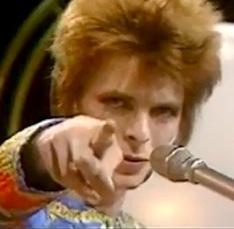
Late-life melancholy with jazzy modulations: Bowie in messianic mode in the video for the album’s title track Blackstar

➢ With an album as rich and strange as Blackstar, Bowie is well and truly back from beyond, reports Neil McCormick, Daily Telegraph music critic, 18 December 2015:

For his 27th studio album, has Bowie gone jazz? On first listens to Blackstar, released on 8 January, Bowie’s 69th birthday, it certainly sounds like rock’s oldest futurist has dusted down his saxophone. They are tooting, parping, wailing and gusting all over the place, occupying rhythmic, atmospheric and lead parts, with guitars and keyboards intermingling in a weave of supporting roles.
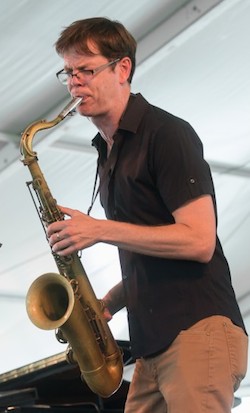
Donny McCaslin, David Bowie, jazz, Lazarus, Blackstar

Donny McCaslin: Bowie’s new-found friend

The saxophone was Bowie’s first instrument, which he started learning in his pre-teens inspired by a bohemian, jazz-loving elder half-brother, Terry Burns. Bowie once said that, aged 14, he couldn’t decide if he wanted “to be a rock’n’roll singer or John Coltrane”. Even in his rise to rock fame, Bowie remained a creature of the jazz age, at least in the sense of the boundary-crashing freedom that characterises his work.

A new single, Lazarus, released today, may kick off in the vague realm of contemporary music, with spectral guitar and stuttering rhythms calling to mind the young British trio the xx, but it is not long before those saxophones are sighing and the beat is fragmenting. Just about holding it together are the familiar tones of Bowie’s teeth-gritted, tight-chested whisper of a vocal, proclaiming it is This way or no way / You know I’ll be free / Just like that bluebird / Now ain’t that just like me? Sure sounds like jazz to me. . .

What Bowie has created with this hardcore jazz crew, though, is not something any jazz fan would recognise and is all the better for it. At its best, free jazz is amongst the most technically advanced and audacious music ever heard but it can be uncompromisingly difficult to listen to for the non-aficionado. The improvisational elements that make it so gladiatorial and hypnotic live can make it over complex and inaccessible on record. Bowie’s intriguing experiment has been to take this wild, abstract form and try to turn it into songs. Blackstar is an album on which words and melody gradually rise from a sonic swamp to sink their hooks in. It is probably as close as free jazz has ever got to pop. . . / Read the full review at Telegraph online

◼ IN AN UNNERVING SIMULATION OF BOWIE’S VOICE, the star of Bowie’s new musical Lazarus, Michael C. Hall, sings its title track for the CBS Late Show (below) the day it is released as a single. The maestro himself is watching the show at home in his armchair. How meta-modern is that?!

➢ Bowie fulfills his jazz dream – Listen to an NPR Music interview with the two main characters who accompany Bowie on this new adventure in music – his longtime friend and producer Tony Visconti and his new-found friend/saxophonist and band leader Donny McCaslin.

➢ Nov 23, more background revelations in Rolling Stone – “We were listening to a lot of Kendrick Lamar,” says producer Tony Visconti. “The goal was to avoid rock & roll”

➢ PLUS: The Blackstar album reviewed track by track by Neil McCormick
FRONT PAGE

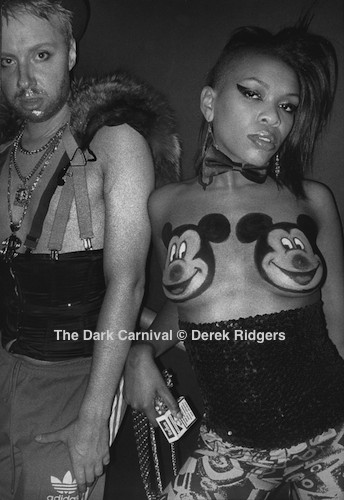
➤ Spicy new survey from Derek Ridgers celebrates the wild hours between dusk and sunrise

books, Carpet Bombing Culture,photography, nightlife, London, UK, youth culture, street style, Dark Carnival, Derek Ridgers

Clubbers at the Astoria in 2000 photographed by Derek Ridgers


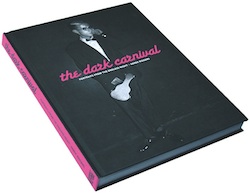
◼ HERE’S A PROMO VIDEO FEATURING some preposterous talking heads who include photographer Yasmine Akim and dancer Constantine Flowerz, describing a new large-format book of spicy photographs from Derek Ridgers’ travels through London clubland… The Dark Carnival: Portraits from the Endless Night is being published next week by Carpet Bombing Culture.

books, Carpet Bombing Culture,photography, nightlife,London, UK, youth culture, street style, Dark Carnival, Derek Ridgers, If you’re in it, you’ll be on the list for the launch party on Friday 27th from 5pm at the Lights of Soho gallery, followed on by a free Soho Swag night from 9.30pm at the 68 and Boston bar at the top end of Greek Street, hosted by 80s shapers Christos Tolera and Chris Sullivan.

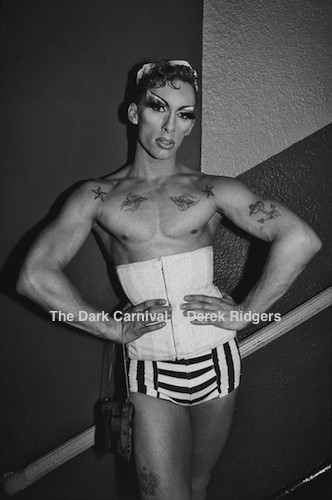
The Dark Carnival is Derek’s second book published this month. He modestly calls it “my 40-year wander through nightclubs” but this delicous cornucopia selected by Derek himself proves much more of an adult shocker where anything goes on the themes of sexuality, seduction and shame (lack of), with eye-poppers shot at Anarchy, Smack, Submission, Wacko, Wicked, Rubber Ball and coming right up to date at Torture Garden.

➢ Buy The Dark Carnival direct from Carpet Bombing Culture, 216 huge pages for £30

photography, nightlife, London, UK, youth culture, books, Carpet Bombing Culture,street style, Dark Carnival, Derek Ridgers

Anonymous clubber in Brixton 2011 photographed by Derek Ridgers

AUDIO UPDATE: ROBERT ELMS INTERVIEWS DEREK ON BBC RADIO LONDON 9 dec 2015

+++
Q: Does this kind of nightlife still exist?

“Yes it does. It’s not quite so focussed today and readily categorisable. Hardly any of the little basement clubs are left in Soho. I think the St Moritz is the only one” – Derek Ridgers on BBC Radio London

FRONT PAGE

1980s ➤ The Ridgers lens lays bare the pursuit of love

The Others, Derek Ridgers, Idea Books, youth culture, nightlife, London, Swinging 80s, Dover Street Market, photography, style,

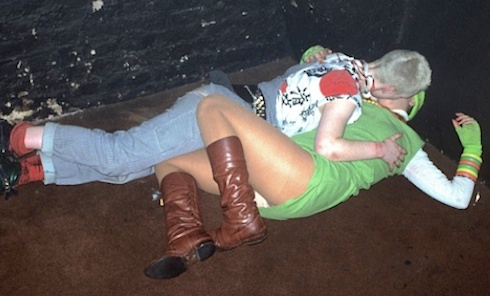
London 1984: if this is you, come to the party! Photo © Derek Ridgers

◼ IF THIS PHOTO SHOWS YOU perfecting the horizontal jig in a London club in 1984, you’ll find yourselves immortalised in the latest book by photographer Derek Ridgers, titled The Others. The collection captures young love in all its clubland guises and if you spot yourself in this gallery why not email info [a t] idea-books.com and ask to come to the London launch this Thursday, 19 Nov?

Between 1980 and 1986 Ridgers and his candid lens couldn’t help following the pursuit of romance among the lovers, the loveless, the lonely and the last to leave in nightclubs as disparate as Gossip’s, Planets, Great Wall, Batcave, Feltham Football & Social Club, Flick’s, Lyceum, Le Beat Route, Camden Palace, Taboo and many more.

These snogging couples represent Britain’s many subcultural tribes who expressed distinct affinities in the early 80s through personal style and musical tastes. The book’s foreword says its intriguingly contradictory title describes the “other” clubbers who had enough attitude *not* to get rejected by the greeters on the doors of London’s finest clubs. It would make more sense to call these kids The Chosen Ones. Once inside a club, however, they got their priorities right and relegated posing into second place behind the down-to-earth goal that was really on their minds.

The Ridgers images capture all the fun and frailty and the frissons of exploring your youthful identity among like-minded tribalists in ways the publisher was probably trying to nail: a sense of “otherness” that characterised many subcultures in that austere and intolerant era. Whether brave or tentative, outsiders or players, they were helping shift attitudes in dark and stylish cellars across the land. They re-energised Britain by mobilising the talents in which the young excel: through music, clothes, haircuts and romance.

The Others is priced £35 for 124 pages in a limited edition exclusively available at Dover Street Market London and New York, Ginza and the Comme des Garcons Trading Museum in Paris, as well as Marc Jacobs’ Bookmarc stores in New York, Los Angeles, London, Paris and Tokyo. And online from Idea Books.

The Others, Derek Ridgers, Idea Books, youth culture, nightlife, London, Swinging 80s, Dover Street Market, photography, style,

Big hair, 80s-style: Mohican and his captive. Photo © Derek Ridgers

FRONT PAGE

1982 ➤ Discovered: Lost footage of PX and Steve Strange in drag

◼ A SENSATIONAL DISCOVERY LOST FOR 30 YEARS … This 14-minute TV report captures the subculturally fertile period of spring 1982 when so many of London clubland’s collaborative talents were making their own creative waves, even as nightlife itself went mainstream with a bang and mega-discos started to take hold across austerity Britain.

Here leader of the Blitz Kids and club entrepreneur Steve Strange is discovered by Robert Mugnerot for TF1’s Megahertz in an excellent piece of reportage from London. It was shown in France on 23 March 1982, two weeks before Steve staged his Best of British designers fashion show at Le Palace in Paris, but shot presumably in that pause when Strange and his deejay Rusty Egan were clubless, between the end of Heroes in Baker Street’s Barracuda, Dec 1981, and the opening of Camden Palace in April 1982.

This package intersperses Visage performance clips with initial footage at the always-cool Embassy club showing many of the usual suspects, plus a good sequence inside Helen Robinson’s PX boutique, featuring Helen, the young milliner Stephen Jones and designer Melissa Caplan. It closes with model Julia Fodor in studio for a Visage video shoot, plus Steve Strange dragged up as his pal Francesca Thyssen singing The Lady is a Tramp in a duet with the French singer Ronny, both wearing Antony Price, as featured in Vogue. Cap that!

Stephen Jones , PX, fashion,Steve Strange, Swinging 80s

1982: Milliner Stephen Jones and Steve Strange show off the PX boutique to French TV. (Screengrab © TF1)


Steve Strange , video, Ronny

1982: Steve Strange dragged up singing The Lady is a Tramp with Ronny for French TV. (Screengrab © TF1)

➢ Previously at Shapersofthe80s, my full 1982 report and videos of the Best of British show in Paris: Steve Strange takes fashion to the French

FRONT PAGE

➤ Princess Julia relives the day when 1980 went Boom!

 Daily Mirror, Blitz Kids, New Romantics

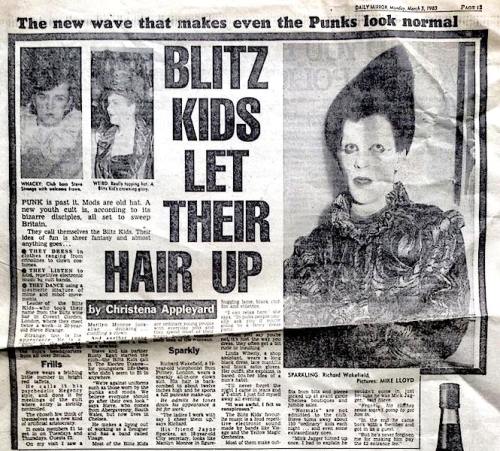
The Daily Mirror, 3 March 1980

◼ IT WAS MARCH 1980 WHEN the term Blitz Kids was first used to describe the “weird” and “whacky” young people making waves with their in-flight haircuts at the Tuesday club-night in London’s Blitz wine bar. The cutting here from the Daily Mirror says it all: in those days the left-wing tabloid sold 3.6million copies daily and was still taken seriously for its news coverage, while the Sun was just overtaking those sales figures with a distinctly down-market approach. Newspapers were a mass medium back then.

Using the lively wide-eyed language of the red-tops, Mirror feature writer Christena Appleyard put her finger on exactly those elements of individualism and waywardness that would later the same year see the Blitz Kids renamed the New Romantics. What she completely omits to mention is that four days later the house band of the Blitz, Spandau Ballet, were playing only their fourth live gig in London, at the trendy Scala cinema. In fact, she doesn’t even mention the band alongside Visage and Yellow Magic Orchestra as part of the club’s “electro diskow” synthesised soundtrack.

Appleyard was a savvy writer hearing only one part of a genesis story, yet her headline put the Blitz Kids on the media map and Boom! – this was lift-off for the careers and reputations of about 50 cool clubbers
in the short term, and a whole new look and sound for UK pop culture generally.

Julia Fodor is part of the founding mythology of the Blitz Kids, and tonight in London she was giving an illustrated “audience” to a select crowd in Hoxton. At The Glory pub she was reliving her teen years as mannequin de vie for PX, the New Romantic clothes shop, and as Blitz Club cloakroom girl, who later became a cultural commentator and international club deejay who at her height was being helicoptered into Paris to play at the posey Queen nightclub on the Champs Elysées.

New Romantics, fashion

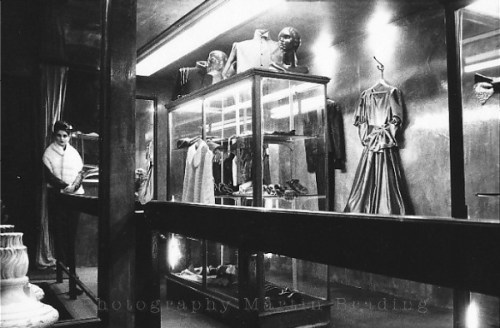
PX moves into Endell Street in Feb 1980: New Romantic satin gowns, Fauntleroy collars – and Julia. Photographed © by Martin Brading

And Julia’s rise was the norm for those key Blitz Kids with ambition and attitude in 1980. Before that March you could count the media mentions of Steve Strange’s club night: three in the Evening Standard; a page in Tatler; a feature in New Society, the sociology weekly; and a feature about “chiconomy” in the March issue of 19, the teen magazine.

Then Boom! The Blitz Kids headline triggered a small rash of media outbreaks as two perceptive photographers visited the club to take pictures – Homer Sykes and Derek Ridgers – while student journalist Perry Haines featured his Blitz pals in the Evening Standard fashion pages. What put Spandau Ballet on the map, however, were reports in the Standard, the Daily Star and Record Mirror of their electrifying concert, complete with ornamental Blitz Kids dancing in the aisles to a whole new style of music-making – theatrical, romantic, fashion-conscious and danceable – that resulted in a second Scala concert being scheduled for May.

Reading about the Blitz phenomenon had intrigued a young researcher on Janet Street-Porter’s yoof documentary slot, 20th Century Box, at London Weekend Television which then commissioned the May replay for their cameras. In the meantime one alert talent scout at Chrysalis Records also wanted to hear the band’s music. The next few months saw the Blitz Kids start to gobble up column inches and enliven the odd TV strand, while the two coolest magazines of the decade, The Face and i-D, were launched specifically to report this burgeoning youth culture based on street style.

Spandau landed the first contract for a New Romantic band in October, while Visage released its first album in November after signing to Polydor, and the Romantic band-wagon was under way. By Christmas 1981 the sound of the UK pop charts had been transformed completely from rock guitars to bass and drum.

❏ Tonight and for two more Mondays, An Audience with Princess Julia celebrates London’s glorious counter-culture with extracts from her own memoirs supported by visuals by her friend, deejay and face about the club scene Jeffrey Hinton. Tonight Professor Iain Webb also participates, with bespoke accessoriser Judy Blame on Nov 16 and milliner Stephen Jones OBE on Nov 23 – all at The Glory, London E2 8AS.
➢ Tickets available only in advance via Ticketweb

JULIA RAMBLING DOWN MEMORY LANE TONIGHT

Blitz Kids, Ryan Lo, fashion, Princess Julia

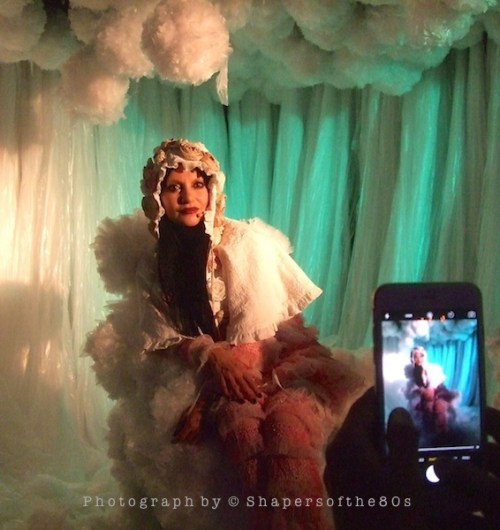
Julia talks: adorned in a kind of Baby Jane pink ruffled nightie by Ryan Lo, from his SS16 collection, with cap of roses (inset, being snapped by Louie Banks)

Click any pic below to launch slideshow

FRONT PAGE