Category Archives: Youth culture

2016 ➤ Britain stunned by sudden death of George Michael, our biggest pop superstar of the 80s

GEORGE MICHAEL
25 June 1963–25 December 2016
George Michael, Wham!, pop music,

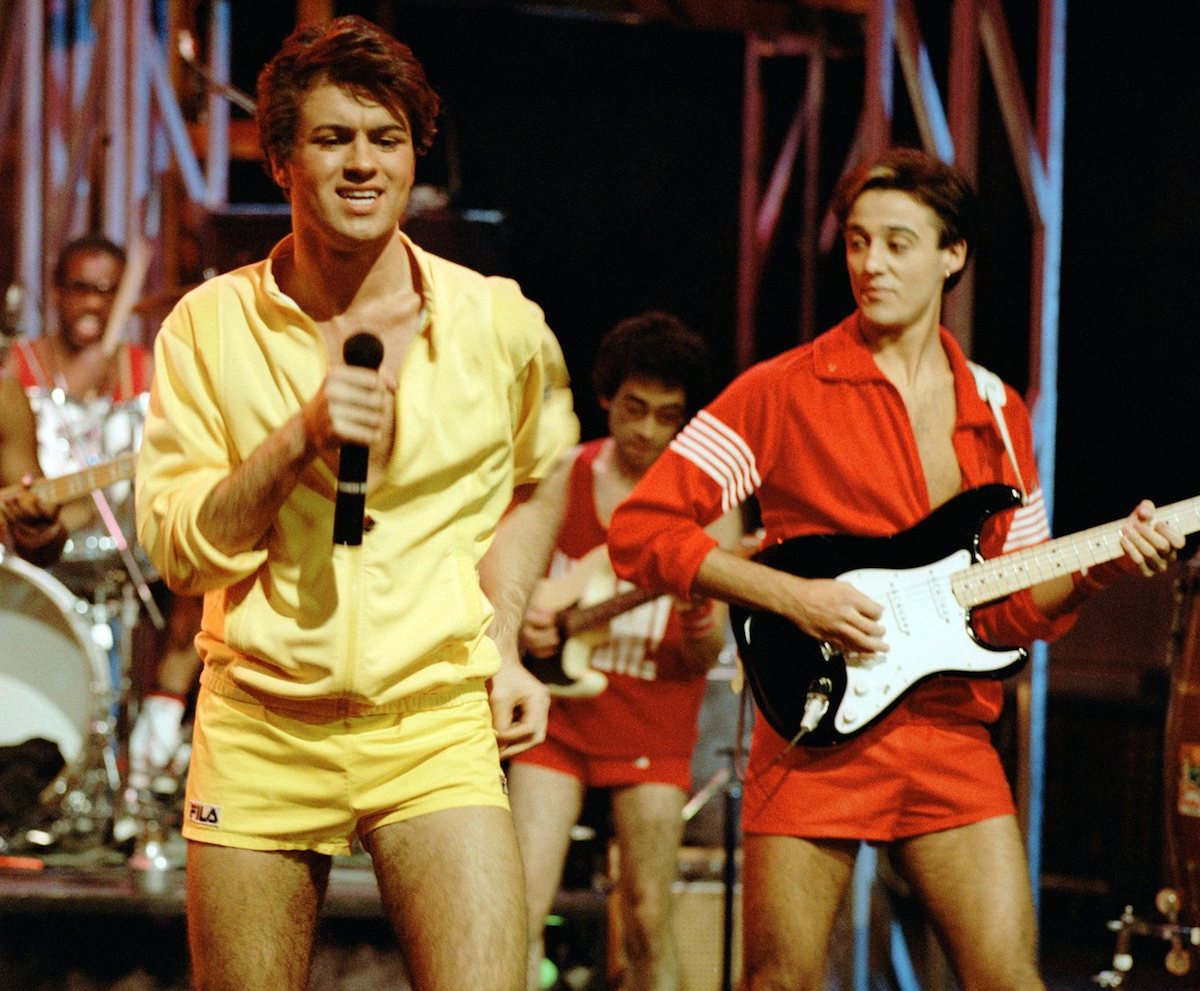
Wham! on The Tube, 1983: George Michael with his partner Andrew Ridgeley on guitar (Photo: ITV)

“ Five albums in 25 years is not exactly prolific
but I think pretty good in terms of quality. . .
The body of work is safe now. If I get hit
by a bus tomorrow, people will remember
what I have done and they’ll still enjoy it ”
– George Michael, 2008

WHAM! SOLD 40 MILLION RECORDS WORLDWIDE in four years after emerging from London’s innovative clubbing scene in 1982. As a solo singer-songwriter George Michael then sold another 100 million records, scored seven number one singles in the UK and eight number one hits in the US. He ranks among the best-selling British acts of all time, with Billboard magazine ranking him the 40th most successful artist ever. And he won every major world music award, often more than once. Yet his career was sporadic, interrupted by odd breaks, bouts of melancholy, health problems and in recent years a series of run-ins with the law over reckless driving, drugs and sex.

On his music, disc jockey Paul Gambaccini says: “George is likely to be remembered in two different ways: in Britain he’s a pop star and in America he’s a soulboy.” On his hedonism as propaganda, author Mark Simpson in Rolling Stone concludes: “Whatever the long term effects on his happiness, being ‘openly closeted’ for so long seems to have been key to not only making Michael a commercially-successful artist but also a surprisingly subversive one. And perhaps it also lay behind his determination, once out, not to go back into the biggest closet of all: respectability.”

OBITUARY HIGHLIGHTS

➢ Singer who became Britain’s biggest pop star
– Guardian obituary:

George Michael, who has died aged 53, was Britain’s biggest pop star of the 1980s, first with the pop duo Wham! and then as a solo artist. After Wham! made their initial chart breakthrough with the single Young Guns (Go for It!) in 1982, Michael’s songwriting gift brought them giant hits including Wake Me Up Before You Go-Go and Careless Whisper, and they became leading lights of the 80s boom in British pop music.

From the late 1990s onwards Michael was beset by a string of personal crises and clashes with the law caused by drug use. He had always felt ambivalent about the demands of stardom, and found it difficult to balance his celebrity status with his private life. After years of concealing his homosexuality, he eventually came out in 1998, after being arrested for engaging in a “lewd act” in a public lavatory in Beverly Hills, California. . . / Continued at The Guardian


➢ One of the more enduring musicians of the 80s generation – BBC obituary:
His talents as a singer, songwriter and music producer made George Michael one of the world’s biggest-selling artists. Blessed with good looks and a fine singing voice, his stage presence made him a favourite on the live concert circuit as he matured from teen idol to long-term stardom.

After early success in the duo Wham! he went on to build a solo career that brought him a string of awards and made him a multi-millionaire. But there were times when his battle with drugs and encounters with the police made lurid headlines that threatened to eclipse his musical talents. He admitted that he often went out at night seeking what he called “anonymous and no-strings sex”. . . / Continued at BBC online

“ Outside of Elton John, I’d say he is
probably the greatest philanthopist
in popular music ” – Paul Gambaccini

➢ Dame Esther Rantzen, Childline founder:
For years now George has been the most extraordinarily generous philanthropist, giving money to Childline, but he was determined not to make his generosity public so no-one outside the charity knew how much he gave to the nation’s most vulnerable children. Over the years he gave us millions and we were planning next year, as part of our 30th anniversary celebrations to create, we hoped, a big concert in tribute to him – to his artistry, to his wonderful musicality but also to thank him for the hundreds of thousands of children he helped through supporting Childline.

Kenny Goss , George Michael,

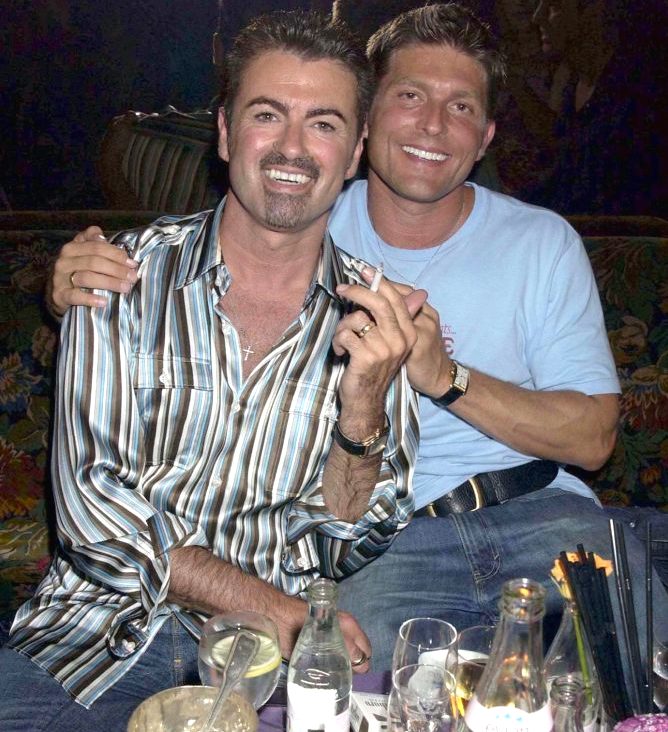
George with Kenny Goss in happier times… they met in 1996 and broke up in 2009 (Photo: Rex)

“ The truth is my love life has been a lot more turbulent than I’ve let on ” – George Michael

➢ Spending time together with love of his life – The Sun:
George Michael had secretly become close again with the love of his life Kenny Goss, just weeks before his death. George had reached out to Kenny following their difficult split. A close friend revealed: “George and Kenny are back spending time together again and it’s an exciting time for those of us who have been so worried over the last few years. The pop superstar split from Texan art dealer Kenny in 2009 after 13 years and his life quickly spiralled, culminating in a lengthy stint in the world’s most expensive rehab clinic in Switzerland last year.

On the opening night of his Symphonica tour in 2011, the singer admitted: “In truth Kenny and I haven’t been together for two and a half years. I love him very much. This man has brought me a lot of joy and pain”. . . / Continued at The Sun online

➢ Jim Fouratt, US 80s club host and activist:
No one seems to remember the incident between George Michael and the president of Sony Music America, Tommy Mottola. I do. George Michael set up a meeting with Mottola, having sold 80 million records worldwide, reaping huge profits for the company. Michael was not happy with how his new album was being marketed. Suddenly, from behind closed doors, the Sony staff could hear Mottola shouting: “Get this faggot out of my office!”

George left. Mattola’s homophobia shocked him. He went back to England. Sued Columbia and spent six years without a release in the US. Finally David Geffen signed him to his new label Dreamworks after settling the lawsuit which gave Dreamworks all rights in the US for a new George Michael album. A hit. George Michael was back on the charts in the US. Then the arrest in a public bathroom in Beverly Hills made headlines across the world. Michael (finally) came out.

Very sad to learn of George’s passing. But he stood up for himself after he was very publicly outed. Yes, he could have come out earlier – but Mottola’s action gives one insight into why he did not.

➢ Owen Jones, Guardian writer:
The popstar’s openness about his sex life, and his campaigning for LGBT rights, offered a liferaft to many – particularly at a time when anti-gay sentiment was rife. As a closeted teenager back in 1998, it is impossible not to recall the courage and defiance of George Michael. A talented and much adored musician, yes. But also a gay man, and a gay icon, who made the lives of so many LGBT people that little bit easier.

➢ 20 essential songs: The best of the pop icon George Michael’s hits – at Rolling Stone:
George Michael swiftly transitioned from teenage pretty boy to outspoken pop force. “It says something for the power of the music,” he told Rolling Stone after the release of his smash 1987 solo debut, Faith, “that I’ve managed to change the perception of what I do to the degree that I have in this short a time. Because it’s something that a lot of people thought wasn’t possible. . . / Continued online

CELEBRITY TRIBUTES

Andrew Ridgeley, schoolfriend, partner in Wham! – “Heartbroken at the loss of my beloved friend Yog. He had a voice that would transport you, he was the finest singer/songwriter of his generation & has left the best of himself for us. RIP.”

Michael Lippman, Michael’s manager, told Billboard that he died of heart failure and was found “in bed, lying peacefully”. . . “I’m devastated.”

Spandau Ballet – “We are incredibly sad at the passing of our dear friend George Michael. A brilliant artist and great songwriter.”

Simply Red – “It’s hard to take in. One of our most talented singer- songwriters has left us. Such sad, tragic news.”

Mark Ronson – “George Michael was one of the true British soul greats. A lot of us owe him an unpayable debt.”

Paul McCartney – “George Michael’s sweet soul music will live on even after his sudden death. Having worked with him on a number of occasions, his great talent always shone through and his self-deprecating sense of humour made the experience even more pleasurable.”

Tony Visconti, producer – “I lived through early grief of my pop idols dying on me. Nothing, however, prepared me for this year. Of course the biggest blow was when David Bowie passed. He was my colleague, but more importantly a friend for 48 years. I’m just barely in the acceptance stage with that; my philosophical attitude, ‘this just happens’, helped a lot. But today, with the death of George Michael, this is a little too close to home. Wham made their first album in my Good Earth studios with Chris Porter engineering and he eventually producing George Michael. As my office was in the studio I would pop my head in and say hello. This has happened too much this year. As of today it feels like a damn conspiracy.”


Chaka Khan – “Performed a few shows with George Michael when he was with Wham in the 80s. Here’s a clip of him covering Ain’t Nobody from 1991.”

Sir Elton John – “I am in deep shock. I have lost a beloved friend – the kindest, most generous soul and a brilliant artist.”

THE TERRY WOGAN SHOW, 1984

TALKING ABOUT A FILM OF HIS LIFE, 2005

‘MY OWN SELF-DESTRUCTIVE STREAK’, 2007

➢ 2016, London’s young guns remember George Michael

➢ Previously at Shapersofthe80s:
2010, Rich List puts George Michael top of the popstars from the un-lucrative 80s

FRONT PAGE

➤ Ex-Blitz Kid Rusty Egan and friends dress 80s electro-pop in brilliant new clothes

Welcome to the Dancefloor, Rusty Egan, electro-pop, Blitz Kids, New Romantic, EDM, synthesisers,

Egan deejaying at Tramp this week: a nightclub launch for Welcome to the Dancefloor

AFTER FIVE YEARS OF BLAGGING, and five years of feuding with former collaborators, 80s Blitz Club deejay Rusty Egan’s own “electro-diskow” album, Welcome to the Dancefloor, amounts to a superb sonic landmark. He and his guest performers engage an impressive range of emotions by dramatically humanising the potential starkness many associate with electronica.

ALBUM REVIEW
Welcome to the Dancefloor
Rusty Egan

Spookily, their energy rockets us immediately into that vast clean stereo soundscape that uniquely defined the new music of 1980. Here synthesiser chords are stretched and layered and cracked like a whip, as if by an invisible hand in another time and space, which of course was precisely the sound of London clubland when its youth culture erupted as a volcano of creativity. The album’s pacey opening track finds ex-New Order’s Peter Hook on The Other Side spinning through the Milky Way, his thin 80s vocal style querulous and wistful, yet poppily optimistic.

That era did after all abandon the overpowering noise of the rock stadium and the punk nihilists to celebrate a return to melodious singing voices and to arch lyrics meant for listening, while synthesisers defined a fresh musical ambience. Inexperienced young artists unsure about their singing ability half shouted, half vocodered their limited vocal range to re-imagine their teenage dreams on a different planet.

Egan’s collaborators: click any pic below to launch slideshow

While Egan has carefully selected 13 tracks reflecting the wide spectrum of synth possibilities, half are love songs in the spirit of the 80s generation who were dubbed by the press New Romantics. Nevertheless he has created a consummate showcase for electronic music, co-produced by Nick Bitzenis (aka Nikonn). He has had a hand in writing a majority of the songs, many co-written with Chris Payne (of Fade to Grey fame), these being subsequently endorsed and expressed by a handful of starry friends such as Midge Ure and Tony Hadley on tracks of their own.

Despite its title, this is not dance music that the funk nation would groove to. Laying down a dominant 4-4 beat is not conducive to free-form movement unless you think you’re Tik or Tok. Exceptions include Egan’s own pulsating title track with robo vocals as if by Stephen Hawking and knowing breaks parodying Tenek and the Human League; also the nippy number Hero, which gains spiritual resonance from Andy Huntley’s richly textured delivery.

➢ Listen online to Welcome to the Dancefloor
track by track

The stand-out track is Midge Ure’s transformation of an Egan/Payne song titled Glorious. He rewrote lyrics and melody so as to construct one magnificent crescendo filled with space and tension reminiscent of “Ohhhhh, Vienna!” A close second for reconjuring the authentic 80s is Egan’s own Wunderwerke, driven by his Trans-Europe vocals through classic synth sweeps, hypnotic repeats and bass stabs. Third comes Erik Stein on the astonishingly contemplative Ballet Dancer, basking in a wonderful waterfall of synths.

Like Brexit, Tony Hadley *is* Tony Hadley and here (without the Ballet) on the coltish lovesong Lonely Highway he canters to the top of a whole new hill as a crooner. What distinguishes this album is that it’s awash with affecting lyrics and fine voices to listen to in the name of electro pop – among the gentlest are Be The Man featuring the gorgeous inflections of Kira Porter; Nicole Clarke’s ethereal contribution to Love Can Conquer All; and Love Is Coming My Way, a second number from the silken-voiced Stein.

And just wait for the Chariots of Fire finale: Egan’s intensely personal track, Thank You, which unleashes a shock of the best kind. To describe more would be to spoil a gifted idea. It is emotional and all too evidently sincere. Thank you, Rusty.

Welcome to the Dancefloor, Rusty Egan, electro-pop, Blitz Kids, New Romantics, EDM, synthesisers,

Rusty Egan: co-producer, co-writer and much else – has created a landmark album in Welcome to the Dancefloor

➢ Pre-order Welcome To The Dancefloor as 180g vinyl LP and CD variants, plus bonus mixes, at Pledge Music. – All pledges immediately receive MP3 downloads of the album, with the physical products promised by Rusty Egan “once we reach a target” (unspecified). At worst, PledgeMusic clearly says it “will refund you if the Artist doesn’t reach their target”.

➢ Previously at Shapersofthe80s:
1980, First sighting of the Blitz Kids

FRONT PAGE

➤ Escape to the Nightlifers’ Shangri-la just in time for Christmas

Animal Nightlife, Andy Polaris, soul music, jazz, pop group,London, Andy Polaris,nightclubbing,Shangri-la, CD

Cool-hunters 1985: the Animal Nightlife lineup who charted with their album Shangri-la. . . Billy Chapman, Paul Waller, Andy Polaris, Leonardo Chignoli and Steve Brown

REMEMBER SNAKE-HIPPED ANDY POLARIS, frontman for Animal Nightlife, the soul/jazz/pop socialist collective who emerged from London’s cool clubbing scene and charted with Native Boy in 1983? This week their debut album Shangri-la is re-issued in a deluxe two-CD edition, having charted in summer 1985 only on vinyl.

Andy says: “It comes with a bonus disc of remixes and a great booklet with retro photos of the band in its two phases. Just in time for Christmas. The vinyl album has long been deleted and since then a very poor compilation of songs was released. The re-issue’s  tracks consist of the album in its original form and a second CD containing other singles and extended remixes that were only available on 12-inch before.” Lois Wilson supplies some nicely informed sleeve notes identifying Animal Nightlife’s role as innovators when the UK’s thriving underground changed the face of nightclubbing.

“Just listen to the Pink Panther style
saxophone of instrumental Basic Ingredients
and try not to lose yourself momentarily
in another world, a better world even”
First review (7/10) by Loz Etheridge

Managed by Steve Lewis, London’s coolest club deejay in the Beat Route’s heyday, Nightlife’s swing sound with an electronic twist enjoyed its moment as the hippest trend in music while Polaris penned his own brand of torch song and the band wore head-to-foot styles from Bolshevik bolshieness to Johnson’s jazz-age retro. Rabid clubbers must remember how Nightlife’s crazy animalettes and animalads went through about 35 line-up changes during their eight years on the scene, sadly scoring only four chart singles. For some band members, good times tended to take precedence over naked ambition in those highly competitive years when British acts were storming international pop charts.

“The must have re-issue CD of 2016.
A perfect Xmas stocking filler”
– deejay Mark Moore

By 1985 the band had slimmed down to the five-piece pictured on the CD cover. They consisted of Andy Polaris (vocals), Leonardo Chignoli (bass), Paul Waller (drums), Steve Brown (guitar) and Billy Chapman (playing a thrilling saxophone). After switching from the finger-snappy Innervision label to supercool Island Records, they were all packed off to Philadelphia where the first album was recorded at the legendary home of Philly World Records.

“The label wanted a bit more discipline from us,” Andy says, “and they sent us to America to get us out of our element and into the hands of those seasoned veterans who’d created the fabled Philly sound. We five working-class boys from London were wide-eyed and just did everything they told us. It paid off, because after our sojourn at Philly World our urban jazzy feel translated into a more sophisticated British club sound.”

❑ Standout track on the second Shangri-la CD of lost mixes is reggae producer Dennis Bovell’s version of Native Boy. Whoever’s on vibes – “mm, nice”.

➢ Shangri-la is cheaper direct from Cherry Red records (plus quick delivery)

➢ Andy Polaris recalls his impressions of recording with the Philadelphia greats

➢ Definitive yet unofficial Animal Nightlife band history created online by Mike Albiston, a fan who remembers their last gig. Last updated 2010 and viewable since then thanks to the Wayback Machine

➢ Catch Andy Polaris’s reminiscences in the recent BBC doc Boy George’s 1970s: Save Me From Suburbia

➢ Previously at Shapersofthe80s: Animal Nightlife as part of the UK’s second wave of 80s image bands

FRONT PAGE

2016 ➤ On film: two electrifying hours of The Beatles as they’ve never been seen and heard

The Beatles, Eight Days a Week, Ron Howard, documentary, film, Paul McCartney, Ringo Starr, John Lennon, George Harrison, Swinging Sixties, live concert, vintage, pop music, Shea Stadium, touring,

Pristine footage: The Beatles play Shea Stadium in August 1965. (Image: SubaFilms)

LAST NIGHT AT A LONDON CINEMA I saw the most exciting live pop concert since the same band played live in the Swinging Sixties. Ron Howard’s new Beatles documentary, Eight Days A Week about the touring years 1963-66, is a sensational feast of long-lost performance footage that confronts us with the Fab Four’s raw onstage energy and pounding tempo – the audio as gorgeously restored as the images. This two-hour celebration of Beatle genius goes behind the clichés of hysteria to give us Access All Areas. It delivers one revelation after another, from Paul’s “Oh-my-God” moment when Ringo joined the band, to the jaw-dropping recording of a top-ten single in 90 minutes of studio time, to their 1964 triumph for civil rights when the band refused to tour in the US until audience segregation was abandoned at their venues.

New interviews from Ringo Starr and Paul McCartney keep dropping gems of insight about this the most commercially successful group in pop history, while vintage footage does as much justice to lippy John Lennon and “quiet” George Harrison who are no longer with us.

Throughout this joyous moptops-into-men odyssey we’re wide-eyed at the sheer cheek of these multimedia superstars, aged between 19 and 22, who created their own interview style by pinging back witty ad-libs to questions from the world’s media. The downside was mass hysteria from teenaged babyboom fans laying siege to hotels and airports where they repeatedly overwhelmed police and security on an often scarifying scale.

Beatle albums sat at No 1 in the charts for 20 to 30 weeks at a time – more No 1 albums than any other musical act. Their 20 No 1 hit singles on the Billboard Hot 100 chart remain unchallenged.

The Beatles, Eight Days a Week, Ron Howard, documentary, film, Paul McCartney, Ringo Starr, John Lennon, George Harrison, Swinging Sixties, live concert, vintage, pop music, Shea Stadium, touring,

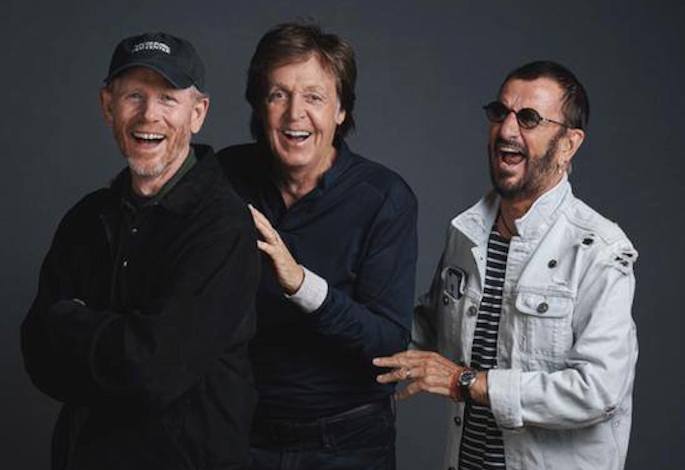
Ron Howard with Paul and Ringo this week: “I love this photo that was taken yesterday at Abbey Road Studios in historic Studio 2 while we were promoting The Beatles: Eight Days a Week”

Everything The Beatles did was without precedent. Among their innovations they launched arena rock and at Shea Stadium Howard’s doc ensures that we hear George’s guitar chords above the screaming audience of 55,000 fans. As a shock reminder of Sixties technology, Vox had built three new amps for the Beatles, each souped up to 100 watts (!!!) specially for touring America, their output being relayed via microphones to feed the stadium’s tinny loudspeaker system!!!

It is a breath-taking source of inspiration to know that during The Beatles’ far from meteoric early years, this Liverpudlian band of brothers had played at least 456 live gigs before signing their recording contract with EMI. Yes, 456 !!! With that amount of practice, it should be no surprise to find that their legacy amounts to 237 original compositions – songs which most people on the planet can hum, while the most radical among them personify the Sixties counterculture. As the best-selling band in history, the Fabs revolutionised all of music for ever.

Howard’s previous reality epics include the wonderful Apollo 13 and the gripping joust, Frost/Nixon. This week he told The Guardian: “I began to think of the Beatles story as like Das Boot: they’re in it together, they have each other, they know what their objective is, but, y’know, it’s a dangerous world out there.”

WHAT THE PRESS ARE SAYING

➢ Ron Howard trashes the idea that there’s nothing new to say about the Beatles – The Guardian:
This is about the Beatles as live phenomenon, and the fact that their music was all the more remarkable because it had to be heard above the scream – that ambient sound of sex, excitement and modernity, mixed in with a thin chirrup of press envy. The scream was an important part of it. . . an almost unbroken four-year, semi-improvised multimedia performance for which there was no pre-existing template – not simply the music but the giant public spectacle and public scrutiny.

➢ 10 Things we learned from Eight Days a Week
– Rolling Stone:

In February 1964, the band and their entourage occupied nearly the entire 12th floor of the Plaza NYC, including the 10-room presidential suite. But despite the space, the four friends retired to smaller quarters. “The four of us ended up in the bathroom just to get a break from the incredible pressure,” Starr says.

➢ “We were force-grown, like rhubarb,” says John Lennon
– Daily Telegraph:

The film shrewdly draws a line between the Beatles’ mischievous sense of humour and their long-time producer George Martin’s earlier life recording alternative comedy. Martin had worked with the Goons, an enormous influence on the band’s growing lyrical eccentricity in that period, as well as their off-the-cuff ribbing of strait-laced reporters.

REMASTERED UK FOOTAGE, MANCHESTER 1963

Previously at Shapers of the 80s:

➢ No wonder The Beatles changed the shape of music after 456 sessions practising in public

➢ 1963, With The Beatles the day Kennedy was shot: “The second house was distinctly more subdued”

➢ 1966, More popular than Jesus: the fascinating Lennon interview in full

FRONT PAGE

2016 ➤ Bowie’s passionate eye for art proves to be not bad at all

Damien Hirst,David Bowie, Sotheby’s, auction, art, furniture

In the Bowie/Collector sale: one of Damien Hirst’s first spin paintings from 1995 with a long-winded title, painted with household gloss. Sotheby’s est £250k-350k.

◼ WHAT A BRACING INSIGHT into David Bowie’s creative mind! Only 30 items are displayed in an exhibition of the musician’s art collection in London, yet, whether or not you share Bowie’s taste, his sharp eye for a strong image is indisputable.

This exquisite mini-show at the auctioneer Sotheby’s provides a taster for the sale of 400 items from Bowie’s collection in November. Sotheby’s chairman describes the musician’s taste as “eclectic, unscripted, understated” and there’s not a dud in sight. What is immediately evident is strong work by artists who changed the future, from an impertinent Marcel Duchamp readymade, through Wyndham Lewis, David Bomberg, Harold Gilman, Henry Moore, Peter Lanyon, Kenneth Armitage and Frank Auerbach. The core is clearly driven by Bowie’s love of 20th-century British art, with international detours to acknowledge Basquiat and others, plus dozens of items of 20th-century furniture.

Sotheby’s Bowie/Collector previews in London from 20 July to 9 August, then tours to LA, NYC, HK and returns to London in the autumn for a ten-day full exhibition from 1 November and an auction in three parts.

Click any pic below to launch slideshow

The only thing I buy addictively is art
– David Bowie

A spokesman for Bowie’s estate said: “David’s art collection was fuelled by personal interest and compiled out of passion. He always sought and encouraged loans from the collection and enjoyed sharing the works in his custody. Though his family are keeping certain pieces of particular personal significance, it is now time to give others the opportunity to appreciate – and acquire – the art and objects he so admired.”

➢ David Bowie’s personal art collection to feature in three sales – at Sotheby’s

➢ Works the late singer quietly collected over the years go on display – feature and gallery at the Guardian
The singer, who died in January, studied art and design at technical college and once confessed to buying art “obsessively and addictively”, but the scale of the addiction had not been realised. His family say they are selling because they have not got the space to keep the collection.

➢ Bowie’s Art and Furniture Collection – New York Times
“. . . his collection of modern and contemporary British art [includes] paintings by John Virtue, Stanley Spencer, Leon Kossoff and Patrick Caulfield, as well as work by contemporary African artists and pieces of outsider art. Mr Bowie also owned pieces by major international figures: Duchamp’s sculpture À bruit secret, two Hirst “spin” paintings and … a 1960s stereo cabinet by Achille and Pier Giacomo Castiglioni.”

➢ Starman in the saleroom – Antiques Trade Gazette
The top lot is expected to be Jean-Michel Basquiat’s Air Power, an acrylic and oilstick on canvas from 1984 that has an estimate of £2.5–3.5million. Prices for the artist have increased dramatically since Bowie bought the 5ft 6in high painting at Christie’s for a premium-inclusive £78,500 in November 1995.

David Bowie, Sotheby’s, auction, art, furniture

In the Bowie/Collector sale: Italian Brionvega Radiophonograph (model RR 126) by the Castiglioni brothers from 1965. Sotheby’s estimate £800-1,200

FRONT PAGE