Just watch this long-lost footage from the Johnny Carson show. Bowie utterly sensational on both tracks, the second being Ashes to Ashes. But this powerful version of Life on Mars has to be yet *another* definitive one!!!
➢ Posted at YouTube by Nacho Video: “ Here’s my new clean-up of the classic David Bowie 1980 performance on The Tonight Show – recorded at NBC Studios in Burbank, Los Angeles on September 3rd 1980. It was broadcast forty years ago on the 5th of September 1980.
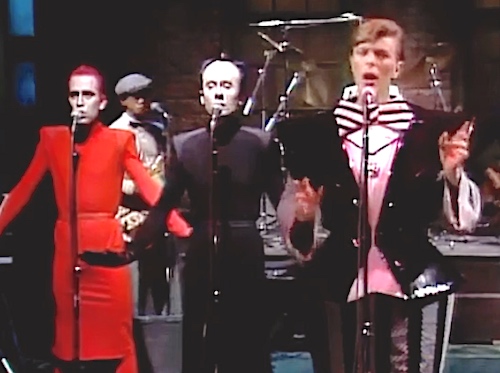
Performing with Bowie on the Tonight Show was a one-off band. Bowie’s regular musical right-hand man, Carlos Alomar was leading the band of young up and coming musicians, who were playing with Bowie for the first, and as it turned out, the only time.
The Tonight Show performance is unique in other ways. It was Bowie’s only live appearance of 1980, and the only time any Scary Monsters material was performed live, in its day. And the Tonight Show was one of only two live appearances he made (the other SNL, 1979) in the five-year period between the ISOLAR II 1978 tour and the Serious Moonlight tour in 1983.
The Tonight Show performance is great! Bowie is in fine voice and the band are full of spirit. I love Bowie and Alomar’s big smiles, as it becomes clear that the performance is a success. For me, this performance has always been frustratingly good, because it is a tantalizing glimpse of what a Scary Monsters tour could have been like. . .” / Continued at Nacho Video/Youtube
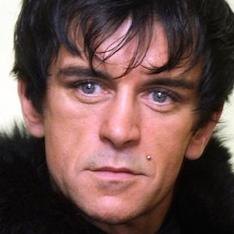
Unique live lineup for The Tonight Show, 1980: Bowie sings Life on Mars in James Dean rebel mode with Carlos Alomar on guitar at left
Click picture to view an immaculate video of Bowie singing The Man Who
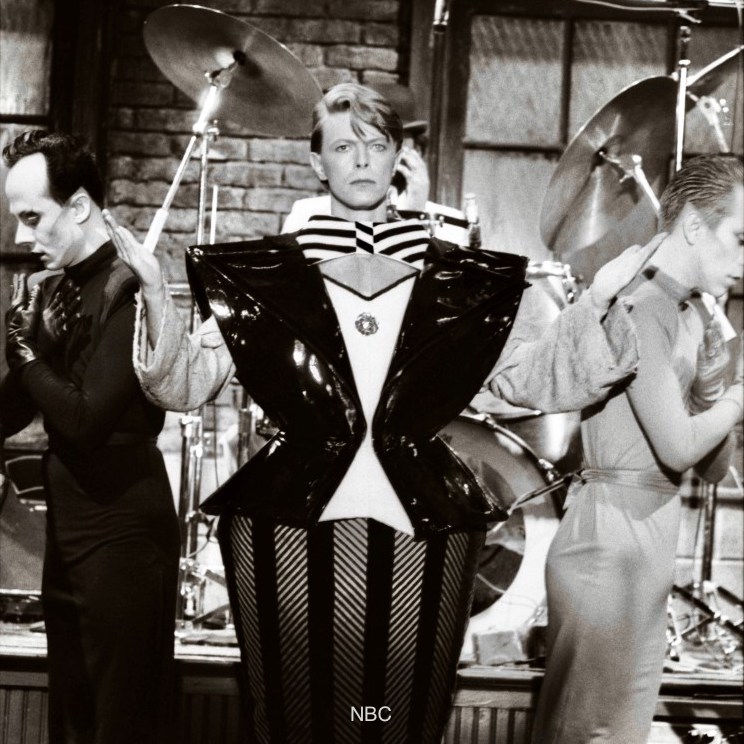
❚ HERE’S A RARE CHANCE TO VIEW one of the most inspired renderings of The Man Who Sold the World: David Bowie during a performance on Saturday Night Live on 15 December 1979. As backing singers we see the bizarre German punk Klaus Nomi at centre and wearing red at left is American performance artist, Joey Arias, who became a regular act at Club 57 in New York’s East Village. Anyone who visited the 2013–2015 touring exhibition, Bowie Is, from London’s V&A museum, will have seen Bowie’s huge tubular costume at first hand…
Luckily, this 8-minute clip also includes brilliant versions of TVC 15 with Bowie in a skirt and heels, plus Boys Keep Swinging where he sports a nude puppet costume with bizarre extremities. Nomi introduces us to his poodle who appears to have swallowed a TV set in this gifted trio of performances.
The Man Who Sold the World – title track of Bowie’s third studio album – was written in 1970 but released on the B-side of a single hence missed the charts in its own right. It did reach No 3 after Lulu covered the track in 1974 and other covers followed, including one by Midge Ure. Critically the song is widely regarded as one of Bowie’s essential best and only in his last couple of decades did he start rendering it in live performances in utterly different and often haunting ways. Nevertheless, the SNL video from 1979 is powered by a cascade of supremely confident operatic flourishes, “Ohhhh-oh-ohhhh, ohhhhhhh-oh!”
SNL December 1979: In his outsized costume, Bowie sings The Man Who Sold The World, flanked by Klaus Nomi and Joey Arias
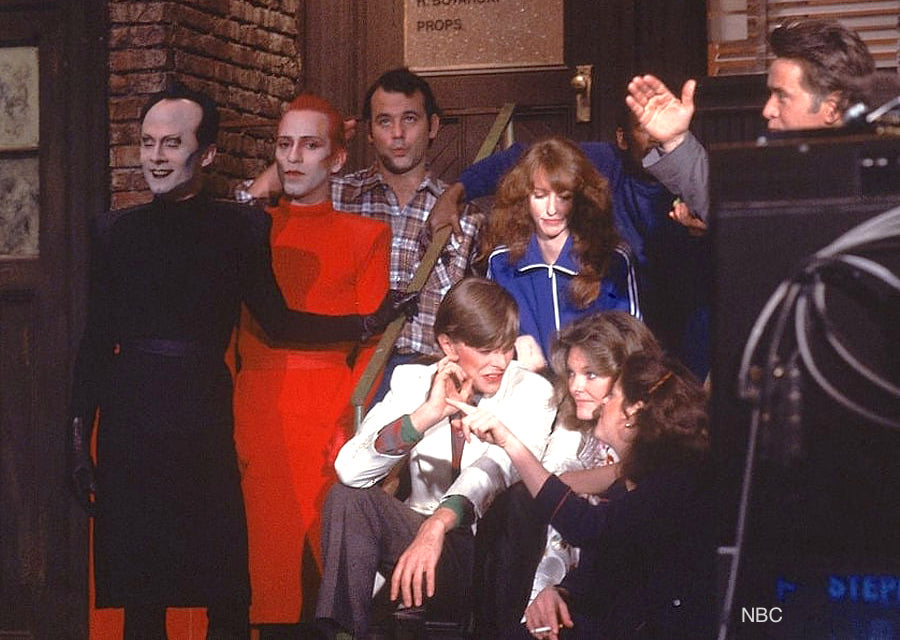
Backstage at that SNL, December 1979, from left: Klaus Nomi, Joey Arias, Bill Murray, Bowie, Laraine Newman, Jane Curtain, Gilda Radner, Martin Sheen (hosting that night)
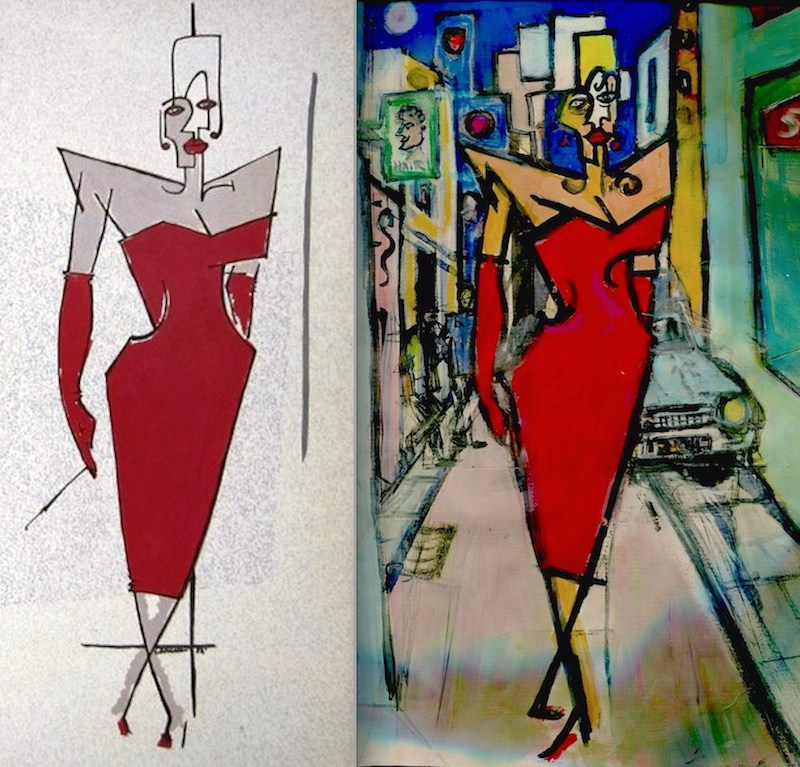
Carioca then and now: left, the cover for Chris Sullivan’s band’s 1982 single Carioca and, right, his new upfront reworking for 2019
Leah Seresin and mum Deirdre, newly painted by Sullivan
◼ WHO IS CHRIS SULLIVAN THIS WEEK? That all-round creative dynamo who drove much of the Swinging Eighties and ran the influential Wag club for 19 years epitomised that New Romantic era by declaring “One look lasts a day”. Suddenly he is enjoying another creative spurt. Fans will have noticed a series of bold and comic painted caricatures of his friends appearing on Facebook this month. As affectionate portraits they speak for themselves. But then last week he posted one called Carioca, inspired directly by the 12-inch single sleeve for his band Blue Rondo a la Turk. It was included in their album Chewing The Fat which dates from 1982.
Fans will also recall that Sullivan as vocalist not only put the band together as a septet of crazy soul-jazz-Latin musicians on a 0-to-10 sliding scale of eccentricity – where all of them scored at least an 11 – that won them a £500k contract with Virgin. He also painted every one of their vinyl record sleeves in his own playful version of cubism. So here above we can now compare his restrained vamp Carioca from 1982 with her current rather more in-your-face madame for 2019. So what’s this all about, Chris?
Bear in mind Sullivan was one of that gang of St Martin’s heroes who put London clubs such as the Blitz, Beat Route and the Wag on the map from 1980 on, and had studied first on the college’s fashion course, then switched to fine art. I am off to Soho to find out and will be reporting back. . .
Sullivan caricatures: A pair of what the painter calls Beat Peeps from Eighties New York
STEPPING OUT TO CARIOCA ON THE ITV SHOW RAZZMATAZZ 1982
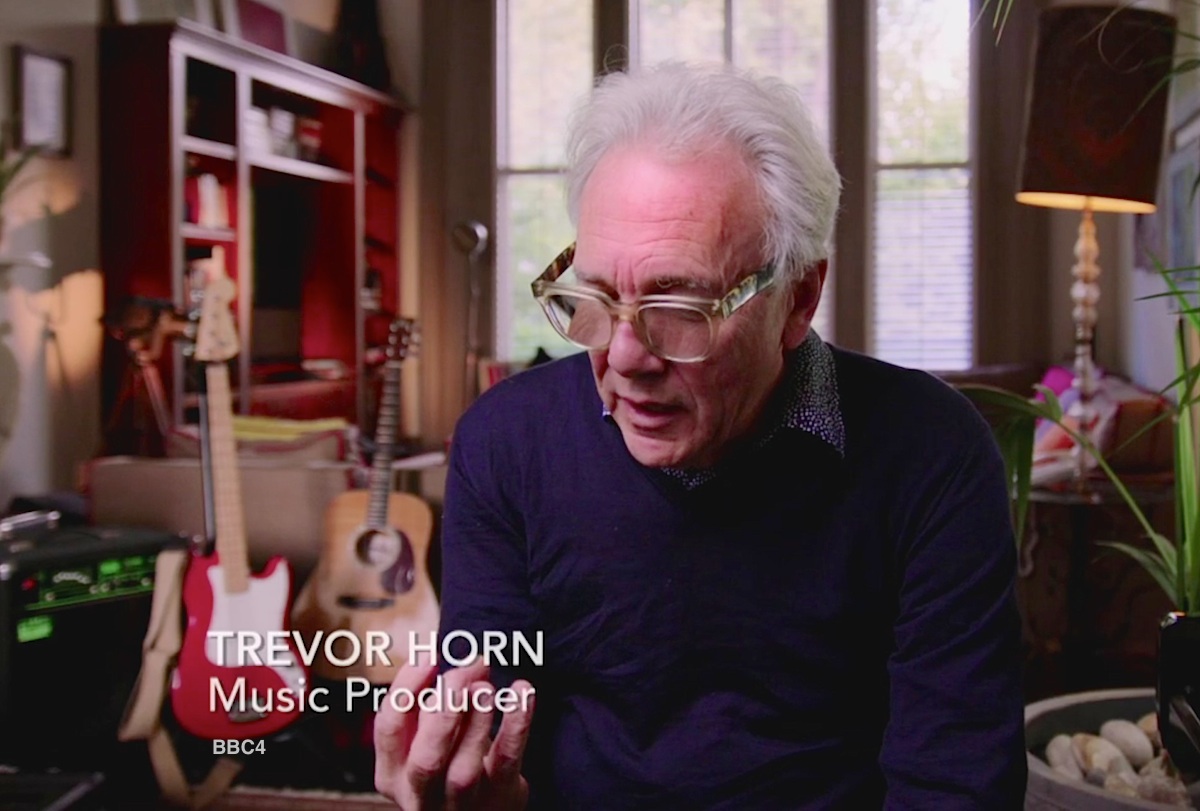
◼ RECORD PRODUCER TREVOR HORN – who helped shape the sounds of such 80s acts as ABC, Grace Jones, Pet Shop Boys and Frankie – last night shared five keys to being a successful pop artist. During the repeat of The Secret Science of Pop on BBC4 he said:
1 – Be able to write or have access to the best material.
2 – Have a really great voice, across two octaves.
3 – Have personal charm and charisma.
4 – Be physically and mentally strong.
5 – And, you’ve got to want it.
All of which made a deal more sense than the deluded “scientist” – a professor at London’s Imperial College who doesn’t deserve to be named! – who attempted to analyse success in the pop charts of the past 50 years by deconstructing thousands of hit tunes note by note. Nothing he proposed made any sense at all and after wasting 60 minutes of our time he shamelessly admitted he had “singularly failed” to out-flank Horn.
As compensation, Horn’s production team shared quite a lot of their intuitive magic in perhaps 15 of those minutes. Shame the whole documentary wasn’t about them instead.
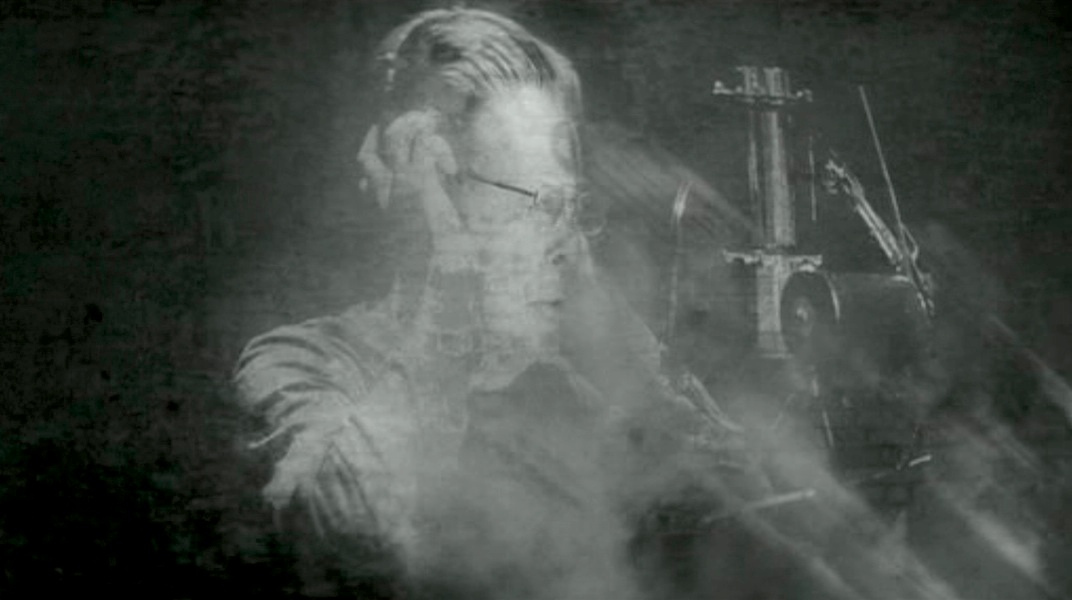
Bowie as a projected image in the video for Sue (Or in a Season of Crime)
“If you feel safe in the area that you’re working in, you’re not working in the right area. Always go a little further into the water than you feel capable of. Go a little bit out of your depth and when you don’t feel that your feet are quite touching the bottom, you’re just about in the right place to do something exciting” – David Bowie
◼ THE MOST GRIPPING SEQUENCES in the new TV documentary about Bowie’s final surge of creativity are those which assemble every musician in the bands he worked with from 2012 to the end. Each band re-enacts pivotal moments when they rehearsed the music, inspired by his lyrics, and laid down the tracks for the albums The Next Day and Blackstar. Particularly revealing is the session when pure jazz soloists created the nerve-tingling Sue (Or in a Season of Crime), which Bowie added to his 2014 “best-of” collection, Nothing Has Changed.
To mark the first anniversary of the star’s death, this weekend BBC2 screened David Bowie: The Last Five Years, Francis Whately’s sequel to his other superb documentary Five Years broadcast in 2013. The role of jazz in Bowie’s musical temperament seldom gets discussed, though his producer Tony Visconti says the jazz influence had always been there in the music but underneath the surface. As a small child Bowie heard a jazz band and right away said: “I’m going to learn the saxophone. When I grow up, I’m going to play in [this] band. So I persuaded my dad to get me a kind of a plastic saxophone on hire purchase.”
In 2013 in New York he met Maria Schneider, a jazz composer, handed her a demo disc and asked her to extemporise around a tune called Sue. In turn, she told him he had to listen to this sax player Donny McCaslin and without missing a beat Bowie went straight into the studio with his group and Maria and out came possibly the purest jazz number of his career, a discomfiting tale of infidelity. It won Schneider a Best Arrangement Grammy in 2016.
Donny McCaslin enthuses about Bowie during rehearsals
Maria Schneider’s proposed scoring for Sue
REVIEWS OF THE LAST FIVE YEARS TV DOC
➢ A thrilling portrait of a late-life renaissance
– Jasper Rees at the Arts Desk “ The opening yielded much joyful footage of Bowie goofing around on the Reality tour (2003), seeming much more like one of the boys than he ever managed with Tin Machine. The band still seemed spooked at the memory of his collapse, before he was carted off to retirement in an ambulance.
Maria Schneider was one of many musicians – three complete bands – who re-formed to walk through the creation of the music. Drummer Zachary Alford still looked shocked at the NDA handed him as he showed up to work on The Next Day. “If I said anything about it,” remembered bassist Gail Ann Dorsey, “I would be in big trouble legally.” Nobody was asked if Bowie really would have sued his collaborators for spilling the beans.
The recent collaborators reflected on the extent to which the new music was steeped in the past. But there was also good stuff from the old lags who worked (and sometimes slept) with Bowie in the feather-cut era: Ideally there would be a DVD with extras featuring much more from each of them. Chief keeper of the flame Tony Visconti sat at a console and played excerpts of Bowie’s unaccompanied vocal takes. On Blackstar came the haunting sound of Bowie wheezing like an ancient mariner fighting for every last scrap of breath. . . ” / Continued online
➢ A treat and a treatise on music’s departed genius
– by James Hall, Daily Telegraph “ The Last Five Years wove previously unheard Bowie interview material with on-screen contributions from collaborators including producer Tony Visconti. The access and insights were faultless. Whately’s programme was essentially a treatise on artistic rebirth. And it showed that although Bowie’s musical style constantly changed, the themes that preoccupied him — alienation, escape, the notion of fame — were there until the end.
During his final creative burst, Bowie gradually revealed to collaborators that he was ill. In the most poignant scene, we learned that Bowie only discovered his cancer was terminal three months before he died. This was in October 2015 when he was filming the video for Lazarus, in which he sings the line “Look up here, I’m in heaven”. Bowie worked and cared and joked until the end. Through tears, Visconti said that he was at ‘the top of his game’. . . ” / Continued online
Brixton tribute concert for Bowie: Gail Ann Dorsey singing Young Americans with Spandau Ballet’s Steve Norman. (Photo: Getty)
❏ On what would have been Bowie’s 70th birthday his friend the actor Gary Oldman gathered at the Brixton Academy a 30-strong all-star lineup of musicians who had collaborated throughout his career, with some glorious orchestral and choral support. The show is the first in a run of gigs around the world taking place in cities that have a strong connection with Bowie and his work.
The London concert featured Mike Garson, Earl Slick, Adrian Belew, Mark Plati, Gerry Leonard, Sterling Campbell, Zachary Alford, Holly Palmer, Catherine Russell, plus such guests as Tony Hadley and Simon Lebon. Special highlights saw Gail Ann Dorsey singing Young Americans with Spandau’s Steve Norman on sax; and an audience singalong to Life on Mars? led by Adrian Belew and gifted vocals from Tom Chaplin from the band Keane. Plenty of live videos at YouTube.
➢ Choose “View full site” – then in the blue bar atop your mobile page, click the three horizontal lines linking to many blue themed pages with background article
MORE INTERESTING THAN MOST PEOPLE’S FANTASIES — THE SWINGING EIGHTIES 1978-1984
They didn’t call themselves New Romantics, or the Blitz Kids – but other people did.
“I’d find people at the Blitz who were possible only in my imagination. But they were real” — Stephen Jones, hatmaker, 1983. (Illustration courtesy Iain R Webb, 1983)
“The truth about those Blitz club people was more interesting than most people’s fantasies” — Steve Dagger, pop group manager, 1983
PRAISE INDEED!
“See David Johnson’s fabulously detailed website Shapers of the 80s to which I am hugely indebted” – Political historian Dominic Sandbrook, in his book Who Dares Wins, 2019
“The (velvet) goldmine that is Shapers of the 80s” – Verdict of Chris O’Leary, respected author and blogger who analyses Bowie song by song at Pushing Ahead of the Dame
“The rather brilliant Shapers of the 80s website” – Dylan Jones in his Sweet Dreams paperback, 2021
A UNIQUE HISTORY
➢ WELCOME to the Swinging 80s ➢ THE BLOG POSTS on this front page report topical updates ➢ ROLL OVER THE MENU at page top to go deeper into the past ➢ FOR NEWS & MONTH BY MONTH SEARCH scroll down this sidebar
❏ Header artwork by Kat Starchild shows Blitz Kids Darla Jane Gilroy, Elise Brazier, Judi Frankland and Steve Strange, with David Bowie at centre in his 1980 video for Ashes to Ashes
VINCENT ON AIR 2026
✱ Deejay legend Robbie Vincent has returned to JazzFM on Sundays 1-3pm… Catch up on Robbie’s JazzFM August Bank Holiday 2020 session thanks to AhhhhhSoul with four hours of “nothing but essential rhythms of soul, jazz and funk”.
TOLD FOR THE FIRST TIME
◆ Who was who in Spandau’s break-out year of 1980? The Invisible Hand of Shapersofthe80s draws a selective timeline for The unprecedented rise and rise of Spandau Ballet –– Turn to our inside page
SEARCH our 925 posts or ZOOM DOWN TO THE ARCHIVE INDEX
UNTOLD BLITZ STORIES
✱ If you thought there was no more to know about the birth of Blitz culture in 1980 then get your hands on a sensational book by an obsessive music fan called David Barrat. It is gripping, original and epic – a spooky tale of coincidence and parallel lives as mind-tingling as a Sherlock Holmes yarn. Titled both New Romantics Who Never Were and The Untold Story of Spandau Ballet! Sample this initial taster here at Shapers of the 80s
CHEWING THE FAT
✱ Jawing at Soho Radio on the 80s clubland revolution (from 32 mins) and on art (@55 mins) is probably the most influential shaper of the 80s, former Wag-club director Chris Sullivan (pictured) with editor of this website David Johnson
LANDMARK FAREWELLS. . . HIT THE INDEX TAB UP TOP FOR EVERYTHING ELSE












 ➢➢ Shapers of the 80s ➣➣