Category Archives: Pop music

1981 ➤ Chant No 1: Spandau revive the rumble of funk while hard times loom

❚ ON THIS DAY IN 1981 Spandau Ballet, spearhead band of the New Romantic movement, were flying off to Spain and Portugal by way of a working holiday with sun and sand — a brief tour of principal cities to establish their first European fan base, which remains strong today. Most significantly, on Ibiza, the island which young British sunseekers were starting to make their own, Spandau played at the then spanking new Ku club, as one of the first fashion bands whose visits were to make Ku one of the Mediterranean’s destination nightspots.

Spandau Ballet, Ibiza, 1981

Spandau Ballet in 1981: a quick sprint to the Iberian peninsular as well as a hot date at Ibiza’s Ku club

But the day before their departure, Spandau had lit the fuse to a musical bombshell. They changed their sound to outflank the emergent slipstream of new image bands invading the British charts with synth-pop.

That Thursday they had taken over Le Beat Route in Soho, a mythical Mod club during the 60s, now fronted by Ollie O’Donnell, a suited but laid-back young crimper from Keith-at-Smile’s cool salon in Knightsbridge. The downstairs hideaway in Soho was the current Friday-night HQ of London’s nightlife leaders whose jackets and printed ties were hastily shaking off the New Romantic tag even as Duran Duran’s second single revelled in it. The bamboo decor helped: hints of a tropical holiday-camp with baskets for lampshades. South Seas tongue-in-cheek, maybe. Glamorous it was  not. The ethos for new one-nighters was never to be smart, always gently ironic.

Here before an invited audience of Friday regulars the innovative Russell Mulcahy directed Spandau’s promotional video for their fourth single, Chant No 1. The bombshell was a surprise change of direction, announced by rat-a-tat congas and a burst of brass. The new tune, Gary Kemp said, had been inspired directly by the dissonant brass on the disco-funk track Wheel Me Out, the debut 12-inch dance single on Ze from US new-wave group Was (Not Was). The eerie sound had been introduced to keen Brit ears during the Axiom fashion show that had preceeded Spandau’s set in New York that May, during the first Blitz Invasion.

Chant No 1 was a blue-eyed funk mover that echoed the band’s teen years on the soul circuit, musically fresh while the lyrics seeped a certain seedy paranoia. There on-camera was a black trio of brass instrumentalists, Beggar & Co, who were the horn section for the British funksters Light of the World, and who’d already had their own hit with Somebody Help me Out.

Gone were the artsy settings and OTT costumes of Spandau’s early videos. This razor-sharp musical documentary intercuts Soho streetlife with a live club  performance by Spandau. “Down, down, down, pass the Talk of the Town” urges the deejay’s Chandleresque rap as Tony Hadley sweeps past The Talk, the cobwebbed Mecca of international cabaret from the Judy Garland era. Inside the steamy Beat Route itself we take in the stylish ambience where the “mobile knives” now live to dance, as well as dress up in a distinctly more boy-meets-girl way than the incessant camperie of the Blitz, the long-gone poser-paradise. We glimpse the deejay Steve Lewis before his portrait of Lenin, in a season when Soviet button badges are also de rigueur, and it’s evident that, yes, things are different here.

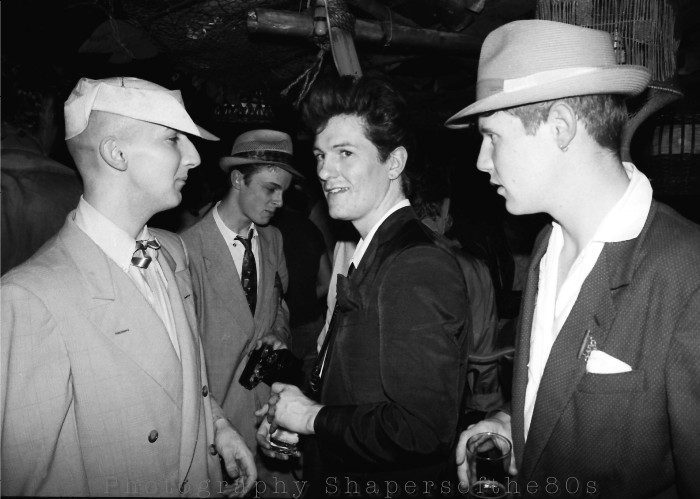
Stephen Jones, Graham Smith, Ollie O’Donnell, Robert Elms

Three hats and a quiff: Stephen Jones, Graham Smith, Robert Elms and at centre Beat Route host Ollie O’Donnell, during the shooting of the Chant No1 video in 1981. Photography © Shapersofthe80s

The video emphatically makes the point that clubland rules. Spandau drummer John Keeble spoke with only slight exaggeration when he said: “For the next couple of years, no new band played live on a stage.” What he meant was that rock venues as the source for original music had been superseded by nightclubs. White socks and hedonism were the key: girls in swirling party frocks with hair cropped like chives, and boys wearing braces and rolled-up sleeves soon walked the streets of every town. Ha! Why, even the NME finally conceded by introducing a “Dance Chart” alongside their lists of Indie garage bands.

Spandau Ballet, Gary Kemp, Chant No 1, video, Beat Route, clubbing

Chant No 1: Gary Kemp with one of Beggar & Co’s brass section at front

Once released on July 6, Chant No 1 rocketed straight up the charts to reach No 3 on August 1 (the NME chart actually placed it at No 1). Simultaneously remixed by Richard Burgess as a B-side and as an extended twelve-incher for clubs, the track immediately became an upbeat dance anthem for the school-leavers who were discovering what economic “hard times” were going to mean.

“I Don’t Need This Pressure On” ran Spandau’s chorus as a timely slogan for that summer when Britain went into shellshock from the rare experience of repeated race riots on the streets of London, Manchester and Liverpool. The fashion-conscious band who had been dismissed by the rockist press as fascists and dandies hit back with supreme optimism. This vibrant tune pressed the pop button with fans as well as rival bands who envied the chemistry of Spandau plus Beat Route. It announced a new brand: Team Soho. For ten weeks in the charts, Chant No 1 confirmed its rhythm as the sound of the new pop: once-and-for-all the dominance of the rock guitar was shifting to the supremacy of bass and drum for pop generations to come.

Ironies were everywhere. Not only did the crepe-shoed rocker Shakin’ Stevens occupy the No 1 spot for four consecutive weeks with Green Door, a comforting throwback to 50s nostalgia. By contrast, the cool young band who also held Chant off the top spot for another three consecutive weeks were The Specials, whose haunting single Ghost Town (where “all the clubs have been closed down”) became a poignant epitaph for the inner-city angst starting to erupt among the ranks of the hard-pressed in Margaret Thatcher’s Britain. The times were changing, not entirely for the better.

Beat Route, nightclubbing, Soho, Spandau Ballet, video,Chant No 1,

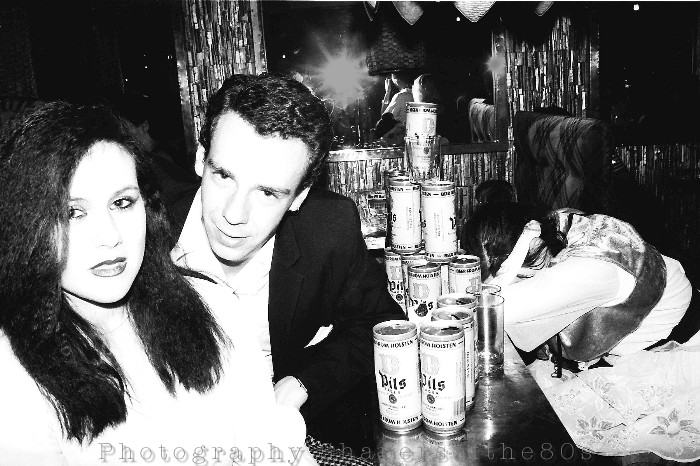
The legend that became Le Beat Route: a little light romancing, a lot of heavy drinking. Photography © Shapersofthe80s

THE SPANDAU STORY SO FAR

➢ 1980, Spandau fire the starting gun for British clubland’s pop hopefuls: dada didi daaa!
➢ 1980, The day Spandau signed on the line and changed the sound of British pop

How many people dID it take to launch an electro-diskow band?

Waldorf Hotel, Spandau Ballet, Covent Garden, Blitz club, New Romantics, youth culture,youth movement, Blitz Kids , To Cut a Long Story Short, London, UK, singles chart, aged 20, club-hosts, DJs, Herbie Knott

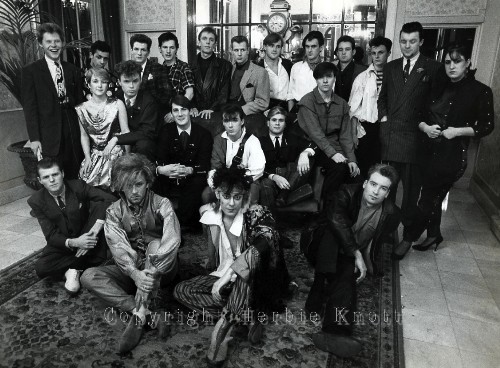
Waldorf Hotel 1980: seated at centre, Spandau Ballet, house band of Covent Garden’s Tuesday-night Blitz Club, home of the New Romantics movement, plus support team of Blitz Kids who helped put their first single To Cut a Long Story Short into the UK singles chart at No 5, on Dec 6, 1980. Average age 20, everyone had a specific role to play in staging and promoting the band: seven musicians, six designers, three media and management, three club-hosts, two DJs, one crimper and 22 egos. Photographed for the Evening Standard © by Herbie Knott

FRONT PAGE

➤ INDEX of posts for June 2011

Boy George, 50th birthday,Jon Moss, Barbara Moss,

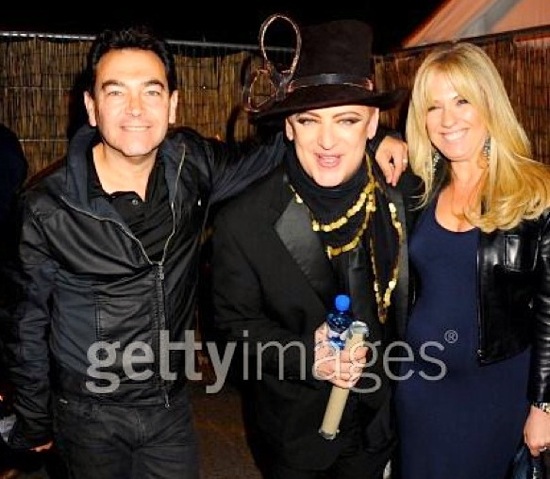
That Man in the Middle: George O’Dowd at his 50th birthday party with former Culture Club drummer and father of three children, Jon Moss and his wife Barbara. © Dave Benett/Getty

➢ Jarvis takes his lyrics to Eliot’s publisher Faber — video interview with Pulp’s songwriter

➢ Too cool to crow — Paradise Point just happen to be gigging in Hyde Park before Grace and Pulp top the bill

➢ Lest we forget: man has changed his ways since Peter Wyngarde cracked the sickest joke on vinyl

➢ Irrational, Professor Cox! Discussing science in a tent at Glastonbury?

➢ Martin Kemp’s Stalker gets autumn DVD release

➢ Will the magical blasts from the past follow St Martin’s out of Soho? Plus — Pulp’s finest hour at the art school’s farewell party

➢ Heaven 17 remind us how electronic music can send the soul soaring!

➢ The Blitz Kids WATN? No 28: Stephen Linard, fashion designer

➢ Hot days, cool nights, as Blue Rondo join the new Brits changing the pop charts — first glimpse of the crazy seven-piece as the 1981 charts fill with the new British pop

Pepsi DeMacque, Shirlie Holliman, Pepsi & Shirlie, then and now,Here & Now, tour

Back on tour: Pepsi & Shirlie in 1987, and this year photographed by Shirlie Kemp’s daughter, Harleymoon

➢ When Shirl asked Peps if she fancied an arena tour, Peps said to Shirl, Why not? — TV interview

➢ EPIC forecasts for the 2015 media landscape loom closer than we think

➢ Aside from the freaks, George, who else came to your 50th birthday party?

➢ One million people think Charlie really is SoCoolLike — meet  the UK’s most popular YouTuber

➢ 1904, The day Nora made a man of Joyce — Bloomsday celebrated

➢ Boy George hits the big Five-0 and he now says, yes, he has ‘lots of regrets’

Paradise Point, Run In Circles , video, Cameron Jones,pop music

Cameron Jones: Paradise Point vocalist

➢ Hear about the many lives of Midge Ure, the Mr Nice of pop — This Is Your Life, 2001

➢ Wise-cracking Sallon shimmies back onto London’s party scene — Boy George’s best friend recovers after assault

➢ Mix your own version of Bowie’s Golden Years with a new iPhone app

➢ 2010, Lady Gaga ousts Lily Allen as UK’s most played artist

➢ Martin Rushent is dead — friends pay tribute to the man who made stars of the Human League and shaped the sound of 80s electro-pop

➢ What happens when retromania exhausts our pop past — Simon Reynolds on our compulsion to relive and reconsume pop history

➢ Up close and cool — Paradise Point’s first official video wins Boy George’s approval

Farewell St Martin’s, Pulp, Jarvis Cocker,University of the Arts, CSM,

Pulp playing at St Martin’s: Jarvis Cocker bids farewell to his old art school at the best party for years. Grabbed from gstogdon’s YouTube video

FRONT PAGE

➤ Jarvis takes his lyrics to Eliot’s publisher Faber

+++
❚ FABER AND FABER EXCITEDLY ANNOUNCE they are to publish Jarvis Cocker’s Mother, Brother, Lover: Selected Lyrics, in October 2011. Only days earlier the prestigious publisher of T S Eliot, the leading poet of modernism, unveiled their monumental digital milestone The Waste Land for iPad, itself probably the mightiest poem of the 20th-century. Now they have signed Pulp’s singer and songwriter, as a spry chronicler of Britain’s common people fast achieving the status of a national treasure. In the video [above] Jarvis talks to Faber publishing director Lee Brackstone about writing lyrics, his inspiration, habits and thoughts on putting together his first published collection.

It was shot on the day he’d signed the contract, three weeks before today’s announcement and right after the reunited Pulp’s triumphal UK comeback at the Isle of Wight festival after a nine-year absence. Jarvis is visibly thrilled to bits and he gives a hugely entertaining interview. “I fell into the thing of writing lyrics when I was 15 because nobody else would. It was like homework, it was as appealing as that. The first lyric I ever wrote started, Shakespeare rock, Shakespeare roll.”

He tackles the risk of writing cosmic bilge, his breakthrough precipitated by an accident when his gaze shifted to the everyday, and the influence of Scott Walker who married realism to cinematic orchestration: “I liked his song The Amorous Humphrey Plugg [deft and witty lyrics by Walker from his 1968 album Scott 2] which is about slipping on a newly waxed floor… a humdrum everyday thing with a massive orchestral backing. I’d been looking for the epic in the everyday. I don’t think everyday life is mundane. I’m curious about what keeps people functioning.”

➢ Pulp’s reunion concerts continue through the summer, with their headline gig at the Wireless Festival in Hyde Park this Sunday, returning to the UK for Reading and Leeds festivals in August

FRONT PAGE

➤ Too cool to crow — Paradise Point just happen to be gigging in Hyde Park before Grace and Pulp

Paradise Point,O2Academy ,Wireless Festival ,livepop,Hyde Park, music festival

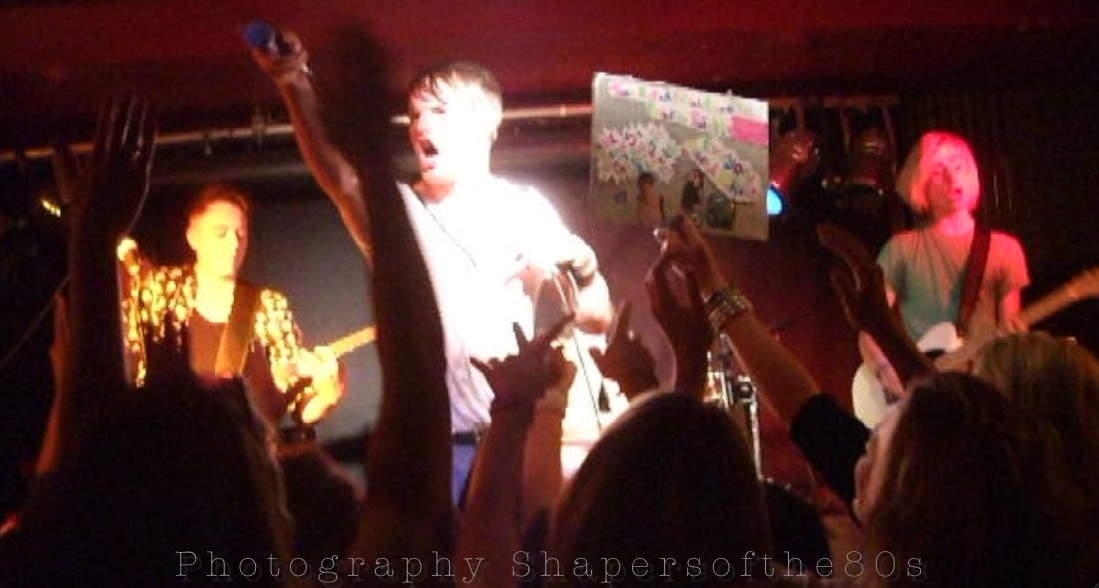
“It takes a minimum of four girls to start The Scream,” said Steve Dagger in the 80s: the old rule of pure-pop was certainly fulfilled at Islington’s sold-out O2Academy when Paradise Point headlined tonight. Cam Jones leads an encore of Run In Circles which basically the girls sang for him — in between screams. Roman Kemp at left, Adam Saunderson right © Shapersofthe80s

Wireless Festival ,Hyde Park, Paradise Point , 2011◼ THIS WEEK BASSIST ROMAN KEMP told Hemel FM: “We’ve only been around for eight months so we’re amazed by how it’s been going. The other day we were confirmed for the Wireless Festival on Sunday. We were amazed. Playing before Pulp!”

OK, a bit of artistic licence there. The club scene’s dynamic pure-pop teen band Paradise Point are scheduled to strike up at exactly 15:20 in Hyde Park, which is about four hours before Grace Jones goes on, to be followed by Jarvis Cocker’s band Pulp who top the bill at the three-day fest. All the same, Kemp wasn’t exactly overdoing the crowing rights. This gig is a huge coup for a bunch of live 18-year-old popsters without a recording deal.

➢ Wireless Festival runs July 1–3 in Hyde Park, London,
with Black-Eyed Peas, Chemical Brothers and Pulp
headlining a bill of 91 acts across four stages

Paradise Point, O2Academy,Steve Dagger, Martin Kemp,Wireless Festival

In the audience for Paradise Point at Islington’s O2Academy: Spandau manager Steve Dagger and Martin Kemp vote Roman Kemp’s band a hit. So no surprises there, then.

Call of the Wyld is a blogger who “tracks young, new and exciting bands as they emerge” and last month he wrote: “This lot are sex on legs and even if they weren’t actually any good they would still find it hard to walk on stage without being shrieked at. Fortunately their music is excellent too. These are real pop gems — certainly 80s inflected, but delivered with a whomp and panache that would put a lot of other acts to shame. The Only One is a track that is going to get them a lot of attention.” As a taster or three, view PP’s live debut last November (below), videoed by Shapersofthe80s, scan our first PP concert review and give the Hemel FM interview a spin:/%20

FRONT PAGE

➤ Lest we forget: man has changed his ways since Peter Wyngarde cracked the sickest joke on vinyl

Peter Wyngarde, Jason King, Department S, The Prisoner,TV series, RCA,

From villainous to tasteless: At the age of 32 Peter Wyngarde was distinguished enough to guest-star as the sinister Number Two in the epic TV series The Prisoner (1967). Two years later he created the novelist-cum-sleuth Jason King in Department S

❚ EMMA PEELPANTS is a keen-eyed blogger who plunders magazine and retail archives in search of 60s clothes and the whole vulgar, vibrant style of that swinging decade. Once in a while, she has a mensday and today she exhumes that male stereotype, “the heel” — the overbearing, amoral lothario who 40 years ago fancied himself rotten and treated women as playthings. Miss Peelpants publishes a hideously recognisable illustration of a heel from a copy of the teenage magazine 19, dated 1972, where one such sophisticat is grinding his heel into a bevvy of scantily clad girls. 19’s Guide to Recognising a Heel shows the just-got-out-of-bed coiffed hair, the bandito moustache, the whisky-and-cigarette in one hand, plus total absence of a smile, which he would have deemed too uncool.

To anybody of a certain age, the dandy in the illustration is all too visibly based on the actor Peter Wyngarde who shot to fame playing exactly this kind of international playboy in two late-night TV espionage series at the dawn of the 70s, Department S and Jason King. These expressed notions of contemporary glamour by being set in airports and beside Riviera pools. Their action-hero won awards as the “Best Dressed Man In Britain” while Sun readers voted him the “Man With the Sexiest Voice on Television”.

When Sex Leers Its Inquisitive Head , RPM, recording, CD,comedy,Peter Wyngarde What Emma links us to is possibly the most offensive song ever recorded by a star considered suave in his day. The one-off “comedy” album for RCA in 1970 was titled Peter Wyngarde and billed as dwelling on “the darker side of human behaviour”. It was said to have been withdrawn from sale after four days. Unbelievably it was re-released on RPM in 1998 retitled When Sex Leers Its Inquisitive Head with a “Don’t buy this” warning on the sleeve. As a model of appalling bad taste it not only leaves no innuendo unturned, but contains one track actively celebrating rape.

Lest we doubt that political correctness has delivered a few benefits over the years, the Lipstick Thespians have posted this number on YouTube. For those who wish to avoid hearing Wyngarde’s ripe spoken-word rendition, the Thespians have posted the full wince-making lyrics (words and music by Hubert Valverde and Peter Wyngarde). Many people feel that the actor met his just desserts when he wrecked his career in what politicians euphemistically call a moment of madness in 1975. He’s still alive and kicking and signing autographs, now aged 77.

Now feel the pain of date rape

Rhoda Dakar, The Boiler, 2-Tone Records, The Special AKA, ❏ RHODA DAKAR (left), lead singer of The Bodysnatchers, but here as The Special AKA, made The Boiler the strongest single of 1982 in this writer’s opinion, and deeply chilling. Despite being shunned by the safe daytime BBC radio deejays, it was well played by John Peel and spent five weeks in the UK singles chart, reaching No 35. The rare video below has ropey vision but good audio and it pays to listen right to the end.

Jerry Dammers formed The Special AKA, along with Dakar and John Bradbury, after The Specials announced their break up in 1981. Their first single release was The Boiler by Rhoda with The Special AKA (written jointly by the band and produced by Dammers on 2-Tone Records in Jan 1982).

FRONT PAGE