Category Archives: obituaries

2015 ➤ Steve Strange’s anniversary: deciphering the pen portraits of the man of masks

Steve Strange, Stephen Harrington, Blitz Kids, New Romantics, nightclubbing, Swinging 80s, London, fashion, pop music, Visage, tributes, youth culture, obituaries

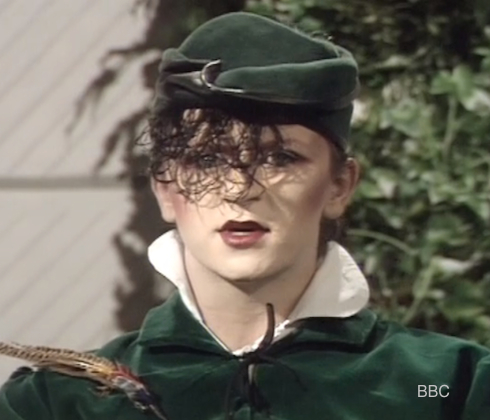
Steve Strange in 1981: here in Robin Hood guise (BBC)

FIRST PUBLISHED 13 FEBRUARY 2015

◼ ONE OF STEVE STRANGE’S TALENTS was persuading the press to believe in his latest wheeze, however fantastic. He had a way of convincing himself that a story was already written and a mission achieved before he had pressed the accelerator and set off. This irritated as many journalists as it amused and many were consequently very sceptical of his next big announcement – like saying he’d booked a big American star to do her first live promotional performance in Britain at his crowning glory, the Camden Palace, capacity 1,410. But in fact he had and she did, and in June 1983 the unknown Madonna was launched in the UK singing to backing tapes for half an hour.

The myths surrounding Steve were always the stuff of self-promotion. Dressing up was part of the same story-telling ritual. Today, he would say, I am Robin Hood, tomorrow Ruritanian Space Cadet, the next day Marionette with the mind of a toy. A compulsive man of masks presents a tricky subject for the scribblers obliged to capture that life once it is spent, so we must tiptoe through the obituaries like a minefield, and beware of tripping over Steve’s much-spun versions of history that were pure fantasy. Even national newspapers seemed to fall for many of the dreams he spouted, as well as the exceedingly vague memories committed to his 2002 book, Blitzed. As the mainstream obituary writers lead you through those New Romantic years, see if you can spot the porkies. . .

➢ The Times obituary:
As the head boy of the “new romantics”, Steve Strange was the flamboyant scene-maker of a colourful subculture that dominated early 1980s British pop music as a showily garish counter-reaction to the stylistic austerity of punk. If punks were the roundheads in pop’s civil war, the “new romantics” were the cavaliers, ushering in a restoration of glitz and glamour, with a delectably decadent flourish… / Continued online

➢ Adam Sweeting, Guardian:
In 1978, Strange and Rusty Egan (then drummer with the Rich Kids) began holding David Bowie nights on Tuesdays at Billy’s club in Soho, a squalid bunker situated beneath a brothel. “We played Bowie, Roxy Music and electro,” said Strange. “It was where our friends could be themselves.” Billy’s could hold only 250 people [not quite!] but swiftly developed an outsize reputation, numbering among its garishly clad clientele such stars-to-be as George O’Dowd (the future Boy George), Siobhan Fahey, later of Bananarama, and Marilyn. . . / Continued online

Billy’s club,Helen Robinson, nightlife, London ,Steve Strange, PX

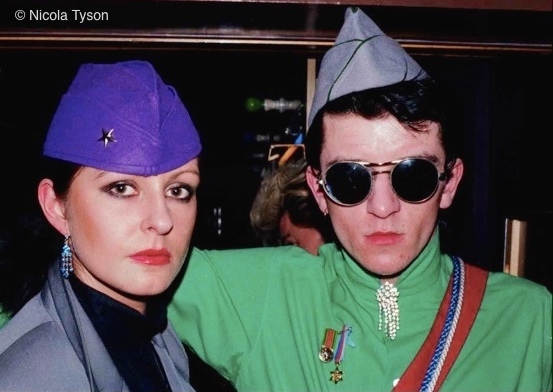
Billy’s club 1978: Strange as Ruritanian Space Cadet alongside PX designer Helen Robinson. (Photograph by © Nicola Tyson)

➢ Daily Telegraph obituary:
Strange fronted sleek operations, such as Club For Heroes in Baker Street and the Camden Palace in north London, where Madonna performed her first British live concert. But Visage split amid acrimony over the division of royalty payments, and his nightspots fell out of vogue in the mid-1980s with the rise of rap, hip-hop and dance music. By this time Strange had a reputation for high-handedness. Years later, Boy George lampooned Strange as the preposterous club host character “Nobby Normal” in his biographical musical Taboo. Strange was not amused. “I don’t think I have that strong a Welsh accent,” he complained. . . / Continued online

➢ The Scotsman obituary:
Although his career as a pop star afforded him only one real hit as frontman of the band Visage, 1980’s austere synthesiser anthem Fade to Grey, Steve Strange’s distinctive image and party-loving persona saw him help invent London’s New Romantic scene. . . Visage’s time in the sun flared all too briefly; with Strange being courted to repeat the clubbing success of places like the Blitz in various US cities, he dived wholeheartedly into the life of the international rock star, with all the pitfalls that entailed. Put off by Strange’s drug use, spending sprees and debauched behaviour, Midge Ure left to concentrate on Ultravox and Visage’s 1984 third album Beat Boy was a critical and commercial failure. The band split the following year, the same year that Strange first took heroin. . . / Continued online

➢ Pierre Perrone in The Independent:
A flamboyant figure with a self-destructive streak . . . By the late 90s he was back in Wales and, by his own admission, acting “very bizarrely”. He spent six weeks in a psychiatric hospital, was arrested for shoplifting and given a suspended sentence. “I don’t know whether it was cry for help,” he told The Independent in 2000, blaming an over-reliance on Prozac, though he seemed comfortable with his avowed bisexuality. . . / Continued online

FRONT PAGE

2024 ➤ Andy Polaris reminds us of Quincy Jones’s legacy as a titan of 20th-century showbiz

Tribute, concert review, Quincy Jones, Michael Jackson, Grammy awards,

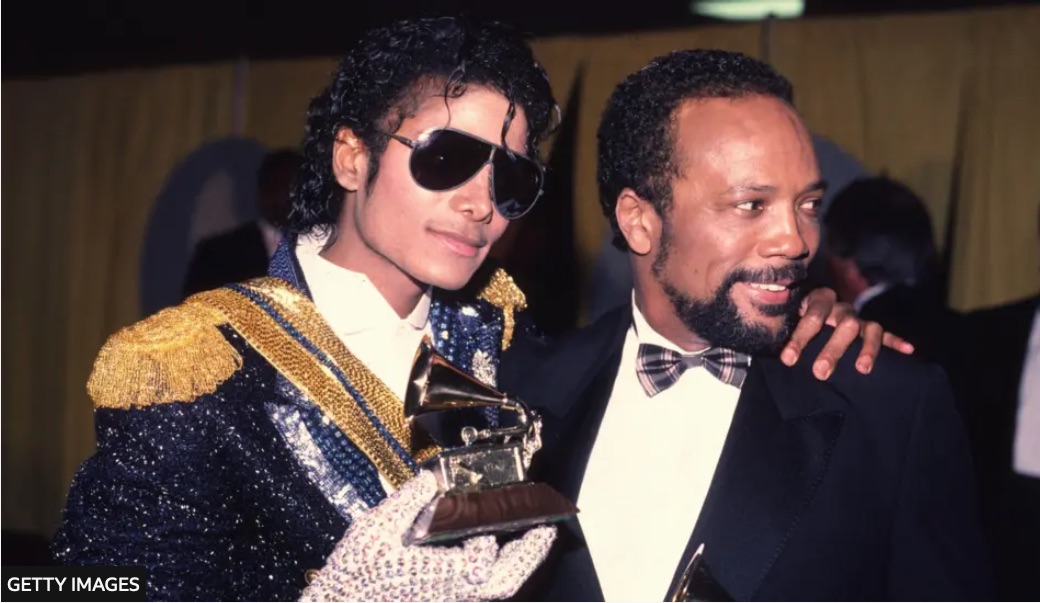
1984: Quincy Jones with Michael Jackson at the 1984 Grammy Awards, where they won eight

❚ The cross-cultural pioneer Quincy Jones died this week
aged 91 in Los Angeles. In tribute, we republish Andy Polaris’s appreciation of his genius when he brought a huge
orchestra to London’s O2 arena on 25 Jun 2019…

Excerpt from the review at the Polaris music blog: Quincy Jones Jr is a titan of 20th-century entertainment whose creative talent has spanned decades as composer, multi-instrumentalist, singer-songwriter, arranger, producer and publisher. He has received the most Grammy nominations, a staggering 80, and won 28, plus seven Oscar nominations, and a Jean Hersholt Humanitarian award in 1996 amongst other industry accolades. He has worked with superstars from Aretha Franklin, Frank Sinatra, Count Basie, Miles Davis, Dizzy Gillespie to Michael Jackson. In 2018 a Netflix film Quincy won the Critics Choice Documentary award.

As a teenage prodigy Quincy Jones had been tutored by Ray Charles and mentored by Count Basie, by 19 was touring Europe with Lionel Hampton for three years, at 24 studied at the feet of the godlike Nadia Boulanger in the American School at Fontainebleau, and soon after became a troubleshooting vice-president for Philips Records of Holland.

This week [in 2019] sees the 10th anniversary of Michael Jackson’s death and despite the controversy and those clamouring on social media to cancel his music, the audience at this O2 concert showed that, whatever your feelings, it’s nigh on impossible to crush the joyous memories and mood of his repertoire. In addition, we were treated to the formidable playlist of our youth unfolding before our ears thanks to the savvy musicianship of the band and huge orchestra, which even included a harp, all conducted and hosted by Jules Buckley… / Review continued at Apolarisview

➢ Guardian obituary: Quincy Jones was the first black composer to find acceptance in Hollywood and won 28 Grammys

FRONT PAGE

2024 ➤ Pilger’s fearlessness is what journalism still needs today

John Pilger, Daily Mirror, Rupert, Murdoch, Robert Maxwell, Mirrorscope, Journalism, tributes
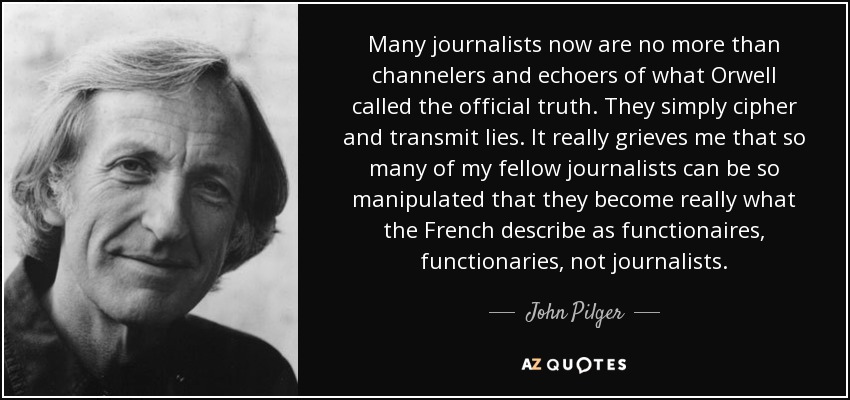
❚ ONE OF THE GREATEST post-war crusading journalists has died after a lifetime of championing frank journalism and regularly criticising the mainstream media. In 2002, John Pilger said that “many journalists now are no more than channellers and echoers of what Orwell called the official truth”.

Though aged only 28 when named in the British Press Awards as Journalist of the Year 1967, Pilger became the backbone of the Daily Mirror’s revolutionary investigative Mirrorscope sections – four-pagers twice a week – when the tabloid respected for its humanity was selling 5million copies a day (long before The Sun posed any kind of threat), the world’s highest English-language circulation.

Pilger was already a mentor for me in 1969 when the paper created its glossy mid-week Mirror Magazine and I joined in my first Fleet Street job, surrounded by the giants of the day.

Pilger spent 23 years with the Mirror, through what proved a golden age for British journalism. It was not to last. In a landmark New Statesman column in December 1991 he reflected on how popular journalism had been hijacked by both “the monster” Robert Maxwell, who lucked into buying the Mirror after a management cock-up and reduced its sales to an all-time low, and by Rupert Murdoch whose Sun had overtaken its rival’s sales by creating an agenda of sexism, racism and voyeurism. Pilger savaged the journalists in both camps for their cynicism.

His later career included more than 60 hard-hitting ITV documentaries which won Bafta and Emmy awards. The activist Noam Chomsky said of him: “John Pilger’s work has been a beacon of light in often dark times.” Playwright Harold Pinter described him as “fearless”. Pilger’s is a voice we still need to hear.

John Pilger, 9 October 1939 – 30 December 2023

➢ The Guardian’s robust obituary of the fervent critic of US and British foreign policy – “Why do many journalists beat the drums of war regardless of the lies of governments?” Pilger asked in 2010”

➢ The Times: Critical obituary of the “left-wing anti-American journalist” … “denounced as a dupe of the eastern bloc”

➢ Pilger’s own informative website

➢ Heroes Paperback – 1 Feb 2001 – John Pilger’s autobiography

FRONT PAGE

2023 ➤ Witnessing the performance of Gambon’s life as his tribute to Pinter

Tributes, theatre No Man’s Land, Michael Gambon, Harold Pinter, David Bradley,

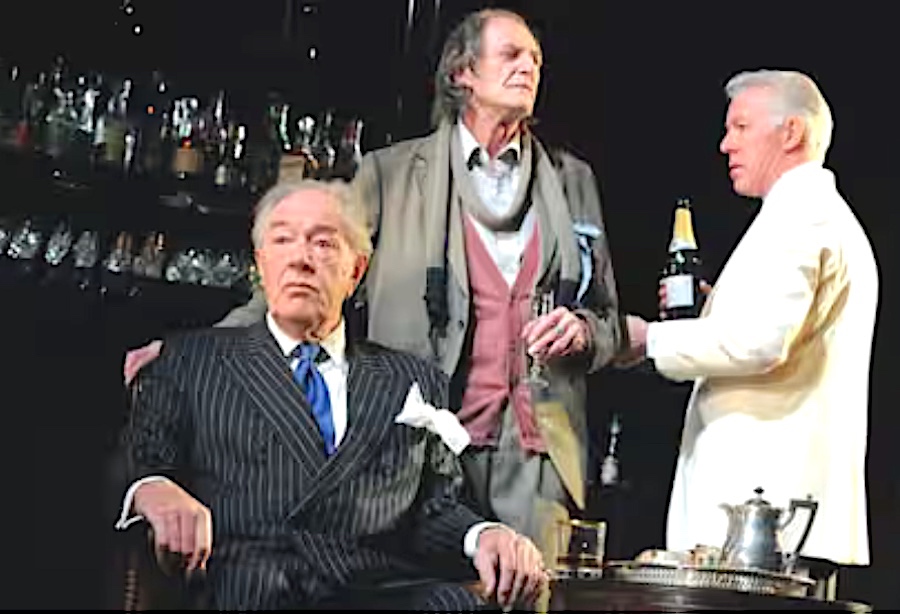
Duke of York’s, 2008: Michael Gambon, David Bradley and Nick Dunning in No Man’s Land. (Photograph: Tristram Kenton)

❚ MICHAEL GAMBON WAS UNDOUBTEDLY Britain’s greatest living actor for much of his career and remained so until his death this week. So, indeed, Harold Pinter had also become our greatest playwright by the end of his life. In the week of Pinter’s death at Christmas 2008, Gambon was playing in the West End in this, one of the master’s most enduring plays, No Man’s Land, and on Boxing Day he marked the theatre’s loss in ways I shall never forget.

That day, on Radio 4’s World at One, Michael Gambon promised to give the performance of his life, so I determined to go and see again the performance I’d already enjoyed the previous month in one of the Pinter’s most haunting masterpieces about two men in their maturity reflecting on their tenuous – or had it been non-existent? – friendship. As Michael Billington had written in his Guardian review: “Every new production of Pinter’s tantalising, poetic play yields new meanings.”

I’d seen it premiered in 1975 with those grandees John Gielgud and Ralph Richardson at the Old Vic and again when transferred to the Lyttelton in 1977 – several times. The great air/earth partnership of Gielgud/Richardson undoubtedly brought compassion to the roles of Spooner and Hirst, yet when Pinter himself played “the Richardson role” at the Almeida in 1993, opposite the sprightly Paul Eddington, the author turned his second act opening almost into a two-handed farce that had us aching in our seats with continuous laughter and subsequently wondering whether he’d always longed for our two greatest actors to loosen up a bit in the original production.

By the time this day’s greatest living actor Gambon put on the mantle of Hirst, a litterateur haunted by dreams and memories, in this new production at the Duke of York’s, we had learnt to laugh heartily at the humour in Pinter, yet now both Gambon and David Bradley as Spooner were also suffusing the prose with more poetry which the renowned “Pinter pauses” punctuate than I could recall from the past.

Tributes, theatre 
No Man’s Land, Paul Eddington, Harold Pinter,

Almeida theatre, 1993: Paul Eddington and Harold Pinter in his own play No Man’s Land. (Photograph: Tristram Kenton)

A month earlier, I’d been caught short by the intensity of Gambon’s stage presence as he made his demons all but tangible before us. Then on Boxing Day, after the hilarious Act 2 recollections of the men’s seemingly shared past, Gambon suddenly changed gear and dropped timbre to whisper the crucial “Good Ghost” speech about the passing faces in his photograph album with an ethereal beauty and clarity of Shakespearean proportions. It was an unparalleled moment to witness.

Following the curtain calls, the cast paused to pay brief onstage tributes to Pinter. Gambon told us that, after rehearsals, the playwright had asked him if he would read the Good Ghost speech at his funeral (which indeed he did only days later). Suddenly for the second time this night, Gambon delivered the speech again there and then. Alas the words lost something of the ineffable truth they had touched when, minutes earlier, Gambon had been in character and had delivered them “trippingly on the tongue”.

Without doubt, the actor brought greatness to the role of Hirst this night – in fairness, all the cast were on the balls of their feet too. More satisfying, in the fleeting moments of live performance, fresh glimpses had been revealed of Pinter’s bleak insights into memory and ageing. All in all, the essence of theatre.

➢ Billington’s review of No Man’s Land in The Guardian, 2008
➢ Michael Gambon’s obituary in The Guardian, 2023

FRONT PAGE

2023 ➤ Fond farewells to the glorious Queen of the Telegraph fashion pages

Hilary Alexander, tributes, Daily Telegraph, fashion,

Farewell to Hilary Alexander on her retirement in 2011: here’s the spoof front page every good hack deserves to cap their career. Read my own account linked below

“The dizzy industry doyenne” – Obituary at Vogue
https://www.vogue.co.uk/arts-and-lifestyle/article/hilary-alexander-obituary

Fashion editors, tributes, obituary, Hilary Alexander, Suzy Menkes, Anna Wintour

The British fashion triumvirate in their heyday: Suzy Menkes of the International Herald Tribune, Hilary Alexander of the Daily Telegraph and Anna Wintour, editor-in-chief of US Vogue

❚ ONE OF BRITISH JOURNALISM’S greatest characters has died and you won’t hear a word spoken against her – apart from on the hilarious spoof tribute page produced for Hilary Alexander’s leaving party in 2011 after donkeys years as fashion director of the Daily Telegraph, when it enjoyed the highest daily sales among UK quality newspapers. During the 1980s-90s I worked regularly alongside Hilary and also dared go out on the town with her to witness her beaming smile and unique dress sense turn heads in all directions. As British fashion grew in credibility on the world stage, Hilary became one of a triumvirate of British fashion editors the international circuit took very seriously, the others being Suzy Menkes of the International Herald Tribune and Anna Wintour of US Vogue, who have been awarded two OBEs and a DBE by the Queen. Hilary was twice named British Fashion Journalist of the Year. Two enthusiastic obituaries remark that she pursued work like “a Stakhanovite” implying exceptional efficiency.

A memorial service for Hilary’s admirers and colleagues is being held at midday on Monday 12 June at St Bride’s in Fleet Street.

Early yesterday, Hilary’s 77th birthday, she died from a heart attack while in hospital. Our mutual colleague Penelope McDonald recalls the laughs they had enjoyed over the years – especially at the annual Fenwick Christmas shopping evenings to which Hils attracted leading designers. She devoted much time to inspiring and mentoring young fashionistas. In 2002, the artist Georg Meyer-Wiel remembers his graduation show in menswear at the RCA because he met big names such as Mary Quant and Issey Miyake in the company of Hils at the gala.

When I was editing the student edition of the Telegraph in 1988 Hils was keen to shoot a winter fashion feature with students in the coldest place in the UK. Amazingly, according to the Met Office, this proved not to be Scotland but the Tyneside estuary which receives freezing oceanic winds from the east. Consequently there we were in December fitting out some model students at Newcastle’s Uni and Poly with warm winter wear for our pages. In about 2002 my colourful Blitz Kid friend Judith Frankland recalls meeting Hils in Paris at a party for John Malkovich. She says: “I was dressed up as you can well imagine and she came straight over to me and said ‘I have to know who you are’ and smiled and told me to contact her if I was in London. Of course I didn’t have to ask who she was! It’s a good job she hadn’t seen me mere minutes later as my platform departed from the rest of my shoe, grrr!”

Fashion editors, tributes, obituary, OBE, Hilary Alexander, photos,

The umpteen faces of fashion queen Hilary Alexander: click to enlarge this Google set

Paul Hill, foreign desk manager at the Daily Telegraph, also recalls: “She used to organise the Christmas shows in Canada Square, taking over the canteen for the day and putting catwalks in and often filming them for DVD circulation to staff. I was in one (as one of five Elvis impersonators singing appallingly badly All Shook Up) and Hils was everywhere with what started as a full bottle of scotch, but by the end of the show was almost empty and she was a very happy and relaxed director! She would inveigle all sorts of seriously-minded staffers into these annual events, famously Lord Bill Deedes, to dress up – make-up and all – as Mick Jagger to mime along to Brown Sugar.”

In today’s Vogue obituary Anna Wintour says: “Hilary was irrepressible in everything she did. She lived life to the fullest and her reporting on fashion was just as committed. I threw a party for her in Paris when she retired – except she never retired! Hilary could never quite leave an industry that she loved so much.”

Fashion editors, tributes, obituary, OBE, Hilary Alexander, photos,

The fashion front row L-R: Jonathan Newhouse, Anna Wintour, Bill Nighy, Hilary Alexander, writer Lisa Armstrong and Laura Craig at the Mulberry AW 2012 show during London Fashion Week. (Photo © Dave M Benett). Click to enlarge.

In the Telegraph obituary Lisa Armstrong writes: “To sit next to Hilary at the shows was to be treated to an experience that was a unique blend of massage and wrestling match. Bobbing to the music – whatever it was – she was always the first to bounce out of her seat as the models were still filing off the catwalks, the ears of Uncle Bulgaria’s hat flopping away as she stormed the catwalk to get backstage before everyone else. She would do anything to get a story.”

Our set of photos here from a Google search for Hils sums up her eternal exuberance (“I will not stop flying. I will not stop smoking.”). Her home life in Dulwich was surprisingly private. Born in New Zealand, Hils was educated in Hong Kong and, having ended an unfortunate early marriage, she leaves no partner. Her funeral could be a starry event, though my own 2011 tribute in the link below is probably unbeatable!

➢ Previously at Shapersofthe80s:
2011, The incomparable Hilary Alexander makes her own front-page news as she leaves the Telegraph

Fashion editors, tributes, obituary, Vivienne Westwood, Hilary Alexander,

Hilary’s last profile photo posted at Twitter 2022… Hils celebrates her retirement with Andreas Kronthaler and Vivienne Westwood in 2011

➢ “More stamina than teenagers. To sit next to her at the shows was truly an experience” – Daily Telegraph obituary

➢ “A discerning eye for detail and relentless pursuit of a story made her name” – The Times obituary… She was on first-name terms with many designers but never forgot the readers for whom she was writing. “It’s hard for the average person to decide what to wear,” she said. “Our role is to take the threads that come through from the catwalk shows and say ‘This is the way to wear things’.” She saw fashion as more than mere style and was instrumental in making it newsworthy. “It’s not frivolous – any industry that employs half a million people and generates billions a year is a serious news subject.

Fashion editors, tributes, obituary, OBE, HM Elizabeth II, Hilary Alexander,

Fashion royalty: Hilary Alexander was made an Officer of the Order of the British Empire by the Queen in 2013… Hils sports a black silk dress with a jazzy poppy print to coordinate with the OBE ribbon

THE BRITISH FASHION COUNCIL’S
VIDEO TRIBUTE TO OUR HILS

FRONT PAGE