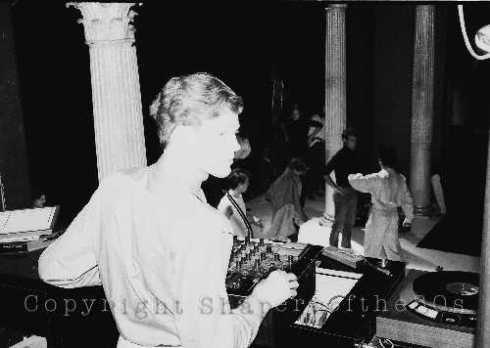
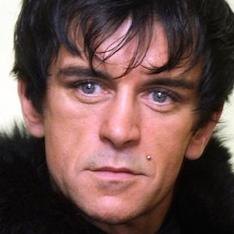
“Mixed live on machines but not by machines. I left a couple of (tiny) mistakes on. I like the flaws. A flaw is what makes something beautiful truly interesting” x 62m
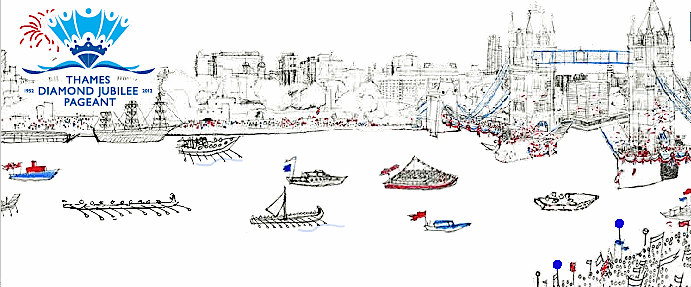
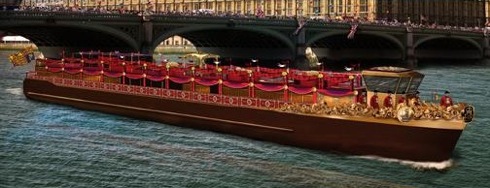
➢ 1,000 boats will muster on the River Thames — in case you hadn’t heard — on Sunday June 3, to accompany Her Majesty The Queen in the Thames Diamond Jubilee Pageant. The flotilla itself will be over seven miles long and will pass 25 miles of Thames river bank and under 14 bridges. It will take 90 minutes to pass any given point. A global TV audience is expected to number hundreds of millions… / continued online
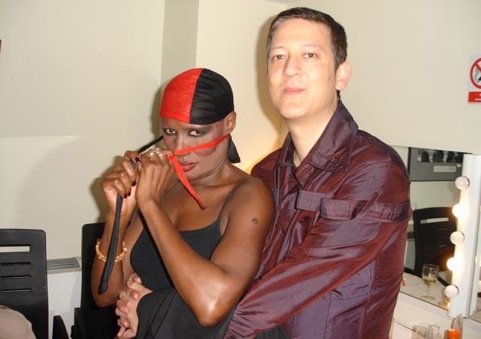
Official and unofficial Pageant soundtracks: the London Philharmonic Orchestra’s CD, and DJ Mark Moore of S’Express
“ According to Adrian Evans, the “pageant master” tasked with arranging a London Philharmonic Orchestra soundtrack for the Jubilee flotilla’s voyage down the river Thames, the Kinks’ Waterloo Sunset didn’t quite make the cut. Come June 3, the 86-year-old monarch will instead be serenaded with movie themes and century-old chestnuts. Today, though, The Guardian offers its own fantasy flotilla playlist of 14 tracks which start from Albert Bridge with The Clash’s London Calling — 1979. (London is drowning and I live by the river. The video for this Thameside apocalypse was shot beside the bridge)…
It nods to Southwark Bridge with S’Express: Theme from S’Express — 1988. (Shoom, in nearby Southwark Street, was ground zero for British acid house. Supercool DJ Mark Moore is suitably lowkey today on Facebook, “Most amusing”, and reminds us he was frontman in the 80s act)…
And reaches Tower Bridge with Blur’s This is a Low — 1994. (The flotilla turns around here, but the song follows the river eastwards. And into the sea/ Goes pretty England and me)… ” / continued at Guardian online
The Queen’s royal barge, 2012-style: a specially adapted Thames river boat dressed for the Diamond Jubilee Pageant
Tony Hadley today: flanked by two of ITV’s Loose Women, Ruth Langsford and Janet Street-Porter who shot the first TV doc about Spandau Ballet in 1980
❚ MORE COLD WATER HAS BEEN POURED on any future reunion for Spandau Ballet. The leaders of the 80s New Romantics movement haven’t worked together since their Reformation reunion tour ended in 2010. Today on ITV’s Loose Women chat show, Janet Street-Porter asked 51-year-old singer Tony Hadley whether he would ever tour again with Spandau. He replied straight away: “Very doubtful.” His life is busy and full of hoovering these days, he says. Big Tone is now the father of five children — baby Genevieve Elizabeth was born in February.
➢ Hadley’s own plans include Rewind The 80s Festival returning for a fifth successive year Aug 18–19 at Henley-on-Thames with Kool & The Gang, OMD, Grandmaster Flash, Rick Astley, Soul II Soul, Five Star, Starship, Jimmy Somerville, Sinitta, Marc Almond, Midge Ure, Adam Ant and more, plus festival fun
+++ ◼ AS WITH ANY ARTICLE AT THE GRAUNIAD about New Romantic cheerleaders Spandau Ballet, the resulting comments published online are always riotously entertaining. This is the one band that really winds up Guardianistas to a pitch of fury. When the 80s band announced their reunion tour in 2009, Michael Hann declared how much he’s always loathed them in a Graudina music blog which then provoked 342 comments — 342! — most of them apoplectic. How many other bands can claim such a following?
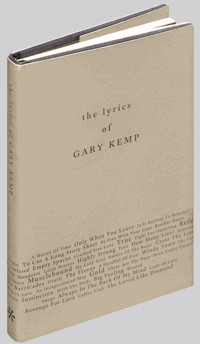
As it happens the Spandau songwriter has recently published an 88-page coffee-table book, titled The Lyrics of Gary Kemp from Lyric Book Company
Today for no apparent reason, the Guranaid runs an item about how Gary Kemp and Steve Norman made Spandau’s 1983 No1 hit True, in which lyricist Kemp admits: “I’m still berated for the line Take your seaside arms, but it’s straight out of Lolita by Vladimir Nabokov.”
Readers of Shapersofthe80s already know that the song was inspired by Kemp’s unrequited pash for poppette Clare Grogan — he was 22, she was 18 — who fronted an 80s band of Scottish cuties called Altered Images. On the same page, Steve Norman deconstructs his self-taught sax solo which has a key change in reply to Grover Washington’s Just The Two of Us.
All of which strangely prompts tearful blubbing at the Graun, rather than the usual explosion of acerbic outrage. Specimen comments follow after this gratuitous excuse to run a video…
VIDEO OF DARLING CLARE IN HER HEYDAY,
NOT TO MENTION SWIVEL-HIPS TICH
❏ Nepthsolem moans: “It always sounds to me like See side arms, as though referring to the service revolver I imagine was issued to all New Romantics, but sadly never used on TOTP.”
❏ DeeSawdeley says: “I always thought it was seaside aunt, which (for those of us with a seaside aunt, anyway) makes much more sense. Bet he wishes he’d written that now!”
❏ Stolencar comments: “Note also he says she gave him a copy of Lolita not that she had read it.”
❏ To which Vastariner responds: “There’s a picture of her reading it on the front of the Best Of Altered Images compilation released in 1991. Some might call me obsessed for knowing that, or because I have a username taken from one of her lyrics… etc etc.”
❏ From another planet, Golgafrinchan sobs: “I had unrequited love for Clare Grogan, still do to be fair. If you’re reading this Clare, get in touch, there’s still time.”
❏ DameHedwig adds:“I’ve often told my son that if things had worked out for me, Ms Grogan would be his Mum.”
❏ And Mccaugh:“As for the sublime Miss Grogan, well, just how many times did we go and see Gregory’s Girl? Helped, of course, by the fact that it ran at the Dominion Cinema in Edinburgh for three years non-stop.”
❏ Finally Bloodydoorsofftells a despicable and blatant untruth about darling Clare, so you’ll just have to go to Grunadia Online to see it. And plenty more.
1963: Sassoon creates the “bob” on designer Mary Quant. (Photo: Getty)
“He revolutionised not just hair but fashion” — model-turned-Vogue fashion editor Grace Coddington
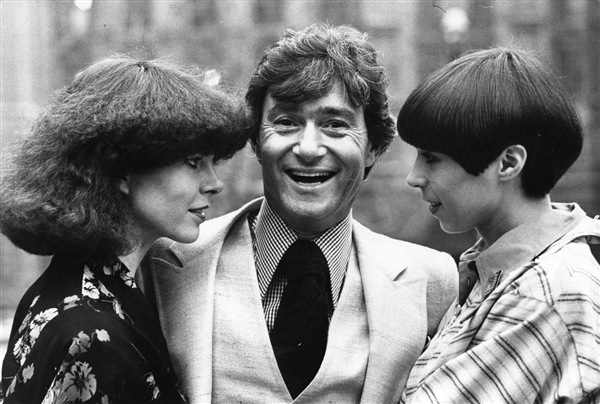
Comeback 1975: Vidal Sassoon between two contrasting examples of his hairdressing for a teach-in at the Albert Hall, where he returned to hairdressing after a five-year break. (Photograph by Tim Graham / Getty)
“ Vidal Sassoon, who was found dead at home on Wednesday, was at the cutting edge – literally and metaphorically – of hairdressing. His sharp, geometric, low-maintenance 1960s hairstyles revolutionised his craft, sounding the death knell for the stiff, set hairdos of the 1950s. An astute businessman, he made a fortune from his salons and products, and became a household name. “I wanted to eliminate the superfluous and get to the basic angles of cut and shape,” he said… ” / continued online
+++ ❏ Craig Teper’s 2010 documentaryVidal Sassoon: The Movie follows the true rags-to-riches tale of how a boy from a London orphanage went on to open his own Bond Street salon in 1958 and — influenced by the Bauhaus designs he had studied — he create the “shape” that became his signature cut, the five-point bob. It revolutionised hairdressing. His geometric wash-and-wear cuts marked the end of the beehive and the bouffant hair styles of the 50s. Admirers included the Duchess of Bedford, model Jean Shrimpton, actor Terence Stamp, and film star Mia Farrow. In 1963 he devised the classic “bob” for fashion designer Mary Quant, who called him the “Chanel of hair”. By 1964 he’d gone international by opening his first salon in New York.
Sassoon The Movie: the London crimper freed women from 50s bouffants by pioneering the low-maintenance hairstyles that defined the 60s
➢ Choose “View full site” – then in the blue bar atop your mobile page, click the three horizontal lines linking to many blue themed pages with background article
MORE INTERESTING THAN MOST PEOPLE’S FANTASIES — THE SWINGING EIGHTIES 1978-1984
They didn’t call themselves New Romantics, or the Blitz Kids – but other people did.
“I’d find people at the Blitz who were possible only in my imagination. But they were real” — Stephen Jones, hatmaker, 1983. (Illustration courtesy Iain R Webb, 1983)
“The truth about those Blitz club people was more interesting than most people’s fantasies” — Steve Dagger, pop group manager, 1983
PRAISE INDEED!
“See David Johnson’s fabulously detailed website Shapers of the 80s to which I am hugely indebted” – Political historian Dominic Sandbrook, in his book Who Dares Wins, 2019
“The (velvet) goldmine that is Shapers of the 80s” – Verdict of Chris O’Leary, respected author and blogger who analyses Bowie song by song at Pushing Ahead of the Dame
“The rather brilliant Shapers of the 80s website” – Dylan Jones in his Sweet Dreams paperback, 2021
A UNIQUE HISTORY
➢ WELCOME to the Swinging 80s ➢ THE BLOG POSTS on this front page report topical updates ➢ ROLL OVER THE MENU at page top to go deeper into the past ➢ FOR NEWS & MONTH BY MONTH SEARCH scroll down this sidebar
❏ Header artwork by Kat Starchild shows Blitz Kids Darla Jane Gilroy, Elise Brazier, Judi Frankland and Steve Strange, with David Bowie at centre in his 1980 video for Ashes to Ashes
VINCENT ON AIR 2026
✱ Deejay legend Robbie Vincent has returned to JazzFM on Sundays 1-3pm… Catch up on Robbie’s JazzFM August Bank Holiday 2020 session thanks to AhhhhhSoul with four hours of “nothing but essential rhythms of soul, jazz and funk”.
TOLD FOR THE FIRST TIME
◆ Who was who in Spandau’s break-out year of 1980? The Invisible Hand of Shapersofthe80s draws a selective timeline for The unprecedented rise and rise of Spandau Ballet –– Turn to our inside page
SEARCH our 925 posts or ZOOM DOWN TO THE ARCHIVE INDEX
UNTOLD BLITZ STORIES
✱ If you thought there was no more to know about the birth of Blitz culture in 1980 then get your hands on a sensational book by an obsessive music fan called David Barrat. It is gripping, original and epic – a spooky tale of coincidence and parallel lives as mind-tingling as a Sherlock Holmes yarn. Titled both New Romantics Who Never Were and The Untold Story of Spandau Ballet! Sample this initial taster here at Shapers of the 80s
CHEWING THE FAT
✱ Jawing at Soho Radio on the 80s clubland revolution (from 32 mins) and on art (@55 mins) is probably the most influential shaper of the 80s, former Wag-club director Chris Sullivan (pictured) with editor of this website David Johnson
LANDMARK FAREWELLS. . . HIT THE INDEX TAB UP TOP FOR EVERYTHING ELSE