Category Archives: London

➤ Farewell Trevor the mutton-chopped Spider from Mars

Ziggy Stardust, Spiders from Mars,plaque, Woody Woodmansey, Trevor Bolder ,

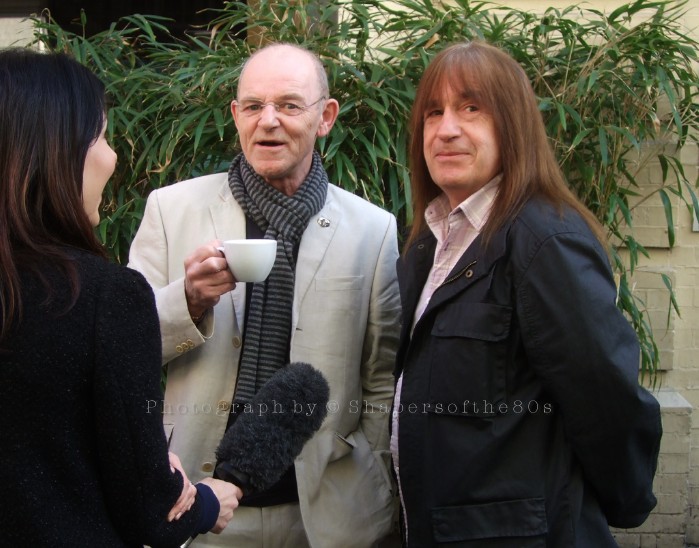
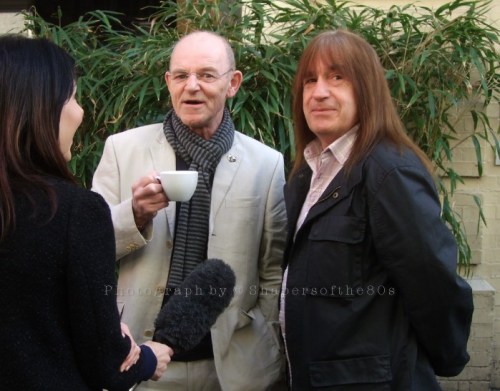
March 27, 2012: Spiders Mick Woody Woodmansey and Trevor Bolder being interviewed at the unveiling of the plaque to Ziggy Stardust in Heddon Street, London. Photo © Shapersofthe80s

➢ Trevor Bolder dead at 62 Long-time Uriah Heep bassist and Spiders From Mars icon Trevor Bolder has died of cancer at the age of 62, it’s been confirmed. Bolder joined David Bowie’s backing band in 1971, alongside guitarist Mick Ronson – with whom he’d played in The Rats – and drummer Woody Woodmansey… / Continued at Classic Rock

David Bowie tonight paid his own tribute:
“Trevor was a wonderful musician and a major inspiration for whichever band he was working with. But he was foremostly a tremendous guy, a great man.”

➢ A very frank Trevor Bolder interview at Let It Rock, 2003
Q: How did you, hailing not from London, arrive at that John Peel session?
A: Mick Ronson and Woody [Woodmansey] had played on The Man Who Sold The World album with David Bowie. They did that album with him and then left – they didn’t want to play with Bowie any more – so they came up to Hull, where I joined them, and we played for about six months as a band. And Bowie rang up one day and asked if we’d go down and do this John Peel show with him, cause he needed a band. So we said, “OK, we’ll come down and do that”. That’s basically how it all started.
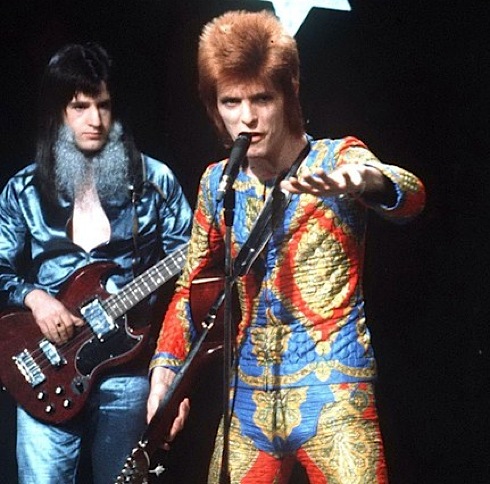
Ziggy Stardust, David Bowie,Spiders from Mars,Trevor Bolder

Playing bass with Bowie, 1973: Bolder sporting his fantastical mutton-chop whiskers

➢ Trevor Bolder’s life at NNDB
Gender: Male
Religion: Scientology
Race or Ethnicity: White
Sexual orientation: Straight
Occupation: Bassist
Nationality: England
Executive summary: Uriah Heap bassist

Yet another native of Hull, Yorkhire, to become important to the London music scene during the 1970s, Trevor Bolder was born to a strongly music-oriented family, taking up both cornet and trumpet at the age of nine and performing with local brass bands during his adolescence. In his teens he took the direction followed by many other young males of his generation and switched to the guitar, at which time he formed The Chicago Star Blues Band with his brother. Stints in other Hull-based bands like Jelly Roll and Flesh came later, with Bolder eventually trading in his guitar for an electric bass; meanwhile, food was kept on the table through a series of day jobs that ranged from hairdresser to piano tuner.

In 1970 he received an invitation from fellow Hull native Mick Ronson to come to London and join Ronno – an outfit that had been active earlier in the year as The Hype, and which had served as a backing band for vocalist David Bowie. Ronno only managed one single (1971, Fourth Hour of My Sleep) before poor response prompted Vertigo, the band’s label, to abandon them; not long afterwards, however, Bowie enlisted most of the line-up (Ronson, Bolder and drummer Woody Woodmansey) for his fourth album Hunky Dory (1971). Thus the way was paved for the creation of Ziggy Stardust and the Spiders From Mars in 1972, a highly theatrical concept band that would launch Bowie and his bandmates into international stardom… / Continued at NNDB

Ziggy Stardust,mime, David Bowie,Spiders from Mars,Trevor Bolder

Costumed by Kansai Yamamoto,1973: Bassist Bolder looking deeply uncomfortable in Japanese garb as his master Bowie goes into his Marcel Marceau mime routine

➢ “It is with great sadness that Uriah Heep announce the passing of our friend the amazing Trevor Bolder”

Trevor Bolder , Uriah Heep

Trevor Bolder onstage with Uriah Heep, 2011: He was due to play the Donington Park Download festival with Heep in June

FRONT PAGE

➤ Revealed! The crucial Bowie diary date: May 25

David Bowie13,FiveYears,film, Francis Whately

❚ FRANCIS WHATELY’S DOCUMENTARY FILM David Bowie, Five Years: The Making Of An Icon has a transmission date – next Saturday on BBC2 at 9.20pm and next week’s Radio Times is publishing a cover feature. Beautifully edited, in both sound and vision, the 90-minute film explores five pivotal years in the singer’s career – 1971, 1975, 1977, 1980, 1983 – and features interviews with Bowie’s collaborators. Here’s the trailer:
+++

➢ Update May 26: Catch up on iPlayer with David Bowie, Five Years – A consummate TV documentary with unseen footage in pristine quality adds lustre to the current golden age for music docs … Watch Bowie’s musical collaborators on camera showing how they created their classic riffs… Wakeman on piano! Carlos on everything! Nile saying “I was as nervous as hell” Deeply satisfying.

➢ Update: Bowie from the horse’s mouth – director Francis Whately tells Ariel how his film is unique

David Bowie, BBC2, Five Years, documentary, Radio Times, ➢ David Bowie, Five Years – previews at Uncut’s blog

➢ Early footage of Bowie showed how his then-wife Angie helped to build his reputation – at the Daily Telegraph

➢ Five remarkable encounters with Ziggy Stardust are revealed for the first time in a new TV film – at the Daily Mail

➢ David Bowie photographs by Masayoshi Sukita on show again June 28–July 27 at Snap, London SW1Y 6NH

1973 BOWIE TV REPORT EXHUMED

+++
➢ Nationwide part two: filmed in 1973 for BBC TV, it includes backstage reports from the May 25 show at Bournemouth Winter Gardens, UK

FRONT PAGE

➤ Webb’s flipside of the 80s fashion revolution as seen last night at the ICA

Cover girl: Scarlett Cannon at last night’s book launch . . . and covered in 1985 by photographer David Hiscock, scarfed by Hermès

CLICK ANY PIC TO LAUNCH CAROUSEL:


+++
❚ LAST NIGHT DIEHARD 80s FASHIONISTAS celebrated the launch of an elegant hardback with far greater ambitions than most coffee-table photobooks. It’s a glorious personal CV posing as one man’s record of five energetic years. It doesn’t quite knock the sensationalist Casanova off his perch as the master memoirist, but Iain R Webb’s chutzpah certainly takes your breath away.

As Seen in BLITZ, Fashioning ’80s Style is among the most unabashed, single-minded, focused works of diarism you are likely to have read. In capturing his output as a fashion journalist, this book aspires to present social history expressed through fashion. He brings a new twist to the well-tried technique of oral history, because the 100+ collaborators who contribute to this book are constantly telling the author how marvellous he is, but in the second-person singular. They are talking to “you”, meaning “me”, the author whose name appears on the cover, Iain R Webb.

Its 272 pages record a series of testimonials: “You pulled so many creative people round you” … “We did it because you asked us to” … “You jump-started my career as a photographer” … “You were one of our earliest supporters” … “You had different ways of shooting things” … “You were doing the opposite of high fashion and glamour” … “You showed me a life that was different” … “You were so beautiful and excitingly aloof” … “I would have done anything you asked” … “You were the person who ––”.

There is no place in Webb’s memoir for Eng Lit’s Unreliable Narrator, or for self-doubt or inner struggle. His worldview is confirmed at every turn. Assertion is all: The 80s – we did it my way. We, the readers, are soon rocking on our heels at the sheer brass-necked cheek of it all!

Having said which, consider the credentials of everyone involved. They amount to a Who’s Who of the fashion shapers of the 80s: Jasper Conran, John Galliano, Jean Paul Gaultier, Katharine Hamnett, Marc Jacobs, Stephen Jones, Calvin Klein, Barry Kamen, Baillie Walsh, Martine Sitbon, Princess Julia, Nick Knight, David LaChapelle and many more.

Iain R Webb, fashion,photography, books

The author last night: Iain R Webb signing his book with lavish tributes to his former colleagues

We’ve heard enough about George O’Dowd’s tawdry version of events. Finally we have a much-needed corrective view of the youth cultural revolution that fired up the Swinging 80s. As Seen in BLITZ celebrates Webb’s own unique take on the decade of egotism through the pages he produced. We hear the voices of his co-stars – the photographers, designers, models and stylists who supported him as a lynchpin fashion editor – all dissecting the nuances of their subversive visions.

The whole momentum of post-punk street style during the decade’s dawn, 1980-83, is what drew the eyes of the world’s fashion industries back to Britain and put London Fashion Week on the agenda of every serious commentator twice a year.

While studying fashion design at St Martin’s, Webb was at the centre of London’s nightlife crowd at the now-legendary club called the Blitz – very much one of the 20 key Blitz Kids, as the media tagged them. He rightly claims: “At the dawn of a hedonistic club scene that saw the birth of the New Romantics … on the pages of Blitz, The Face and i-D, a new breed of young iconoclasts hoped to inspire revolution.” These were three new magazines, soon dubbed “style bibles”, which gave journalistic expression to the fertile innovations in UK pop culture and defined the era.

Blitz was a desultory magazine, almost entirely devoid of character in its early years. It was launched in 1980 with a title that its owner says seemed “catchy”, utterly oblivious to the pivotal club-night of the same name and the precocious youth-quake putting London back at the centre of the pop universe. It took until about 1983 for Webb to recognise the gap in the market for radical and purposeful fashion journalism and to infiltrate Blitz, the magazine.

Iain R Webb, As Seen in BLITZ, fashion, books, photography

Webb’s ICA launch: the author sets the style for the evening. After Godot, out of skip? I stand corrected: After Wild Boys, out of Burroughs

Webb beavered his way up to becoming its fashion editor from Feb 1985 to August 1987 and was often given 20 pages a month to be filled with his “singular vision if they were to be taken seriously”. Webb’s USP was an “ongoing love/hate relationship with the fashion industry. It was not about selling a look, it was about saying something”. He expressed his ethos on a T-shirt in a 1986 photo shoot: “We’re Not Here to Sell Clothes”. When he was headhunted to join the London Evening Standard in 1987, his shoes at Blitz were filled by Kim Bowen, Queen Bee of the Blitz Kids, herself the wildest child in the club.

Webb’s purpose, he writes, “has always been to inspire or provoke, engage or enrage” and his images “manipulated fashion to explore ideas of transformation, beauty, glamour and sex”. His book brims with attitude and evidence that the fashion world did indeed tilt slightly on its axis during the 80s – as eye-witness accounts confirm in entertaining archive interviews.

How does an author cap all this? At his launch party last night at the Institute of Contemporary Arts, the savviest fashion editor of his day sported an awkward grey suit, and a battered pair of lucky suede shoes, every inch Beckett’s absurd tramps waiting for Godot, looking to all the world as if he’d spent the night in a skip. Anti-fashion to a T. Who’d have thought Webb had once held plumb posts at Harpers & Queen, The Times and Elle? And won the Fashion Journalist of The Year Award in both 1995 and 1996. And remains Professor of Fashion at the RCA and Central Saint Martins!

Iain R Webb, As Seen in BLITZ, fashion, books, photography

As Seen in BLITZ, 1986: classic Hermès scarves redeployed as boxer shorts and tailored jacket. Model Barry Kamen says says the female model’s attitude is so Webb, so BLITZ

❚ THIS BEAUTIFUL PHOTOBOOK, As Seen in BLITZ, precipitates a weekend of events at London’s ICA. Today there is a pop-up show in the ICA Theatre curated by the author Iain R Webb to display his own highly confessional memorabilia, plus a series of talks with special guests, film screenings.

In the darkened theatre only the 80s ephemera are visible as you enter: an array of toplit boxes on tables, containing notebooks, diary pages, sketches and name-droppy correspondence. These relics of a career lie in plain wooden showcases – “vitrines” would be an overstatement – more like pauper’s coffins. They amount to a novel kind of runway show of “my creations”. On one sheet of paper, Webb outlines his vision as fashion editor of Blitz, explaining London’s appeal: “The young English inherit a fight-back spirit, whilst the old fall sleepily into a heritage of traditional and quality goods … Of late the two have begun to merge, and the results have ensured the envy of the rest of the world.” Another note identifies the icing on a girl’s wardrobe as “an abundance of dishevelled accessorising – 1985 is a time to be ALIVE”.

➢ Webb’s As Seen in BLITZ discounted from £35 to £21

➢ The Victoria & Albert Museum exhibition Club to Catwalk: London Fashion in the 1980s runs from July 10, 2013 to Feb 16, 2014

FRONT PAGE

➤ You can eat your hat, if you’re Stephen Jones

Accent of Fashion ,Stephen Jones, hats, Antwerp,

Spot the real Stephen Jones: with Dominique Persoone and The Chocolate Line for The Accent of Fashion show in Antwerp, 2010

CLICK ANY PIC TO LAUNCH CAROUSEL:

+++

❚ OUT OF THE BLUE THIS WEEK, Stephen Jones Millinery posts pix of some novelty hats from the past couple of years, in chocolate. The Covent Garden hatter’s output during the past month is no less extraordinary, from the straw beret made of gold to catch the April sun, to his Top Hat collection of 21 hats and six occasion bags styled for the high street which are on sale in Debenhams now. Grazia Daily asked the milliner: What do you think is the most modern type of headwear? Jones replied: “Something small and neat with a romantic touch.” So that’ll mean his Coworth Park Royal High Tea collection (pictured above at centre) – they don’t come smaller. Now watch a charming short film from Italian Vogue of Jones tending the models backstage at a runway show. He is, as the digiterati say, always on.

FRONT PAGE

1666 ➤ Pepys reveals a courtly fashion in the ashes of the Great Fire of London

Great Fire of London , Museum of London , Samuel Pepys

The Great Fire of London 1666, looking west from a boat near Tower Wharf. The painting depicts Old London Bridge, Old St Paul’s and the Tower of London. (Dutch School, probably 17th century, Museum of London prints)

◼ THE DIARY OF SAMUEL PEPYS might have been written for radio. Today’s eye-witness drama on BBC Radio 4 had plain Mr Pepys reliving the Great Fire of London which destroyed 75% of the City in September 1666, while confirming the essence of a great diary: that the events pictured and people’s voices are so vivid you needn’t think twice about believing them – even the apparent sincerity of the dandiest of all English kings, Charles II, rolling up his sleeves and “pulling together” among the citizen fire fighters in the street.

Samuel Pepys

The obsessive diarist: Portrait of Samuel Pepys 1666, by John Hayls (National Portrait Gallery, London)

His humble employee, the civil servant Mr Pepys, was careful not to remind readers that His Maj was obliged to give his royal permission first before property-owners’ homes could be torn down to halt the march of the flames (the common practice in those days), a nuance which resulted in the Lord Mayor of London, Sir Thomas Bloodworth, emerging as the dithering fall guy in the history books. After all, the fire did start in the shop of the king’s own baker, Thomas Farynor, in Pudding Lane.

A more amusing footnote to history was revealed by today’s drama and this was the king’s perfectly serious response once the fire had been defeated. On October 8 Mr Pepys wrote in his diary: “The king hath yesterday in Council declared his resolution of setting a fashion for clothes, after so much is lost. It will be a vest, and it is to teach the nobility thrift, and will do good.”

A week later, Mr Pepys reports: “The king begins to put on his vest, and I did see several persons of the House of Lords and Commons too, great courtiers, who are in it; being a long cassocke close to the body, of black cloth, and pinked with white silke under it, and a coat over it, and the legs ruffled with black riband like a pigeon’s leg; it is a very fine and handsome garment. It is a fashion, the king says; he will never change.”

➢ Pepys: Fire of London – the terrific Radio 4 drama
is repeated 3 Sept 2016 and then on BBC iPlayer for the next week

Within a month news came to the English court that Louis XIV, the king of France, had put all his footmen and servants in this same dress as a livery. “Vests were put on at first by the King to make Englishmen look unlike Frenchmen; but at the first laughing at it, all ran back to the dress of French gentlemen.” All of which made Pepys “mightie merry, it being an ingenious kind of affront”, adding for appearance’s sake, “and yet makes me angry”.

Of course Charles changed his dress many times after his solemn assumption of a lifelong garment. The 17th century was a restless, trying time in men’s dress. “They had lost the doublet, and had not found the skirted coat, and stood ready to take a covering from any nation of the earth,” wrote the costume historian Alice Morse Earle.

Charles II , Nell Gwyn

Could this be the black vest as royal fashion statement? Charles II and Nell Gwyn, painted by Edward Matthew Ward, 1854 (detail, V&A collection)

The famous vest is said to be represented in a portrait of Lord Arlington, by Sir Peter Lely, but it’s hard to find much resemblance to Pepys’ description, or indeed any other contemporary portraits to capture this contribution to royal fashion. What we do find however is a 19th-century painting by Edward Matthew Ward, of Charles courting his mistress Nell Gwyn in an unusually all-black ensemble, a very sober expression of Charles’ innate flamboyance as the leader of fashion in his Restoration court. Can this be the black memorial vest?

More usual royal swagging and drapery in this portrait, Charles II of England by Simon Verelst (The Royal Collection)

Typically the king favoured swagging and drapery in his daywear: Charles II of England by Simon Verelst (The Royal Collection)

The timing of Ward’s painting is right. As an actress – a profession the king had legalised for women – Nell was very much in favour with the Merry Monarch before and after the Great Fire, and gave birth to two sons by the king in 1670 and 1671 (among at least twelve illegitimate children that he acknowledged by various mistresses).

Compared with the king’s usual love of ornament, Ward’s rare depiction of simplicity in black may indeed be the monarch’s gesture of sympathy toward the losses inflicted by the Great Fire. Pepys reports that the cost in lost rent from the houses burnt was £600,000 per year, which would represent at least £115 million in today’s money.

Great Fire of London, map

Colours show the progress of the Great Fire of London: it began on the night of September 2, 1666, on Pudding Lane, in the shop of Thomas Farynor, baker to King Charles II. It raged for four days, destroyed three-quarters of the City’s wooden buildings, and spread even beyond the medieval walls to the west. (Museum of London)

FRONT PAGE