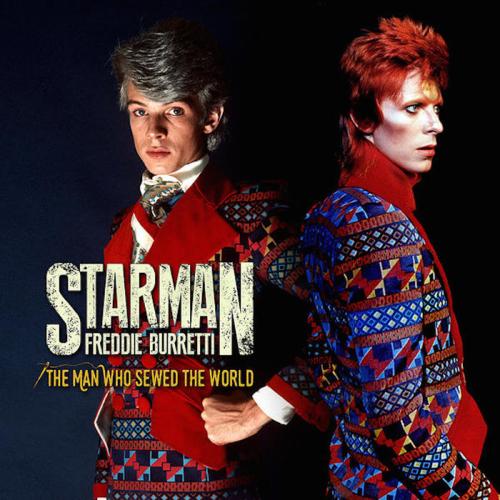
Connected by “otherness”: In a scoop for the film Starman, Bowie himself gave this unseen 1973 picture of Freddie Burretti wearing his own design for a lush crimson suit to launch the Aladdin Sane album. Both photographs by Masayoshi Sukita
Click to zoom down to Andy Polaris’s film review
❚ BETWEEN 1970 AND 1974 FREDDIE BURRETTI not only became David Bowie’s intimate teenage playmate but gave visual expression to the singer’s pop ambition. When they met Bowie was 23 and married to Angie while former Mod face Freddie, with his 28-inch waist and voluptuous long-hair, was as sexy as many another 19-year-old in that moment when David Johansen, Marc Bolan and Bowie were creating what became known as glam rock. But Freddie and David clicked instinctively in what Bowie calls their “otherness”, much of which derived from their sexuality. David’s career rebirth as an alien on Planet Earth was a masterstroke of pop invention and it was Burretti who created the exotic and brazenly sexual one-piece style of costuming in lush fabrics that we associate with Ziggy Stardust.
A new documentary biopic was previewed in London last night and not only breathes fresh life into familiar Bowie music but pieces together a unique chapter about his personal relationships against the austere climate of Britain in the 70s. Director Lee Scriven captures on film a score of eye-witness accounts, chief among them Freddie’s brother Stephen, his special friend and flatmate Wendy Kirby, his younger It-girl protégée Daniella Parmar, and biographer Kevin Cann.
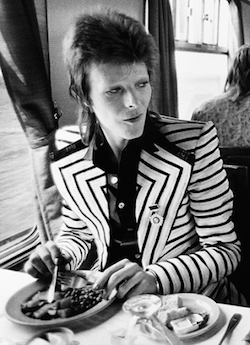
Burretti stripes 1973: Bowie photographed on the Aberdeen express by Mick Rock
Titled Starman: Freddie Burretti – The Man Who Sewed The World, the biopic’s impact is cumulative. Burretti described himself as “just a dress designer” – raised in Hackney, transplanted at 14 to Bletchley in the home counties, then escaping at 18 back to London to live the life – yet by the time the on-screen talking heads arrive at GQ editor Dylan Jones, it becomes clear that a body of opinion today ranks Burretti alongside giants such as Zandra Rhodes, Vivienne Westwood and even Alexander McQueen, whose design talent blossomed more than a decade later.
Indeed, Burretti’s “stylish, yet slightly whimsical approach to tailoring” and the enduring influence of his adventurous cutting in several suits of the moment during 1973–74 is thoroughly acknowledged in the V&A catalogue to its touring exhibition, David Bowie Is. The singer’s blurring of the line between stage wear and day wear persuades an impressive list of high-fashion designers to admit their debt to him, including Riccardo Tisci at Givenchy whose SS2010 show opened with a black-and-white striped blazer in a blatant tribute to the one Bowie was famously photographed wearing on an intercity train in May 1973.
Bowie told Fan magazine in 1974: “Freddie is extremely patient. He just listens to my ideas and has this sort of telepathy, because whatever I think of in my mind he produces for real. I just hope he’ll continue to design incredible clothes for me.”

Click on these pics to enlarge

At Radio City Music Hall, New York, 1973
❏ Up until now very few pictures of Freddie Burretti were known to the public – even the cover of the sex education magazine Curious shown below surfaced in only 2010 with Cann’s chronology of Bowie’s early life, Any Day Now. As the gay liberation movement was gathering momentum in Britain, we see Bowie wearing a floral “man-dress” designed by Savile Row tailor Mr Fish, known for putting Mick Jagger in a frock for the Stones’ 1969 Hyde Park concert. Bowie had two Mr Fish dresses which he wore in 1970 in cover photographs for the album The Man Who Sold the World.
With Starman, Scriven’s company LJS films has scored a major coup. The publicity photo you see up top has never been published before and was given to the project by Bowie himself, showing off Freddie’s good looks, with grey highlights in the hair. Today you’ll come across very few pictures of the gorgeous suit in rich crimson-and-blue velvet with flared crimson trousers created for the launch of the Aladdin Sane album. Its first outing was Bowie’s interview on the Russell Harty TV chat show recorded on 17 January 1973, and in an associated live clip singing Drive-In Saturday.
Uniquely, what Starman has done is to collage together Burretti and Bowie in the crimson suit to simulate a sumptuous set of photos taken that February by Masayoshi Sukita against the glistening art deco interior of Radio City Music Hall in New York. Scriven said: “I have been told Freddie would arrive at studio shoots in advance with the clothes and help the photographer by standing in as a model so he or she could set up the lighting etc ready for Mr Bowie.” Some of the shots play with his mirrored reflection and the collage cleverly echoes the originals.
In the UK an NME headline revealed the new persona, “Goodbye Ziggy, Big Hello to Aladdin”, while at Radio City on 14–15 February Bowie and the Spiders were launching their US tour. One poor black-and-white photograph suggests he might well have been wearing the crimson suit as he helicoptered onto the Music Hall stage. In this 90-minute show Bowie transitioned through the hit songs of Ziggy Stardust to introduce Aladdin Sane and all but one track from the new album – all this, remember, before his official and unexpected “retirement of Ziggy” announcement in London that July. Included in Freddie’s £1,000 invoice for costumes supplied to the tour, Cann’s meticulous book records “Red Check Suit 40 guineas” (about £500 today).
The tragedy is that the Burretti-Bowie partnership ended the next year, over a “financial disagreement”, according to Cann’s book. Immediately, Burretti slipped out of the public eye.
THE NIGHT DAVID MET FREDDIE
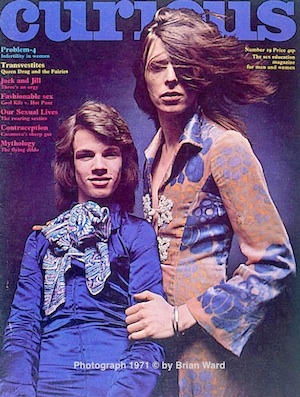
Curious magazine, 1971: Bowie wears his Michael Fish “man-dress” and plans to create a band called The Arnold Corns to showcase Freddie as “the next Mick Jagger”. In the studio, it turned out that Freddie couldn’t sing
❏ Their relationship had begun in 1970 in Kensington’s fashionable gay disco Yours Or Mine beneath El Sombrero, a Mexican restaurant. The Bowies were regulars, and one night David spotted Freddie cutting a dash on the up-lit dancefloor. Angie Bowie crossed the room to ask him and Wendy to join them for a drink.
In an interview with 5years.com Angie said in 2000: “You have no idea how handsome this man was. Freddie was wearing white Spandex hotpants with a navy blue sailors trim and a sailor shirt with short sleeves out of the same white Spandex edged in navy on the collar and sleeves. He looked totally Scandinavian with high cheek-bones and lots of blond hair, but he was tall and had big hands and feet speaking of his artistry and physical stamina. Every night he made new clothes to wear. He was so brilliant.”
At last night’s screening flatmate Wendy also remembered that day: “Angie approached us and asked us to have a drink. We hesitated and that’s what’s missing from the film – our sheer arrogance. We nearly said no!” She added: “Watching the film was quite strange. No one imagines their youth will be portrayed on screen and it was a little unsettling. I think the film was an affectionate glimpse of a time long gone. I didn’t appreciate at the time how talented Freddie really was. Lee’s film brought home how exceptional his work was. I’m proud to have known the man who was ‘just Freddie’ to me.”
Was Bowie’s gay phase in truth a marketing stance, as some argue? In his 2011 biography Starman, Paul Trynka reports American actor Tony Zanetta saying: “He was bisexual, but what he really was, was a narcissist – boys or girls, it was all the same. He was attracted to the gay subculture because he loved its flamboyance. Sometimes it was just an expression of communication – sometimes it was a way of. . . assimilating someone.” Bowie knew exactly what he was doing.
❏ Read on for a review of the film by Andy Polaris, ex-Blitz Kid and 80s pop singer who regards Bowie as one of rock’s serious gods.
➢ Starman director Lee Scriven’s website

Angie and David at home to Freddie in Haddon Hall: the host wears his Michael Fish designed “man-dress” that was banned from his American album cover for The Man Who Sold the World
➢ Previously at Shapersofthe80s: 2011, I danced in Bowie’s lost Jean Genie video, by Wendy Kirby
➢ Previously at Shapersofthe80s: 2010, A feast of Bowie-ana served in waffeur-thin slices by Kevin Cann
Last night’s preview: click any pic below to launch slideshow

This weeks preview at the Olympic Cinema, London

Wendy Kirby dressed for a night on the town

Freddie and Daniella Parmar, photographed in 1971 by Mick Rock

Estelle Randle who portrays Wendy Kirby in the Starman film with Jordan Rivenberg who portrays Freddie aged 19

Freddie’s flatmate Wendy Kirby meets Estelle Randle who portrays her in the Starman film

Freddie’s flatmate Wendy Kirby meets Jordan Rivenberg who portrays Freddie in the Starman film

Wendy Kirby reunited at the screening with Daniella Parmar, fellow habituée of the Sombrero nightclub

Arnold Corns guitarist Mark Carr Pritchard with Kevin Cann, author of Any Day Now, the exhaustive chronology of Bowie’s early years

Freddie’s flatmate Wendy Kirby as 70s blonde
➢ Previously at Shapersofthe80s:
1970, Where to draw a line between glitter and glam
☐++++++☐++++++☐
ANDY POLARIS REVIEWS STARMAN THE MOVIE
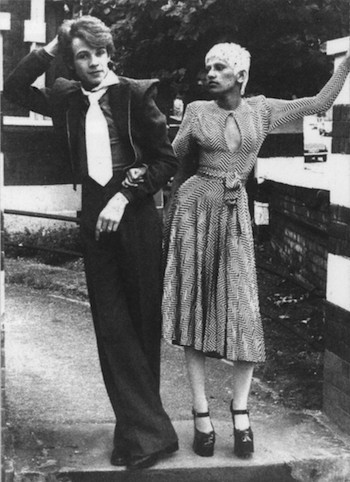
Bowie’s designer Freddie and It-girl Daniella in about 1971: striking a pose that David and Angie came to emulate

Andy Polaris
❏ Starman: The Man Who Sewed The World gives a fascinating insight into the relatively unknown life of fashion future legend Freddie Burretti. This working-class lad had a creative mind able to absorb everything he loved about Mod fashion, having taught himself to make his own clothes at an early age. With enough dedication and focus to learn tailoring as well as the youthful dynamics of the dancefloor, he was obviously adept at observing styles and reworking looks to his own vision.
A chance meeting at the disco lead to the serendipitous collaboration with Bowie and the singer’s as yet not fully realised Ziggy Stardust wardrobe. These bold textured prints and coloured jumpsuits were, and are, extraordinary for capturing Bowie’s otherness at that time. Aladdin Sane prints that looked like Liberty worn by the androgynous male rock star blew our tiny minds back then.
What I loved about the movie was seeing the genesis of Freddie’s glamour vision in a mundanely drab landscape played out with the innocence of his mainly, it appears, female friends notably Wendy bf and Daniella protégée. Wonderful to hear their counterpoint stories of that inner ciricle involved in Bowie’s creation of Ziggy with Freddie’s ascendant talent and confidence.
The pairing of Freddie and Daniella wearing his clothes is groundbreaking. Looking at those photos we see the androgynous beauty of Freddie (like a still from James Bidgood’s 1971 cult movie Pink Narcissus) teamed with Daniella’s Asian complexion and short spiky blonde crop. They had already created David and Angie’s classic image before the rest of the world saw it!

Coordination of styles, 1973: which came first, Johansen of New York Dolls or Bowie in Burretti suit?
In fact, Daniella also anticipates Ava Cherry singing with Bowie in Young Americans several years later when we note the similar styling – how did that happen?
From my own black perspective, a brown or black face was something I would immediately zone in on, seeing someone like you up there on a stage and hanging out with the stars. Marc Bolan having the black Gloria Jones as his wife was a big bloody deal to some black kids, for sure.
Freddie’s whole look seems to have been adopted wholesale by David Johansen of the New York Dolls, so the influence of this young British designer can today be recognised rippling out into the wider pop culture although it probably wasn’t acknowledged at the time. Maybe a parallel could be drawn between Freddie and Alexander McQueen – both gay and from working-class backgrounds – though McQueen came to work with Bowie as an established star, whereas Freddie created an image that made Bowie a star. Today it is unreal to imagine any designer could achieve such pivotal pop success without a massive team behind them.
➢ Video: Andy Polaris sings Mr Solitaire on Top of the Pops
➢ Follow Andy’s blog APolarisView: one man’s adventures in display and other obsessions
FRONT PAGE