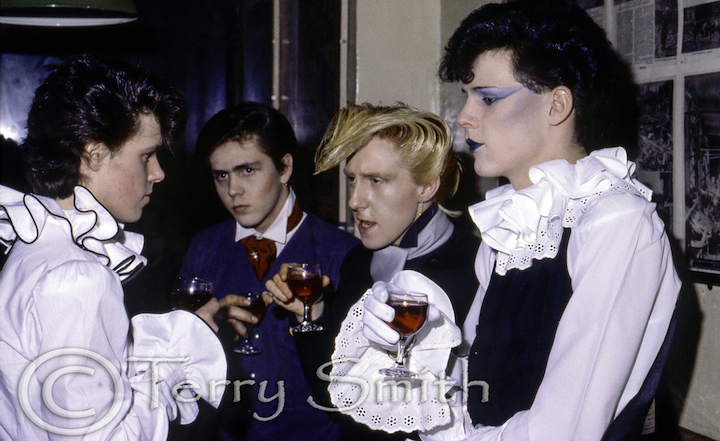
+++ ◼ AN ENORMOUS NEW CACHE of photographs of the Blitz Club in colour has been discovered from the spring of 1980 when the UK media started to take an interest in the Tuesday-night antics of the nightlife posers at Covent Garden’s Blitz Club. They were to become celebrated as the Blitz Kids by some and as New Romantics by others. Until this moment it has been easy to count the number of surviving professional pictures ever taken inside the Blitz during its 20-month life – all of them in black-and-white – and the total doesn’t even approach 100.
Now a call to Shapers of the 80s by the British photographer Terry Smith has unearthed probably 300 more images, commissioned by Time magazine. Many of them are in glorious colour, shedding extra light on the creativity of the night-owls who were in the throes of transforming the fashion and pop landscape of Britain in the Swinging 80s.
Shapers of the 80s today showcases the first of four batches of Terry’s pictures capturing the Blitz in colour, while a selling exhibition of his black-and-white images is preparing to open on 7 June in St Leonards-on-Sea.
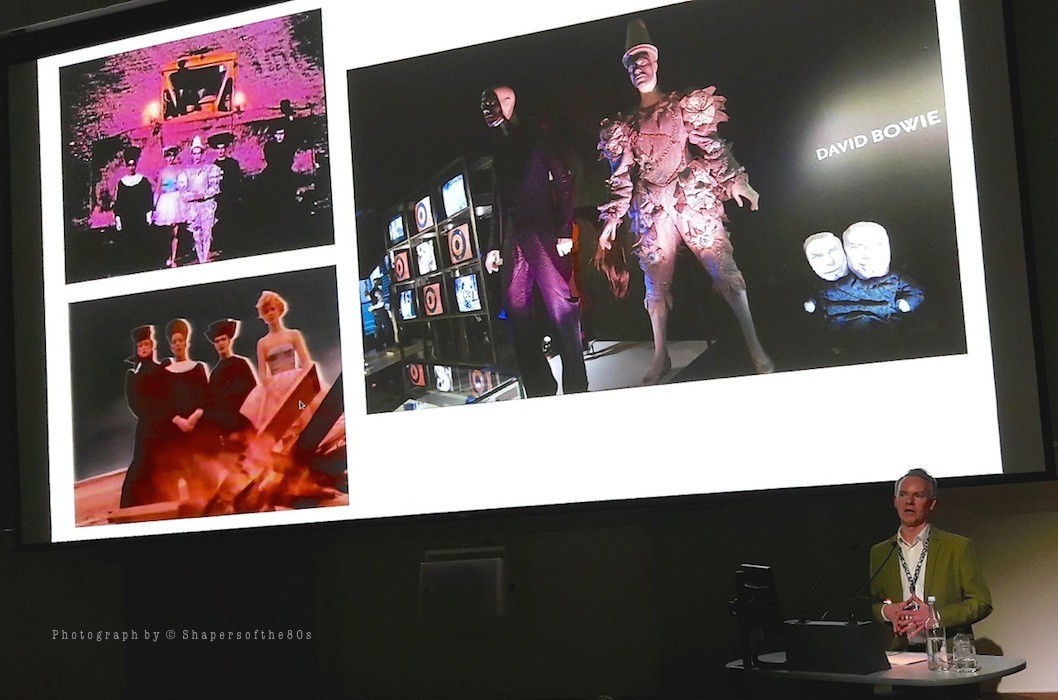
Giving this week’s V&A Lunchtime Lecture, May 2018: Curator Keith Lodwick in full flow. . . On-screen, Bowie’s Pierrot costume displayed in the V&A’s 2013 exhibition Bowie Is, with Steve Strange and other Blitz Kids pictured in Bowie’s Ashes to Ashes video in 1980
◼ 80S POP-STAR FRIENDS OF STEVE STRANGE turned out this week for a unique event at the V&A, the UK’s premier museum of art and design. The weekly Lunchtime Lecture was titled Steve Strange: From Blitz Club to Top of the Pops, and was delivered by Keith Lodwick, curator of Theatre and Screen Arts, to an audience that included singer Clare Grogan, ABC’s Martin Fry and his wife Julie, Jennie Matthias from The Belle Stars and Fifi Russell from Yip Yip Coyote. Steve’s mother Gillian Harrington and his sister Tanya had travelled from Wales with PR Amanda Lloyd to attend the occasion with other family members.
The talk traced Strange’s flamboyant life from Wigan Casino, through glam-rock and punk, to hosting a landmark club-night at Billy’s jointly with deejay Rusty Egan, then another at the Blitz in 1979–80. This was the club-night that Band Aid organiser Midge Ure has described as “the beating heart of the electronic dance music that led the 1980s.”
Strange said of his strict admissions policy on the door: “I wanted creative-minded pioneers who looked like a walking piece of art.” Indeed, the club became Strange’s own catwalk for sporting outrageous outfits by both the leading designers of the day and London’s budding fashion students. Lodwick said: “He once told a journalist ‘I am on stage 24 hours a day’. Steve, who died in 2015, remains one of the enduring figures of the New Romantic period.”
Click any pic below to view larger in a slideshow
Curator Keith Lodwick lecturing: On-screen, my own history of the New Romantics movement written for Observer Music Magazine in 2009
On-screen, images of Steve Strange now in the V&A collection
On-screen, some of Steve Strange’s clothes acquired for the V&A collection
On-screen, four of Steve Strange’s hats designed by Stephen Jones, now in the V&A collection
Singer Eve Ferrett talking with Fifi Russell from Yip Yip Coyote, while distracted by Kim Smith showing us her Black Star for last week’s Bowie meet-up
Curator Keith Lodwick with Steve Strange’s mum Gill (bathed in curious lighting)
Lodwick reminded us of the pop pantheon Strange was joining at the museum when he extended “a huge thank-you to Gill, Tanya and Amanda for being a link in the chain that enabled the V&A to acquire Steve’s archive and costumes two years ago. The family donated mainly clothes from the 2000s – including designs by Vivienne Westwood and Alexander McQueen. Steve’s costumes join those worn by Sandie Shaw, the Beatles, Mick Jagger, Marc Bolan, Jimmy Page, Elton John and Adam Ant.”
We watched two video clips which underlined Strange’s obsession with image-making: the music video for his band Visage’s hit Fade to Grey in which he is transformed into a snake; and a documentary in which milliner Stephen Jones suggests that berets he made for both Strange and for the Princess of Wales coupled them “as a fashion force together”.
Lodwick concluded: “Steve’s legacy will live on for being central to re-energising the club scene in London – pushing forward electronic music, fashion, photography and pop.”
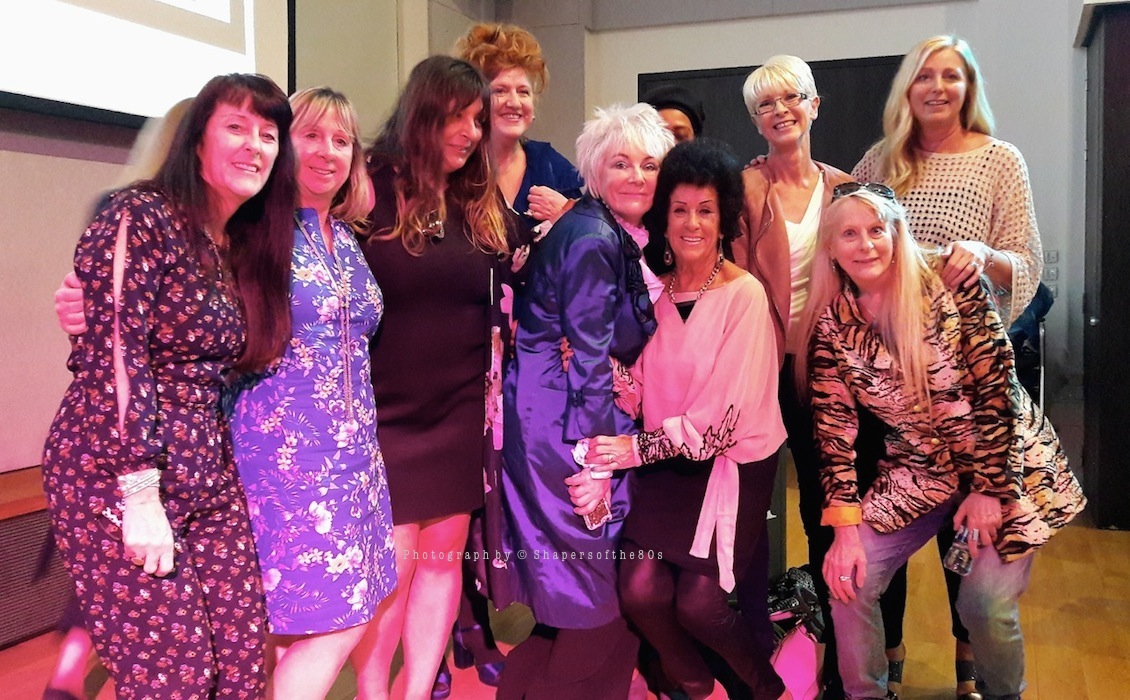
At this week’s V&A talk: Some of the women in Steve Strange’s life. . . From the left, sister Tanya Harrington, Monica Towner, Rachelle Boyle, Eve Ferrett, Kimbo at centre next to Steve’s mum Gill, Jennie (Belle Stars) Matthias (almost hidden at back), Wendy Tiger, Alison Graham, Amanda Lloyd far right
◼ HERE’S ONE OF THE MOST exhilarating interviews you’re ever likely to read with a godlike genius of the American music industry who has won 28 Grammy awards and co-produced Michael Jackson’s biggest-selling albums. The Beatles aren’t the only stars to receive blunt verdicts today from Quincy Jones. But then he did train under the celebrated Nadia Boulanger who during seven decades taught hundreds of leading composers and musicians of the 20th century at the elite Paris Conservatoire, so he does know his stuff. Jones also reckons Jacko “stole lots of songs” and claims to know who shot JFK in 1963. Jones is about to turn 85, so what does he have to lose? Read his eye-poppingly frank revelations in a Q&A interview with Vulture, the culture and entertainment site from New York magazine. He does also pay respec’ to six young stars “doing good work”.
❏ Zayn Malik tells Elle India that he has recorded a tune in Hindi for a forthcoming Bollywood movie. Bradford-born Zayn is the son of a British Pakistani father and English mother who converted to Islam when they married.
❏ The Libertines to headline Kendal Calling, 26-29 July.
❏ Kylie to play two intimate shows in March in London and Manchester.
❏ Spice Girls ‘to kick off world tour in UK this summer’.
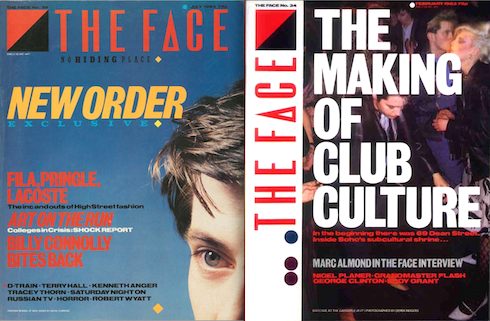
◼ 1983 PROVED TUMULTUOUS for British youth culture. By December, London’s leading club deejay Jay Strongman declared “This was the year of Go For It”, after 17 new British pop groups lorded it in the US top 40 chart that autumn, while our spirited fashionistas were making waves around the world, with Princess Diana playing ambassador for the classic designers, and Boy George pushing the wilder extremes of street style. Among major features I wrote for The Face was February’s cover story The Making of Club Culture, and in the Evening Standard Posing with a purpose at the Camden Palace, a centre spread on the runaway megaclub hosted by Strange and Egan.
Nightlife was a burgeoning story as black beats took over dancefloors everywhere and Manchester’s tearaway megaclub was the Hacienda, despite the oppressive clean-up being imposed by the city’s infamous Chief Constable. Clubbers from across the nation swarmed in to create a grand coalition of all the cults – “your complete i-D line-up, minus the Worlds End spendthrifts”. In my January report for The Face one inmate bemoaned Hacienda music as “too funk-based” though another, a flat-top lad called Johnny Maher, revealed his secret, despite having launched some new indie rock band minutes earlier. “I schtupp to funk,” he said.
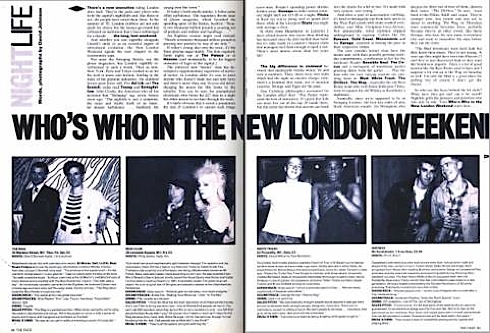
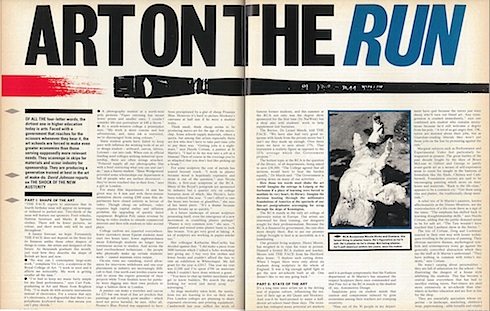
In July The Face published a major piece of reportage, Art on the Run, prompted by numerous friends in fine-art education, and billed it as a “shock report” on the Conservative government’s debilitating squeeze on the art schools. Ironically in the same issue my regular Nightlife column identified the four hottest clubland teams as a Who’s Who in the New London Weekend: “Not since the Swinging Sixties had London nightlife reverberated to such a boom.” These clubs were the unofficial job centres that kept a generation in freelance employment and introduced the verb to vop into the language (derivation: “What are you up to these days?” – “Oh, a Variety Of Projects”). Some of that effort was fuelling the rise of computer games which in the June issue Virgin assured me was “the new pop industry”!
Brighton hotspot 1983: Ian, Oliver Peyton and Kate hosting The Can (Photo Shapersofthe80s)
My Nightlife column in The Face’s October issue featured Brighton’s trendiest hotspot (seconds before the very word trendy passed its sell-by outside the Greater London stockade). The Can was presided over by a young Oliver Peyton with Andy Hale as the deejay breaking funk there. Years later Oliver thanked me for this exposure and said he would never have come up to London and started opening restaurants without The Face’s prompt! (One of the few people who have ever thanked me for writing about them! Cheers, Oliver.)
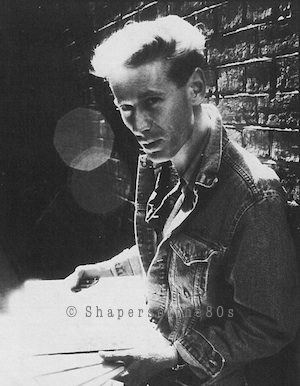
Jay Strongman in 1983: ruling London’s three hottest turntables
By this fertile year’s end I had FIVE indicative pieces of reportage published in the December issue of The Face including a detailed rundown on the new dance music by club deejay Jay Strongman, plus news of the imminent Westwood/ McLaren break-up which I’d scented from body language backstage at their Paris runway show.
The launch of the first London Fashion Week that same October confirmed that British street style was being feted in the international spotlight, yet it begged the question how on earth had this suddenly come about? Click through to our inside page to read the feature investigation that set out to answer such questions, by asking decision-makers in the industry to identify the best of Britain’s young designer talent under the headline Eight for ’84. . .
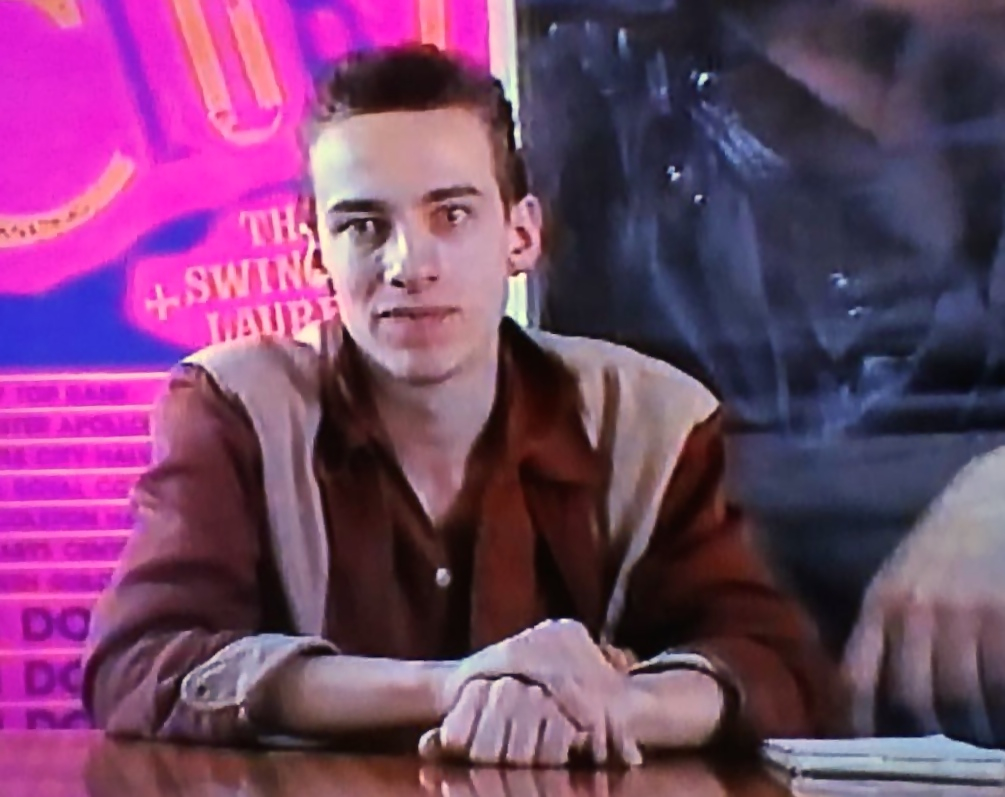
The boy wonder: “Scoop” Simper plugging No1 on Switch, the TV pop show
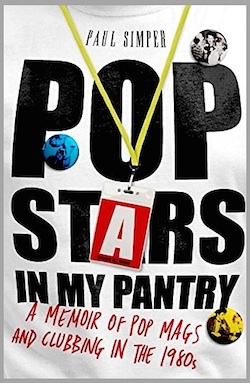
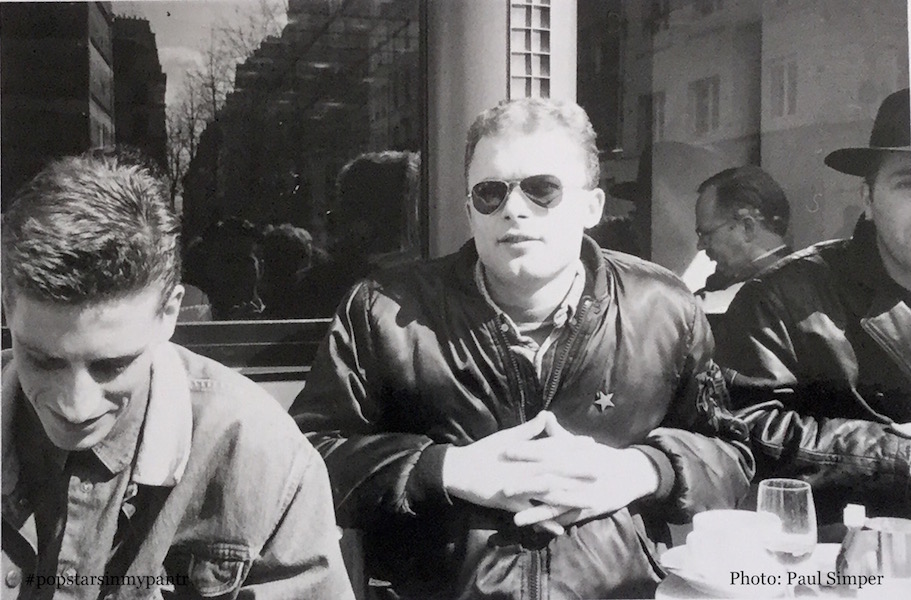
A rare book is published this month giving a vivid eye-witness account of one of the most creative eras for British pop music, the Swinging 80s. Paul Simper himself says: “It’s the pop life story pop-pickers have been gagging for.”
He should know, having emerged from London clubland to become the leading commentator on the New Pop led by image-conscious young bands when the rock press at large was giving them short shrift. Not only was he genuinely The Friend of The Stars but was one of the few writers who could also give it pure laldy dancing his socks off down Le Beat Route. Pop Stars in My Pantry is his confessional memoir and today Shapers of the 80s reprints an exclusive extract. . . But first, who is the man called Simper?
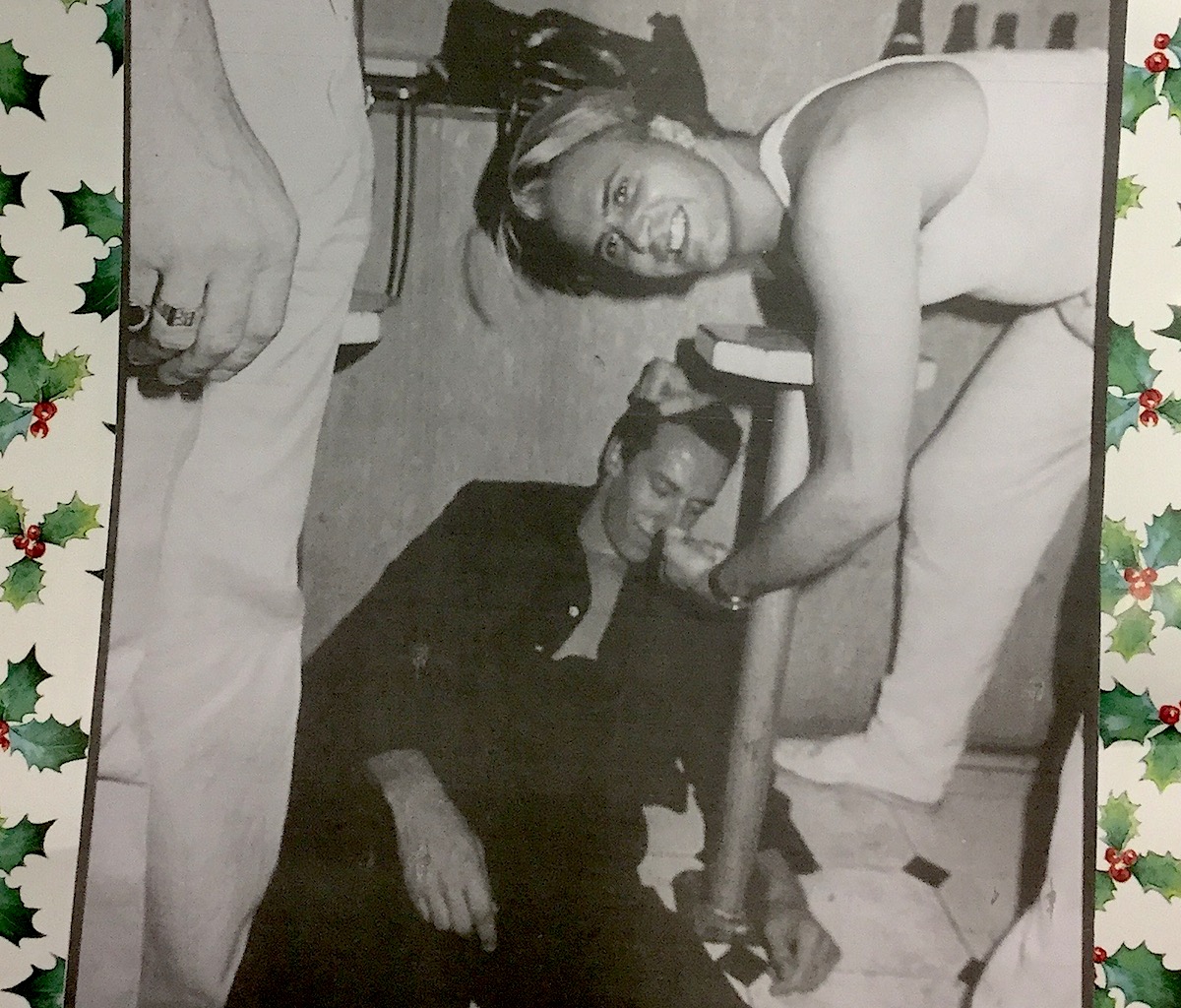
Wakey-wakey! Spandau Ballet sax player Steve Norman discovers our hero Simper relaxing during a characteristic night out on the town during London’s Swinging 80s
◼ THERE’S NO EXPLAINING PAUL SIMPER except as a life force which is Always On – sometimes as a mouse, sometimes a bunny, often in a skirt or a sequinned tuxedo. Not usually at same time, obvs. He’s obsessive, definitely bonkers, extremely good “in the room” and, oh yes, quite an entertaining showbiz writer.
Now he’s had the nerve to bring out his life story as a book called Pop Stars in My Pantry (PSIMP for short) when you’d think people in the music biz would have learned a lesson from Morrissey’s Pooterish own goal. Luckily Simper seems to have had massively more fun than Moz, actually likes the people he writes about and, oh yes, brings a wicked sense of humour to an industry not noted for knowing how to laugh.
As a singer in Slippry Feet – a marriage of supper-club in a circus ring meets David Lynch in a disco – Simper only ever got as far as being the best group of December 1993. Bar none. Fortunately for this book he has the day job to fall back on and he is SUCH a namedropper. Look at the puffery adorning his book’s back jacket: “Always a joy to hang with” – Siobhan Fahey; “The most trusted person in 80s pop” – Patsy Kensit; “Truly the epitome of the embedded journalist” – Gary Kemp.
Goes with territory when you have become Friend of The Stars, having leapfrogged from Melody Maker within minutes of coming up from the sticks in 1981, onto smart new fan mags like New Sounds New Styles and No 1 which counted clubbing on-the-town as research. There from the off, he was friends with the burgeoning new generation of self-invented nightlife stars who were storming off fashionable dancefloors across the UK and into the singles charts to knock the rock dinosaurs for six. Fellow clubbing names being dropped go from George Michael to Frankie Goes to Hollywood, Bananarama to Boy George. Not to mention Madonna, Prince, Whitney, Elton and Weller. Woohoo!
Early on I nicknamed him “Scoop” Simper because even though I worked for a Deeply Influential Mainstream Newspaper, whenever any big sexy pop star, like, y’know Debbie Harry, flew in from abroad *he* got the exclusive interview even though he “only” worked for one of those pure-pop weeklies full of pinups and lyrics and breathless reviews.
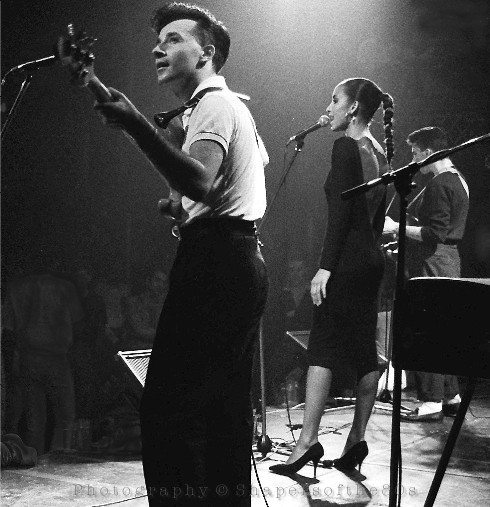
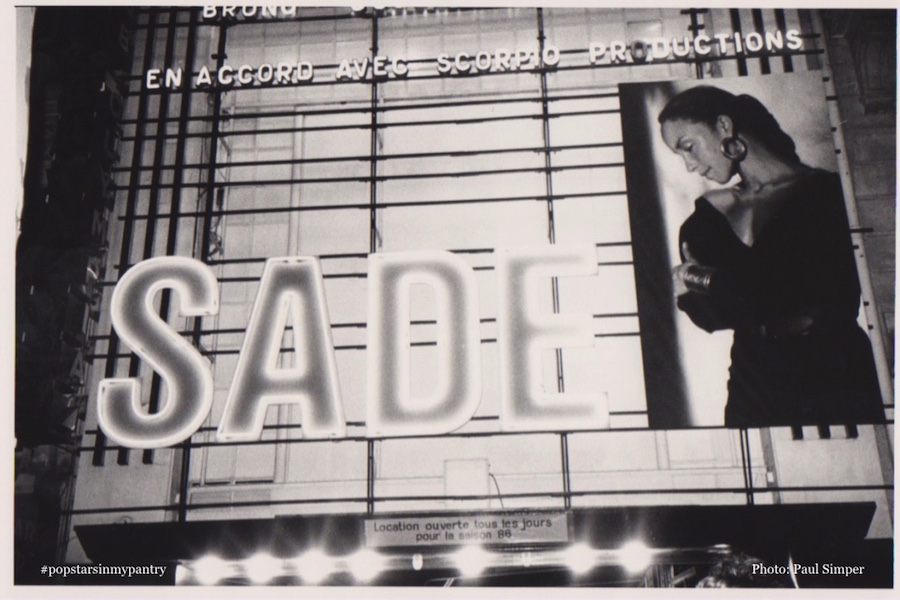
So who’s having the last laugh now?! Well probably Scoop, as usual, since PSIMP proves to be “a right frollicking read for the adults in your family”, while my own book has blurted itself out and into this website for several years, clocking up barely a handful of Wikipedia footnotes to credit. And now His Majesty is entrusting Shapers of the 80s with running an excerpt from one of the best chapters in his book, the story of Sade Adu, the Essex girl who rose via St Martin’s School of Art to become one of the UK’s biggest Grammy-award winning pop exports, described by Robert Sandall in The Sunday Times in 2010 as “the most successful solo British female artist in history”.
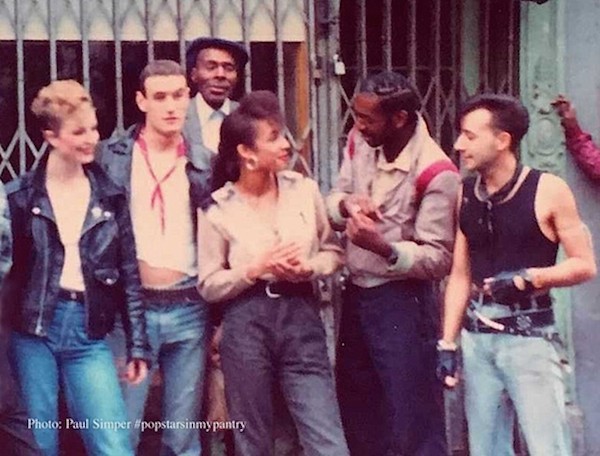
Scoop spills the beans: “Sade was very much a part of my early years as a young pop writer living in London. She even used to kindly let me sleep on her sofa.” So here’s a short teaser-taster from PSIMP, but do click through to our inside page for the full extract when Sade’s first band Pride goes in search of Manhattan’s edgy Village scene. . .
“ I owed Sade and Bob Elms plenty. When I first moved to London I couldn’t have been more grateful for the existence of their north London home tucked away in multi-cultural Wood Green on the Noel Park Estate.
Their old sofa didn’t exclusively have my name on it – fresh-down-from-Hull saxophonist Stuart Matthewman was pretty much clothed, housed and fed by them over the same period – but on the occasions I was invited back, I took some shifting. Sade reckoned that a pair of my old socks stuck around even longer than me until she ceremonially buried them, like high-grade plutonium, in the back garden.
I was never so bold as to turn up unannounced, but if Bob suggested a home viewing of an under-the-counter video of Texas Chainsaw Massacre or The Hills Have Eyes that he’d got his mitts on in Soho (I’d discovered in my early days in London there was a black market for everything), then I was more than up for it.
My telly viewing habits were not of primary importance to the residents at No 64 Hewitt Avenue by the spring of 1982, though, when Bob and Lee Barrett started talking up this new band called Pride that “Shard” was in. Stuart Matthewman was also involved, as were fellow Hull lads drummer Paul Cooke and bass player Paul Denman.
Back in Hull, Stuart had been in The Odds, a pop/mod band similar to The Piranhas that had started out doing speeded-up punk versions of 60s hits like The Dave Clark Five’s Glad All Over. He then played sax in a ten-piece Elvis impersonator show called Ravin’ Rupert, which covered the whole spectrum of The King’s career from rockabilly to Vegas delivered by a front man sporting a quiff and wearing Rupert-the-Bear checked trousers. A tad cooler was Paul Cooke and Paul Denman’s prog-rock band, The Posers, which Stuart credits as being the only band in Hull trying to do something new.
As for Sade, her singing career had only begun a few months previous when she sang onstage for the first time as part of another London band, Ariva. Considering Ariva were viewed as a bit of a Blue Rondo rip-off, ironically it was on the way to a Rondo gig on Barry Island that Lee first clocked Sade singing along to the radio and asked her if she could sing. She thought she probably could so said Yes. . . ”
➢ Choose “View full site” – then in the blue bar atop your mobile page, click the three horizontal lines linking to many blue themed pages with background article
MORE INTERESTING THAN MOST PEOPLE’S FANTASIES — THE SWINGING EIGHTIES 1978-1984
They didn’t call themselves New Romantics, or the Blitz Kids – but other people did.
“I’d find people at the Blitz who were possible only in my imagination. But they were real” — Stephen Jones, hatmaker, 1983. (Illustration courtesy Iain R Webb, 1983)
“The truth about those Blitz club people was more interesting than most people’s fantasies” — Steve Dagger, pop group manager, 1983
PRAISE INDEED!
“See David Johnson’s fabulously detailed website Shapers of the 80s to which I am hugely indebted” – Political historian Dominic Sandbrook, in his book Who Dares Wins, 2019
“The (velvet) goldmine that is Shapers of the 80s” – Verdict of Chris O’Leary, respected author and blogger who analyses Bowie song by song at Pushing Ahead of the Dame
“The rather brilliant Shapers of the 80s website” – Dylan Jones in his Sweet Dreams paperback, 2021
A UNIQUE HISTORY
➢ WELCOME to the Swinging 80s ➢ THE BLOG POSTS on this front page report topical updates ➢ ROLL OVER THE MENU at page top to go deeper into the past ➢ FOR NEWS & MONTH BY MONTH SEARCH scroll down this sidebar
❏ Header artwork by Kat Starchild shows Blitz Kids Darla Jane Gilroy, Elise Brazier, Judi Frankland and Steve Strange, with David Bowie at centre in his 1980 video for Ashes to Ashes
VINCENT ON AIR 2026
✱ Deejay legend Robbie Vincent has returned to JazzFM on Sundays 1-3pm… Catch up on Robbie’s JazzFM August Bank Holiday 2020 session thanks to AhhhhhSoul with four hours of “nothing but essential rhythms of soul, jazz and funk”.
TOLD FOR THE FIRST TIME
◆ Who was who in Spandau’s break-out year of 1980? The Invisible Hand of Shapersofthe80s draws a selective timeline for The unprecedented rise and rise of Spandau Ballet –– Turn to our inside page
SEARCH our 925 posts or ZOOM DOWN TO THE ARCHIVE INDEX
UNTOLD BLITZ STORIES
✱ If you thought there was no more to know about the birth of Blitz culture in 1980 then get your hands on a sensational book by an obsessive music fan called David Barrat. It is gripping, original and epic – a spooky tale of coincidence and parallel lives as mind-tingling as a Sherlock Holmes yarn. Titled both New Romantics Who Never Were and The Untold Story of Spandau Ballet! Sample this initial taster here at Shapers of the 80s
CHEWING THE FAT
✱ Jawing at Soho Radio on the 80s clubland revolution (from 32 mins) and on art (@55 mins) is probably the most influential shaper of the 80s, former Wag-club director Chris Sullivan (pictured) with editor of this website David Johnson
LANDMARK FAREWELLS. . . HIT THE INDEX TAB UP TOP FOR EVERYTHING ELSE













 ➢➢ Shapers of the 80s ➣➣