Category Archives: Britain

➤ Mr Porter asks the expert about: bomber jackets

Chris Sullivan, video, bomber jackets, fashion, style, YouTube

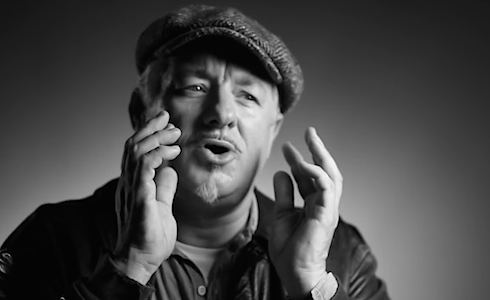
Click on the picture to view Sullivan’s video in a new window

CHRIS SULLIVAN, STYLE JOURNALIST and legendary former director of Soho’s Wag club, suggests why bomber jackets transcend the notion of fashion – “which is rather unbecoming for any man over the age of 30”. . . In the UK during the second world war a cottage industry sprang up of American servicemen getting their A2s copied by English tailors. Sullivan says: “You can have a bomber jacket for 30 years and still keep wearing it because it will always look good.”

➢ Previously at Shapersofthe80s: Sullivan tells the ribald tale of the mayhem he helped cause in clubland

FRONT PAGE

1981 ➤ Hot days, cool nights, as Blue Rondo join the new Brits changing the pop charts

Blue Rondo à la Turk , pop music, 1981

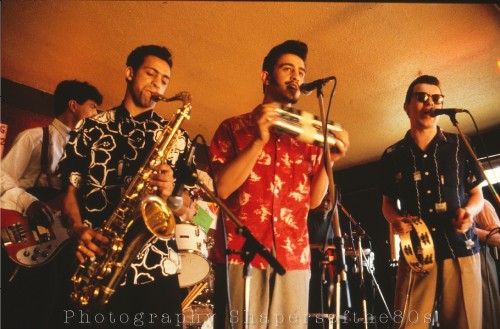
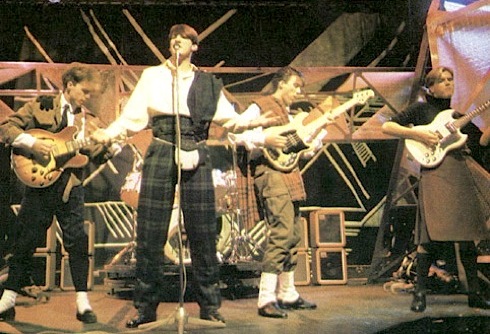
Blue Rondo’s official debut in Chelmsford, June 1981: Moses Mount Bassie, Christos Tolera and Chris Sullivan front the seven-piece. Photograph © Shapersofthe80s

◼ “GET IN THE BACK OF THE VAN,” I was told on this day 30 years ago. “You’re coming for a ride.” Graham Ball was a club host empowered to open the trendiest of doors in Soho, so “No thanks” was not an option. “I’ve got a new band to show you. And you’re not quite going to believe what you’ll hear and see.” He was, apparently, now also a manager. We arrived in blisteringly hot sunshine at a characterless modern pub in Chelmsford, Essex, well away from Soho clubland, and there of course were the rest of The Firm — the handful of sharp young dudes at least half the age of the grunters who dominated the pop industry, all being groomed by Spandau’s 23-year-old Steve Dagger to inherit the mysteries of management for a new generation of bands.

Assembling an assortment of instruments onstage were five, six, no, seven of the most variegated musicians you felt might belong in a special institution for their own safety. I had been invited to write the first piece about the craziest combo  inspired by London’s Blitz Club, which had closed the previous autumn, and by this summer they were but one among the slipstream of bands erupting on London’s burgeoning nightlife scene. From their opening vocals — “Oo-oo, aa-aa, mm-mm ah!” — Blue Rondo à la Turk were sensational, and my review appeared in the second issue of New Sounds New Styles. It took only three months before Rondo signed a deal and charted in November.

➢ Read that first review of Blue Rondo as they create a buzz with their new Latin sounds — from NSNS August 1981

This was the summer
of New Romance

Spandau Ballet, Ultravox, Duran Duran, 1981

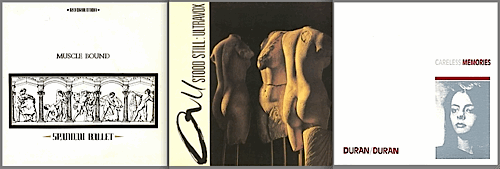
Leaders of the Romantics in 1981: Spandau Ballet, Ultravox, Duran Duran

ON THIS DAY in 1981 the UK charts were bursting with the new generation of image-conscious British groups who whose linking of soul and electro-pop were to change the style and the rhythm of pop charts for ever. . .

Ultravox were enjoying their fifth hit single All Stood Still.
Linx were enjoying their third hit Throw Away the Key.
Spandau Ballet were enjoying their double-sided third hit single, Muscle Bound/Glow. At Easter they had also signalled their new funky direction by introducing Chant No 1, which would become London’s clubbing anthem and reach No 2 later this summer.
Duran Duran were enjoying their second hit Careless Memories.
Orchestral Manoeuvres in the Dark were enjoying their second hit Messages.
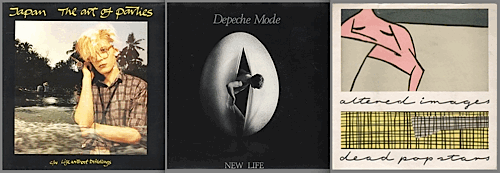
Japan were charting with The Art of Parties.
Landscape were charting with Norman Bates.
Shalamar (with honorary Brit and body-popping pioneer Jeffrey Daniel) were charting with A Night to Remember.

➢ Elsewhere at Shapers of the 80s: 100+ acts who set the style for the new music of the 1980s

Light of the World were charting with I’m So Happy.
Imagination were charting with their debut Body Talk.
The Human League entered the charts on this day with Empire State Human.
Depeche Mode’s second single New Life was soaring towards No 11.
Visage’s second hit single had just fallen out of the chart.
❏ Likewise Heaven 17’s debut Fascist Groove Thang.
❏ Likewise Altered Images’ debut Dead Pop Stars.
❏ Likewise Level 42 with their second hit, Love Games.
❏ And the honorary Brit, Kid Creole, was heading into the charts with his Coconuts and their debut single, Me No Pop I — a compulsively danceable new sound on Antilles introduced to London last year by i-D co-editor Perry Haines.

New Romantics, bands, Swinging 80s,Japan the band, pop music, Depeche Mode, Altered Images

Going Romantic in 1981: Japan the band, Depeche Mode, Altered Images

Oh, and two nights earlier at Le Beat Route I’d snapped the new boy in George O’Dowd’s life enjoying their first date. Nobody dreamt that George and Jon Moss would one day be putting together their own band.

♫ VIEW fine Northern Soul footwork from Rondo mentalists in this performance of Me and Mr Sanchez shot at the Venue in London:
+++

FRONT PAGE

On this day in 1980 ➤ Spandau fired the starting gun for British clubland’s pop hopefuls: dada didi daaa!

rel="nofollow"

Nov 13, 1980: chart entry qualifies Spandau for their first Top of the Pops

◼ TODAY’S THE DAY THE HOTTEST NEW BAND OF 1980 released their debut single 30 years ago. Inside a year, Spandau Ballet had clicked with clubland’s coolest fan base, played only eight bookings, refused to make any demo tapes but instead spent that year winding up the media and the music industry with word-of-mouth rumours of a youth movement right behind them.

Steve Norman

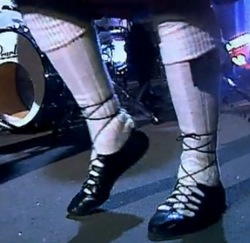
Kilt-wearing Steve Norman’s lace-ups

On October 10 Spandau signed an unprecedented deal with Chrysalis, on October 27 they released To Cut a Long Story Short driven by a monophonic synthesiser: Daa-didi dada dada di-di dada didi daaa! On November 15 the single entered the chart. Bingo – Top of the Pops.

In 1980, for every new band firing up their ambition in the wings, Spandau acted as a fuel injection system. For electro bands who had been nibbling at success  — OMD, Simple Minds, Japan, Ultravox — here was the bandwagon. And they jumped on board.

NOW TURN TO OUR INSIDE PAGE

➢ Full timeline of Spandau Ballet’s wind-up year from tease dates to Top of the Pops in 12 months!

HERE’S THE VIDEO FOR Spandau’s ORIGINAL, NOW IN HD…

➢ My full history of the birth of the New Romantics
in the Observer Music Monthly

➢ Elsewhere at Shapers of the 80s: 190+ acts who set the style for the new music of the 1980s

FRONT PAGE

➤Six magazines that changed the course of postwar British journalism

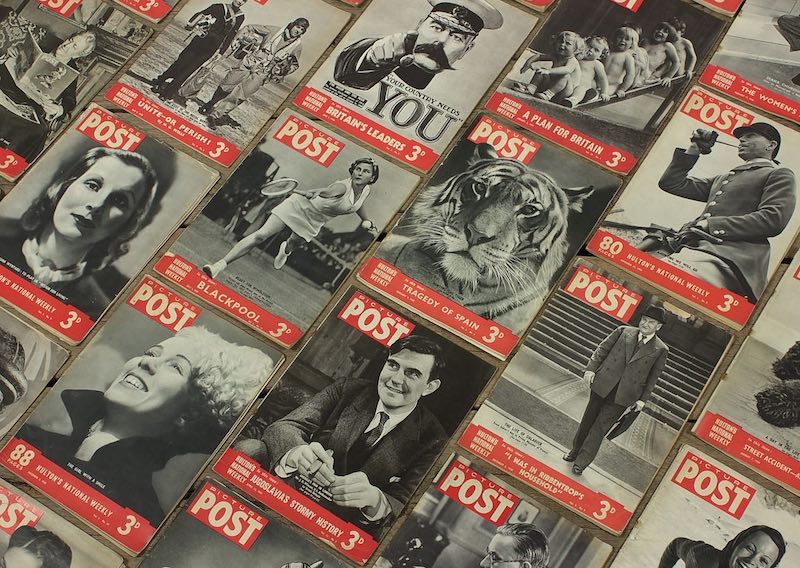
journalism, Picture Post, influencers, magazines pre-war

Picture Post covers from 1938 onwards

[This post was first published at Shapers in March 2009]

PICTURE POST 1938-57

The pioneer of photo-reportage. At the height of its powers during the Second World War this was the most widely read periodical in the country, selling 1,950,000 copies a week. Its inspirational editor from 1940 Tom Hopkinson recruited the photographers Bill Brandt, Bert Hardy, Kurt Hutton, Felix Man, Francis Reiss, Thurston Hopkins, John Chillingworth, Grace Robertson, Leonard McCombe. Staff writers included MacDonald Hastings, Lorna Hay, Sydney Jacobson, J. B. Priestley, Lionel Birch, James Cameron, Fyfe Robertson, Anne Scott-James, Robert Kee and Bert Lloyd; freelance contributors included George Bernard Shaw, Dorothy Parker and William Saroyan.

SUNDAY TIMES MAGAZINE 1962-today

The first colour supplement to be published as a weekly addition to a UK newspaper. The first editor was Mark Boxer. From the outset, “photographer first” was the benchmark and required serious investment in photo-reportage from the world’s trouble spots. Michael Rand, its art director for 30 years from 1962, said the credo was “grit plus glamour – fashion juxtaposed with war photography and pop art”. He went on to champion the work of such photographers as Terry O’Neill, Brian Duffy, Richard Avedon, Eugene Richards, Diane Arbus, Mary Ellen Mark. The magazine featured images from the Vietnam war by the photographer Don McCullin, a photo-essay on the Vatican by Eve Arnold, many portraits and photo-essays by Lord Snowdon, and Bert Stern’s final photoshoot with Marilyn Monroe, among many other photographic collections.

NEW SOCIETY 1962-1988

A weekly magazine of social inquiry and cultural comment, it drew on the disciplines of sociology, anthropology, psychology, human geography, social history and social policy, and it published wide-ranging social reportage. The cultural commentator Robert Hewison wrote that New Society became “a forum for the new intelligentsia” created by the expansion of higher education in Britain from the early 1960s. The editor Paul Barker (1968–86) was described by the labour historian Eric Hobsbawm as the “most original of editors”.

NOVA 1965-75

Launched under the slogan A new kind of magazine for the new kind of woman, Nova created its own unique niche in the British consumer magazine market under gifted editor Dennis Hackett, together with visionary art director Harri Peccinotti. They swiftly established their magazine as an influential must-read for the movers and shakers of Swinging London, among men as well as the original target audience of women becoming devotees of its heady mixture of social issues and cutting-edge fashion and modern lifestyle features. Nova’s agenda of journalistically taboo subjects included contraception, abortion, cancer, race, homosexuality, divorce and royal affairs, invariably boosted by stylish and provocative cover images, making it a rarity among magazines. Ultimately Nova had more male readers than female.
[Nova incidentally is where my own career began – DJ, creator of Shapersofthe80s]

RADIO TIMES 1968-88

Programme listings magazine transformed with provocative feature articles under editor Geoffrey Cannon and art director David Driver to create Britain’s biggest weekly magazine sale which rocketed as TV itself became the mass medium, from 8 million to 11.2 million for the Christmas edition of 1988.

THE FACE 1980-2004

In 1980, Nick Logan, a respected ex-editor of NME, staked his house on launching a new magazine that was to make style the focus of youth culture, as much as music. The Face was quickly dubbed Britain’s “style bible”. Even with a top monthly sale of only 120,000, it had an impact not only on the pop press, but the mainstream media too which spawned style pages in newspapers and magazines and “yoof” TV shows across the enlarged landscape of broadcasting. His influential art director Neville Brody single-handedly revolutionised the way magazines were conceived while contributing many new fonts to the canon.

FRONT PAGE