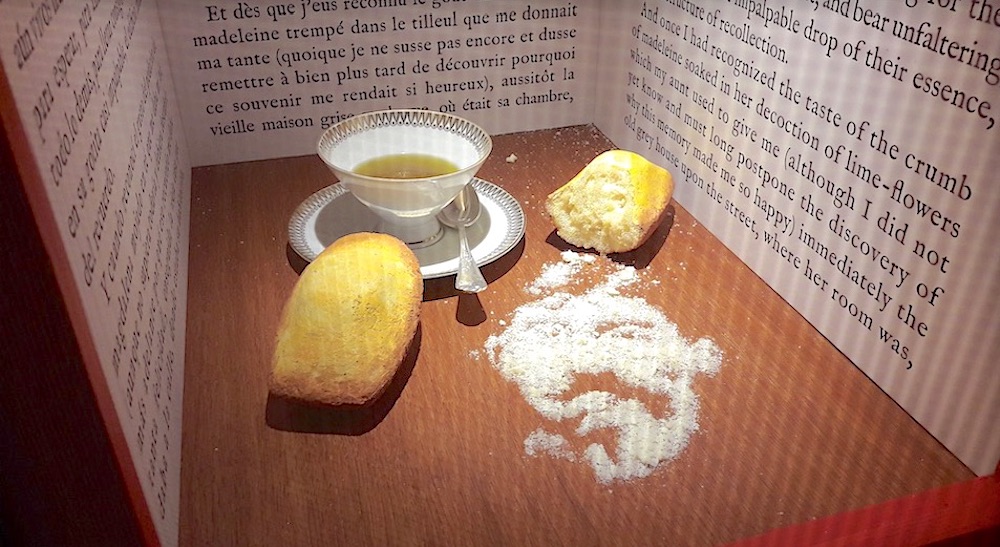
❚ HOW MANY OF US CAN CLAIM to have read the whole of Marcel Proust’s literary masterwork, originally titled for its English edition Remembrance of Things Past, in seven volumes, containing 1.2million words? Not many of us. What about reading it twice? As a journalist I interviewed painter David Hockney on his 46th birthday when he revealed that he had enthusiastically read the epic twice, drawing parallels between the act of looking around Proust’s world by reading his lengthy descriptions and the time it takes for our eyes to dart around a cubist painting. They are both about duration. And the great device Proust donated to literature was his episode of the madeleine, when a simple cake triggers a moment of involuntary memory.
In 1992, when a new English edition titled In Search of Lost Time was published, novelist A S Byatt admitted, without being boastful, that she too had read Proust twice. This happened at a party thrown by the highly sociable biologist Lewis Wolpert who raised the topic as a Proustian two-timer himself, though a viral buzz through this party could find no others. More impressive still, when our paths crossed a couple of years later, Antonia remarked: “Make that three readings now. But this time in French.”
Proust’s episode of the madeleine: involuntary memory evoked in a French exhibition of 2015
Johnny Marr at 60: creating an innovative sound at Manchester’s new Aviva Studios
❚ WATCH OUT FOR two live performances of classics and fan favourites brought to life as A Night with the Johnny Marr Orchestra, a new, expanded sound as the one-time Smiths guitarist takes to the stage with a full classic orchestra on Dec 7 and 8. I shall be in Manchester (train strikes willing) to report back.
For two special performances this week at the Aviva Studios, the city’s brand-new exhibition and entertainment complex, Johnny is joined on stage by some of the best classical musicians from the North. Together, they’ll reinterpret his impressive solo catalogue currently selling as a limited double-CD titled Spirit Power which celebrates his songs, bangers, and electric shows from the past ten years, “having put myself under pressure to make singles”.
Celebrating Marr’s solo career: an impassioned photo-book and a UK tour next year
All of which trails a UK tour next spring and helps promote his chunky 288-page hardback book, Marr’s Guitars, packed with spectacular colour photos and his own passionate reflections on how his collection of more than 130 guitars has created his innovative sound. As Johnny says: “There is a human story behind these guitars. Historically, guitars do have this association with certain sounds and songs.”
The composer Hans Zimmer – with whom Johnny collaborated on the Bond soundtrack for No Time to Die – pens an impressively flattering foreword in the book, stressing that “Each artist gets their guitar to tell their personal story.” He is not talking about the sound you associate with metal guitars and a cheesy orchestra, “usually tasteless”, but in Marr’s case his own very particular and sensuous aesthetic. “The guitar lets us reveal ourselves more profoundly than words ever could,” Zimmer concludes.
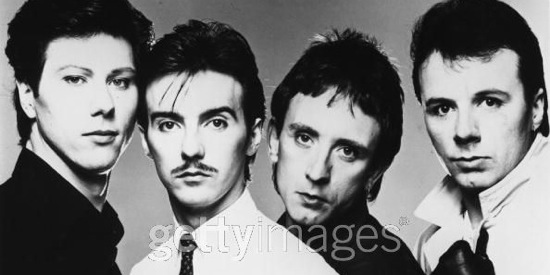
❚ ON THIS DAYin 1980 Ultravox released one of the three most significant albums of the year that exemplified Britain’s new wave of synthesised electronic music – the others coming from Orchestral Manoeuvres In The Dark (in February) and Japan (in October). None of them acknowledged any association with the New Romantics movement. Ultravox’s 12-track album Vienna made an immediate impact, though its title track was only its third to be released, hitting No 2 in the charts in January 1981, later winning Single of the Year at the Brit Awards and an age later voted “the UK’s favourite No2 of all time” in a BBC poll.
It was produced by the German Conny Plank with an evocatively romantic landmark video directed by Russell Mulcahy who was creating a stunning visual vocabulary for the then novel music video. Midge Ure can take full credit as lead singer and guitarist for breathing a subtle blend of Roxy Music’s style and krautrock clarity into Ultravox and building them into a credible vanguard for electronica. Even as the word punk was given the heave-ho in favour of the term “new wave”, Ure was probably the first active player of a synth among any of his clubbing pals, having bought his first, the polyphonic Yamaha CS-50, in the summer of ’78.
As one of the most innovative musicians of the new decade, having had fingers in more pop pies than most, Ure is well qualified to stake his claim to have shaped the music of the Blitz Kids (among whom he was very much an honorary member), and here he describes the inspiration for Vienna, in an extract from his eloquent and candid 2004 autobiography If I Was (Virgin Books):
“The first time I plugged in and made a noise with Ultravox was in April 1979 at a rehearsal room in the Elephant and Castle. Right from the first minute I knew I had come home. This noise was what I had been searching for, not only could these people make that noise, but they also could teach me how to make it. [These people being Chris Cross, Billy Currie, Warren Cann.]
What we were doing was radical and new: synthesisers, drum machines and electric guitar mixed together, synth bass with regular drums playing on top of it, the electronic and the organic. It had never been done before. Our sound was massive, this weird crossover between Kraftwerk and the guitars, bass and drums that belonged to every rock band in the world…
I might have been a one-time teeny-bop guitarist but once I was behind the technology, the music that made me famous was the darkest, most serious stuff I’d ever done. Those early days in Ultravox were the best time of my life. The result was a complete crossover, maybe that’s why it worked. The music came from all of us: everyone contributed and we split all the songwriting credits four ways. The classic example of all of us working together was Vienna.
One night I was sitting having a conversation with my old manager, Gerry Hempstead, who had co-managed the Rich Kids, when his wife Brenda said to me: ‘Midge, what you need to write is a song like that Vienna.’ I looked blank and she went, ‘You know, the Fleetwood Mac song.’ I looked blanker. ‘No, it wasn’t Vienna,’ said Gerry, ‘it was Rhiannon.’ That was the night I went home with Vienna lodged in my brain.
The next morning it was still there. I walked into the kitchen in my little flat and said to Billy, who was staying over, ‘I’ve got a line running around in my head I can’t get rid of, “this means nothing to me, this means nothing to me, Vienna”.’ We built the song from that one lyric. Every component element came from all four of us. It wouldn’t have been Vienna without Warren’s heartbeat drum sound, and it wouldn’t have been Vienna without the bass synth notes and Billy’s eerie viola… ” / Continued in Chapter 10 of If I Was
“The essence of the whimsical”: Stephen Jones photographed by Sølve Sundsbø Studio
◼ THE LEADING BLITZ KID and former star of St Martin’s art school Stephen Jones spearheaded the fashionable revival of British millinery in the early 1980s that was to win him the OBE. Deploying unusual materials and radical designs, he pushed the boundaries of hat design and found himself recruited by the couturier Christian Dior who tested his inventiveness further. For more than two decades this collaboration has yielded such creations as wired arrays that mimic the hairstyles of those wearing the ensembles, or enigmatic masks that conceal and reveal.
This month sees the publication of a lavishly illustrated book titled Dior Hats: From Christian Dior to Stephen Jones in which he reviews the house’s star-studded 70-year history along with three other co-authors. As his own promotional device, today Stephen published an almost poetic personal account of his art and craft pinpointing the magic spell that a hat can cast. He writes:
“ For the past 24 years I have had the honour of creating hats for Christian Dior. It’s been an extraordinary time following in the footsteps of the greatest names in fashion. Whereas so much of fashion seems ephemeral, Dior has some sort of gravitas – or maybe that’s in my mind’s eye as, conversely, hats are the essence of the whimsical.
Dior hats run the gamut of simplicity to complexity, but most often they attract themselves to the happy spot in between. What is unique is that they complete the outfit but can stand by themselves too. This is crucial, because in reality the hat is not about itself but the person wearing it – whether woman, man or child.
Although I ‘bear the crown’, the hats I create are always in collaboration. The different creative directors with whom I have worked always have their distinct point of view. When they arrive at Dior, they understand that hats are an essential part of the Dior iconography, as pivotal as the Bar jacket, fantasy evening dresses or the colour grey. Certainly, hats underline their point of view: To hat or not to hat? Are hats retro or modern? Do they enrich or dilute? These are perennial questions to be resolved every season.
However, the studio is only one side of the story; for me the atelier is also a huge part of the creative process. The fastidious premieres, the multi-talented milliners (never petits mains), the devoted suppliers, all working in harmony to create that evocation of fashion, France and Dior; un joli chapeau!
I thank you all. ” – Stephen Jones
“Without hats there is no civilisation” said Christian Dior. Left: Stephen Jones says: “Suggestion of a pert hairdo” – Sara Dijkink wears a Jones for Maria Grazia Chiuri, SS 2019… Right, Africa Penalver wears an evening bibi in velvet with satin bows; Cuba, by Christian Dior AW 1955. (Photographs by Sølve Sundsbø Studio)
Ribald and passionate: Sullivan and Elms capping each other’s stories with gusto
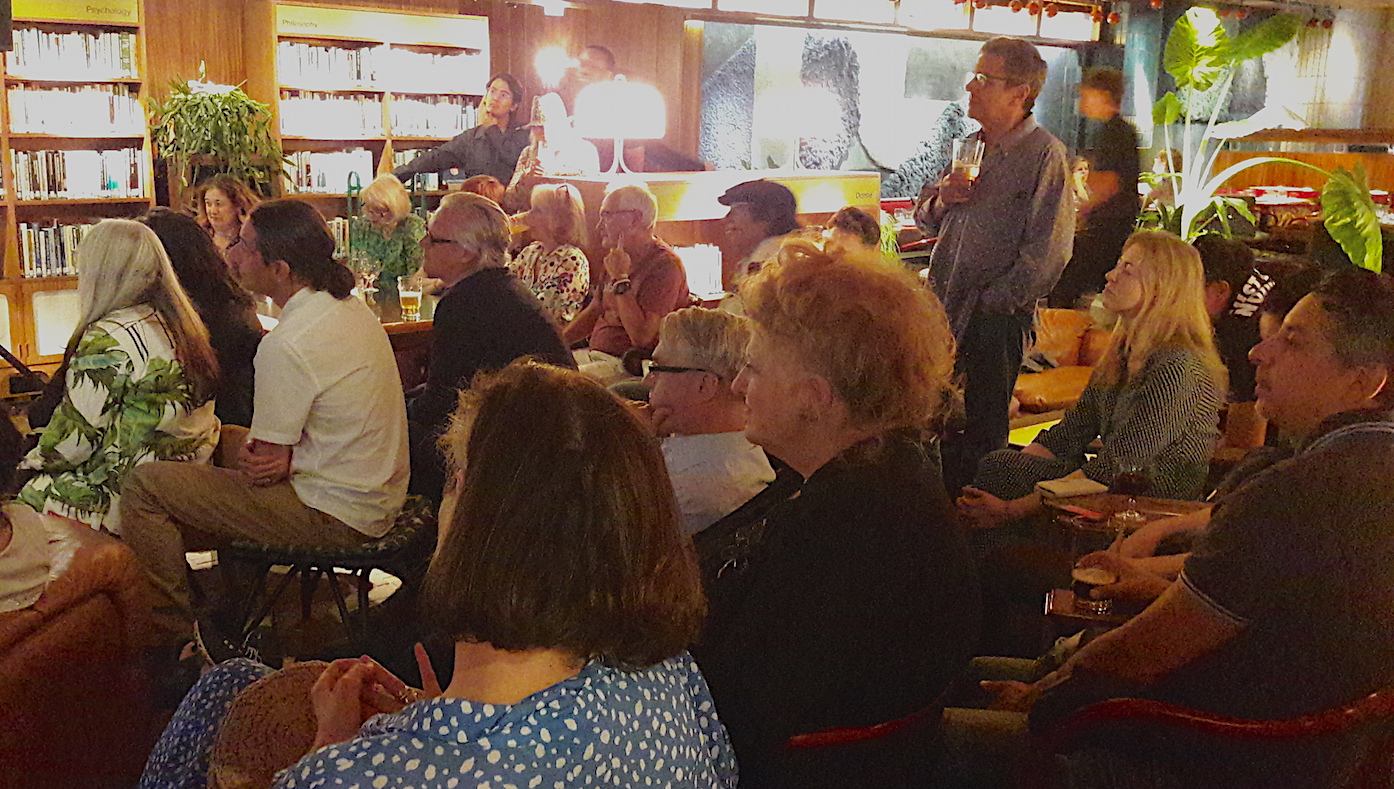
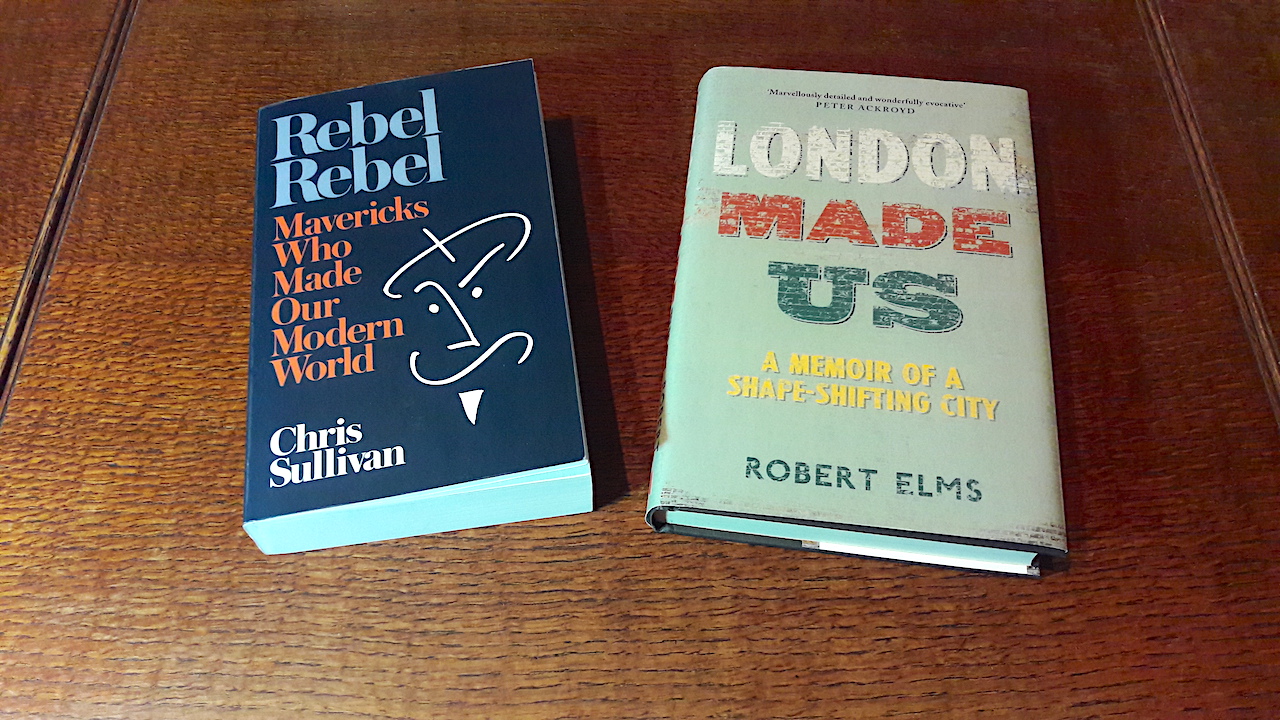
◼ TWO LIFE-LONG PALS, both born raconteurs and clubland wags, sat on a pair of wonky stools this week in public and for an hour had an invited crowd roaring as helplessly as themselves as each capped the other’s stories. The subject was the ever-changing face of London and their faces were those of writer/artist Chris Sullivan (nominally a Welshman who revealed roots that led to a grandfather who’d been a bouncer at the capital’s Windmill Theatre), and BBC London broadcaster Robert Elms (a paid-up Cockney in all but the Bow Bells bit, whose mum was a clippie on the buses at age 15). Both are renowned for having shaped the style revolution of the Swinging Eighties. Now they had taken over a snug corner of the library lounge at the Standard Hotel in King’s Cross, a venue which prompted some ribald tales of their mis-spent teens.
Topics ranged from the East End to West End. There was much mention of food from the era before London became cuisine capital of the world: Elms remembered the early pizza parlours that served your American Hot with a whole baked potato and coleslaw all on one plate. “Which Italian ever had that?” he howled. From the audience, David Rosen recalled Blooms in Whitechapel as an essential kosher eaterie when its walls were blessed with photography by Bauhaus star Moholy-Nagy.
A wrapt audience for Sullivan and Elms: familiar faces from their colourful circle of London friends
For half a century Soho had been the red-light district and as a result, Elms said, by the mid-70s civilised people had given up on the centre of town. Only a public outcry in 1973 protected the 19th-century neo-classical buildings of Covent Garden as the market prepared to relocate to Nine Elms. He added: “London was going to be knocked down after the market moved out and this generation of Londoners [the audience] saved it by our creativity.” It was for instance the place where the seminal New Romantics Blitz club-night opened in 1979, a year before the desolate central market reopened as a shopping centre.
The lack of affordable nightclubs for teenagers in 1979 also drove Bob and Chris to initiate their own pioneering ad hoc parties at the Mayhem print warehouse featuring snake-charmers and blue movies projected onto the ceiling as their “crash course for ravers”. These parties were free, Bob confessed, because they never dreamed they could charge people admission. Chris became so animated at this point he was falling off his stool with laughter.
Of Soho’s Wag club, the pivotal black music nightspot he ran for almost two decades, Sullivan reminded us: “London was a dodgy place. Coming into Soho was taking your life in your hands. The only reason we were able to take over the Wag was because it was a no-go area. About three months after it started, a prostitute got her throat cut outside the Pizza Express by her pimp. People forget it was dangerous. Back then you could be attacked in Soho for wearing the wrong clothes.” Consequently, Elms added: “That Blitz/Wag generation were pretty tough.”
Today the sentimental pair remain firm fans of “the greatest city on earth” but then, they both revel in making things happen wherever they go.
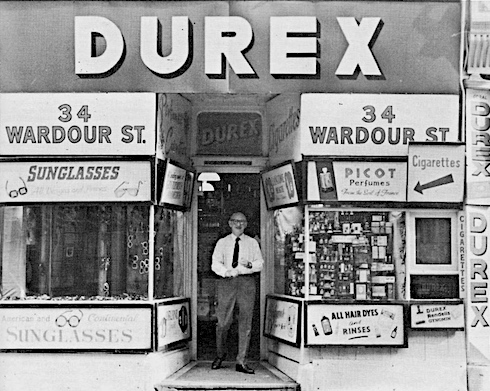
Condoms by the gross: legendary Soho shop-front
❏ Throwaway revelation: The landmark 18-foot wide DUREX sign that graced a Wardour Street shopfront almost opposite the Wag, and had serviced the needs of timid schoolboys for generations, today belongs to Valentine Morby!
Their latest books 2019: Sullivan’s from Unbound, Elms’s from Canongate
➢ Choose “View full site” – then in the blue bar atop your mobile page, click the three horizontal lines linking to many blue themed pages with background article
MORE INTERESTING THAN MOST PEOPLE’S FANTASIES — THE SWINGING EIGHTIES 1978-1984
They didn’t call themselves New Romantics, or the Blitz Kids – but other people did.
“I’d find people at the Blitz who were possible only in my imagination. But they were real” — Stephen Jones, hatmaker, 1983. (Illustration courtesy Iain R Webb, 1983)
“The truth about those Blitz club people was more interesting than most people’s fantasies” — Steve Dagger, pop group manager, 1983
PRAISE INDEED!
“See David Johnson’s fabulously detailed website Shapers of the 80s to which I am hugely indebted” – Political historian Dominic Sandbrook, in his book Who Dares Wins, 2019
“The (velvet) goldmine that is Shapers of the 80s” – Verdict of Chris O’Leary, respected author and blogger who analyses Bowie song by song at Pushing Ahead of the Dame
“The rather brilliant Shapers of the 80s website” – Dylan Jones in his Sweet Dreams paperback, 2021
A UNIQUE HISTORY
➢ WELCOME to the Swinging 80s ➢ THE BLOG POSTS on this front page report topical updates ➢ ROLL OVER THE MENU at page top to go deeper into the past ➢ FOR NEWS & MONTH BY MONTH SEARCH scroll down this sidebar
❏ Header artwork by Kat Starchild shows Blitz Kids Darla Jane Gilroy, Elise Brazier, Judi Frankland and Steve Strange, with David Bowie at centre in his 1980 video for Ashes to Ashes
VINCENT ON AIR 2026
✱ Deejay legend Robbie Vincent has returned to JazzFM on Sundays 1-3pm… Catch up on Robbie’s JazzFM August Bank Holiday 2020 session thanks to AhhhhhSoul with four hours of “nothing but essential rhythms of soul, jazz and funk”.
TOLD FOR THE FIRST TIME
◆ Who was who in Spandau’s break-out year of 1980? The Invisible Hand of Shapersofthe80s draws a selective timeline for The unprecedented rise and rise of Spandau Ballet –– Turn to our inside page
SEARCH our 925 posts or ZOOM DOWN TO THE ARCHIVE INDEX
UNTOLD BLITZ STORIES
✱ If you thought there was no more to know about the birth of Blitz culture in 1980 then get your hands on a sensational book by an obsessive music fan called David Barrat. It is gripping, original and epic – a spooky tale of coincidence and parallel lives as mind-tingling as a Sherlock Holmes yarn. Titled both New Romantics Who Never Were and The Untold Story of Spandau Ballet! Sample this initial taster here at Shapers of the 80s
CHEWING THE FAT
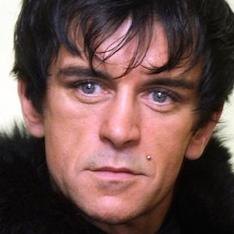
✱ Jawing at Soho Radio on the 80s clubland revolution (from 32 mins) and on art (@55 mins) is probably the most influential shaper of the 80s, former Wag-club director Chris Sullivan (pictured) with editor of this website David Johnson
LANDMARK FAREWELLS. . . HIT THE INDEX TAB UP TOP FOR EVERYTHING ELSE















 ➢➢ Shapers of the 80s ➣➣