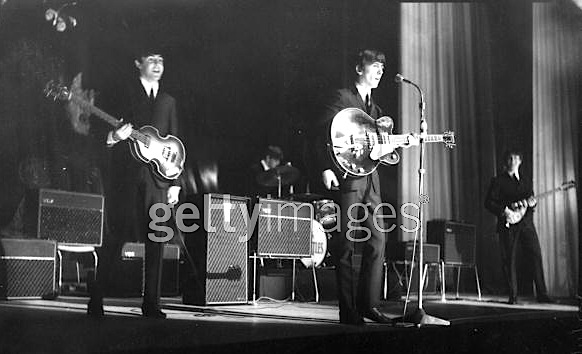
Beatles live onstage in Stockton, Nov 22, 1963: George Harrison at the microphone on the night Kennedy was shot. Note the amplifier perched on a chair!
60
YEARS
ON
❚ WHERE? LIVE, ONSTAGE IN STOCKTON-ON-TEES.Count the simple Vox amps behind the band and note how one is perched on a chair! This picture was taken on Friday Nov 22 1963 at the 2,400-seat Globe theatre when the Beatles played the art-deco venue on their first nationwide tour. The band’s half-hour set during twice-nightly performances at 6.15 and 8.30 was supported by seven other acts with tickets priced from 6 shillings to 10s 6d, when a workman’s weekly wage might be £7….
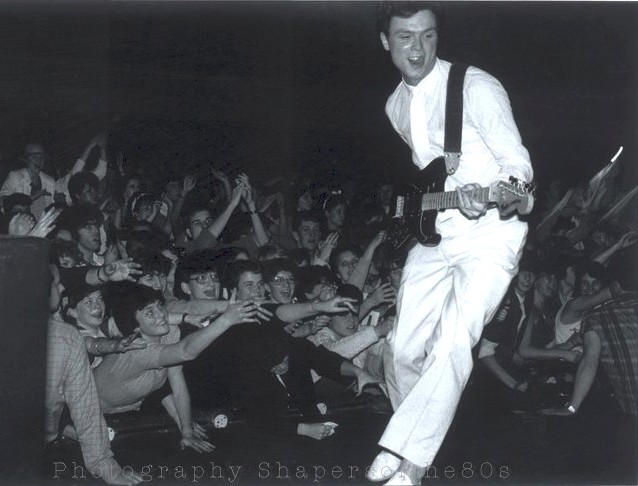
❚ YES IT’S 30 40 YEARS SINCE Spandau Ballet scored their only No 1 chart hit single with True, coinciding with their epic “Spandau Over Britain Tour”. By May 3, True the album reached No 1, while the single remained at No 1 as well. The band’s official website is celebrating with a month of recollections from 1983 and asking UK fans to offer their own memories. Naturally Shapersofthe80s was there on the waterfront and has a few inside stories of its own.
The month-long tour ended in triumph at London’s Royal Festival Hall 30 years ago today, on Friday April 29, because True hit the top spot in the UK singles chart and the night before Spandau topped the bill on Top of the Pops – only two weeks after its release. After the London gig there followed a right old knees-up for friends and family aboard a Thames riverboat. As it cast off Shapersofthe80s was onboard and snapped a True romance as Steve “Spiny” Norman took to the dance floor with bass-player Martin Kemp, while Steve’s mum Sheila tried to muscle in. Here are our snaps, never seen before.
CLICK ANY PIC TO LAUNCH CAROUSEL
AND NAME THE FACES:
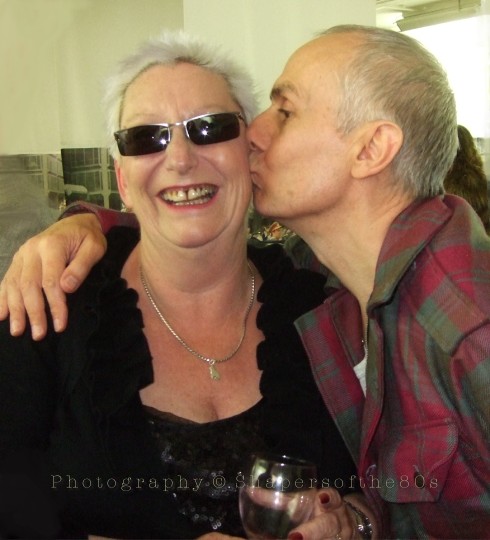
Aboard Spandau’s True riverboat: Steve Norman and Martin Kemp take to the dancefloor, while Sheila Norman asks to join in
Steve and Martin are in heaven… See anybody else you know? Of course: future Spandau biographer Paul Simper in dog-tooth suit from Robot with added Wham!
Steve’s mum Sheila joins the chorus line, and backing singer Sam Brown joins Martin
At last, mother and son get to boogey together
The band’s third album True, produced by Tony Swain and Steve Jolley, had preceded the tour and was to yield several chart hits across the world, Gold among them. The tour moved on to Europe in the summer and to North America in the autumn, when Shapersofthe80s will have some wild eye-witness scenes to report – laters…
➢ Photographer Neil Matthews, another friend of Spandau from their earliest days, has been celebrating with an exhibition of his popstar photos titled My 80s Through the Lens, at The Great British Restaurant, 14 North Audley Street, London W1K 6WE. All images can be viewed online and are for sale in limited editions printed on smart archival paper. As well as Spandau, his subjects include Bananarama, Blue Rondo, Bauhaus, Haysi Fantayzee, Malcolm McLaren, The Jam, Nick Heyward, Bow Wow Wow and more.
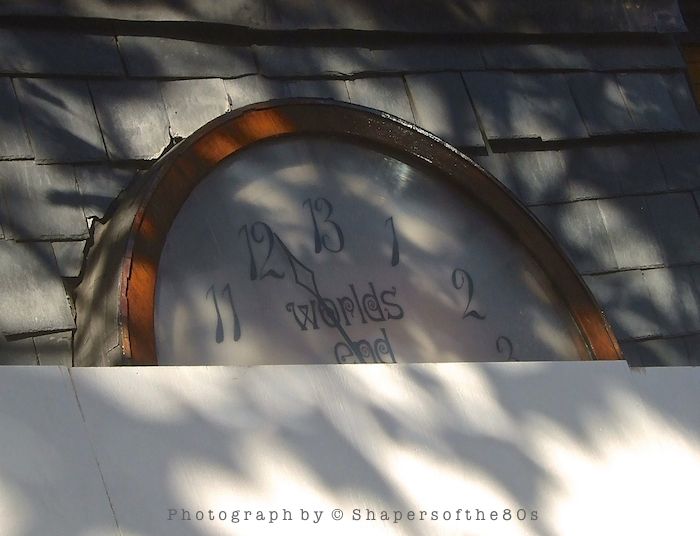
430 King’s Road: the crazy Worlds End clock slips from sight
◼ IF I WERE THE V&A, I’d be eyeing up that fairytale frontage at 430 King’s Road and hoping to buy it up for our national collection, along with its crazy 13-hour clock that turns time backwards. Today the nursery-rhyme cottage façade with slate roofing and wonky door frame vanished behind a builder’s hoardings. For 34 years the Worlds End shop has played home to savages, witches, pirates and other Vivienne Westwood fantasies, but can demolition be imminent?
The shop has stood empty for weeks, “closed for refurbishment until further notice”, according to its blog, which adds that more space has been acquired in the basement of the listed 19th-century building. Viv’s son Ben has given one deadline after another, promising that Worlds End would reopen in October, then “further into November”, and last week “the beginning of December”. A council notice on the hoarding validates it until 30 Jan 2015, so this could mean all promises are off until February.
Click any pic below to launch slideshow
Tourist destination: Worlds End in Chelsea
Builder’s hoarding masks the Worlds End shop today
Barren interior: the empty shop photographed by Simon John Fisher Turner last week
Jordan, setting the style for punk in 1976
Viv’s Mayfair flagship store heads her chain of 12 UK retail outlets with Ben supervising Worlds End and devising between them clever ways to reinvent mum’s vast repertoire of silhouettes from squiggle shirts to mountain hats. Following her former partner Malcolm McLaren’s death in 2010, Viv asserted her rights to the various shop names and retail trademarks from their 13 years together and has adroitly capitalised on their sales potential since.
Ben has wittily related the freaky tale his father Malcolm told him about how he acquired 430 King’s Road, when the owner gave him the keys one day in 1971 and never came back.
A dynasty of subversive shops have mythologised this Chelsea address which is today one of Britain’s youth-cultural tourist magnets. The hippie boutique Hung on You of 1967 was followed by Mr Freedom, Paradise Garage, and in 1971 Let It Rock, the first of five retail ventures pursued by McLaren and Westwood, after meeting at Harrow School of Art. Next came Too Fast to Live Too Young to Die, then the most notorious, Sex, the home in 1975 of punk and the Sex Pistols, Malcolm’s creation wearing his Svengali hat. Here too Jordan (née Pamela Rooke) became the female face of punk as both sales assistant and living mood board who single-handedly turned the safety pin into a fashion statement.
This week from Berlin Jordan expressed concern about the rumours surrounding the shop: “Really shocked, has it closed or is it being redesigned? Surely Vivienne hasn’t closed it, it is iconic!” Jordan was in Berlin, coincidentally, for the latest leg of the Punk’s Dead touring exhibition of Simon Barker’s photos of the movement’s earliest flowering. Simon, of course, aka Six, was one of punk’s feted Bromley Contingent who himself went on to front the Worlds End shop for many years. He piped up: “The problem is it is lined with asbestos. Plus Malcolm wouldn’t have cared about Worlds End being redeveloped – a ‘dance in the ruins’.”
Time for a check-call to the Westwood HQ. A spokeperson there purred soothingly: “What’s happening is a major renovation. To remove what’s in the walls and floors will take one or two months. Worlds End is definitely not in danger of being closed.” Sorry, Malcy: your dance has been postponed.
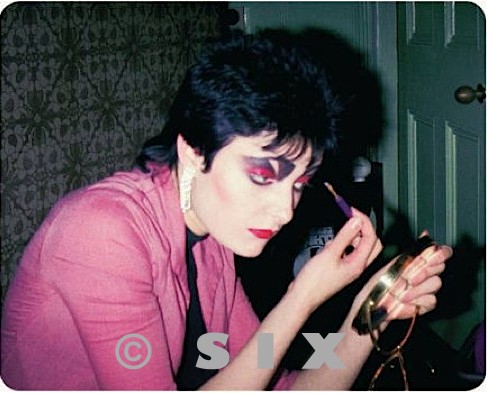
In the Punk’s Dead show: Siouxsie Sioux at the St James hotel in 1977. Photographed by Six
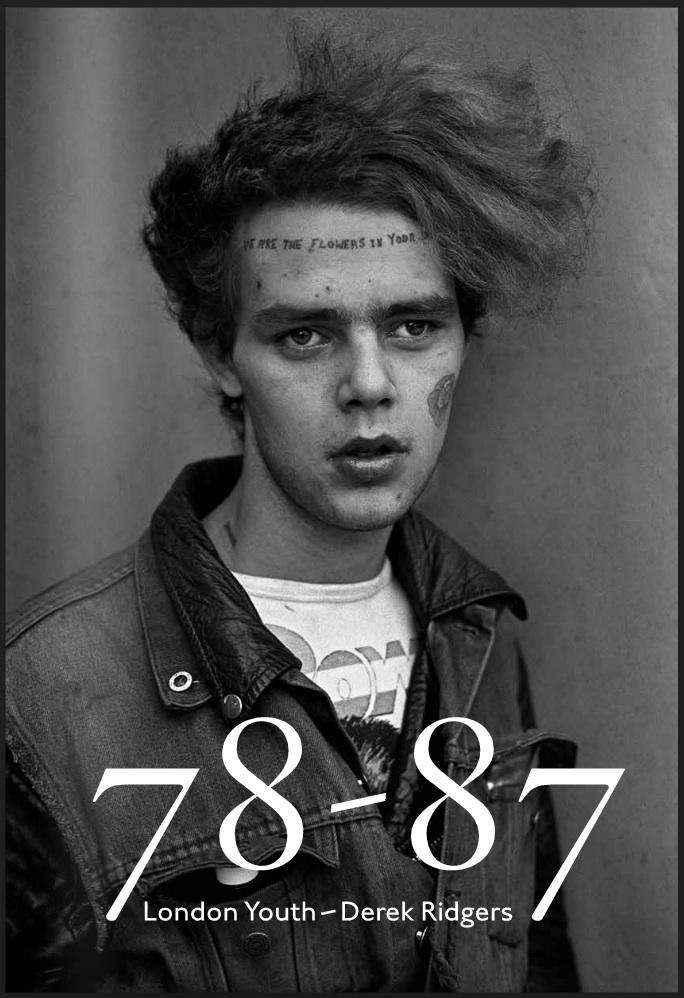
Underground publicity: Derek Ridgers with lavish poster treatment for his photo-book published jointly by Damiani and Transport for London. (Pic by Shapersofthe80s)
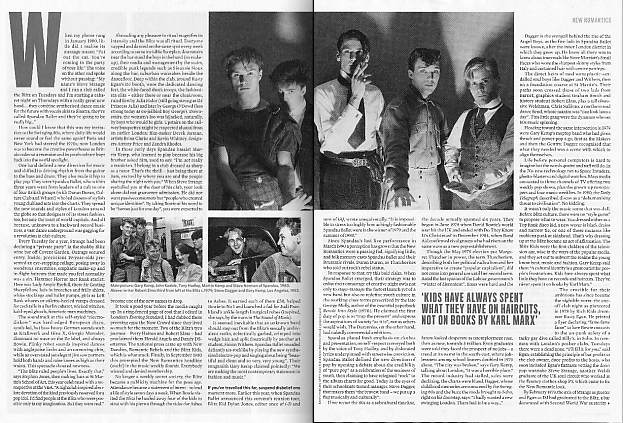
❚ THIS FRIDAY AT THE V&A MUSEUM, London photographer Derek Ridgers will try to explain the power of his touching yet confrontational images of London youth taken in the transformational decade of the 1980s. His newly published book 78–87 London Youth can be viewed online. He is best known for these documentary portraits taken on the streets and in the clubs by night, though he has also snapped celebs from James Brown to The Spice Girls, Clint Eastwood to Johnny Depp, as well as Tony Blair, gangster ‘Mad’ Frankie Fraser, artist Julian Schnabel, writer Martin Amis, fashion designer Vivienne Westwood and more.
The recessionary 70s had precipitated a drone age of rocketing unemployment in the UK, threatening no jobs for school-leavers, ever. Yet from this black hole burst a passionately tribal youth culture that was to create the Swinging 80s, an era of optimism, marked by hedonistic good times and a flair for exhibitionism that played up to Derek’s camera. Ambition and self-improvement were the ultimate goals of the young then, in sharp contrast to the cynical narcissism of today’s lost children.
Twinkle Bunty comments on this Sacrosanct club pic by Ridgers posted at Facebook: “Just trotted over to Foyles and bought Derek Ridgers’ fab new book. Thrilled to find this pic from 1985 of me and Billie Madley proving that the 80s were ALL about the eyebrows. Mine were jet black Rimmel and Billie’s were red BIRO.” Another from Laura Whitcomb: “When you shaved that eyebrow it was epic… That Westwood shirt and suit and of course those ear muffs your obsession – and the inimitable final touch of a Fosters with a baby blue straw.” Plastic bath cap: Billie’s own.
❚ IN OCTOBER 1982, I INTERVIEWED DEREK RIDGERS while writing the massive survey of London’s newly exploding nightlife phenomenon which became The Face’s cover story, The making of UK club culture in February 1983. Direct from my original notes, here is Derek’s perceptive analysis which helped inform my thinking about the turmoil that was transforming British youth culture…
Derek talking: “The depression of the late 70s made the future oh so inevitable. But from the Blitz club period onward [1979], the feeling has been different. A reaction of ambisexual kitsch. It’s an honesty with the way you look and what you want to do. There’s an enthusiasm to investigate the possibilities. There’s no sense of inevitability.
“As a photographer, I go as the casual observer and stand in the shadows. When I first went to those Tuesday nights at Billy’s [1978] it was like walking into a Hieronymous Bosch painting – furtive but lively, very decadent reflecting what they were into, and yet with a sense of oneness, a dedication that’s never been equalled since.”
In 1980 the Blitz leaders had moved on to another Covent Garden club called Hell which Derek said “was similar but more decadent because they tried to keep it to themselves. In its final weeks, only out-of-towners were going to the Blitz, because by then the media had blown away the furtiveness”.
Click any pic to launch slideshow
Two members of the pop group Spandau Ballet on the King’s Road in 1980, in strict New Romantic garb
Chris Hambleton’s own snap of the book with him at the Batcave, left, and designer Stephen Linard at the Wag, right
Designer John Galliano at St Martin’s School of Art the day he graduated, 1984
Yes that is Jaye Davidson, top right at Sacrosanct 1985, who went on to star in the 1992 film, The Crying Game
In 1982 Steve Strange and Rusty Egan began fronting the 1,600-capacity Camden Palace and the Pose Age went public. Ridgers said then: “At the Palace poses are adopted, yet it’s probably more interesting than the Blitz or Billy’s because it’s more honest… 90% are regulars, 9% out-of-towners, and 1% could be any type of person who’ll choose to go clubbing there, but go nowhere else except their own pub. Sometimes they’re out of their depth and try to dress as they think is expected – they bring with them an unconsidered primitiveness.
“Men are wearing dresses now but not pretending to be women. They are proud to be men – that’s fairly modern.” In autumn 1982 Boy George was in the charts with Culture Club’s first single. “George wants to look pretty, rather than handsome. He asks me whether I find him attractive and I have to pretend he’s a girl and give him an appraisal – which I don’t mind. I don’t feel threatened.”
“What’s important at the Palace is feeling special, being noticed – in a sea of other people. A good club has become a place to go for the right social reasons, rather than just to hang out.”
Beatles live onstage in Stockton, Nov 22, 1963: George Harrison at the microphone on the night Kennedy was shot
❚ WHERE? LIVE, ONSTAGE IN STOCKTON-ON-TEES.Count the simple Vox amps behind the band and note how one is perched on a chair! This picture was taken on Friday Nov 22 1963 at the 2,400-seat Globe theatre when the Beatles played the art-deco venue on their first nationwide tour. The band’s half-hour set during twice-nightly performances at 6.15 and 8.30 was supported by seven other acts with tickets priced from 6 shillings to 10s 6d, when a workman’s weekly wage might be £7.
During the first house in Stockton, England, the assassin’s bullets killed John Kennedy in Dallas, USA. At 43 he was the youngest man elected to the US Presidency and during the cold war era as the Soviet Union threatened world peace the hopes of the West rested on his shoulders. In Britain TV programmes were interrupted to break the dramatic news just after 7pm.
In those days we’d seen nothing as electrifying as the Beatles and while their audience at the 18th date on their first serious tour were discovering the power of The Scream, these fans remained respectfully seated throughout the show. Even so, personal accounts say the second house in Stockton was distinctly more subdued. Shocked by the news about JFK, Lynda Richardson, a fan travelling back to Redcar by coach, said: “No one spoke a word all the way home.”
Click any pic to launch carousel
The Globe, Stockton, Nov 22, 1963: Beatles fans learning to scream. (Picture, Evening Gazette)
The Globe, Stockton, Nov 22, 1963: Beatles fans firmly seated. (Picture, Evening Gazette)
Pre-Beatles hysteria: massive queues along Stockton High Street when Tommy Steele played the Globe in 1957
The Globe, Stockton, today: awaiting its £8m restoration
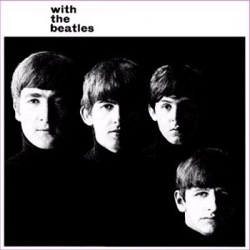
Also on this day the Fab Four’s second album With The Beatles was released on Parlophone eight months after their chart-topping debut LP and it immediately broke sales records. Lennon’s raw vocals barked fresh life and sexual danger into the Motown covers Please Mr Postman, Money and You Really Got a Hold on Me. With its eight original compositions, this was the album that moved William Mann, classical music critic of The Times, to write that Lennon and McCartney were “the outstanding English composers of 1963”.
Earlier in the year three Beatles singles had gone to No 2 and to No 1 twice in the UK chart and now another with advance sales of a million copies – I Want To Hold Your Hand – was racing up the chart to become the Christmas No 1.
This November, too, the Daily Mirror coined the word Beatlemania to describe the tour’s first gig, a phenomenon really triggered with the release of the single She Loves You in August. During the tour, The Beatles had also stopped the Royal Variety Performance – playing four numbers and watched by half the nation in a TV show of recorded highlights – when John Lennon famously quipped: “Will those in the cheaper seats clap your hands. The rest of you can just rattle your jewellery.” The group guest-starred on BBC TV’s flagship Morecambe & Wise Christmas Show, while their own Beatles’ Christmas Show was to run at London’s Astoria Finsbury Park for 30 performances (100,000 seats) featuring the Fab Four in comic “skits” with six pop acts in support including Cilla. By this stage the Fabs could go nowhere without a personal police escort. [See, How does a Beatle live? – at Shapersofthe80s]
The Globe, Stockton, 2009: a glorious interior in art deco style
Today the Globe in Stockton, a small market town in County Durham, is a disused shell which is Grade II-listed. Built in 1935, its facade is enlivened with fluted plaster and the interior retains riotously colourful art deco features typical of the period. As a “super-theatre” the Globe hosted opera, ballet and an annual pantomime, together with touring variety, musicals, and pop concerts by Tommy Steele, the Rolling Stones, Searchers, Seekers, Billy J Kramer, Herman’s Hermits, Animals and Swinging Blue Jeans. It closed as a theatre in 1975, eked out the role of bingo hall until 1996 and then closed its doors.
The Theatres Trust describes the Globe as “an excellent example of its kind” and it is one of 68 buildings on its At-risk register. In 2009, Stockton-based Jomast Developments Ltd announced plans to restore the Globe and recruited theatre expert David Wilmore to the task. He called the Globe “a real Sleeping Beauty”. Finally last month Jomast reported that the Heritage Lottery Fund has earmarked £4m towards an £8m project to transform the Globe into a live entertainment venue for music, comedy and other events, with a capacity of 2,500 and the potential to create 64 jobs. The new venue is likely to open in 2016. [Update 2024: still going strong according to Google Maps.]
THE DAY AMERICA’S CAMELOT FELL
❏ View The Beatles on CBS Morning News with Mike Wallace on November 22, 1963 (despite the erroneous date on the video), the day JFK was shot … In old-school TV style Alexander Kendrick reports grudgingly on Britain’s energetic threat to The American Way under the title, The Beatles, New Phenomena In Britain. Asked about the band’s future Paul McCartney says: “We could have quite a run.”
ANOTHER LEGEND IN THE MAKING
➢ At the Northern Echo in 1963 its young editor was Harold Evans, who went on to build the international reputation of The Sunday Times. On Nov 22, after putting the Echo to bed, he was being driven to Stockton for the annual press ball when news of JFK’s assassination came over the car radio. He immediately returned to his Darlington office and produced an entirely new paper. Evans decided The Beatles were worth a few downpage column inches squeezed into the Teesside edition only.
PHOTO UPDATES
➢ Ringo Starr’s lost Beatles photo album, Nov 2013 – “All anyone could talk about when we came to America was our hair. The boots were famous. The jackets were famous. The pop songs were famous, but they came in about third. The hair was first.”
➢ Choose “View full site” – then in the blue bar atop your mobile page, click the three horizontal lines linking to many blue themed pages with background article
MORE INTERESTING THAN MOST PEOPLE’S FANTASIES — THE SWINGING EIGHTIES 1978-1984
They didn’t call themselves New Romantics, or the Blitz Kids – but other people did.
“I’d find people at the Blitz who were possible only in my imagination. But they were real” — Stephen Jones, hatmaker, 1983. (Illustration courtesy Iain R Webb, 1983)
“The truth about those Blitz club people was more interesting than most people’s fantasies” — Steve Dagger, pop group manager, 1983
PRAISE INDEED!
“See David Johnson’s fabulously detailed website Shapers of the 80s to which I am hugely indebted” – Political historian Dominic Sandbrook, in his book Who Dares Wins, 2019
“The (velvet) goldmine that is Shapers of the 80s” – Verdict of Chris O’Leary, respected author and blogger who analyses Bowie song by song at Pushing Ahead of the Dame
“The rather brilliant Shapers of the 80s website” – Dylan Jones in his Sweet Dreams paperback, 2021
A UNIQUE HISTORY
➢ WELCOME to the Swinging 80s ➢ THE BLOG POSTS on this front page report topical updates ➢ ROLL OVER THE MENU at page top to go deeper into the past ➢ FOR NEWS & MONTH BY MONTH SEARCH scroll down this sidebar
❏ Header artwork by Kat Starchild shows Blitz Kids Darla Jane Gilroy, Elise Brazier, Judi Frankland and Steve Strange, with David Bowie at centre in his 1980 video for Ashes to Ashes
VINCENT ON AIR 2026
✱ Deejay legend Robbie Vincent has returned to JazzFM on Sundays 1-3pm… Catch up on Robbie’s JazzFM August Bank Holiday 2020 session thanks to AhhhhhSoul with four hours of “nothing but essential rhythms of soul, jazz and funk”.
TOLD FOR THE FIRST TIME
◆ Who was who in Spandau’s break-out year of 1980? The Invisible Hand of Shapersofthe80s draws a selective timeline for The unprecedented rise and rise of Spandau Ballet –– Turn to our inside page
SEARCH our 925 posts or ZOOM DOWN TO THE ARCHIVE INDEX
UNTOLD BLITZ STORIES
✱ If you thought there was no more to know about the birth of Blitz culture in 1980 then get your hands on a sensational book by an obsessive music fan called David Barrat. It is gripping, original and epic – a spooky tale of coincidence and parallel lives as mind-tingling as a Sherlock Holmes yarn. Titled both New Romantics Who Never Were and The Untold Story of Spandau Ballet! Sample this initial taster here at Shapers of the 80s
CHEWING THE FAT
✱ Jawing at Soho Radio on the 80s clubland revolution (from 32 mins) and on art (@55 mins) is probably the most influential shaper of the 80s, former Wag-club director Chris Sullivan (pictured) with editor of this website David Johnson
LANDMARK FAREWELLS. . . HIT THE INDEX TAB UP TOP FOR EVERYTHING ELSE















 ➢➢ Shapers of the 80s ➣➣