Tag Archives: New Romantics

➤ Smile please, Derek — you’re one of the Sunday Times Mag’s 60 ace snappers in its birthday show

Keith Richards,Sunday Times Magazine ,Derek Ridgers, photography, exhibitions,Saatchi Gallery,Paintworks, Cube, Waterhall

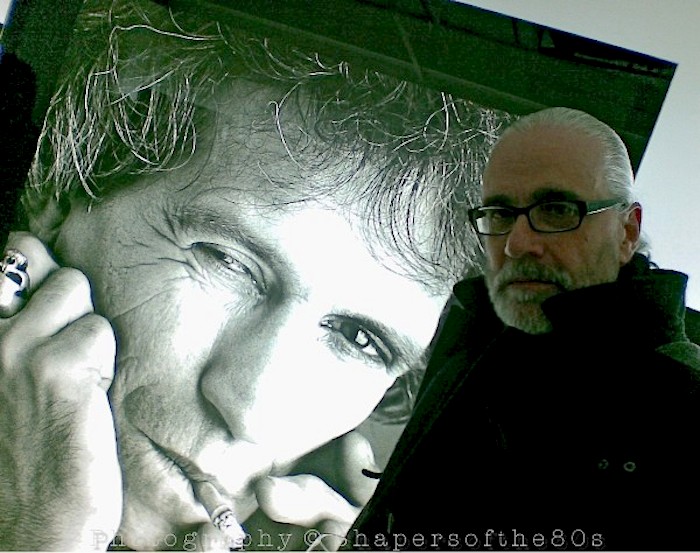
Snapper and Stone: Derek Ridgers seen at last night’s Sunday Times party at the Saatchi Gallery beside his photo of Keith Richards, published by the Magazine in 1986. (Nokia mobile snap by yours truly)

◼ WHAT ARE THE ODDS on any photographer having an iconic photograph included in the exhibition celebrating the 50th anniversary of The Sunday Times Magazine, the UK’s first newspaper colour supplement? Launched in the dull days of 1962 when papers appeared only in black-and-white, as did TV, the mag proclaimed itself the paper’s Colour Section to point up its USP. Since then it must have published at least 250,000 pages, so the odds of being shown in the powerful new exhibition at London’s Saatchi Gallery are stacked against most of its contributing photographers. Only 60 were chosen for the show.

This elegantly mounted selection of 100 historic pix, plus various supporting mementoes, packs a surprising punch. The vitality of the huge images is an object lesson in what makes photographic magic.
Sunday Times Magazine , photography, exhibitions, Saatchi Gallery

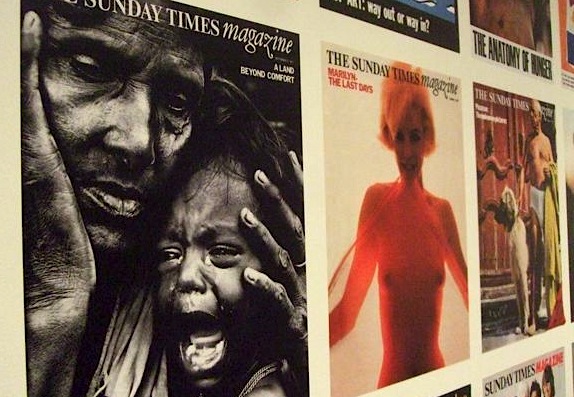
Grit and glamour on ST Magazine covers: Don McCullin’s exhausted mother and weeping child in Bangladesh, 1972 … Marilyn Monroe on a 1973 cover, photographed in a famous series of naked pictures by Bert Stern, a month before her death in August 1962

Right from the off, the Mag established its benchmark: “photographer first”. In Feb 1962 the 24-year-old David Bailey’s launch issue cover shots at Chelsea Reach showed the model Jean Shrimpton wearing a Mary Quant outfit and announced the dawn of Swinging London. Inside pages featured pop artist Peter Blake five years before he designed the Beatles’ Sgt Pepper album sleeve, and a short story titled The Living Daylights by 007 author Ian Fleming.

In the words of Michael Rand, the Mag’s art director for 30 years, its credo was “grit plus glamour — fashion juxtaposed with war photography and pop art”. This meant serious investment in photo-reportage from the world’s troublespots. He went on to champion the work of Eve Arnold, Snowdon, Terry O’Neill, Brian Duffy, Richard Avedon, Eugene Richards, Diane Arbus, Mary Ellen Mark. Rand says he felt a great responsibility to project the honesty of their pictures. Risking his life in the warzones of the late 20th century, Don McCullin survived sniper bullets to return with some of the century’s most haunting pictures, and to write movingly of the impact on his own soul from having witnessed at first hand the pain and the pity of shell-shocked soldiers and starving children in Biafra, Vietnam and Northern Ireland. In 1989, Stuart Franklin, onetime president of the Magnum agency, leant out of a hotel window to give the world the unforgettable image of a young man single-handedly halting a column of tanks in Tiananmen Square.
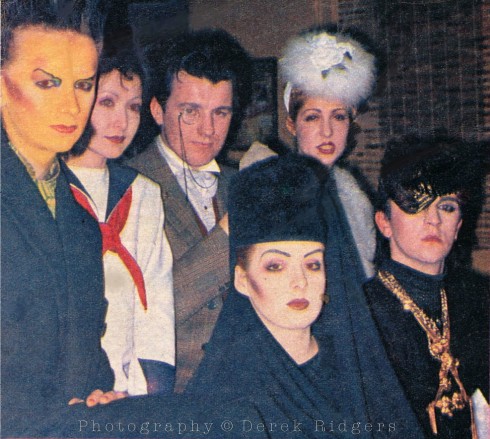
First group pic of key Blitz Kids, April 1980: George O’Dowd, Vivienne Lynn, Chris Sullivan, Kim Bowen, Pinkietessa and Steve Strange immmortalised by Derek Ridgers for The Sunday Times Magazine

All the more reason to be extra-impressed at last night’s party launching the exhibition to meet my old ally on London’s clubbing scene in the 80s, Derek Ridgers. You know his pictures of everyone within a mile of Steve Strange, king of the posers, because they’re all over this website, and as half a dozen key Blitz Kids well remember, he snapped their first published group shot at the Blitz for the ST Magazine in April 1980. Last night Derek had been chatting on and off for at least half an hour while we sidestepped the namedroppy media luvvies and posey models to mingle with the veterans Mike Rand and Beatle biographer Hunter Davies, ST picture editor Ray Wells and snapper Uli Weber (standing in front of his demonic pic of Boy George sprouting a pair of satanic horns, while his pic of Kylie Minogue in the bath is on the poster for this show).

Eventually Derek, who is modest to a fault, asked if I was carrying a camera and I had to say no, thinking it a bit uncool at a swanky champagne bash for 700 media A-listers (which was obviously his view too since his own holster was empty). We did then discover that we were both toting the same unsmart workhorse Nokia 6300 mobile with 2Mp cams onboard. OK, they’ll do, so would I mind taking a pic of him beside his own exhibit at the end of the gallery? Excuse me, Derek? Nice old mild-mannered Derek with his long hair tied in a tail, and knapsack over his shoulder? Renowned for his book full of skinhead and punk portraits, not to mention the dodgy habitués of sexclubs like Skin Two, of David Claridge vintage? Derek’s IN this show? Yes he is. Even with the odds stacked at 250,000 to one against, it’s true. “I was amazed when they sent me an email asking if they could show this photograph,” he said. “So I said, yes, I didn’t mind.” How cool is that?

What we see is a charismatic mugshot of wrecked old Scary Stone, Keith Richards, snapped back in late 1985 when the face of the “10th greatest guitarist of all time” was engraved with a tiny fraction of the million lines it boasts now. He was settling into his  marriage to the model Patti Hansen, and Derek persuaded the rock star to pose for him after a chance encounter at the Savoy hotel in London. He says: “There was no KR entourage whatsoever. He couldn’t possibly have been any more helpful. I guess that’s what makes him the guy he is.”

Full marks for initiative, Derek. In 2012 The Sunday Times remains the UK’s best-selling quality newspaper. In the season of Oscars and artsy prizegivings, to be included among the 60 top photographers in the life of its mighty Magazine is pretty well the best gong a lensman can win.
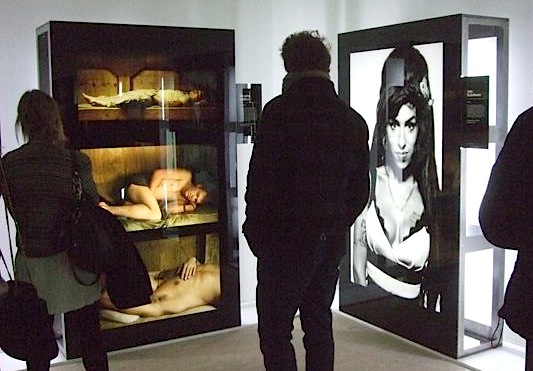
Grit and glamour at the Saatchi Gallery: Tim Hetherington’s photographs observe American soldiers asleep in 2009 in Afghanistan. He said they are about “the intimacy of war. We’re not talking about friendship. We’re talking about brotherhood.” He was killed in Libya in 2011 … Minutes before a tense Amy Winehouse went onstage at a Mandela tribute concert in 2008, Terry O’Neill persuaded the singer to pose for a pic dedicated to the great man. O’Neill said: “She steeled herself for it.” All published in the ST Magazine. Gallery views by Shapersofthe80s
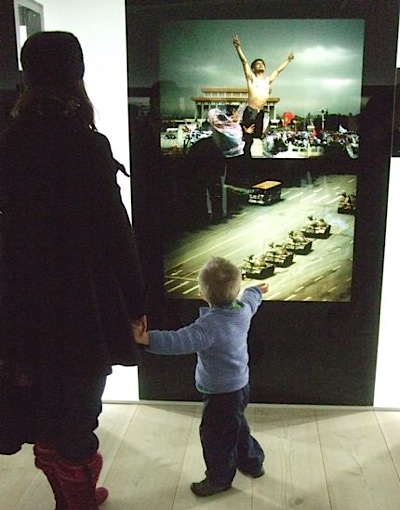
Beijing 1989: Stuart Franklin photographed pro-democracy student protesters in Tiananmen Square which made a cover shot for the ST Mag. Two days after the massacre of hundreds of civilians, he caught “Tank Man” defying Chinese T-59 tanks armed only with his shopping bags

Glamour and grit: Faye Dunaway in Beverly Hills at 6am the day after winning her 1977 Oscar for Network, photographed by her future husband Terry O’Neill… Right, in 1976 Don McCullin catches six Christian Phalangist militia playing music over a girl’s corpse after they went into East Beirut to “clean up the rats”. One had a Kalashnikov and another a lute stolen from the home of the people they’d just killed. McCullin says: “It haunts me to this day.”
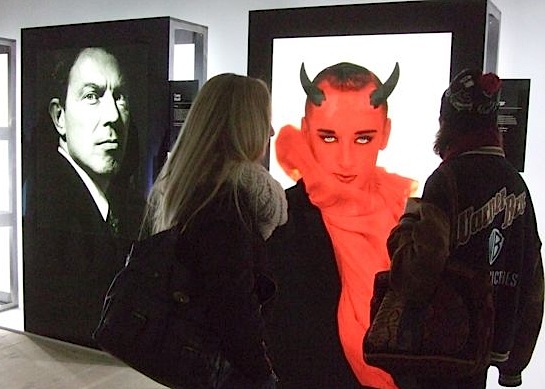
Grit or glamour, the eyes have it: Nigel Parry nails the steely ambition of Tony Blair in 1994, weeks before becoming the Labour Party leader and going on to win three general elections … Uli Weber nails the demons of pop singer Boy George on tour in 1993, after emerging from one of his early descents into drug-fuelled despair

➢ Update: The Sunday Times Magazine 50th Anniversary Exhibition runs at the Saatchi Gallery, London, was scheduled to run until Feb 19, excluding Feb 11–14, now extended to March 18. Entry is free. The Magazine published a dedicated anniversary issue Sunday, Feb 5.

➢ Update: The free exhibition 50 Years of The Magazine goes on tour — Paintworks, Bristol Mar 24–April 3, Cube, Manchester April 11–23, Waterhall, Birmingham May 22-June 2
FRONT PAGE

➤ Quietly, quietly, lensman Ridgers talks about capturing life in the margins

Derek Ridgers, Ronnie Biggs, great train robbery,Rio de Janeiro,photography

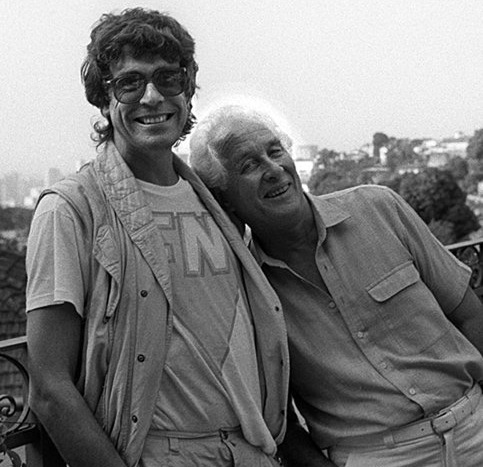
Derek Ridgers meets the fugitive Great Train Robber Ronnie Biggs in Rio, about 1985: “I played pool with Ronnie a few times and he was a lot better at it than I was. I suppose he had plenty of time to practise.” (Picture courtesy of Derek)

❚ WITH 35 YEARS OF EXPERIENCE, Derek Ridgers is one of the UK’s leading documentary photographers, notably of youth culture, its rock stars and its street tribes. “Derek Ridgers’ compulsion to photograph London clubs over two decades was an extraordinary one,” curator Val Williams wrote in his 2004 book, When We Were Young: Club and Street Portraits 1978–1987. Here were “transient beings moving across an urban landscape, flamboyant souls who cared more than anything about how they looked and whose greatest fear was of being ordinary. But it was the ordinariness that Derek Ridgers glimpsed in these costumed characters that makes his photographs so powerful.

Witchity club, London, 1979

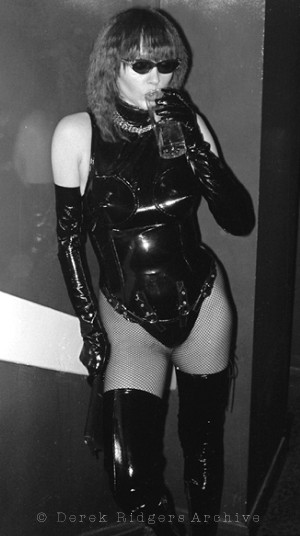
An era of conspicuous sexuality: clubber at Witchity, a David Claridge dive in 1979, photographed by Derek Ridgers

“Ridgers’ photographs are an undeliberate chapter in a decade of English social and cultural history which changed the way we thought about music, fashion and consumption. It was the decade of the handmade and the customised, of Oxfam shopping, conspicuous sexuality, of excess, wide success and dismal failure.” Well, that’s a point of view.

His earliest exhibitions in the 70s and 80s featured punk portraits and skinheads, and many seminal images of London’s clubland New Romantics. He has mainly worked for UK magazines and newspapers such as NME, The Face, The Independent, The Sunday Telegraph, Time Out and Loaded. He now runs the Derek Ridgers Archive where limited edition prints are for sale, and he blogs occasionally though thoughtfully at Ponytail Pontifications. Derek has always been the “quiet observer”. He collaborated only once with Shapersofthe80s and his fine shots can be seen on our inside page about the 1983 Face cover story, The making of UK club culture. He also brilliantly articulated what remains today the definitive description of Billy’s, the font of all 80s clubbing. You’ll read it in the feature.

Oomska, a new UK-based online arts and pop culture magazine, today asked Derek to share his views about photography. Here are some highlights:

Other than a camera, my favourite piece of equipment, if one could characterise it as such, is the sun.

❏ The digital age has probably added several years to my life expectancy — when I think about all the wasted time and expense of having clip tests made prior to getting the bulk of my colour film processed, I think I must have been mad.

❏ I love Garry Winogrand but some of his photographs (for instance the ones taken in the Ivar Theatre) suggest that he wasn’t necessarily always thinking about the art.

❏ It’s becoming harder and harder these days to earn a living as a professional photographer … I don’t particularly care.

❏ The most popular camera used on Flickr is now the iPhone 4. The rise of the hybrid consumer appliance will probably continue.

❏ For me it’s whatever works… Photoshop has brought all those darkroom techniques that took years to learn within the reach of everyone.

❏ A static image can still have more power than a moving one because you can live with it and study it and let its whole being seep into you and fix itself into your brain.

➢ Read the full Ridgers interview at Oomska

Derek Ridgers, photographer,Beat Route, clubbing

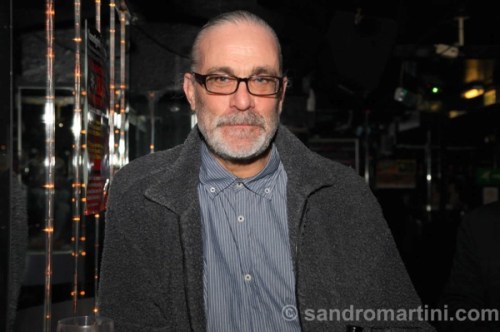
The snapper snapped: Derek Ridgers at last December’s party at the Beat Route reincarnation to launch somebody else’s photobook We Can Be Heroes. Snapped by Sandro Martini

FRONT PAGE

➤ Rolling Stone puts Ziggy on its cover but has nothing new to say about ‘How Bowie changed the world’

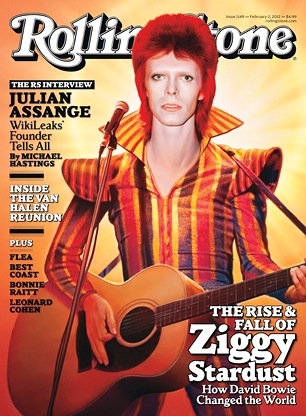
❚ THERE’S A BREATHLESS FOUR-PARAGRAPH teaser online at Rolling Stone magazine’s website in an attempt to sell the February 2 issue. It’s headlined How David Bowie Changed The World. Yet it promises nothing we haven’t read a million times before. Instead, try our own tribute on Bowie’s 65th birthday, linked further down this post.

Rolling Stone magazine, David Bowie,Bowie changed the world, Rise & Fall of Ziggy Stardust, glam-rock, Major Tom,We Can Be Heroes,Angie Bowie, New Romantics, Blitz Kids, Bowie's Bequest, ➢ Here’s the best Rolling Stone can find to say about Bowie:

He phoned Angela in London, asking for her help: witches intended for him to impregnate one during Walpurgis Night. He later said Satan was living in his indoor swimming pool. David needed an exorcism (“I really walked into other worlds,” he later said), and Angela got him one – though it was by way of a long-distance phone call. “David was never insane,” Angela wrote. “The really crazy stuff coincided precisely with his ingestion of enormous amounts of cocaine, alcohol and whatever other drugs.” In any event, the rite may have helped break Bowie’s fear of a fiend possessing him. “It was time to get out of this terrible lifestyle I’d put myself into, and get healthy,” he later said. “It was time to pull myself together … / Continued online at Rolling Stone

❏ Update Feb 8: Now this Bowie issue has reached the UK, Mikal Gilmore’s account of the Ziggy phenomenon proves a workmanlike retelling of the familiar, but is oh-so relentlessly downbeat. He even cites an alleged quotation from 1998: Bowie is supposed to have said that, “Without Iman, I’d have put my head in the oven by now”. It’s a cheap shot because the quote has never been attributed, so counts for nothing more than hearsay. Rolling Stone claims a circulation of 1.45m.

David Bowie, 65th birthday, New Romantics, Ziggy Stardust, glam-rock
➢ Here’s what Shapersofthe80s had to say on his recent birthday:

As a cultural lightning rod Bowie has bequeathed insights into the realm of the imagination. As a performer he has delivered a repertoire of life-skills through a cast of mythical personalities invented for himself as a popstar, from the self-destructive Ziggy Stardust and the amoral Thin White Duke, to his romanticised “Heroes” (his own quote marks added to emphasise self-awareness). Through their formative years, Bowie invited his acolytes to do A…. and B…. and C…. / Read on to discover what

➢ With 12 early videos, Shapersofthe80s asks where each of these turning points in Bowie’s career might otherwise have led him

➢ Try also Strange Fascination by David Buckley (2005) — “One of the most authoritative Bowie books you’re ever likely to read” (Mojo)

➢ The Complete David Bowie, by Nicholas Pegg (2011) — “I can’t imagine how this book could be better… the definitive read for Bowiephiles” (Uncut)

FRONT PAGE

2012 ➤ If David Jones hadn’t become Bowie what would have become of the rest of us?

What, me, pensioner? David Bowie and his wife the supermodel Iman attend the DKMS Annual Gala in New York City last April. (Photo by Andrew H. Walker/Getty)

David Bowie, 65th birthday, New Romantics, Ziggy Stardust, glam-rock
❚ HAPPY BIRTHDAY MR BOWIE. And thanks for the boggling, inspirational, poptastic ride so far —140 million albums sold and the rules of rock rewritten. You will be the genie waiting at the end of time. Boy George has this to say in his foreword to Graham Smith’s new book on 80s clubland, named after David Bowie’s song We Can Be Heroes: “Of the New Romantic moment I have always said, It was all Bowie’s fault.” What he refers to is the Bowie bequest to the teen generations he entertains. As a cultural lightning rod he has bequeathed insights into the realm of the imagination. As a performer he has delivered a repertoire of life-skills through a cast of mythical personalities invented for himself as a popstar, from the self-destructive Ziggy Stardust and the amoral Thin White Duke, to his romanticised “Heroes” (his own quote marks added to emphasise self-awareness). Through their formative years, Bowie invited his acolytes:

✰ to explore identity, androgyny, the primacy of the visual.

✰ to adopt stances: individualism, alienation, decadence, transgression.

✰ to follow his principles for living amusing lives: disposable identities, portable events, looks not uniforms, tastelessness “on purpose”.

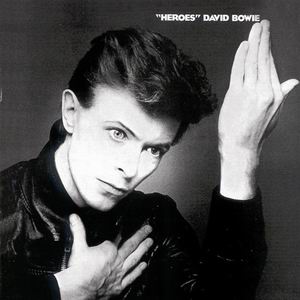
David Bowie, Heroes,His signature tune, “Heroes”, still echoes today as a heart-stirring anthem because he was passionate and optimistic and musically this number is brimming with awe. He sang about intimacy and love triumphing over the horrors of the outside world. Finding joy in simple pleasures could make heroes of us all, “just for one day”. As a creed to live by, it has underpinned his own life. “I’m an instant star,” he said. “Just add water and stir.”

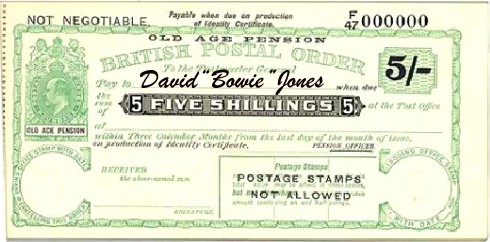
Were he still living in the UK, today’s birthday would designate him, in the idiom, “an old-age pensioner”, and the state would pay him slightly more than the five shillings a week handed over when the scheme began 100 years ago. He can’t be 65, you’re saying as you inspect the picture of him and his wife Iman [above] at a leukemia charity gala in New York last year. He looks too good for 65. “Waddayamean?” he’d be bound to snap, flinging back the old feminist line, “This is how 65 looks in the 21st century.”

True, if you start young, break the rules and push yourself to the max, as all geniuses do. While in short trousers, the little suburban Londoner David Jones was nothing if not prolific. At 11 he was playing a skiffle bass, buying and collecting the NME for future reference, learning the sax at 13 and soon moving up through a succession of bands: Konrads, Hookers, King Bees, Manish Boys, Lower Third, Buzz, and Riot Squad.

At school he fell under the spell of an art teacher, Owen Frampton, whose own son Peter went on to musical fame. Bowie has said: “I went to one of the first art-oriented high schools in England, where one could take an art course from the age of 12. Three-fourths of our class actually did go on to art school.”

Everybody knows how this liberal education shaped his outsider stance, how he redefined glam-rock, and how his incarnation as Ziggy Stardust made him an international star and one of the most iconoclastic forces in 70s music. How much more fun though to celebrate a grand milestone by looking back to the earliest expressions of that genius and to wonder aloud how else might the talents of the young David Jones have developed? Today, we find whole chapters of his formative experiments on video online, from mime artist and music-hall hoofer, to actor and fin-de-siècle soothsayer. In all the springboard moments pictured in the slideshow above, Bowie is no older than 24. At any moment the fickle finger of fate could as easily have pointed in any number of directions…

➢ VIEW a dozen video turning points
in David Bowie’s early career 1965–1974

INSTEAD, THIS IS WHAT HAPPENED

In 1969 Bowie’s manager Kenneth Pitt proposed to showcase his talents by producing a half-hour film called Love You Till Tuesday. The compilation showcased tracks from his 1967 debut album, plus a spanking new song, Space Oddity, which introduced Major Tom and became his first hit. Cleverly anticipating the first Nasa Moonwalk in 1969, the filming for this number pastiches Stanley Kubrick’s cine-epic premiered the previous year. It effectively proposed what today we call the promo video which, as Kevin Cann reveals in his exhaustive 2010 Bowie biography Any Day Now, remained substantially unseen by the public until its release as a clip in 1984. The whole half-hour showreel went online for the first time only yesterday…

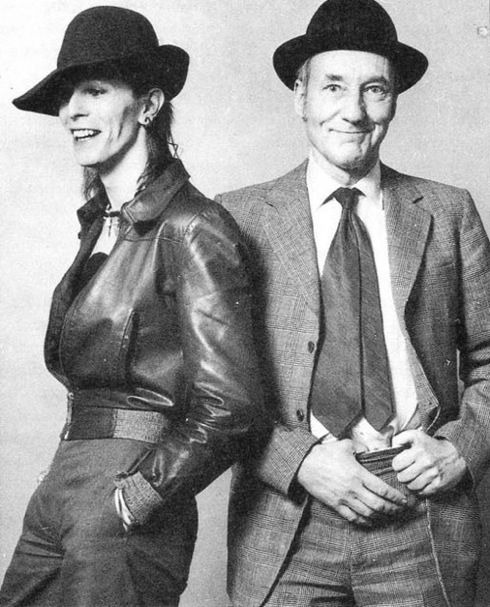
THEN HE MET WILLIAM BURROUGHS

David Bowie , William Burroughs

1973: Bowie is interviewed for Rolling Stone with novelist Wiliam Burroughs and photographed by Terry O’Neill

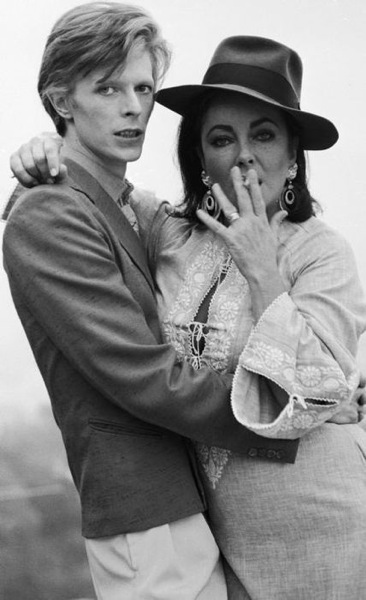
THEN HE MET LIZ TAYLOR

David Bowie , Liz Taylor, Terry O'Neill

1975: Bowie meets Hollywood legend Liz Taylor. Photographed by Terry O’Neill

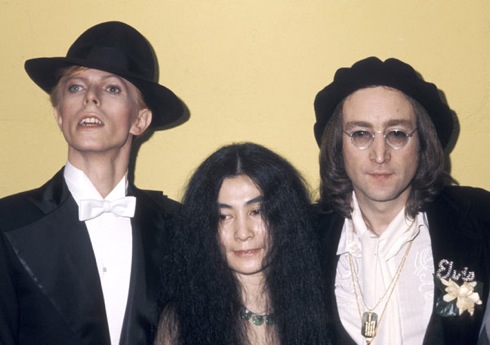
THEN HE WROTE A SONG WITH JOHN LENNON

David Bowie , Yoko Ono, John Lennon, Grammys

1975: At the Grammys, Bowie upstages Yoko Ono and John Lennon — one day he gets jamming with David in a studio and turns a lick into the song Fame

AND THE REST IS, WELL, BOWIE…

➢ Radio 2’s clips from Inspirational Bowie at iPlayer — Marc Almond: “I climbed over the orchestra pit and David Bowie took my hand. He sang Give me your hand in Rock ’n’ Roll Suicide and it was an epiphany”

➢ Happy 65th Birthday Bowie: BBC 6Music audience curates a playlist of favourite tracks, on iPlayer until Jan 13

FRONT PAGE

➤ Record numbers visit Shapersofthe80s for the best Blitz Kid photos and eye-witness memories

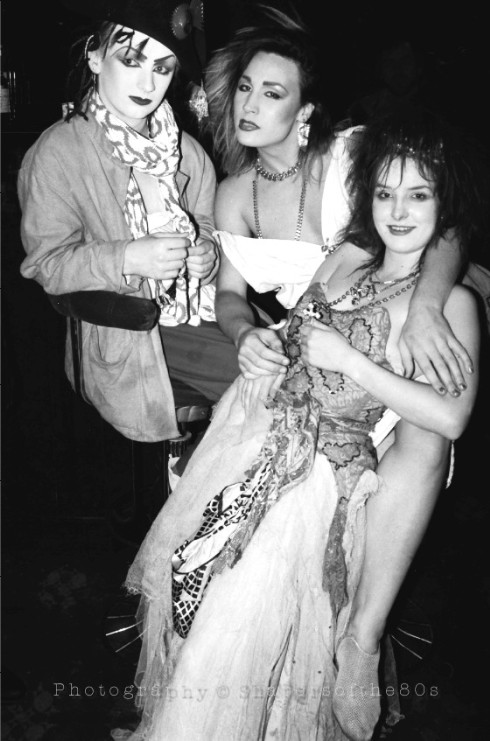
Planets club in Piccadilly, 1981: George O’Dowd before he became Boy, his sidekick and future singer Marilyn, and fashion goddess Kim Bowen. Photographed by Shapersofthe80s

❚ 2011 WAS A BUMPER YEAR for Shapersofthe80s. Visits to this website have doubled year on year, to a total of 174,658 page views during 2011. Also during the past six months, views increased by 40% over the previous six months — driven substantially by our exclusive pictures of Steve Norman’s wedding, and by exploring the heritage which informs We Can Be Heroes, Graham Smith’s definitive new photobook about 80s clubbing.

Of all topic areas, inevitably Blitz Kids and New Romantics have attracted most visits — about 16,000 views in total. Nightclubbing in the 80s came third with 11,000. Discover why, inside at Why them? Why then?

Most popular popstars viewed here in 2011 …

Martin Kemp, Steve Norman, NYC,Axiom,fashion

Lexington Avenue 1981: A fashion shoot features Martin Kemp wearing Demob and Steve Norman wearing Pallium, along with local girls. Photographed © by David Spahn

1 — Spandau Ballet — Total page views include Tony Hadley’s international tour with John Keeble, Steve Norman’s wedding, Martin Kemp’s cinematic triumphs and Gary Kemp as cultural pundit, as each of the band members has been pursuing his own interests since their farewell performance in July 2010.

2 — Boy George whose rise and fall seems Greek in its tragedic possibilities.

3 — Duran Duran who have patiently rebuilt their credibility over the past year. (Of their total page views here, almost half came in one day, yesterday*)

4 — Paradise Point — Britain’s brightest new pop musicians who mysteriously vanished from the stage almost as soon as they had published one of the most seductive videos of the year [see below].

5 — Sade whose long-awaited world tour slaked her fans’ thirst and gave her a No 1 album on both sides of the Atlantic.

6 — George Michael — another 80s survivor whose vulnerability almost renders him indestructible.

+++
Steady attractions at Shapersofthe80s are the post about John Rutter’s royal wedding anthem, and historically important interviews with the painter David Hockney (1983) and with Beatle John Lennon (1966).

++++++++++++

* It is an astonishing statistical exception that yesterday proved our busiest day of the year thanks entirely to Duran Duran sharing on Facebook the link to our choice of the 10 most creative tribute videos celebrating their comeback. So, despite our having followed Duran’s world tour since their newest album was launched in 2010, almost as many fans visited in a single day as during the entire year to date.
❏ iPAD, TABLET & MOBILE USERS PLEASE NOTE — You may see only a tiny selection of items from this wide-ranging website about the 1980s, not chosen by the author. To access fuller background features and site index either click on “Standard view” or visit Shapersofthe80s.com on a desktop computer. ➢ Click here to visit a different random item every time you click

FRONT PAGE