Tag Archives: John Keeble

1981 ➤ Why naked heroes from antiquity stood in for Spandau on their first record sleeves

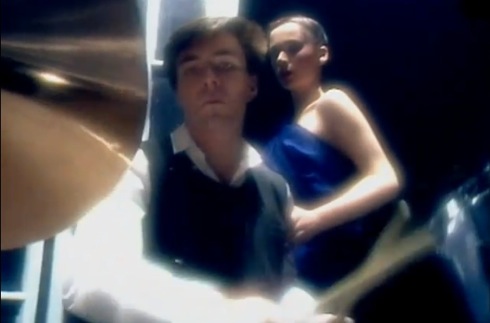
➢ CLICK TO VIEW ♫ THE VIDEO FOR SPANDAU BALLET’S SECOND SINGLE, THE FREEZE …
Spandau Ballet, The Freeze, John Keeble, video, New Romantics
♫ BLUE SING LA LUNE, SING LAGOON… ♫ No, nobody has ever known what the lyrics to The Freeze were going on about, but that wasn’t the point 30 years ago today when it entered the UK singles chart at No 24. It wasn’t an obvious choice for Spandau Ballet’s second single, after their first, To Cut a Long Story Short, had peaked at No 5. The Freeze was not chosen for singability but for its New Romantic clubbing credibility. In 1981 the pathfinding band were consolidating the new approach they had styled White European Dance Music — led on The Freeze by Gary Kemp’s two-fingered synth arpeggios, plus enough percussive kick-drum snaps underpinned with bassline rhythms to fill dancefloors even in Birmingham, where Duran Duran had yet to release their debut single.

The Freeze was a subtle rallying call to soulboys and girls up and down the land, as distinct from the new wave’s “electric” factions who were inventing alien soundscapes haunted by multi-layered synthesisers. Spandau were to release one more double-sided single and an album in similar style before throwing New Romantic rivals into confusion by changing their sound utterly — and fashionably — to funk by mid-summer. Spandau moved ever onward by translating the New Romantic mantra that “One look lasts a day” into its musical equivalent.

Likewise, the new video dispensed with their earlier tartans to reveal a mix of a medieval doublet from PX, masculine string vests, a pair of dark-glasses to transform Tony Hadley into Donald “The Forger” Pleasence [♫ The art is pretending it’s art ♫], and a grey pleated Melissa Caplan “gymslip” [above] for drummer John Keeble (not known in the years since for cross-dressing — although, no, hang on, there is one as-yet unpublished pic of him as Carmen Miranda on tour in the US).
Spandau Ballet, record sleeves,

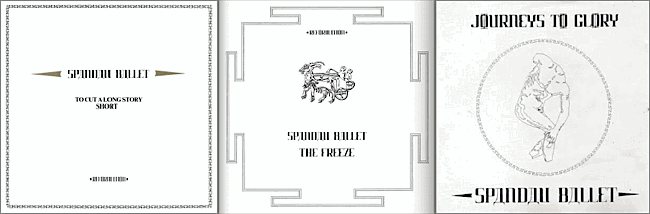
Graham Smith’s minimalist livery for Spandau Ballet’s white record sleeves: To Cut..., The Freeze, Journeys to Glory

While ex-Middlesex art-school fashion-designer Simon Withers set the style for Spandau’s staging and clothing, a complete livery for their suite of vinyl record sleeves was masterminded by Graham Smith while still studying graphics at Camberwell (all of which counted towards his coursework and earned him a first-class degree in 1981 and, fortuitously, an entire window display in HMV’s Oxford Street record store). The early singles — To Cut…, The Freeze, Musclebound and Glow — were taken from Spandau’s first album Journeys to Glory, which reached No 5 in March, and were styled in black-on-white with minimal distraction beyond a few classical motifs, like those decorating the set in The Freeze video. Most daringly, there wasn’t even a photograph of the band on the debut single.

Graham says now: “I wanted to create an overall corporate visual package for Spandau that was cutting edge and reflected their aspirations. It had to have style. Style was the buzzword at the time. Even magazines were being named with Style in the title. It’s overused today, but it wasn’t then.”
Spandau Ballet, New Romantics, record sleeves

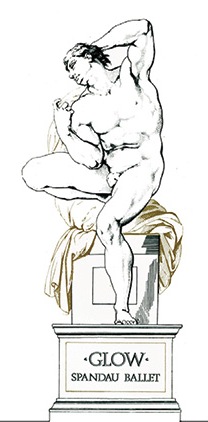
Sleeve for Spandau Ballet’s Glow: Another hero, by Smith after Flaxman

His minimalist vision was pretty prescient for 1980, though he wasn’t alone. Up North, former classmates at Manchester Polytechnic Peter Saville and Malcolm Garrett had been transforming graphic design in the record business for a couple of years, Saville for Joy Division and OMD among others while establishing a bold house style at Factory Records (where one post-punk sleeve was made of sandpaper as a Situationist joke), and Garrett for the new-wavers Buzzcocks and Magazine. Both were inspired by the pioneers of 20th-century typography to let stock fonts alone evoke mood and character, just as Penguin Books had done. The Mancunians, too, had often abandoned band portraits to underscore musical integrity.

Even so, it was quite a feat for Graham Smith to convince Spandau’s manager Steve Dagger and his five ostentantiously dandy band members with trendsetter ambitions that they remain invisible on their first set of singles.

Graham says: “This was obviously seen as a perverse and uncommercial move by Chrysalis [the record company], but that was the whole point. I felt by doing so we gave mystique to this new and very visual band. It added a strength to Spandau as they were clearly stating they were not packaged by the record company, but doing things on their terms. This move would still be considered questionable in marketing terms today.”
Spandau Ballet, Musclebound, record sleeves

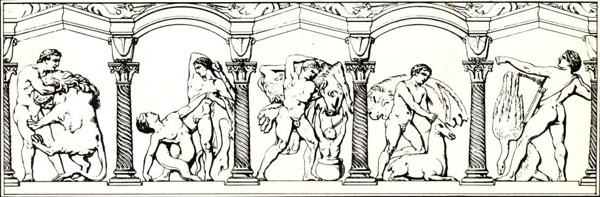
More Flaxmanesque heroes: Spandau Ballet sleeve imagery for Musclebound

A few tasteful nudes from classical antiquity stood in for the band, resonating with the New Romantics’ lifeline back to Bowie’s “Heroes”. Graham says: “The iconic imagery for the album was based on Greek sculptor Myron’s The Discus Thrower. Glow was based on 18th-century etchings by the neoclassical sculptor John Flaxman. The Freeze image I sourced from a reference book on Egyptian icons — the chariot simply worked with the Journeys to Glory theme. The white spartan package was pure and reflected some of Gary’s lyrics and statements at the time, such as I am beautiful and clean.”

“There were claims at the time that some of the imagery had Aryan overtones which mirrored the band’s earlier fashion choices. I somewhat misguidedly thought this was perfect at the time – think of Bowie saluting at Victoria Station in an open limousine several years earlier!”
Spandau Ballet, St Tropez, Simon Withers, Graham Smith, Robert Elms,New Romantics

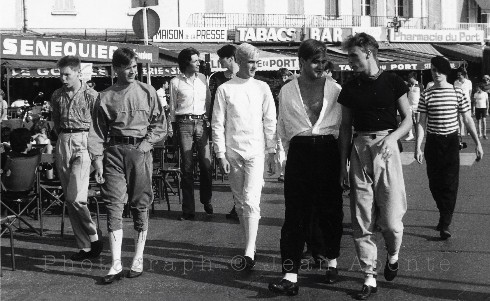
Graphic designer Graham Smith (right): The Spandau Ballet entourage in St Tropez in 1980 also includes writer Robert Elms (left) and stage/fashion designer Simon Withers (centre in white). Photograph © by Jean Aponte
FRONT PAGE

2011 ➤ The unknown Mr Big behind London’s landmark nightspot makes his return to the Blitz

Return to the Blitz, Eve Ferret, Mike Brown, Blitz club, Steve Strange

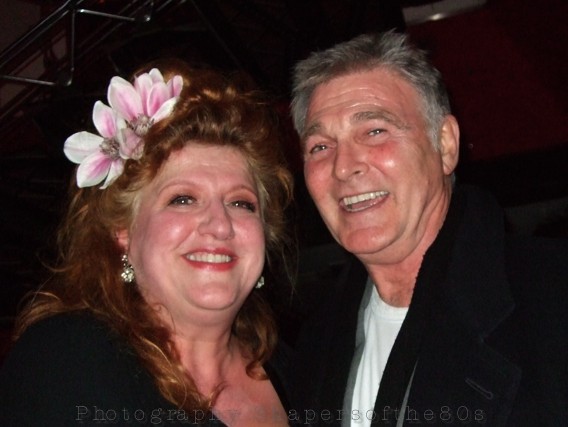
Reunited last night after 30 years: the reclusive founder of the Blitz wine bar, Mike Brown, and the cabaret singer Eve Ferret who first tasted stardom there. (Photograph © by Shapersofthe80s)

❚ BIGGEST SURPRISE AT LAST NIGHT’S Return to The Blitz party, thrown by Steve Strange, Rusty Egan and Rose Turner, was the arrival from Spain of the brains behind the original bar that became the crucible for New Romantic nightlife back in 1979. International man of mystery Mike Brown has always been described by those who worked for him in the late 70s as very private, and indeed he must be the only person among us to generate nil Google results. Nobody was more thrilled to see him for the first time in 30 years than actress and singer Eve Ferret, who made good in cabaret at the Blitz. It was almost a This Is Your Life moment as the pair lingered fondly in each other’s arms.

Biddie & Eve, James Biddlecombe, Blitz club

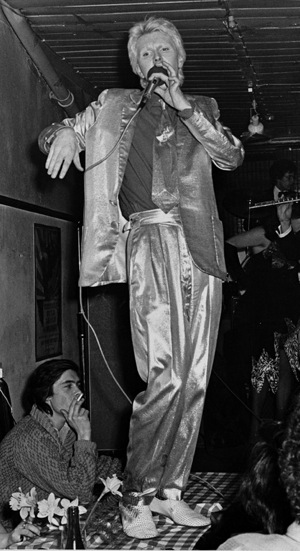
One-man cabaret: Biddie on-table at the Blitz wine bar in 1977

It was Brown who had the shrewd idea of buying the four-storey Victorian house at No 4 Great Queen Street in 1976 and opening a wine bar there. “I felt like a change from the recruitment business which I was running,” he said last night. “And I’d been watching a World War Two movie about Churchill which gave me the idea for a Blitz theme.

“I remember it was black and white and showed Londoners down in the Underground shelters whilst the bombs were dropping. More than the actual horror of the damage that was being inflicted, it was the way Londoners banded together that lingers. I remember thinking that I lived on the fourth floor of an old building divided into six flats yet I didn’t know any of the occupants.”

Mike ran his main business in nearby Lincoln’s Inn Fields, and his soft spot for nostalgia was well known to the Blitz staff — barmaid Sally Marks says she imagined he would have been a fighter pilot in another life. Hence the Blitz’s utilitarian wartime decor: bare floorboards, green and cream paintwork, red-gingham tablecloths, hanging enamel lampshades, which were never dusted. Famously the walls were lined with portraits of Churchill and WW2 posters in the declamatory graphics of the period: “Careless talk costs lives” and so on.

Blitz club, Mick Hurd, Richard Jones, Eve Ferret, Brendan Connolly , Sally Marks

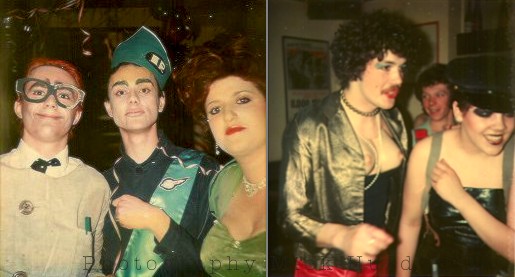
Dressing up for the Blitz wine bar’s Come as your Wildest Dream party, 1977: Mick Hurd, Richard Jones as Thunderbirds heroes, with Eve Ferret… and, right, manager Brendan Connolly with barmaid Sally Marks. (Polaroids © by Mick Hurd)

Mike said: “I am a great lover of traditional pie-and-mash and decided that the food theme would be along the lines of bangers-and-mash. The menus looked like old wartime ration books and we had our own wine labels made up.”

Despite having the Irish charmer Brendan Connolly as manager, and the dashing Peruvian Mario Testino behind the bar (as well as Sally, Ian Harington, Mike Roskams, Mick Hurd, Roy Brentnall, Paul Frecker and many, many others), the Blitz with its gorblimey menu wasn’t frankly much of a success. As the oil crisis squeezed western economies in the austere 70s, so London nightspots started resorting to cabaret to attract custom. Coinciding with a menu upgrade, the first performers to make their name at the Blitz were the song-and-dance duo Biddie & Eve.

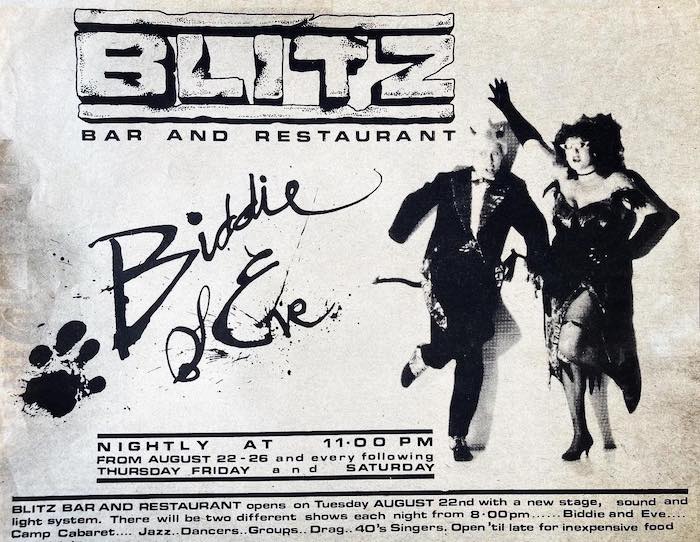
Slim, camp and Bowie-esque James “Biddie” Biddlecombe started at the Blitz singing solo, accompanied by pianist Richard Jones (later an opera director). Along came buxom redheaded Eve Ferret whose laughter could shake a cocktail. Their riotous partnership was inevitable. Biddie recalls: “Initially we would perform in the middle of the floor three nights a week. By 1978 we’d grown so busy they decided to build us a stage.” Sally says that one night when Island Records boss Chris Blackwell turned up with Bob Marley, the godfather of reggae was persuaded to get up and do a number.

Biddie & Eve, Eve Ferret, James Biddlecombe, Blitz club, London, 1970s

The 1978 relaunch, now with a stage: flyer for Biddie & Eve’s regular thrice-weekly cabaret

With Brendan’s encouragement, Biddie-life-and-soul helped establish a reputation for themed costume events with titles such as Come as Your Wildest Dream, or Stars of Film and TV, so the Blitz rapidly attracted, in the language of the time, an “up for it” party crowd, which included the likes of Tim Rice and Janet Street-Porter from the swank media haunt Zanzibar along the street. Then in February 1979, in walked Steve Strange and his competitive brand of teen cabaret on Tuesdays and the rest is New Romantic history.

The Blitz bar closed when Mike sold the building in 1981 “because after five years I’d had enough”, by which time Strange & Egan had upscaled their ambitions to Club For Heroes over on Baker Street. And Mike went back to recruitment. He said: “It is very humbling to know that there is still such interest in the Blitz Kids. They were a great bunch and it was a very exciting time.”

Shirlie Holliman,Eve Ferret,John Keeble, Martin Kemp, Blitz club

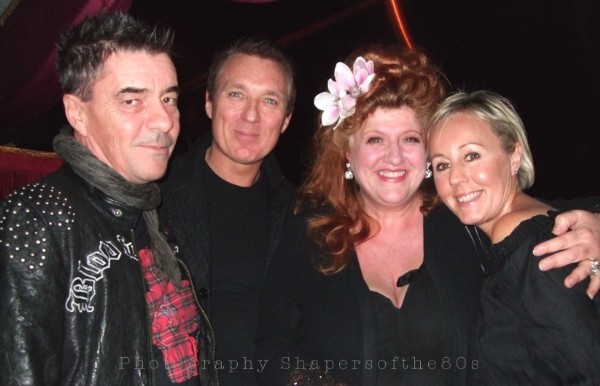
Spandau delegation at Return to the Blitz 2011: John Keeble, Martin Kemp and Shirlie Holliman catch up with Eve Ferret, second right. (Photograph © by Shapersofthe80s)

➢ Rusty Egan’s set list for Return To The Blitz
reunion party, 15 Jan 2011

FRONT PAGE

1980 ➤ The day Spandau signed on the line and changed the sound of British pop

Spandau Ballet, Virginia Turbett,Chrysalis,Steve Dagger, New Romantics

The way they wore: Spandau Ballet minutes before signing their record record deal in October 1980. Photographed at London’s Waldorf Hotel © by Virginia Turbett

◼ AS THE COOLEST CULT LEADERS OF 1980, Spandau Ballet’s songwriter Gary Kemp claimed: “We want the band to be at all times the most contemporary statement we could possibly make on modern London.” In the face of the post-punk new wave, it took courage to decide to play fresh sexy dance music in a corporate landscape dominated by adult-oriented rock supergroups. In the event, the five boys from the Angel, Islington, quickly assumed the role of houseband to the Blitz club and by placing the bass guitar and the bass drum at the front of the sound made it hip once more to play pop.

Spandau Ballet were being managed by their onetime schoolmate Steve Dagger, aged only 23, while three record labels competed to secure them. On this day 30 years ago they signed a deal with Chrysalis Records and walked into the future clutching an advance cheque for £85,000 — at the time, a record sum for an untried band that had played all of eight bookings and had refused to cut demo discs.

“We were strong, it was a real gang, a real team mentality. It was: We’re Spandau Ballet, who the f*** are you?” — John Keeble, Spandau drummer

By breaking all the industry rules, Spandau triggered a fashion and dance music movement that had been evolving in the nightclubs of Britain. At the very moment that the Blitz closed its doors, the press dubbed their followers the New Romantics, and a slipstream of more than 100 new image bands was born. The new sounds and new styles of this, the last of the Babyboomer generation, went on to dominate the international landscape of pop and over the next three years put more British acts in the US Billboard charts than the 1960s ever achieved.

ELSEWHERE ON SHAPERS OF THE 80s

➢ Oct 16, 1980: One week in the private worlds of the new young
➢ Birth of the New Romantics and the band who made it hip to play pop
➢ How the rhythm of the pop charts changed

Spandau Ballet, The Makers,The Cut,Roots, Dame Alice Owens

Tony Hadley fronts The Makers: Spandau as a school band playing to the fourth form at Dame Alice Owens — grabbed from video

➢ VIEW ♫ Early footage of Spandau Ballet in the Young Guns documentary from 2000
➢ New Romantics: I Was There — ex-Sounds hackette Betty Page’s recollections for Record Collector, written with the benefit of hindsight in 2004

FRONT PAGE

➤ Albums that defined the new 80s funk

Spandau Ballet,Journeys to Glory, Diamond,  teen scream,Glow, UK tour, 1982, live, Bournemouth

HITS FROM 1981 & 1982

◆ These are the unique rhythms of Spandau Ballet’s earliest tracks, which changed the sound of the British pop charts for ever. Released today are remastered special editions of Spandau’s first two albums across four CDs: March 1981’s synth-led Journeys To Glory, and Diamond, the first soulful singles for which were being released to satisfy fast-changing tastes in the UK even as the first album took off in North America. Bonuses include 12-inch remixes of the band’s debut single To Cut A Long Story Short, The Freeze and Glow — a much underestimated gem driven by Keeble’s “boom-ka” dancebeat — plus a previously unreleased BBC session from March 1981 … Bonuses on the Diamond set include remixes of what became 1982’s clubbing anthem for soulboys and girls, Chant No 1 (just pipped at the post for the chart No 1 spot), Instinction, Paint Me Down and She Loved Like Diamond — all of which are appearing for the first time in CD format. The listing contains five previously unreleased BBC tracks recorded on April 10, 1982, live at the Winter Gardens, Bournemouth, during the UK tour that saw Spandau trigger the return of the full-throated teen scream.

FRONT PAGE

2009 ➤ Onstage, Spandau’s Hadley and Kemp finally get huggy

Hell had frozen over, Tony Hadley said in 2007, and ruled out any chance of reunion for his band. So it’s all the more magnanimous that today he can say onstage “We are very happy boys”…

Spandau Ballet, Reformation tour, Tony Hadley,Gary Kemp, Martin Kemp, Steve Norman, John Keeble,David Tench, Dawn Joseph, 2009, comeback, live concert, Dublin, With the Pride, © by Shapersofthe80s

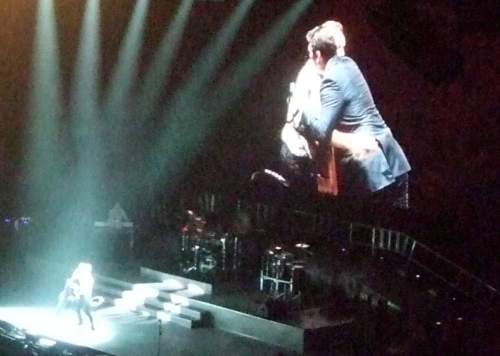
The picture they said could never be taken: a big hug between Spandau Ballet’s Tony Hadley and Gary Kemp during the band’s 2009 comeback concert in Dublin, after duetting With the Pride from 1984. Photographed © by Shapersofthe80s

❚ EXTRAORDINARY. UNEXPECTED. From the off, the Dubliners roared a loud, exuberant and warm welcome to the band that hadn’t played together for 19 years. They cheered the best bits by each musician – John, Steve, Gary, Martin and vocalist Tony. They cheered whenever closeups appeared on the monster live video backdrop. Within a day, amateur videos on YouTube [see below] were vividly testifying to the energy the event generated.

Spandau Ballet’s comeback Reformation tour began at the O2 arena in Ireland’s capital city on October 13, 2009, with a huge flickering video montage to remind us of the way the world was when they set the style as electro-pop innovators in 1980. Headlines announced “Recession”, “Unemployment” … “and Dreams”. Then a jabbing finger on an early synthesiser triggered a chugging high-octane version of their oh-so-cool first hit, To Cut a Long Story Short…

➢➢ Click to continue reading full concert report…

FRONT PAGE