❚ ANOTHER GLORIOUS Last Night of the Proms, conducted for the first time by a woman, Marin Alsop, who said she was amazed to be the first in its history because it is after all 2013 and we’ve had 118 years in which to dare! Stars included violinist Nigel Kennedy who indulged himself in some wild and hilarious improv all the way through Vittorio Monti’s accelerating gypsy piece, Csárdás (you’ll know it when you hear it, most recently in Lady Gaga’s song Alejandro).
But the singing sensation of the evening was the American mezzo-soprano Joyce DiDonato who lifted Over the Rainbow way out of the Garland league into a coloratura heaven of her own, wow! Then she led 6,000 voices in the Albert Hall, plus thousands more in public parks across the UK, in Rule Britannia. As is tradition, she swished the wings of her expansive bat-cape to reveal it to be a dreamy puce abstraction of the Union Jack – which we were told was designed for the occasion by Vivienne Westwood. Cool Britannia Rules again.
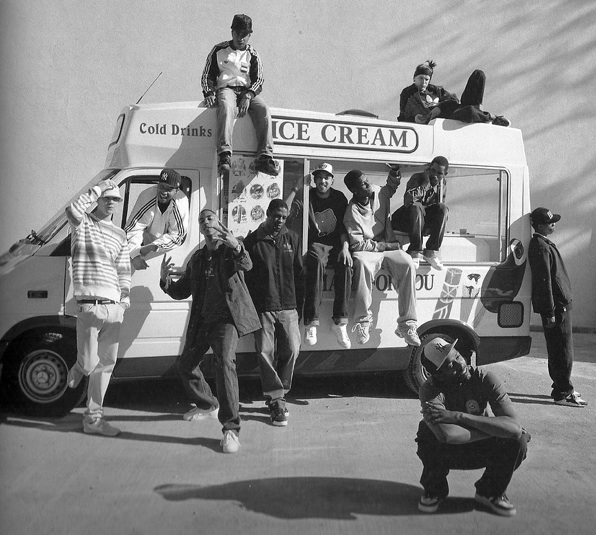
Sound of new London: the influential grime collective Roll Deep in 2009. Photograph by Simon Wheatley
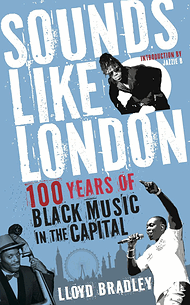
❚ HERE’S AN INSPIRATIONAL BOOK that rocks you on your heels by making a mighty claim that in your guts you know is right. With quiet assurance the author Lloyd Bradbury traces a century of black music in his chunky 430-page Sounds Like London to arrive at this conclusion: that UK black music has dramatically reshaped British culture and mainstream pop. He said last week: “It’s astonishing that we’ve come from Lord Kitchener at the gangplank of the Windrush to Dizzee Rascal at Glastonbury in less than three generations. Today’s music-makers do not think of it as anything to do with black musicians. It is basically London pop music. It is an astonishing evolution.”
If the music’s substantially hidden pre-WW2 history is an eye-opener, the postwar lineage is electrifying. Bradbury draws a continuous arc from the Caribbean immigrant Kitchener singing his calypso “London is the place for me” the moment he disembarked from SS Empire Windrush at Tilbury in 1948, to embrace the jazz bands, blues and clubs and the many hybrid sounds of reggae, highlife, lovers rock and homegrown funk that have led on through peculiar twists to jungle, drum and bass, garage, dubstep and grime and become the soundtracks for British dancefloors today.
The book pays serious tribute to Guyanan-born Eddy Grant whose north London studio brought on a whole generation of musicians (and whose 1979 hit Living on the Front Line lent its name to the Evening Standard’s column about youth culture). The final chapters set out one of the most efficient roadmaps you’ve read to the truly creative UK music-makers of the past 20 years which otherwise saw our charts being despoiled by Cowell’s vacuous talent show victims and tedious bitch-n-gangsta videos from North America.
Bradley, who grew up in Kentish Town, writes: “British black music has never been so prominent. Indeed it’s at the point now where artists such as Labrinth, Tinie Tempah and Dizzee Rascal are bona fide pop stars, with a young mainstream audience that accepts them. The brilliant thing about the current state of British black music is that … our guys have very often succeeded in spite of the UK music business rather than because of it.”
Click any pic to launch carousel
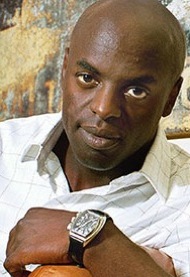
Former radio pirate turned author Lloyd Bradley speaking at last month’s Open East Festival in Stratford
In similar vein, Jazzie B of Soul II Soul writes in his foreword to the book: “Sounds Like London is a story that needed to be told by somebody who really cares about it, and the most important thing about this book is Lloyd Bradley. The reason this story of London’s black music hasn’t been told before is because up until now he wasn’t ready to write it.”
Former sound-system owner, pirate radio deejay, classically trained chef and adviser to the British Council, Lloyd Bradley has been writing about black music in Britain, the US and the Caribbean for over thirty years.
“ Sounds Like London is a riveting read. It’s one to wolf down in a few sessions, and then savour slowly at a more considered pace… He avoids trotting out the usual suspects who pop up perennially as talking heads as part of the dumbing-down documentary epidemic, so the stories and angles seem fresher than might be anticipated. Quite correctly, Eddy Grant is right at the heart of Lloyd’s history lesson, and it is wonderful to read a book that recognises his role in changing pop music for ever. But some of the other choices of, well, witnesses are also inspired. People like Wookie, Root Jackson, Hazel Miller of Ogun Records, Teddy Osei of Osibisa, and Soul II Soul’s designer Derek Yates come across particularly well and have some great tales to tell… ” / Continued online
“ Traditionally, black music in this country has been described by historians, as well as its champions in the rock press, as rebel music… Sounds Like London certainly has its darker moments – Trevor Nelson talks about being asked to DJ at clubs to which, as a punter, he was repeatedly refused entry; producers bristle at the memory of clueless major-label representatives craving their demographics but demanding they make stylistic compromises that damaged their reputations… This is an invaluably materialist book that is often at its most enlightening when it recounts the dramas of distribution – label bosses circulating their records via an alternative network of barbers, grocers, hairdressers and travel agents, for example. The much-missed Stern’s record store began life as an electrical supplies shop on Tottenham Court Road that was popular with African students who paid for repairs with new vinyl from their home countries. For Bradley, black music in London is often creative expression and sometimes art, but almost without exception it is work… ” / Continued at Guardian Online
More like Freddie Starrdust: The Bowie Experience tribute act outside the V&A yesterday in shabby Earthling coat and filthy lace. Photograph by Andy Polaris
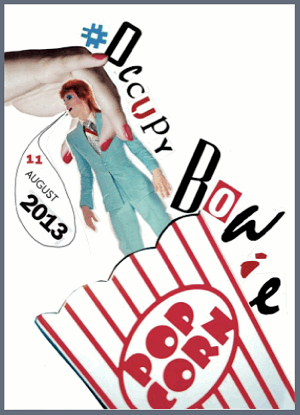
❚ “CALLING ALL MISFITS, ANDROGYNES, glam rockers, goblin kings, scary monsters and super creeps: you are invited to a gathering on the steps of the V&A on the last day of the Bowie exhibition, 11 August. Together we will create a tableau vivant.” This call to arms by an ad hoc faction calling itself Occupy Bowie posted a tortuous Tumblr page that dared to translate this difficult French phrase as a “living picture” and illustrated several examples from a long tradition blah blah of motionless, silent models in poses plastiques blah blah often theatrically lit blah blah.
Another page at Facebook declared: “In honour of music, art and David Bowie, it will be a spectacle. It is a participatory event for visual extremists of all stripes. Don’t call us a flash mob.”
As it happens, this tribal turnout by a few dozen fans yesterday afternoon proved to be less a flash mob, more a naff huddle. There was a singalong to Rebel Rebel, but no truly glam Bowie persona in sight, what with the low-rent mimes and the generally jumble-sale approach to costume topped with nylon wigs that could have come from Ridley Road Market. By midnight we could count only three photographs of this act of mass homage posted online, then a couple more today.
Click any pic to launch carousel
Photo Denis Carr
Photo Denis Carr
Suspected ringleaders – note tatty jeans
Best Bowie in show
As it happens, Andy Polaris, who lives in East London, claims he was “passing by” the V&A in West London at 3pm and snapped the faithful engaged in their mystical rites. His verdict: “It looked more Freddie Starrdust than Ziggy Stardust.” This referred to the shabby Earthling playing guitar who is known as The Bowie Experience, a professional tribute impersonator wearing the least glam costume of any Bowie incarnation. Polaris said: “The women looked a lot better than the men and the girl with the dark hair and Aladdin streak was the best.” Funny, that. Even the apparent ringleaders themselves, University of the Arts types subtly disguised on Facebook as Occu PyBowie, let the side down in scruffy old jeans. They’d never have let each other get away with that in 1973, let alone the Blitz in 1980.
Brilliant sunshine put paid to any “theatrical lighting” to compare with the photographs of Ryan Schude or the Society of Beaux-Arts Architects Ball, 1931, that Occupy Bowie had cited as inspiration on that ambitious Tumblr page. Better luck at the exhibition’s Toronto opening in September, lads.
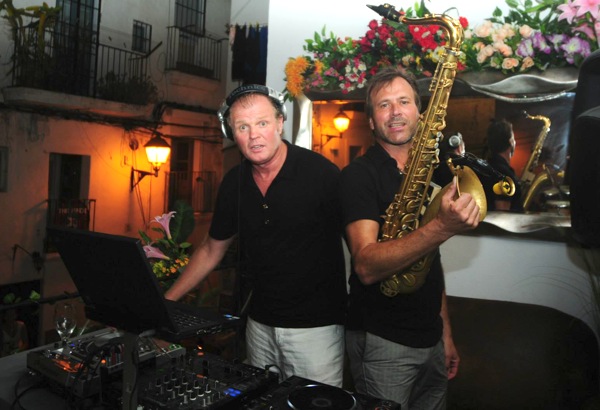
Electronic Beach Club in Ibiza: Rusty Egan and Steve Norman poised to start last Friday’s session. Photograph courtesy El Brasero
❚ THEY WERE DANCING IN THE STREETS OF IBIZA last Friday night to the toe-tapping toons of Steve Norman (saxophonist, guitarist and percussionist with Spandau Ballet) and Rusty Egan (former Visage drummer and deejay at London’s legendary Blitz Club in the 80s). Regular readers of Shapersofthe80s know that Norman-Egan’s storming double act, billed as Electronic Beach Club, have been entertaining sunseekers at the Nassau Beach Club on Playa D’en Bossa, fortnightly since May and they’re in residence until September.
Steve of course made his home on what he calls “this fair, white isle of Ibiza” in the 90s when he introduced the idea of live musical improvisation with the deejay at a club residency in San Antonio. What’s new today is the idea of beach clubs, and he and Rusty are finding themselves in demand across the island. Last Friday saw a huge gay pride street party in Ibiza town when the open-air El Brasero restaurant invited them to entertain the crowds from a first-floor terrace. Their playlist featured a lot of 80s pop and even Daft Punk’s Get Lucky. Naturally, we asked Steve for an update…
❏ Steve Norman writes: “Friday’s street party was fantastic, very emotional. My first proper street gig since The Roots Silver Jubilee set back in 1977. El Brasero is one of a collection of fab little eateries in the Gypsy quarter of Ibiza town. We set up on the terrace overlooking the street with a washing line complete with the family’s Sunday best hung out to dry serving as a backdrop.
Photographs by El Brasero, Carrer Passadis 4, Ibiza
The week’s washing aloft, Egan-Norman to the fore
Click any pic to launch carousel
“Rusty surpassed himself with his choice of tunes and I sweated like a trooper on what was a very, very hot August night. But the main protagonists were the crowd, all the people drinking, eating or passers-by who stopped to watch. They all entered into the spirit of the event and the connection was made. For me it was one of my fave gigs ever. And the woman whose washing line it was never did throw water over me as she had threatened to do, should I not live up to her expectations, when what I could’ve done with was a nice cold shower!
“All great with Rusty, he’s a pal. Not driving me nuts anything like he normally does. I am doing gigs without him as he is doing without me but we have something unique together. What go down well are songs that people half recognise. Melody is the key, that’s why I believe the sax resonates so much with audiences. I always try to be singalongy with what I play – as Deuce Barter says, ‘simple phrases that the postman can whistle’. Oh and a deep version of True by Deep Mind normally finishes it off quite nicely.
“I’ll be taking my sax to Sa Trincha at Salinas Beach Friday for a brief session with deejay Franco Moiraghi and again with Franco at Downtown Cipriani when the restaurant turns into a nightclub on Saturday night/Sunday morning… that’s a very decent gig indeed. Rusty’s coming to watch and take the piss!”
HERE THEY ARE IN THE LOCAL PROMO
❏ Una actualización del comerciantes del Barrio / Update: Newly published video by the retailers of the Marina district to capture the Ibiza Orgullosa and the inimitable Norman-Egan double act… “Exito espectacular de la primera edicion de Ibiza Orgullosa, organizada por la asociacion del barrio de la Marina de Ibiza ciudad. Gracias a todos por asistir y disfrutar del evento.”
“Possibly one of the best shows yet,” he says, this time featuring Giorgio Moroder, Pet Shop Boys, MGMT, Vivien Glass, Vile Electrodes, Margaret Berger, Kid Moxie, Perfume, Marsheaux, BEF, Sin Cos Tan, Mason, Isaac Junkie feat Heaven 17’s Glenn Gregory, Kurt Baggaley, OMD, Tenek and more.
“ Around 300,000 people have seen the V&A’s David Bowie is exhibition as it enters its closing week. The V&A has been running regular late-night openings to cope with demand and the exhibition has been open until 22.00 every night for the final two weeks. Tickets are still available for purchase every day at the Museum.
To give people one last chance to see the exhibition in the UK the V&A has also commissioned a special film to be transmitted live to over 200 cinemas across the UK on 13 August. David Bowie is happening now will be a cinematic, behind-the-scenes tour of the exhibition in the company of curators Victoria Broackes and Geoffrey Marsh and celebrity guests.
The exhibition will now commence an international tour. Confirmed venues are:
Art Gallery of Ontario, Toronto, Canada from 25 September to 27 November 2013
Museum of Image and Sound, Sao Paulo, Brazil from 28 January to 21 April 2014
Museum of Contemporary Art, Chicago, USA from September 2014 to January 2015
Philharmonie de Paris/ Cité de la Musique, Paris, France from 2 March to 31 May 2015
Groninger Museum, Groningen, The Netherlands from 15 December 2015 to 15 March 2016
Further international venues are under discussion… ” / Continued at Bowie.com
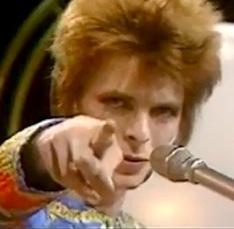
Fresh this week: a new Bowie portrait by Jimmy King, oozing maquillage
➢ Choose “View full site” – then in the blue bar atop your mobile page, click the three horizontal lines linking to many blue themed pages with background article
MORE INTERESTING THAN MOST PEOPLE’S FANTASIES — THE SWINGING EIGHTIES 1978-1984
They didn’t call themselves New Romantics, or the Blitz Kids – but other people did.
“I’d find people at the Blitz who were possible only in my imagination. But they were real” — Stephen Jones, hatmaker, 1983. (Illustration courtesy Iain R Webb, 1983)
“The truth about those Blitz club people was more interesting than most people’s fantasies” — Steve Dagger, pop group manager, 1983
PRAISE INDEED!
“See David Johnson’s fabulously detailed website Shapers of the 80s to which I am hugely indebted” – Political historian Dominic Sandbrook, in his book Who Dares Wins, 2019
“The (velvet) goldmine that is Shapers of the 80s” – Verdict of Chris O’Leary, respected author and blogger who analyses Bowie song by song at Pushing Ahead of the Dame
“The rather brilliant Shapers of the 80s website” – Dylan Jones in his Sweet Dreams paperback, 2021
A UNIQUE HISTORY
➢ WELCOME to the Swinging 80s ➢ THE BLOG POSTS on this front page report topical updates ➢ ROLL OVER THE MENU at page top to go deeper into the past ➢ FOR NEWS & MONTH BY MONTH SEARCH scroll down this sidebar
❏ Header artwork by Kat Starchild shows Blitz Kids Darla Jane Gilroy, Elise Brazier, Judi Frankland and Steve Strange, with David Bowie at centre in his 1980 video for Ashes to Ashes
VINCENT ON AIR 2026
✱ Deejay legend Robbie Vincent has returned to JazzFM on Sundays 1-3pm… Catch up on Robbie’s JazzFM August Bank Holiday 2020 session thanks to AhhhhhSoul with four hours of “nothing but essential rhythms of soul, jazz and funk”.
TOLD FOR THE FIRST TIME
◆ Who was who in Spandau’s break-out year of 1980? The Invisible Hand of Shapersofthe80s draws a selective timeline for The unprecedented rise and rise of Spandau Ballet –– Turn to our inside page
SEARCH our 925 posts or ZOOM DOWN TO THE ARCHIVE INDEX
UNTOLD BLITZ STORIES
✱ If you thought there was no more to know about the birth of Blitz culture in 1980 then get your hands on a sensational book by an obsessive music fan called David Barrat. It is gripping, original and epic – a spooky tale of coincidence and parallel lives as mind-tingling as a Sherlock Holmes yarn. Titled both New Romantics Who Never Were and The Untold Story of Spandau Ballet! Sample this initial taster here at Shapers of the 80s
CHEWING THE FAT
✱ Jawing at Soho Radio on the 80s clubland revolution (from 32 mins) and on art (@55 mins) is probably the most influential shaper of the 80s, former Wag-club director Chris Sullivan (pictured) with editor of this website David Johnson
LANDMARK FAREWELLS. . . HIT THE INDEX TAB UP TOP FOR EVERYTHING ELSE