2011 ➤ Pay now — so We Can Be Heroes goes ahead!

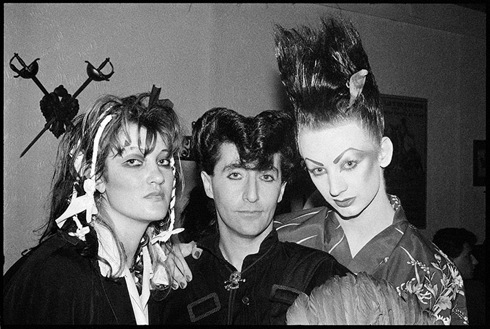
1980: Clare Thom, Philip Sallon and George O’Dowd on a coach trip to Margate. Photograph by Graham Smith/grsmith@mac.com.jpg from his book We Can Be Heroes

WE CAN BE HEROES
must be funded by November 12 17 [update]

❚ NOBODY IS BETTER QUALIFIED to chronicle the whirlwind six years between punk and the death of the New Romantics than Graham Smith through his eye-witness photography, and the writer Chris Sullivan, one of the core movers-and-shapers of his generation. UK music and style evolved out of all recognition in a mighty resurgence of youth subcultures that directly triggered a rejuvenation of mainstream media for the rest of the decade. Shapersofthe80s was on hand as an observer. But these two wags were in the thick of the action — major players in a spontaneous youthful collaboration to regenerate the UK’s ailing music and style scenes as 1980 dawned. With contributions by a galaxy of stars, who include Gary Kemp and Boy George, this will become the definitive story of one of the great explosions of creativity in British youth culture.

The authors aim to get their large-format 320-page coffee-table photobook We Can Be Heroes to you in time for Christmas. Their “crowd-funding” venture requires them to raise the cash first by asking YOU to buy your copy in advance, before 6pm GMT on November 12 17. Your reward is to see your name printed as a Supporter in the limited first edition. The clock is ticking.

View Graham’s video today at Unbound Publishing, a new company under the patronage of Faber, the most prestigious publisher in Britain. Here you can purchase your book and enjoy other perks such as an invitation to the launch party. Join the clubbers at Facebook who are submitting their own photos and tales of merriment.

➢ Twitter directly with the publisher, Unbound

READ WHAT HAS ALREADY BEEN SAID
ABOUT WE CAN BE HEROES

+++

➢ Unbound aims for 40 books in year one … Supported by Faber, the platform was created by QI writers John Mitchinson and John Pollard, and Crap Towns author Dan Kieran — The Bookseller

➢ Funded by the people — Channel 4 News video on “crowdfunding”, the process that decides when and how Graham’s book gets published

➢ Why creative clubbing ended with the 80s — the credentials that equipped Smithy, Sullivan and Elms (and a few other crazies) to start changing the world

➢ Boy George says the 70s were the best time ever to be a teenager — and Tweets that “it’s a brilliant book about the New Romantics! Really!” He has also written a foreword in We Can Be Heroes. (So have Gary Kemp, Steve Strange and Robert Elms)

➢ A slideshow of Graham’s Blitz-era gems at Guardian online

➢ Thirty years of punk and post-punk photo imagery — by Disneyrollergirl, one of The Times’ 40 bloggers who count

➢ Huffington Post: All about 1980s club kids — former Blitz Kid and Times fashion editor Iain R Webb writes about Bowie’s impact on the Blitz scene

➢ A legacy that has inspired each decade since the 80s — Princesss Julia, international deejay and fabulous Blitz Club coat-check girl, writes for i-D about stripping away the posers’ facade

➢ Update Nov 6: priceless storytelling about 80s mayhem with Elms and Sullivan on video

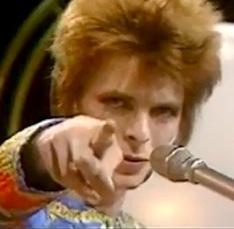
➢ Promo video for Blue Jean (1984) starring David Bowie as Screamin’ Lord Byron before a London clubland audience … Below is the alternate version of Blue Jean for MTV, starring Bowie and the Aliens, shot live before an audience in Soho’s Wag club, which was hosted for 19 years by Chris Sullivan

+++

FRONT PAGE

2011 ➤ Duran Duran are the Wild Boys of Madison Square Garden

+++
❚ DURAN DURAN WOW NEW YORK covering Frankie’s Relax at their sold-out show at Madison Square Garden last night, in a 20th anniversary celebration for radio stars Scott & Todd of 95.5 WPLJ. Girl Panic! remains the stand-out single from the album All You Need Is Now.

FRONT PAGE

➤ The Bowie factor at the Blitz: glamour, drama and collage couture

Iain Webb at St Martin’s School of Art in 1977 — photographed by fellow student Stephen Jones who went on to become an international hat-maker

❚ FOR TODAY’S HUFFINGTON POST, Iain R Webb, former Blitz Kid and later Times of London fashion editor, writes of the imminent photo-book about the tumultuous fashion and music scene that emerged from London’s Blitz Club in 1980. We Can Be Heroes by Graham Smith is a fascinating documentation of the demimonde nightclub scene from punk through New Romantic and out the other side… Webb writes:

It is certainly fitting that Smith has chosen the Bowie lyric as the title of his book because Bowie is to thank for inspiring the transformational theatrics employed by the Blitz Club regulars. In the early 1970s Bowie brought glamour and drama to rock music at a time when it was difficult to tell if the denim clad hairy on stage had nodded off during the drum solo. He was a shrewd style thief, an ardent advocate of collage couture. One of the only musicians to survive the vicious tongue-lashing of punk, it was Bowie who helped fuel the electro soundtrack of the 80s’ subterranean underworld. His Berlin trilogy of albums — Low, Heroes and Lodger — explored the neue world of Kraftwerk and machine Muzak. Although let’s not forget to credit Giorgio Moroder and Donna Summer who had been knocking out the electronic beats in the gay clubs of many a twelve-inch single / continued online

➢ A new book about 1980s club kids by Iain R Webb
at The Huffington Post

➢ When Iain met Stephen, London traffic stopped
and St Martin’s stood still

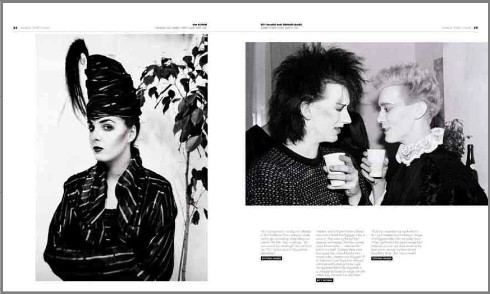
A sample spread from We Can Be Heroes by Graham Smith: his photos here show Blitz Kid style-leaders Kim Bowen, “Boy” George O’Dowd and Stephen Linard

THREE WEEKS LEFT TO RAISE THE CASH

❏ Will you help ensure publication of We Can Be Heroes by buying your personal copy today? Graham Smith’s book is the definitive history of early 80s nightclub music and style, which were the last manifestation of Britain’s collaborative youth culture. Alongside Graham’s superb photographs is racy text by Chris Sullivan, fabled host of Soho’s long-running Wag club, plus much other celebrity commentary.

Unbound is a new “crowd-funding” company run by three young dynamos well versed in publishing who are ensuring high-quality printing in Germany of this 320-page hardback using 180gsm paper, all in time for Christmas, priced £30. Visit Graham’s page at Unbound to discover why your immediate contribution towards the cost of the limited first edition is so important that the book will carry your name as an early supporter.

➢ £30 buys you the hardback first edition of We Can Be Heroes and your name printed inside — £50 buys an autographed copy and there are many other perks including a de luxe edition

❏ iPAD, TABLET & MOBILE USERS PLEASE NOTE — You be see only a tiny selection of items from this wide-ranging website about the 1980s, not chosen by the author. To access fuller background features and site index either click on “Standard view” or visit Shapersofthe80s.com on a desktop computer. ➢ Click here to visit a different random item every time you click

FRONT PAGE

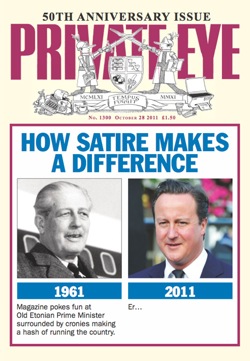
➤ Happy golden anniversary to Lord Gnome, Glenda Slagg, Topes, O’Booze, Knacker, Knee and especially Gnome-Mart’s theme tune

Private Eye, First 50 Years,magazine covers,satire
❚ HOW ONE MAGAZINE has enriched a nation’s vocabulary over 50 years is evidenced by the enormous page at Wikipedia, detailing euphemisms for sex (“Ugandan discussions”) and drunkenness (“tired and emotional”), and the eternal cast of daft characters from public life, as headlined above.

October 25, 1961, saw the first issue of Private Eye as a silly-jokes threat to the ancient humourous periodical, Punch. The Eye was quickly given a worthy role by the nation’s thirst for incisive satirical critiquing of all aspects of the British Way of Life, the irony being that today the Eye itself has become an institutional beacon in the democratic process. As editor for the past 25 years, Ian Hislop’s best boast is that he is the most sued man in Britain, libel writs being substantially provoked by the rear-end pages of sound investigative journalism. Not a bad metamorphosis. Is it then churlish to mention that what some of us really, really miss are the hilarious sketches once enacted on 7-inch flexi-discs attached to the cover and given away with the Christmas issues? [See below]

➢ Private Eye’s own library of epochal covers

➢ Bags of Private Eye memorabilia as Creative Review previews the new V&A studio display paying homage to the magazine’s humourists

➢ Direct link to the V&A’s video and display Private Eye: The First 50 Years, running October 18 to January 8

Private Eye, First 50 Years,magazine covers,satire,humour
❏ Back in the 1960s the then new technology of offset litho encouraged cut-and-paste techniques such as the DIY speech balloon photograph (one Queen and a bevy of prime ministers, above). This didn’t stop the Eye from becoming a prominent outlet for the nation’s leading cartoonists (the Thompson effort below appears in the V&A display).
Private Eye, First 50 Years,satire,V&A exhibition,humour, cartoons

GNOME-MART’S CACOPHONY OF CELEBRATION

Private Eye, 50th anniversary, issue No 1300, Gnome-Mart,satire ➢ The Eye celebrates its 50th anniversary with issue No 1300 and at its website a page of unfunny audio recordings that simply don’t come close to the efforts 40 years ago of Peter Cook, Willie Rushton & Co.

➢ Update Nov 5: Fortunately The Grauniad has released an exclusive CD of classic audio sketches made by Private Eye legends Peter Cook, Dudley Moore, Eleanor Bron, Willie Rushton, John Wells and Richard Ingrams — 34 excerpts spread over 40 minutes include Grocer Heath, E J Thribb, Farginson, I Musicci di Neasden, Inspector Knacker and many more favourites.

➢ The full archive of Private Eye recordings made by Peter Cook, Dudley Moore, Barry Humphries, John Wells, John Bird, Barry Fantoni, Richard Ingrams and Spike Milligan – plus rare photos, video clips and historical notes – can be found at privateeyerecords.com. The whole catalogue of Golden Satiricals is due for release on CD in January 2012.

➢ Whistleblowers and those with a social conscience can download past Eye investigations into subjects such as NHS whistleblowers; How Britain’s poverty relief fund abandoned the poor; full background to the ACTIS-CDC sell-off; How Blair’s government blew £12.4bn on useless IT for the NHS; deaths of four young recruits at the Deepcut army barracks, etc.

Private Eye, 50th anniversary, privateeyerecords, Gnome-Mart,satire,CD,Golden Satiricals

FRONT PAGE

2011 ➤ Oo-er, Metamodernists say: Go forth and oscillate

Annunciations,installations, Luke Turner, photography,Metamodernism,manifesto, fine art

Annunciations (installation view), 2011 © by Luke Turner: The Annunciations series revolves around the experience of art, the visual realm, and the ghosts of art history

❚ YOU READ IT HERE FIRST. As the V&A’s exhibition on Postmodernism lays bare the cultural malaise of recent decades, a bright new dawn is announced  “with emphatic optimism (and a pragmatic romanticism)” by the publication of “The Metamodernist manifesto”…

  1. We recognise oscillation to be the natural order of the world.
  2. We must liberate ourselves from the inertia resulting from a century of modernist ideological naivety and the cynical insincerity of its antonymous bastard child.
  3. Movement shall henceforth be enabled by way of an oscillation between positions, with diametrically opposed ideas operating like the pulsating polarities of some colossal electric machine, propelling the world into action…

➢ Continue reading The Metamodernist manifesto

➢ Luke Turner’s Annunciations 2011 reviewed by Siobhan Wall — “Each photograph in Annunciations is named after a famous Renaissance painting, and it’s apparent that these largely abstract images are a carefully considered distillation of what lies beyond the figurative and literal in the well-known masterpieces…”

➢ Notes on metamodernism is the webzine that documents current developments in politics and aesthetics that can no longer be explained in terms of the postmodern, proposing instead “a sensibility that oscillates between modern positions and postmodern strategies; between construction and deconstruction (indeed, reconstruction); a desire for sens and a doubt about the sense of it all; between sincerity and irony; hope and melancholy”.

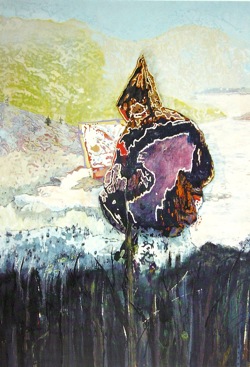
Peter Doig, Figure in Mountain Landscape, New Romanticism,Death of Painting,

Peter Doig, Figure in Mountain Landscape, 1997-8

➢ The new New Romanticism — “the act of presenting the commonplace with significance, the ordinary with the mysterious, etc, and this undertaking’s inevitable and necessary failure… But why now? … To express a dissatisfaction about a present that is increasingly uninhabitable, and a desire for a future whose blueprint has yet to be drawn”.

➢ Peter Doig and the “Death of Painting”  — “His work explores a tension between the designs of humanity and the wild, natural world it has to reckon with… He seems to paint about painting, each canvas becomes an allegory of the strangely beautiful problems, inadequacies and imperfections of creative vision.”

❏ iPAD, TABLET & MOBILE USERS PLEASE NOTE — You may see only a tiny selection of items from this wide-ranging website about the 1980s, not chosen by the author. To access fuller background features and site index either click on “Standard view” or visit Shapersofthe80s.com on a desktop computer. ➢ Click here to visit a different random item every time you click

FRONT PAGE