Today The Thin White Duke walks tall again— the god, the brand, the signifier — the three-in-one trinity that is David Bowie fired up one of the great transformative albums of the 70s, Station to Station. His 10th in a studio, it is now re-released in special edition 3-CD box set.
This month the German journalist Finn Johannsen interviewed the club deejay and co-founder of the Blitz Club, Rusty Egan for the Nokia blog, Sounds Like Me. He discusses Bowie’s seminal role in 70s and 80s music, describes a typical night out at the Blitz, and what today’s clubbers can take from such an innovative chapter of music-making. Here’s a taster…
Rusty Egan at the Blitz, 1980: rare pic of him spinning the discs
FJ — David Bowie was always famous for continuously reinventing his career, but did this phase particularly appeal to you?
RE — Bowie’s Berlin years I believe were the foundation of the Blitz club playlist. Via Bowie I found Kraftwerk, and that lead to Neu!, Can, Cluster and Krautrock, as it was called. Bryan Ferry then led to the work of Brian Eno, and his ambient series … All this music lead to the basis of my collection. If you join the dots Bowie, Eno, Iggy, Kraftwerk, Mick Ronson, Lou Reed.
FJ — It is obvious that Bowie was heavily influenced by German experimental groups like Kraftwerk or Neu! How much of them can be found in Low and Heroes?
RE — Massive influences. Bowie is a SONGWRITER. Without songs you have music. The Germans made amazing music without lyrics. It was experimental because of the instruments used and the long, long tracks. Bowie took the basis of this experimental music and the growing feelings evoked by Möbius, Cluster, Can, Neu! and went into Hansa studios by the Wall and with Brian Eno created the Berlin sound. Heroes sung in German as Helden is a perfect example. Six minutes long, but what were the instruments used? Can you hear guitar, bass and drums? Nothing but a long, long tone changing and changing… It’s not rocket science and it is music.
From the makers of The X Factor: a new magazine, edited by the man who toyed with Kelly Clarkson like a cat with a mouse
❚ WE LOVE HIM, THEY LOATHE HIM, the worst of them. One of the most influential and passionate commentors on the pop scene appears to have jumped ship in the direction of Simon Cowell’s entertainment goldmine. Peter Robinson, the 30-something wag and one-man Girls Aloud fanclub, has made his Popjustice blog a compelling read for fans who favour his surreal version of the truth, but a gunk tank for stars who imagine there’s any such thing as an even break.
Yet this morning’s Media Guardian unequivocally describes him as “formerly” the editor of PJ, while announcing the launch of X magazine, whose own website gives him the title of Senior Editor there. Sounds like a golden-handshake welcome to X which is to be the weekly print offshoot of the Cowell TV franchise, The X Factor. A 100-page launch issue appears tomorrow to coincide with series seven of the ITV talent show, and distribution is initially through Tesco supermarkets, price £1.95, even when the show is off-air.
"Senior Editor" of X magazine: no, not the Peter Robinson who dresses as Marilyn, the other Peter Robinson
A “surprising” level of access to contestants is promised, though Robinson is reported to have feared that X would be “pretty much a glorified fan magazine”. The big cheese at its publisher, Haymarket Media Group, convinced him that the owners were happy for X to “not always toe the party line”. Some might think this a risky ploy. Is the cheese actually familiar with the Robinson technique? Does the cheese know how often his notoriously cringe-making interviews must have turned a star to jelly? In fact, has the cheese read the all-time car-crash sofa-chat Robinson conducted with American Idol winner Kelly Clarkson? In which he provoked her to confess: “I’m not a man and I don’t claim to be.”
There hasn’t been a decent mag purely about pop since the upstart Smash Hits doled out respect and ridicule in equal measure. It ran for almost three decades as a fortnightly, shuffling off-stage only in 2006. Channel 4’s Popworld spin-off died after two issues in 2007. Nevertheless, according to another Haymarket cheese, women’s weeklies are reckoned to be on “vibrant” form, and Robinson is talking up his new title: “Our editorial team is the strongest of any British pop magazine in almost 20 years and this certainly feels like the biggest pop magazine launch in Justin Bieber’s lifetime.”
Robinson was working as a freelance in 2000 when, for the love of it, he founded Popjustice as a music site with attitude. He has overseen its successful monetisation in cahoots with w00tmedia, and bolted on a record label called Popjustice Hi-Fi. The Times reckons PR is one of the music industry’s Top 20 star makers while The Observer rated Popjustice the world’s most powerful music blog. So has he truly relinquished the crown after 10 years? No, of course not! What? Give up the most powerful throne in pop? That was just “a mistake/assumption on Media Guardian’s part” PR assures us. Not for nothing have hacks long dubbed it the good old “Grauniad”! So rest assured that a familiar bum stills sits in the PJ hotseat, while steering the pop universe with his left hand.
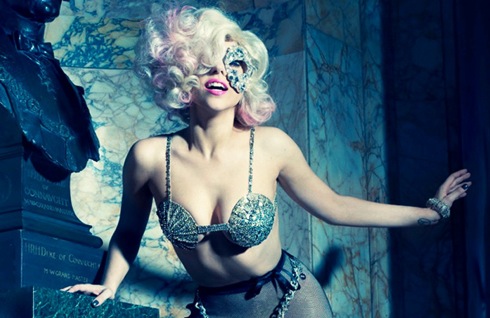
Lady Gaga in performance: does she mark the end of the sexual revolution?
Paglia the hurricane
❚ CAMILLE PAGLIA describes herself as a “dissident feminist”. Others have dubbed her “Hurricane Camille”. With a PhD from Yale, she is one of America’s brightest women, variously expressing iconoclastic opinions as a social philosopher, cultural critic, author and educator who believes that most women are bisexual. Her powers of reasoning mean that she is not easily dismissed. So when in today’s Sunday Times Magazine she detonates a dynamite demolition job on the popstar Lady Gaga, we should perhaps take notice. She argues that Gaga is “sexually dysfunctional”, and marks the end of the sexual revolution. Then she savages Gaga’s “little monster” fans. Here are Paglia’s juiciest soundbites:
❏ “Despite showing acres of pallid flesh in the fetish-bondage garb of urban prostitution, Gaga isn’t sexy at all — she’s like a gangly marionette or plasticised android.”
❏ “How could a figure so calculated and artificial, so clinical and strangely antiseptic, so stripped of genuine eroticism have become the icon of her generation? Can it be that Gaga represents the exhausted end of the sexual revolution?”
❏ “For Gaga, sex is mainly decor and surface; she’s like a laminated piece of ersatz rococo furniture. Alarmingly, Generation Gaga can’t tell the difference. Is it the death of sex?”
❏ “Drag queens, whom Gaga professes to admire, are usually far sexier in many of her over-the-top outfits than she is.”
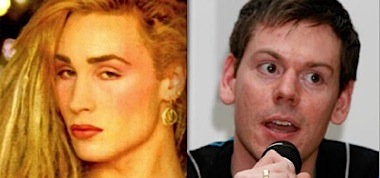
Stefani Joanne Angelina Germanotta: as brunette herself on MTV's Boiling Points in 2005, and as Lady Gaga last year, blonde but without make-up
❏ “Marlene and Madonna gave the impression, true or false, of being pansexual. Gaga, for all her writhing and posturing, is asexual.”
❏ “Most of her worshippers seem to have had little or no contact with such powerful performers as Tina Turner or Janis Joplin, with their huge personalities and deep wells of passion.”
❏ “Generation Gaga doesn’t identify with powerful vocal styles because their own voices have atrophied: they communicate mutely via a constant stream of atomised, telegraphic text messages. Gaga’s fans are marooned in a global technocracy of fancy gadgets but emotional poverty.”
❏ “Do you really believe that Lady Gaga is 23 years old? I’ve been in advanced doubt about it for a while, particularly after seeing this ‘Rare pictures!’ video of early photos of her hanging with some mighty tough critters. (A friend of mine said of Gaga in this vid: ‘Too many miles of bad road there.’) I think Gaga was a hell of a lot sexier as a fun Italian-American brunette. This artificial, masklike, over-the-top Club Kids thing that she’s now into seems compulsive and wearily passé. Give it a rest, and focus on the music!”
Camille Paglia wrote a big thing about Lady Gaga for the Sunday Times. Some of her points were good but a lot of it felt like she was writing the article for the benefit of one reader — Madonna — and most of the good bits were buried by an avalanche of General Missingthepointness. We particularly love an outraged Paglia railing against Lady Gaga for “rudely” wearing sunglasses in interviews, and the idea that Lady Gaga has gone on tour to escape scrutiny (?!). Give it a rest Paggo.
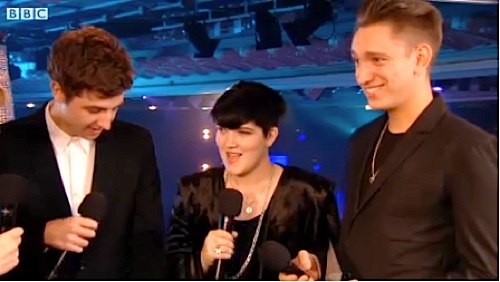
Tongue-tied winners, The xx tonight: very rare smiles from the ultra-cool Jamie Smith, Romy Madley Croft and Oliver Sim
❚ TONGUE-TIED, GANGLY, GAWKY and utterly lacking in stage presence — that’s the face of cool London in the 20-tens presented by The xx. This year’s £20,000 Mercury Music Prize was won tonight by the band of the moment, whose eponymous first album, xx, on the Young Turks label evokes a soulful yet haunting dreamworld of urban alienation. So musically spare are their songs — such as Islands, which instantly became Single of the Week on iTunes (UK) — that you can almost count the individual notes picked on guitar and synth. Their dark, hushed sound has been called “post-coital” yet they strenuously deny the lyrics are about sex. Which they are.
The Modfather Paul Weller was bookie’s favourite among the shortlisted best albums of the year which represent a dozen impressive strata of British musical tastes. Yet every web designer in Shoreditch, the creative media quarter of London, has been rooting for The xx since their album raised understated murmurs of approval in August 2009. By year’s end, Brick Lane habitués were declaring them “The Greatest Band of All Time”. No maybes, note.
This year, Karl Lagerfeld chose their track VCR for his Fall/Winter fashion show, then The xx were chosen by Matt Groening to headline two nights at All Tomorrow’s Parties, one of the annual unsponsored festivals in England which was curated by the Simpsons creator in May. The BBC made them the sound-track to its general election coverage, so well do The xx capture the 20-ten zeitgeist.
Arch is one word for the band’s style. Absorbing is another. It’s their artfully choreographed videos which can intensify the music’s emotional effect considerably more than the live performance, notably Saam’s black-and-white take on Islands [view below]. In public the trio are uniformly clad in nihilist black, but this is neither 70s Goth, nor 50s Left-Bank. Nor 30s Fascism, though redolent of it. Their merchandising comes in similar colourways from Ts to tote bags to skateboard decks to a £150 light box, all in black emblazoned with a bold white X. The motif is insistently present. Does it signify a vote? A negative verdict? The chromosome that determines gender? Or love, as in kisses after a lover’s signature?
The ubiquitous X is on all merchandising, here a lightbox for £150
A low-key Generation Y ethos underpins the band’s rise, from Romy Madley Croft and Oliver Sim polishing lyrics over IM, Jamie Smith improvising on an Akai MPC beat synthesiser that was a birthday present, recording in a garage the size of a bathroom, and doing their own production, to headlining their own international tour which continues through October in North America.
Both onstage at the Grosvenor House receiving the prize from musician Jools Holland and later being interrogated on TV by deejay Lauren Laverne, the trio of 20-year-olds who went to school together in south-west London were visibly in shock, lost for words, their heads bowed in painful shyness. Frontman and guitarist Sim said “Wow”. Twice. Vocalist and guitarist Madley Croft said “Aaah… erm” while keyboardist Smith couldn’t get a word in edgeways through the gauche silences. Romy eventually managed: “I genuinely wasn’t expecting to hear our name, genuinely, genuinely.”
Simon Frith, chairing the Mercury judging panel, declared the winning album to be “a record of its time” that “captures a sense of the uneasy times we live in” and has “an astonishingly coherent sense of itself”. He nailed it: “They have that urban soundscape where they are not exactly secure… That late-night feeling where you like the city and it’s exhilarating, but you don’t know what’s going to happen.”
Spookily they said much the same about Burial, the dubstep hero who attended the same comprehensive, the Elliott School in Putney, and was a Mercury Prize nominee in 2008. He too called himself “a low-key person”. Perhaps there’s something in the local water.
➢ Choose “View full site” – then in the blue bar atop your mobile page, click the three horizontal lines linking to many blue themed pages with background article
MORE INTERESTING THAN MOST PEOPLE’S FANTASIES — THE SWINGING EIGHTIES 1978-1984
They didn’t call themselves New Romantics, or the Blitz Kids – but other people did.
“I’d find people at the Blitz who were possible only in my imagination. But they were real” — Stephen Jones, hatmaker, 1983. (Illustration courtesy Iain R Webb, 1983)
“The truth about those Blitz club people was more interesting than most people’s fantasies” — Steve Dagger, pop group manager, 1983
PRAISE INDEED!
“See David Johnson’s fabulously detailed website Shapers of the 80s to which I am hugely indebted” – Political historian Dominic Sandbrook, in his book Who Dares Wins, 2019
“The (velvet) goldmine that is Shapers of the 80s” – Verdict of Chris O’Leary, respected author and blogger who analyses Bowie song by song at Pushing Ahead of the Dame
“The rather brilliant Shapers of the 80s website” – Dylan Jones in his Sweet Dreams paperback, 2021
A UNIQUE HISTORY
➢ WELCOME to the Swinging 80s ➢ THE BLOG POSTS on this front page report topical updates ➢ ROLL OVER THE MENU at page top to go deeper into the past ➢ FOR NEWS & MONTH BY MONTH SEARCH scroll down this sidebar
❏ Header artwork by Kat Starchild shows Blitz Kids Darla Jane Gilroy, Elise Brazier, Judi Frankland and Steve Strange, with David Bowie at centre in his 1980 video for Ashes to Ashes
VINCENT ON AIR 2026
✱ Deejay legend Robbie Vincent has returned to JazzFM on Sundays 1-3pm… Catch up on Robbie’s JazzFM August Bank Holiday 2020 session thanks to AhhhhhSoul with four hours of “nothing but essential rhythms of soul, jazz and funk”.
TOLD FOR THE FIRST TIME
◆ Who was who in Spandau’s break-out year of 1980? The Invisible Hand of Shapersofthe80s draws a selective timeline for The unprecedented rise and rise of Spandau Ballet –– Turn to our inside page
SEARCH our 925 posts or ZOOM DOWN TO THE ARCHIVE INDEX
UNTOLD BLITZ STORIES
✱ If you thought there was no more to know about the birth of Blitz culture in 1980 then get your hands on a sensational book by an obsessive music fan called David Barrat. It is gripping, original and epic – a spooky tale of coincidence and parallel lives as mind-tingling as a Sherlock Holmes yarn. Titled both New Romantics Who Never Were and The Untold Story of Spandau Ballet! Sample this initial taster here at Shapers of the 80s
CHEWING THE FAT
✱ Jawing at Soho Radio on the 80s clubland revolution (from 32 mins) and on art (@55 mins) is probably the most influential shaper of the 80s, former Wag-club director Chris Sullivan (pictured) with editor of this website David Johnson
LANDMARK FAREWELLS. . . HIT THE INDEX TAB UP TOP FOR EVERYTHING ELSE
















 ➢➢ Shapers of the 80s ➣➣