Category Archives: London

What larks! Festive fun and games and British ways to make merry

Bobbin’ about to the Fiddle ,Charles Williams, 1817,Thos Tegg,caricature, Almack’s,quadrille,dancing,Lady Jersey,

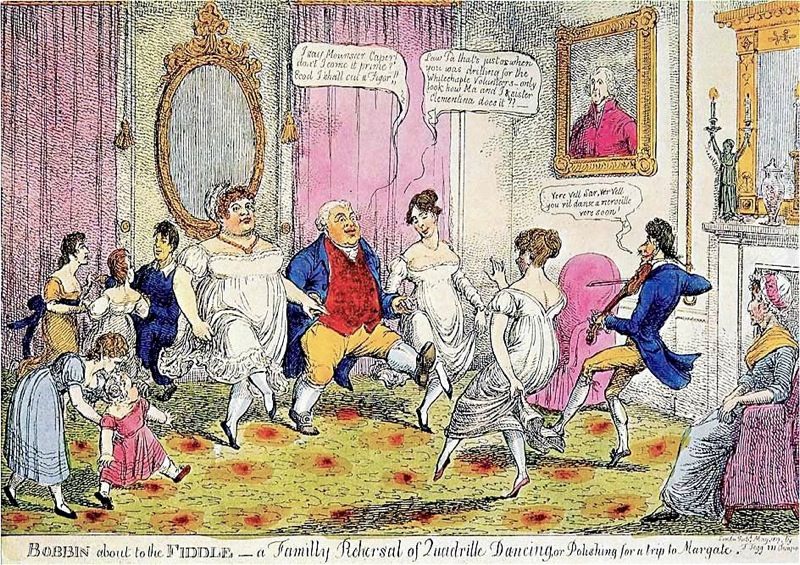
Bobbin’ about to the Fiddle — a Familly Rehersal of Quadrille Dancing, by Charles Williams, May 1817: published by Thos. Tegg No 111 Cheapside

❚ UNLIKE 21st-CENTURY DANCING, when the quadrille was introduced at Almack’s Assembly Rooms in 1815, its steps were notoriously difficult to perform correctly. This luxurious salon in King Street, St James’s — where the ballroom was partitioned off by crimson ropes — was governed by a committee of despotic lady patronesses who ruled over a “magic list” of those who may or may not be admitted to their weekly balls. Studio 54 had nothing on the power of these women: they effectively decided who belonged to “society”… “All on that magic list depends/ Fame, fortune, fashion, lovers, friends…/ Banished thence on Wednesday night/ By Jove you can do nothing right.

Yet even at Almack’s after Lady Jersey, wife of the 5th earl, brought the quadrille over from Paris as an energetic French precursor to traditional square dancing, wallflowers would sit sniggering as they watched the beau monde’s finest stumbling through the intricacies of its steps and twirls and changes of partner. The quadrille nevertheless soon became all the rage, so required determined practice.

Breeding counted for more than money at Almack’s and the prime role of the magic list was to exclude “cits”, precisely the kind of nouveau riche city-dwellers depicted above by caricaturist Charles Williams, in May 1817. This bourgeois family are preparing for their seaside vacation in Margate by practising their dancesteps at home.

The father is saying to the French dancing master: “I say, Mounseer Caper! Don’t I come it prime? Ecod, I shall cut a Figor!!” [ie, figure], and one of the daughters says “Law, Pa, that’s just as when you was drilling for the Whitechaple Volunteers — only look how Ma and I & sister Clementina does it!!” while the dancing master says “Vere vell, Sar, ver vell, you vil danse a merveille vere soon!” Nobody was spared from the satirist’s pen.
Tom Jerry and Logic, Making the Most of an Evening in Vauxhall,Vauxhall Gardens,George Cruikshank, Jonathan Tyers,Roger de Coverley ,Pierce Egan, Life in London,1821

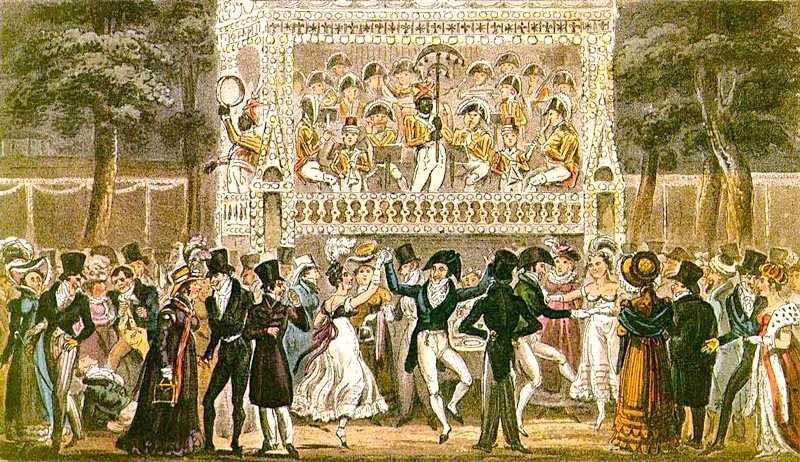
Tom, Jerry, and Logic Making the Most of an Evening in Vauxhall: by Robert and George Cruikshank, from Pierce Egan’s Life in London (1821)

❚ FOR 200 YEARS THE VAUXHALL GARDENS were the most notorious and important of London’s many pleasure gardens, immortalised in Fielding’s novel Tom Jones by the description “where people come to undo others, and others come to be undone”. Vauxhall lay on the south bank of the Thames, up-river in a rural setting beyond London’s city limits, where the gardens opened before the Restoration of 1660 and closed finally with a fireworks display in 1859. Today all that remains is a small park bearing the name of the original Spring Gardens, while nearby streets do likewise for the enterprising proprietor, Jonathan Tyers, who from 1728 invested in enhancing the grounds so that in their heyday he could charge a guinea admission. (That would be £173 or $267 in today’s money!) He commissioned Roubiliac to make the great statue of the composer Handel for the gardens and added an orchestra pavilion, fountains and temples. Frederick Prince of Wales was his most prestigious patron.

Over several acres Tyers introduced formal plantings which offered attractive paved walks lit by thousands of glass lanterns in the arbours by night, and shrubberies for the making of mischief. Fireworks, hot-air balloon rides and circus performers provided entertainment along with music such as Handel’s from the bandstand.
Vauxhall Gardens, 1732,James Boswell, Dr Samuel Johnson,Rowlandson

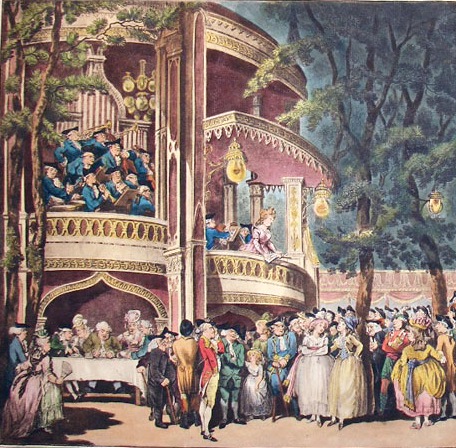
Vauxhall, 1732, engraving after a watercolour by Thomas Rowlandson, published by Richard Powell: In the lower box is a supper party of James Boswell, Dr Samuel Johnson, Mrs Thrale and Oliver Goldsmith. Mrs Weichsel sings from the front balcony while Mr Barthelemon leads the orchestra (Princeton University Library)

Elegant painted booths afforded privacy while dining and the ornate Rotunda and other rococo pavilions became famous London attractions. An audience of 12,000 attended Handel’s Fireworks music at Vauxhall which brought together “persons of all ranks and conditions”. The 19th-century history of London Old and New observes “the English assert that such entertainments as these can never subsist in France, on account of the levity of the people”.

By 1712 Sir Roger de Coverley is supposed to have said that he’d have been a better customer to the gardens “if there were more Nightingales and fewer Strumpets.” So it was inevitable a century later that the rakish Tom and Jerry would pay their guinea for admission to Vauxhall. Their rip-roaring “sprees through the Metropolis” would one day give their names to Hollywood cinema’s cartoon cat and mouse, and in their own day they were no less famous.

“Jerry Hawthorn Esq, and his elegant friend, Corinthian Tom, accompanied by Bob Logic, the Oxonian” were young London clubmen created in 1821 by the sports-writer Pierce Egan in his monthly journal, Life in London, which became a runaway success. It was illustrated by the leading satirist of urban life George Cruikshank and its trio of hellraisers became contemporary pinups much copied by other engravers.

The topmost Cruikshank print is not among the best to record the showy splendour of Vauxhall Gardens but it is one of the few to locate Tom and Jerry, their journalist creator and the graphic satirist at London’s hedonist destination — five Regency legends in one image.
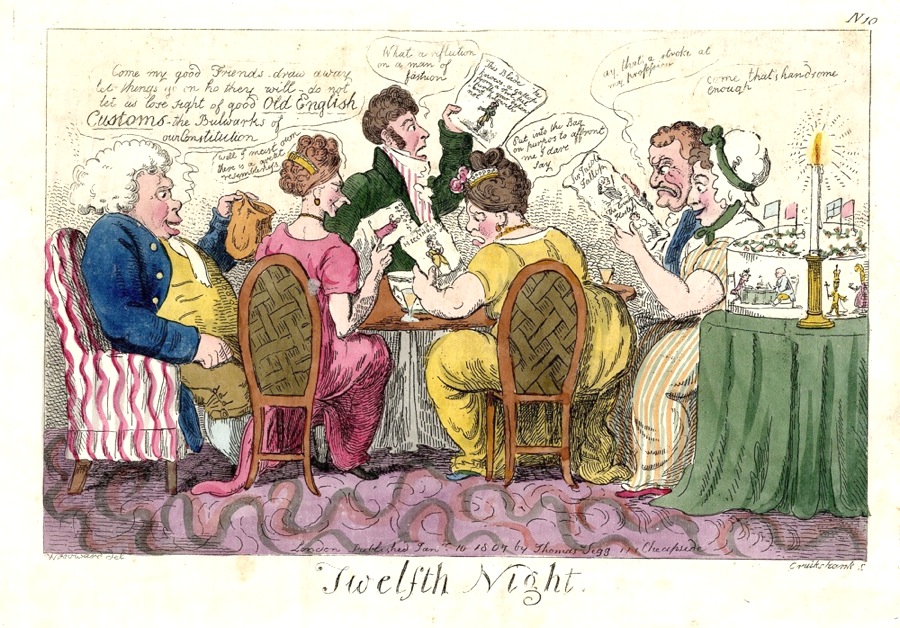
Twelfth Night,Isaac Cruikshank, Thomas Tegg,etching,parlour games

Twelfth Night by Isaac Cruikshank: published Jan 10 1807, by Thomas Tegg, Cheapside

❚ BEFORE TV RULED OUR LIVES, playing parlour games was how families amused themselves at the annual Christmastide gathering and Twelfth Night was the traditional day for games, merriment and feasting. The punch called wassail was the drink of choice, and in the Regency era a grand masqued ball often heralded an end to the solemnity of religious observance. Twelfth Night concludes the 12 days of Christmas and precedes the feast of the Epiphany on January 6 (though these dates vary under different sects of Christianity). It was not until the Victorians, influenced by the monarch’s Germanic roots, that we shifted celebrations to Christmas Day itself, which had previously been only a religious holiday.

Cruikshank’s hand-coloured etching from 1807 (above) shows three couples playing the traditional Twelfth Night game of acting out the character depicted on the tickets they have drawn from a bag held by a fat squire seated at left who sings the praises of “good old English customs”. Each ticket is inscribed with a portrait and description. Only two players are happy with their choice: on the left The Queen of Love has been drawn by a self-satisfied lady with a long nose, and on the right The Lovely Hostess by a jolly lady who smiles. The others have drawn unflattering or sarcastic tickets and regard them with expressions of dismay: the dandy in green is affronted by being perceived as a “man of fashion” while the fat woman in yellow has drawn “Miss Higginbottom” and remarks “Put in the bag on purpos to affront me I dare say”. We see a decorated Twelfth Night cake and candle on the side table.

Isaac Cruikshank is one of the four celebrated British illustrators (along with his son George, Thomas Rowlandson and James Gillray) who established satirical caricature as a powerful medium of social comment at the dawn of the 19th century. The Private Eyes of yesteryear.
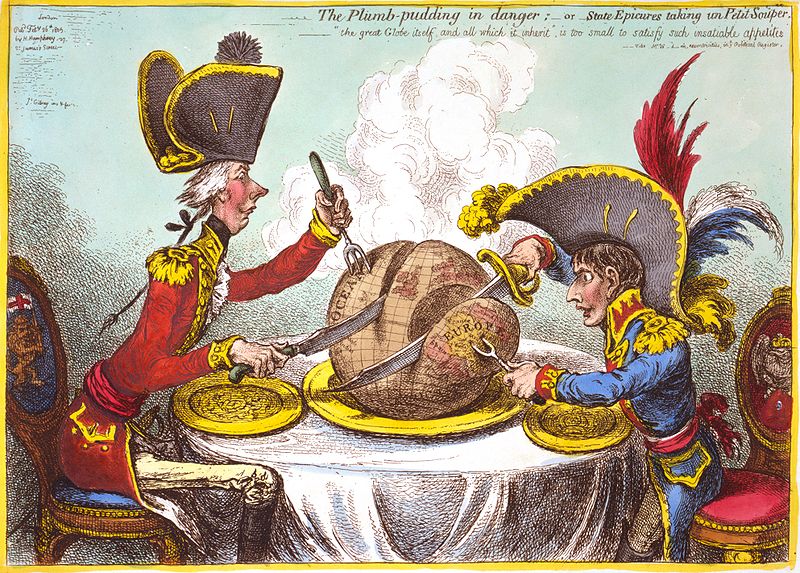
The Plumb-pudding in danger, James Gillray,  Humphrey, Library of Congress

The Plumb-pudding in danger: by James Gillray, published London H. Humphrey, 1805 Feby 26 (Library of Congress)

❚ PLUM PUDDING IS THE ESSENTIAL CONCLUSION to a traditional Christmas feast. It is made not from plums but dried fruit and for good luck every member of the family should have a hand in stirring the mix before it is steamed or boiled. Since medieval times, the pud has become as symbolic of Britishness as Britannia and John Bull. This political cartoon was drawn by James Gillray in 1805 as a response to one of the most traumatic periods in Britain’s history.

It is titled The Plumb-pudding in Danger and shows William Pitt, Britain’s youngest prime minister, wearing a regimental uniform and sharing a table with the French emperor, Napoleon. A plum pudding represents the world as a globe and each leader is carving himself a slice. Pitt takes possession of the seas with a slice considerably larger than Napoleon’s, who carves off Europe where the French are the dominant military power. The previous year war had been renewed between Britain and the First French Empire that had followed the Revolution of 1789 and a period of continual warfare. With Napoleon intent on invading Britain, Gillray produced many prints in which he imagined the horrors of a successful invasion. By 1805 a British naval blockade on France was successfully frustrating French sea-trade and naval retaliation, so that January the emperor sought a reconciliation with England. Presciently this cartoon was published only months before the decisive British naval victory in the Battle of Trafalgar.
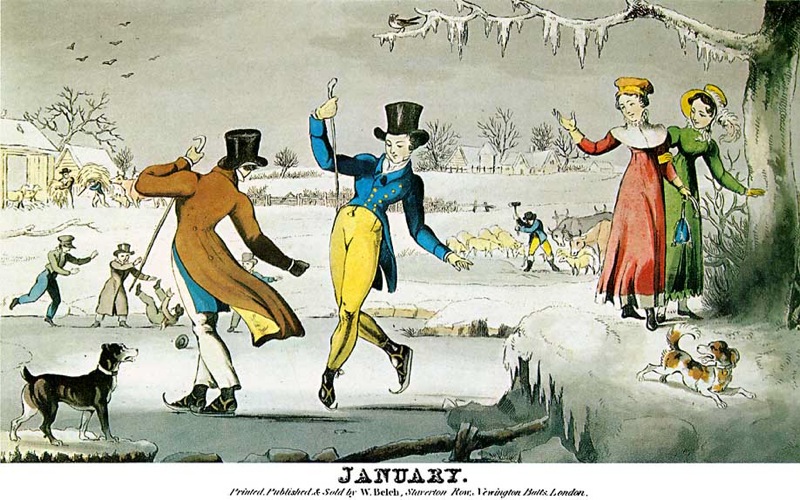
W Belch,January,engraving, ice-skating,1810,Henry Raeburn,Coleridge,Georgian England

January, one of a series of prints depicting the months, c1810: printed, published & sold by W. Belch, Staverton Row, Newington Butts, London

❚ THESE YOUNG BUCKS ARE FLOUTING THE RULES of ice-skating in the Regency period. Among outdoors activities in Georgian England, skating was so hugely popular that the poet Samuel Taylor Coleridge waxed exceeding florid in a prose essay about the pastime for The Friend magazine, where he noted “the melancholy undulating sound from the skate”. Inevitably society proposed “a proper attitude for genteel rolling”, the posture illustrated most famously in Sir Henry Raeburn’s painting of the Reverend Robert Walker, who as a member of the Edinburgh Skating Society is seen serenely gliding with arms crossed over his chest. Evidently, the two January bucks above were only too keen to flaunt their own style to catch the attention of their female admirers on the riverbank.

➢ The Republic of Pemberley and all things Austen
➢ 500 articles in an online magazine dedicated to Jane Austen’s Regency world

FRONT PAGE

2010 ➤ Duran no turkey: here’s the Bacofoil video, plus two tracks premiered at East Village Radio

♫ View Nick Egan’s studio video of
All You Need Is Now in HD

All You Need Is Now, Duran Duran, video, Nick Egan,John Taylor, Simon Le Bon
❚ UNVEILED TODAY: the Nick Egan directed video for All You Need Is Now, the new single by 80s supergroup Duran Duran — which was available worldwide on iTunes from Dec 8. The nine-track digital album of the same name, produced by Mark Ronson is the band’s 13th in a studio. Ronson has called it the “imaginary follow-up to Rio that never was”. An expanded LP with additional original tracks will be released in March 2011 in various formats.

Duran Duran, Mediterranea❏ Update AYN debuts at No 6 on Billboard’s Alternative Albums Chart Jan 5. DD will be the featured artist on VH1’s Top 20 Spin on Jan 30.

❏ Here’s the new Duran track Mediterranea at beach-bum tempo, streamed live from East Village Radio on Dec 10:

It’s on the EP From Mediterranea With Love, an iTunes release in Europe, here premiered on the bumbling Mark Ronson’s show at East Village Radio, NYC, when Le Bon and Rhodes had a battle to get a word in edgeways. Whatever his gifts in a recording studio, the music producer is fudge as a broadcaster. Also, it’s not for him to tell us his own production is “amazing”, durr! Ronson, stick to the day job and leave the criticism to the big beasts who can tell a hawk from a handsaw. As it happens, the new tune proves to be classic DD.

❏ Another premiere streamed from East Village Radio — why this new album track is called The Man who Stole a Leopard (feat Kelis) is finally revealed by ITN newscaster Nina Hossein:

Nick Rhodes, Duran Duran , All You Need Is Now

No regrets: Nick Rhodes in the AYN video

➢ Read Crispin Kott’s 9/10-star review of the Duran album from Pop Matters

➢ Nick Rhodes is the man from Duran — Evening Standard interview Dec 9, 2010 … Is Rhodes at all embarrassed by his 18-year-old self? “Not even slightly. When we were teenagers, the world was pretty grey. You want something more exciting — to travel, to see what’s out there.”

FRONT PAGE

1980 ➤ How Duran Duran’s road to stardom began in the Studio 54 of Birmingham

Duran Duran, Berrow Brothers, Rum Runner, New Romantics,Nick Egan,video, All You Need Is Now

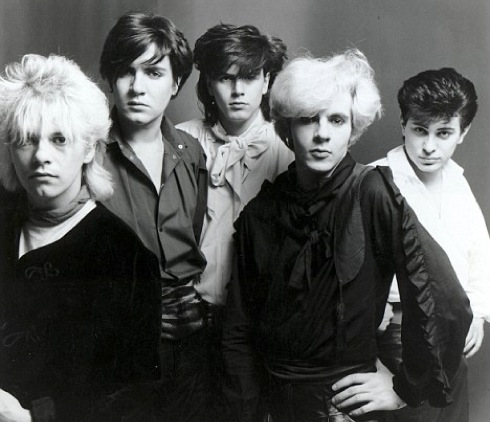
Duran Duran as full-on Romantics: Betty Page thought only co-founder Nick Rhodes (second right) passed the bouffant test convincingly

❚ ON OR ABOUT THIS DAY IN 1980 (MAYBE) some say Duran Duran signed their contract with EMI. The band seem mysteriously unable to remember when, so guesses might run from Dec 9 because Andy Taylor recalls the news of John Lennon’s death ruining his breakfast in London, and possibly Dec 22, date of a celebratory gig at Birmingham’s Cedar Club. However, the first official book, Their Story by Kasper de Graaf, places the signing firmly at 5 January 1981. According to co-manager Paul Berrow, the contract paid out a £28,000 advance (£90,000 in today’s money).

As the house band of the New Romantics in Britain’s second city, Birmingham, they were styled locally by Kahn & Bell, photographed by Paul Edmond, and managed by Paul and Michael Berrow, owners of the glitzy Rum Runner nightclub on Broad Street.

The Berrows had inherited the family business from their influential bookmaker father who had opened the club in the Swinging 60s and the sickly odours of Brut and Estee Lauder still lingered. Inspired directly by a visit to New York’s Studio 54, the brothers refurbished the Rum Runner in 1979 with state-of-the-art mirror-tiled walls and zigzags of neon. They then introduced a playlist heavily flavoured with Moroder-style imports and the American club-funk championed by the Nile Rodgers band Chic, whose string of chart hits was restoring credibility to disco music following the ridicule inflicted by the low-rent movie Saturday Night Fever. But how to become the Studio 54 of the Midlands?

Enter a band called Duran Duran in January 1980, armed with a four-song demo recorded at Bob Lamb’s studio which included Rio as a work in progress. The DD line-up were offered the club as daytime rehearsal space and jobs by night, including deejaying for Nick Rhodes. Roger Taylor recalls that the brothers “were looking for a band that was a cross between Gino Soccio, Genesis and Chic” — all the more curious that they made many attempts to contact Steve New to recruit the Rich Kids guitarist into the band, but they heard nothing from him.

Duran Duran, Meolody Maker, Andy Taylor

The Melody Maker ad that landed Andy Taylor in April 1980: unearthed by Duran fan Figital

Inevitably the lineup was rationalised and by the summer Andy had been recruited (“They were quite blatant,” Andy told Rolling Stone much later. “They said, ‘We’re posers. We want a good-looking poser band”). Then came Simon Le Bon as singer. According to him: “They had this thing about being between Chic and the Sex Pistols, but I thought they were more like in between Roxy Music and the Sex Pistols.” The band were searching for a musical direction.

Meanwhile as the rival nightclub Barbarella’s fell from favour, the Birmingham poser scene was reinventing itself in local bars around the peacock clothes designers Jane Kahn, Patti Bell and a veteran of Billy’s club in Soho, Martin Degville, who was commuting to London weekly to run a branch of his shop in Kensington Market. That summer the Rum Runner gave over Tuesdays to a Bowie/Roxy night. Sounds familiar? Enter journalist Betty Page and the rest is history.

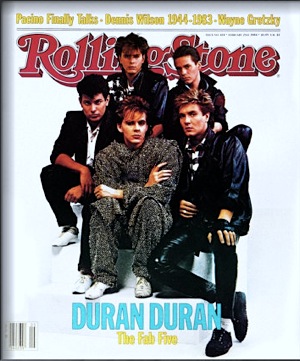
Within three years Duran Duran’s synth-pop had made The Fab Five one of the handful of British supergroups dominating the global stage. Duran can claim to have led the MTV-driven “Second British Invasion” of the United States from the autumn of 1981 with their raunchy and cinematic videos, and over 30 years enjoyed 21 singles in the Billboard Hot 100 and sales of 100m records.

BETTY PAGE OF SOUNDS RECALLS HOW SHE WAS
INVITED TO “DISCOVER” DURAN DURAN

Betty Page, Sounds, Beverley Glick

Betty Page in youthful bloom, more recently identified as Beverley Glick

In September 1980 in the pages of the music weekly, Sounds, Betty had slapped the label “New Romantics” on Spandau Ballet, house band of London’s Blitz club and then received a call from the hungry manager of this Brummie band called Duran Duran…

Paul Berrow was a smooth operator. ‘Come to the Rum Runner,’ he said of the club he co-owned with his brother Michael. ‘We’ve got a scene going on up here to put the Blitz to shame, and a band to go with it.’ Clever, I thought. He had singled me out to be the first journalist to write about his group. And they actually wanted to be called New Romantics! Nick was the most obviously New Romantic — a bouffant blond David Sylvian lookalike who sported extravagantly frilly shirts and shiny suits — but the style sat rather uncomfortably on the others.

The alarmingly pretty, floppy-fringed bassist John Taylor drew the line at satin shirts and a shoulder sash. ‘We were never meant to be bagged in with any elitist scene,’ said John, the pretty one. ‘The main chunk of our audience in Birmingham is those people,’ said Nick, the bouffant one, ‘but we’re not as tied to it as Spandau obviously are. When people come to see us we’d much sooner they dance and have a good time rather than dress up in the clothes and just stare… © Beverley Glick

➢ Read Betty Page’s retrospective survey of the New Romantics
– I Was There, originally published in Record Collector in 2004

ARCH-RIVAL MANAGER’S VERDICT ON DURAN

Years after both bands had achieved superstar status, Steve Dagger, the manager of Spandau Ballet, wrote this nugget summarising Duran Duran’s contribution to the 80s music scene. It was published in a partwork published by The Sunday Times in 1997 titled 1000 Makers of Music, which spanned all genres from classical to pop:

Rolling Stone, Duran Duran,Fab Five,Second British Invasion Duran were among a new group of artists who provided a glittering, sexy contrast to the prevailing dull corporate pop-punk of the 1970s. Taking their influence from the art-school underground of electronics/Ferry/Bowie, they came to prominence as the Birmingham ‘it’ band at the same time Spandau Ballet reigned over a similar scene in London. After an awkward but successful period as the Birmingham ‘answer to’, Duran metamorphosed in 1982 into a sleek, glamorous international entity with the seminal album Rio, having perfected a distinctive Duran sound fusing synths and guitar licks over post-disco rhythm. Inspired songs such as Hungry Like the Wolf were accompanied by cinematic videos, together creating an electric pop culture moment. After being derided for years, Britain had produced a group America could not ignore: Duran surfed in on the newly conceived MTV to conquer the States. They continue to make great British records and should recently have won a Novello for their lament to the 1980s, Ordinary World. [Key work: Is There Something I Should Know? (1983)]

❏ View this hilarious early video of white-faced New Romantics doing their wobbly dances to Duran Duran’s first single Planet Earth, performed at the Rum Runner in 1980 (now remastered in high quality). Note the hijacked Warren Street Jive in the official promo video sequences shot much later in a studio . . .

FRONT PAGE

2010 ➤ A feast of Bowie-ana served in waffeur-thin slices

David Bowie, review,Curious magazine, Any Day Now,Brian Ward,Arnold Corns,Man Who Sold The World,Mr Fish,Freddi Burretti, Ziggy Stardust,Yours or Mine,Malcolm Thomson

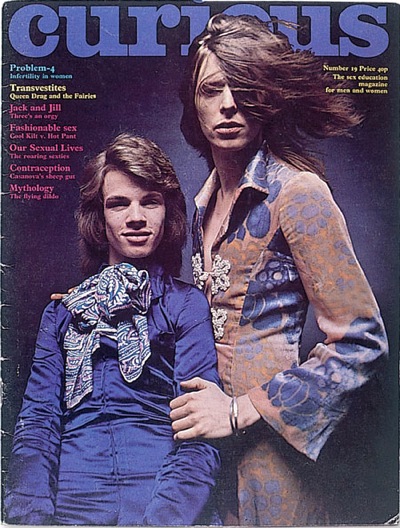
Candid cover for Curious magazine from 1971: Bowie spotted the dress designer Fred Burrett (aka Rudi Valentino) at the Kensington disco Yours or Mine wearing white spandex hot pants. He became a close friend Bowie determined would be “the next Mick Jagger” in a specially created band called The Arnold Corns. In the event, as Freddi Burretti he made Ziggy Stardust’s outfits from the first quilted jumpsuit onward… Bowie here drags up in the Mr Fish “man-dress” that appears on the sleeve for The Man Who Sold The World — one of many mementoes in Any Day Now, Kevin Cann’s new book about Bowie. Photographed © by Brian Ward

❚ DAVID BOWIE HAS BEEN THE SINGLE MOST INFLUENTIAL FORCE IN POPULAR MUSIC SINCE [Fill in the benchmark of your choice, eg:] Mozart/ Schubert/ Marie Lloyd/ Gershwin/ Little Richard/ Sondheim/ Spinal Tap. In which case, this Christmas there can be no better present for anybody with the slightest interest in the godlike creator of Ziggy Stardust than Kevin Cann’s new photobook Any Day Now, The London Years 1947-1974 (Adelita, £25).

It is impossible adequately to acknowledge the trainspotterish, yet deeply rewarding scope of this sheer labour of love that has amassed 850 pictures — friends, lovers, costumes, contracts, doodles, laundry bills, performances, candid snaps — on 336 pages. Why, it even has a backstage photo I’ve never seen of the day I met Bowie at the London Palladium when he sang Space Oddity for charity (and met the cult ukulele player Tiny Tim, going on to record one of his B-sides, Fill Your Heart, on Hunky Dory).

This book is a feast of Bowie-ana served up like La Grande Bouffe, in ever more tempting waffeur-thin slices. Cann is a veteran chronicler of the pop star’s work and here neither attempts a long-form biography, nor detracts from Nicholas Pegg’s much more musically appreciative survey, The Complete David Bowie, last updated in 2006. Any Day Now is more a chronology that feels as if it has an entry for every day in the star’s first three decades, running to 140,000 words (original interviews, press reports, eye-witness accounts), all diced and dispersed through the calendar. Contributions include a foreword by Kenneth Pitt, Bowie’s gifted manager 1967-1970.

Any Day Now, Kevin Cann, Adelita

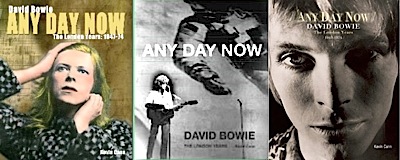
Early cover designs for Any Day Now, publicised during the past year. At centre, the Palladium performance of Space Oddity

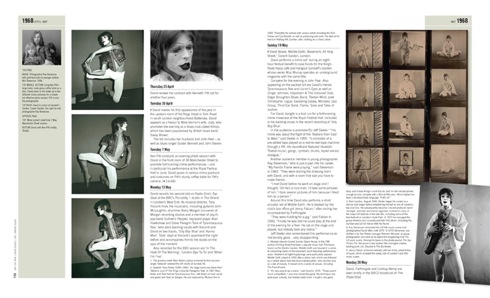
A typical spread [see below] might contain six images and as many short items, some of which are set in a font so small as to demand a magnifying glass for reading. An efficient index helps you to pick your topic and start panning for gold.

So for example, the “seminal” filmed version of Space Oddity, Bowie’s biggest hit, that has been exhumed then forgotten four times in the past 40 years, is finally accounted for in all its charmingly improvised glory. Since 2005, we have been able nonchalantly to click on YouTube to view this paradigm of all pop videos dating from before the word was invented. Yet originally it was a mere segment in a half-hour TV film about Bowie titled Love You Till Tuesday (LYTT) and directed by Malcolm Thomson.

While America was testing its first unmanned Apollo Lunar Module in 1968, the Space Oddity segment was of course inspired by that year’s visionary 70mm movie release, Stanley Kubrick’s 2001 A Space Odyssey. Cann’s chronology documents Thomson filming what Bowie evidently intended as a tongue-in-cheek spoof from its conception in Oct ’68 to wrap in Feb ’69. Bowie wrote the song itself, a forelorn meditation on love and fame, as his own love-life was falling apart and after viewing the Kubrick film “while stoned” (allegedly) that January, six months before the first Moon landing.

Ultimately in a studio in Greenwich, Bowie dons a barely-plausible zip-up silver space suit, blue visored helmet and Major Tom breast-plate while Samantha Bond and Suzanne Mercer as Barbarella-esque astro angels (more ’68 iconography), flaunting ludicrous blonde wigs and diaphanous gowns, simulate weightlessness among inflatable plastic furniture. It’s a modest little dig at Swinging 60s ephemera to set beside Barbarella, Blow-up and the incomparable Modesty Blaise.

Despite the single spending 14 weeks in the charts in 1969 and reaching No 5, Cann reports, TV networks showed “no interest” in the film, LYTT, containing this musical jewel, so it did not have its first public airing until 1972, on the BBC’s Old Grey Whistle Test. It then vanished until 1975 and the re-issue of Space Oddity when the clip was supplied as a promo to broadcasters, which doubtless helped the song’s progress to No 1 in the charts. Even then, the film clip did not receive a release until an album of same name, LYTT, came along in 1984. We then had an even longer wait until a DVD release in 2005 delivered the remastered version we enjoy today.

Not many people know this, 1 – In the same month, Feb 1969, Bowie auditioned for the hippy stage musical Hair! Twice! [Any Day Now, page 146]

Not many people know this, 2 – The book’s timeline ends in 1974 because Bowie left the UK on March 29 that year, aged 27, and has never resumed residency here since. Sob! Onboard the SS France bound for New York, the harmonica legend and Gershwin protege Larry Adler gives a recital. When the crew hear that Bowie is not going to do likewise while aboard and express their disappointment, Bowie gives them an impromptu performance in the canteen: 10 songs including Space Oddity. A few crew members took instruments and they played with him. What a jam session that must have been!

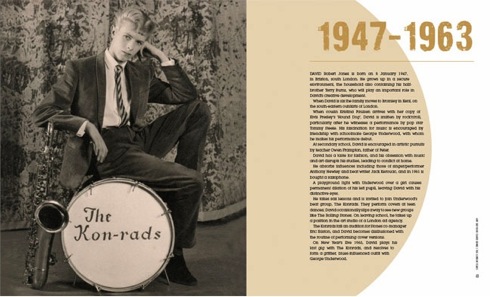
Any Day Now, Bowie, Kevin Cann,Kon-rads,Bowie

Spread from Any Day Now, the new book about Bowie’s formative years: here seen in his David Jones era when he formed his first band the Kon-rads at the age of 15

Melissa Alaverdy,Lindsay Kemp,Bowie , Any Day Now, Kevin Cann, Adelita

Another spread from Any Day Now, designed by Melissa Alaverdy: Bowie learning white-faced mime under Lindsay Kemp

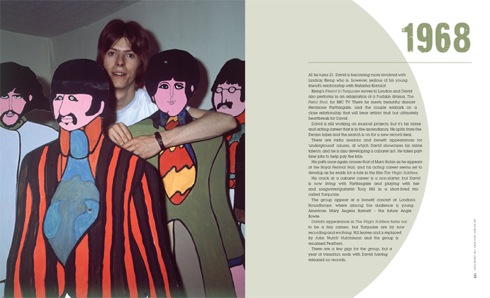
Melissa Alaverdy , Any Day Now, Kevin Cann, Adelita,Bowie,Beatles

Another spread from Any Day Now, designed by Melissa Alaverdy: Bowie is seen here with Yellow Submarine-era Beatles

➢ Why there will never be another David Bowie — Caspar Llewellyn-Smith says Lady Gaga has got it wrong if she thinks the Thin White Duke’s brilliance comes down merely to striking a decent pose (from The Observer, Oct 10, 2010)

➢ Review in the Guardian: Two Bowie biographies shed new light on the career of pop’s greatest chameleon, but the man himself remains elusive

FRONT PAGE

➤ Whatta they like? Essex reality stars shake their vajazzles in the face of Hollywood

The Only Way is Essex, vajazzle,reality TV, soap opera,ITV2,
❚ IN THE SPACE OF TWO MONTHS The Only Way Is Essex has become “totally must-watch TV”, an addiction and an education for anybody who does not live in Essex. The huge county lies along the north bank of the Thames estuary, stretching from the east of London to the coast, and socially it might as well be another nation. “I compare Essex to LA — we live the same lifestyle, we’ve got as much money and got the same tans,” says hunky reality-star and club promoter Mark Wright, 23.

“The boobs may be fake” say the opening titles but the cast of 20-somethings are “real people” thrust into to this enhanced reality show that is the jaw-dropping hit of the season. They’ve given the English language new buzzwords spoken in their unique variant on Estuary English: “jel”, “vajazzle”, “shu’ up”, and “whatta we like?” Get up to speed with YouTube’s clips ahead of series two, plus the fight-back from authentic East-End Londoners.

The Only Way is Essex,Amy Childs, ITV2

Spot the essential assets: beautician Amy Childs in The Only Way Is Essex © itv.com

The 10-episode series was filmed mainly in the towns of Brentwood where the The Sugar Hut bar is located, Gants Hill, Chigwell, Buckhurst Hill, and The Manor House nightclub in Woodford Bridge. It was shot only days before being broadcast, presumably so cast members had little chance to object to the odd scene where they might have felt like prize twerps. Unsurprisingly, ITV2 has received plenty of complaints for the show’s “negative representation of Essex”. Surprisingly, the first series was such minority cult viewing on ITV2 between Oct 10 and Nov 10 that its biggest single audience was only 1.2m viewers.

The Only Way Is Essex, Jessica Wright, Lydia Bright,Essexmas,nativity, New magazine

Essexmas: Jessica Wright and Lydia Bright in a nativity scene shot for © New! magazine

The tabloid press was unusually slow in conceding that the show made compelling viewing. Series two faces one mighty hurdle that may well stymie the innocent charm of the original format — key members of the cast are being snapped up by pushy big-hitting agents who will no doubt insist on contracts that guarantee more respec’ for the talent.

A Christmas special called The Only Way Is Essexmas to due air at 9pm on Christmas Eve.

❏ XMAS UPDATE — The paradox of such a calculated TV format is how quickly it backfires. The Christmas special was as joyless as the format is heartless. In the end, these non-professional, often tongue-tied actors are simply pushed from one pedestrian stunt to another daft costume party set-up, where they are humiliated on camera and in front of their friends as their relationships crumble and their social ineptitude is laid bare. The two or three fun boys and girls in the cast have been reduced to polyfilla between the slimebags whose mums and dads really ought to tell them what prats they are making of themselves. The pet “micro-pig” as Christmas present proved to be a cringemaking booby-trap, just like Arg’s party singalong, while the two-timing antics of lothario Mark and his female sidekicks were blatantly egged on by the TV professionals. The crude splicing to turn shots into scenes indicates how desperately short of plausible footage the producers are. The Essexmas special stank of shameless exploitation by all at Lime Pictures.

Sociological footnote

❏ ESSEX IS OF COURSE the county which has created almost every British subculture since World War 2, from Mods to Soulboys-and-girls to Vajazzlers ! Essex Man and Essex Girl are pejorative terms that have been colloquial currency for 30 years. Essex Man was rated as a serious political force in the 1979, 1983 and 1987 elections which put Margaret Thatcher in power and kept the Conservative Party there. The stereotypical Essex Girl can be heard before you see her coming, she wears white stiletto heels, peroxide blonde hair, an orange tan, and is famed for being free with her sexual favours. Essex Girl jokes reached mania levels in the 90s when the classic of its kind went like this. Q — What’s the difference between an Essex Girl and a supermarket trolley? A — A supermarket trolley has a mind of its own.

The Only Way Is Essex, Lola

Lola, the Essex girl group: Lauren, Jess, Amba & Linzi being groomed for pop success, though by the Christmas special Linzi had dropped out

➢ Tease trailer with best bits from The Only Way Is Essex remixed by Cassetteboy

➢ The Only Way Is Essex: Totally Vajazzled — Best of series one compilation is on the highly temperamental ITV player until Jan 6

➢ East London thumbs its nose at Essex

➢ Three new TOWIE video clips — view Mark, Arg, Kirk, Lauren Pope, Candy and Michael talking about Christmas

FRONT PAGE